Moon · Deep guide · orbits Saturn
Pallene
Also called: Saturn XXXIII · S/2004 S 2 · S/1981 S 14
A moon seen once by Voyager 2 in 1981, then found again by Cassini 23 years later.
What is it?
Pallene is a very small, smooth moon of Saturn about 4.5 km across, orbiting between Mimas and Enceladus. The Cassini imaging team discovered it in 2004. Researchers then realised Voyager 2 had caught it in a single 1981 photograph, but one image was not enough to work out an orbit. Enceladus gently perturbs its path, and like Methone it has a smooth, ellipsoidal shape.
The deep dive
Researched for the Atlas from Wikipedia — Pallene (moon) (3,066 characters read) · updated Nov 14, 2026
01 A moon discovered twice, decades apart
Pallene's discovery story has an unusual twist. When the Cassini Imaging Team spotted it in 2004 during the Cassini–Huygens mission and gave it the temporary designation S/2004 S 2, researchers soon realized the moon had actually been photographed before — by Voyager 2 on August 23, 1981. It had appeared in a single Voyager frame and received the provisional label S/1981 S 14, with a rough estimate placing its orbit about 200,000 km from Saturn. Because it turned up in only one image, there was not enough data to calculate its orbit, so it was effectively lost. Only after the 2004 Cassini detection could scientists compare the old Voyager image with the new observations and confirm they were looking at the same body. That gap of more than two decades between first photograph and confirmed discovery is a reminder of how difficult it is to track small, faint objects orbiting a distant giant planet.
02 The name behind the moon
The name Pallene comes from Greek mythology, specifically from the group known as the Alkyonides — the seven beautiful daughters of the giant Alkyoneus. Pallene is one of those seven sisters. The International Astronomical Union provisionally approved the name in 2005, and it was formally ratified at the IAU General Assembly in 2006. The moon also carries the official numerical designation Saturn XXXIII, which simply records its place in the running list of confirmed Saturnian satellites. Naming small moons after figures connected to Saturn's mythological family is a longstanding convention, and the Alkyonides provided a convenient cluster of names for a cluster of similarly tiny moons discovered around the same time — Methone and Anthe are fellow Alkyonides. This mythological bookkeeping helps scientists group related objects conceptually, even before their physical relationships are fully understood.
03 How Enceladus tugs Pallene's path Deeper
Although Pallene is tiny, its orbit is not perfectly stable — it is visibly shaken by gravitational perturbations from the much larger Enceladus. These perturbations cause Pallene's osculating orbital elements to wobble measurably: the semi-major axis shifts with an amplitude of about 4 km, and the longitude varies by about 0.02°, which corresponds to roughly 75 km along the orbital path. The eccentricity fluctuates across various timescales, ranging between 0.002 and 0.006, while the inclination oscillates between approximately 0.178° and 0.184°. Interestingly, Mimas perturbs the nearby moon Methone even more strongly than Enceladus perturbs Pallene, suggesting that the strength of these resonant nudges depends on the specific geometry and mass ratios involved. For a long time it was believed that Pallene was locked in a 19:16 orbital resonance with Enceladus, but closer analysis has shown it is merely very close to that resonance without actually being captured inside it — a subtle but important distinction in celestial mechanics.
04 Why Pallene has a ring but no arc
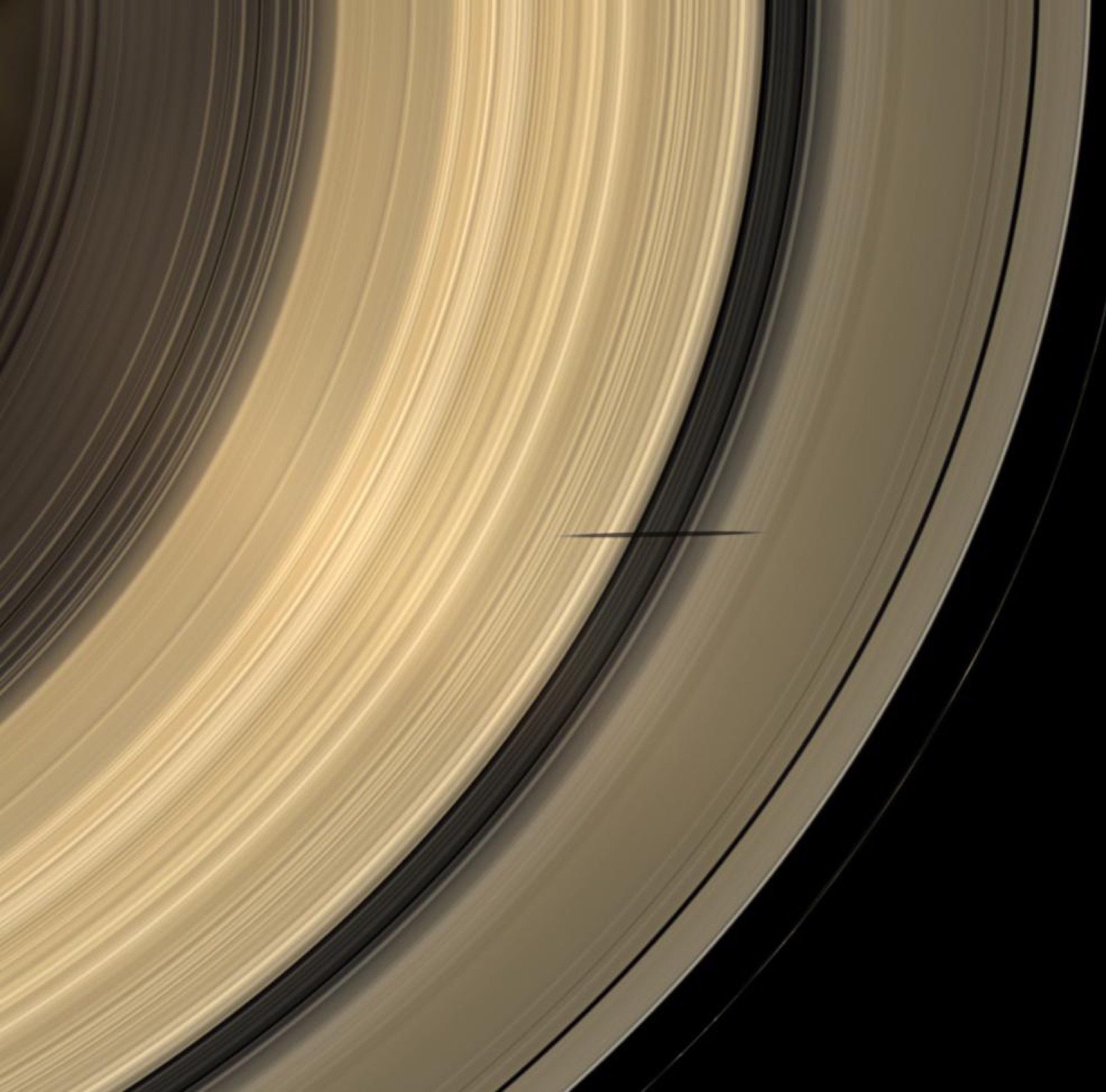
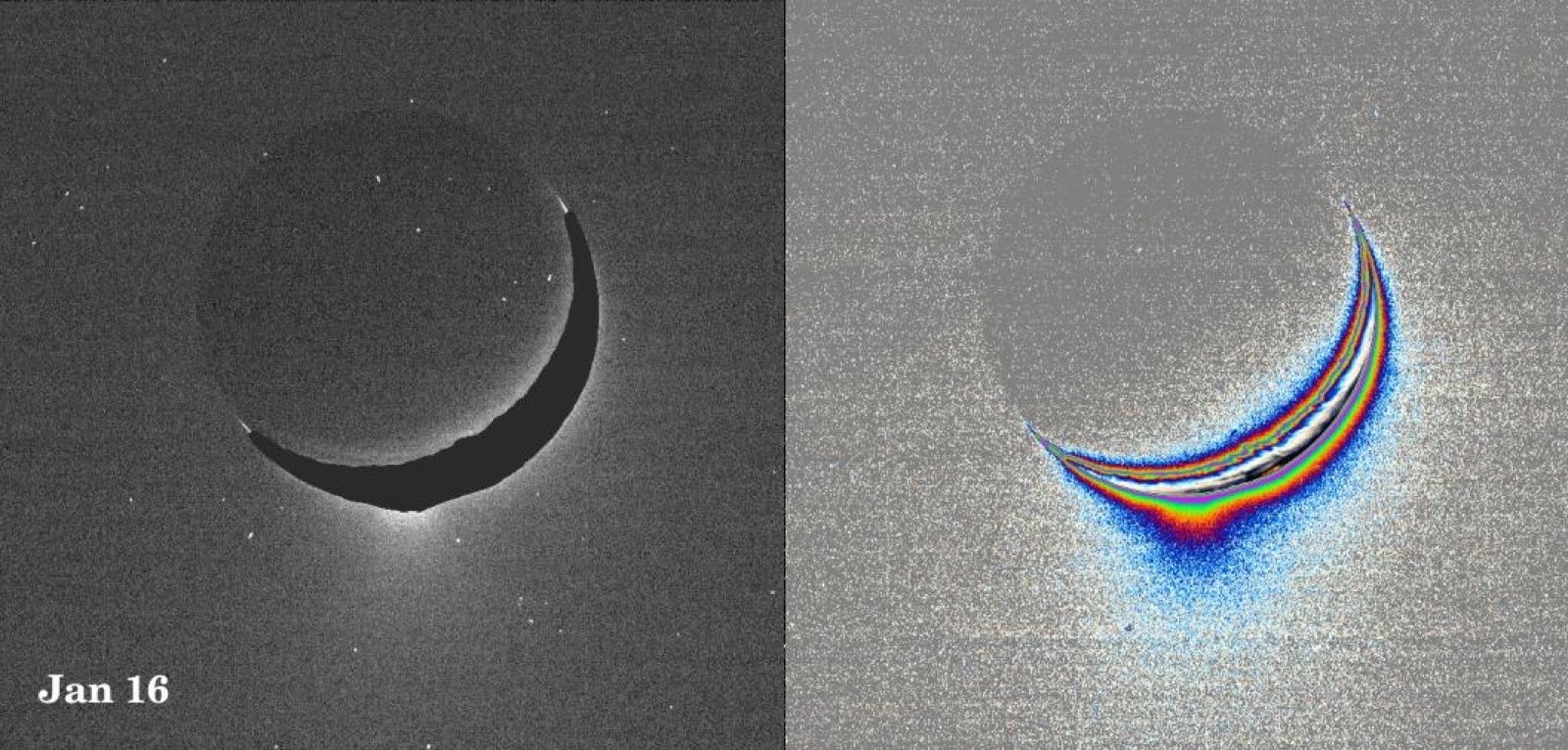
One of the most striking things about Pallene is that it is surrounded by its own faint ring — the Pallene Ring — discovered in 2006 from Cassini images taken in forward-scattered light. The ring stretches about 2,500 km in radial extent and is fed by dust particles blasted off Pallene's surface when meteoroids slam into it. Those ejected grains spread along the moon's entire orbital path, forming a complete, if diffuse, ring. This sets Pallene apart from three other ring-embedded small moons — Methone, Anthe, and Aegaeon — which are associated with arc structures rather than full rings. The reason for the difference comes down to orbital resonance: those other moons are trapped in resonances that keep their ejecta clustered into a confined arc, while Pallene's ejecta, unconfined by resonance, disperses all the way around Saturn. The ring's source material and its thin, diffuse character make it one of Saturn's most delicate and interesting ring features.
05 A smooth, dark, egg-shaped little world
Pallene belongs to a trio of Saturnian moons — along with Aegaeon and Methone — that share a distinctive set of physical traits. All three are smooth bodies with an ellipsoidal shape, more like a squashed egg than a jagged rock. Their surfaces are darker than scientists would expect given their small size and location, and one leading explanation is that high-energy radiation from Saturn's magnetosphere is chemically altering and darkening the surface material over time. Pallene itself shows an additional asymmetry: its leading hemisphere — the side that faces the direction of orbital motion — is darker than its trailing hemisphere by roughly 10 to 20 percent. This kind of leading-trailing asymmetry is seen on other icy moons too, though the precise mechanism driving it on Pallene is still not fully pinned down. The smooth, rounded shape suggests that Pallene's surface has been reshaped, possibly by the same dust that feeds its ring.
06 Cassini's close encounters with Pallene
The Cassini spacecraft, which orbited Saturn and studied the system until September 2017, made two dedicated fly-bys of Pallene. The first came on October 16, 2010, passing at a distance of 36,000 kilometers from the moon. The second occurred on September 14, 2011, at a somewhat greater distance of 44,000 kilometers. Neither pass was especially close by planetary-science standards — for comparison, 36,000 km is roughly equivalent to circling Earth's equator nearly nine times — so the images and data returned were limited in resolution. Pallene is so small and faint that even Cassini, one of the most capable planetary probes ever built, could not resolve fine surface detail during these encounters. Nevertheless, Cassini's observations were essential for establishing Pallene's shape, surface brightness, albedo asymmetry, and the existence of its ring, all of which would have been impossible to determine from Earth-based telescopes.
07 Open questions about this tiny satellite Deeper
Despite everything Cassini revealed, Pallene leaves several questions unanswered. The cause of its surface darkening remains debated: high-energy radiation is the leading candidate, but the exact chemistry and timescale of that darkening are not established. The 10–20 percent leading-versus-trailing albedo difference is documented but not yet fully explained — it could relate to dust accretion patterns, radiation processing, or both acting at different rates on the two hemispheres. The near-resonance with Enceladus is intriguing: Pallene sits very close to but outside a 19:16 resonance, and it is an open question whether it was once captured and escaped, or simply never entered. The long-term fate of the Pallene Ring — whether it is in a steady state continuously replenished by meteoroid impacts or slowly dispersing — is also unresolved. These uncertainties make Pallene a small object with a surprisingly rich set of unfinished scientific stories.
08 Where Pallene fits in Saturn's moon system
Pallene orbits Saturn in the gap between two much more famous moons: Mimas, known for its resemblance to the Death Star, and Enceladus, celebrated for its geysers and subsurface ocean. Sitting in that middle ground, Pallene is part of a family of very small inner moons that occupy the region where Saturn's main rings give way to the broader moon system. Its orbit, shared with its own dust ring, occupies a region of space that is shaped by gravitational influences from both of its larger neighbors. Unlike Mimas and Enceladus, Pallene is too small to generate internal heat, drive geology, or hold any atmosphere. Instead it serves as a passive participant in the dynamics of this region — a natural laboratory for understanding how tiny bodies survive, evolve, and interact with rings and larger moons in a complex gravitational environment.