Moon · Deep guide · orbits Saturn
Anthe
Also called: Saturn XLIX · S/2007 S 4
A moonlet that leaves a faint arc of dust along its orbit.
What is it?
Anthe is a very small moon of Saturn, only a couple of kilometres across, that lies between Mimas and Enceladus. The Cassini imaging team found it in images from May 2007, then spotted it in older pictures back to 2004. A resonance with Mimas makes its orbit sway by about 20 km over two years. Material knocked off by micrometeoroids is thought to supply the Anthe ring arc, and Anthe, Methone and Pallene may form one family.
The deep dive
Researched for the Atlas from Wikipedia — Anthe (moon) (1,538 characters read) · updated Nov 14, 2026
01 How Cassini stumbled upon a hidden moon
Anthe's discovery unfolded in two stages, which is itself telling about how faint and elusive this moon is. The Cassini Imaging Team first spotted it in pictures taken on 30 May 2007, but once they knew what they were looking for, they went back through the archive and found it hiding in plain sight in observations stretching as far back as June 2004 — nearly three years of unnoticed appearances. The formal announcement came on 18 July 2007. The discovery process illustrates a recurring theme in planetary science: tiny moons are rarely found in real time. They turn up as afterthoughts during careful re-examination of data collected for other purposes. Cassini's cameras were not pointed at Anthe; Anthe simply happened to drift through the field of view, leaving faint streaks that only patient image analysis could distinguish from noise or cosmic ray hits.
02 A naming mix-up that made history
Even before Anthe received its permanent name, it was caught up in an administrative tangle unusual in planetary science. Its provisional designation, S/2007 S 4, was accidentally assigned a second time to a completely different Saturnian satellite discovered later. The error was caught quickly — the incorrect publication was retracted within a few hours and republished the next day under the correct designation S/2007 S 5 — but the episode left a small footnote in the cataloguing record. Anthe's permanent name comes from mythology: it is one of the Alkyonides, daughters of the giant Alkyoneus in Greek legend. The name itself means "flowery," a quietly poetic label for one of the solar system's most barren specks of ice and rock. It carries the formal number Saturn XLIX and is recognized as the sixtieth confirmed moon of Saturn.
03 Mimas pulls the strings from next door Deeper
Anthe does not travel a clean, undisturbed ellipse around Saturn. Instead, it is locked in a 10:11 mean-longitude resonance with Mimas, a moon roughly a thousand times more massive. The mechanics work like this: for every 11 times Anthe completes a circuit, Mimas completes almost exactly 10, and the repeated gravitational nudges accumulate rather than cancelling out. The result is measurable and substantial: Anthe's osculating semi-major axis — the instantaneous best-fit value of its orbital distance — wobbles by an amplitude of about 20 km. That cycle repeats on a timescale of roughly 2 Earth years. To put 20 km in perspective, it is about the length of Manhattan Island, yet in orbital terms it represents a significant perturbation for a body only about 2 km across. Resonances like this are not mere curiosities; they sculpt the entire architecture of Saturn's inner moon system over geological time.
04 A family of three moons in similar orbits
Anthe does not occupy its region of space alone. Its orbital neighborhood is shared by two other small moons, Pallene and Methone, and their close proximity in terms of orbital distance is considered significant. Scientists have proposed that these three moons may form a dynamical family — a grouping of objects that share a common origin or have been shaped by the same gravitational environment over time. The idea is analogous to asteroid families in the main belt, where clusters of bodies with similar orbits are interpreted as fragments of a once-larger parent object or as populations corralled by the same resonant forces. Whether Anthe, Pallene, and Methone genuinely share a common history or are simply neighbors by coincidence remains an open question, but their clustering between the orbits of Mimas and Enceladus gives researchers a compelling reason to study them as a system rather than as isolated objects.
05 What shape is Anthe, really? Deeper
Anthe is so small that Cassini could not resolve it into a clearly defined disk, yet astronomers were still able to extract shape information from the way its brightness varied. The analysis produced axis ratios: the medium axis is approximately 0.7 times the length of the long axis, and the short axis is approximately 0.95 times the length of the medium axis. Reading those numbers together, Anthe is moderately elongated along one direction but nearly round in the other two — something like a flattened ellipsoid, broader than it is long in one plane but close to spherical in the perpendicular plane. This shape is described as similar to that of Methone, its orbital neighbor. Neither moon is spherical, which is expected for bodies too small for their own gravity to pull them into a round form, but neither is wildly irregular. Their shared shape profile adds another thread of evidence linking them as a possible dynamical family with a common physical history.
06 How micrometeorites build a ring arc
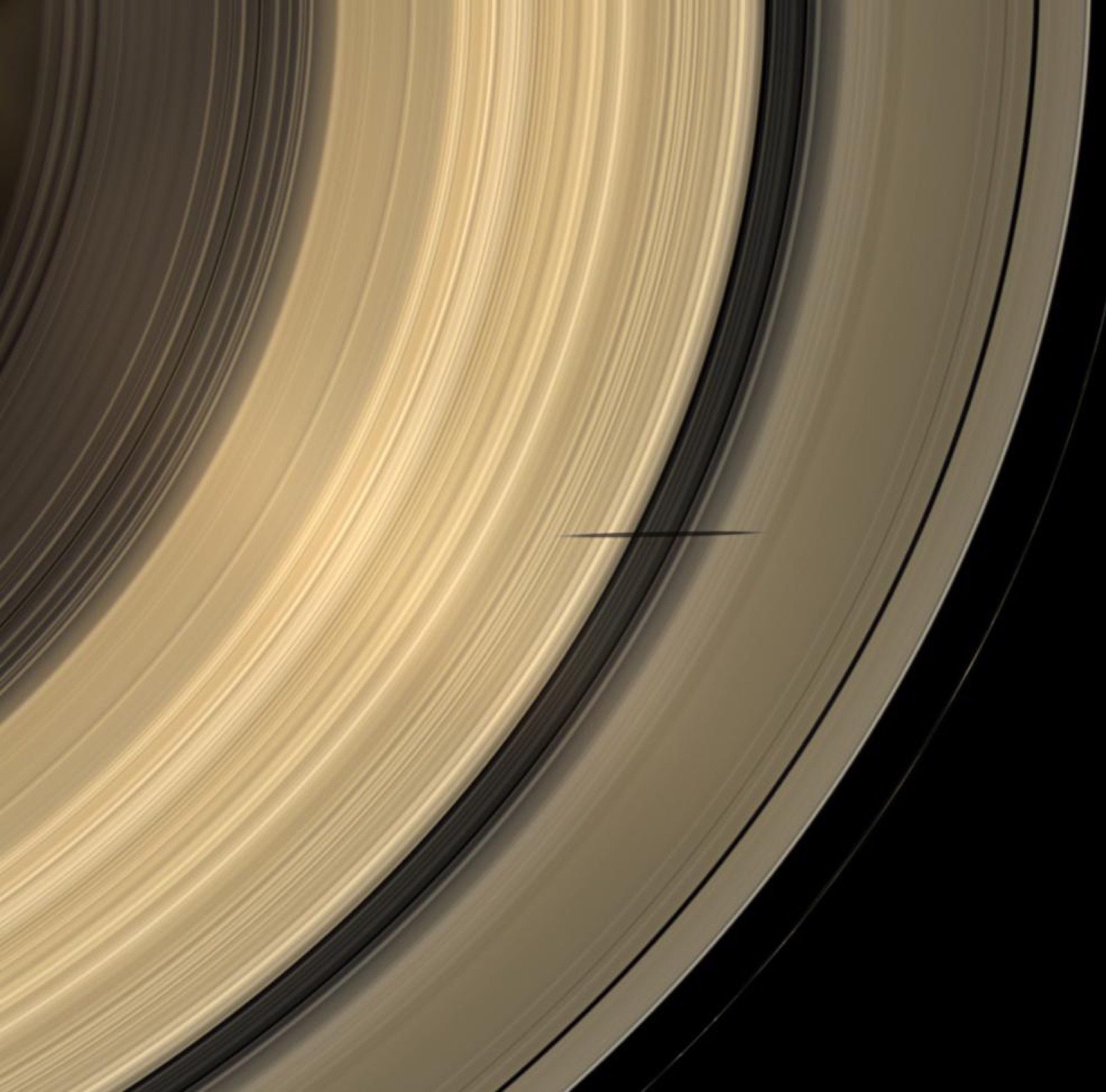
One of the most striking things about Anthe is that it is not just a moon — it is apparently a ring factory. When tiny interplanetary dust grains and micrometeorites strike Anthe's surface at high speed, they blast loose small particles of surface material. Because Anthe's gravity is negligible for a body of its size, that ejected material does not fall back; instead it escapes into orbit around Saturn. Over time, this process populates a faint arc of debris that shares Anthe's orbital path, stretching partway around Saturn rather than forming a complete ring. This structure, known as the Anthe Ring Arc, was first detected in June 2007, almost simultaneously with the moon's formal announcement. The arc is co-orbital with Anthe, meaning it travels at the same orbital distance. Methone has a similar associated arc, reinforcing the idea that all three members of the proposed dynamical family generate dust through the same impact-gardening process.
07 The Anthe Ring Arc and when it was found Deeper
The Anthe Ring Arc earns its own examination because its detection timing is remarkable. It was first identified in June 2007, the same general period in which the moon itself was confirmed in Cassini imagery. The arc is described as faint and partial — it does not encircle Saturn completely but instead occupies only a fraction of the full orbit, hugging the path that Anthe follows. The leading explanation for why the arc remains arc-shaped rather than spreading into a uniform ring involves the same 10:11 resonance with Mimas that perturbs Anthe's orbit. Resonant forces can confine debris to a preferred longitude range, preventing it from spreading all the way around. This kind of resonant confinement has been observed elsewhere in the Saturn system, most famously in the arcs within Neptune's Adams ring, so the Anthe Ring Arc fits into a broader pattern of resonance-shaped ring structures seen across the outer solar system.
08 How small is "very small," exactly?
The article's description of Anthe as "very small" is not just vague modesty — it reflects genuine difficulty in measuring an object at that scale from a spacecraft hundreds of thousands of kilometers away. What the shape analysis does reveal is that Anthe is elongated, with its longest dimension setting the scale against which the axis ratios of roughly 0.7 and 0.95 are measured. For comparison, Methone, described as having a similar shape, has been estimated elsewhere in the scientific literature as being only a few kilometers across, placing Anthe firmly in the category of objects that would be invisible to the naked eye even from low Saturn orbit. At this scale, the concept of a "surface" becomes somewhat philosophical — there is likely a regolith of loose material, but whether it behaves like soil, gravel, or a barely-cohesive rubble pile is unknown from the data the article describes.
09 Orbital position: the gap between giants
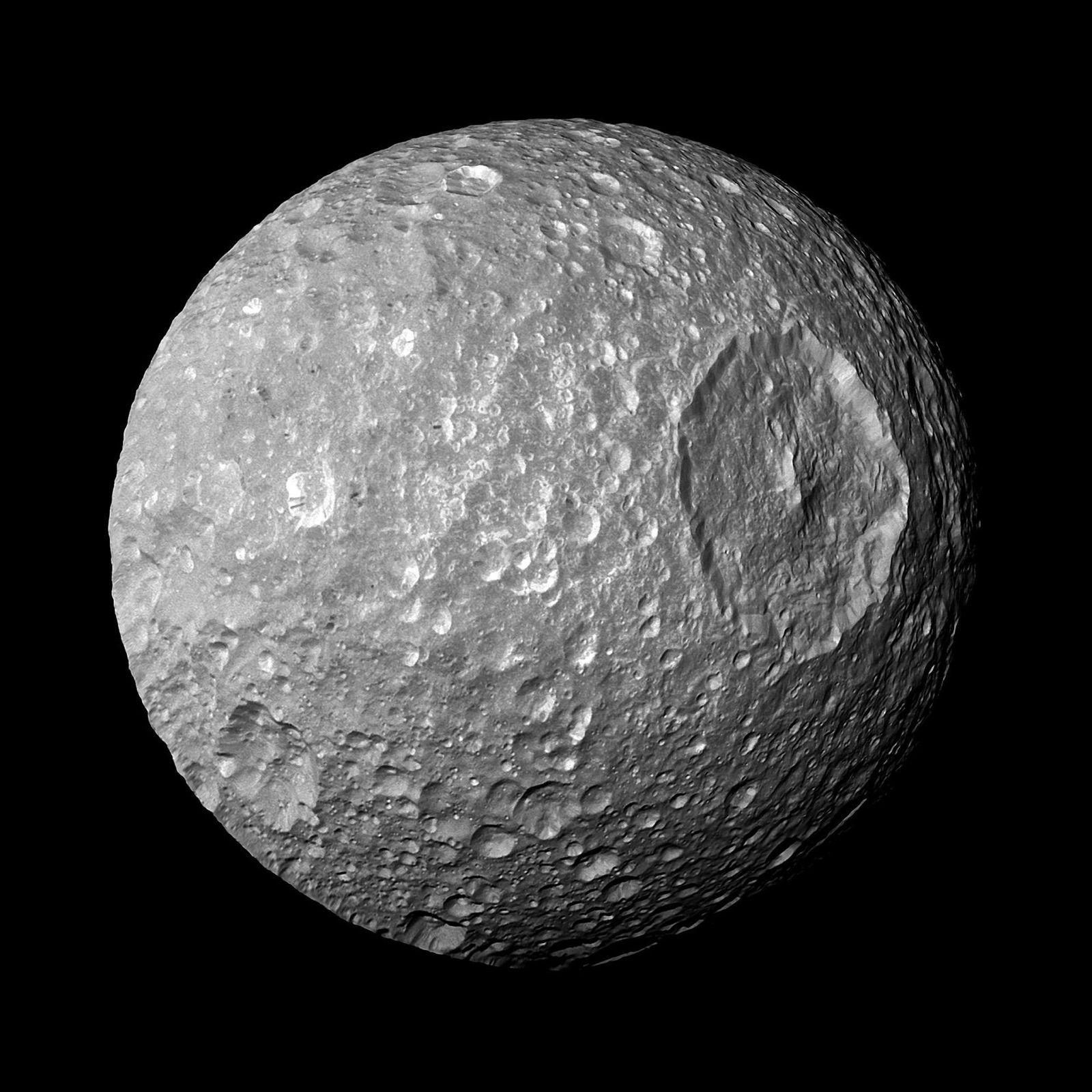
Saturn's inner moon system is dominated by Mimas and Enceladus, two moons large enough to be geologically interesting and massive enough to gravitationally bully everything near them. Anthe occupies the zone between these two giants, a gravitationally complex region where resonances from both neighbors can in principle affect any small body's orbit. That Anthe survives in this region at all — rather than being ejected or accreted over billions of years — may itself be a clue to its relatively recent origin or to the stabilizing effect of the resonances that confine it. Its position between Mimas and Enceladus places it at a distance from Saturn that the article does not specify precisely in kilometers beyond the resonance context, but the orbital architecture means that any spacecraft visiting Anthe would do so against a backdrop of Saturn's most famous and scientifically active inner moons.
10 Open questions the data leaves unanswered Deeper
Even after Cassini's extended mission at Saturn, Anthe remains poorly characterized in several important ways. The article describes the dynamical family hypothesis — that Anthe, Pallene, and Methone share a common origin — as a suggestion prompted by their orbital proximity, not a confirmed fact. The mechanism that would have produced three separate small moons in roughly similar orbits is not established. Possibilities include fragmentation of a larger parent body, capture of planetesimals into resonant orbits, or accretion from ring material, but none of these scenarios has been confirmed with existing data. The internal composition of Anthe is entirely unknown; whether it is predominantly water ice, silicate rock, or a mixture cannot be determined from brightness and shape measurements alone. The long-term stability of the Anthe Ring Arc and how much mass Anthe loses to it per year are also unconstrained. These gaps make Anthe a compelling target for any future mission to Saturn's inner moon system.
11 What resonance timing tells us numerically Deeper
The 10:11 mean-longitude resonance between Anthe and Mimas is worth unpacking numerically because it quantifies the gravitational relationship precisely. For every 10 complete orbits Mimas makes, Anthe completes almost exactly 11. This near-integer ratio means that specific longitude alignments between the two moons repeat regularly rather than shifting randomly, so the gravitational kicks Mimas delivers to Anthe accumulate in a predictable pattern. The observational consequence is that Anthe's osculating semi-major axis oscillates by about 20 km in amplitude on a cycle of roughly 2 Earth years. That 2-year period is the synodic recurrence timescale of the resonance — how long it takes for the alignment geometry to repeat. Tracking this oscillation over multiple cycles allowed astronomers to confirm the resonance identification and to measure its strength. The same mathematical framework that describes this resonance is used across planetary science to understand how ring particles, small moons, and even Kuiper Belt objects are sculpted by their more massive neighbors.