Moon · Deep guide · orbits Saturn
Methone
Also called: Saturn XXXII · S/2004 S 1
A 3-km moon as smooth as an egg, with no craters in sight.
What is it?
Methone is a small, egg-shaped moon of Saturn that orbits between Mimas and Enceladus. The Cassini imaging team discovered it in June 2004, and in May 2012 Cassini flew within 1,900 km and revealed a remarkably smooth surface. Mimas's gravity rocks Methone's orbit back and forth through a resonance. Dust chipped off by tiny meteoroid impacts is believed to form the faint Methone ring arc that shares its orbit.
The deep dive
Researched for the Atlas from Wikipedia — Methone (moon) (3,908 characters read) · updated Nov 14, 2026
01 An egg in space: Methone's impossible shape
Most moons, even small ones, look lumpy and cratered — battered relics of a violent solar system. Methone is something else entirely. When Cassini finally got close enough to photograph it in May 2012, scientists saw a smooth, egg-like body with no visible craters and an almost plastic quality to its surface. Technically it is a triaxial ellipsoid, meaning all three of its principal axes have different lengths. Its longest axis — the one that points directly toward Saturn — is 1.6 times longer than its polar axis, stretched out by Saturn's tidal pull. Its middle axis is 1.07 times the polar length, puffed outward slightly by the centrifugal force of Methone's own rotation. These numbers aren't just curiosities; they tell physicists exactly how the moon has responded to competing forces over geological time, settling into what is called an equipotential surface — the shape a fluid body would naturally adopt when gravity, tides, and spin all reach a perfect balance.
02 Fluff and flow: what Methone is made of Deeper
The smoothness of Methone's surface points toward a deeply unusual material property. Scientists think the outer layer is composed of what they call icy fluff — a loosely packed, low-density regolith that may be mobile enough to slowly flow across the surface and fill in any craters that form. This would explain the almost eerie absence of impact scars. On rigid moonlets like Janus or Epimetheus, craters accumulate and persist; on Methone, the fluffy regolith apparently erases them. The process may be helped along by electrostatic effects — electric fields in Saturn's magnetospheric environment could cause fine charged particles to migrate across the surface independently of any physical impact. Because Methone's shape fits the expectations of hydrostatic equilibrium so well, scientists can use the geometry to estimate its bulk density: 0.31 grams per cubic centimeter, with an uncertainty range of about +0.05 to −0.03 g/cm³. That figure is among the lowest density values ever measured or inferred for any body in the Solar System — lighter than any ice, implying the interior is largely empty pore space.
03 Mimas pulls the strings: Methone's perturbed orbit Deeper
Methone does not follow a simple, steady ellipse around Saturn. Its orbit is continually tugged by a 14:15 mean-motion resonance with Mimas, a moon roughly a hundred times more massive. For every 15 orbits Methone completes, Mimas completes almost exactly 14, and the repeated gravitational nudges accumulate in a predictable pattern. The result is that Methone's semi-major axis oscillates by about 20 kilometers and its longitude of periapsis swings by about 5 degrees, both on a cycle of roughly 450 days. Its orbital eccentricity bounces between 0.0011 and 0.0037 on different timescales, while its inclination varies between approximately 0.003 degrees and 0.020 degrees. These are small numbers in absolute terms, but for such a tiny moon they represent a significant ongoing agitation — Methone is never quite settling down. Understanding this resonance is important for modeling the long-term stability of the entire inner satellite region of Saturn.
04 Methone's ghostly ring arc
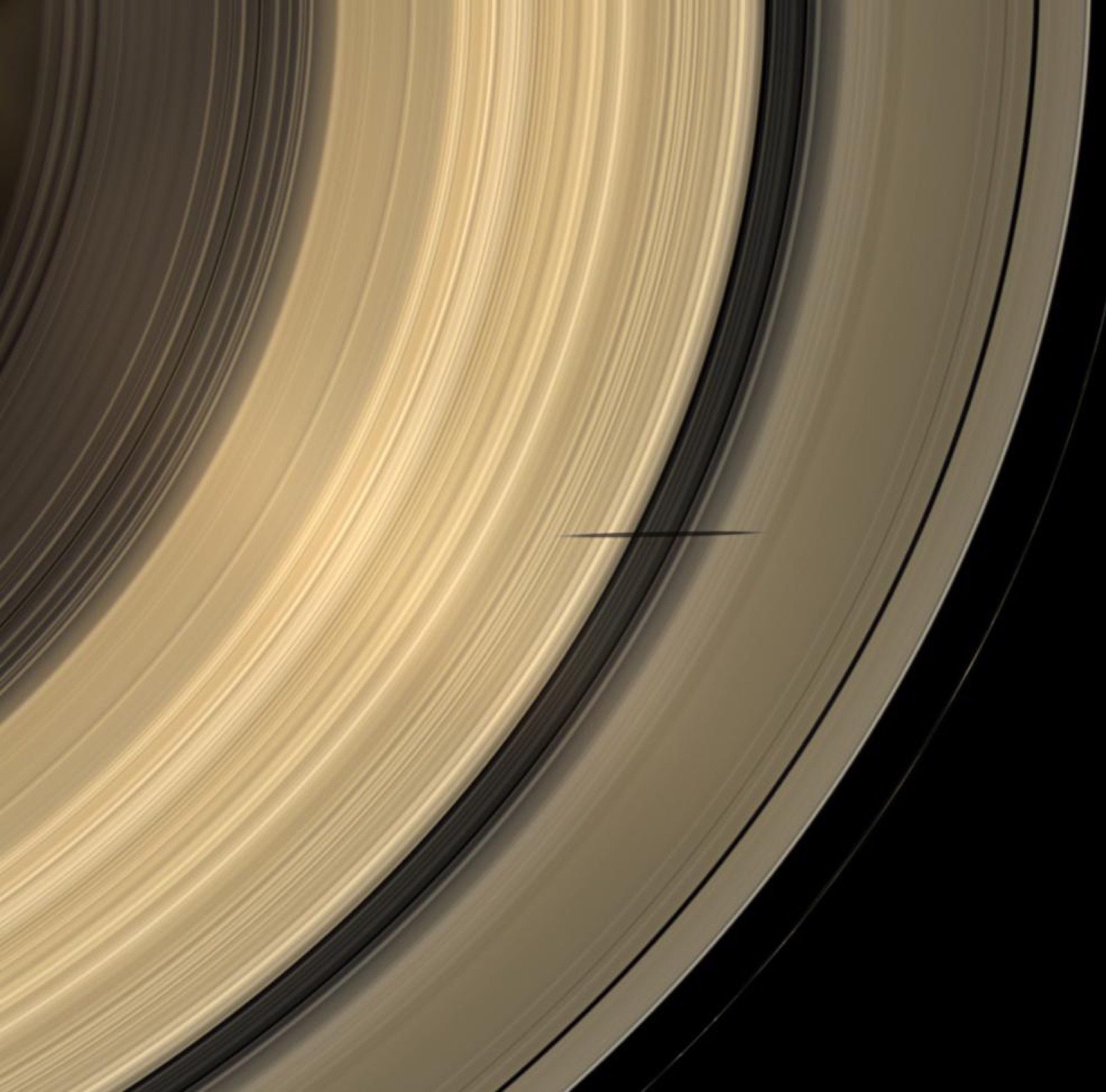
Methone doesn't just orbit Saturn — it generates its own faint partial ring. When micrometeoroids slam into Methone's fluffy surface, they blast material off into space. Because Methone is so small and its gravity so weak, much of this debris escapes and spreads along its orbital path rather than falling back down. The result is the Methone Ring Arc, a tenuous partial ring that shares Methone's orbit around Saturn. It was discovered in September 2006, before Methone itself had even been photographed up close. The arc is described as co-orbital with Methone, meaning it occupies the same orbital zone rather than being a separate ring at a different distance. Scientists believe the arc is continually replenished by ongoing impacts onto Methone's surface. The moon's two companion moonlets in this region — Pallene and Anthe — are thought to generate similar arc structures, suggesting this impact-driven ring-seeding process is a common feature of small, loosely bound moons embedded within Saturn's broader ring environment.
05 Two-toned: Methone's albedo mystery Deeper
Even on a moon this small, the surface is not uniform. Methone has two sharply defined regions of different brightness, measured as albedos of 0.61 ± 0.06 and 0.70 ± 0.03. The darker region is centered on the leading hemisphere — the side that faces forward as Methone moves along its orbit. This pattern is reminiscent of thermal anomalies seen on the leading hemispheres of much larger moons like Mimas and Tethys, where the leading face is altered by increased exposure to electrons from Saturn's magnetosphere. The same electron-bombardment explanation has been proposed for Methone. However, there is an important complication: on Mimas and Tethys, the thermal anomalies come packaged with a distinct ultraviolet and infrared color signature. On Methone, that color difference is either extremely faint or entirely undetectable. This suggests that whatever is creating the albedo contrast on Methone may be a physical rather than compositional difference — perhaps variations in regolith grain size, the degree of compaction, or the microstructure of individual particles — rather than a change in the chemical makeup of the surface material.
06 Discovery at the edge of visibility
Methone was found in 2004 by the Cassini Imaging Team, which gave it the temporary designation S/2004 S 1. It is also catalogued as Saturn XXXII — the 32nd recognized moon of Saturn. The name Methone was formally approved by the International Astronomical Union's Working Group on Planetary System Nomenclature on January 21, 2005, and ratified at the IAU General Assembly in 2006. Despite being discovered in 2004, Methone remained essentially a point of light for years. The Cassini spacecraft visited the moon twice, and it was not until May 20, 2012, that the close-up photographs revealing its remarkable egg shape were taken. On that date Cassini passed within a minimum distance of 1,900 kilometers — roughly the distance from London to Cairo — giving scientists their first real look at the surface. The long gap between discovery and detailed imaging illustrates how crowded and complicated Saturn's inner moon system is, and how much planning goes into targeting any single small object during a planetary mission.
07 The mythology behind the name
The name Methone connects this tiny moon to a rich strand of Greek mythology. In ancient stories, Methone was one of the Alkyonides — the seven beautiful daughters of the giant Alkyoneus. The Alkyonides were said to be so devoted to their father that when he was slain by the hero Heracles, they threw themselves into the sea and were transformed by the gods, in some versions of the myth becoming seabirds associated with the halcyon days of calm winter weather. Naming Saturn's small inner moons after figures from mythology has been a consistent practice, and the Alkyonides group appears multiple times in the Saturnian system. Methone's companions in the same orbital region — Pallene and Anthe — are also named from the same mythological family, giving a small cluster of moons a shared narrative identity that reflects their shared physical environment between the orbits of Mimas and Enceladus.
08 How Methone compares to its neighbors
Methone belongs to what planetary scientists call the Alkyonide group, a cluster of small moonlets orbiting Saturn between the larger moons Mimas and Enceladus. Its nearest neighbors in this family are Pallene and Anthe, and all three are thought to share similar physical characteristics — smooth, loosely structured bodies embedded in faint ring arcs. The smoothness of Pallene and Anthe is inferred partly by analogy with Methone, since they have not been imaged at the same resolution. What sets Methone apart within this group is simply that Cassini got close enough in 2012 to confirm the theoretical predictions directly: the equipotential shape, the absence of craters, the two-toned surface. The comparison with rigid, heavily cratered moonlets like Janus and Epimetheus elsewhere in the Saturn system is striking — those bodies look ancient and battered, while Methone looks almost freshly molded, as though its surface is constantly renewing itself through the slow movement of its unusually mobile material.
09 Open questions Cassini left behind Deeper
Despite Cassini's close approach in 2012, Methone left scientists with more questions than answers. The interior structure remains unknown beyond what can be inferred from the moon's shape and density estimate of 0.31 g/cm³. What exactly icy fluff is at the microscopic level — how the particles are arranged, how mobile they truly are, and what triggers their movement — has not been directly measured. The mechanism creating the albedo difference between Methone's leading and trailing hemispheres is still debated: electron bombardment from Saturn's magnetosphere is a candidate, but the absence of the expected color signature leaves the explanation incomplete. Whether electrostatic processes are truly moving material across the surface, or whether some other exotic mechanism is responsible, is unresolved. And the long-term dynamical fate of Methone under the continuous perturbation of the 14:15 resonance with Mimas — whether it will remain stable, gradually migrate, or eventually be disrupted — remains an open theoretical problem with no spacecraft currently positioned to gather new data.