 Photograph · NASA/JPL-Caltech/Space Science Institute
Moon · Deep guide · orbits Saturn
Mimas
The 'Death Star' moon is hiding a shockingly young ocean.
What is it?
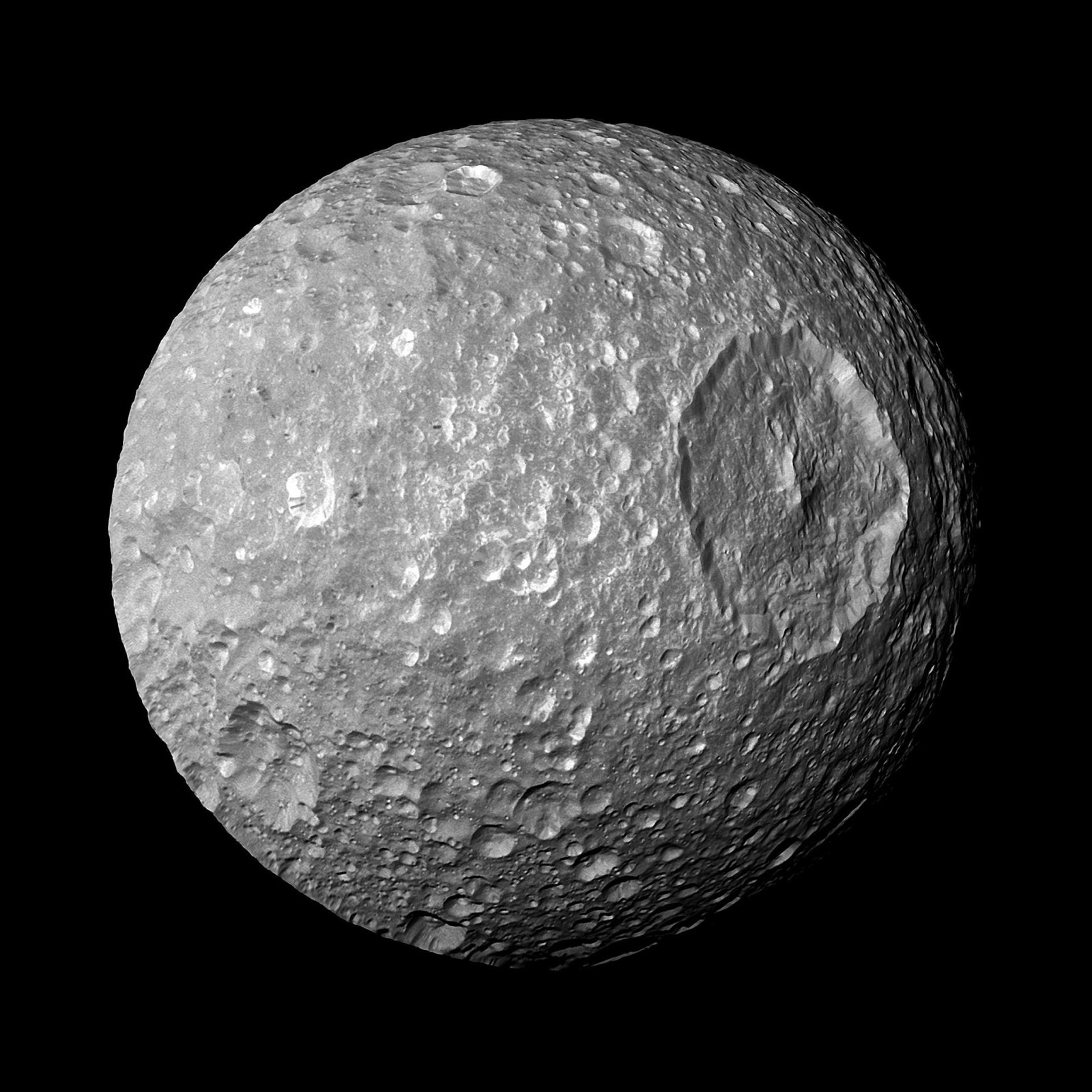
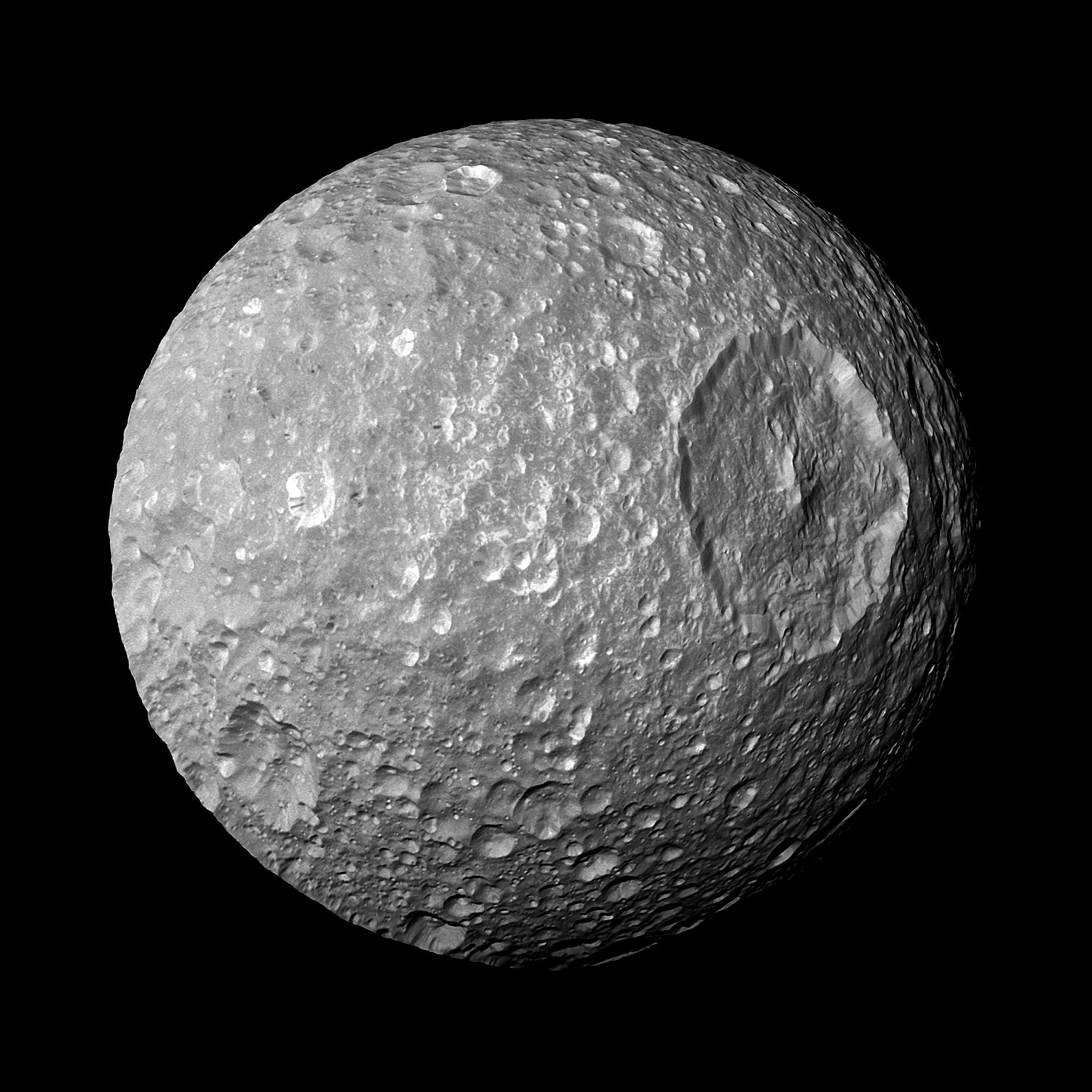
Tiny Mimas, 396 km across, is famous for Herschel crater, which makes it look uncannily like the Death Star. In 2024 it delivered a genuine shock: subtle wobbles in its orbit revealed a global ocean beneath its battered shell — an ocean apparently only 5–15 million years old, geologically newborn. Even the deadest-looking worlds can hide water.
The deep dive
Researched for the Atlas from Wikipedia — Mimas (8,967 characters read) · updated Sep 20, 2026
01 The smallest world gravity has rounded
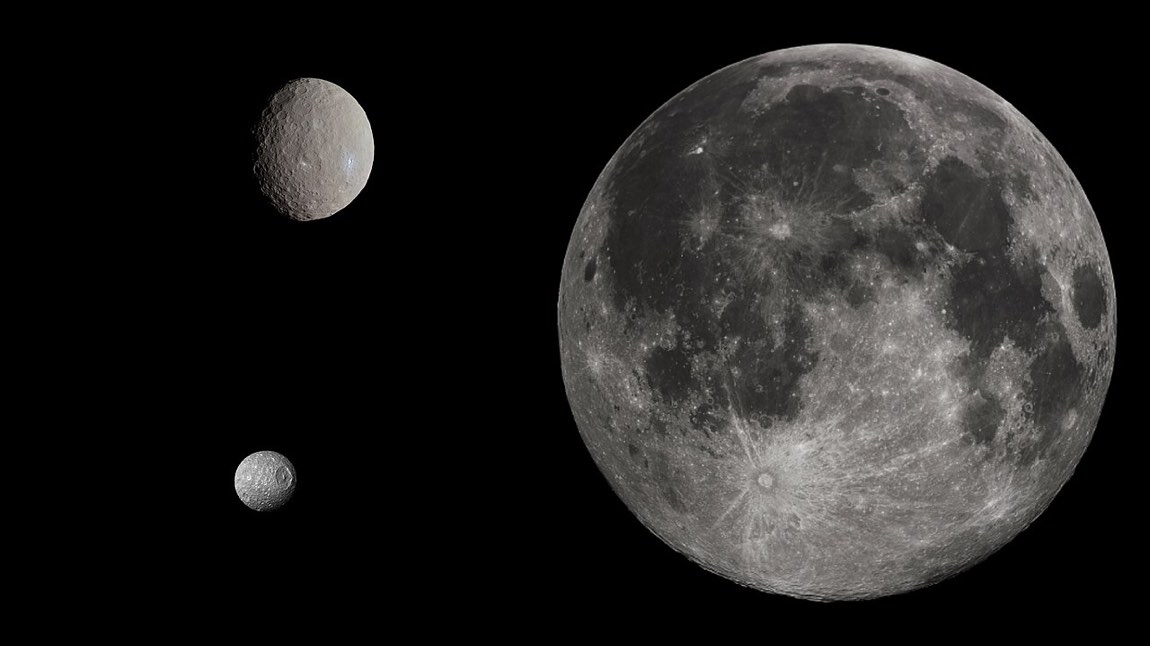
Mimas holds a remarkable distinction in planetary science: with a mean diameter of just 396.4 kilometres, it is the smallest astronomical body known to be roughly rounded in shape due to its own gravity. Below a certain size, a rocky or icy object simply lacks enough self-gravity to pull itself into a sphere, remaining instead as an irregular lump. Mimas sits right at that threshold. Even so, it is not a perfect ball. The tidal forces Saturn exerts on it have stretched the moon noticeably — its longest axis is about 10 percent longer than its shortest — giving it a slightly squashed, oblate form that was clearly visible in a Cassini image taken on 14 October 2009. Its surface area is slightly less than the land area of Spain or California, making it a world you could in principle drive across in a few days if roads existed.
02 A crater that nearly broke a moon
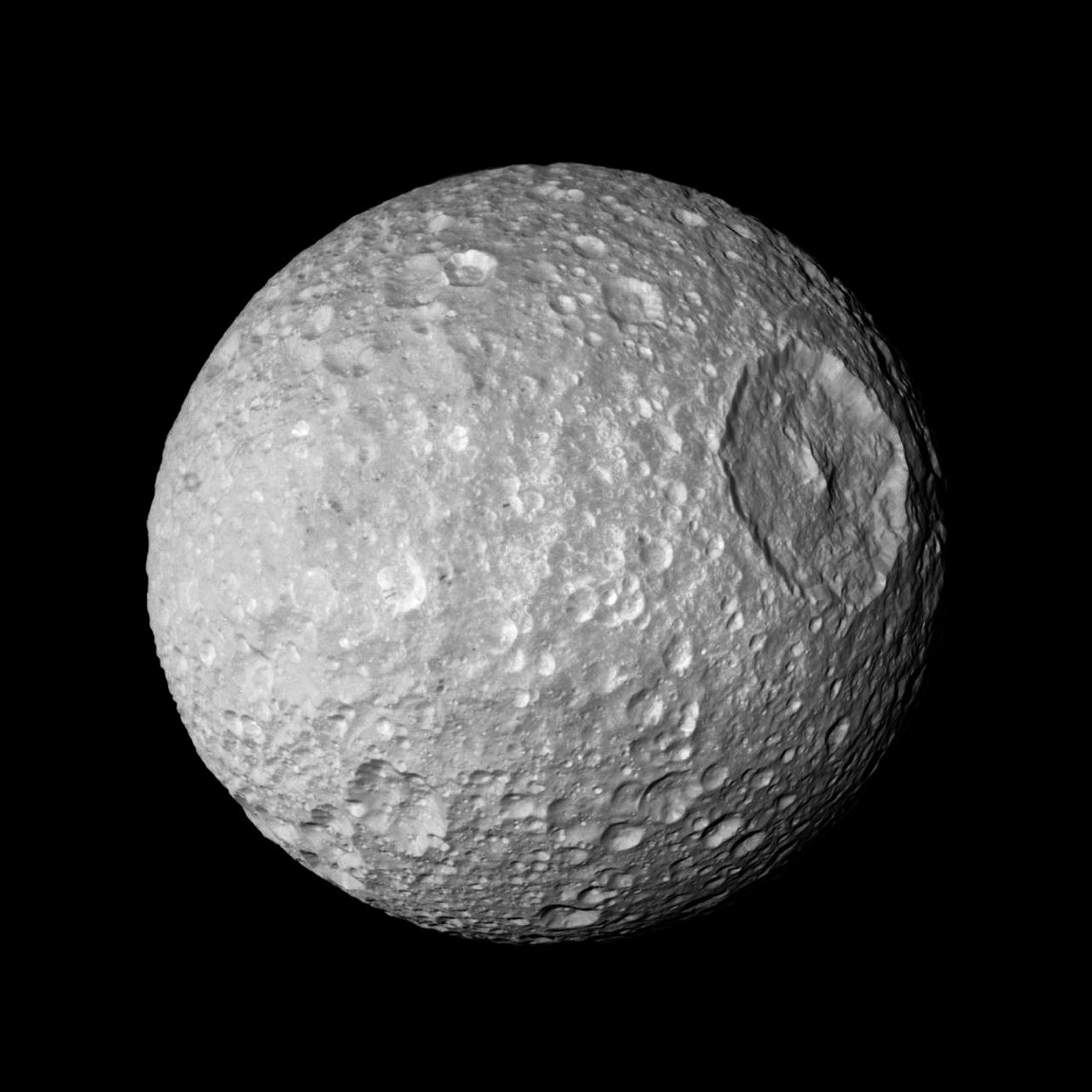
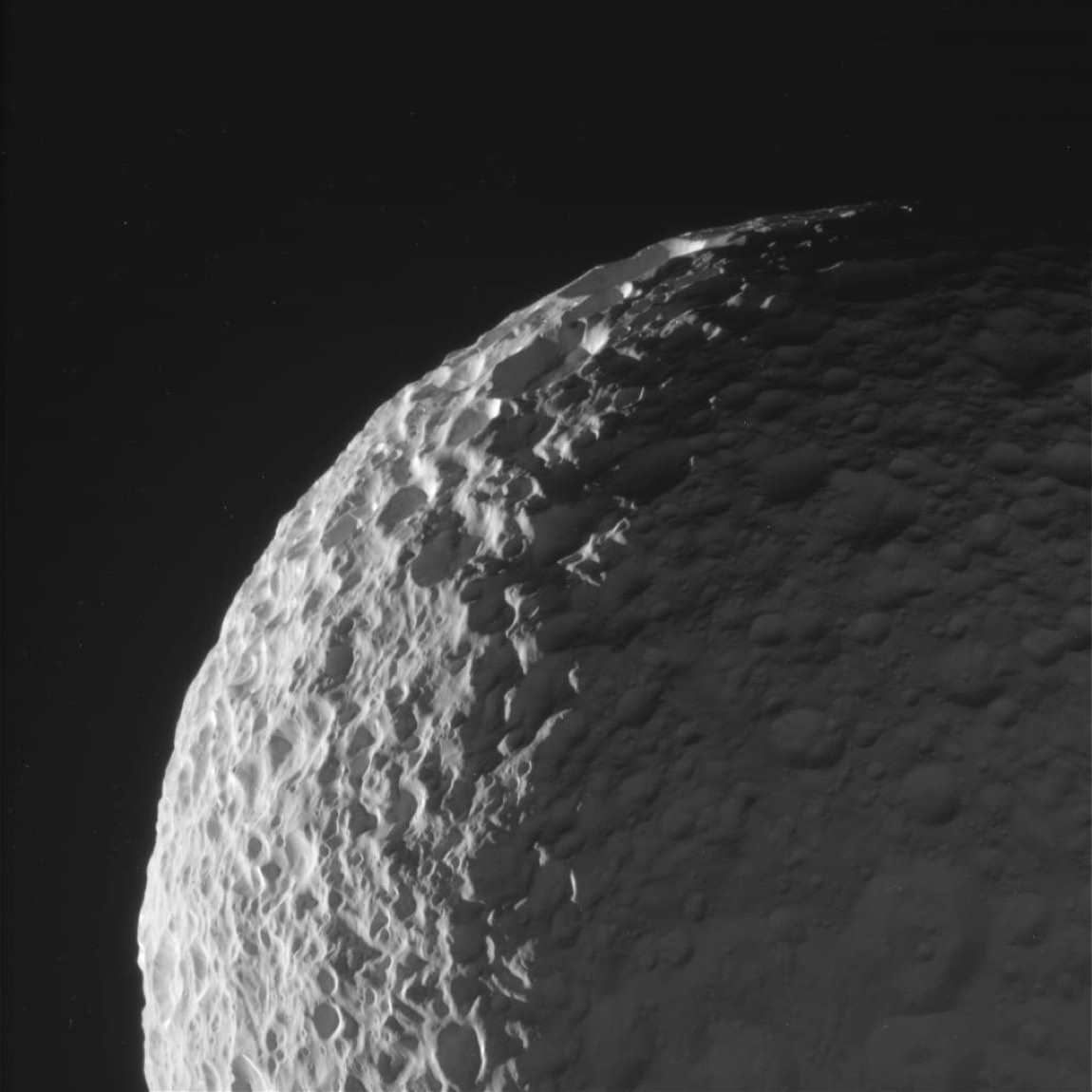
The Herschel crater dominates Mimas the way nothing else dominates any comparably sized moon in the Solar System. Stretching 139 kilometres across — almost one-third of Mimas's own mean diameter — it is one of the largest craters relative to parent-body size anywhere in the Solar System. Its walls rise approximately 5 kilometres high, parts of its floor plunge 10 kilometres deep, and a central peak thrusts 6 kilometres above the crater floor. To appreciate the scale, scientists note that an equivalent crater on Earth would exceed 4,000 kilometres in diameter, wider than the entire continent of Australia. The impact that gouged out Herschel was so violent that shock waves propagated through the entire moon, heavily disrupting the surface on the exact opposite side of Mimas — the antipodal region — through focused seismic energy. The object that hit Mimas almost shattered it entirely.
03 Ice, rock, and a surprisingly low density Deeper
Mimas's density of just 1.15 grams per cubic centimetre tells a precise compositional story. Pure water ice has a density of about 0.92 g/cm³, and typical silicate rock sits near 2.5 to 3 g/cm³, so Mimas's figure indicates it is overwhelmingly water ice laced with only a modest fraction of rock. This makes it one of the iciest moons known. The low density also has implications for its interior strength: an ice-dominated body is weaker than a rocky one, which makes the survival of the Herschel impact even more surprising. Despite being composed mostly of frozen water, Mimas is not geologically dead — or at least not as dead as its surface implies. The cratering pattern itself is uneven: most of the surface hosts craters larger than 40 kilometres in diameter, but in the south polar region craters larger than 20 kilometres are notably absent, hinting at some process that may have resurfaced or modified that terrain in the past.
 ⤢
⤢
04 The hidden ocean debate, year by year Deeper
The question of whether Mimas conceals a subsurface ocean has been one of planetary science's most contested recent debates. In 2014, researchers detected an anomalous wobble — a librational motion — in Mimas that could not be explained by its orbit alone, suggesting either an elongated interior core or a buried liquid ocean. By 2017 the ocean hypothesis seemed to collapse: scientists argued that an internal ocean would generate surface tidal stresses comparable to those seen on Europa, yet Mimas shows no cracking or tectonic features whatsoever. A mass anomaly associated with Herschel crater seemed a simpler explanation. Then in 2022, scientists at the Southwest Research Institute developed a tidal heating model showing an ocean could exist beneath a stable icy shell between 24 and 31 kilometres thick without producing any surface cracking. On 7 February 2024, researchers at the Paris Observatory announced that Mimas's orbit apsidally precesses more slowly than a solid body would, providing fresh independent evidence for a subsurface ocean 20 to 30 kilometres below the surface.
05 A remarkably young ocean
If Mimas truly harbours a subsurface ocean, that ocean is startlingly young by Solar System standards. Researchers estimate it formed within the last 25 million years, and possibly as recently as the last 2 to 3 million years — a cosmic eyeblink given that Saturn and its moons formed roughly 4.5 billion years ago. The reason scientists believe the ocean is so young comes from the very surface that originally seemed to rule one out: Mimas is heavily cratered and shows no geological activity at all. A long-lived ocean would have had time to generate tidal stresses strong enough to crack and resurface the ice, as happened on Europa and Enceladus. Because the surface looks ancient and undisturbed, the ocean must be too fresh to have done that work yet. The heat that created and currently sustains this ocean is thought to come from Saturn's powerful tidal forces acting on the moon's interior.
06 How Mimas sculpts Saturn's rings
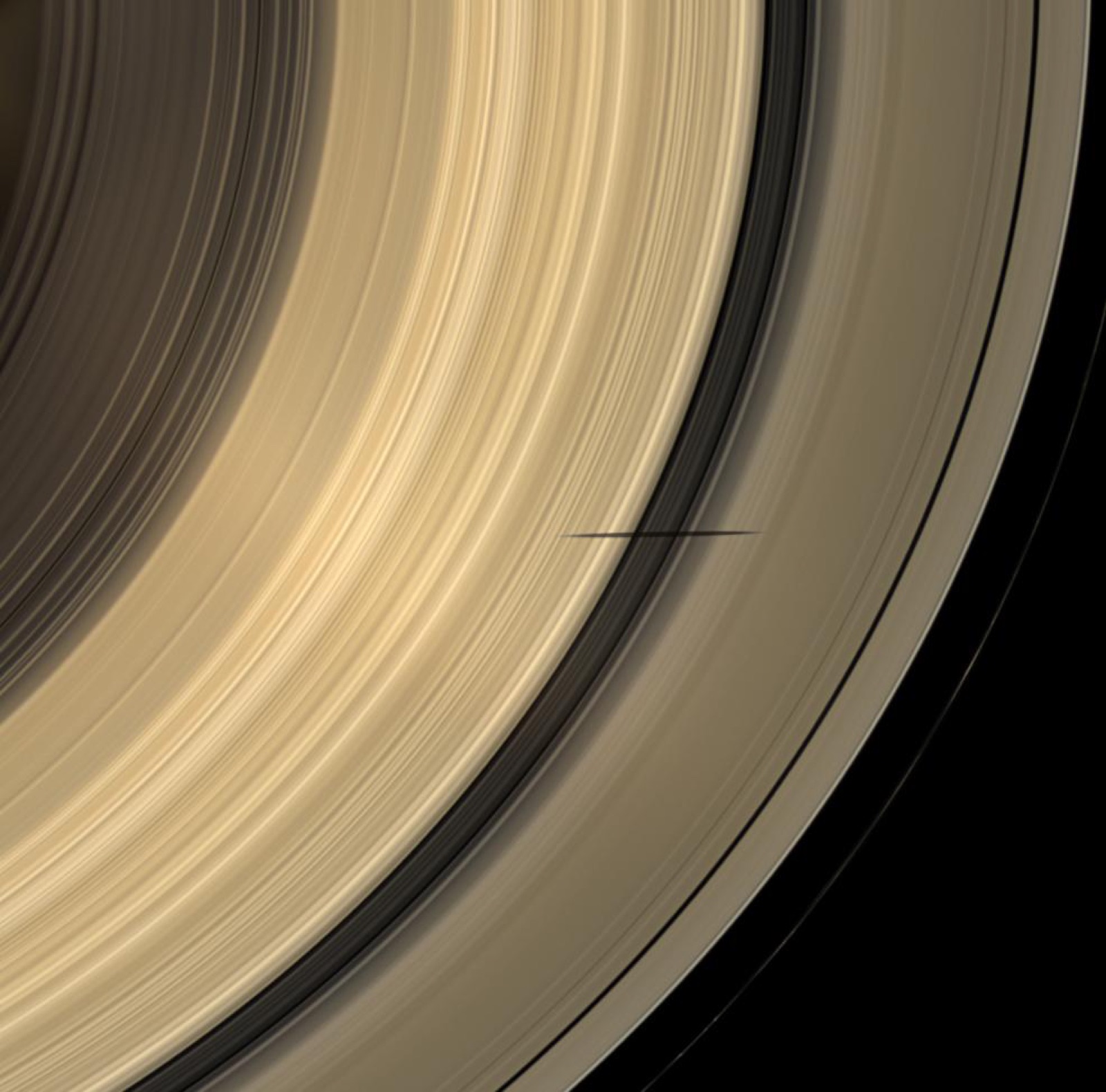
Mimas punches well above its weight when it comes to shaping Saturn's ring system. Its most dramatic influence is the Cassini Division, one of the largest gaps in Saturn's rings, sitting between the broad A Ring and B Ring. Particles in the Huygens Gap at the inner edge of the Cassini Division orbit Saturn exactly twice for every single orbit Mimas completes — a 2:1 resonance. Every time those particles lap Mimas twice, they receive a gravitational nudge in the same direction, and over time those repeated pushes accumulate and kick the particles into new orbits outside the gap, clearing a lane thousands of kilometres wide. Mimas is also involved in a 3:1 resonance with the boundary between the C and B rings, and the G Ring sits about 15,000 kilometres inside Mimas's orbit in a 7:6 co-rotation eccentricity resonance with the moon. Even Saturn's outer F Ring shepherd moonlet Pandora is linked to Mimas through a 2:3 resonance.
 ⤢
⤢
07 Discovery with a giant telescope
William Herschel discovered Mimas on 17 September 1789, using an instrument that was remarkable even by modern standards of ambition: his 40-foot telescope, a reflecting telescope with a 48-inch (1,200-millimetre) aperture metal mirror. The "40 feet" referred to the focal length, not the mirror diameter — an important distinction, since modern telescopes are typically described by aperture. Herschel noted in his own records that the "great light" of the instrument was essential to the detection, catching the moon at its greatest preceding elongation from Saturn where it was easiest to separate from the planet's glare. The crater that defines Mimas visually today carries Herschel's name in his honour. His son John Herschel later gave the moon its official name in his 1847 publication Results of Astronomical Observations made at the Cape of Good Hope, choosing figures from Greek mythology connected to the Titans and Giants who warred with the Olympians.
08 Spacecraft visits, from Pioneer to Cassini
The exploration of Mimas unfolded across several decades of spacecraft missions. Pioneer 11 made the first close passage of the Saturn system in 1979, achieving its closest approach to Mimas of 104,263 kilometres on 1 September 1979 — enough for a distant look but not a detailed portrait. Voyager 1 followed in 1980 and Voyager 2 in 1981, providing the first images sharp enough to reveal the enormous Herschel crater and begin mapping the cratered surface. The revolutionary leap came with the Cassini orbiter, which entered Saturn orbit in 2004 and spent years systematically studying the entire system. Cassini imaged Mimas many times at varying geometries and wavelengths, and on 13 February 2010 it executed a targeted close flyby, passing within just 9,500 kilometres of the surface. That encounter produced the high-resolution data used in the librational analysis that sparked the subsurface ocean debate.
09 The temperature map that looked like Pac-Man
In 2010, NASA released a thermal infrared map of Mimas constructed from Cassini images, and the pattern it revealed was wholly unexpected. The warmest regions of the moon's surface, rather than forming a simple band near the equator where solar heating is strongest, instead traced a shape along one edge of Mimas strikingly similar to the iconic 1980s video game character Pac-Man — with the Herschel crater sitting in precisely the position of an "edible dot" or "power pellet" in the game. Scientists were puzzled, because the thermal pattern did not match simple solar heating predictions. The leading explanation involves differences in the physical properties of the ice: compacted, older ice in certain regions retains heat differently than fresher, fluffier ice, creating the unusual thermal signature. The pattern became one of the more charming scientific surprises of the Cassini mission, widely shared in popular science coverage.
 ⤢
⤢
10 The accidental Death Star
Mimas occupies an unusual place in popular culture as the real-world moon that happens to resemble the Death Star, the fictional planet-destroying space station from the 1977 film Star Wars. From certain viewing angles, Herschel crater's circular form and concave interior echo the concave "superlaser" dish of the Death Star's design. The resemblance is entirely coincidental: the film was conceived and produced nearly three years before any spacecraft had resolved Mimas clearly enough to reveal the Herschel crater's true appearance. George Lucas and his designers had no knowledge of the feature when creating the Death Star's iconic look. The comparison has made Mimas one of the more recognisable moons in the public imagination despite being smaller and less scientifically famous than neighbours like Titan or Enceladus.
11 Resonance with Tethys and a mystery moon Deeper
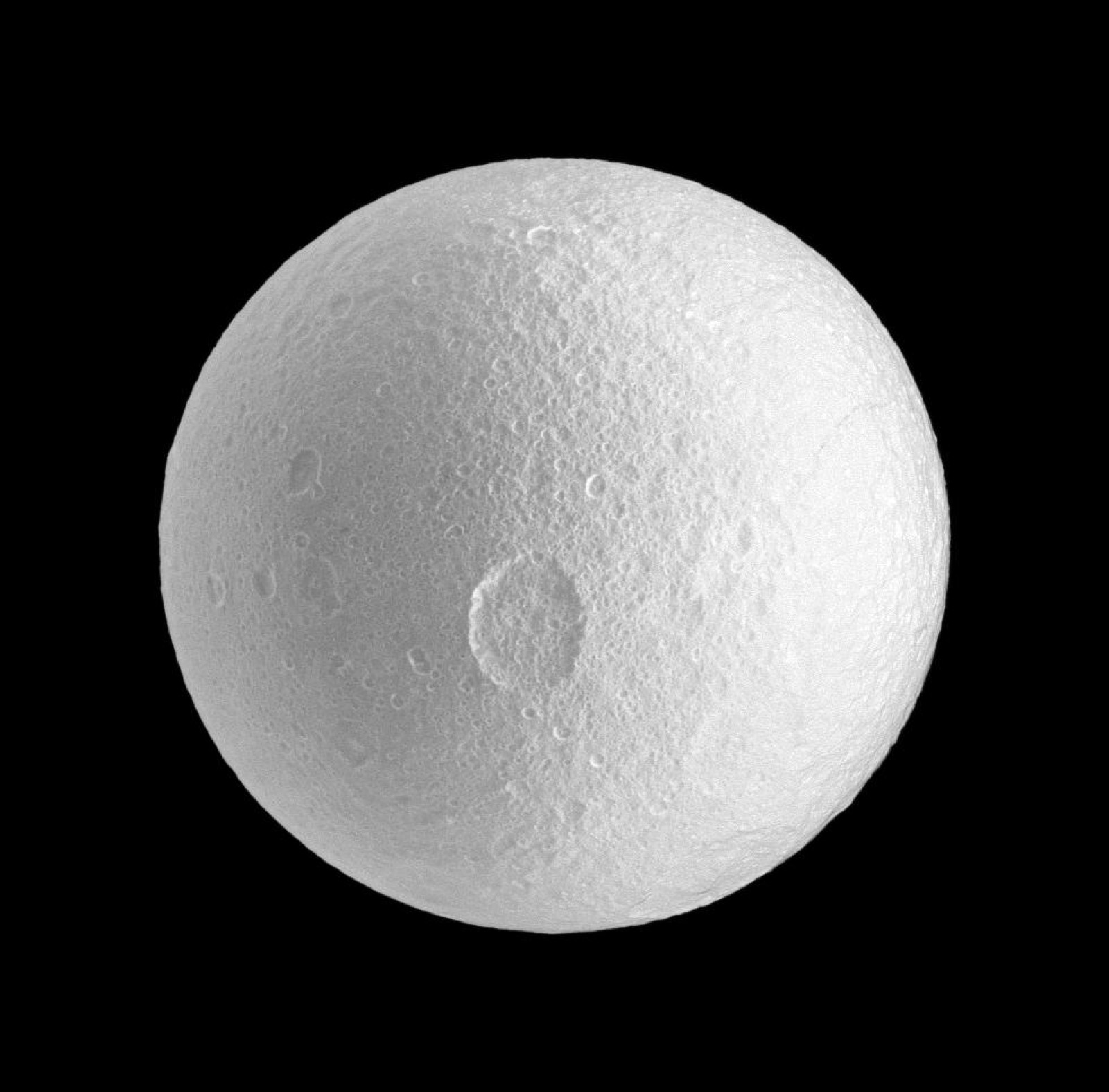
Beyond its influence on Saturn's rings, Mimas is gravitationally entangled with at least one fellow moon. It sits in a 2:1 mean-motion resonance with Tethys, a significantly larger Saturnian moon, meaning Mimas completes two full orbits for every single orbit Tethys makes. Such resonances are common in Saturn's system and help stabilise orbital arrangements over long timescales. There is also a tantalising unresolved footnote in Mimas's history: in 1982, astronomers Stephen P. Synnott and Richard J. Terrile reported the detection of a small moon sharing Mimas's orbit — a co-orbital companion. Co-orbital moons, like the Trojan pairs found elsewhere in Saturn's system, are not unprecedented, but the Mimas companion was never confirmed by subsequent observations and remains an open question. Whether it was a real object that has since been lost to view, an observational artefact, or something else entirely has not been definitively resolved.
12 Naming mythology and the symbol proposal
The name Mimas comes from one of the Giants of Greek mythology — not the Titans, but the Giants, the generation after them, who also fought a great struggle against Zeus and the Olympians. John Herschel chose this mythological framework deliberately, connecting Saturn's moons to figures associated with the god Cronus (Saturn's Greek equivalent) and the battles of divine generations. The correct adjectival form of the name, used when describing things belonging to or characteristic of Mimas, is Mimantean or Mimantian, both pronounced the same way — the Greek and Latin root being Mimant- rather than simply Mimas-. More recently, a software engineer named Denis Moskowitz, who designed most of the dwarf planet astronomical symbols, proposed an unofficial symbol for Mimas: a Greek letter mu, representing the initial of Mimas, combined with the crook of the traditional Saturn symbol. The symbol has not been widely adopted, as planetary moons other than Earth's have historically never received official astronomical symbols.
 ⤢
⤢
You would weigh…
Surface gravity 0.06 m/s² vs Earth’s 9.81 m/s². Try every world →