 Photograph · NASA/JPL/Space Science Institute
Moon · Deep guide · orbits Saturn
Tethys
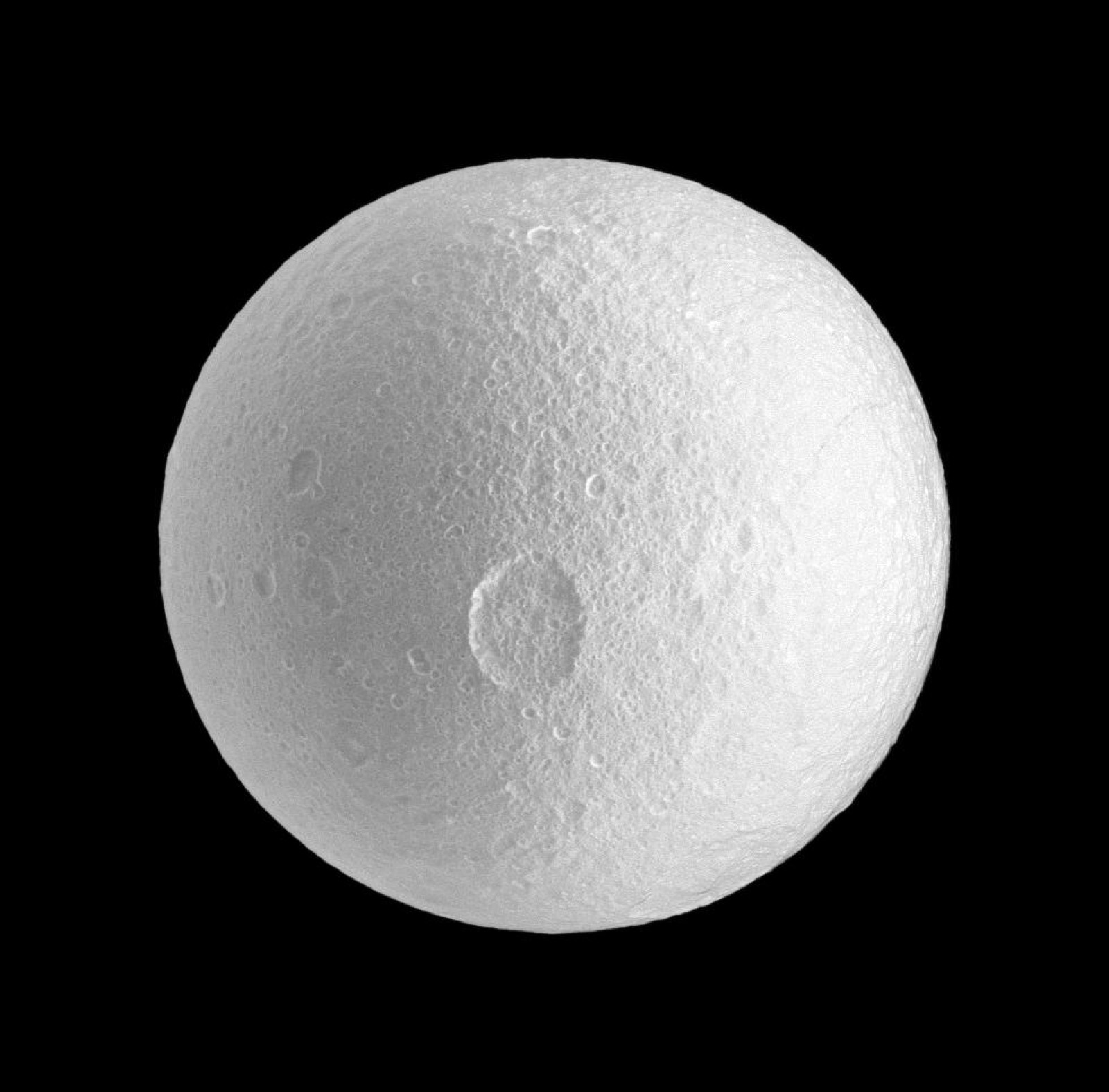
An ice moon scarred by a crater nearly half its own width.
What is it?
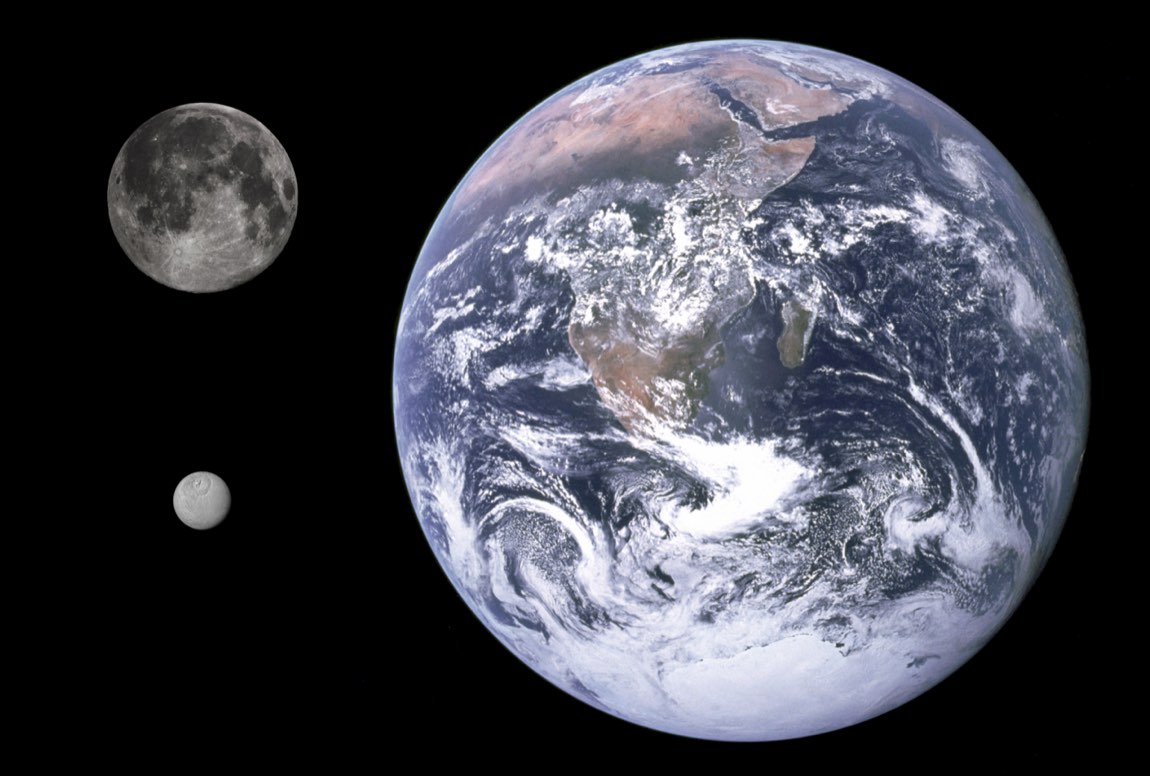
Tethys is almost pure water ice — its density is barely above water's — and it wears two colossal scars: Odysseus, an impact crater 450 km wide on a moon only 1,062 km across, and Ithaca Chasma, a canyon system stretching three-quarters of the way around the globe. The impact that made one may have cracked open the other.
The deep dive
Researched for the Atlas from Wikipedia — Tethys (moon) (16,594 characters read) · updated Sep 20, 2026
01 How Cassini mapped a world in detail
Three spacecraft gave humanity its first looks at Tethys before Cassini arrived to do the serious science. Pioneer 11 swung past on 1 September 1979 at a distance of 329,197 km — close enough to confirm the moon existed but too far for sharp pictures. Voyager 1 followed on 12 November 1980 at 415,670 km, its best images blurry at a resolution no better than 15 km per pixel. It was Voyager 2 that changed things: on 26 August 1981 it passed within just 93,010 km, returning images as sharp as 2 km per pixel. That single flyby was good enough to reveal Ithaca Chasma running nearly three-quarters of the way around the moon and to spot the giant Odysseus crater. Cassini then eclipsed everything. Its closest targeted flyby on 24 September 2005 came within a remarkable 1,503 km of the surface, and over its 2004–2017 mission it mapped Tethys down to a resolution of 0.29 km — fine enough to read the geology like a textbook.
02 A moon built almost entirely of ice
Tethys has the lowest density of all major moons in the Solar System at just 0.98 g/cm³ — slightly less than liquid water and far below solid rock. That single number tells a powerful story: the interior must be almost entirely water ice with only a tiny fraction of rock mixed in. Spectroscopy confirms it. In the near-infrared, strong water-ice absorption bands appear at wavelengths of 1.25, 1.5, 2.0, and 3.0 μm. No other compound has been unambiguously identified. Possible minor ingredients include organics, ammonia, and carbon dioxide, but none has been pinned down. A small amount of darker material is also present, and its spectral properties resemble the dark material seen on Iapetus and Hyperion — the best candidate being nanophase iron or hematite. If Tethys has a differentiated rocky core at all, that core would be no larger than 145 km in radius and account for less than 6% of the moon's total mass.
03 The surface that reflects almost everything
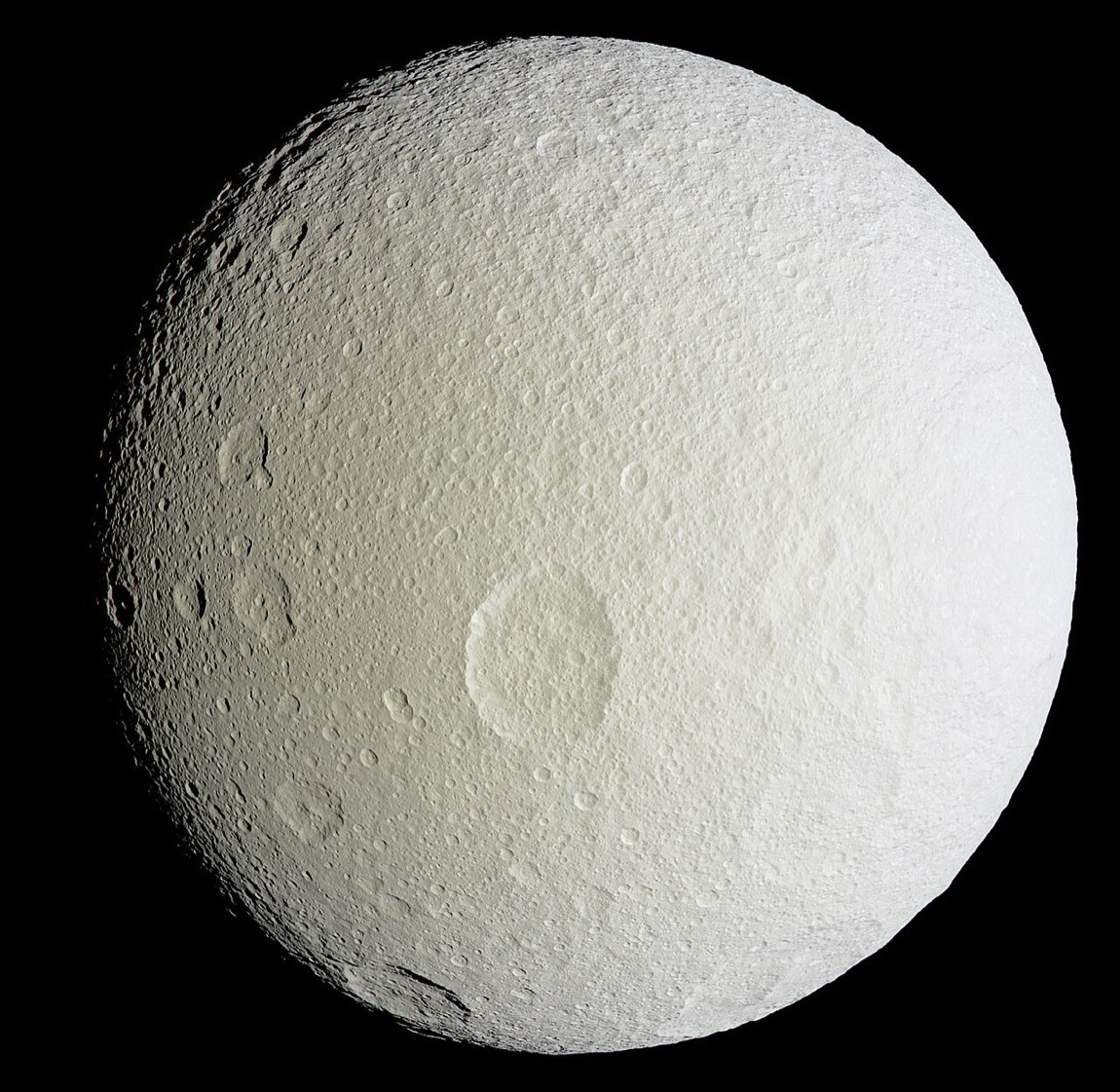
Tethys has a visual albedo of 1.229, making its surface one of the most reflective in the entire Solar System. To put that in context, fresh snow on Earth reflects roughly 80–90% of sunlight; Tethys reflects even more, and in fact an albedo above 1.0 arises from the way icy, porous surfaces scatter light in ways that flat measurements underestimate. The reason is a constant gentle sandblasting by tiny water-ice particles from Saturn's E-ring, which is itself fed by the south polar geysers of Enceladus. These microscopic grains coat Tethys's leading hemisphere preferentially, keeping it 10–15% brighter than the trailing side. The radar albedo is also very high, and Cassini radar observations at a wavelength of 2.2 cm revealed that the icy regolith covering the surface has a complex structure with a porosity exceeding 95% — meaning the top layer is essentially a very loose, fluffy frost rather than solid ice.
 ⤢
⤢
04 Color stripes, cold patches, and a Pac-Man moon Deeper
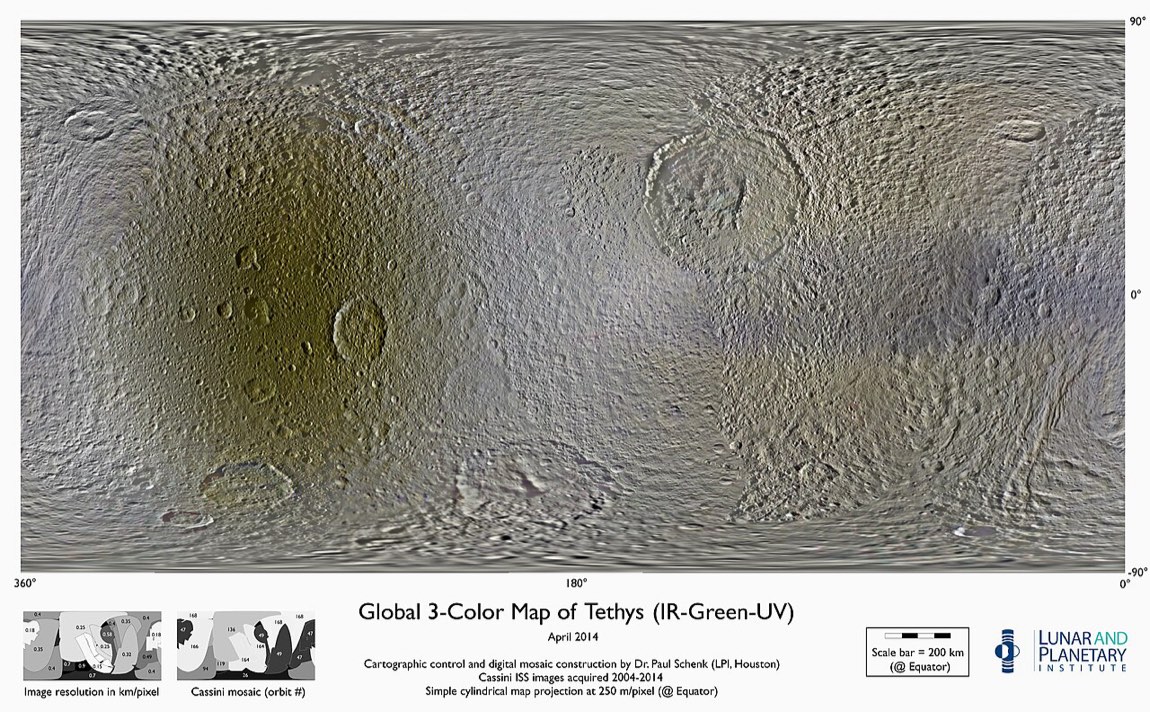
Look closely at Tethys and you see not one uniform surface but a patchwork of color zones. The trailing hemisphere grows progressively redder and darker toward the anti-apex of motion, while the leading hemisphere shows a slight reddening near the apex without much darkening. Between these zones a distinctly bluish band girdles the moon along a great circle through the poles — a color boundary driven largely by which hemisphere receives fresh bright E-ring particles and which gets bombarded by dark material drifting in from outer moons. On the leading hemisphere, a separate dark bluish equatorial band stretches 20° north and south of the equator in an elliptical shape. This band, which has a parallel only on Mimas, is almost certainly carved out by energetic electrons from Saturn's magnetosphere carrying energies greater than about 1 MeV. Those particles drift opposite to Saturn's rotation and strike preferentially near the equator of the leading face. Cassini thermal maps revealed something unexpected: that bluish band is noticeably cooler at midday than the surrounding terrain, giving Tethys a striking "Pac-Man" appearance at mid-infrared wavelengths.
05 Ithaca Chasma: a crack that ate a continent
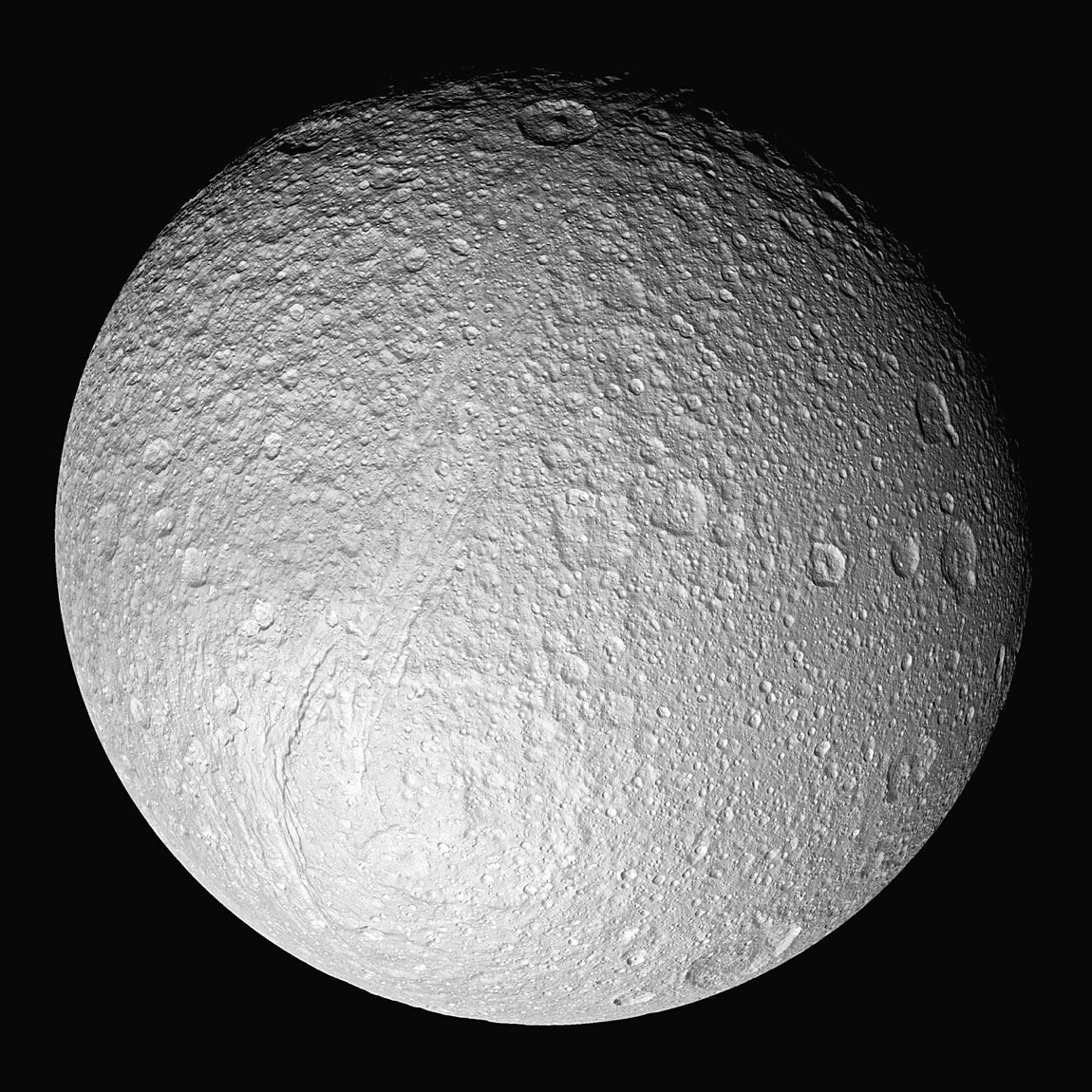
Stretching more than 2,000 km in length — about three-quarters of the way around Tethys's circumference — Ithaca Chasma is one of the largest canyon systems in the Solar System. It is roughly 100 km wide and about 3 km deep, and covers approximately 10% of Tethys's entire surface area. For scale, that length is comparable to the distance from New York to Denver. Scientists have proposed two main explanations for its formation. The leading hypothesis is that Tethys once harbored a subsurface ocean of liquid water, and when that ocean froze, the expanding ice cracked the shell — producing the chasma to accommodate the added volume. That primordial ocean may itself have been generated by tidal heating during a 2:3 orbital resonance between Dione and Tethys early in the Solar System's history, with the ocean freezing once the resonance ended. A competing idea links Ithaca Chasma to the Odysseus impact, with the chasma being the outermost ring graben produced by the shock wave. However, crater-count dating from high-resolution Cassini images shows that Ithaca Chasma is older than Odysseus, making the impact hypothesis unlikely.
06 Odysseus: the crater that refused to stay deep
The Odysseus impact basin spans about 450 km in diameter — nearly two-fifths of Tethys's entire width — making it one of the largest impact structures relative to its parent body in the Solar System. Yet for all that violence, the crater today is remarkably shallow. Its floor has relaxed over geological time until it conforms to the spherical curvature of Tethys itself, a process called viscous relaxation in which the warm, slowly flowing ice beneath gradually fills in the depression. The rim crest still rises about 5 km above the mean satellite radius, and the central complex features a pit 2–4 km deep surrounded by massifs that soar 6–9 km above the crater floor — which itself sits about 3 km below the average radius. The smooth plains on the trailing hemisphere are located nearly antipodal to Odysseus, consistent with seismic waves from the impact being focused to the opposite hemisphere — though the sharpness of the plains' boundaries suggests the final smoothing was due to endogenic intrusion rather than simple impact shaking.
 ⤢
⤢
07 Trojan companions riding the same orbit
Tethys does not travel alone. Two small moons, Telesto and Calypso, share its orbit around Saturn in a stable gravitational arrangement. Telesto occupies the L4 Lagrange point, sitting 60° ahead of Tethys along the orbit, while Calypso occupies the L5 point, trailing 60° behind. Lagrange points are locations where the gravitational pulls of Saturn and Tethys combine to trap smaller objects in long-term stable orbits — the same geometry that locks Jupiter's Trojan asteroids in place. Tethys's entire orbit lies deep within Saturn's magnetosphere, at a distance of about 295,000 km from the planet's center, which is roughly 4.4 Saturn radii. The orbit has negligible eccentricity and an inclination of about 1°. Tethys is also locked in an inclination resonance with the much smaller moon Mimas, but because both bodies have low gravity, the resonance does not generate noticeable orbital eccentricity or tidal heating in either moon today.
08 How Tethys was born from Saturn's disk Deeper
Tethys formed within the Saturnian sub-nebula — a disk of gas and dust that encircled Saturn shortly after the planet itself coalesced. At Saturn's distance from the Sun, temperatures were cold enough that water ice was the primary solid building block. The accretion process probably lasted several thousand years. Simulations suggest that heat released by the constant rain of impacting material warmed Tethys's outer layer, reaching a maximum temperature of around 155 K at a depth of about 29 km. After accretion ended, thermal conduction slowly transferred that heat inward: the outer shell cooled and contracted while the interior expanded, building up extensional stresses in the crust estimated at 5.7 MPa — likely enough to crack the surface. Because Tethys has so little rock, radioactive decay could not have powered significant further heating. One provocative idea for the moon's extreme ice richness holds that the inner Saturnian moons, including Tethys, accreted from the tidally stripped icy crust of a Titan-like moon that was swallowed by Saturn long ago.
09 Naming a moon: from Louis XIV to Greek myth
Giovanni Domenico Cassini discovered Tethys in 1684 alongside Dione, using a large aerial telescope set up at the Paris Observatory — the same instrument with which he had found Rhea and Iapetus in 1671–72. Rather than use mythological names, Cassini called his four discoveries Sidera Lodoicea, "the stars of Louis," in honor of King Louis XIV of France. For more than a century the moons were simply numbered: Tethys was Saturn I in the early scheme. When William Herschel added Mimas and Enceladus in 1789, the roster reshuffled; the discovery of Hyperion in 1848 reshuffled it once more. The modern name Tethys came from John Herschel, son of William. In his 1847 publication Results of Astronomical Observations made at the Cape of Good Hope, he proposed naming Saturn's moons after the Titans — the brothers and sisters of Kronos, the Greek equivalent of Saturn. Tethys is named for the titaness Tethys. The moon is also formally designated Saturn III, or S III Tethys, and its name carries two accepted pronunciations depending on whether the first 'e' is long or short.
 ⤢
⤢
10 Open questions: what we still do not know Deeper
Despite four spacecraft visits and thirteen years of Cassini observations, Tethys leaves scientists with stubborn puzzles. The interior structure remains unresolved: it is not known whether the moon is differentiated into a rocky core and an ice mantle, or whether it is simply a fairly homogeneous ball of ice throughout. A subsurface ocean is considered unlikely based on the shape data, which are consistent with a homogeneous interior — but that conclusion is not airtight. The identity of the dark material mixed into the surface ice has not been established; nanophase iron or hematite are candidates, but no compound other than crystalline water ice has been unambiguously confirmed. The extreme purity of Tethys's water-ice composition also lacks a fully satisfying explanation. And while the Cassini plasma observations confirmed that Tethys is geologically dead today — producing no new plasma in the Saturnian magnetosphere — the sequence and timing of its geological events, from the formation of Ithaca Chasma to the age of Odysseus, are still debated. Present knowledge of the full evolution of Tethys, as the article's authors note, remains very limited.
11 Saturn's magnetosphere shapes the surface Deeper
Tethys cannot escape Saturn's magnetic embrace. Its orbit sits entirely within Saturn's magnetosphere, which means the plasma co-rotating with the planet continuously strikes the moon's trailing hemisphere. Energetic electrons and ions embedded in the magnetosphere also bombard the surface constantly. This magnetospheric environment does two things to the surface. First, high-energy electrons with energies above about 1 MeV drift in the direction opposite to Saturn's rotation and preferentially hit the leading hemisphere near the equator, slowly darkening and cooling that equatorial strip to produce the telltale bluish "Pac-Man" thermal signature seen in Cassini infrared maps. Second, plasma impact on the trailing hemisphere is thought to contribute to its progressive reddening and darkening relative to the leading hemisphere. Meanwhile Cassini plasma observations in Tethys's vicinity showed no fresh plasma being produced, confirming the moon is geologically inert — unlike active Enceladus, which pours new material into the E-ring constantly.
12 Cratered terrain and how scientists date it Deeper
The majority of Tethys's surface is ancient hilly cratered terrain dominated by craters larger than 40 km across. Most are simple central-peak craters; those exceeding 150 km in diameter develop more complex peak-ring structures; and only Odysseus has a central pit morphology. Older craters tend to be shallower than young ones — a sign of viscous relaxation slowly flattening them over time. Scientists use crater density to build a relative timeline: the more densely cratered a region, the older it is. By this method the heavily cratered uplands are judged to date back to Solar System formation roughly 4.56 billion years ago. The interior of Odysseus crater, by contrast, is the youngest unit identified, with an estimated age ranging widely from 3.76 to 1.06 billion years depending on which absolute chronological model is applied — a reminder that translating crater counts into real ages for the outer Solar System carries significant uncertainty. The smooth plains on the trailing hemisphere and Ithaca Chasma fall somewhere in between, with the chasma confirmed older than Odysseus.
 ⤢
⤢
You would weigh…
Surface gravity 0.14 m/s² vs Earth’s 9.81 m/s². Try every world →