Moon · Deep guide · orbits Neptune
Despina
Also called: Neptune V · S/1989 N 3
A rubble-pile moon that shepherds Neptune's Le Verrier ring.
What is it?
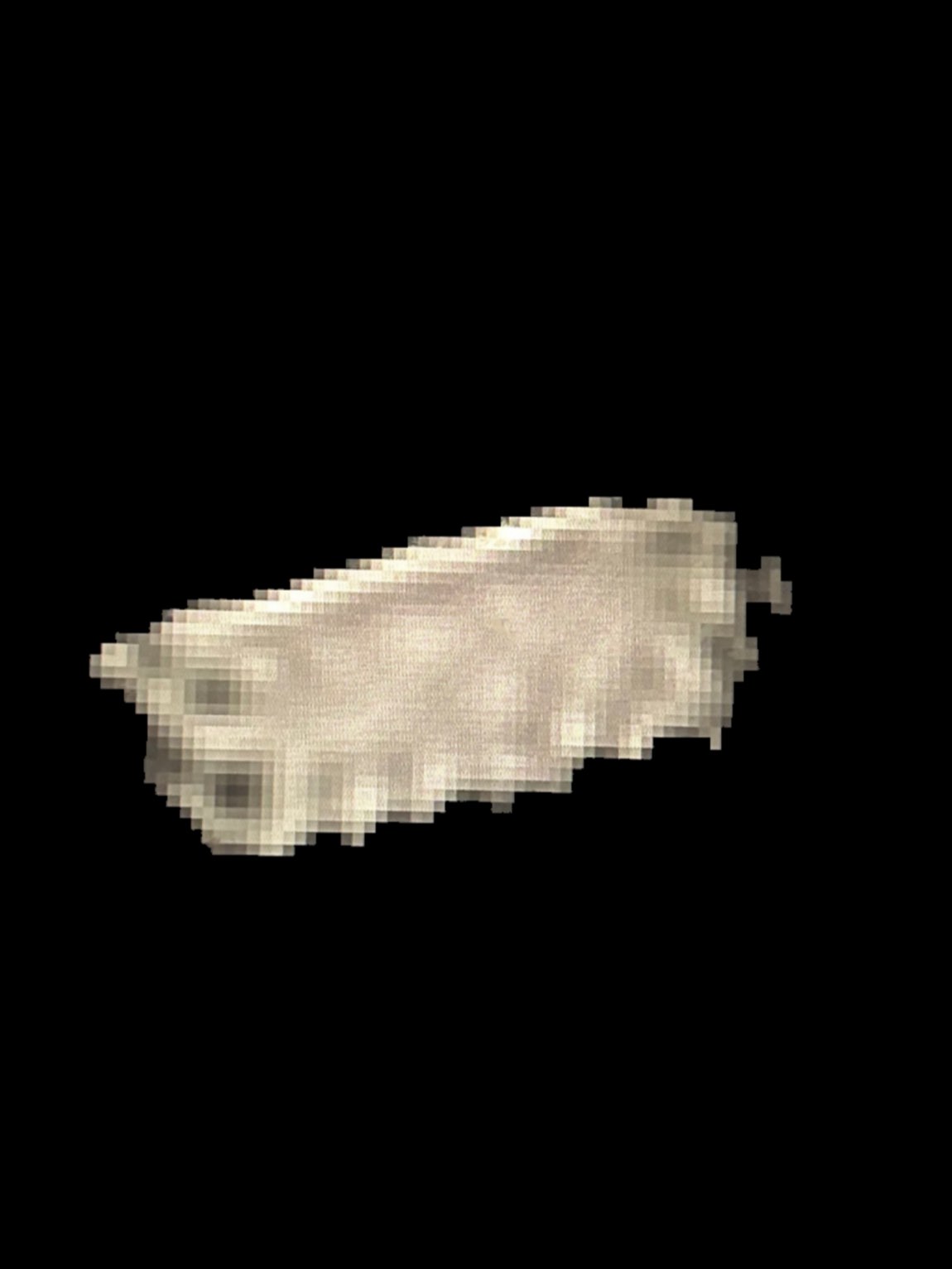
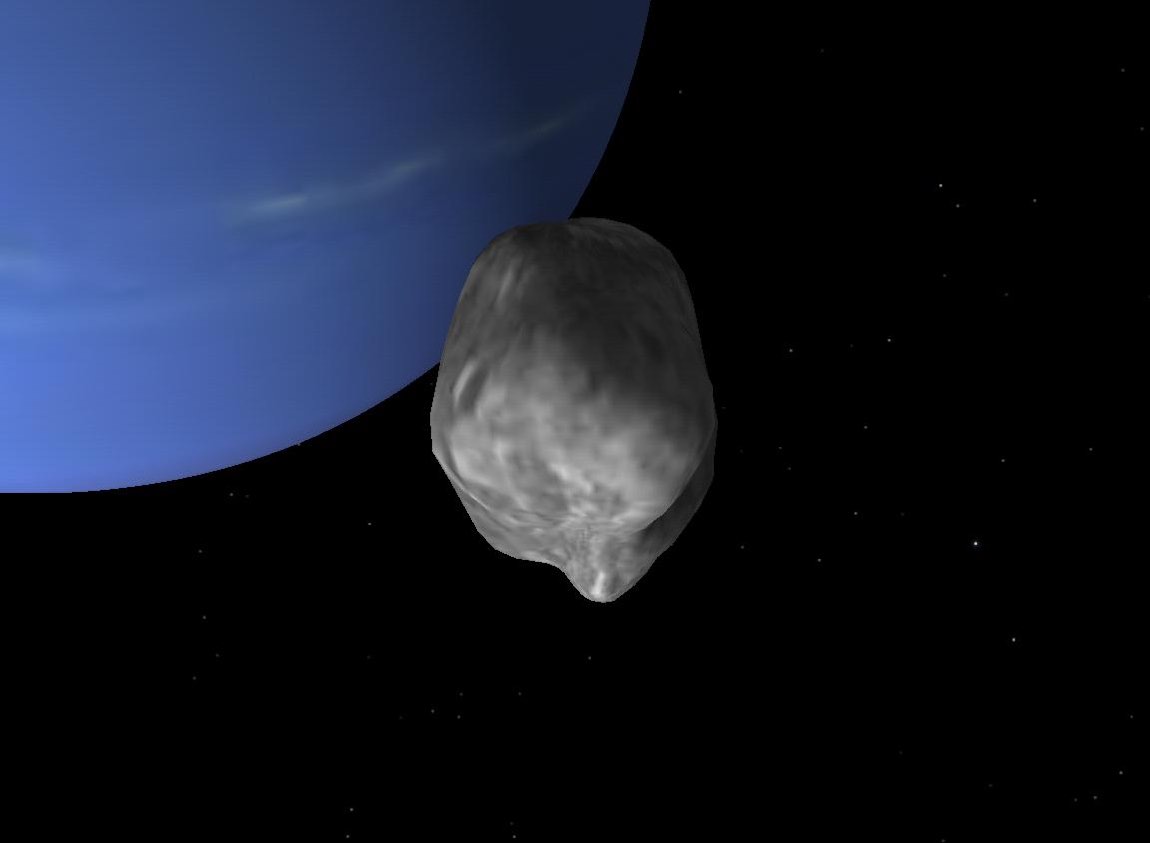
Despina was discovered in Voyager 2 images in late July 1989, as the probe closed in on Neptune. It is an irregular, unaltered body about 150 km across, likely reassembled from debris of Neptune's original moons after Triton's capture disrupted them. Despina orbits just inside the Le Verrier ring and helps shepherd it. Tides are slowly pulling it toward Neptune, so one day it may break up or fall into the planet.
The deep dive
Researched for the Atlas from Wikipedia — Despina (moon) (1,647 characters read) · updated Nov 15, 2026
01 A moon born from ancient wreckage
Despina almost certainly did not form the way most moons do. The leading hypothesis is that it is a rubble pile — a loose collection of fragments that re-accreted after Neptune's original inner satellites were shattered. The culprit was Triton, Neptune's large and unusual moon, which was captured into a highly eccentric initial orbit long ago. That wild orbit sent gravitational shockwaves through the inner Neptunian system, disrupting whatever moons existed at the time. The debris eventually clumped back together under its own gravity, producing Despina and its irregular siblings. This violent origin story explains a great deal about Despina's character: it is lumpy, asymmetrical, and shows absolutely no sign of geological modification — no resurfacing, no smoothing, no sign that internal heat ever reworked the surface. What you see is essentially a rubble heap that has been sitting undisturbed since the solar system was young.
02 A shepherd standing guard over the Le Verrier ring
Despina plays an active gravitational role in Neptune's ring system. Its orbit sits just inside the Le Verrier ring, one of Neptune's narrow rings, and this positioning makes Despina a shepherd moon. Shepherd moons work by exerting gravitational nudges on ring particles that stray too close to their orbit, pushing them back into the ring's boundaries and preventing the ring from spreading out and dissipating over time. Without Despina's gravitational influence, the Le Verrier ring would gradually blur and broaden. The moon therefore acts as an invisible fence, maintaining the ring's sharp inner edge. Despina also orbits just outside the orbit of Thalassa, the next moon inward, which means it occupies a narrow slot in a tightly packed region of the inner Neptunian system where orbital relationships are complex and consequential.
03 Doomed to spiral inward — eventually Deeper
Despina's long-term future is not a stable one. Because it orbits below Neptune's synchronous orbit radius — the distance at which an orbiting body keeps pace with the planet's rotation — tidal forces are slowly sapping its orbital energy. This process, called tidal deceleration, causes the moon to gradually spiral inward toward Neptune rather than outward. Over an immense timescale, two possible endings await Despina. If it survives the journey inward, it may eventually plunge into Neptune's upper atmosphere. Alternatively, before it reaches the planet itself, it could cross its own Roche limit — the critical distance within which Neptune's tidal stretching force exceeds Despina's own self-gravity — and be pulled apart. In that scenario, Despina's material would spread into a new planetary ring rather than impact the planet. Neither outcome is imminent on human timescales, but the trajectory is set.
04 What water ice might be doing on its surface Deeper
Spectroscopic observations have revealed a distinctive absorption feature at 3.0 microns in Despina's reflected light. This deep absorption is attributed to either water ice or hydrated silicate minerals — the article does not definitively distinguish between the two, and that ambiguity is scientifically meaningful. Hydrated silicates would suggest that liquid water once interacted with rocky material at some point in the moon's history or the history of the material it formed from, while water ice would simply indicate frozen water on or near the surface. The albedo — reflectivity — of Despina varies noticeably with wavelength: 0.09 at 1.4 microns, 0.1 at 2.0 microns, dropping sharply to just 0.03 at 3.0 microns, and recovering somewhat to 0.07 at 4.6 microns. This wavelength-dependent behavior is itself a diagnostic tool that planetary scientists use to narrow down surface composition.
05 How dark is Despina, really?
Despina is a remarkably dark object. Its albedo — the fraction of incoming sunlight it reflects — sits at around 0.09 at 1.4 microns, meaning it reflects less than one-tenth of the light that hits it at that wavelength. At 3.0 microns, it drops to just 0.03, making it barely more reflective than a lump of charcoal in that part of the spectrum. This darkness is consistent with the other small inner moons of Neptune, which share similar low-reflectivity surfaces. The dark material is likely a mixture of carbon-bearing compounds and other dark substances that have accumulated or been altered over billions of years of radiation bombardment from the Sun and from Neptune's magnetosphere. Despina's composition appears similar enough to its inner Neptunian neighbors that planetary scientists treat these moons as a family sharing a common origin and history.
06 A single spacecraft and a brief encounter
Everything we know about Despina comes from one mission and one fleeting encounter. Voyager 2, the NASA spacecraft launched in 1977, flew past Neptune in August 1989 as part of its grand tour of the outer solar system. It was during this flyby that images taken in late July 1989 revealed Despina for the first time. The discovery was announced on 2 August 1989 in International Astronomical Union Circular 4824, which noted that the detection was based on ten frames taken over five days, implying Despina first appeared in images sometime before 28 July 1989. No spacecraft has returned to Neptune since Voyager 2's departure, meaning every measurement of Despina's size, shape, composition, and orbit relies on data now more than three decades old, supplemented by Earth-based and orbital telescope observations taken at enormous distance.
07 Naming a moon after a forgotten goddess
Despina carries the name of a figure from Greek mythology who is not especially well known outside specialist circles. Despoina was a goddess, daughter of Poseidon and Demeter. Her parentage made her a sibling of sorts to other figures in the Olympian family tree, and her name in Greek essentially means "mistress" or "lady." The choice is thematically appropriate: Neptune's moons are named after figures connected to Poseidon, the Greek equivalent of the Roman sea god Neptune, so a daughter of Poseidon fits neatly into the naming convention. The name was not given immediately upon discovery — Despina carried the temporary designation S/1989 N 3 for more than two years before the name Despina was formally assigned on 16 September 1991. The moon is also designated Neptune V, reflecting its place in the catalog of Neptunian satellites.
08 An irregular shape with no geological story Deeper
Despina's approximately 150-kilometer diameter places it in an interesting size range. At that scale, some solar system bodies manage to pull themselves into rough spheres through their own gravity, while others remain irregular. Despina falls firmly in the irregular category — its shape is lumpy and asymmetrical. More telling than its shape, however, is what is absent: there is no sign whatsoever of geological modification. No impact basins that have been partially flooded by ancient material, no fracture patterns suggesting internal stresses, no smooth plains hinting at past resurfacing. The surface appears to record every blow it has received without any subsequent alteration. This geological silence is consistent with a rubble-pile body that formed cold, never generated significant internal heat, and has simply accumulated impact scars ever since. It is in many ways a preserved relic — a snapshot of conditions in the early Neptunian system.
09 Despina's place in a crowded inner system Deeper
Neptune's inner moon system is a compact and intricate neighborhood. Despina is the third-closest inner moon to Neptune, orbiting just outside Thalassa and just inside the Le Verrier ring. This tight arrangement — moons, rings, and orbital resonances packed into a relatively small region — is itself a consequence of the system's turbulent past. Triton's capture disrupted earlier orbital architectures, and what remains today is a system that re-organized itself from the wreckage. Despina sits at a gravitationally significant location: inside the synchronous orbit radius, which means tidal forces act to pull it inward rather than push it outward as they would for a moon orbiting farther from the planet. The moon's role as shepherd to the Le Verrier ring adds another layer: its position is not just an accident of current dynamics but an ongoing, active gravitational relationship that shapes the visible structure of Neptune's ring system.
10 Open questions three decades after discovery Deeper
Despite being discovered in 1989, Despina remains poorly understood in several important respects. The exact composition of its surface — whether that 3.0-micron absorption feature signals water ice or hydrated silicates — has not been definitively resolved. The precise timescale on which tidal deceleration will drag Despina inward, and whether it will ultimately impact Neptune or break apart at the Roche limit, depends on physical parameters that are not yet precisely known, including Neptune's tidal dissipation factor. The internal structure of Despina — how loosely or tightly its rubble-pile components are bound together — also remains uncharacterized. A future Neptune orbiter would almost certainly transform our understanding of Despina, as it would of the entire Neptunian system. Until such a mission flies, the moon remains largely a collection of tantalizing partial answers extracted from brief images taken during a single fast flyby decades ago.
 ⤢