Moon · Deep guide · orbits Neptune
Thalassa
Also called: Neptune IV · S/1989 N 5
A disk-shaped little moon that circles Neptune in about seven and a half hours.
What is it?
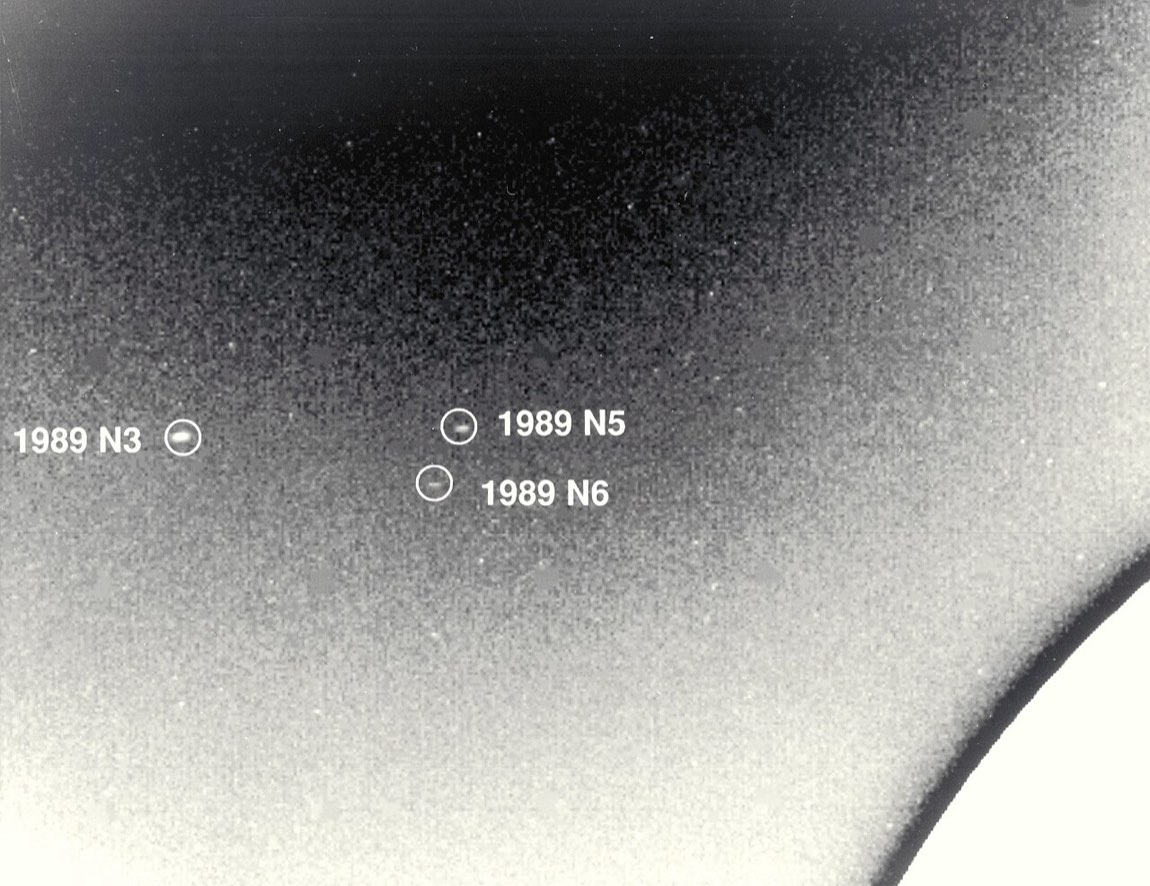
Thalassa was discovered in 1989 in Voyager 2 images, picked out from 25 frames taken over 11 days. It is an irregular, roughly disk-shaped body about 108 km wide, probably a rubble pile rebuilt from fragments of Neptune's earlier moons. Thalassa shares a 'dance of avoidance' resonance with Naiad, passing it every 21.5 days. Because it orbits inside Neptune's synchronous distance, tides are slowly drawing it inward, and it may eventually break apart into a ring.
The deep dive
Researched for the Atlas from Wikipedia — Thalassa (moon) (2,053 characters read) · updated Nov 15, 2026
01 A Moon Born from Catastrophic Wreckage
Thalassa almost certainly did not form the way most moons do — by quietly accreting from a disk of material left over after a planet's birth. Instead, scientists believe it is a rubble pile, rebuilt from the shattered remains of Neptune's original inner satellites. The culprit behind that destruction was Triton, Neptune's large and unusual moon, which was captured into a very eccentric initial orbit long ago. That wild orbit sent gravitational shockwaves through the inner Neptunian system, smashing earlier moons to fragments. Those fragments then slowly re-accreted under their own gravity, producing the loose, jumbled structure that Thalassa likely is today. This origin story means Thalassa is not a pristine relic of the solar system's formation but rather a second-generation object — a phoenix of rubble rising from a violent ancient collision cascade. The same traumatic history is thought to apply to several of Neptune's other small inner moons, making the entire inner Neptunian system a kind of graveyard and nursery simultaneously.
02 An Odd Shape: Disk, Not Potato
Most small, irregularly shaped moons in the solar system look like lumpy potatoes or battered asteroids — elongated and uneven in all directions. Thalassa breaks that pattern in a quietly surprising way. Despite being classed as an irregular body, it appears to be roughly disk-shaped. That is genuinely unusual. How a rubble pile — a loosely bound collection of fragments held together by gravity rather than by solid rock — ends up with a flattened, disk-like geometry rather than a more chaotic tumbled form is not fully explained. One possibility is that the re-accretion process itself, occurring within Neptune's strong tidal environment, encouraged material to settle into a flattened configuration. Whatever the cause, Thalassa's shape makes it stand out among the small inner moons of the outer solar system, and it remains one of the more intriguing unanswered questions that any future close-up spacecraft observation would need to address.
03 Spiraling Slowly Toward Its End Deeper
Thalassa's orbit sits inside Neptune's synchronous orbit radius — the distance at which a moon would orbit at exactly the same rate as the planet spins. Any moon closer than that threshold experiences tidal deceleration rather than tidal acceleration, meaning the planet's gravity steadily saps orbital energy from the moon instead of adding to it. The practical consequence for Thalassa is sobering: its orbit is slowly shrinking. Over geological timescales it is spiraling inward toward Neptune. Two possible fates await it. If it reaches Neptune's Roche limit — the distance inside which tidal forces overpower the moon's self-gravity — the stretching forces will tear it apart, and the debris could spread into a new planetary ring. Alternatively, if its structure is cohesive enough to survive past the Roche limit, it could ultimately plunge into Neptune's atmosphere. Either way, the spreading debris is expected to eventually impinge upon the orbit of Despina, the next moon outward, complicating that moon's future as well.
04 The Dance of Avoidance with Naiad
One of the most elegant orbital relationships in the Neptunian system plays out between Thalassa and its inner neighbor Naiad. The two moons are locked in a 69:73 orbital resonance — meaning that for every 73 orbits Thalassa completes, Naiad completes exactly 69. Rather than simply passing each other at random points in space, the resonance choreographs their encounters precisely. Naiad, which has a nearly 5-degree orbital inclination, swings above and then below Thalassa's orbital plane in a repeating pattern: twice from above, then twice from below, in a cycle that takes about 21.5 Earth days to complete. When they pass, the two moons are separated by roughly 3,540 km — close, but always safely distant. Although their orbital radii differ by only 1,850 km, Naiad's inclined path carries it approximately 2,800 km above or below Thalassa's orbital plane at each closest approach. This geometry keeps the moons from ever actually getting dangerously close to each other, which is exactly why astronomers describe it as a dance of avoidance.
05 Why This Resonance Is Scientifically Unusual Deeper
Orbital resonances are common throughout the solar system — Jupiter's moons Io, Europa, and Ganymede share one of the most famous examples. Typically, resonances involving small moons are associated with eccentricities: one or both orbits are elliptical, and the gravitational nudges at regular intervals keep those ellipses aligned in a stable configuration. The Thalassa-Naiad resonance is different in a way that planetary scientists find noteworthy. In this case, the eccentricities of both orbits are minimal — the paths are nearly circular. What drives the avoidance pattern instead is Naiad's nearly 5-degree orbital inclination. Using inclination rather than eccentricity as the primary mechanism for a stabilizing resonance is unusual, and it means the mathematical framework for understanding this interaction differs from more commonly studied resonance types. The resonance still achieves the classic purpose — maximizing separation at conjunction to keep the orbits stable — but it does so through a less familiar route, making the Thalassa-Naiad pair an interesting case study for celestial mechanics researchers.
06 Eleven Days of Images, One New Moon
Thalassa was not found by a telescope scanning the sky on a clear night — it was identified in photographs taken by a spacecraft hurtling past Neptune at tens of thousands of kilometers per hour. Voyager 2, during its historic 1989 Neptune flyby, captured the images from which Thalassa was eventually pulled out of the data. The discovery announcement, issued on 29 September 1989 under the designation S/1989 N 5, specifically mentions 25 frames taken over 11 days, which places the actual discovery date sometime before 18 September 1989. The speed of the encounter and the faintness of the moon meant that patient analysis of multiple images — not a single lucky photograph — was required to confirm the detection. Thalassa was then a temporary designation number for two years before receiving its permanent name on 16 September 1991, more than two years after the images were first taken.
07 A Name Drawn from the Sea Itself
The name Thalassa carries a double layer of meaning that feels almost too fitting for a moon of Neptune, the Roman god of the sea. In Greek mythology, Thalassa was a sea goddess, described as a daughter of Aether — the god of the upper air — and Hemera, the goddess of day. She was a primordial figure, representing the sea itself as a divine entity. But the name also works on a purely linguistic level: in Greek, the common word for "sea" is simply thalassa, used in everyday speech for millennia. So the moon bears a name that is simultaneously a mythological deity and a plain noun meaning the sea. The convention of naming Neptune's moons after figures connected to the sea and water mythology has been applied throughout the Neptunian system, but Thalassa's name, being both a character and a concept, is among the most direct expressions of that theme.
08 Neptune's Inner Moon Family at a Glance
Thalassa occupies a specific address in a crowded inner neighborhood. It is Neptune's second-innermost satellite, which places it in a region of the Neptunian system where tidal forces from the planet are strong, orbital periods are short, and the history of collisional disruption has been intense. Its nearest inward neighbor is Naiad, with which it shares the 69:73 resonance described above. Beyond Thalassa, moving outward, lies Despina — a moon whose orbital future may eventually be disturbed by the debris Thalassa leaves behind if and when it breaks apart or spirals inward to its end. This arrangement means Thalassa is not an isolated object but an active participant in the ongoing gravitational ecology of Neptune's inner system, influencing and being influenced by its neighbors in ways that planetary scientists continue to untangle.
09 Open Questions a Future Mission Could Answer Deeper
Voyager 2 remains the only spacecraft to have visited Neptune, and its 1989 flyby lasted a matter of hours in terms of close observation time. The images it captured were enough to reveal Thalassa's existence and rough shape, but they fall far short of what would be needed to understand the moon in depth. Key open questions include the precise internal structure of this presumed rubble pile — is it a loosely bound aggregate, or has it partially consolidated over billions of years? What does its disk-like shape tell us about the conditions under which it re-accreted after the Triton disruption event? How quickly is its orbit actually decaying, and on what timescale will it reach its Roche limit or Neptune's atmosphere? A dedicated Neptune orbiter, something that has been seriously proposed but not yet funded, could spend months or years making close passes of Thalassa and its inner moon companions, turning these open questions from speculation into data.
 ⤢