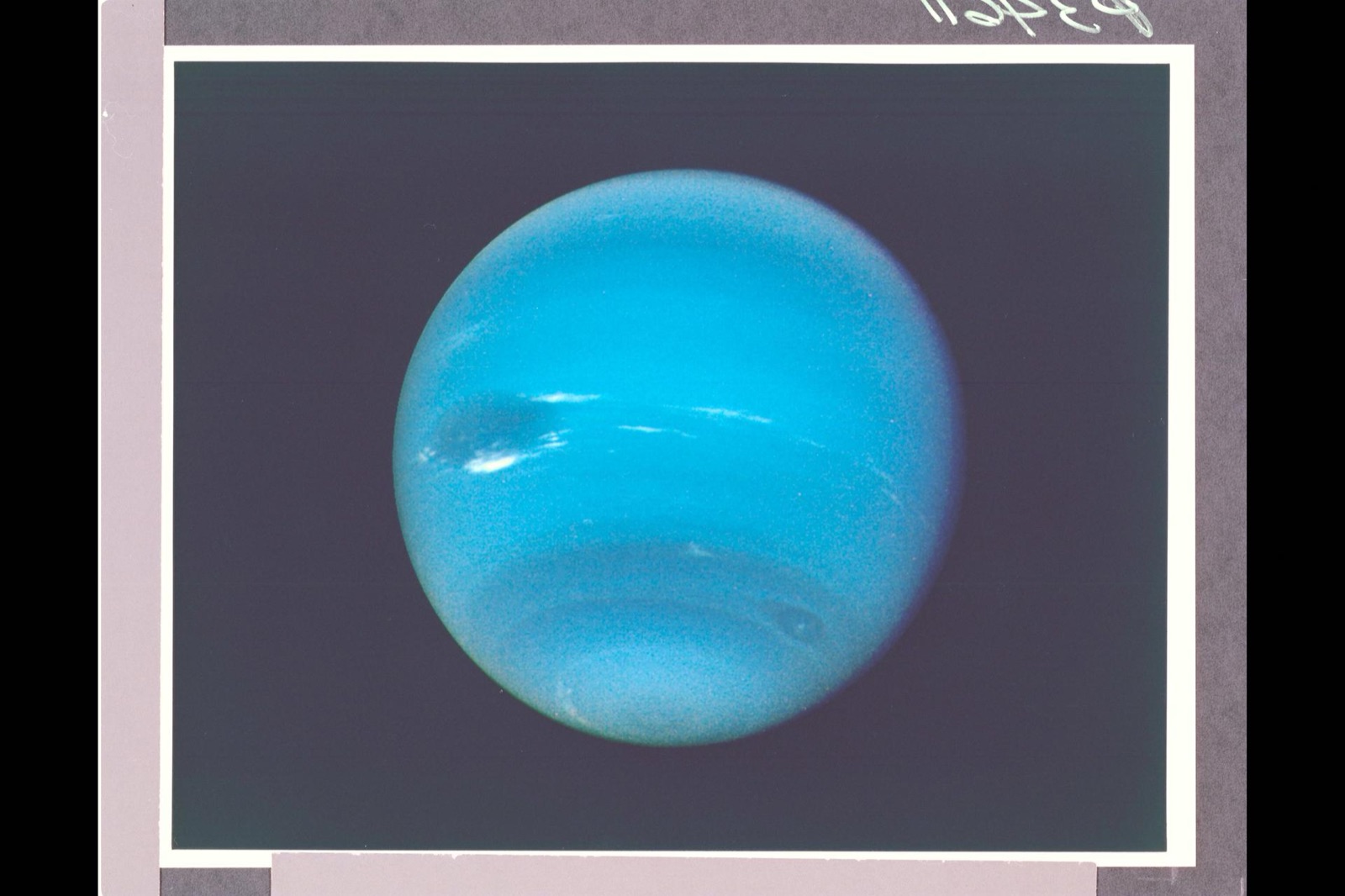
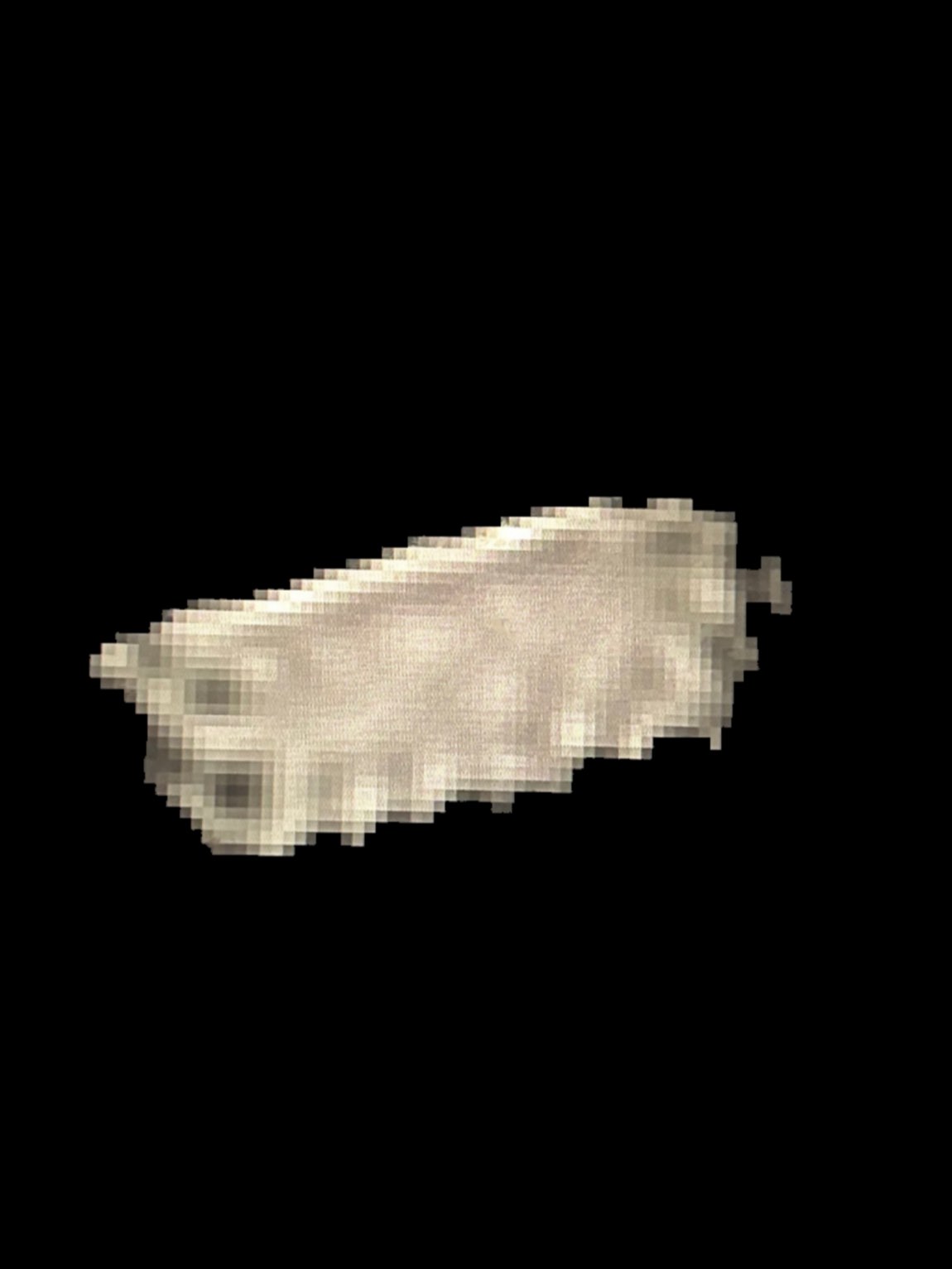
 Photograph · LordGMC12 · CC BY 4.0
Moon · Deep guide · orbits Neptune
Galatea
Also called: Neptune VI · S/1989 N 4
The moon thought to keep Neptune's Adams ring and its bright arcs in place.
What is it?
Galatea was found in Voyager 2 images in July 1989. It is an irregular body roughly 200 km long, with no sign of any geological activity, and is probably a rubble pile. It orbits about 1,000 km inside the Adams ring and appears to act as its shepherd, its gravity helping confine the ring's clumpy arcs. Galatea lies inside Neptune's synchronous orbit, so it is slowly spiralling inward.
The deep dive
Researched for the Atlas from Wikipedia — Galatea (moon) (2,412 characters read) · updated Nov 15, 2026
01 A Moon Built from Wreckage
Galatea is not a pristine world that formed neatly alongside Neptune. Scientists think it is a rubble pile — a loose collection of fragments that re-accreted after Neptune's original inner satellites were smashed apart. The culprit was Triton, Neptune's large moon, which was captured into a highly eccentric initial orbit and whose gravitational perturbations sent destructive shockwaves through the inner satellite system. The pieces eventually clumped back together under their own weak gravity, producing the irregularly shaped body we see today. Because it assembled from debris rather than growing gradually from a protoplanetary disk, Galatea never underwent the internal heating or differentiation that reshapes larger worlds. It shows no sign whatsoever of geological modification — no craters that have been erased, no signs of resurfacing, no tectonic features. What you see on Galatea's surface is essentially a frozen snapshot of chaotic early Neptunian history, making it a time capsule of violence from the outer solar system's youth.
02 Water's Fingerprint on a Dark Surface Deeper
Despite looking like an unremarkable dark rock, Galatea carries subtle chemical clues locked in its surface. Spectroscopic observations reveal a deep absorption feature at 3.0 microns, a wavelength where water ice and hydrated silicate minerals strongly absorb light. More specifically, the surface shows a deep 3-micron OH band and the presence of phyllosilicates — sheet-like clay minerals that only form when rock is altered by prolonged contact with liquid water. This is a striking finding. It implies that the material making up Galatea was once exposed to water at temperatures somewhere between less than 300 and 400 K, warm enough for aqueous alteration to proceed over long timescales. Crucially, the bulk of this material was never heated above 700 K, the threshold at which hydration would have been baked away. Clear signatures of pure water ice are actually absent, which shifts the compositional picture closer to carbonaceous chondrites and main-belt asteroids like Ceres. Galatea's surface albedo varies with wavelength: 0.08 at 1.4 and 2.0 microns, dropping to just 0.04 at 3.0 microns, and rising again to 0.12 at 4.6 microns.
03 A Shepherd Moon Keeping Rings in Line
One of Galatea's most important roles in the Neptunian system is gravitational babysitting. It acts as a shepherd moon for the Adams ring, Neptune's outermost and most famous ring, which sits roughly 1,000 kilometres outside Galatea's orbit. Shepherd moons work by exerting gravitational nudges on ring particles that stray too far inward or outward, effectively herding them back into a narrow band. Without Galatea's influence, the Adams ring would gradually spread and dissipate. Even more intriguing, the Adams ring contains unusual clumps of denser material called ring arcs rather than being uniform all the way around. Resonances between Galatea's orbital motion and ring particles in the ratio 42:43 are considered the most likely mechanism confining these arcs to specific locations. Every 43 orbits Galatea completes, certain ring particles complete 42, creating a repeated gravitational pattern that corrals material into arc-shaped concentrations. This resonance relationship makes Galatea not just a passive bystander but an active architect of Neptune's ring structure.
04 Weighing a Moon by Watching Rings Wobble Deeper
Galatea is too small and too far away for its mass to be measured by tracking a natural or artificial orbiting companion — it has neither. Instead, scientists used a clever indirect method: they watched the Adams ring. Galatea's gravity creates measurable radial perturbations, tiny ripples and distortions in the ring's position, as ring material responds to the moon's gravitational tugs each orbit. By precisely modeling these perturbations using data from Voyager 2 observations, researchers estimated Galatea's mass at (2.12 ± 0.08) × 10¹⁸ kilograms. For perspective, that is roughly 0.036 percent of the Moon's mass — an enormous difference in scale, but enough mass concentrated in a small irregular body to meaningfully sculpt a ring system. The small uncertainty quoted, ±0.08 × 10¹⁸ kg, reflects how well the ring-perturbation method can constrain the mass when the orbital geometry is well characterized. This technique — essentially letting a ring serve as a natural gravitational probe — is one of the more elegant measurement strategies planetary scientists have available when direct spacecraft flybys are not possible.
05 Spiraling Slowly Toward Its Doom
Galatea's long-term future is not a stable one. Its orbit lies below Neptune's synchronous orbit radius — the distance at which a moon's orbital period would match Neptune's rotation. For moons inside this radius, tidal forces work in reverse compared to our own Moon: instead of being pushed gradually outward, Galatea is being pulled gradually inward. This process is called tidal deceleration, and it means Galatea is slowly spiraling toward Neptune. Eventually, one of two fates awaits it. If it reaches Neptune's Roche limit — the distance within which tidal stretching overcomes a loosely bound body's self-gravity — it may be torn apart and spread into a new planetary ring system. Alternatively, it could survive tidal disruption and eventually collide with the planet itself. The timeline for either outcome is not specified precisely by current data, but the direction of travel is clear. For a moon that may already be a rubble pile held together loosely, the Roche limit scenario seems particularly plausible. Galatea's fate offers a natural experiment in how ring systems can be born from doomed moons.
06 Discovered in Ten Frames Over Five Days
Galatea was discovered in late July 1989, spotted in images taken by the Voyager 2 spacecraft during its historic flyby of Neptune. The discovery was announced on 2 August 1989 in International Astronomical Union Circular 4824, which described the find as based on ten frames taken over five days — a detail that implies the actual discovery date was sometime before July 28, 1989. At the time, Galatea received the temporary designation S/1989 N 4, a provisional label indicating it was the fourth new Neptunian satellite candidate announced in 1989. Because it was discovered purely through spacecraft imagery rather than from Earth-based telescopes, it had no prior observational history whatsoever. Voyager 2 remains the only spacecraft ever to visit the Neptunian system, meaning these 1989 images are still among the best direct data humanity has on Galatea. The moon's permanent name, drawn from Greek mythology, was assigned more than two years after discovery, on 16 September 1991.
07 The Nereid Behind the Name
The name Galatea connects this moon to one of the richest threads in Greek mythology. Galatea was one of the fifty Nereids, sea nymphs who were daughters of the sea god Nereus and companions of Poseidon — the Greek equivalent of Neptune, the god after whom the planet itself is named. The mythological naming scheme for Neptune's moons thus has a pleasing internal logic: a world of ocean associations surrounded by moons named for sea deities and their kin. This particular Galatea was the object of obsessive, unrequited love from Polyphemus the Cyclops, a giant from Sicily immortalized in Homer's Odyssey. Polyphemus famously serenaded her from clifftops while she remained indifferent, preferring the mortal Acis. The story of this impossible love was retold by the Roman poet Ovid and inspired composers and artists for centuries. That mythological resonance — a lonely giant reaching futilely toward something beautiful and distant — has an almost poetic appropriateness for a small, dark moon orbiting alone in the cold outer reaches of the solar system.
08 Galatea Among Neptune's Inner Moons Deeper
Within Neptune's crowded inner satellite system, Galatea occupies a specific positional rank: it is the fourth-closest inner moon to Neptune and the fifth-largest moon of the planet overall. Its compositional profile — dark surface, hydrated silicates, phyllosilicates, carbonaceous-chondrite-like character — appears to be shared with other small inner Neptunian satellites, suggesting a common origin story. If those inner moons all reassembled from the same debris field created when Triton's capture destabilized the original satellite system, they would naturally share bulk compositions inherited from whatever material was present in the inner Neptunian disk at that time. The presence of phyllosilicates across this family implies that aqueous alteration was a widespread process in those original parent bodies before they were broken up. This shared chemistry makes it harder to study Galatea in isolation — it is better understood as one survivor among a family of shattered and reassembled worlds, all orbiting within Neptune's shadow, all slowly being shaped and herded by the gravitational landscape that Triton's violent arrival created billions of years ago.
09 Open Questions a Future Mission Must Answer Deeper
Despite everything Voyager 2 revealed, Galatea remains poorly understood. No spacecraft has visited Neptune since 1989, and no mission is currently en route. The fundamental shape and volume of Galatea are known only roughly — enough to call it irregular, but not enough to build a detailed topographic map. Its internal structure is inferred rather than measured; the rubble-pile model is plausible given its history but unconfirmed. The exact timeline of its inward spiral toward Neptune is unconstrained. The ring-arc confinement mechanism involving the 42:43 resonance is considered the most likely explanation but has not been definitively proven. The aqueous alteration implied by phyllosilicates raises questions about where and when that water was present — was it in the original pre-disruption satellites, in the disk material they formed from, or somewhere else entirely? A future Neptune orbiter equipped with modern spectrometers and imaging systems could resolve many of these questions, but as of the information available in this article, Galatea remains one of the solar system's genuinely mysterious small worlds.