 Photograph · NASA / JPL / Space Science Institute · Public domain
Moon · Deep guide · orbits Saturn
Prometheus
Also called: Saturn XVI · S/1980 S 27
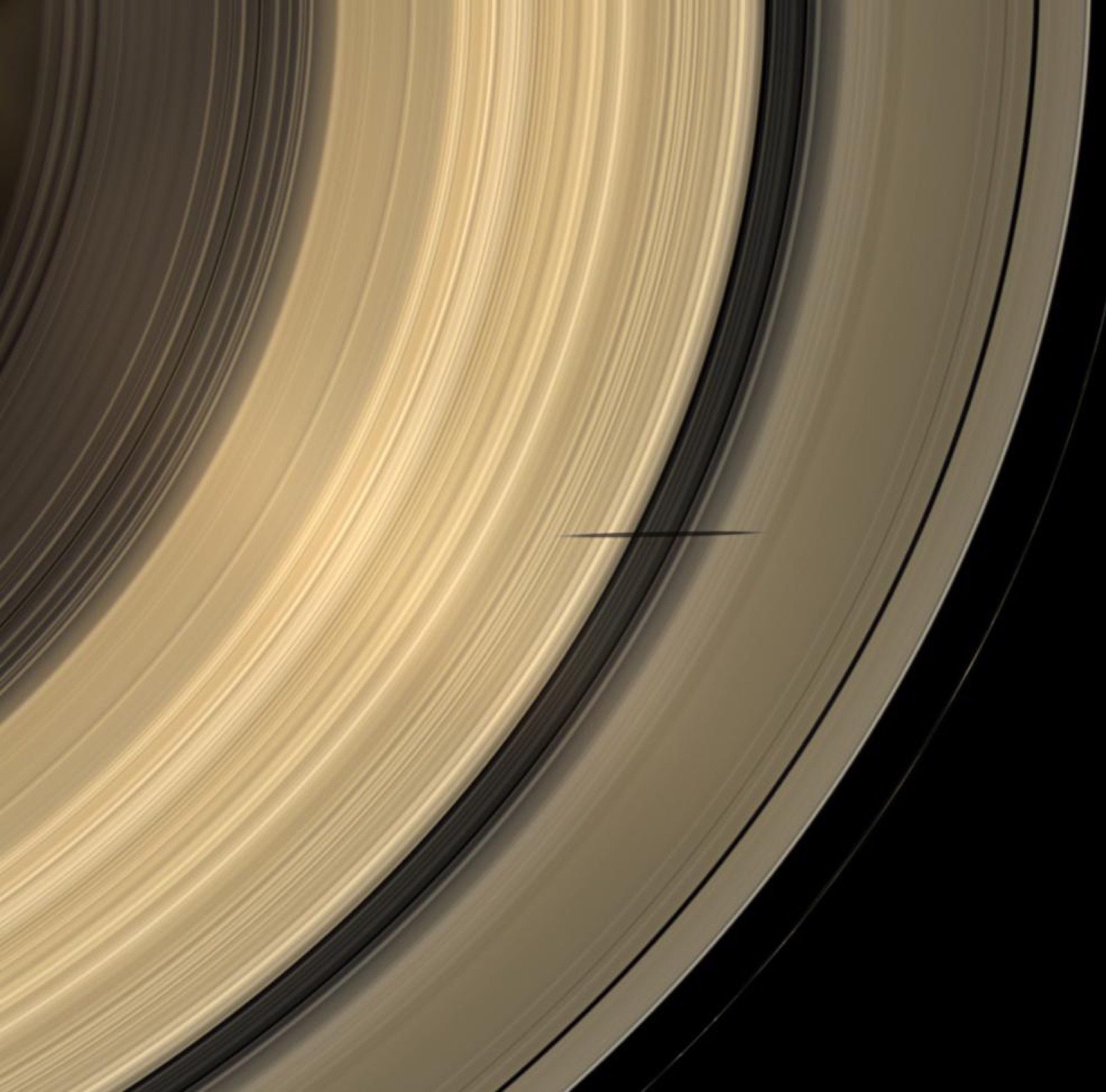
The shepherd moon that carves kinks, streamers and knots into Saturn's narrow F ring.
What is it?
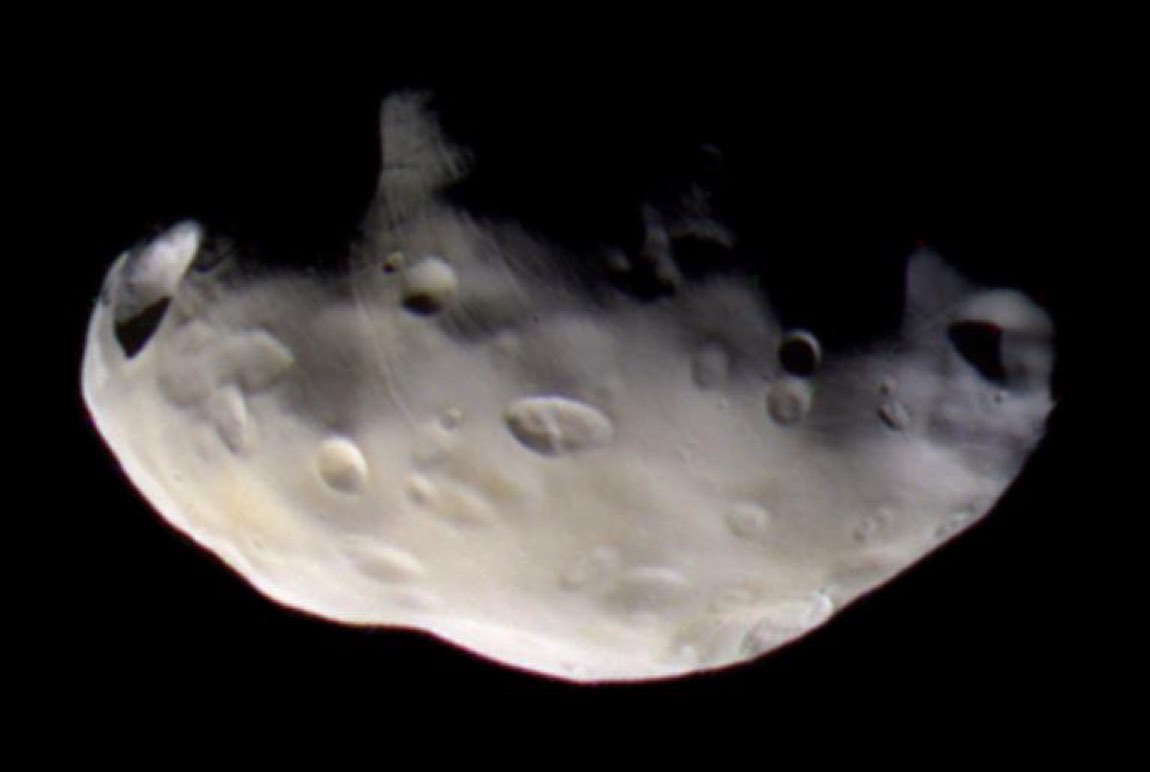
Prometheus is an elongated inner moon of Saturn, about 137 km long, that orbits just inside the narrow F ring. It was found in Voyager 1 images in October 1980. As it passes, its gravity tugs streamers of material out of the F ring, and it is now thought to be the main moon keeping that ring confined. Its low density and bright surface suggest a porous, icy body. Prometheus and its neighbour Pandora pull on each other chaotically and approach within about 1,400 km every 6.2 years.
The deep dive
Researched for the Atlas from Wikipedia — Prometheus (moon) (2,449 characters read) · updated Nov 14, 2026
01 A Moon Shaped Like a Lumpy Potato
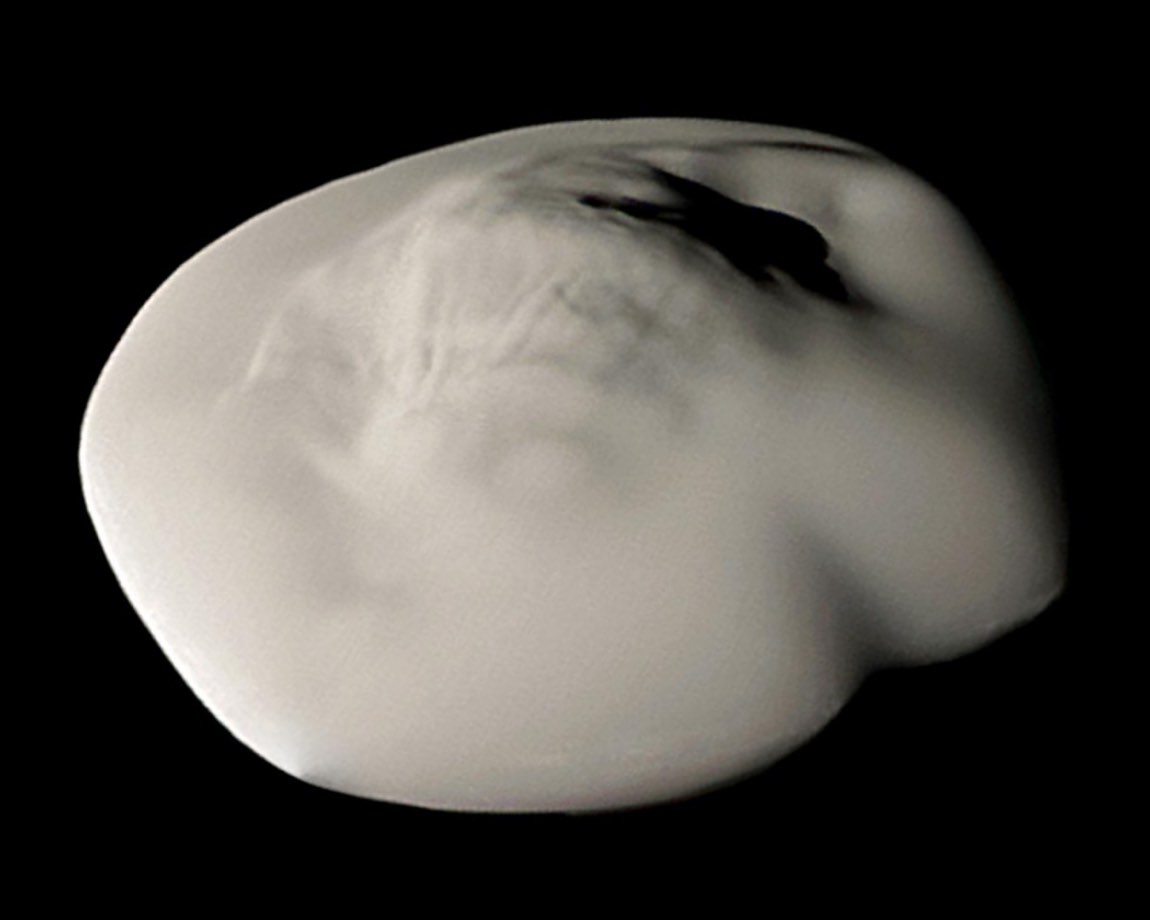
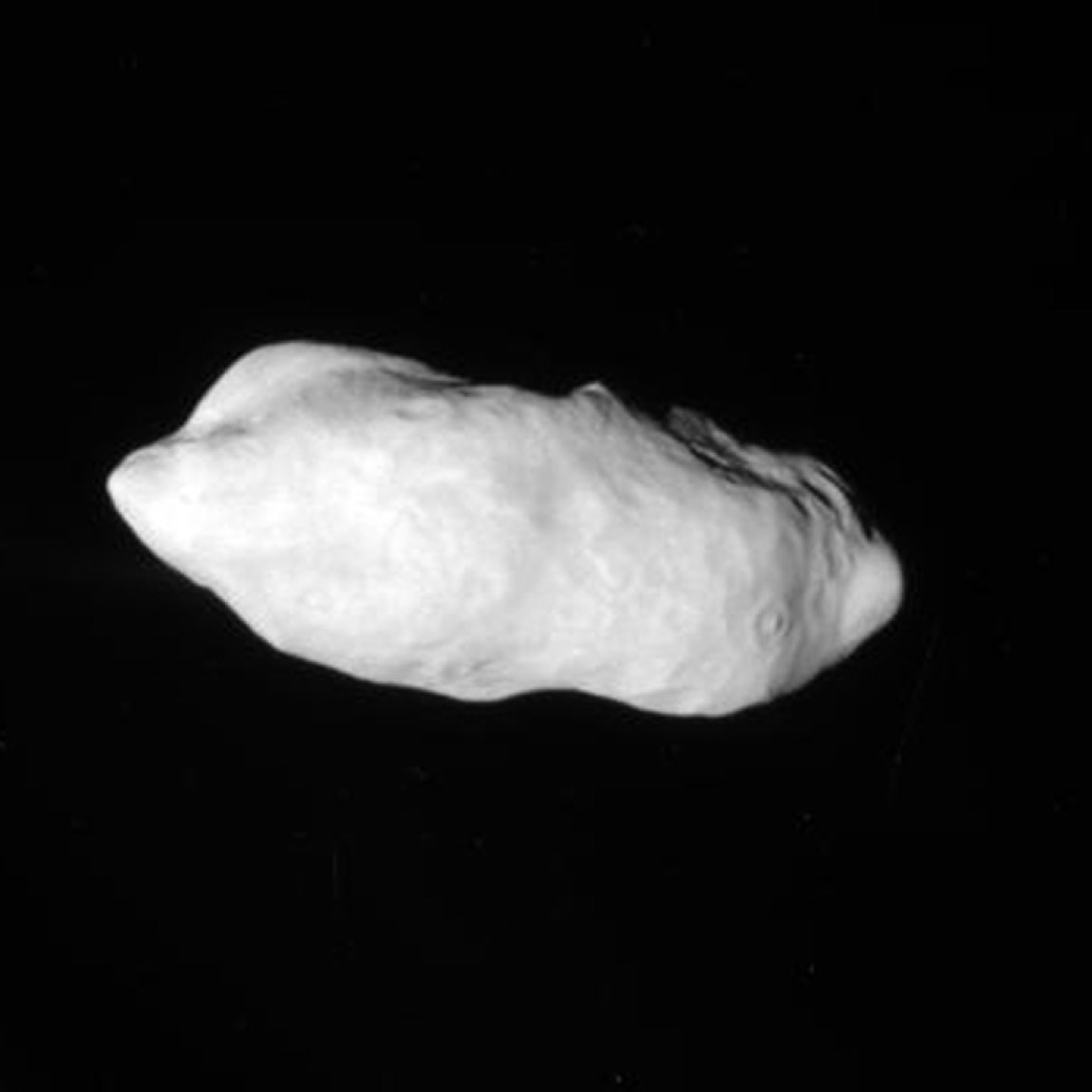
Prometheus is one of Saturn's most dramatically misshapen moons. Rather than the spherical form we expect of large worlds, it stretches out to roughly 137 km × 81 km × 56 km — meaning its longest dimension is nearly two and a half times its shortest. For scale, that longest axis is about the driving distance from Los Angeles to San Diego. Scientists think this extreme elongation is not a fluke of erosion or impact damage, but may reflect how Prometheus was born: the low-speed merging of several similar-sized bodies, essentially a gentle cosmic pile-up that locked multiple chunks together without enough energy to reshape them into a sphere. This origin story is supported by the moon's remarkably low density, which suggests it is a very porous icy body riddled with internal voids, more like a loosely packed snowball than a solid rock.
02 Two Faces of a Battered Surface Deeper
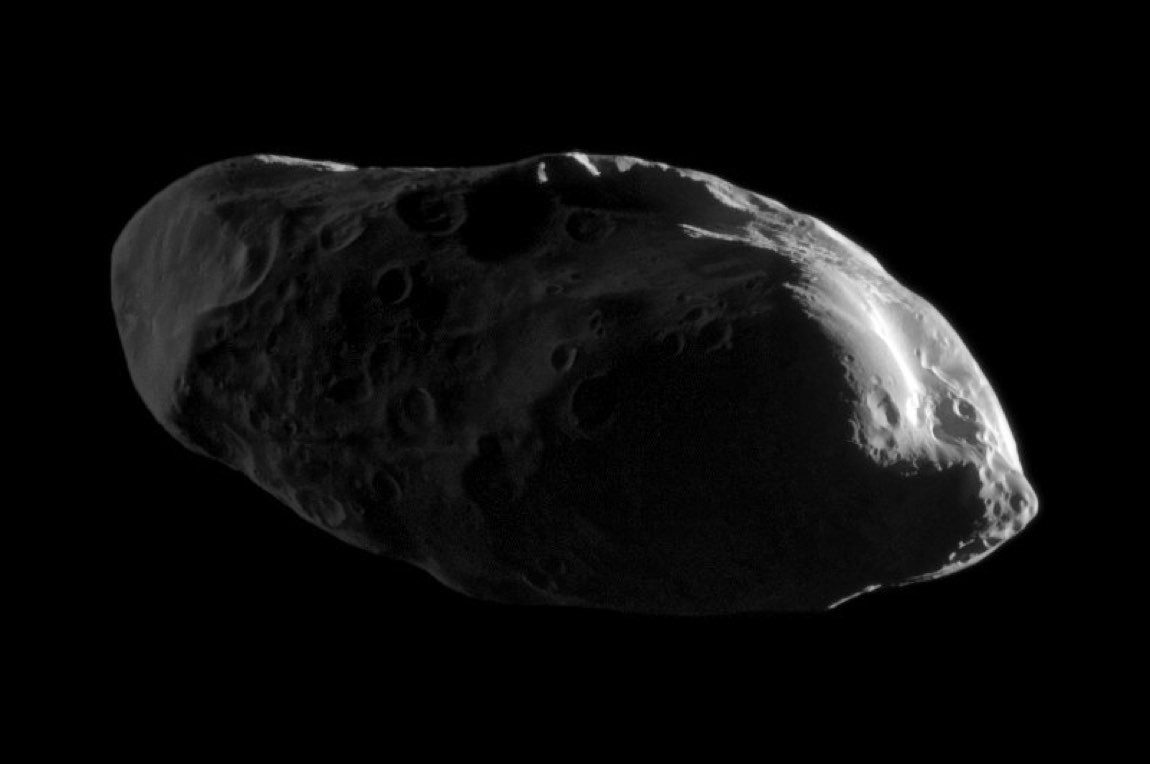
Look closely at Prometheus and its surface divides into two distinct types of terrain, though both are equally cratered and battle-worn. What separates them is a series of long scarps — steep cliff-like slopes — that cut across the moon. Scientists have proposed that at least one of these scarps could be exposing a core section of the interior, essentially a window into Prometheus's deep structure. If that interpretation is correct, this core section would account for roughly two-thirds of the total volume of the moon, making it a dominant internal feature rather than a small kernel. Impact craters roughly 20 km in diameter are plainly visible on the surface, and the overall heavily cratered landscape gives Prometheus a strong family resemblance to its nearby neighbors Epimetheus and Janus. The surface also bears ridges and valleys, adding topographic texture to what might otherwise appear a battered and monotonous world.
03 Prometheus Was Born from a Single Photo Session
Prometheus was not discovered by a patient astronomer peering through an eyepiece on a clear night. It was found on 24 October 1980, pulled out of images captured by NASA's Voyager 1 spacecraft as it swept through the Saturn system. The moon was immediately given the provisional designation S/1980 S 27 — a placeholder label reflecting the year and order of discovery. For five years it carried that anonymous tag, until late 1985 when it received its permanent name: Prometheus, after the Titan of Greek mythology who stole fire from the gods and gave it to humanity. It is also catalogued under the formal designation Saturn XVI, reflecting its place in the ordered list of Saturn's known moons. This naming and numbering system places Prometheus firmly in the administrative record of solar system exploration, a world identified, named, and filed within the span of a few years.
 ⤢
04 How Prometheus Sculpts the F Ring
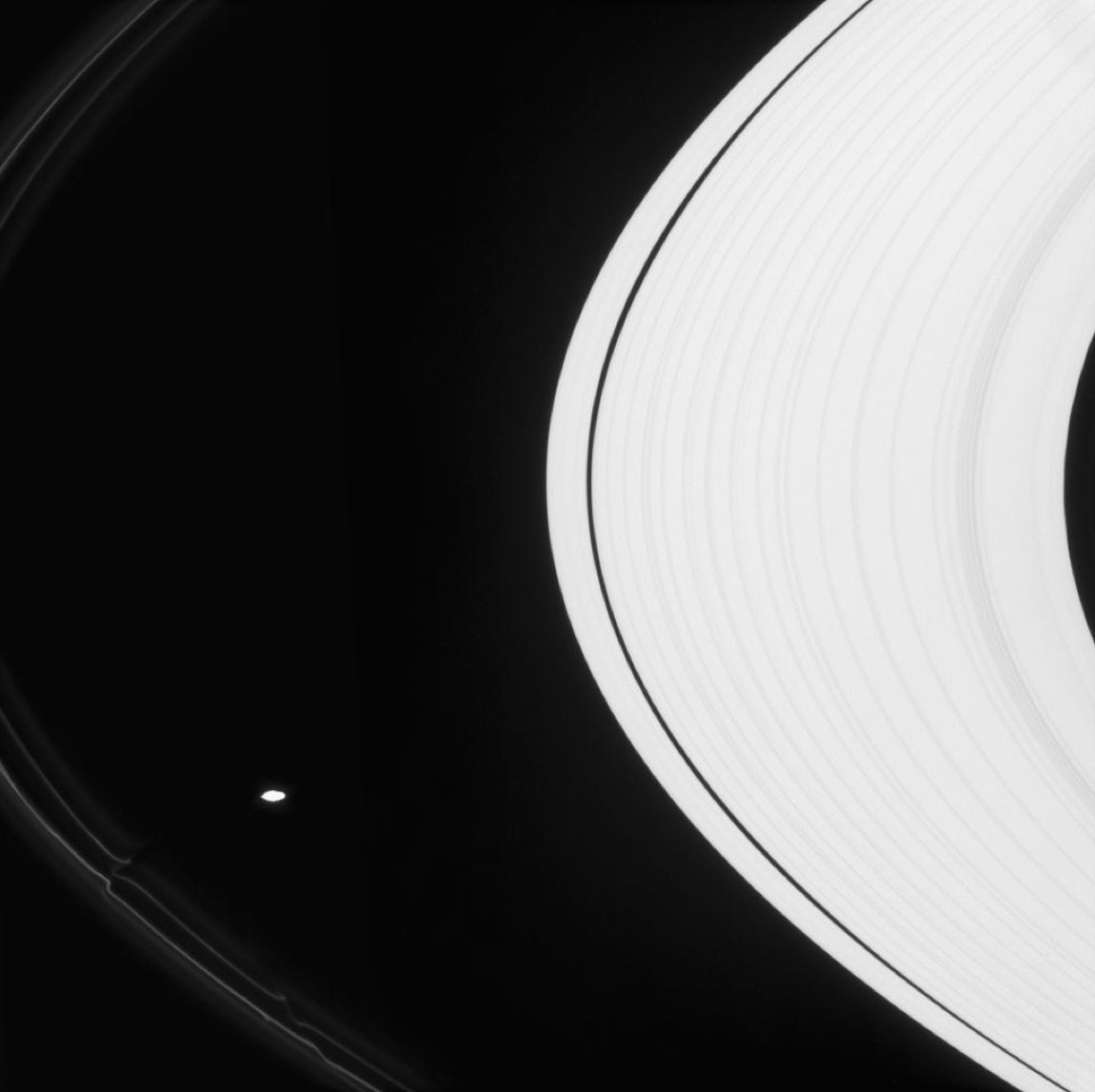
Prometheus earns its scientific importance largely through what it does to Saturn's narrow F Ring. It orbits just inside that ring, acting as a shepherd satellite that helps confine material along the ring's inner edge. Pandora orbits just outside the F Ring and was traditionally thought to serve as an outer shepherd in a tidy paired arrangement, but more recent studies have complicated that picture — indicating that only Prometheus genuinely contributes to the ring's confinement. Cassini spacecraft images revealed the mechanism in vivid detail: as Prometheus moves along its orbit, its gravitational pull periodically reaches into the F Ring and draws streamers of material outward, then releases them, creating kinks and knots that ripple through the ring structure. This give-and-take between moon and ring is one of the most direct and visually dramatic examples anywhere in the solar system of a moon actively shaping a planetary ring.
05 A Chaotic Orbit Driven by Resonance Deeper
The orbit of Prometheus is not the well-behaved ellipse of a typical moon. It is classified as chaotic, and the culprit is a series of four 121:118 mean-motion resonances with Pandora. This resonance means that for every 121 orbits Prometheus completes, Pandora completes 118, and those near-synchronizations repeatedly nudge both moons out of predictable paths. The gravitational conversation reaches its loudest point approximately every 6.2 years, when the periapsis — the closest point in Pandora's orbit to Saturn — lines up with the apoapsis — the farthest point in Prometheus's orbit. At these moments the two moons approach to within approximately 1,400 km of each other, close enough for meaningful gravitational kicks that alter both trajectories. Prometheus also perturbs the smaller moon Atlas through a 53:54 mean-longitude resonance, and it participates in a 17:15 mean-motion resonance with Epimetheus, but only during the period when Prometheus is on the outer orbit relative to Janus.
06 A Countdown to Catastrophe: 20 Million Years
The gravitational interactions that make Prometheus so scientifically interesting also carry a long-term consequence. Because Prometheus and Pandora continually exchange energy and angular momentum with Saturn's rings and with each other, their orbits are slowly evolving in ways that cannot be sustained indefinitely. Scientists calculate that within the next 20 million years, Prometheus and Pandora are expected to crash into each other or into the moon Mimas. Twenty million years sounds vast by human standards, but in geological and planetary terms it is a relatively brief window — roughly the time since the early Miocene epoch on Earth. When that collision eventually occurs, it will be a significant event in the Saturn system, potentially reshaping the ring environment and creating new debris fields from the wreckage of one or both moons.
 ⤢
07 Voyager Started It, Cassini Finished the Story
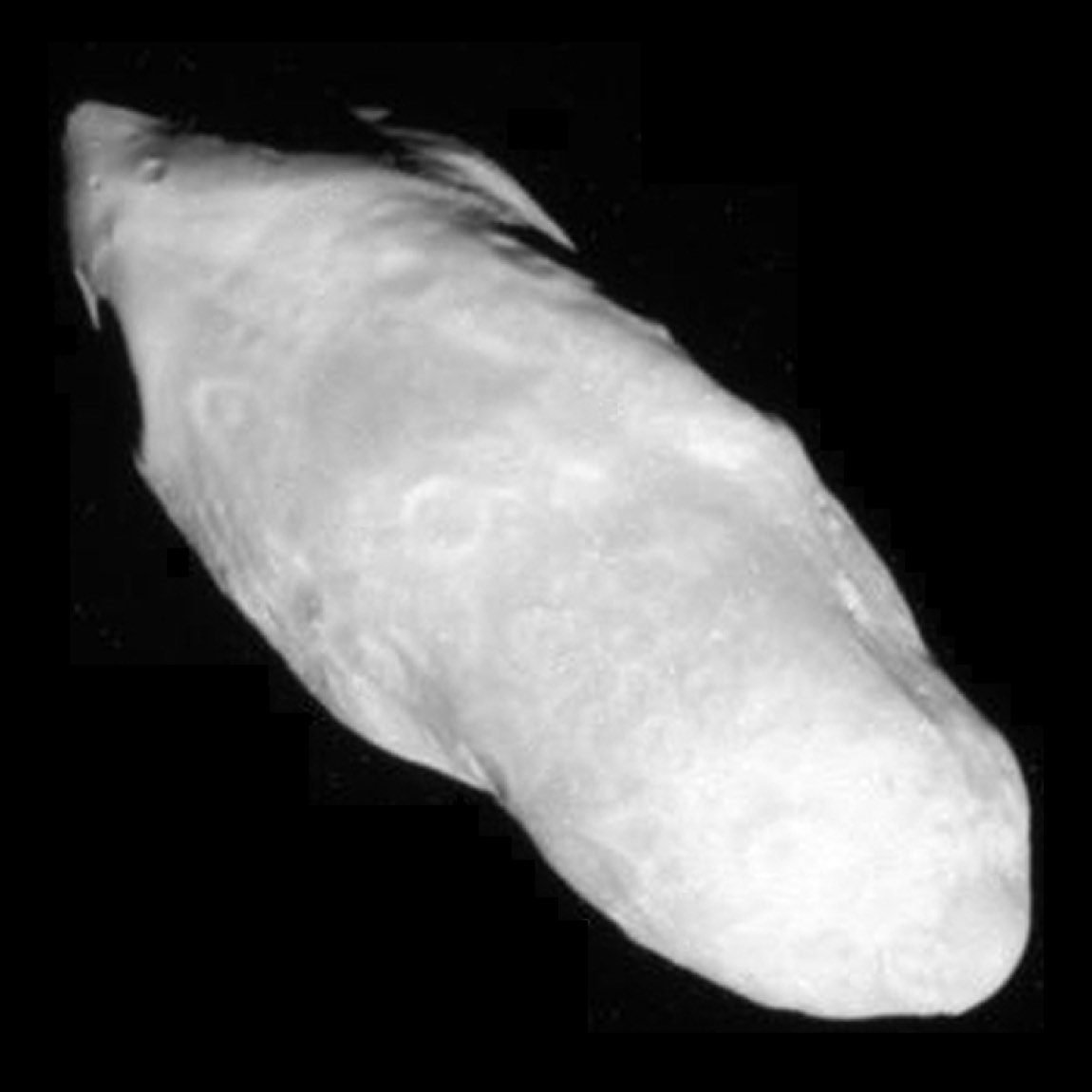
Prometheus's discovery by Voyager 1 in 1980 was only the opening chapter of its exploration. The images from that flyby were enough to identify the moon and reveal its basic elongated shape, but the resolution was limited. It was NASA's Cassini mission, which arrived at Saturn in 2004 and operated for over a decade, that brought Prometheus into genuine scientific focus. Cassini's cameras provided the detailed images that revealed the two distinct surface terrain types separated by scarps, documented the kinks and knots in the F Ring caused by Prometheus's gravity, and allowed researchers to track the moon's chaotic orbital behavior with enough precision to characterize the resonance structure with Pandora. Without Cassini, Prometheus would remain little more than a blurry, strangely shaped dot. The mission transformed it into a world with an interior structure, a geological history, and an active, ongoing relationship with the ring system around it.
08 Porous Ice: What Prometheus Is Made Of Deeper
Direct sampling of Prometheus is far beyond current technology, but the moon's physical properties offer indirect clues about its composition. Its very low density, combined with a relatively high albedo — meaning it reflects a substantial fraction of incoming sunlight — points strongly toward a composition dominated by ice rather than rock. More specifically, the low density suggests that Prometheus is not simply a solid block of ice but a highly porous structure, full of internal gaps and cavities. This kind of rubble-pile architecture, loosely bound by gravity with significant empty space inside, is consistent with the proposed formation scenario of multiple similarly sized bodies merging at low speed. A violent, high-energy collision would have compacted material and produced a denser body; the gentler assembly process instead produced something airier, structurally fragile by planetary standards, and highly elongated — matching exactly what we observe.
09 Its Name Carries a Mythological Weight
The name Prometheus was chosen to follow the convention established for Saturn's inner moons: they are named after figures from Greek and Roman mythology associated with Saturn and the Titans. Prometheus himself is one of the most compelling characters in Greek mythology — a Titan who defied the Olympian gods by stealing fire and giving it to humanity, and who was punished by being chained to a rock while an eagle ate his liver each day, only for it to regenerate overnight. The choice of such a culturally resonant name for what is, in physical terms, a small irregular chunk of porous ice reflects the tradition of treating even modest members of the solar system as worthy of mythological significance. The name was officially assigned in late 1985, five years after the moon's discovery, following the standard process of review and approval by the International Astronomical Union.
 ⤢
10 Open Questions About This Small World Deeper
Despite the data returned by Cassini, Prometheus leaves several genuine uncertainties on the table. The interpretation of one scarp as an exposed core section remains a hypothesis rather than a confirmed fact — the internal structure of the moon has never been measured directly, and the two-thirds estimate for the core's share of total volume rests on that interpretation. The exact mechanism by which Prometheus's elongated shape was locked in during formation is also not definitively resolved; the low-speed merger hypothesis is plausible but not proven. The long-term chaotic evolution of Prometheus's orbit means that precise predictions of its future path become increasingly unreliable over time, and the exact timeline of a potential collision with Pandora or Mimas carries inherent uncertainty. These open questions make Prometheus a genuinely unfinished scientific story, one that a future dedicated Saturn mission could meaningfully advance.