 Photograph · NASA · Public domain
Moon · Deep guide · orbits Saturn
Aegaeon
Also called: Saturn LIII · S/2008 S 1
A 1.4-km sliver of a moon buried inside the bright arc of Saturn's G ring.
What is it?
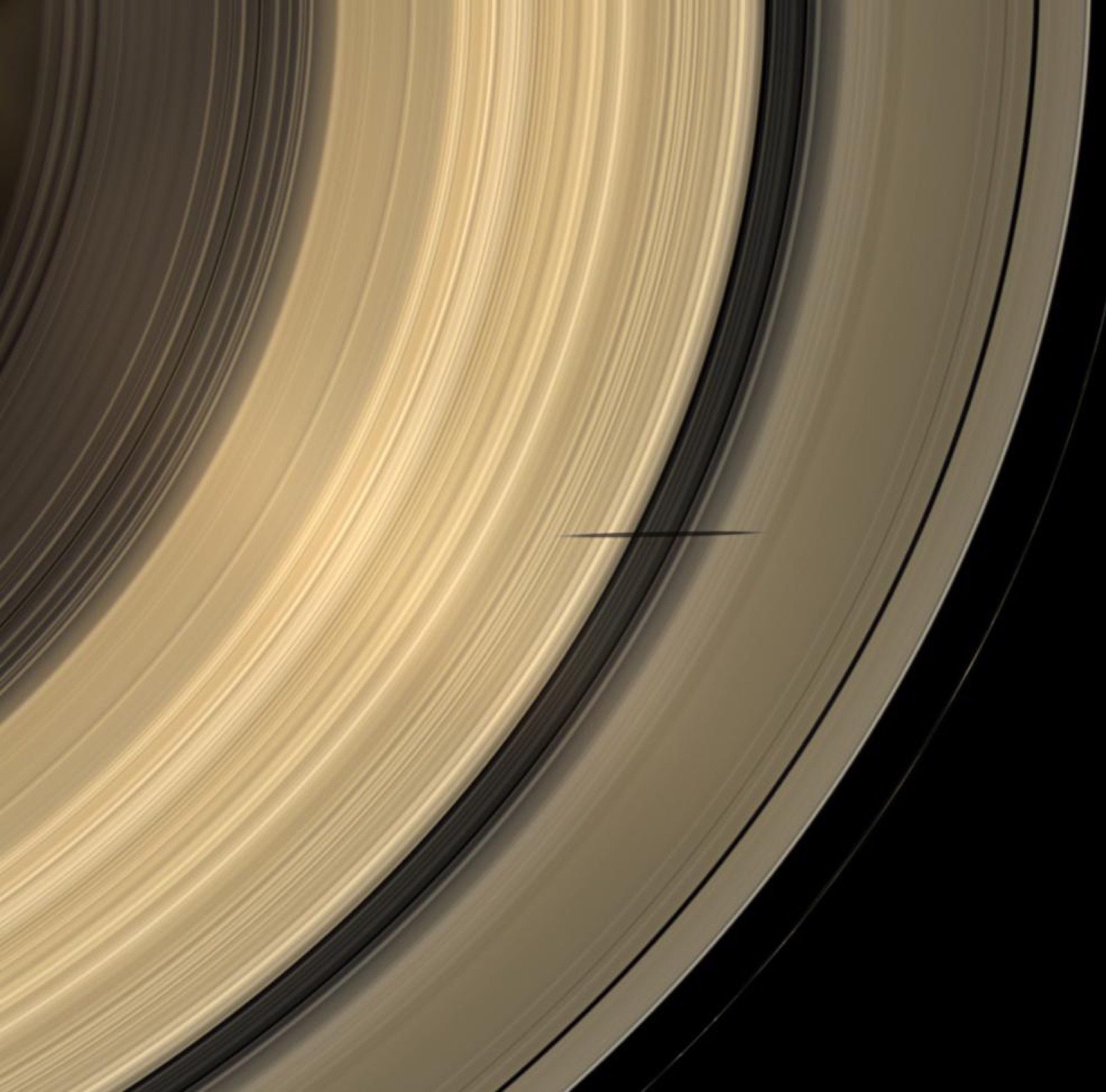
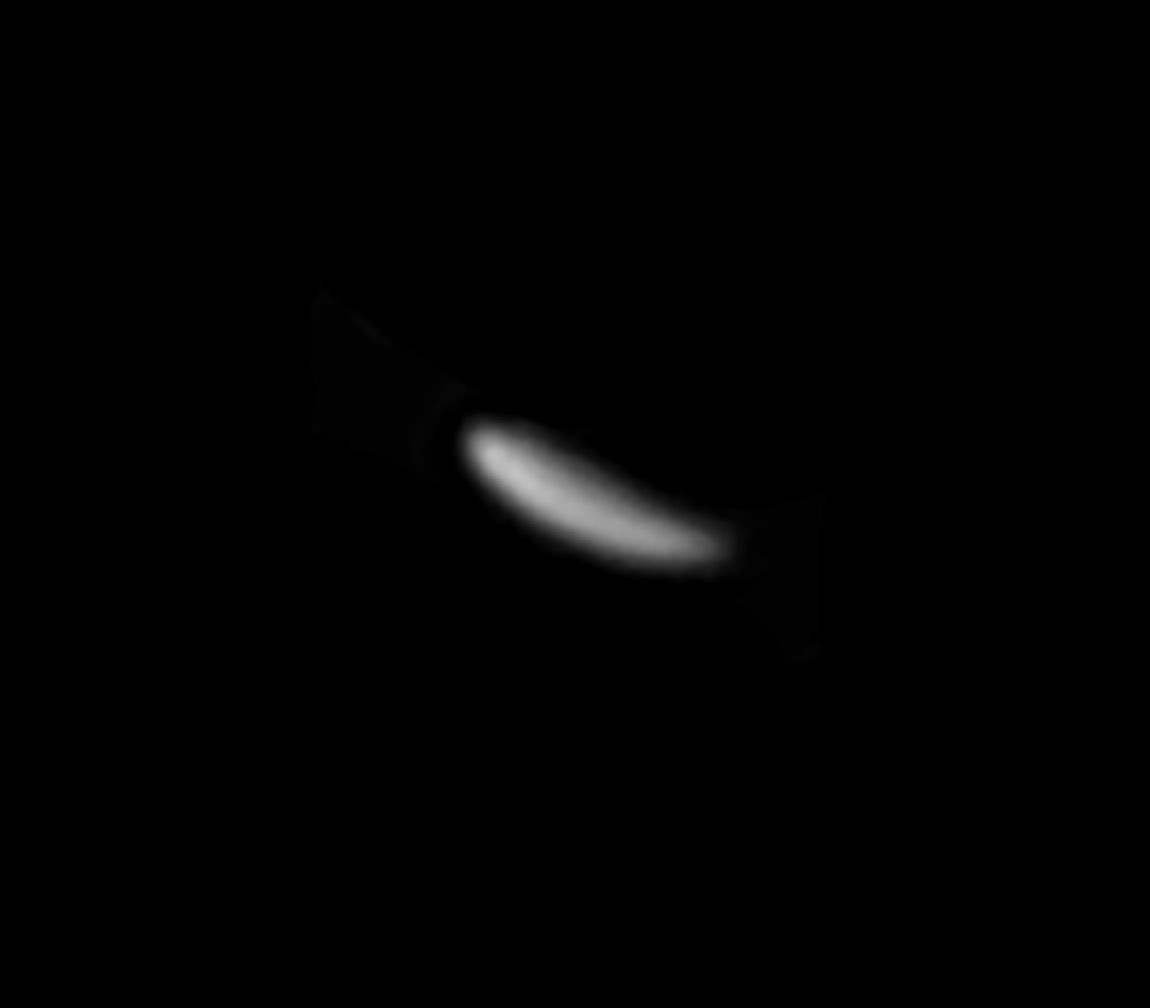
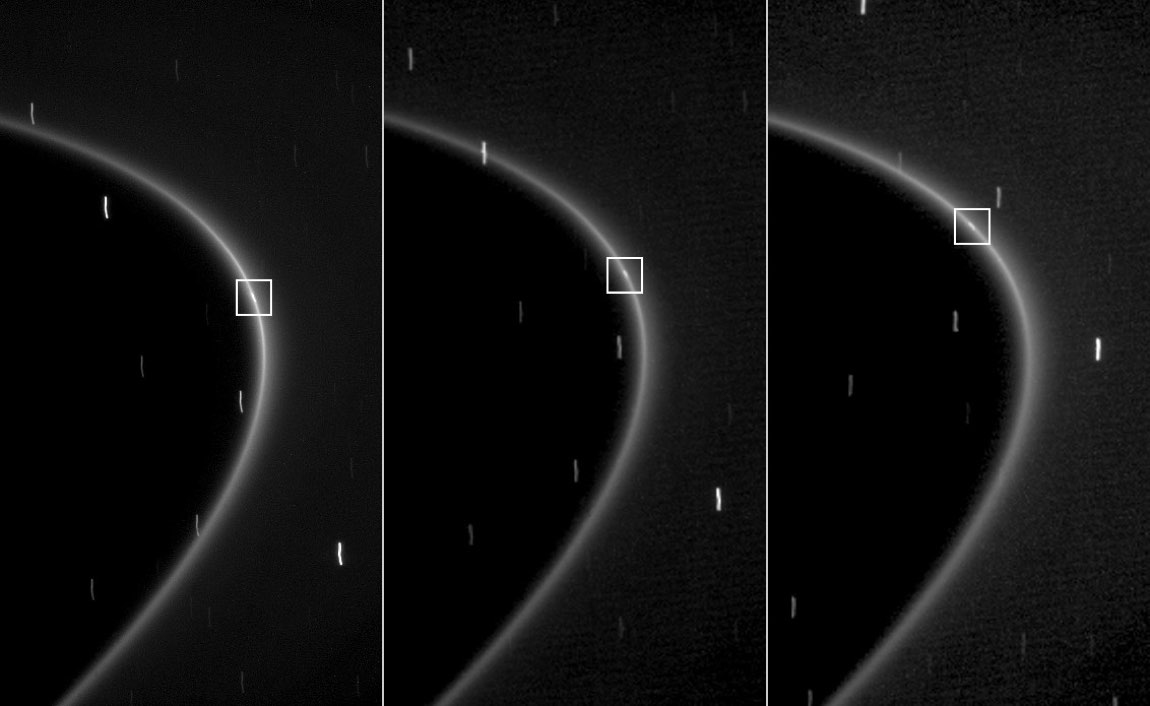
Aegaeon is a tiny, extremely elongated moon about 1.4 km long that orbits inside the bright arc of Saturn's G ring. Cassini photographed it in August 2008, and Carolyn Porco's imaging team announced it in March 2009. Debris knocked off Aegaeon by impacts forms the ring arc, which then spreads out to make the rest of the G ring. It is held in a 7:6 resonance with Mimas and is the smallest known Saturnian moon outside the main rings.
The deep dive
Researched for the Atlas from Wikipedia — Aegaeon (moon) (2,715 characters read) · updated Nov 14, 2026
01 The Tiniest Moon Beyond Saturn's Main Rings
Aegaeon holds a remarkable record: it is the smallest known moon of Saturn that orbits outside the planet's main ring system. Its dimensions have been measured at just 1.4 km × 0.5 km × 0.4 km — meaning its longest axis is barely longer than a typical city's downtown core. Despite that minuscule size, it qualifies as a moon in its own right rather than a ring particle, though the boundary between the two categories is genuinely blurry at this scale. For comparison, its two nearest relatives in character, Anthe and Methone, are also tiny, but Aegaeon is the smallest of that trio. Its extremely elongated shape — almost like a flattened grain of rice — sets it apart visually, though its surface is thought to be similarly smooth to Methone, suggesting that fine, loosely bound material coats the exterior rather than jagged crags.
02 A Paradox: Small Yet Rounded by Gravity Deeper
Ordinarily, objects as small as Aegaeon are expected to be lumpy and irregular, because self-gravity at that scale is usually too weak to pull material into a smoother equilibrium shape. Yet scientists believe Aegaeon has been rounded into something approaching hydrostatic equilibrium — the state where gravity and internal pressure balance each other out into a roughly regular form. The explanation proposed in the article is that Aegaeon likely has a somewhat low density combined with a highly porous, icy interior. A porous structure means the material can compact and settle more easily under even weak gravitational forces. This icy, sponge-like interior is consistent with the broader family of small Saturnian moons that formed from ring material or icy debris. It makes Aegaeon a scientifically interesting edge case: an object sitting right at the fuzzy border between a shaped moon and an oversized ring particle.
03 Why Aegaeon Is Surprisingly Dark
You might expect a small, icy moon to be bright and reflective, but Aegaeon is exceptionally dark, with an albedo of roughly 0.15. To put that in perspective, that figure is comparable to the dark side of Iapetus — Saturn's famously two-toned moon — which is itself one of the darker surfaces in the Saturnian system. Two competing explanations have been raised. The first is that darker meteoric material makes up the dust within the G Ring and coats Aegaeon's surface over time. The second is more dramatic: Aegaeon may have been disrupted at some point in its history, an event that stripped away its ice-rich outer layers and left the rockier, darker inner core exposed. Neither explanation has been definitively confirmed, and the question of what gives this tiny moon its surprisingly dull surface remains genuinely open.
04 Locked in a Resonance Tighter Than Its Neighbors Deeper
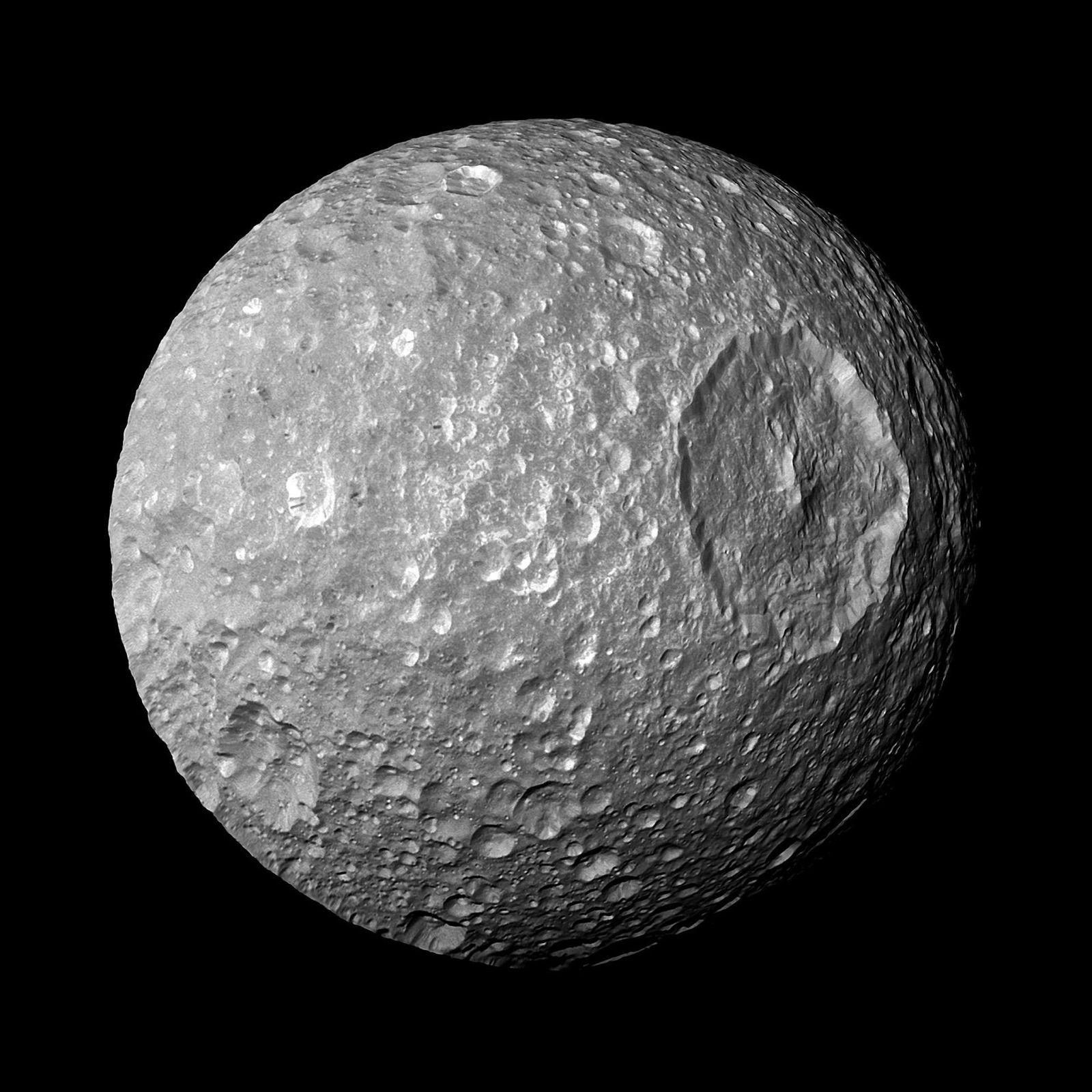
Aegaeon orbits Saturn in a 7:6 corotation eccentricity resonance with Mimas, meaning that for every 7 orbits Aegaeon completes, Mimas completes exactly 6. This gravitational handshake is not just a curiosity — it actively shapes Aegaeon's path. The resonance causes an oscillation of approximately 4 km in Aegaeon's semi-major axis over a cycle of about 4 years, along with a corresponding wobble of a few degrees in its mean longitude. What makes this especially notable is that two other small Saturnian moons, Anthe and Methone, are also in orbital resonances with Mimas, yet Aegaeon is described as more tightly trapped in its resonance than either of those two. This tighter gravitational grip has implications for how material is confined and distributed in the arc associated with Aegaeon, and it makes the moon a useful natural laboratory for studying resonance dynamics at small scales.
05 The Bright Arc and the Ring It Feeds
Aegaeon orbits within the bright segment of Saturn's G Ring, and scientists believe it is probably a major source of that ring's material. When micrometeoroids strike Aegaeon's surface, they blast debris free from its weak gravitational hold. That ejected material forms a bright arc near the inner edge of the G Ring. Over time, this arc spreads outward and gradually replenishes the rest of the ring. All three of the small resonant moons — Aegaeon, Anthe, and Methone — are associated with arc structures created the same way, but Aegaeon's arc is notably the brightest of the three despite Aegaeon itself being the smallest. This apparent contradiction likely reflects how efficiently the resonance concentrates material in the arc rather than allowing it to disperse, making the arc an indirect portrait of the resonance dynamics at work.
06 An Almost Perfectly Flat, Circular Orbit Deeper
Aegaeon travels around Saturn at an average distance of 167,500 km, completing one orbit in just 0.80812 days — less than 20 hours. That places it between the orbits of Janus and Mimas. What is striking is how orderly its orbit is: Aegaeon maintains an inclination of only 0.001° to Saturn's equatorial plane, which is essentially zero — it hugs the equator with extraordinary precision. Its orbital eccentricity is similarly tiny at just 0.0002, meaning its path is nearly a perfect circle. These near-zero values are consistent with an object that formed from, or has long been embedded within, ring material that itself occupies a flat, well-defined plane. The orbital resonance with Mimas introduces small but measurable oscillations into these values, but the overall picture is of an exceptionally disciplined, well-confined orbit.
07 Discovery From Half a Billion Kilometers Away
Aegaeon was spotted in images taken by the Cassini spacecraft on 15 August 2008, though the discovery was not publicly announced until 3 March 2009. The announcement came from Carolyn Porco of the Cassini Imaging Science Team, and the moon was initially given the provisional designation S/2008 S 1. Detecting an object measuring barely more than a kilometer across from a spacecraft orbiting Saturn — itself located hundreds of millions of kilometers from Earth — speaks to the remarkable precision of Cassini's imaging instruments. The moon was formally named Aegaeon on 5 May 2009, less than two months after the discovery announcement, an unusually swift naming in planetary science. The name comes from one of the Hekatonkheires, the hundred-handed giants of Greek mythology, continuing the tradition of naming small Saturnian moons after figures from that mythological family.
08 Cassini's Four Close Passes — and One Near Miss
The Cassini spacecraft completed four flybys of Aegaeon at distances closer than 20,000 km, though the discovery of the moon only came partway through that sequence. The closest of all pre-discovery encounters happened on 5 September 2005, when Cassini passed within 8,517 km — roughly the distance from New York to Tokyo — without anyone yet knowing what it had flown past. After the 2008 discovery and 2009 announcement, only one subsequent close flyby occurred. That encounter on 27 January 2010, at a distance of 13,306 km, produced Cassini's highest-resolution images of Aegaeon, giving scientists their clearest look at the moon's shape and surface properties. A planned close flyby on 19 December 2015 ended in disappointment: Cassini was unable to capture any images during that pass, leaving that observational opportunity unfulfilled.
09 What We Still Don't Know About Aegaeon Deeper
For all that Cassini revealed, Aegaeon remains poorly understood in several important respects. The source of its dark surface is unresolved, with both external contamination by ring dust and an ancient disruption that exposed a rocky core remaining as plausible but unconfirmed hypotheses. The interior structure — described as probably porous and icy — is inferred from the moon's overall behavior and shape rather than from direct measurement. The precise mechanism by which the orbital resonance with Mimas keeps Aegaeon so much more tightly confined than Anthe and Methone, despite all three being in similar resonant situations, is not fully explained. With Cassini's mission now ended and no successor Saturn orbiter currently scheduled, the data already in hand may represent the best observations of Aegaeon for a very long time, leaving these questions open for future missions or modeling work to address.
 ⤢