 Photograph · NASA / SETI / P. Jenniskens · Public domain
Meteorite · Deep guide
Almahata Sitta (asteroid 2008 TC3)
Also called: Almahata Sitta meteorite · Station Six
The first asteroid spotted before it hit Earth, its pieces collected from the Sudanese desert.
What is it?
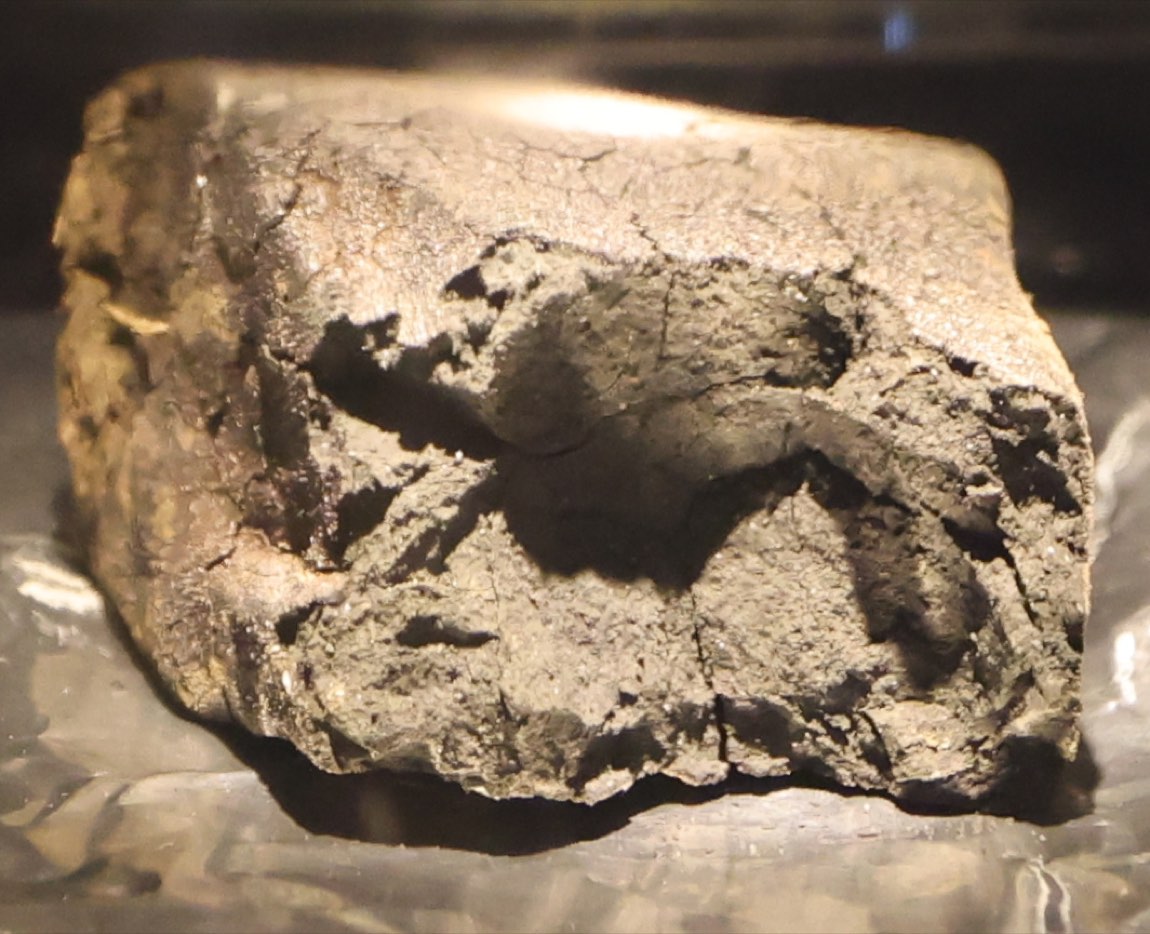
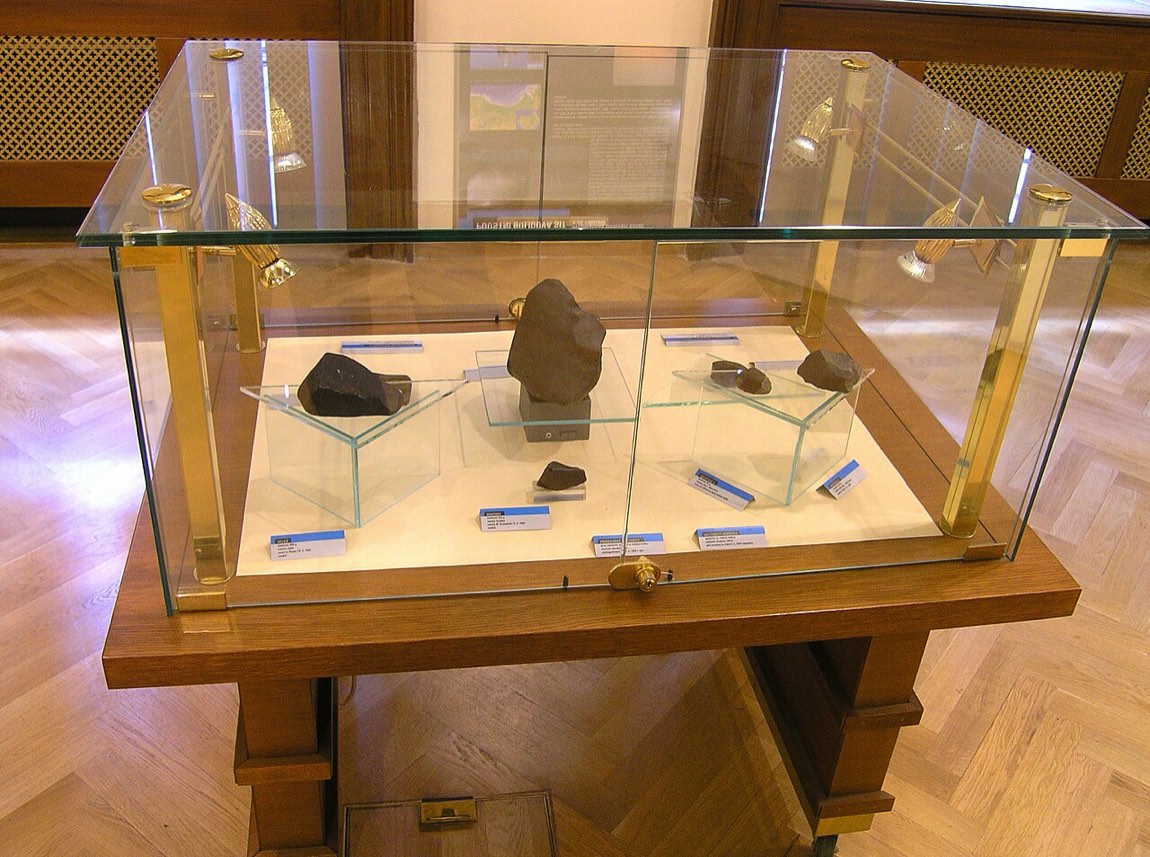
On 6 October 2008 the Catalina Sky Survey spotted a tiny asteroid, about 4 metres wide, just 20 hours before it struck. It was the first time an impact had been predicted ahead of time. Named 2008 TC3, it exploded about 37 km above the Nubian Desert in Sudan the next day. Searchers led by Peter Jenniskens and Muawia Shaddad later collected some 600 meteorites, about 10.5 kg in total, named Almahata Sitta after a railway station. Many are rare ureilites, a type containing tiny diamonds.
The deep dive
Researched for the Atlas from Wikipedia — 2008 TC3 (7,151 characters read) · updated Nov 15, 2026
01 A sky survey catches a falling rock in time
Richard A. Kowalski spotted 2008 TC3 on October 6, 2008, at 06:39:51 UTC using the Catalina Sky Survey's 1.5-meter telescope at Mount Lemmon, north of Tucson, Arizona. That left just 20 hours before impact — barely enough time to mount a global response. What followed was an extraordinary demonstration of Spaceguard, the loose international effort to detect near-Earth objects before they strike. In under 19 hours, 27 amateur and professional observers contributed 586 astrometric measurements and nearly as many photometric ones, all funneled to the Minor Planet Center. Working through the night, the Center issued 25 Minor Planet Electronic Circulars in eleven hours as the orbit solution sharpened with each new data point. The tracking window finally slammed shut at 01:49 UTC on October 7, when the asteroid entered Earth's shadow and vanished from every telescope on the planet. No earlier asteroid had ever been observed, tracked, and then successfully followed to impact — 2008 TC3 set that benchmark alone.
02 What the asteroid looked like from afar Deeper
While most of the world's attention focused on orbital calculations, a parallel effort tried to characterize the asteroid itself before it was gone forever. Photometric observations during those frantic 19 hours gave researchers information on the object's shape and rotation. Spectral observations were carried out at the 4.2-metre William Herschel Telescope on La Palma in the Canary Islands, and the results were ambiguous enough to be consistent with an F-type, C-type, or M-type asteroid — three fairly different categories. After the meteorites were recovered and analyzed in the laboratory, the spectral reflectance of the rocks was compared directly to those telescope readings. The match pinned 2008 TC3 as an F-type asteroid. It was the first time in history that a telescopic asteroid classification and a laboratory meteorite type had been directly, unambiguously linked for the same object. That single connection answered a question planetary scientists had debated for decades: what exactly do F-type asteroids look like up close, in the hand?
03 The fireball that lit up an entire region
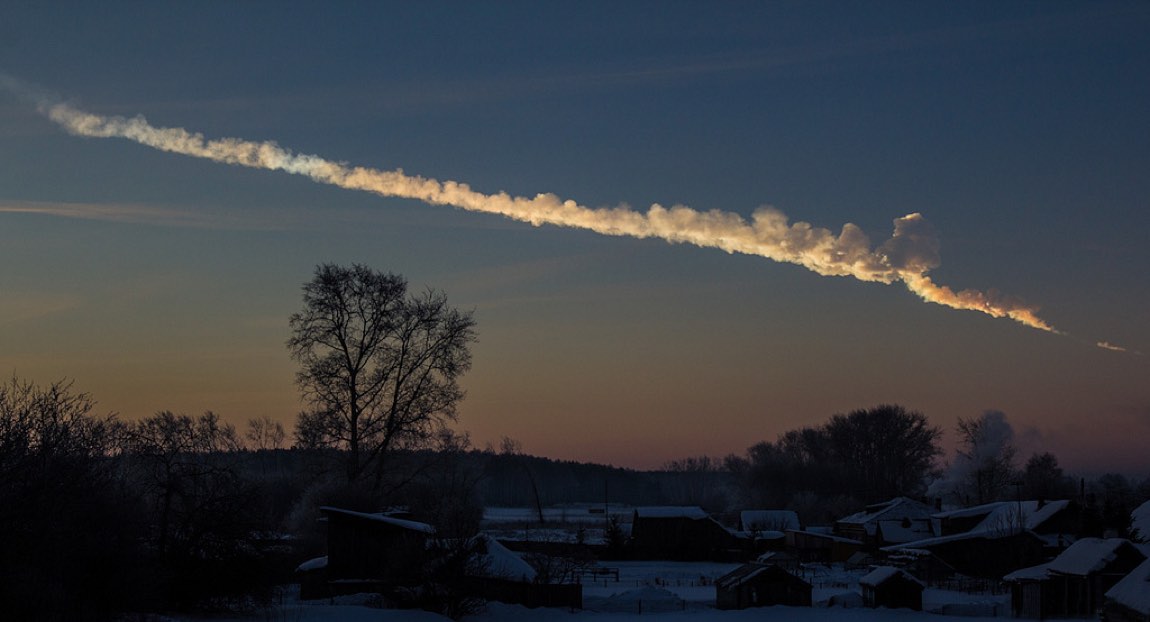
At 02:46 UTC on October 7, 2008 — 05:46 local time, before dawn — the meteor punched into the atmosphere above northern Sudan traveling at 12.8 kilometers per second, arriving at an azimuth of 281 degrees and an altitude angle of 19 degrees to the local horizon. It never reached the ground intact. At roughly 37 kilometers altitude, it exploded over the Nubian Desert with an energy estimated at between 0.9 and 2.1 kilotons of TNT — comparable to a small nuclear weapon, though the blast was high above any inhabited area. The light was so intense that The Times reported it "lit up the sky like a full moon." Pilots aboard an airliner 1,400 kilometers away over Chad — who had been warned in advance — reported seeing three distinct bright flashes in rapid succession. A webcam 725 kilometers north at El-Gouna beach caught the flash lighting up the shore. The European weather satellite Meteosat 8 imaged the explosion from orbit, placing the fireball at approximately 21.00°N, 32.15°E. U.S. government satellites tracked the initial detection at 65.4 kilometers altitude, with the final explosion at 37 kilometers.
04 Sound waves confirmed the blast from Kenya Deeper
Beyond satellites and eyewitness accounts, the explosion left a physical signature that traveled thousands of kilometers through the air itself. Infrasound detector arrays in Kenya — specialized microphones tuned to frequencies far below the threshold of human hearing — picked up a sound wave arriving from the direction of the expected impact site. The energy calculated from that infrasound signal ranged from 1.1 to 2.1 kilotons of TNT, neatly consistent with the satellite-derived figure of 1 kiloton. Infrasound networks were originally developed to monitor clandestine nuclear tests under the Comprehensive Nuclear-Test-Ban Treaty, but they have proven equally useful for cataloguing natural bolides. The Kenya detection added an independent, ground-based confirmation of the event's energy, cross-validating the space-based measurements. The article notes that asteroids of the size of 2008 TC3 — roughly 4.1 meters in diameter and 80 tonnes — actually strike Earth about two or three times per year, though nearly all do so over ocean or uninhabited terrain without prior warning, making Almahata Sitta's documented arrival uniquely valuable for calibrating those estimates.
05 Finding the fragments: a desert grid search
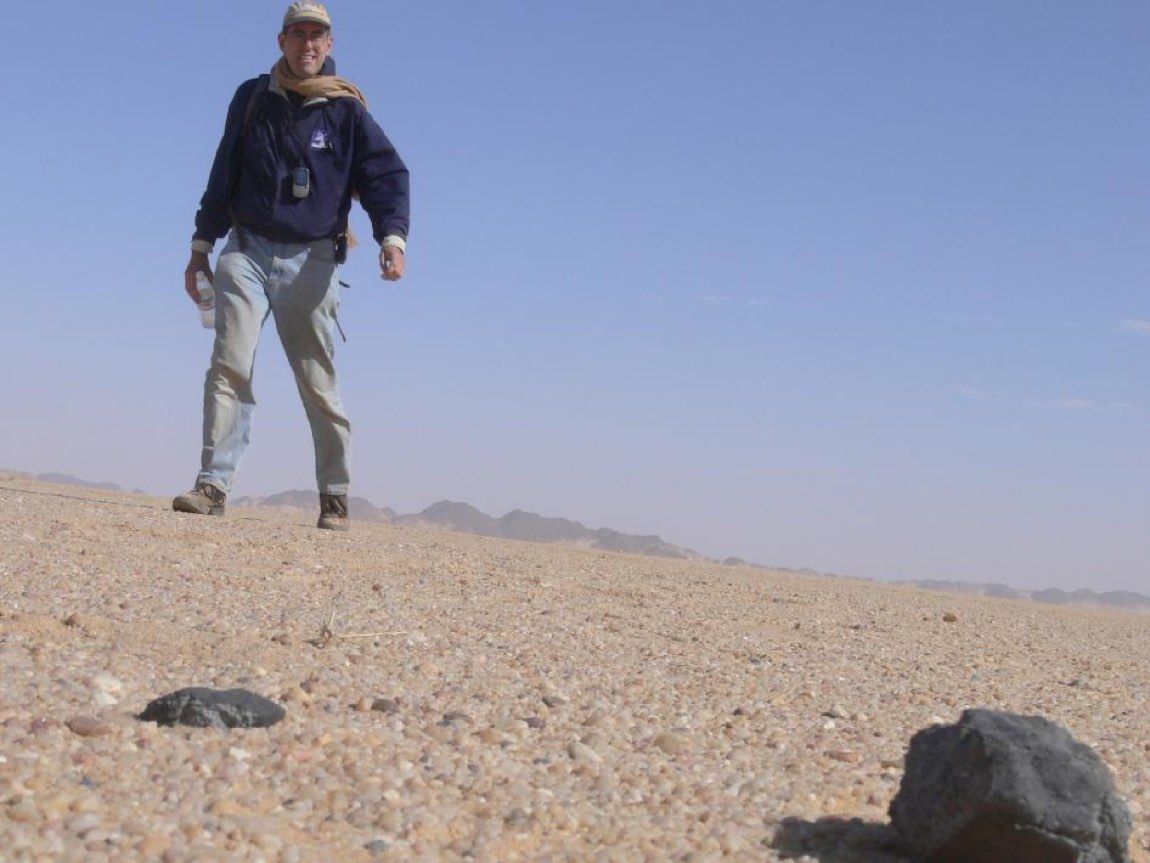
Two months after the impact, on December 6, 2008, a systematic search of the Nubian Desert began. It was led by Peter Jenniskens of the SETI Institute in California and Muawia Shaddad of the University of Khartoum, and carried out with 45 students and staff from the University of Khartoum. Within three days, the team had recovered 15 meteorites. The search was not a random walk — it was guided by a precise search grid and a target area calculated by NASA's Jet Propulsion Laboratory in Pasadena, California. Witnesses in the area were also interviewed to narrow the strewnfield. Follow-up expeditions in 2008 and 2009 expanded the effort to over a hundred students, eventually collecting 10.5 kilograms of rock spread across roughly 600 fragments. Those fragments were collectively named Almahata Sitta — Arabic for "Station Six," referring to a stop on the railway line running between Wadi Halfa and Khartoum, Sudan. The name anchors the meteorites geographically and historically to one of the most remote, sun-scorched landscapes on Earth. Richard Kowalski, who first spotted the asteroid, received a tiny fragment as a gift from colleagues on the Minor Planet Mailing List, an organization he himself had founded.
06 A single asteroid hiding twenty meteorite types Deeper
From the very first day of recovery, researchers noticed something strange: the meteorites did not all look alike. That observation proved to be the opening of a much larger surprise. Detailed studies through the Almahata Sitta Consortium eventually identified over 20 distinct meteorite types within the strewnfield, all confirmed to have fallen from 2008 TC3. The majority were various forms of ureilites, but the collection also contained enstatite chondrites, ordinary chondrites, carbonaceous chondrites, and several rare and unique meteorite types that defied easy categorization. Never before had a single observed meteorite fall been proven to deliver such a mixed assortment. The first sample formally analyzed was described as an anomalous ultra-fine-grained porous polymict ureilite achondrite with large carbonaceous grains — making Almahata Sitta the first observed polymict ureilite fall on record. The presence of fragile carbonaceous chondrites among the recovered pieces raised an important caveat: the violent atmospheric entry likely vaporized some of the most delicate material, meaning the rocks found on the ground may not fully represent what originally arrived. The consortium included NASA Ames, Johnson Space Center, the Carnegie Institution of Washington, and Fordham University.
07 Nanodiamonds and a vanished ancient planet Deeper
Among the minerals locked inside the ureilite fragments are nanodiamonds — microscopic crystals of carbon compressed into diamond structure. The pattern of their growth turned out to be scientifically provocative. Analysis showed the nanodiamonds had grown slowly, which researchers argued was more consistent with formation under sustained high pressure than with the kind of rapid shock compression produced by asteroid collisions. That slow growth, they suggested, pointed to an origin inside a planet-sized object — a body large enough to generate the internal pressures necessary for prolonged diamond crystallization. The implication was striking: 2008 TC3 may be a surviving fragment of a planet that existed in the early Solar System and was later destroyed. Those claims have since been challenged, and the debate remains open. Separately, a December 2020 study reported the discovery in fragment AhS 202 of an extremely rare form of hydrated crystals called amphibole. The researchers interpreted this as evidence that 2008 TC3 originally belonged to a very large Ceres-class dwarf planet with an estimated diameter of roughly 640 to 1,800 kilometers — a body comparable in scale to the largest objects in the asteroid belt today.
08 Ureilites: the meteorite class at center stage
The dominant meteorite type in the Almahata Sitta collection is the ureilite, a rare category of achondrite — meaning a stony meteorite that formed in a body that experienced melting and differentiation, unlike the more primitive chondrites. Ureilites are notable for their carbon content, which appears in several forms including graphite and those scientifically contested nanodiamonds. They are thought to originate from a parent body that was disrupted, possibly by a collision, early in Solar System history. Almahata Sitta gave scientists far more ureilite material in a single, well-documented context than had ever been available before. Because the asteroid's pre-impact orbit was tracked telescopically and the meteorites were recovered from a precisely mapped strewnfield, researchers could connect the ureilite parent body to a specific asteroid spectral class — the F-type — for the first time. The sheer variety of ureilite subtypes within those 600 fragments also revealed new information about the internal structure and compositional heterogeneity of the ureilite parent body, treating it less as a uniform object and more as a geologically complex world that once existed and was then broken apart.
09 Impact predictions: two systems, one target Deeper
Turning a fresh set of telescope observations into a reliable impact warning required automated computational muscle, and two separate systems rose to the challenge in parallel. The University of Pisa's CLOMON 2 semi-automatic monitoring system was one, and NASA's Jet Propulsion Laboratory operated the other, called Sentry. Both independently processed the stream of astrometric data as it arrived and converged on essentially the same conclusion: 2008 TC3 would strike Earth. The projected trajectory placed the intersection with Earth's surface at roughly 20.3°N, 33.5°E, though the object was expected to break apart approximately 100 to 200 kilometers west of that point as it descended through the thickening atmosphere, landing somewhat east of the Nile River and about 100 kilometers south of the Egypt–Sudan border. The fact that two independent systems, built by different institutions on different continents, reached compatible conclusions in real time validated the planet's emerging early-warning infrastructure at a moment when it had never been tested against an actual incoming impactor. The event demonstrated that the warning chain — from discovery telescope to orbital computation to ground alert — could function end-to-end within hours.
10 How common are impactors this small?
2008 TC3 measured about 4.1 meters in diameter and massed roughly 80 tonnes — small enough to fit inside a large living room, but fast enough at 12.8 kilometers per second to deliver the energy of nearly a kiloton of TNT when it disintegrated. The article notes that asteroids of this size strike Earth roughly two or three times per year. What made 2008 TC3 exceptional was not its frequency but its visibility: the overwhelming majority of similarly sized impactors arrive over ocean or uninhabited land, often at night, leaving no documented record beyond the occasional infrasound signal or satellite flash. Because this one was spotted 20 hours in advance, warned pilots and observers, generated a full observational record, and deposited recoverable meteorites in a desert, it became a uniquely complete data point for understanding how small asteroids behave during atmospheric entry. The gap between the 80-tonne incoming object and the 10.5 kilograms recovered on the ground — a loss of more than 99.98% of the original mass — illustrates how thoroughly the atmosphere ablates and fragments even a solid rock traveling at interplanetary speeds.
11 Open questions the fragments leave unanswered Deeper
Despite the richness of the Almahata Sitta dataset, several fundamental questions remain contested or unresolved. The origin of the nanodiamonds — whether they grew slowly inside a large planetary body or formed through shock processes — has been challenged since the initial claims and is not settled. The interpretation of the amphibole crystals in fragment AhS 202 as evidence for a Ceres-class parent body, reported in December 2020, represents a hypothesis rather than a confirmed finding. More broadly, the discovery that over 20 different meteorite types coexist within a single asteroid raises difficult questions about how such compositionally diverse material became bound together in one small object. Were these fragments from a single differentiated body that was shattered and reassembled as a rubble pile? Or does the mixture reflect a collision between multiple distinct parent bodies? The article also flags the concern that the most fragile incoming material — particularly some carbonaceous chondrites — may have been destroyed during entry, meaning the recovered sample set is incomplete by definition. What was lost in the atmosphere may carry information that no laboratory on Earth will ever examine.