 Photograph · Alex Alishevskikh · CC BY-SA 2.0
Meteorite · Deep guide
Chelyabinsk Meteor
Also called: Chelyabinsk meteorite · Chelyabinsk superbolide
A house-sized asteroid exploded over Russia in 2013, shattering windows across a city of a million people.
What is it?
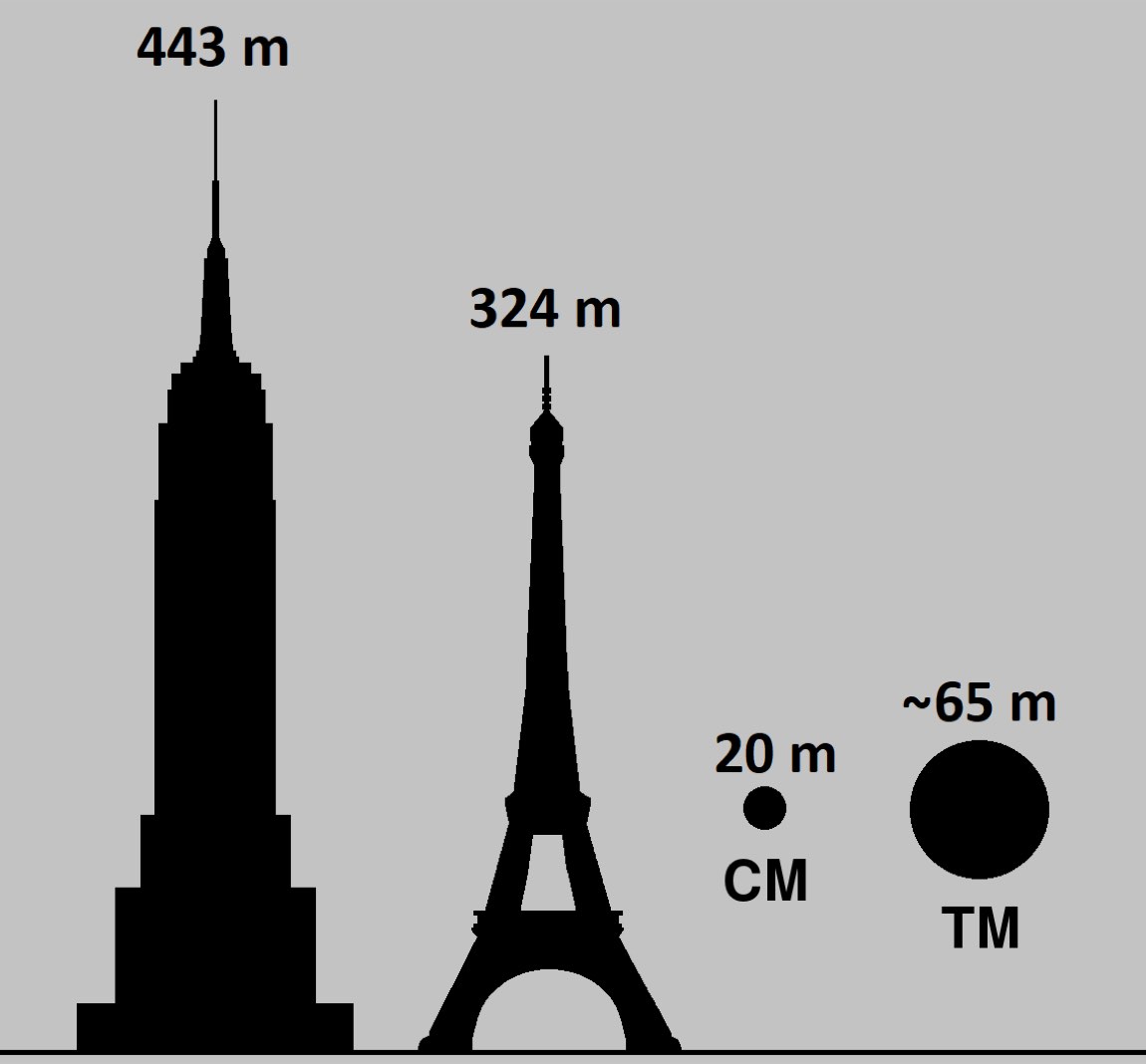
On 15 February 2013, an asteroid about 18 metres wide slammed into the atmosphere over the southern Urals at roughly 19 km/s. It exploded about 30 km up, briefly outshining the Sun, and released energy equal to 400–500 kilotons of TNT, around 30 times the Hiroshima bomb. The shock wave damaged more than 7,200 buildings and about 1,500 people needed medical help, mostly from flying glass. Many small stones fell west of Chelyabinsk, and a 654 kg piece was later lifted from Lake Chebarkul. It was the largest object to hit the atmosphere since Tunguska.
The deep dive
Researched for the Atlas from Wikipedia — Chelyabinsk meteor (25,332 characters read) · updated Nov 15, 2026
01 How the Shockwave Actually Hurt People
Almost every one of the 1,491 injuries recorded in the Chelyabinsk event came not from the meteor itself but from a mundane chain of physics: the airburst's shockwave arrived at ground level two minutes and twenty-three to two minutes and fifty-seven seconds after the blinding flash, long enough that many people had already rushed to their windows to look at the curious bright streak in the sky. When the overpressure wave struck, those windows exploded inward. The result was more than 180 cases of eye pain, 70 reports of temporary flash blindness, and 20 cases of ultraviolet burns similar to severe sunburn — the snow-covered ground likely intensified UV exposure by reflection. One person, a 52-year-old woman with a broken spine, had to be airlifted to Moscow. Vladimir Petrov, who met with scientists to assess the damage, reported that his skin later flaked from the sunburn he received. Among the remarkable human stories, teacher Yulia Karbysheva ordered her 44 students under their desks and away from windows; none of the children suffered cuts, though the blast severed a tendon in Karbysheva's arm and left thigh.
02 A Shockwave That Circled the Globe Deeper
The Chelyabinsk airburst did not just rattle windows in the Urals — its infrasound signature was detected by all 20 monitoring stations of the Comprehensive Test Ban Treaty Organization (CTBTO) Preparatory Commission, a network built specifically to catch clandestine nuclear weapons tests. One station that registered the signal sits in Antarctica, roughly 15,000 kilometres (9,300 miles) from the blast site. More remarkably, the explosion generated infrasound returns after the waves had circled the entire globe, travelling cumulative distances of up to about 85,000 kilometres (53,000 miles), and multiple arrivals from waves that had completed two full laps of the Earth were identified. The reverberations took more than a day to dissipate. This made it the largest infrasound event ever recorded by the CTBTO system since monitoring began in 2001 — a record that stood until the 2022 Hunga Tonga–Hunga Ha'apai volcanic eruption and tsunami. The analysis was also aided by US military infrasound data, made available to civilian scientists under an agreement implemented only about a month before the Chelyabinsk event.
03 Why the Yield Estimate Is So Uncertain Deeper
Calculating how much energy the Chelyabinsk meteor released turns out to be genuinely difficult. Peter Brown of the University of Western Ontario used infrasound records and period-yield scaling to arrive at a best estimate of 460–470 kilotonnes of TNT (1,900–2,000 terajoules), while NASA cited roughly 500 kilotonnes. Boris Shustov of the Russian Academy of Sciences Institute of Astronomy put his preliminary figure at 200 kilotonnes. A 2013 paper explicitly flagged that all 500-kilotonne estimates carry an uncertainty of a factor of two because calibration data at those high energies and altitudes are lacking. At the extreme end, some studies have suggested the explosion could have been as powerful as 57 megatonnes of TNT — which would exceed the estimated Tunguska yield and approach that of the Tsar Bomba. The seismic wave produced when the blast struck the ground gives a separate best estimate of 430 kilotons, also flagged as uncertain. Brown's team also demonstrated that the standard nuclear-weapons damage formulas, drawn from the book "The Effects of Nuclear Weapons," systematically overestimate blast damage from meteor airbursts because they ignore the impactor's rapid directional momentum, which concentrates the blast and thermal pulse at the ground surface more intensely than a stationary explosion at the same altitude would.
04 The Double Smoke Plume's Mushroom Secret
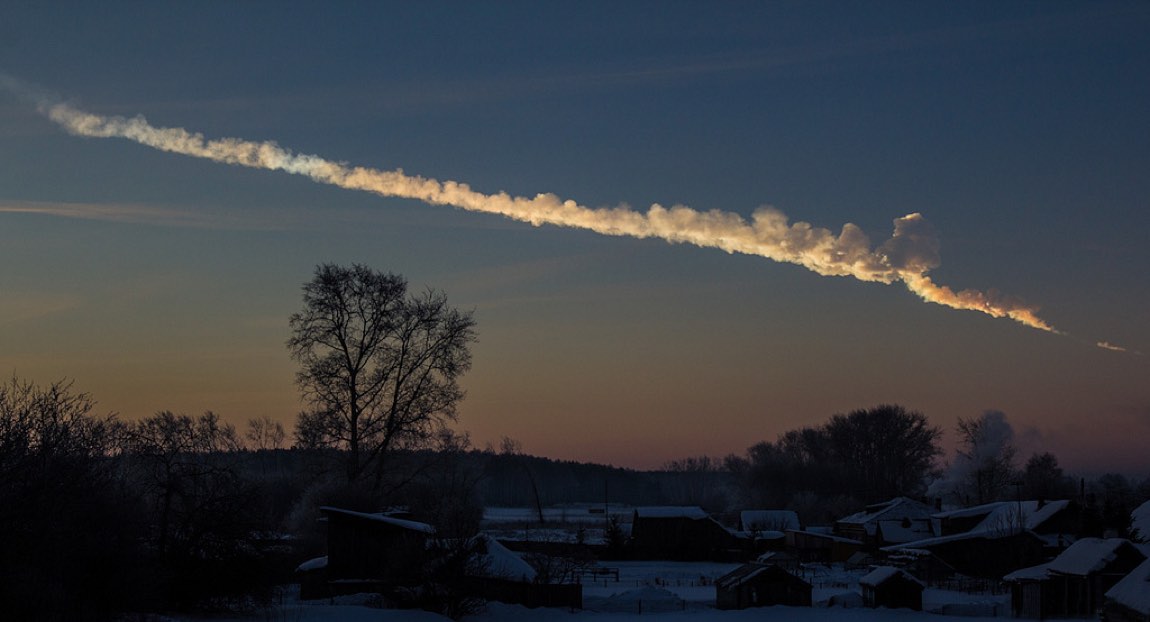
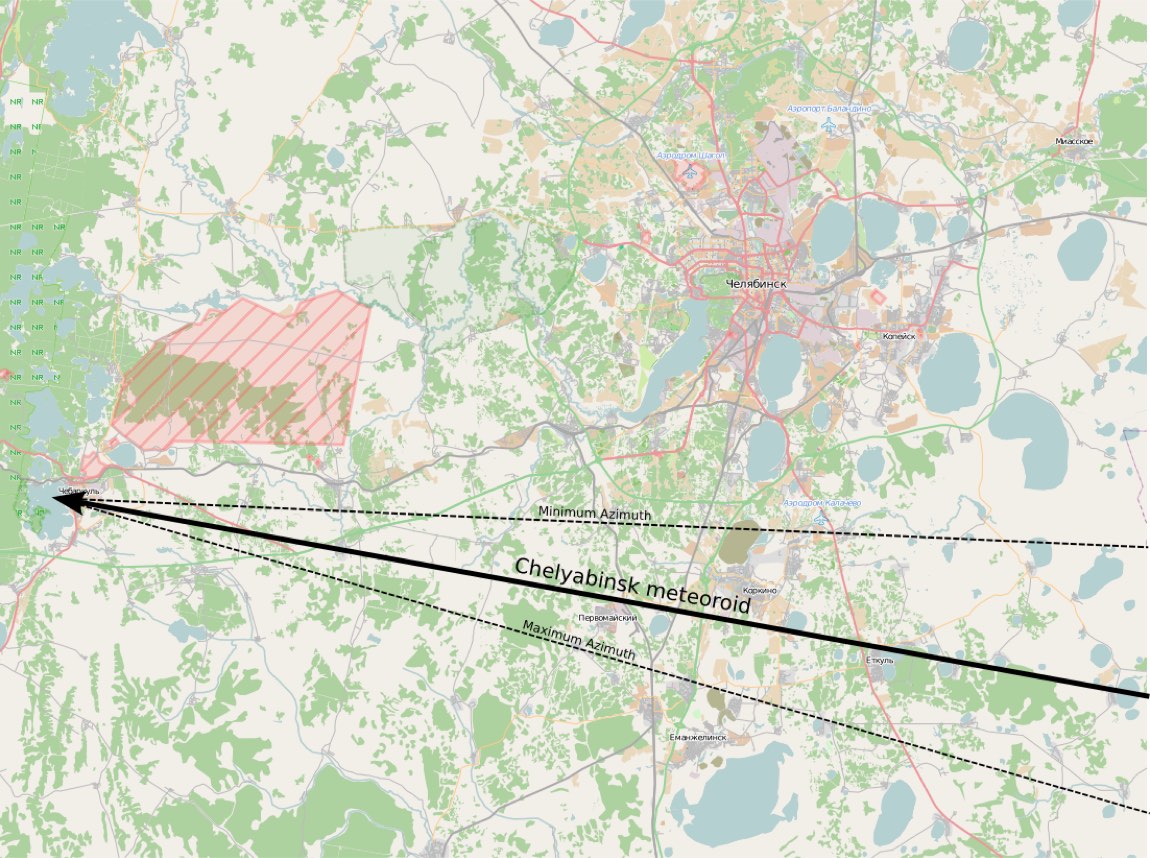
Photographs taken in the minutes after the airburst showed a striking double smoke trail hanging over the Chelyabinsk region. Peter Brown's analysis links this structure directly to where the most violent ablation of the meteoroid occurred. At that section of the trail, rising hot air rushed inward toward the low-pressure core of the dust column — essentially the same fluid dynamic that produces a mushroom cloud, but stretched into a moving, three-dimensional version as the object hurtled forward at nearly 60 times the speed of sound. Photographs captured before the trail split into two plumes show the intermediate cigar-shaped region glowing incandescently for a few seconds: this is the zone of maximum material loss, where the meteoroid was shedding mass most rapidly. The double plume then persisted for a time before appearing to rejoin or close up. A visually similar double-plume structure was also observed following the Tagish Lake fireball, suggesting it is a recognisable signature of a major meteoroid disruption event rather than a local atmospheric quirk.
 ⤢
05 What the Meteorites Are Made Of
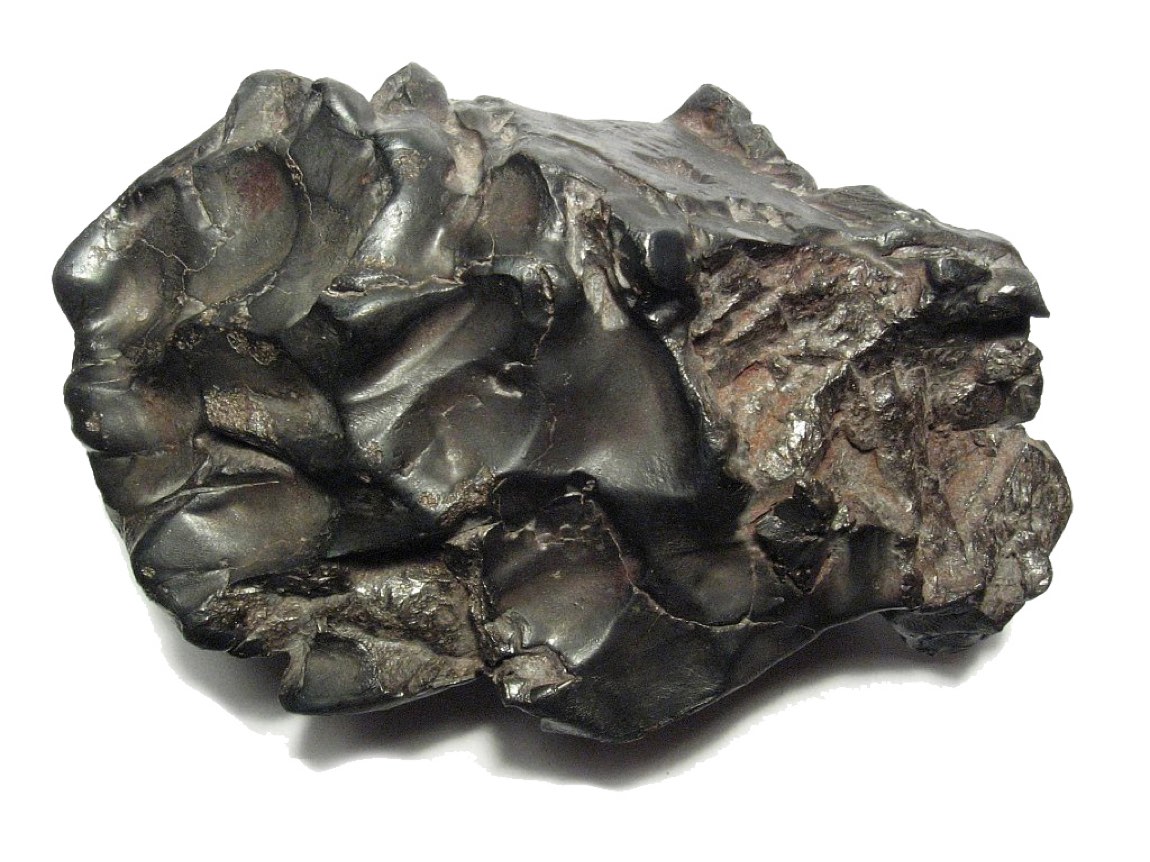
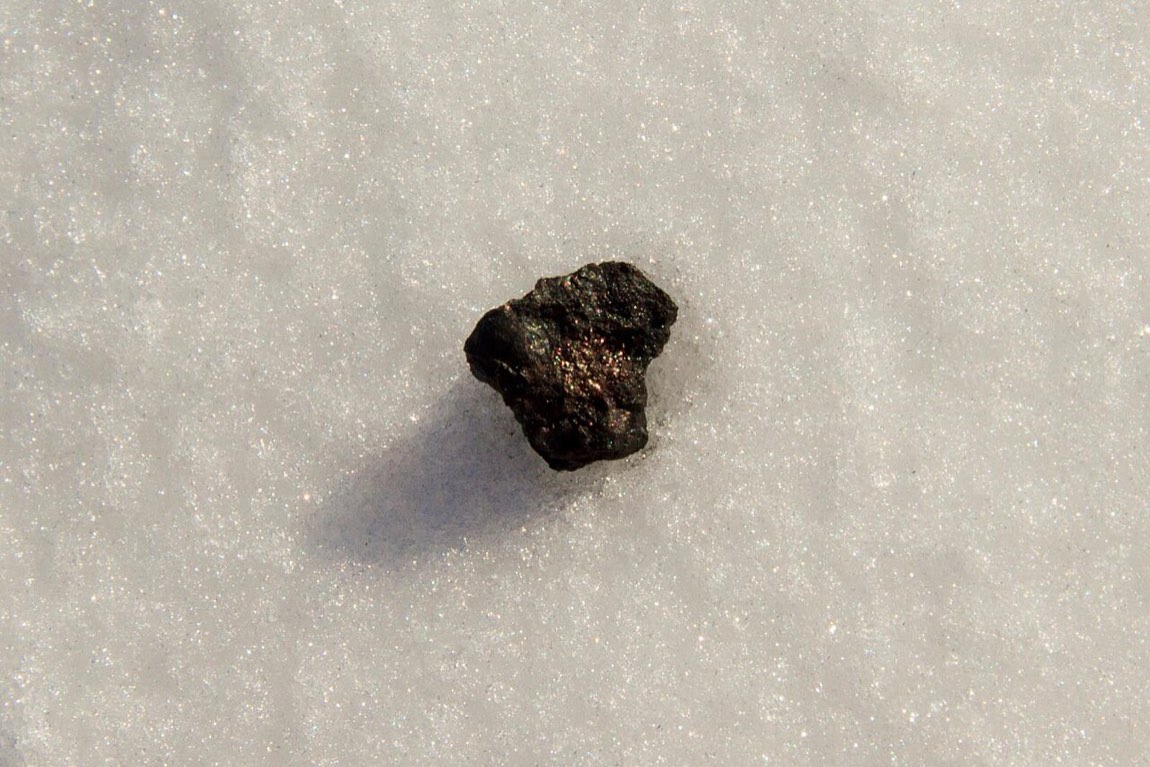
The fragments that survived the Chelyabinsk airburst and reached the ground are classified as LL5 chondrites with a shock stage of S4 — placing them in a family of stony meteorites relatively low in both total iron and metallic iron. The recovered specimens contain about 10 percent iron and display a variable appearance ranging between light and dark types. The dark veins running through many samples are regions of black material that experienced high-pressure shock and were once partly melted, testament to a violent collision somewhere in the asteroid belt long before 2013. The chondrules — tiny, ancient spherical grains embedded in the rock — show metamorphic changes consistent with the original body having been buried several kilometres below the surface of a much larger parent asteroid. During atmospheric entry, petrographic analysis allowed scientists to estimate that the meteoroid's surface was heated to between 65 and 135 °C (149–275 °F). Scientists from the Ural Federal University collected 53 samples from around the Lake Chebarkul impact hole on the day it was discovered; every early specimen was less than 1 centimetre (3/8 inch) across.
06 Raising the Largest Fragment from a Lake
Part of the Chelyabinsk meteoroid punched straight through the ice of frozen Lake Chebarkul, leaving a 6-metre (20-foot) wide hole that was discovered within hours of the event. The impact itself was captured on a security camera — making it the first recorded video of a meteorite actually striking the ground — and analysis of the footage showed the fragment hit the ice at about 225 metres per second (810 km/h; 503 mph), or 64 percent of the speed of sound. In June 2013, magnetic imaging beneath the lake bed located a roughly 300-kilogram (660-pound) fragment buried in the mud. An operation lasting several weeks culminated on 16 October 2013 when the chunk was raised. It turned out to weigh 654 kilograms (1,442 pounds), making it the largest recovered fragment of the Chelyabinsk meteorite. The piece was so heavy that when it was placed on the scales to be weighed, it tipped them and broke apart into three pieces. Its retrieval was possible because scientists had calculated from the shadow-to-impact time difference in the security-camera footage exactly where to search.
07 The Meteor's Journey from the Asteroid Belt Deeper
Based on its entry direction and speed of approximately 19 kilometres per second (12 miles per second), the Chelyabinsk meteoroid is believed to have originated in the asteroid belt between Mars and Jupiter, most likely as a fragment of a larger LL chondrite body. The object belonged to the Apollo group of near-Earth asteroids and was roughly 40 days past its perihelion — its closest approach to the Sun — at the time of impact. Its aphelion, or farthest point from the Sun, lay in the asteroid belt. The prevailing model for how it escaped the belt involves orbital resonance with Jupiter, a gravitational mechanism that gradually stretches an object's orbit until its perihelion drops low enough to cross Earth's path. Analysis of the reconstructed orbit suggested similarities to the 2-kilometre-diameter asteroid (86039) 1999 NC43, raising the possibility that the two bodies were once part of the same larger object, though the timing of the impact cannot be fully reproduced by that orbit. Apollo asteroid 2011 EO40 has also been proposed as a candidate parent body.
08 Why Nobody Saw It Coming
The Chelyabinsk asteroid arrived completely undetected, and the reason is geometric: its radiant — the point in the sky from which it appeared to originate — was located in the constellation Pegasus close to the eastern horizon, in the direction of the rising Sun. Because the object was approaching roughly from the Sun's direction, it was lost in solar glare and simply impossible for ground-based optical surveys to spot in the days or weeks before impact. Neil deGrasse Tyson, director of the New York City planetarium, pointed out publicly that no program had ever attempted to find and catalogue every near-Earth object down to 15 metres (50 feet) in diameter — the approximate scale of the Chelyabinsk impactor. Existing survey efforts at the time aimed only at completing an inventory of objects 150 metres (490 feet) and larger. Even today, the Asteroid Terrestrial-impact Last Alert System could provide a day or so of warning for Chelyabinsk-class events, but only when the incoming object's radiant is not near the Sun — which is precisely the geometry that made this one invisible.
 ⤢
09 Scale of Building Damage Across Six Cities
The airburst's blast wave did not confine its destruction to Chelyabinsk itself. By 5 March 2013 — eighteen days after the event — authorities had tallied more than 7,200 damaged buildings across six cities in the region. That total included roughly 6,040 apartment blocks, 293 medical facilities, 718 schools and universities, 100 cultural organizations, and 43 sports facilities. Only about 1.5 percent of the damaged structures had not yet been repaired by that date. The Chelyabinsk Oblast governor estimated total damage to buildings at more than US$33 million. Emergency repairs were particularly urgent because residents were sheltering in apartments with no windows in temperatures of −15 °C (5 °F), and authorities identified protecting the city's district heating water pipes as the single most critical priority. Approximately 100,000 homeowners were affected. Among the damaged landmarks was the Traktor Ice Arena, home of Traktor Chelyabinsk of the Kontinental Hockey League, which was closed for inspection and disrupted several scheduled events including the team's postseason.
10 How Dashcams Became a Scientific Instrument
Russia's unusually high density of dashboard cameras — mounted in vehicles primarily as insurance fraud deterrents — unexpectedly gave scientists an extraordinary multi-angle record of the entire atmospheric entry. Analysts applied sophisticated techniques including the superposition of nighttime starfield images over recorded daytime footage from the same cameras, allowing the radiant point to be pinned against a known star background. Shadow vectors visible in several online videos provided additional geometric constraints. The result was a provenance trace placing the object as an Apollo asteroid arriving from the constellation Pegasus. A Russian Academy of Sciences field study revisited the camera sites weeks after the event, recalibrating the footage carefully enough to revise the peak brightness altitude upward from 23.3 kilometres (76,000 feet) to 29.7 kilometres (18.5 miles), with a systematic uncertainty of only ±0.7 kilometres (2,300 feet). The Nova documentary "Meteor Strike," broadcast on 27 March 2013, described the video archive and the scientific findings it enabled as "unprecedented." The Lake Chebarkul impact video, released by a security camera in November 2013, further provided the first-ever filmed record of a meteorite hitting the ground.
11 How Often Earth Gets Hit This Hard Deeper
Events involving an object roughly 20 metres (66 feet) across are estimated to occur approximately once every 60 years. The twentieth century offers only a handful of comparably energetic incidents: the 1908 Tunguska event over Siberia, and an event in 1963 off the coast of the Prince Edward Islands in the Indian Ocean — though the 1963 occurrence may not have been a meteor at all. Both of the confirmed twentieth-century events happened over unpopulated or remote areas, which is statistically unsurprising given how much of Earth's surface is ocean or sparsely inhabited land. Looking further back, the 1490 Qingyang event in China allegedly caused 10,000 deaths, though modern researchers are skeptical of that figure. The Chelyabinsk event is the only one in this frequency class confirmed to have caused a large number of injuries in a populated area. The article notes that the 1908 Tunguska blast would have been devastating if it had occurred over a densely populated region — a reminder that the rarity of these events does not make them negligible risks over civilizational timescales.
12 Planetary Defense Responses After the Strike
The Chelyabinsk event struck entirely without warning on the same day that a separate, larger asteroid — 367943 Duende, roughly 30 metres (100 feet) across — made a predicted and widely publicised close approach at 27,700 km (17,200 miles) from Earth about 16 hours later. Although the two objects were confirmed to have entirely different orbital trajectories and were unrelated, the coincidence amplified calls for action. Russian Prime Minister Dmitry Medvedev declared that the event proved the entire planet is vulnerable and that a spaceguard system is necessary. Deputy Prime Minister Dmitry Rogozin proposed an international program to alert countries to potentially hazardous extraterrestrial objects. On the day of the impact, the United Nations Office for Outer Space Affairs suggested investigating the creation of an "Action Team on Near-Earth Objects." Two scientists in California proposed directed-energy weapon technology as a potential asteroid deflection tool. NASA also brought the NEOWISE satellite out of hibernation for a second mission extension to scan for near-Earth objects, and later in 2013 began conducting annual asteroid impact simulation exercises.
 ⤢