Asteroid · Deep guide
2008 TC3
Also called: 2008 TC3 · 8TA9D69
The first asteroid spotted in space before it hit Earth — its pieces were later picked up in the Sudanese desert.
What is it?
2008 TC3 was a small asteroid about 4 m across that was discovered on 6 October 2008, only hours before it struck Earth's atmosphere. Astronomers correctly predicted where it would arrive, and it exploded about 37 km above the Nubian Desert in Sudan on 7 October. Searchers later recovered around 600 meteorites totalling about 10.5 kg, many of a rare type called ureilites that contain tiny diamonds. It was the first time an asteroid impact had been forecast in advance.
The deep dive
Researched for the Atlas from Wikipedia — 2008 TC3 (7,151 characters read) · updated Nov 14, 2026
01 Twenty Hours: The Race to Confirm an Impact
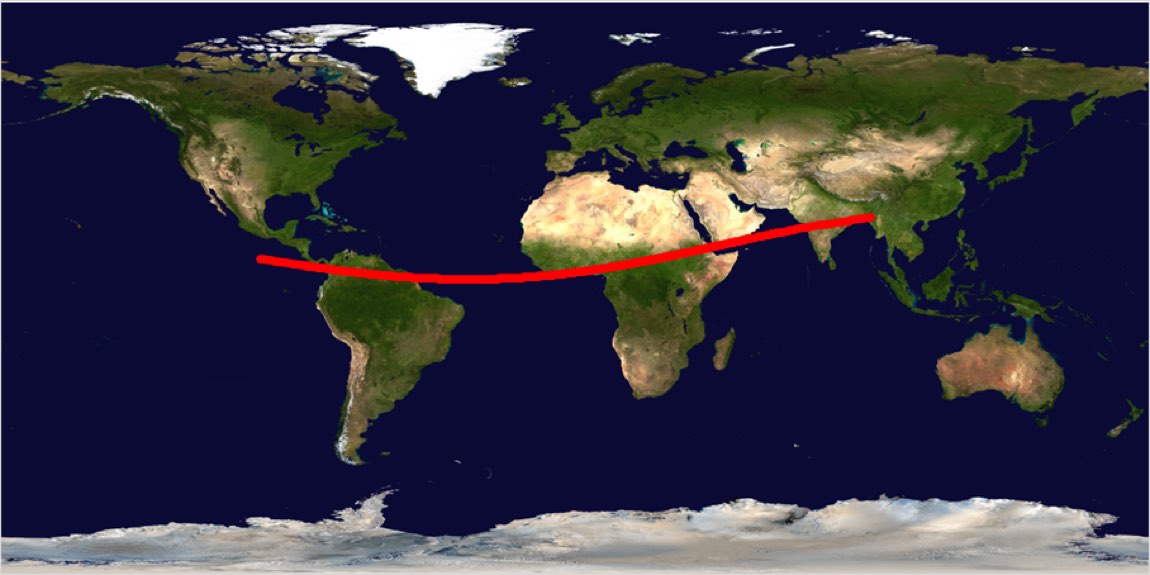
When Richard A. Kowalski spotted 2008 TC3 at 06:39:51 UTC on October 6, 2008, using the Catalina Sky Survey's 1.5-meter telescope at Mount Lemmon, north of Tucson, Arizona, the clock was already running. The object would strike Earth in fewer than twenty hours. What followed was an extraordinary sprint of international science: 27 amateur and professional observers performed 586 astrometric measurements and nearly as many photometric observations in less than 19 hours, all reported to the Minor Planet Center. That center processed the flood of data and issued 25 Minor Planet Electronic Circulars in just eleven hours as new orbit solutions kept arriving. Two independent impact-prediction systems, the University of Pisa's CLOMON 2 and NASA's Jet Propulsion Laboratory Sentry, both confirmed the collision course. By 01:49 UTC on October 7, the asteroid passed into Earth's shadow and further optical observations became impossible — but by then the trajectory was locked in, pointing to a remote stretch of Sudan's Nubian Desert.
02 How the Asteroid's Shape and Type Were Read Deeper
Even during the brief observation window, scientists squeezed out more than just an orbit. Photometric measurements — tracking how the asteroid's brightness varied over time — gave researchers information about its shape and spin. Spectral observations were obtained using the 4.2-metre William Herschel Telescope at La Palma in the Canary Islands, and those spectra were consistent with an F-type, C-type, or M-type asteroid classification. The ambiguity at that stage was real; distinguishing among those classes from a fast-moving point of light is genuinely difficult. The question was later resolved when the recovered meteorites were analyzed. Spectral reflectance measurements of the Almahata Sitta fragments matched the astronomical observations and pinned 2008 TC3 definitively as an F-type asteroid. That linkage — connecting a specific asteroid class observed in space to a specific meteorite type recovered on the ground — was achieved for the first time with this event, giving planetary scientists a concrete Rosetta Stone between telescopic classification and laboratory mineralogy.
03 The Fireball Seen Across a Continent
At 02:46 UTC on October 7, 2008 — 05:46 local time — the 80-tonne, 4.1-meter asteroid hit Earth's upper atmosphere above northern Sudan traveling at 12.8 kilometers per second. It arrived at an azimuth of 281 degrees and struck the atmosphere at an altitude angle of just 19 degrees to the local horizon, meaning it came in on a relatively shallow trajectory. The resulting explosion released energy estimated at between 0.9 and 2.1 kilotons of TNT; U.S. government satellites pinpointed the final blast at 37 kilometers altitude, calculating a total impact energy of 1 kiloton. The light was described by The Times as intense enough to illuminate the sky like a full moon. Pilots aboard an airliner flying over Chad, some 1,400 kilometers away, had been warned in advance and reported seeing three distinct bright flashes in rapid succession. A webcam at El-Gouna beach, 725 kilometers to the north, captured the flash, and the weather satellite Meteosat 8 recorded a low-resolution image of the explosion, placing the fireball at approximately 21.00°N, 32.15°E.
04 Infrasound: Listening to an Impact from Kenya Deeper
Beyond the visual drama, the explosion left an acoustic fingerprint that was detected by infrasound arrays in Kenya — microphone networks tuned to pick up very low-frequency pressure waves that travel enormous distances through the atmosphere. The Kenyan arrays recorded a signal arriving from the direction of the expected impact site, and analysis of that signal independently estimated the explosion's energy at between 1.1 and 2.1 kilotons of TNT. This range overlapped well with the energy estimates derived from U.S. government satellite data, lending confidence to both measurements. Infrasound monitoring of this kind is part of the global network originally designed to verify nuclear test ban treaties; its ability to characterize natural bolide events is a valuable secondary application. The fact that multiple independent sensing systems — ground-based optical observers, orbiting weather satellites, military satellites, and infrasound arrays on a different continent — all converged on consistent answers illustrated just how thoroughly this small but historic impact was documented.
05 Almahata Sitta: Finding the Pieces in the Desert
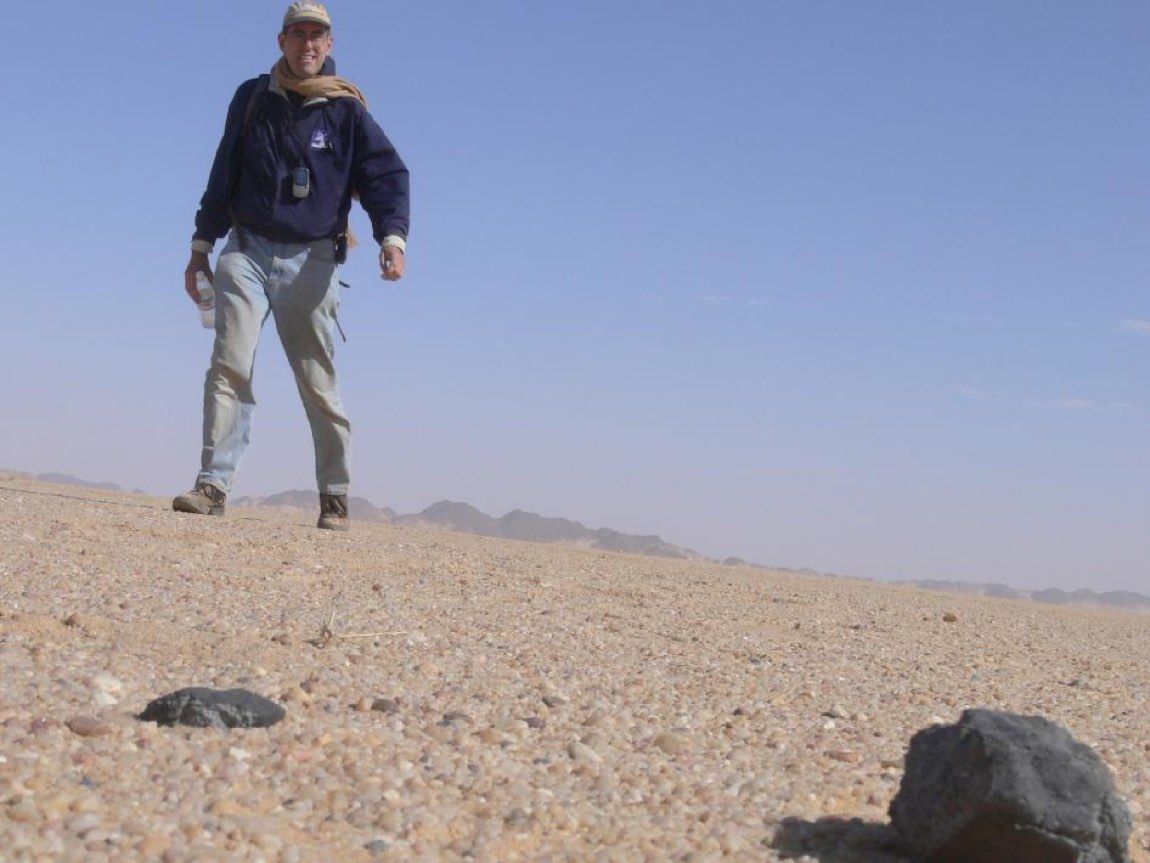
Recovery of the fragments did not begin immediately. A systematic ground search was organized and launched on December 6, 2008 — two months after impact — led by Peter Jenniskens of the SETI Institute in California and Muawia Shaddad of the University of Khartoum, with 45 students and staff from the university taking part. Within three days, 15 meteorites had been found. The recovery effort used a search grid and specific target area prepared by NASA's Jet Propulsion Laboratory in Pasadena. Follow-up searches through 2008 and 2009 brought in more than a hundred students and eventually yielded approximately 600 fragments totaling 10.5 kilograms of rock. The meteorites were collectively named Almahata Sitta, Arabic for 'Station Six,' after the railway station on the Wadi Halfa–Khartoum line nearest the strewnfield. Witness interviews also contributed to narrowing the search area. The name carries a quietly practical poetry: a celestial visitor identified by a station number on a desert rail line.
06 A Meteorite That Broke the Rules of Classification Deeper
The first sample analyzed was described as an anomalous ultra-fine-grained porous polymict ureilite achondrite containing large carbonaceous grains — a mouthful that signals genuine scientific surprise. Ureilites are rare meteorites to begin with, but Almahata Sitta is the first observed fall of a polymict ureilite, meaning it contains a mixture of different mineral compositions jumbled together. As recovery expanded, the surprise deepened: researchers eventually identified over 20 distinct meteorite types within the strewnfield. Most were various forms of ureilites, but the collection also included enstatite chondrites, ordinary chondrites, carbonaceous chondrites, and some rare and unique types that defied easy categorization. All of this variety fell from a single 4.1-meter object. The Almahata Sitta Consortium — involving NASA Ames, Johnson Space Center, the Carnegie Institution of Washington, and Fordham University — confirmed that a single parent body could carry such a heterogeneous cargo, overturning the simpler assumption that one asteroid should produce one meteorite type.
07 Nanodiamonds and a Lost Planet's Legacy Deeper
Among the minerals identified in the ureilite fragments were nanodiamonds — microscopic diamond crystals that form under extreme pressure. Studies of these nanodiamonds found that they had grown slowly, which researchers argued was inconsistent with the rapid shock processes that occur in asteroid collisions. Instead, the slow growth pattern suggested the diamonds formed under sustained high pressure inside a much larger body — something planet-sized — that existed earlier in Solar System history and was subsequently destroyed. This interpretation pointed to 2008 TC3 as a surviving fragment of an ancient, large body, potentially the ureilite parent body that planetary scientists have long sought. However, the article is explicit that those claims have since been challenged, and the origin of the nanodiamonds remains an open scientific question. The debate illustrates how a single small meteorite can sit at the center of large unresolved questions about the early Solar System's population of now-vanished worlds.
08 Amphibole Crystals and a Dwarf Planet Connection Deeper
In December 2020, more than a decade after the impact, further studies of the Almahata Sitta fragments produced another startling result. Researchers examining a fragment designated AhS 202 reported finding an extremely rare form of hydrated crystals known as amphibole. The significance lies in what amphibole requires to form: liquid water and sustained geological processing, conditions that are associated with large, internally heated bodies rather than small asteroids. The researchers interpreted this find as evidence that 2008 TC3 originally belonged to a very large Ceres-class dwarf planet estimated to have had a diameter of approximately 640 to 1,800 kilometers. If correct, the 4.1-meter rock that burned over Sudan in 2008 was a chip off a world that may have rivaled Ceres in size but no longer exists. Like the nanodiamond findings, this interpretation pushes the story of a small desert meteorite back billions of years, to a Solar System populated by bodies that left almost no other trace.
09 What Was Probably Left Out by Entry Deeper
One of the more sobering findings from the Almahata Sitta consortium concerns not what was found, but what was likely lost. The discovery of fragile carbonaceous chondrites among the recovered fragments — materials that are notoriously fragile and prone to destruction during atmospheric entry — was itself surprising. Combined with the observation that the asteroid deposited a prominent layer of dust in the atmosphere during entry, researchers raised a pointed question: does the 10.5 kilograms of recovered rock actually represent the original composition of 2008 TC3, or did the most fragile and perhaps scientifically interesting components simply vaporize before reaching the ground? The article notes that this possibility prompted alternative interpretations about the asteroid's true identity and composition. It is a recurring problem in meteoritics — the atmosphere acts as a filter, and what survives to be studied may be systematically different from what arrived. In this case, the filter may have erased portions of the record before anyone could read them.
10 Spaceguard's First Real-World Test
The network of telescopes and software systems designed to find threatening near-Earth objects — an effort sometimes called Spaceguard — had never before been tested by an actual incoming impactor that was detected in advance. With 2008 TC3, it got that test with almost no warning margin. The object was spotted just 20 hours before impact, and the system responded by mobilizing 27 observers across the globe, feeding data to the Minor Planet Center, running parallel orbital calculations at two separate institutions on two continents, and issuing 25 alert circulars in eleven hours. The predicted impact zone — roughly 20.3°N, 33.5°E — was refined to account for the expectation that the object would break up 100 to 200 kilometers west of that point as it descended. The prediction proved accurate. For planetary defense researchers, the event was proof of concept: the detection-to-warning pipeline worked, even when compressed to less than a day. For asteroids of this size, which strike Earth roughly two or three times per year according to the article, the value of that pipeline is real.
11 The Discoverer's Personal Fragment
Richard Kowalski, the astronomer who first detected 2008 TC3 at the Catalina Sky Survey telescope, received a small piece of the Almahata Sitta meteorite as a gift. It came from friends and well-wishers on the Minor Planet Mailing List — a community Kowalski himself had founded to help connect professional and amateur astronomers. There is a satisfying circularity to that detail: the man who built the communication network that helped accelerate the response to this historic impact was thanked with a fragment of the very object he found. The mailing list he created played a part in the rapid exchange of observations and orbital calculations that made the prediction possible, and the gift acknowledged both the discovery and the broader collaborative spirit it exemplified. Kowalski's fragment is one of approximately 600 pieces recovered from the Nubian Desert, together weighing 10.5 kilograms — a modest physical remnant of an event that reshaped how scientists think about asteroid detection, meteorite diversity, and the deep history of the Solar System.