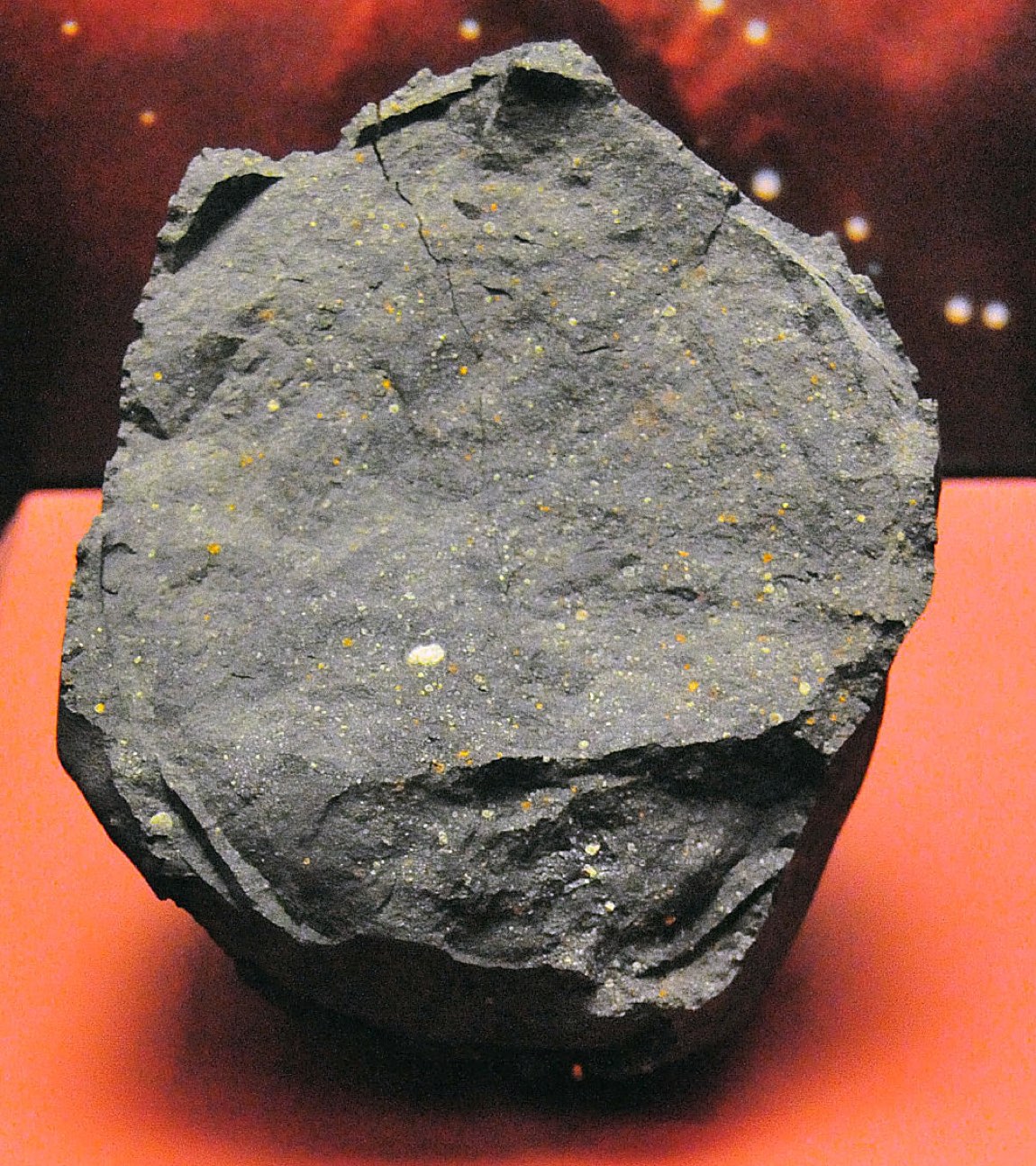
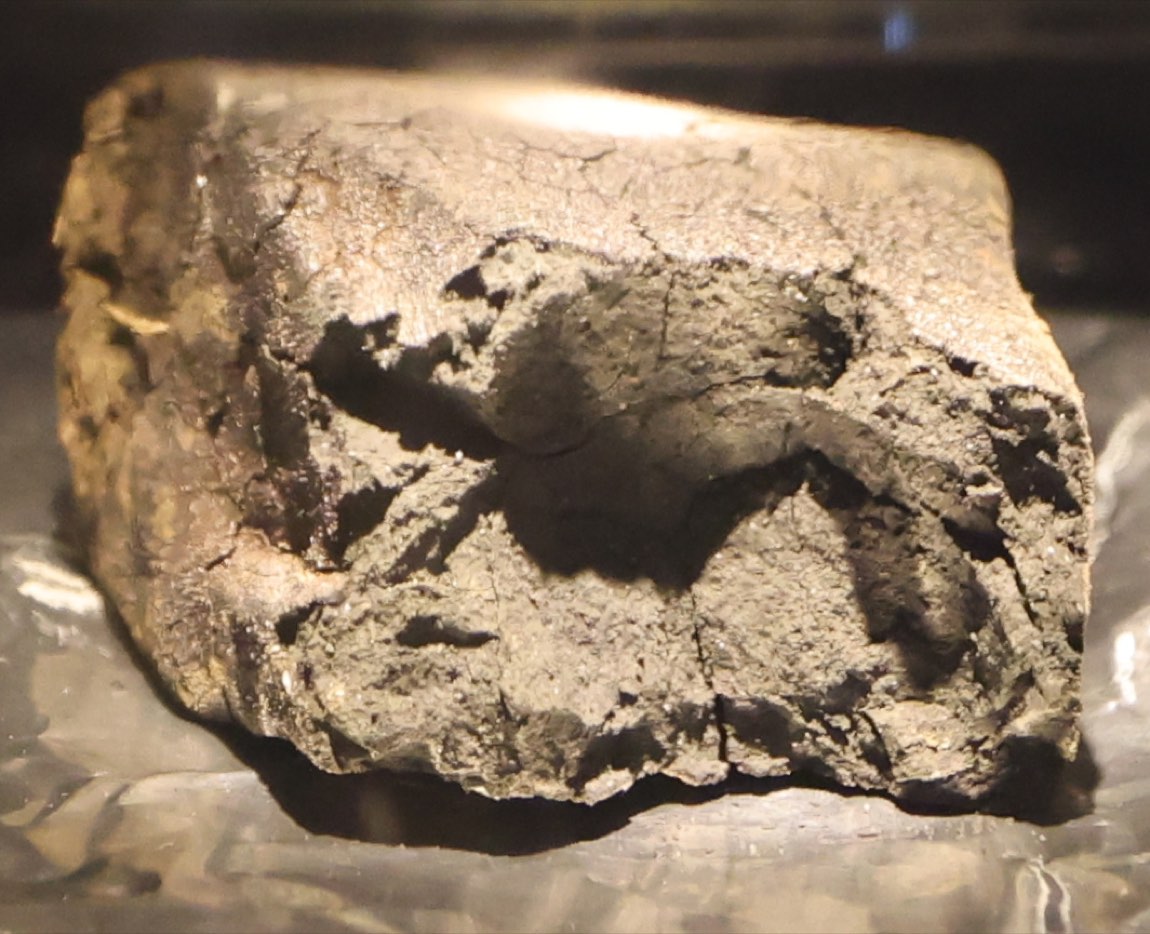
 Photograph · Geni · CC BY-SA 4.0
Meteorite · Deep guide
Winchcombe Meteorite
Also called: Winchcombe
A 2021 fireball over England dropped a rare carbon-rich meteorite onto a family's driveway.
What is it?
At 21:54 on 28 February 2021, a bright green fireball crossed Gloucestershire, England, caught by six UK camera networks and doorbell cameras and reported by more than 1,000 people. Using the footage, scientists traced its path and appealed for help. The next morning the Wilcock family found a pile of dark stones and powder on their driveway in Winchcombe. About 602 g was eventually collected. It is a CM2 carbonaceous chondrite from the asteroid belt and the first meteorite found in Britain since 1991, recovered fast enough to limit contamination.
The deep dive
Researched for the Atlas from Wikipedia — Winchcombe meteorite (3,154 characters read) · updated Nov 15, 2026
01 A Fireball Over Gloucestershire
On 28 February 2021, at exactly 21:54, residents across the United Kingdom and parts of Northern Europe looked up to see a fluorescent green fireball blazing across the sky. More than 1,000 eyewitness reports poured in, making this one of the best-documented meteorite falls in British history. The fireball was bright enough and dramatic enough to trigger a sonic boom audible to people on the ground in the local area — the kind of deep, rolling concussion that accompanies an object punching through the atmosphere at tremendous speed. What made this event scientifically exceptional was not just the spectacle but the documentation. Six separate camera networks belonging to the UK Fireball Alliance, an organisation led by the Natural History Museum, captured the meteoroid's descent on film. On top of that, doorbell cameras on private homes happened to be rolling at just the right moment. Together, these recordings gave scientists an unusually complete picture of the object's path through the atmosphere and allowed researchers to reconstruct its full trajectory with high confidence.
02 How Six Camera Networks Traced Its Path Deeper
Calculating where a falling meteorite will land is part detective work and part physics. Scientists use the recorded images from multiple camera positions to triangulate the fireball's angle of descent, speed, and direction. The UK Fireball Alliance, with its six participating camera networks, provided overlapping lines of sight that made this reconstruction unusually precise for a British fall. Each network contributes slightly different vantage points, and when combined, the data constrain the trajectory far better than a single camera ever could. This geometric approach is similar to the way GPS satellites use multiple signals to pinpoint a location. The result was a predicted fall zone that was specific enough to support a public appeal for fragments — an appeal that proved remarkably successful. Without this multi-network infrastructure, the meteorite might never have been recovered at all, or at best would have been found weeks or months later in a degraded state. The alliance's coordinated design thus directly shaped the scientific value of everything that came after.
03 The Wilcocks Find Stones on Their Driveway
The story of how the Winchcombe meteorite was actually recovered is surprisingly domestic. The Wilcock family heard an unusual sound at the moment the meteorite struck but chose not to go outside to investigate. It was only the following morning that they discovered what had landed on their property: a pile of dark stones and powder sitting on their driveway. The family collected the fragments, placed them in a bag, and had them transported to London for analysis. That driveway pile alone yielded 319 grams (11.3 oz) of material, with additional pieces gathered from the adjacent lawn. The speed of the find — and the fact that the area had not experienced rainfall in the interim — was critically important. The sample was placed in a protected environment within just 12 hours of falling to Earth, before contamination by water, soil bacteria, or atmospheric chemistry could alter its original composition. That tight timeline is what elevated the Winchcombe meteorite from an interesting rock to a scientifically invaluable one.
04 A Months-Long Hunt Across Nearby Villages
Recovery did not stop with the Wilcock family's driveway. In the days following the fall, searchers fanned out across the surrounding countryside, and the finds kept coming. The largest single stone from the meteorite — weighing 152 grams (5.4 oz) — was unearthed on farmland, though it split into two pieces during the recovery process. Meteorite hunter Chris Casey found a 12-gram (0.42 oz) half stone on a grass verge in Woodmancote on 21 March 2021, then 17.5 grams (0.62 oz) more in Bishop's Cleeve just two days later. On 25 March, Casey and Luther Jackson located a 19.2-gram (0.68 oz) stone, also in Bishop's Cleeve. The final recorded discovery came on 1 April 2021, when Jackson — hunting alongside Casey and Graham Ensor — found a fragmented 5.2-gram (0.18 oz) stone on a Bishop's Cleeve footpath. When every piece was tallied, the total recovery stood at 602 grams (21.2 oz), comprising hundreds of individual fragments spread across a scatter zone that told its own story about how the meteorite broke apart during its fiery descent.
05 Why Staying Dry Mattered So Much Deeper
Carbonaceous chondrites are among the most chemically sensitive rock types known. They formed in the cold outer reaches of the early solar system and contain organic compounds, hydrated minerals, and other volatile-rich materials that react readily when exposed to liquid water or the oxygen-rich air of Earth's surface. Even a single rain shower can wash soluble minerals out of the sample, introduce terrestrial bacteria, and permanently blur the chemical record that scientists are trying to read. The Winchcombe meteorite avoided all of that. No rainfall fell on the fragments before they were collected, and they were secured within 12 hours of landing. Scientists described the sample as a "near-pristine record of the composition of primitive asteroids" — language that reflects genuine excitement in the field. For comparison, many historic meteorite finds are recovered days, months, or even years after the fall, by which point contamination has compromised portions of the sample. Winchcombe's rapid, rain-free recovery is a large part of what makes it comparable in quality to material returned by robotic spacecraft.
06 Echoes of the Hayabusa2 Mission Deeper
One of the most striking comparisons scientists have drawn is between the Winchcombe meteorite and the samples returned by the Japanese Hayabusa2 spacecraft from asteroid 162173 Ryugu. Both belong to the same general class of carbonaceous chondrite, meaning they share a family resemblance in terms of mineralogy and likely origin. Hayabusa2 collected its material in a controlled, contamination-free environment specifically designed to preserve pristine asteroid chemistry — an enormously expensive and technically demanding achievement. Yet the Winchcombe meteorite, recovered from an English driveway and a few grass verges, is considered comparable in sample quality. That parallel underscores just how much the speed and care of the initial recovery mattered. It also suggests that naturally delivered carbonaceous chondrites, when caught quickly enough, can serve as ground-truth companions to spacecraft-returned samples, allowing scientists to cross-check findings from two entirely independent sources of the same type of primitive solar system material.
07 First British Meteorite Find Since 1991
Britain is not often in the news for meteorite discoveries, and that is partly a matter of geography and partly of luck. The Winchcombe fall was the first meteorite successfully found in Britain since 1991 — a gap of three decades during which space rocks almost certainly fell on British soil but went unrecovered or unidentified. What changed in 2021 was not the frequency of falls but the infrastructure available to detect and respond to them. The UK Fireball Alliance's camera networks, combined with the speed of a public appeal and the happy accident of a family hearing the impact, compressed the time between fall and collection to an almost unprecedented degree. The result was not just a new British meteorite but the first carbonaceous chondrite ever collected on impact in Britain — a chemically richer and scientifically more valuable class of meteorite than the more common stony or iron types that make up most finds.
08 The Driveway That Went to a Museum
Even the physical site of the impact was treated as a scientific and cultural artifact. On 8 September 2021 — more than six months after the fall — workers carefully cut out and removed 1 square metre (11 sq ft) of the indented asphalt from the Wilcock family's driveway and transported it to the Natural History Museum in London. The indentation left in the tarmac is direct physical evidence of the energy the meteorite carried when it struck. Museums often display the meteorites themselves, but preserving the impact surface adds a vivid dimension to the story — a kind of negative space that makes concrete what it means for a 4.6-billion-year-old rock to arrive suddenly from space at a suburban address. Fragments of the Winchcombe meteorite are also now on display at the local Winchcombe Museum, where the exhibition contextualises both the science and the unexpectedly eventful night that made a small Gloucestershire town briefly famous across the astronomical community.
09 Reading 4.6 Billion Years of Solar History Deeper
The Winchcombe meteorite is 4.6 billion years old, which places its formation at essentially the very beginning of the solar system. Carbonaceous chondrites of this age are considered some of the most primitive solid material accessible to science — they predate the Earth, predate the Moon, and in a real sense predate the planets as we know them. They formed in the asteroid belt between Mars and Jupiter from the same cloud of gas and dust that eventually coalesced into everything orbiting the Sun. Because they never experienced the geological reprocessing that reshapes planetary interiors — the melting, differentiation, and volcanism that erased the original chemistry of rocky planets — they preserve a chemical snapshot of that primordial environment. Reading that snapshot carefully can tell scientists about the temperatures, pressures, and chemical mix present in the early solar nebula. The near-pristine condition of the Winchcombe sample makes it an unusually legible page in that 4.6-billion-year record.
10 Public Science: 1,000 Witnesses Contribute
One of the quieter but genuinely important aspects of the Winchcombe story is how much ordinary people contributed to its scientific outcome. The more than 1,000 eyewitness reports submitted after the fireball added spatial and temporal detail that cameras alone could not fully capture — human observers noted the direction, duration, colour, and sound of the event from locations spread across the UK and Northern Europe. The public appeal for fragments, issued once the trajectory had been computed, reached the Wilcock family and others quickly enough to make recovery possible before any degrading rainfall. And the meteorite hunters — private individuals like Chris Casey, Luther Jackson, and Graham Ensor — systematically expanded the recovered mass over the weeks following the fall, pushing the total from the initial 319 grams found on the Wilcock driveway to a final 602 grams. This kind of coordinated citizen involvement, backed by professional infrastructure, is increasingly recognised as a model for maximising the scientific return from unexpected meteorite falls.
11 What 602 Grams Can Tell Science Deeper
Six hundred and two grams (21.2 oz) sounds modest — roughly the weight of a large apple — but in the context of pristine carbonaceous chondrite material, it represents a substantial scientific resource. The sample is large enough to be allocated across multiple research institutions and analytical techniques without exhausting the supply, allowing destructive tests such as isotope ratio measurements and organic chemistry extractions to proceed alongside non-destructive imaging. The fact that the material arrived as hundreds of separate pieces rather than a single intact stone is actually useful: different fragments may represent slightly different zones of the original parent body, potentially revealing internal heterogeneity. The classification as a carbonaceous chondrite also means researchers will search the sample for presolar grains — microscopic particles older than the solar system itself, inherited from other stars — as well as amino acids and other organic molecules that speak to the chemical preconditions for life in the early solar system. The Winchcombe meteorite thus entered science not as a curiosity but as a working research tool.