 Photograph · Czech Wikipedia user Packa · CC BY-SA 3.0
Meteorite · Deep guide
Příbram Meteorite
Also called: Příbram · Pribram · Luhy
The first meteorite whose fireball was photographed by several cameras, letting scientists trace its orbit.
What is it?
On the evening of 7 April 1959, a bright fireball crossed the sky east of Příbram in what was then Czechoslovakia. Cameras at more than one station recorded it, so for the first time scientists could calculate a meteorite's path through the air and its orbit around the Sun. That calculation also guided the search on the ground. Four stones totalling 5.73 kg were found, the largest weighing 4.425 kg near the village of Luhy. The meteoroid is estimated to have weighed about 53 kg before it broke apart.
The deep dive
Researched for the Atlas from Wikipedia — Příbram meteorite (1,466 characters read) · updated Nov 15, 2026
01 The fireball that lit up Czechoslovakia
On the evening of 7 April 1959, a dazzling bolide blazed across the skies of western Czechoslovakia, visible to witnesses spread across a vast swath of the country. The light it cast stretched across 50 kilometres (31 miles) of sky — roughly the distance from London to Brighton — making it impossible to miss for anyone outdoors that night. As the object plunged deeper into the atmosphere, it shed speed and energy violently. Around 13 kilometres (8.1 miles) altitude, roughly the cruising height of a modern jetliner, the meteorite could no longer hold itself together and broke apart. The breakup was anything but quiet: one loud explosion rang out first, followed by several smaller detonations, the acoustic signature of a rock from space tearing itself to pieces under aerodynamic stress. The drama unfolded in seconds, but the evidence it left behind — both on the ground and in the data recorded by cameras — would reshape how scientists track space rocks for generations.
02 Four named fragments, one famous fall
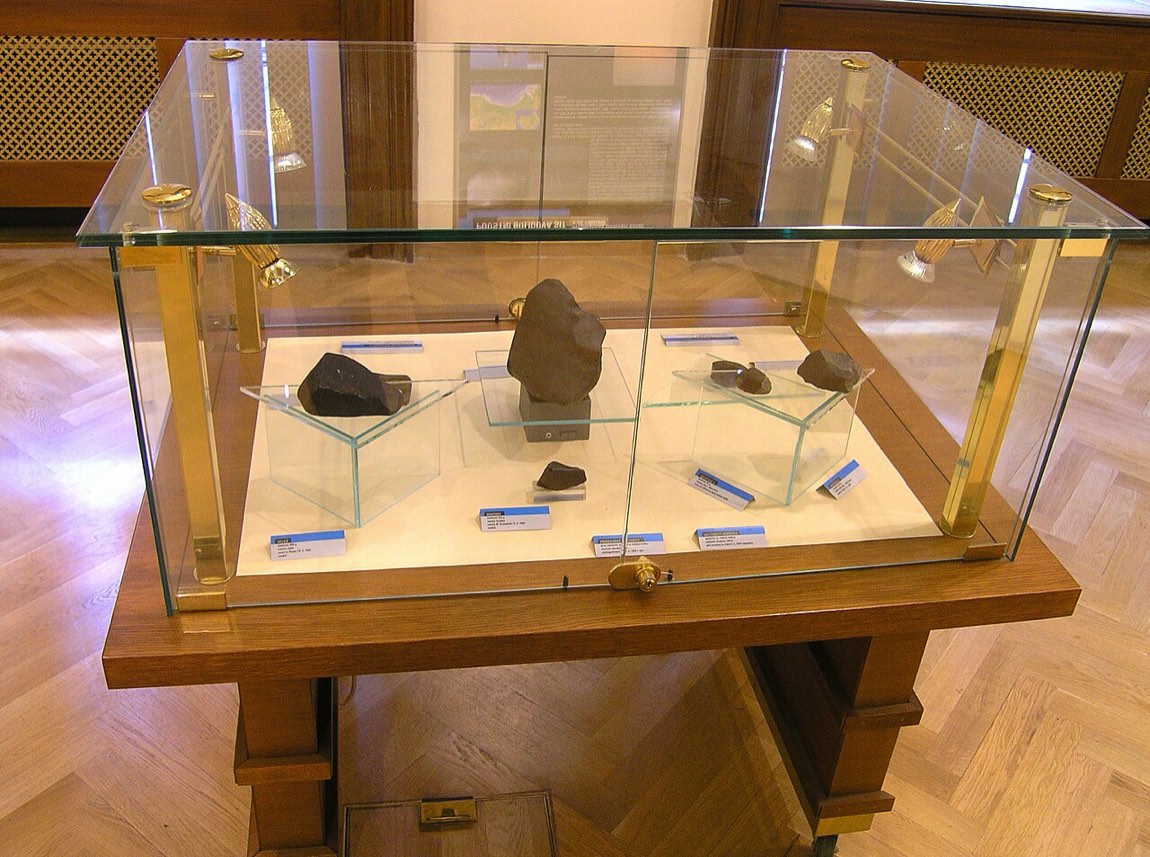
Searchers eventually recovered four distinct pieces of the Příbram meteorite, each named after the Czech village nearest to where it landed. The largest, weighing 4.425 kilograms (9.76 pounds), came down near Luhy in the Dolní Hbity municipality. Next came the Velká fragment at 0.772 kilograms (1.70 pounds), recovered near Kamýk nad Vltavou. Two smaller pieces were found in the Svatý Jan municipality: Hojšín at 0.428 kilograms (0.94 pounds) and tiny Drážkov at just 0.105 kilograms (0.23 pounds). Together the four account for 5.730 kilograms (12.63 pounds) of material. Intriguingly, the article notes that the largest recovered piece — Luhy — was probably only the second-largest fragment overall, implying that a bigger chunk almost certainly exists somewhere but was never found. All four confirmed pieces are now preserved and on public display at the Czech National Museum in Prague.
03 Most of Příbram is still missing Deeper
The four recovered fragments add up to 5.730 kilograms, but that figure sits in sobering contrast to estimates of the meteorite's pre-entry mass: roughly 53 kilograms (117 pounds) before it broke apart in the atmosphere. That means only about 10.8 percent of the original rock made it into human hands. The remaining roughly 47 kilograms were either vaporized during the fiery descent, dispersed as dust too fine to collect, or landed as fragments that were never located. The hint that the largest recovered piece is probably not even the biggest surviving fragment adds another layer of mystery — somewhere in the Czech countryside, a chunk heavier than 4.425 kilograms may still lie buried or unrecognized. This gap between estimated pre-breakup mass and recovered mass is a common frustration in meteoritics, reminding scientists that a fireball's spectacular light show represents enormous energy release and wholesale destruction of the original body.
04 How the rock hit the ground
When the Luhy fragment finally reached the surface, it did not simply bury itself cleanly. The piece punched into ploughed agricultural land to a depth of 20 centimetres (7.9 inches) — about the length of a standard school ruler — before the soft tilled soil absorbed enough energy to stop it momentarily. Then, remarkably, it bounced. The meteorite rebounded and came to rest a further 30 centimetres (12 inches) away from its initial impact point. This bounce-and-settle behavior is a vivid reminder that even a rock falling from space obeys the same physical rules as any other projectile; a freshly ploughed field acts almost like a cushion compared to hard-packed earth or rock. The shallow penetration depth also suggests the fragment had shed most of its velocity by the time it reached the ground, arriving at something closer to terminal velocity than the tremendous speed at which it first entered the atmosphere.
05 Cameras that changed meteorite science Deeper
What elevates Příbram from a notable fall to a landmark event in planetary science is the network of cameras that happened to capture it. Příbram holds the distinction of being the first meteorite in history whose trajectory through the atmosphere was recorded simultaneously by multiple cameras. Before this, scientists could interview eyewitnesses and triangulate rough paths, but the geometry was always uncertain. With photographic records from several stations, researchers could reconstruct the precise angle, speed, and direction of the fireball with far greater accuracy than any witness account alone could provide. This trajectory data fed directly into orbital calculations: by running the math backward from the point of impact and atmospheric entry, scientists determined the orbit this rock had followed around the Sun before it encountered Earth. That made Příbram the first meteorite for which a pre-Earth orbit was scientifically established — a capability that now underpins modern bolide monitoring networks worldwide.
06 Tracing a path back to the solar system Deeper
The camera network's greatest scientific gift was not just finding where Příbram landed, but revealing where it came from. By calculating the meteorite's trajectory through the atmosphere and combining that with the known motion of Earth, scientists could integrate the equations of motion backward in time to reconstruct the orbit the rock followed around the Sun before impact. This kind of reverse-engineering transforms a lump of stone into a labeled package carrying a return address from the solar system. The result for Příbram was a computed heliocentric orbit — meaning its path around the Sun was established, placing it within the broader family of objects that cross Earth's orbit. This was a genuinely new capability in 1959. Prior to Příbram, meteorite orbits were either unknown or only loosely inferred. The Příbram result demonstrated that photographic networks could serve as a systematic tool for linking meteorites in hand to their dynamical origins in space, motivating the construction of similar camera networks in subsequent decades.
07 Recovery aided by the same data
The camera network did double duty: it not only allowed scientists to calculate the meteorite's solar orbit, but it also directly aided the physical search for the fallen fragments on the ground. By precisely computing where the trajectory intersected Earth's surface, searchers could define a strewn field — the elongated area where pieces were expected to land — rather than combing the entire countryside at random. This made recovery dramatically more efficient. Without that photographic evidence, hunters would have relied on witness reports of sound and light, which can be wildly misleading due to the way sound bends in the atmosphere. The fact that four pieces were found, and found relatively quickly, owes much to the trajectory reconstruction that the cameras made possible. It established a template that recovery teams still follow today: get the camera data first, compute the trajectory, define the search zone, then send people into the field.
08 Where to see the fragments today
All four recovered pieces of the Příbram meteorite are on public display at the Czech National Museum in Prague. This means that unlike many scientifically important meteorites that spend their existence in locked storage cabinets or divided among institutions worldwide, Příbram is accessible to anyone who visits. The Czech National Museum, situated on Wenceslas Square, is one of the country's foremost cultural and scientific institutions, making Příbram a centerpiece of its natural history collections. For visitors, seeing the fragments in person offers a tangible connection to a moment that permanently advanced the science of meteorite tracking — a small collection of stones that together weigh less than a large bag of flour, yet carry an outsized place in the history of planetary science. The naming of each piece after a local Czech village also gives the display a geographic and cultural dimension, grounding a cosmic event in the specific landscape where it ended.
09 The altitude of breakup and what it means Deeper
The Příbram meteorite fragmented at an altitude of approximately 13 kilometres (8.1 miles), a figure that sits right at the boundary of the troposphere and the lower stratosphere — the same layer where commercial aircraft cruise. This altitude is significant because it reflects the physical strength of the incoming rock. A stronger, more coherent body might survive deeper into the atmosphere before structural failure; a weaker or more porous object might disintegrate much higher up. The fact that Příbram held together until 13 kilometres suggests it was a reasonably sturdy piece of rock, consistent with its classification as a meteorite type resilient enough to survive atmospheric entry in multiple pieces rather than vaporizing entirely. The explosions heard at breakup — one major detonation and several smaller ones — are consistent with sudden pressure release as internal stress exceeded the rock's tensile strength, a process that takes milliseconds but produces sound waves that travel for hundreds of kilometres across the landscape below.