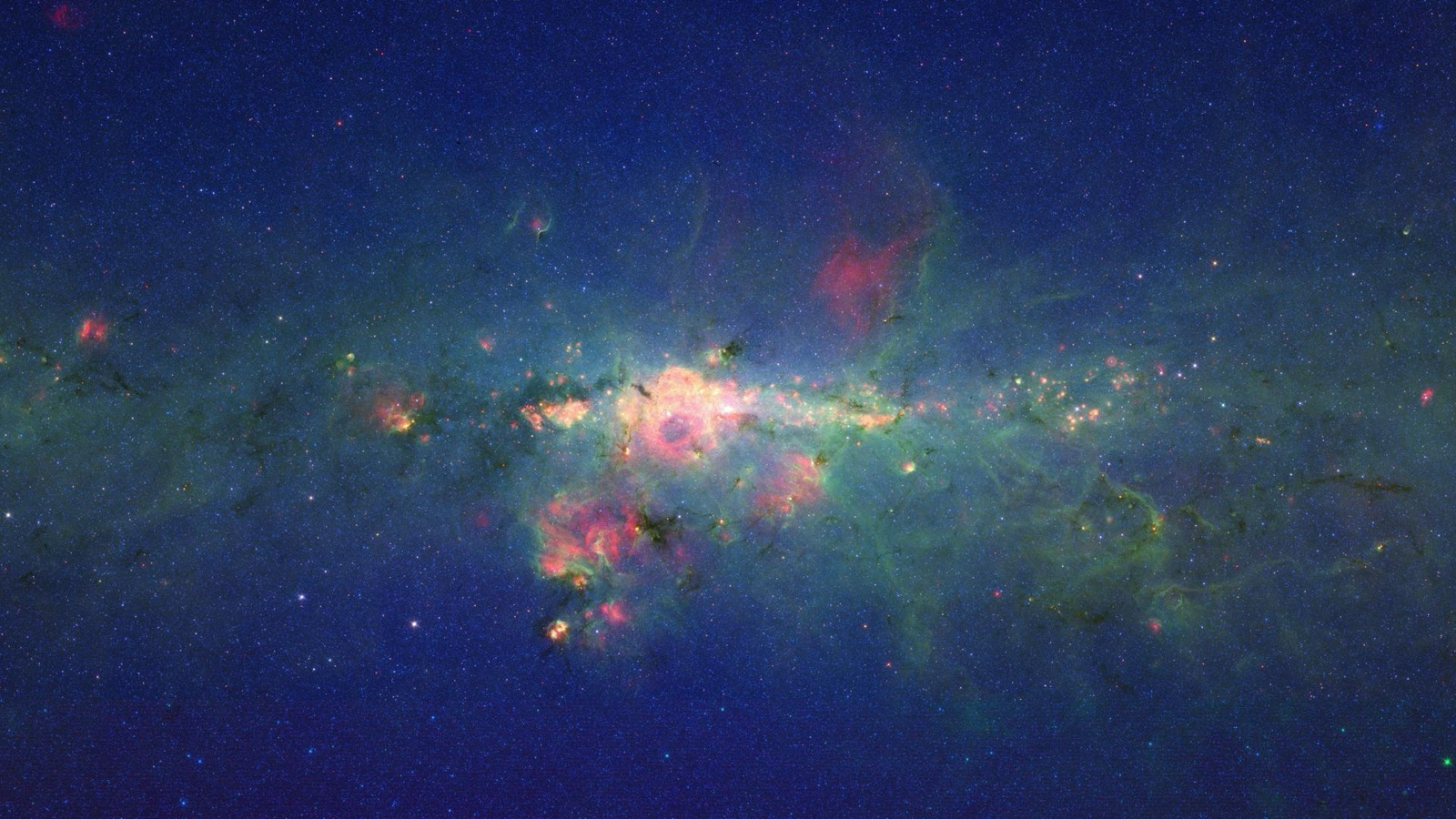
 Photograph · NASA/JPL-Caltech
Galaxy · Deep guide
The Milky Way
A hundred billion stars, and every human who ever lived, in one spiral: our home galaxy.
What is it?
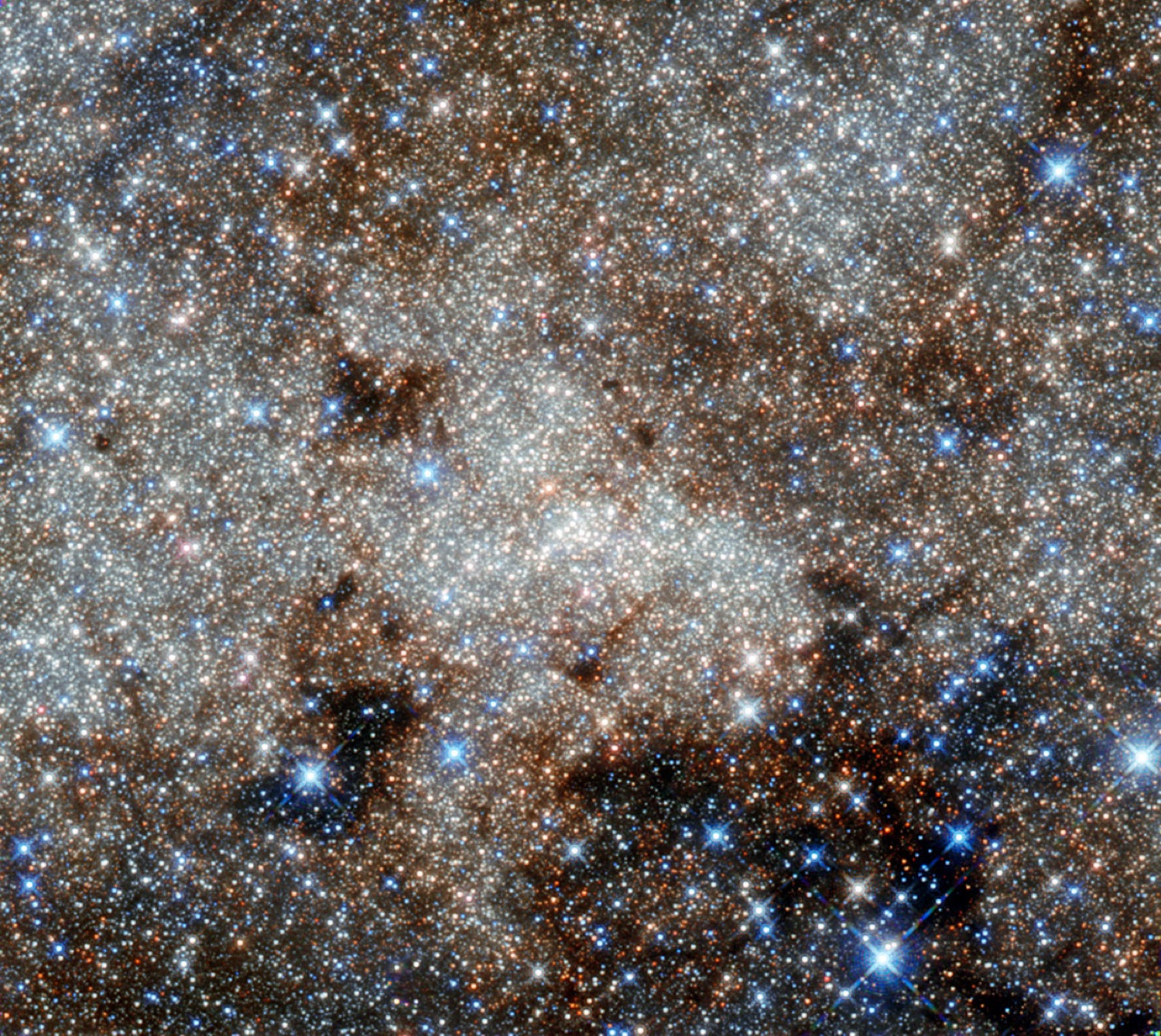
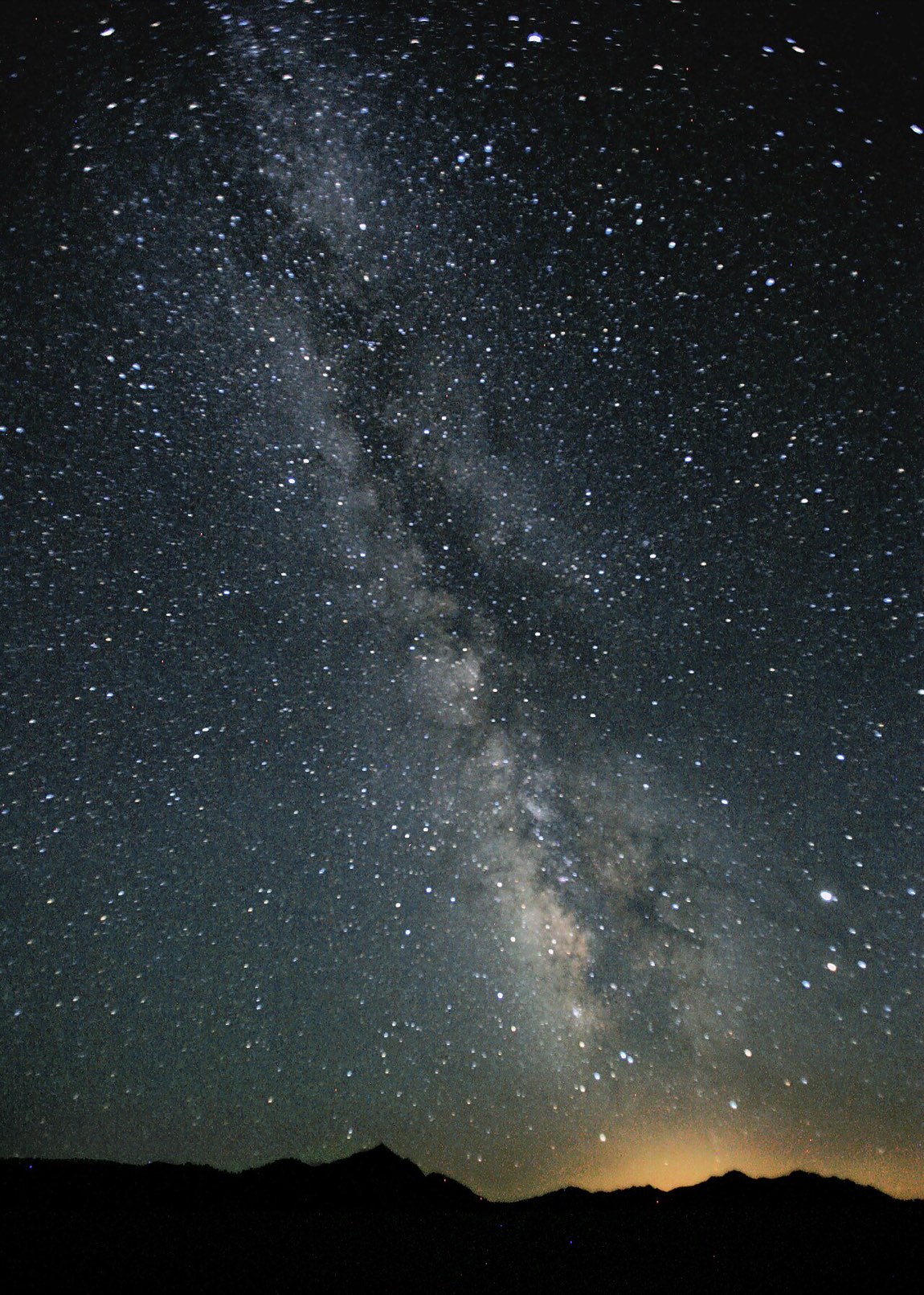
The Milky Way is our galaxy: a barred spiral disk of one to four hundred billion stars, about 100,000 light-years across, with our Sun riding a minor arm about 26,000 light-years from the center. Every star you have ever seen with your naked eye belongs to it. The soft glowing band across a dark night sky is the disk seen edge-on from inside — the combined light of billions of suns too far to separate.
Go deeper
Gaia's astrometry of nearly two billion stars has turned Milky Way structure into precision science: a warped, flaring disk still ringing from past dwarf-galaxy impacts (the Gaia–Enceladus merger ~10 Gyr ago built much of the halo), a central bar feeding a nuclear star cluster around Sagittarius A*, and stellar streams tracing shredded companions. Star counts, total mass (~1–1.5 trillion M☉ with dark matter), even the number of spiral arms remain honest ranges, not single numbers — we map it from inside, through dust. Collision with Andromeda is due in ~4.5 billion years.
01 Seeing your own galaxy
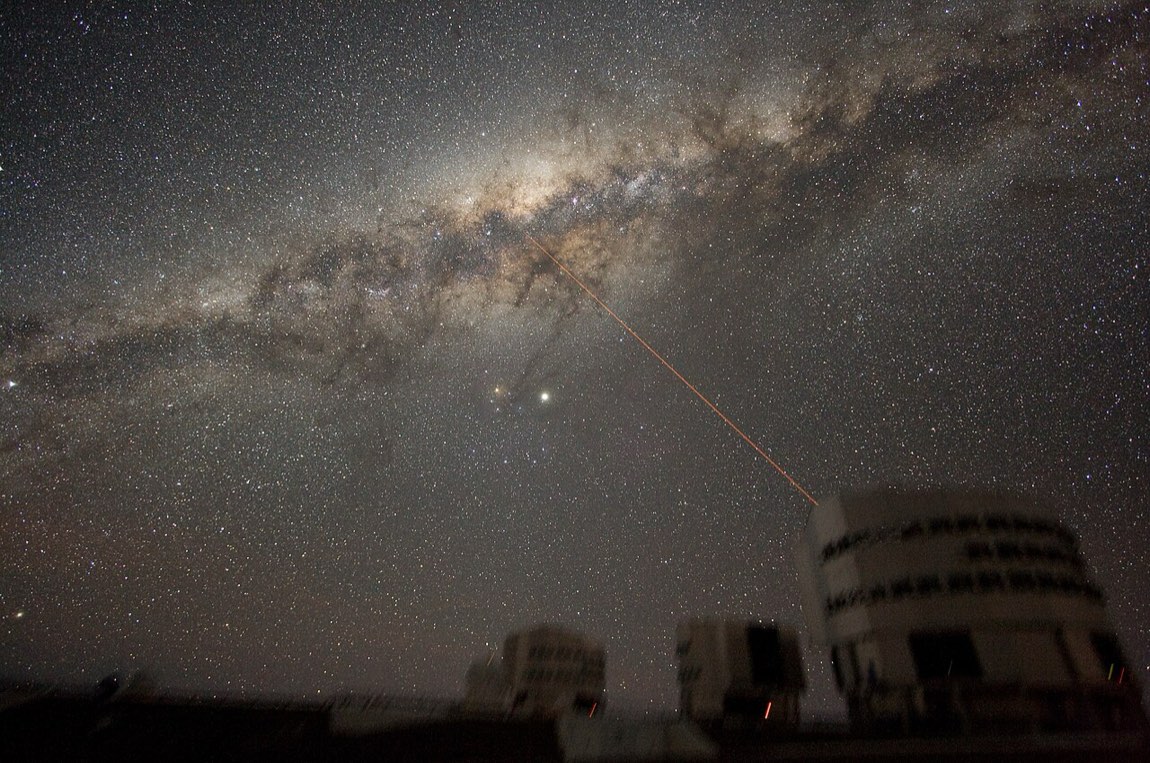
From a truly dark place on a moonless night, the Milky Way rises as a glowing arch with dark rifts of dust running through it — the single most humbling naked-eye sight there is. About a third of humanity, under city lights, has never seen it. The bright core region hangs in Sagittarius, best in July–August evenings (northern hemisphere) — you are looking 26,000 light-years toward the galactic downtown.
02 How do you map a forest from inside it? Deeper
We cannot photograph the Milky Way from outside, so every 'photo of our galaxy' you have seen is an artist's reconstruction or a different galaxy standing in. The real map comes from measuring distances star by star (Gaia's parallaxes), timing masers with radio interferometry, and tracing gas velocities — assembling a 3D model from two billion surveyed points. The reconstruction keeps surprising us: the disk is warped like a vinyl record left in the sun, and it is still wobbling from past collisions.
03 The collision with Andromeda Deeper
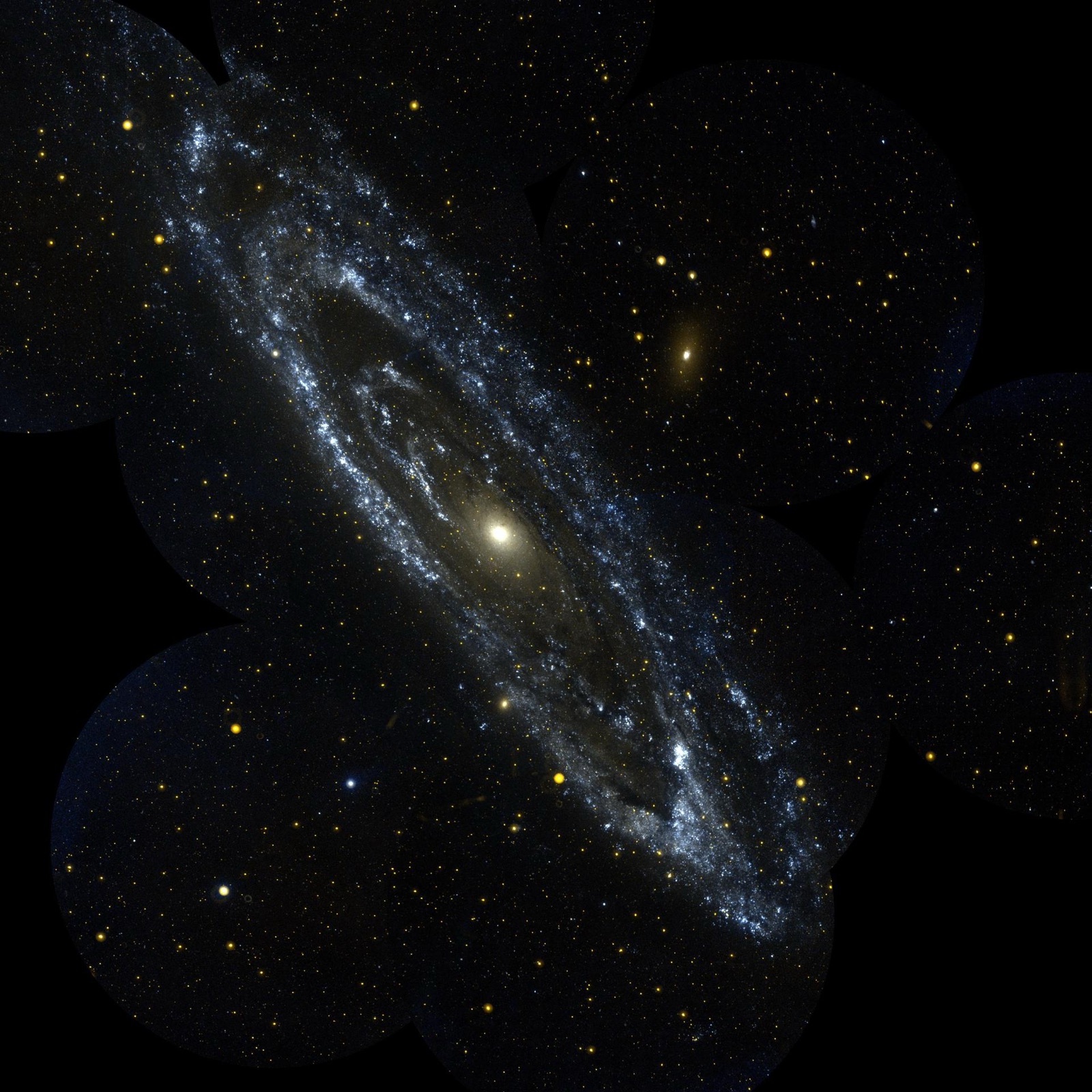
Andromeda approaches at ~110 km/s; in roughly 4.5 billion years the two spirals will tangle, swing through each other, and merge over a couple of billion years into one elliptical galaxy ('Milkomeda'). Individual stars essentially never collide — space is that empty — but both spiral structures dissolve. The Sun, by then a dying star, will likely be flung to a wider orbit rather than devoured.
The deep dive
Researched for the Atlas from Wikipedia — Milky Way (56,555 characters read) · updated Sep 20, 2026
04 A name born from spilled milk
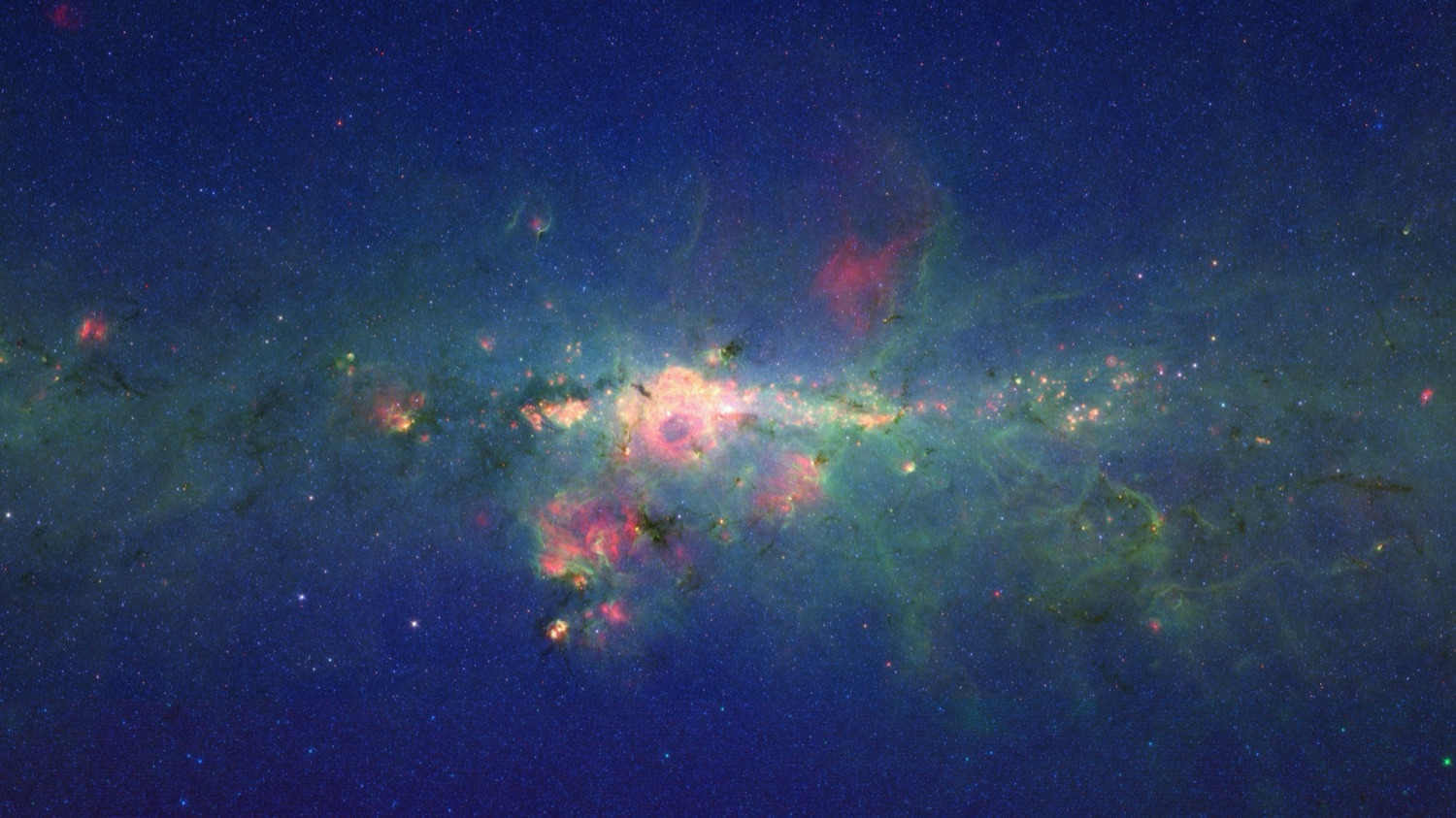
The word "galaxy" itself traces back to the Greek word for milk: "galaxias," from the root "gala." Ancient Greeks called the band of light a "milky circle" — one of eleven circles they identified in the sky, alongside the zodiac, the equator, the tropics, the meridian, and others. The Romans translated the phrase to "via lactea," which passed into English as "Milky Way." Geoffrey Chaucer used the English form around 1380, writing of the "Galaxyë" that men call "the Milky Wey, for hit is whyt." But across cultures, the galaxy earned wildly different names rooted in local experience. Uralic and Baltic peoples called it the "Birds' Path," because migrating birds trace its arc across the Northern Hemisphere sky. Scandinavians called it "Vintergatan" — Winter Street — because it shows most clearly in winter at high latitudes. In Arabic, Persian, and Turkish traditions, it became the "Pathway of the Straw." The Kaurna people of South Australia named it "wodliparri," meaning house river. The Babylonian epic Enuma Eliš described it as the severed tail of the saltwater dragon Tiamat, placed in the sky by the god Marduk after slaying her.
 ⤢
⤢
05 How Galileo cracked the mystery in 1610
For most of human history, the Milky Way was simply a glowing smear in the sky, its nature entirely unknown. Aristotle believed it was part of Earth's upper atmosphere, a fiery byproduct of burning stars that lingered because of its extreme height. The Persian astronomer Al-Biruni, writing around 1000 AD, came closer, proposing it was "a collection of countless fragments of the nature of nebulous stars." But it was Galileo Galilei who settled the question definitively in 1610, pointing his optical telescope at the band and discovering it was composed of a vast number of faint, individual stars packed too closely together to be resolved by the naked eye. One man had transformed a mythological river of milk into a physical structure. More than a century later, in 1755, Immanuel Kant — misreading a suggestion by Thomas Wright — reasoned that the Milky Way was a rotating disk of stars held together by gravity, much like the Solar System but on enormously larger scales. He called the Milky Way and other nebulae "island universes," a term that stayed in use until the 1930s. William Herschel in 1785 made the first attempt to map the galaxy's shape by counting stars in different patches of sky, placing the Solar System near its center — an estimate later shown to be wrong but admirable as a first effort.
06 The Great Debate that changed everything
In 1920, two astronomers stood on opposite sides of one of the biggest arguments in the history of science: was the Milky Way the entire universe, or just one of many galaxies? Harlow Shapley defended the view that spiral nebulae were small objects within the Milky Way. Heber Doust Curtis argued the opposite. Curtis had a powerful piece of evidence: in 1917, he had observed the nova S Andromedae within the Great Andromeda Nebula and found 11 more novae in photographic records. These novae were, on average, ten magnitudes fainter than those seen inside the Milky Way, which implied an enormous distance — he estimated 150,000 parsecs. Curtis also noted dark lanes in Andromeda resembling the dust clouds of the Milky Way and a significant Doppler shift. The debate remained unresolved until Edwin Hubble used the 2.5 m Hooker Telescope at Mount Wilson Observatory in the early 1920s. He resolved individual stars in the outer regions of some spiral nebulae and identified Cepheid variable stars that gave reliable distance measurements. He found that the Andromeda Nebula lies 275,000 parsecs from the Sun — far too distant to be part of the Milky Way. In a stroke, the universe grew almost unimaginably larger.
07 The Fermi Bubbles: a galaxy exhaling Deeper
In 2010, astronomers analyzing data from the Fermi Gamma-ray Space Telescope discovered something extraordinary: two gigantic spherical bubbles of high-energy gamma-ray emission ballooning out from the Milky Way's core, one above and one below the galactic plane. Each bubble is about 25,000 light-years (7.7 kpc) in diameter — roughly one quarter of the galaxy's estimated diameter. Together they stretch from the constellation Grus in the south to Virgo in the north on the night sky. Follow-up observations with the Parkes Telescope at radio frequencies detected polarized emission associated with these structures. The best current interpretation is that the Fermi Bubbles are a magnetized outflow driven by intense star formation in the innermost 640 light-years (200 parsecs) of the Milky Way, not by the central black hole itself. Separately, gamma-ray detectors since 1970 have picked up 511-kiloelectronvolt gamma rays from near the Galactic Center — the specific energy released when an electron and a positron annihilate each other. A 2008 study found that the distribution of these gamma-ray sources matches that of low-mass X-ray binary stars, suggesting those binaries are injecting positrons into interstellar space. The emitting region spans about 10,000 light-years across and shines with a luminosity roughly 10,000 times that of the Sun.
08 A black hole that barely eats
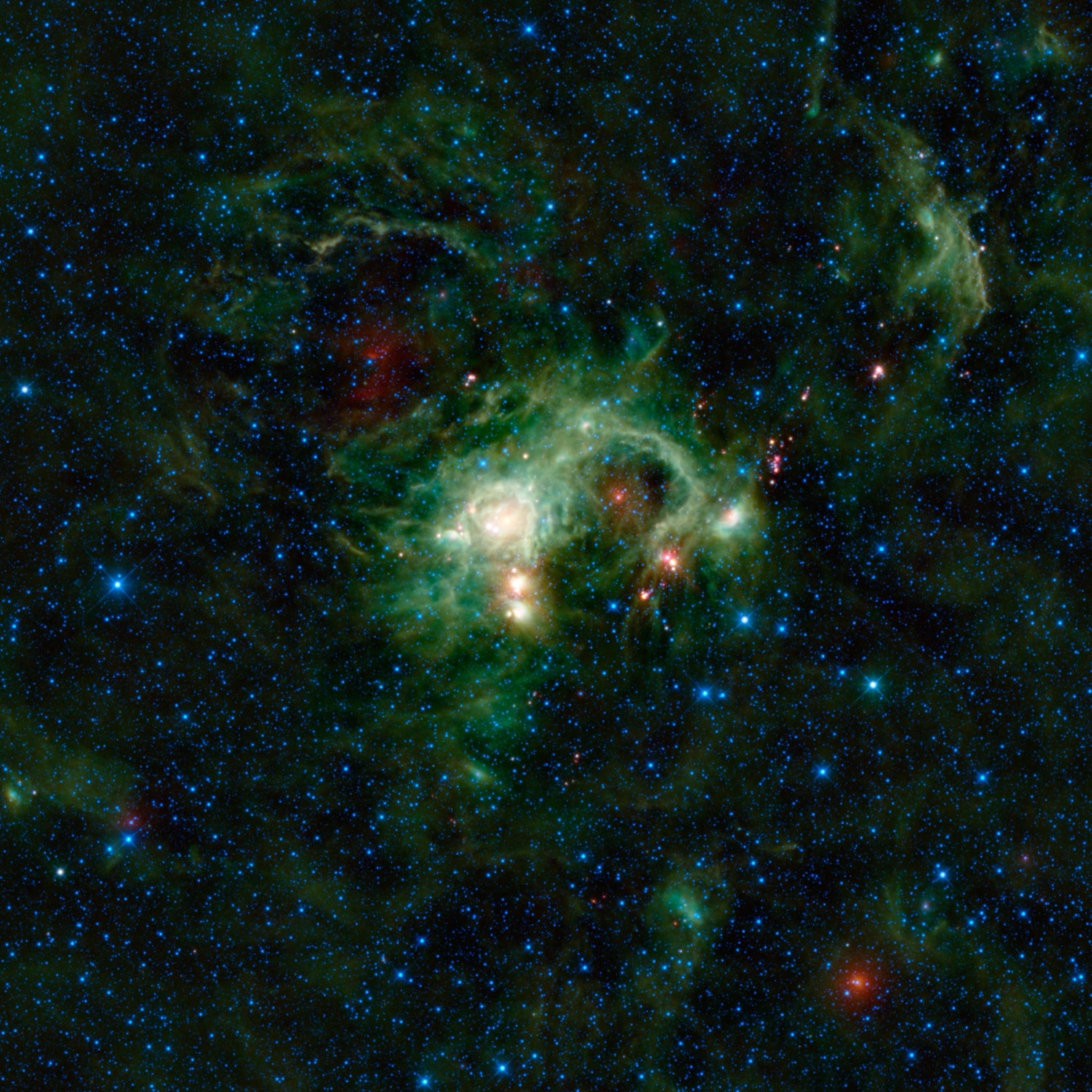
At the very center of the Milky Way sits Sagittarius A*, an intense radio source and the galaxy's supermassive black hole. Its mass is estimated at 4.1 to 4.5 million times the mass of the Sun — a figure pinned down by tracking the orbits of stars swinging around it. Despite its enormous mass, Sagittarius A* is remarkably quiet. Its accretion rate — the speed at which it consumes surrounding material — is estimated at just one hundred-thousandth of a solar mass per year, which is consistent with what astronomers call an "inactive galactic nucleus." For most of its existence it has been, cosmically speaking, asleep. That said, it does have occasional outbursts. On January 5, 2015, NASA reported an X-ray flare from Sagittarius A* that was 400 times brighter than its usual output — a record at the time. The cause may have been an asteroid breaking apart as it fell toward the black hole, or the tangling of magnetic field lines in the infalling gas. In June 2023, astronomers led by Naoko Kurahashi Neilson reported the first detection of neutrinos from the Milky Way's galactic plane using a new cascade neutrino technique, producing the first neutrino-based view of the galaxy's interior.
 ⤢
⤢
09 Dark matter: the invisible majority Deeper
If you add up all the stars, gas, and dust in the Milky Way, the total mass of ordinary matter falls dramatically short of explaining how the galaxy actually behaves. The rotation curve tells the story: in a galaxy made only of visible matter, stars far from the center should orbit more slowly, just as Neptune moves slower than Mercury. Instead, stars across most of the Milky Way's disk orbit at remarkably similar speeds — typically between 200 and 220 km/s — regardless of distance from the center. The only way to reconcile this flat rotation curve is to invoke a vast, invisible mass called dark matter, spread out in a roughly spherical halo around and beyond the visible disk. Mathematical models suggest that the dark matter halo of the Milky Way contains between 1 and 1.5 trillion solar masses, compared to an estimated 46 to 64 billion solar masses in actual stars. A 2020 study predicted the edge of this dark matter halo at around 292 ± 61 kiloparsecs from the center, giving it a diameter of roughly 584 ± 122 kiloparsecs — nearly 2 million light-years. Recent simulations suggest a dark matter region, also containing some visible stars, may extend to almost that full diameter. Dark matter interacts with ordinary matter only through gravity, making it currently undetectable by any telescope that observes electromagnetic radiation.
10 A warped disk embedded in hot fog Deeper
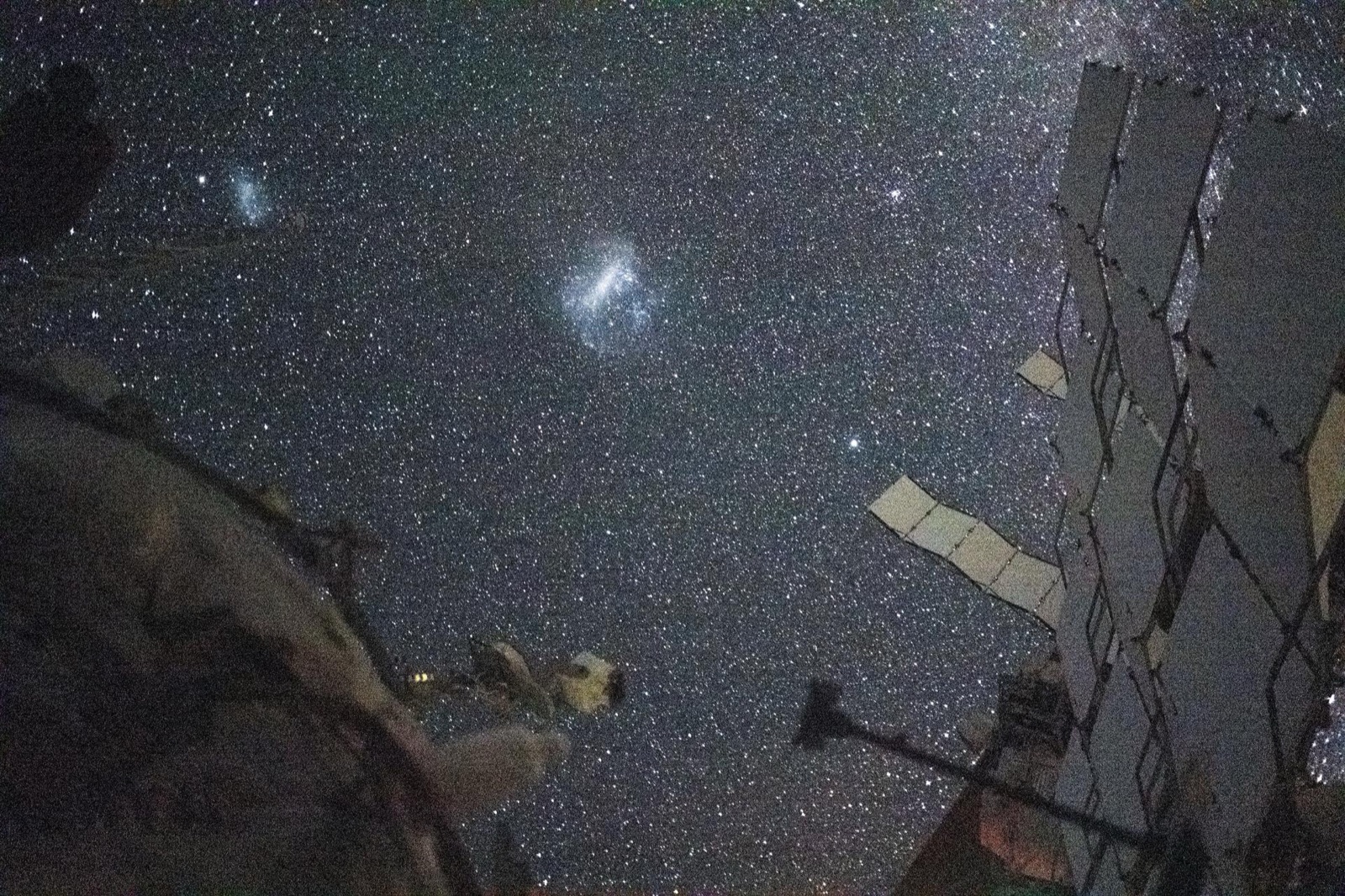
The Milky Way's disk is not a flat, clean platter. It is warped along an S-curve shape, and research in January 2006 linked this warping to the gravitational tug of the Large and Small Magellanic Clouds as they orbit and periodically pass through the galaxy's edges. Although those two satellite galaxies together account for only about 2 percent of the Milky Way's mass, computer models show that their movement creates a dark matter wake that amplifies their gravitational influence far beyond what their visible mass alone would suggest. Surrounding the stellar disk is a gaseous halo of hot plasma, detected by the Chandra X-ray Observatory, XMM-Newton, and Suzaku. This gaseous halo extends for hundreds of thousands of light-years, much farther than the stellar halo, and its temperature lies between 1 and 2.5 million K (1.8 and 4.5 million °F). Its mass is nearly equivalent to the mass of the Milky Way itself, and if confirmed, it could account for a large fraction of the so-called "missing baryons" — ordinary matter that cosmological models predict should exist around galaxies like ours but which has not been observed. The stellar disk itself is estimated to be approximately up to 1.35 kiloparsecs (about 4,400 light-years) thick.
11 How the galaxy's spiral arms really work Deeper
The Milky Way is classified as a barred spiral galaxy, type Sbc in the Hubble system, meaning its arms are relatively loosely wound. Astronomers suspected it was barred since the 1960s, and the Spitzer Space Telescope confirmed in 2005 that the central bar is larger than previously thought. Outside the bar's gravitational influence, four spiral arms emerge — the Perseus Arm, the Scutum–Centaurus Arm, the Carina–Sagittarius Arm, and the Norma Arm — along with features like the 3 kpc Arm discovered in the 1950s through 21-centimeter radio measurements. But the arms are less tidy than any diagram suggests. Estimates of their pitch angle range from about 7° to 25°. They branch, merge, and twist. Near-infrared surveys that can see through dust found that the Scutum–Centaurus Arm contains roughly 30% more red giant stars than the surrounding disk, identifying it as a true major stellar arm — but found no corresponding overdensity in the Carina–Sagittarius Arm. This leads to an odd result: the Milky Way appears to have two major arms as traced by old stars, and four arms as traced by gas and young stars. The reason for this discrepancy is still unclear. A 2011 simulation suggested that repeated collisions with the Sagittarius Dwarf Elliptical Galaxy may have stirred the spiral arm structure into its current form.
12 The galaxy's violent early life
The Milky Way's history is one of repeated collisions and cannibalism. It began about 13.61 billion years ago as one or several small overdensities of matter shortly after the Big Bang. The oldest surviving stellar objects — globular clusters — formed in those first density peaks and now populate the galactic halo. Cosmological simulations indicate that roughly 11 billion years ago the young Milky Way merged with a particularly massive galaxy now labeled "the Kraken," which may have been the largest merger in the galaxy's history. Nearly half the matter in the Milky Way may have originated in other, more distant galaxies absorbed over time. After those early violent mergers, the story becomes quieter. Astronomers estimate that the Milky Way has undergone no major mergers with large galaxies in the last 10 billion years, which is unusual among spiral galaxies of its type. By comparison, the Andromeda Galaxy appears to have had a more turbulent recent history. The thin disk, where the Sun lives, formed separately: measurements of thin-disk stars using nucleocosmochronology suggest it assembled 8.8 ± 1.7 billion years ago, leaving a gap of almost 5 billion years between the formation of the galactic halo and the disk. During that gap, interstellar gas may have been too hot to efficiently form new stars.
 ⤢
⤢
13 Planets by the hundreds of billions
The Milky Way contains between 100 and 400 billion stars, and observations indicate there are at least as many planets as stars — possibly far more. A January 2013 study using Kepler space observatory data on the five-planet system Kepler-32 estimated 100 to 400 billion planets in the galaxy. A separate January 2013 analysis of Kepler data estimated that at least 17 billion Earth-sized exoplanets exist in the Milky Way. In November 2013, astronomers using Kepler data estimated up to 40 billion Earth-sized planets could be orbiting in the habitable zones of Sun-like stars and red dwarfs, with about 11 billion of those orbiting Sun-like stars specifically. By November 2020, estimates climbed to over 300 million potentially habitable exoplanets in the galaxy. Beyond planets, microlensing measurements suggest there are even more rogue planets — worlds drifting through space unbound to any star — than there are stars themselves. The nearest known exoplanet candidate is thought to orbit Proxima Centauri, just 4.2 light-years away, according to a 2016 study. Comets are not confined to our Solar System either: "exocomets" beyond the Solar System have been detected and may be common throughout the Milky Way.
14 Gaia and the revolution in star mapping
For most of the twentieth century, astronomers could measure the precise positions and distances of only a few million stars. The ESA spacecraft Gaia changed that order of magnitude completely. By measuring the parallax — the tiny apparent shift in a star's position as Earth orbits the Sun — of approximately one billion stars, Gaia has expanded the catalog of well-measured stars from about 2 million in the 1990s to 2 billion. That is a factor of 100 in the measurable radius of space and a factor of 1,000 in precision, a transformation so profound that scientists described its data as simply "transformational." Gaia has also revealed unexpected dynamics. A 2020 study concluded that Gaia detected a wobbling motion of the entire galaxy, possibly caused by torques from a misalignment between the disk's rotation axis and the shape of the dark matter halo, or from accreted matter in the halo, or from tidal forces exerted by nearby satellite galaxies. In April 2024, initial studies involving Gaia data and related maps of the magnetic fields of the Milky Way were reported, opening another new window onto the galaxy's large-scale structure. Gaia's data also contributed to a September 2023 reassessment placing the galaxy's virial mass at only 2.06 × 10¹¹ solar masses — roughly a tenth of some earlier estimates — showing that even the galaxy's total mass remains genuinely uncertain.
15 The galaxy's place in a web of structure
The Milky Way does not exist in isolation. Together with the Andromeda Galaxy and about 48 other closely bound galaxies, it forms the Local Group, which is itself surrounded by a Local Void and embedded within the Virgo Supercluster. The Virgo Supercluster is being gravitationally drawn toward the Great Attractor, which is part of an even larger structure called Laniakea. The Milky Way moves at approximately 630 km/s (1,400,000 mph) with respect to the local Hubble flow, and at 552 ± 6 km/s (1,235,000 ± 13,000 mph) with respect to the cosmic microwave background reference frame — a motion detected as a dipole signal by satellites including COBE and WMAP. The galaxy's satellite system includes the Large Magellanic Cloud, with a diameter of 32,200 light-years, and its companion the Small Magellanic Cloud. A stream of neutral hydrogen gas called the Magellanic Stream stretches from these two galaxies across 100° of sky, dragged out by tidal interactions with the Milky Way. The smallest known satellite dwarf galaxies are only 500 light-years in diameter. In 2015, nine new Milky Way satellites were discovered in a single small patch of sky, suggesting that many more may remain undetected, and the current known population of satellite galaxies is thought to have originated from the breakup of a larger system, producing a ring structure roughly 500,000 light-years in diameter.
 ⤢
⤢
Could life exist here?
The Milky Way contains the only life we know of (us) — and hundreds of billions of planets. Estimates of habitable-zone rocky worlds run to the billions; whether any others are inhabited is the open question this whole site keeps circling.
Our labels: Confirmed · Strong Evidence · Estimated · Hypothesis · Theoretical · Speculative (see Methodology).
Could humans live here?
We will never 'visit' the Milky Way — we ARE the Milky Way, briefly organized into people. Crossing it (100,000 ly) is beyond any physics we possess.
Weird & wonderful
- The Sun has completed only ~20 galactic orbits since it formed.
- The Milky Way's disk is proportionally thinner than a music CD.
- Its halo is scarred with the ghost-streams of at least a dozen devoured galaxies.
- You are moving ~830,000 km/h around the galactic center right now.