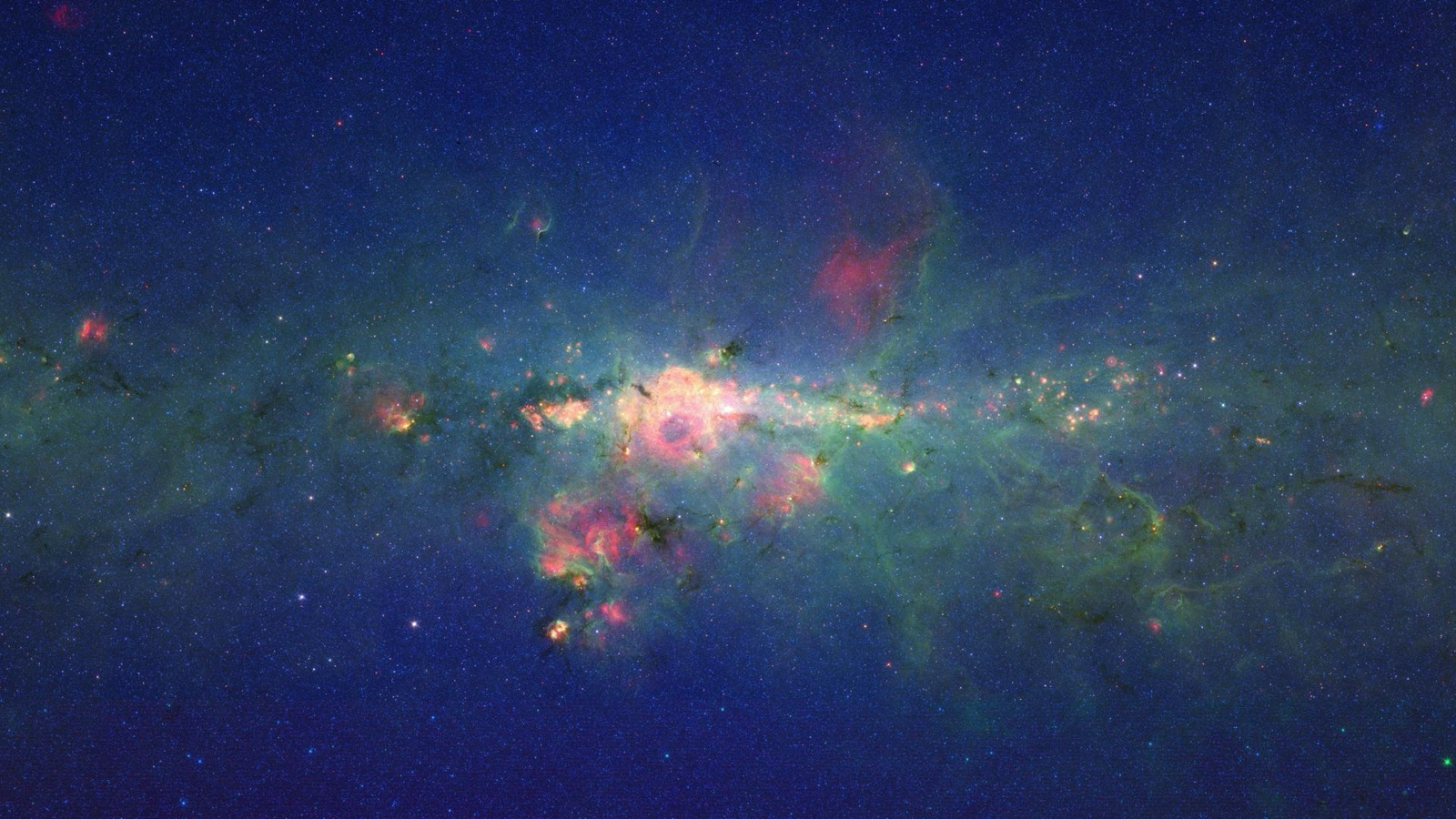
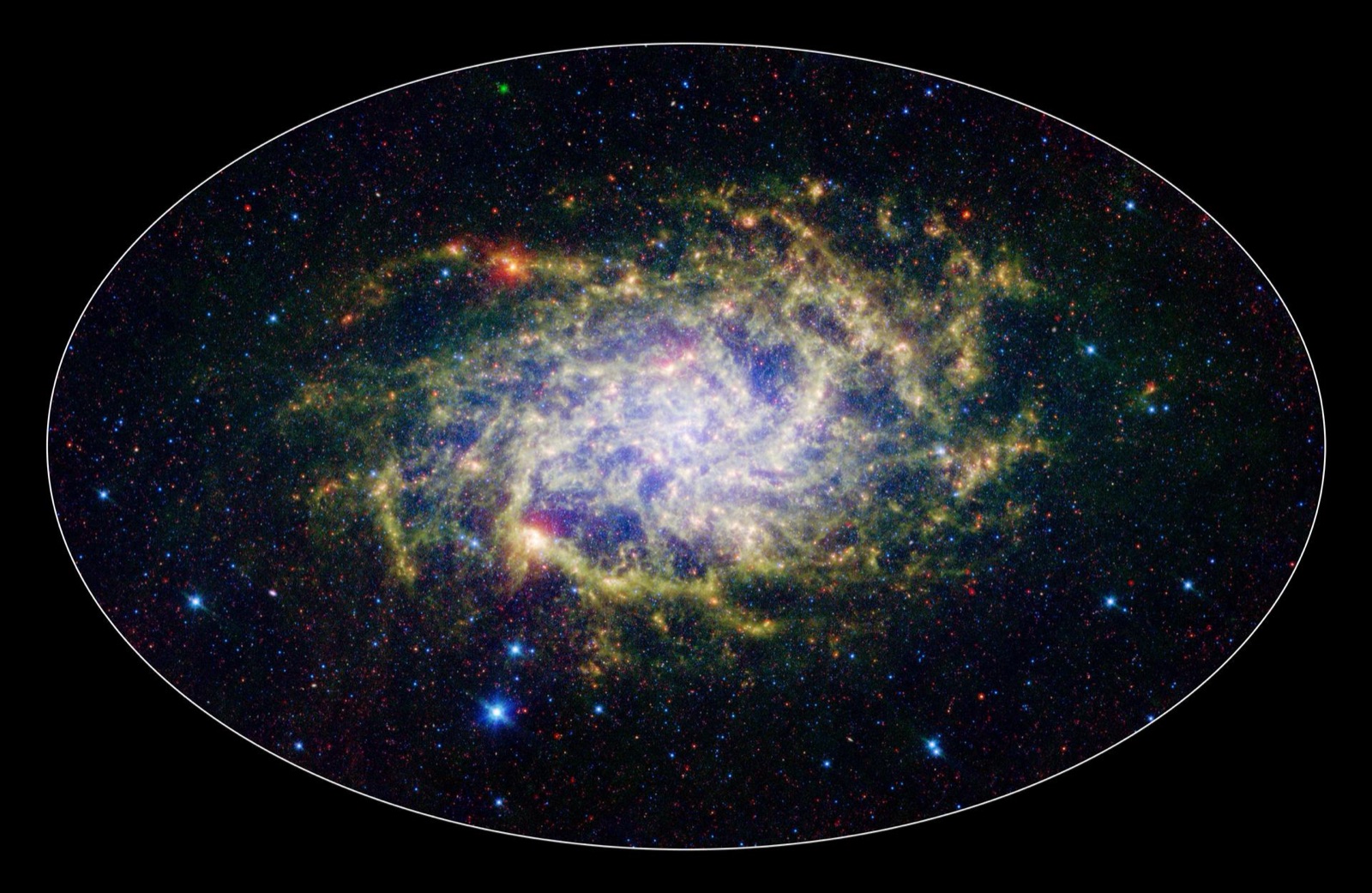
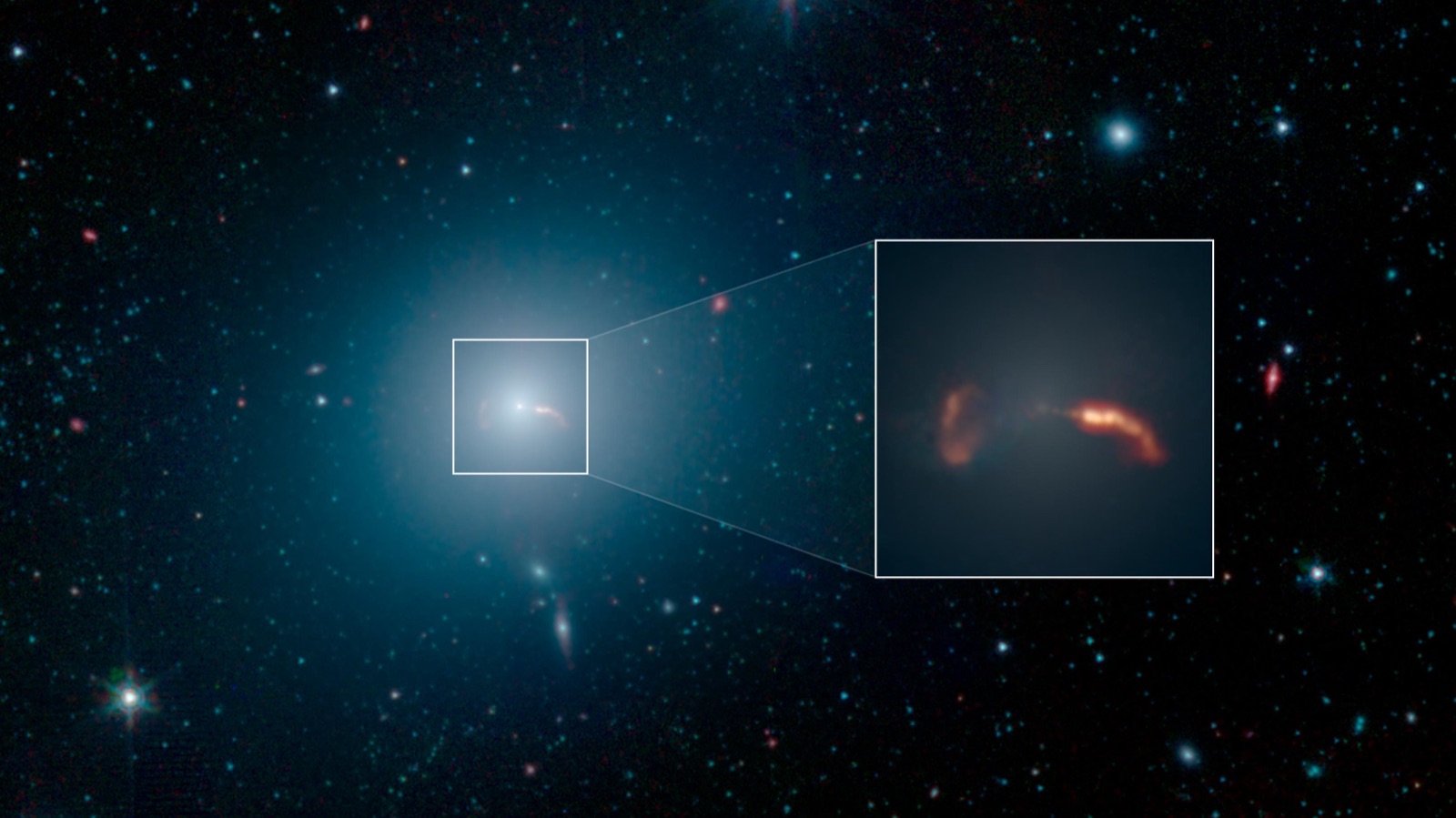
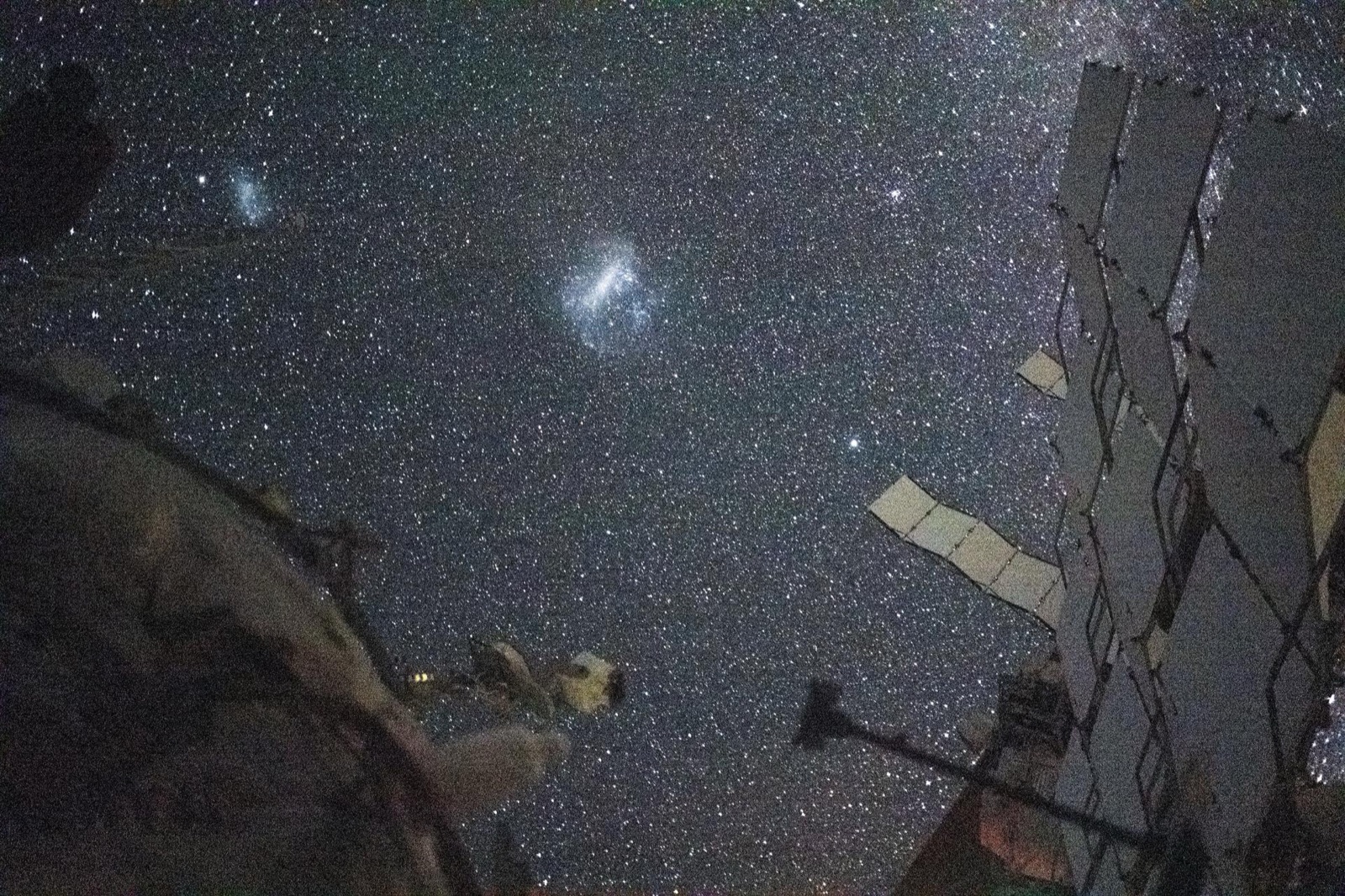
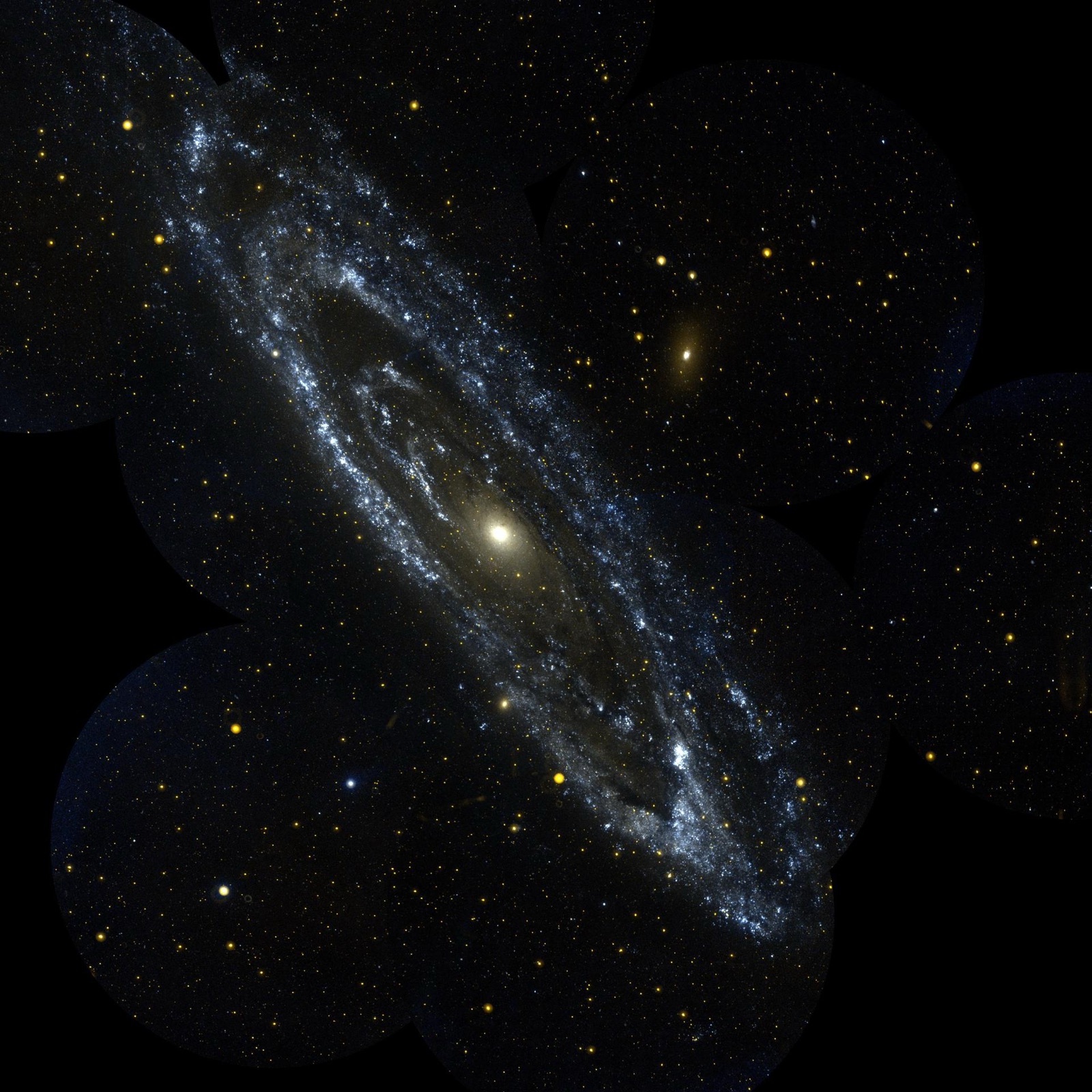
 Photograph · NASA/JPL/California Institute of Technology
Galaxy · Deep guide
The Andromeda Galaxy
Also called: M31 · Messier 31
The most distant thing you can see with your naked eye is our giant neighbor.
What is it?
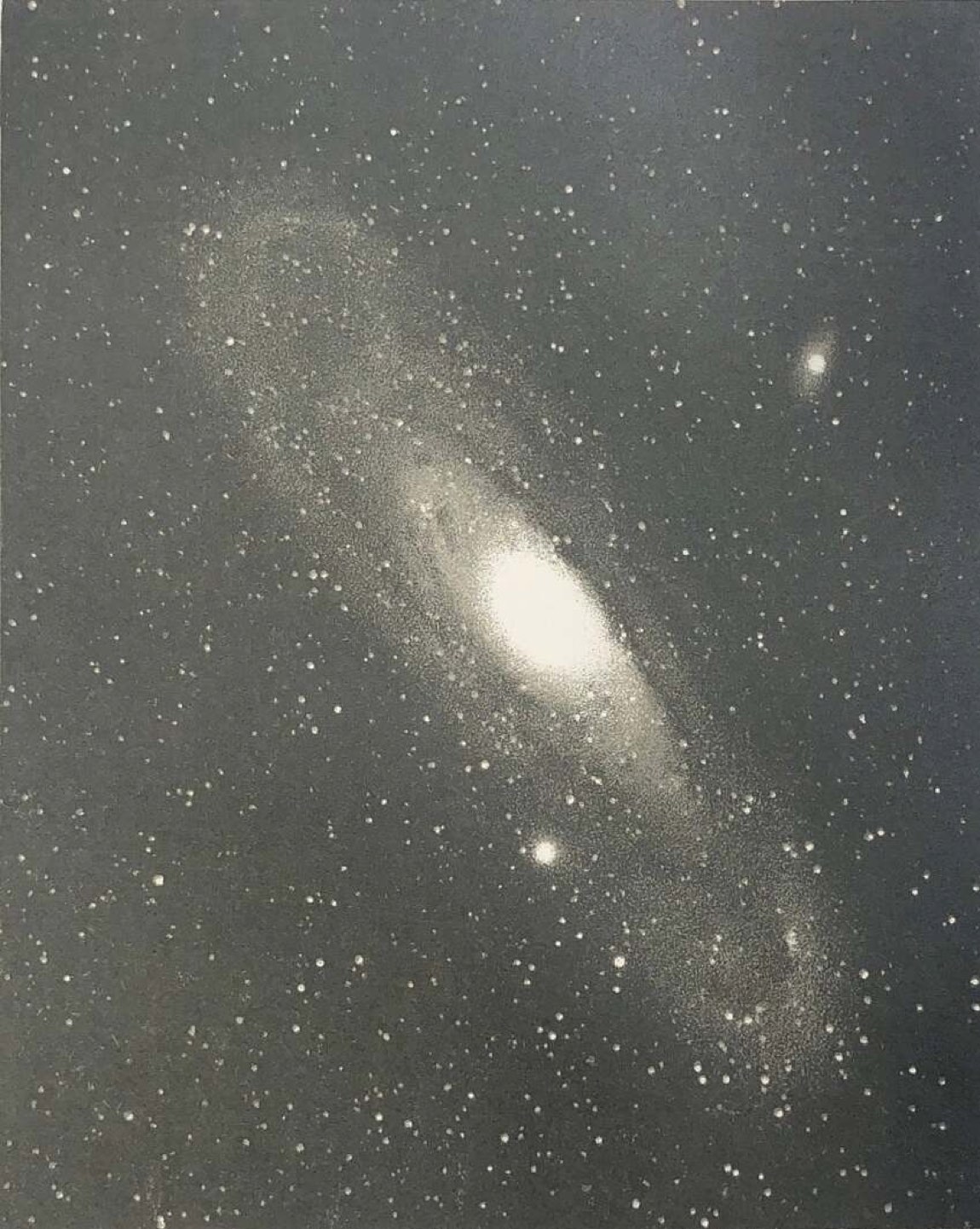
The Andromeda Galaxy is the nearest big spiral to our own — 2.5 million light-years away, a trillion stars strong, and on a slow-motion collision course with the Milky Way. On a dark autumn night you can see it without a telescope: a faint elongated smudge whose light left home 2.5 million years ago, when our ancestors were first learning to use stone tools.
Go deeper
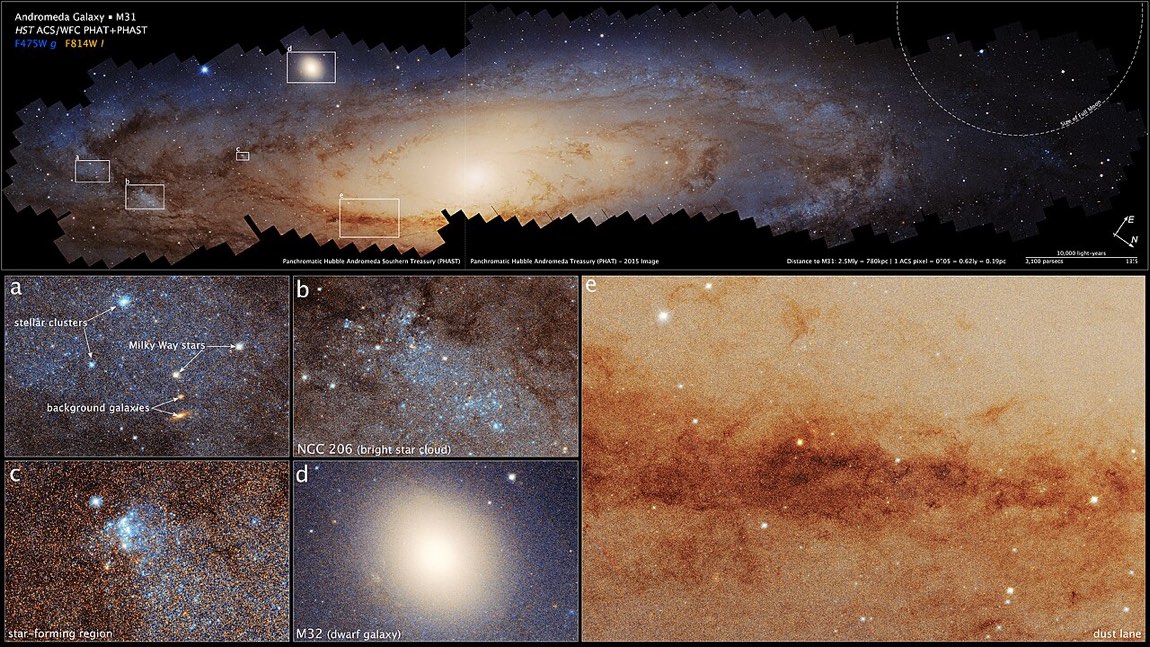
M31 anchors the Local Group with the Milky Way. Hubble's 1923 cepheid in its arms (the famous 'VAR!' plate) proved spiral nebulae are external galaxies — the single measurement that inflated the known universe a millionfold. Andromeda hosts a 100-million-solar-mass central black hole, a double nucleus, and evidence of a violent merger ~2 billion years ago (its giant stellar stream). Blueshifted at ~110 km/s, it and the Milky Way merge in ~4.5 billion years; recent proper-motion work (Gaia) makes the encounter slightly more grazing and less certain in timing than older headlines claimed.
01 How to see it tonight
Autumn and winter evenings, northern hemisphere: find the great square of Pegasus, hop two stars along Andromeda's chain, then two faint stars up — the smudge is M31. From dark skies it is obvious with averted vision; binoculars show it spanning several Moon-widths. You are seeing a trillion suns with equipment you were born with.
02 The island-universe debate Deeper
A century ago, astronomy's 'Great Debate' asked whether spiral nebulae were gas clouds inside our galaxy or 'island universes' beyond it. Hubble's cepheid distance to Andromeda (1923) settled it overnight: the universe is made of galaxies, and ours is one among what we now count in the trillions. Arguably no single photograph changed cosmology more.
The deep dive
Researched for the Atlas from Wikipedia — Andromeda Galaxy (34,342 characters read) · updated Sep 20, 2026
03 A galaxy caught in slow transition
Astronomers classify Andromeda as sitting in what they call the "green valley" of the galaxy color-magnitude diagram — a middle ground between vigorous blue-cloud galaxies still churning out stars and quiescent red-sequence galaxies that have largely stopped. Andromeda is running out of the cold gas it needs to make new stars, producing only about one solar mass of new stars per year. The Milky Way, by comparison, forms stars at three to five times that rate. The rate of novae in the Milky Way is also double that of Andromeda. Models predict that Andromeda's star formation will extinguish entirely within about five billion years — even accounting for the brief burst expected when it collides with the Milky Way. If nothing changes, our galaxy may eventually outshine its famous neighbor.
 ⤢
⤢
04 The violent merger that built Andromeda Deeper
Andromeda was not always so calm. Between two and three billion years ago, a major merger occurred at its location involving two galaxies with a mass ratio of approximately four-to-one. The collision was so violent that for roughly 100 million years afterward Andromeda blazed as a luminous infrared galaxy, pouring out enormous energy as compressed gas collapsed into new stars at a furious rate. Computer modeling of that ancient catastrophe accounts for a remarkable range of structures we see today: the galaxy's metal-rich halo, the Giant Stream of stars that trails away from it, the extended thick disk, the thin young-age disk, the prominent bar, the overall halo density profile, and the striking 10-kiloparsec ring of star formation. Even the bulge profile matches what simulations produce. In short, much of what defines Andromeda's appearance today is a scar from a single, billion-year-old collision.
05 Inside the strange double nucleus Deeper
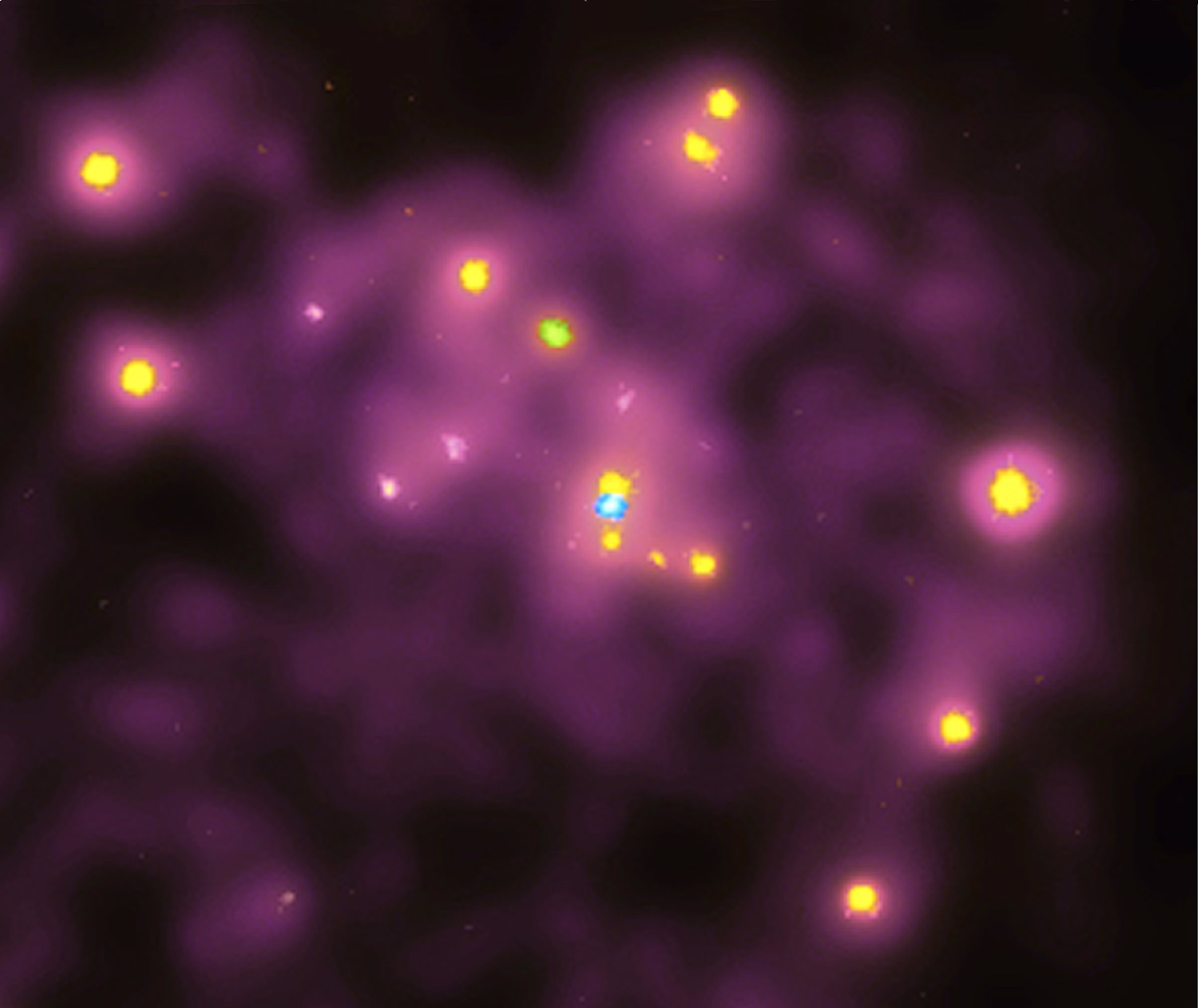
When the Hubble Space Telescope imaged Andromeda's very core in 1991, it revealed something unexpected: not one but two distinct concentrations of stars separated by only 1.5 parsecs, roughly 4.9 light-years. The brighter concentration, called P1, sits offset from the true gravitational center of the galaxy. The dimmer concentration, P2, marks the actual center and harbors a compact cluster of hot, ultraviolet-bright A-type stars along with the supermassive black hole designated M31*, whose mass has been measured at between 1.1 and 2.3 times 100 million solar masses. The leading explanation for the double appearance is that P1 is a disk of stars on eccentric orbits around the black hole — they spend more time near their farthest point from it, so they pile up and look like a separate blob. One hypothesis traces that eccentric disk to a past black hole merger whose gravitational-wave recoil kicked stars into their unusual orbits.
06 Mapping the mass we cannot see Deeper
Figuring out how much Andromeda actually weighs has proven stubbornly difficult, and the answer has shifted repeatedly. Before 2018, most estimates placed its halo mass — including dark matter — at roughly 1.5 trillion solar masses, making it substantially heavier than the Milky Way. Then radio measurements in 2018 pulled that figure back down to about 800 billion solar masses, nearly matching our own galaxy. By 2019, escape-velocity and dynamical-mass calculations placed Andromeda at just 0.8 trillion solar masses — only about half the Milky Way's revised 2019 mass of 1.5 trillion solar masses. Meanwhile the stellar mass — just the stars, not dark matter — stands at 100 to 150 billion solar masses: about 30 percent sitting in the central bulge, 56 percent spread across the disk, and 14 percent scattered through the stellar halo. The article's own summary states plainly that this question remains under active investigation by several research groups worldwide.
 ⤢
⤢
07 A halo of hot gas halfway to Earth
Surrounding Andromeda's visible stellar disk is an enormous, nearly invisible shroud of hot gas. This halo stretches roughly a million light-years from the galaxy — halfway across the gap to the Milky Way — and contains an estimated mass equal to about half of all the stars in Andromeda combined. It is not pristine: supernovae erupting inside the galaxy's disk have blasted heavy elements forged inside stars far out into this halo. Over Andromeda's entire lifetime, nearly half of all the heavy elements ever made by its stars have been ejected beyond the galaxy's 200,000-light-year-wide stellar disk into this diffuse reservoir. The halo's chemical enrichment and structure match what models predict for a galaxy sitting in the "green valley" — one that has lived a full, star-forming life and is gradually winding down.
08 Rings of dust and hidden star birth
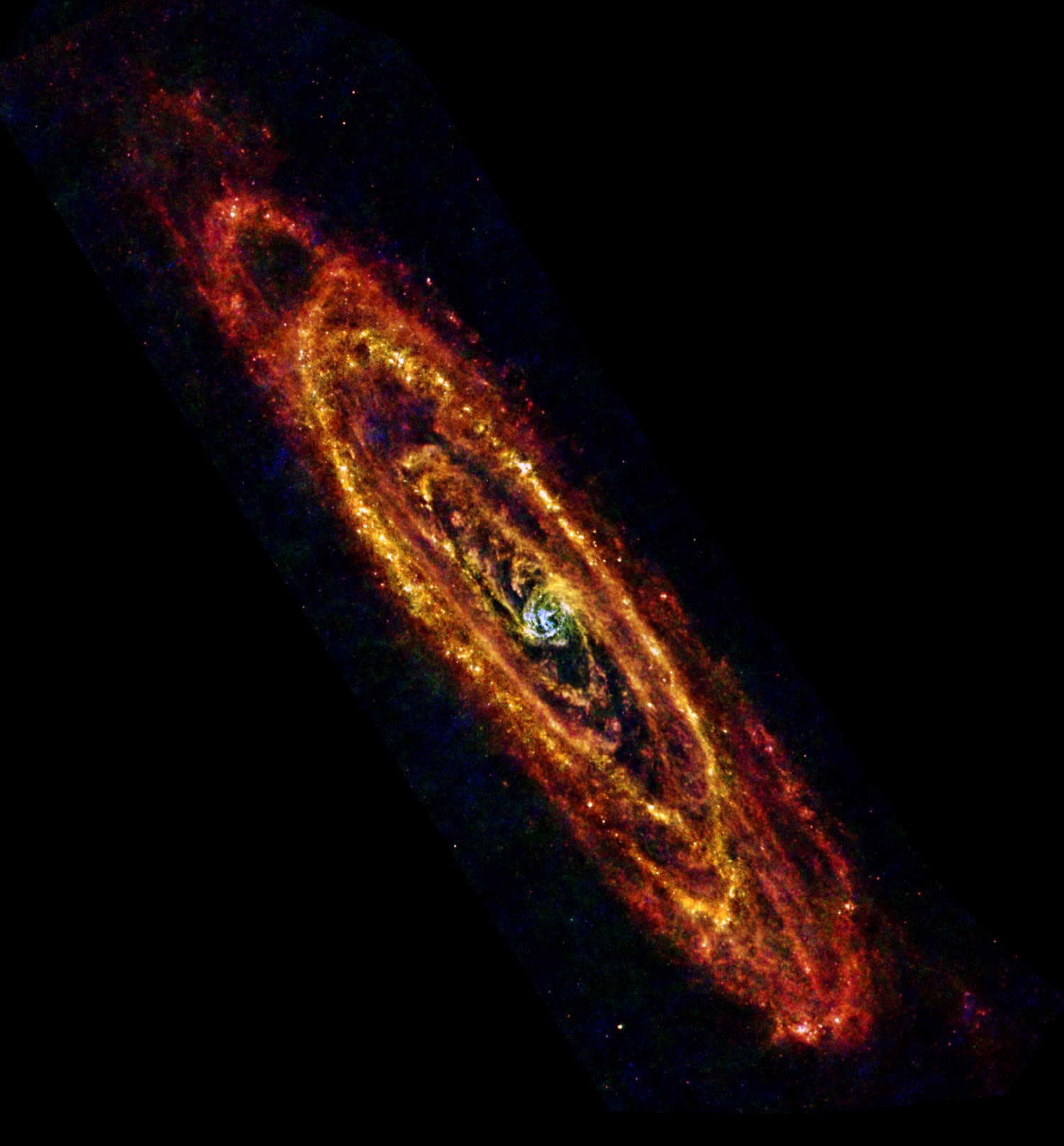
Andromeda's interior is not simply a smooth spiral but a series of overlapping rings of gas and dust. The most prominent, sometimes called the "ring of fire" by astronomers, sits at a radius of about 32,000 light-years from the core. It is all but invisible in ordinary photographs because it is composed primarily of cold dust, yet it is exactly where most of Andromeda's current star formation is concentrated. Infrared observations from the Spitzer Space Telescope reveal a smaller, inner dust ring offset from the galaxy's center, thought to be a scar left when the satellite galaxy M32 punched through Andromeda's disk more than 200 million years ago. Simulations show that collision stripped more than half of M32's original mass and triggered both ring structures — making M32 responsible for reshaping its host galaxy's interior.
09 Globular clusters unlike anything in the Milky Way
Andromeda hosts approximately 460 globular clusters — compact balls of ancient stars — and they differ from the Milky Way's in a telling way: their ages span an enormous range, from systems as old as the galaxy itself down to clusters only a few hundred million years old, far younger than nearly all Milky Way globulars. The most luminous, Mayall II (also called Globular One or G1), outshines every known globular cluster in the entire Local Group and is about twice as bright as Omega Centauri, the Milky Way's brightest. Mayall II is so massive and complex, with multiple distinct stellar populations, that many astronomers think it is not a true globular at all but the stripped core of a dwarf galaxy swallowed long ago. A separate cluster, B023-G078, is the most massive in Andromeda and likely harbors a central intermediate-mass black hole of almost 100,000 solar masses.
 ⤢
⤢
10 How Hubble turned numbers into a debate
When Walter Baade peered into Andromeda's core in 1943 — the first person ever to resolve individual stars there — he identified two distinct populations based on chemistry: young, fast-moving disk stars he called Type I, and older, redder bulge stars he called Type II. That naming convention was then adopted across all of astronomy. A decade later Baade realized he had also been using two different kinds of Cepheid variable stars as if they were one, which had caused astronomers to underestimate cosmic distances. Correcting that single error in 1953 doubled the estimated distance to Andromeda overnight — and doubled the estimated size of the known universe along with it. The Andromeda Galaxy thus sits at the center of two of the twentieth century's most consequential recalibrations of how big the cosmos actually is.
11 Radio waves, X-rays, and a rogue microquasar Deeper
Andromeda has been scrutinized across virtually the entire electromagnetic spectrum. Radio emissions were first detected in 1950 by Robert Hanbury Brown and Cyril Hazard at Jodrell Bank Observatory, with the first radio maps produced in the 1950s at the Cambridge Radio Astronomy Group by John Baldwin and collaborators. Andromeda's core appears in the 2C radio catalog as 2C 56. In 2020, the Westerbork Synthesis Radio Telescope, the Effelsberg 100-meter Radio Telescope, and the Very Large Array together revealed ordered magnetic fields aligned along the galaxy's 10-kiloparsec star-forming ring. Meanwhile the NuSTAR space mission identified 40 X-ray point sources — candidate neutron stars or black holes heating infalling gas to millions of kelvins. Most dramatically, in 2012 a microquasar was detected near Andromeda's galactic center: a jet-producing black hole of about 10 solar masses, the first microquasar ever observed outside the Milky Way.
12 A possible planet 2.5 million light-years away
In 1999, a microlensing event labeled PA-99-N2 was recorded in the Andromeda Galaxy. Microlensing occurs when a massive object drifts in front of a background star and its gravity bends and briefly brightens the star's light. One interpretation of PA-99-N2 is that a red giant was lensed by a star with a mass somewhere between 0.02 and 3.6 times that of the Sun — and that this star is accompanied by a planet with a mass about 6.34 times that of Jupiter. If confirmed, it would be the first planet ever identified outside the Milky Way entirely. A separate 2009 microlensing occurrence may also point to a planet in Andromeda. Both detections remain tentative; anomalies in the original PA-99-N2 event were subsequently identified, and extraordinary claims of this distance require extraordinary confirmation.
 ⤢
⤢
13 Measuring the unmeasurable: distance methods Deeper
Pinning down Andromeda's distance has required at least four independent techniques and more than a century of effort. A 2003 infrared surface brightness fluctuation study yielded 2.57 ± 0.06 million light-years. A 2004 Cepheid variable analysis gave 2.51 ± 0.13 million light-years. In 2005, astronomers discovered an eclipsing binary system made of two hot O- and B-type stars: by measuring the eclipse timing, they derived stellar sizes; combining size with temperature gave absolute brightness; comparing that to apparent brightness produced a distance of 2.52 ± 0.14 million light-years. The tip-of-the-red-giant-branch method that same year gave 2.56 ± 0.08 million light-years. Averaged together, these four approaches converge on 2.54 ± 0.11 million light-years — equivalent to roughly 160.6 ± 7.0 billion astronomical units. The consistency across such different physical principles gives astronomers confidence that this figure is essentially correct.
14 Satellite galaxies arranged in a suspicious plane
Andromeda is attended by more than 20 known dwarf satellite galaxies, a population similar in character to the Milky Way's retinue but more numerous. The two brightest, M32 and M110, are both visibly interacting with Andromeda: M32 appears to have lost more than half its original mass to Andromeda in a past collision, while M110 has contributed a detectable stream of metal-rich stars to Andromeda's halo. A striking discovery in 2006 added a further puzzle: nine of these satellite galaxies do not lie scattered randomly around Andromeda as independent arrivals would be expected to. Instead, they occupy a common plane that cuts through the galaxy's core. Astronomers suggest this alignment hints at a shared origin — perhaps these satellites were once part of a larger structure, like a filament or tidal debris, that fell in together rather than arriving one by one.
15 The amateur's view across 2.5 million light-years
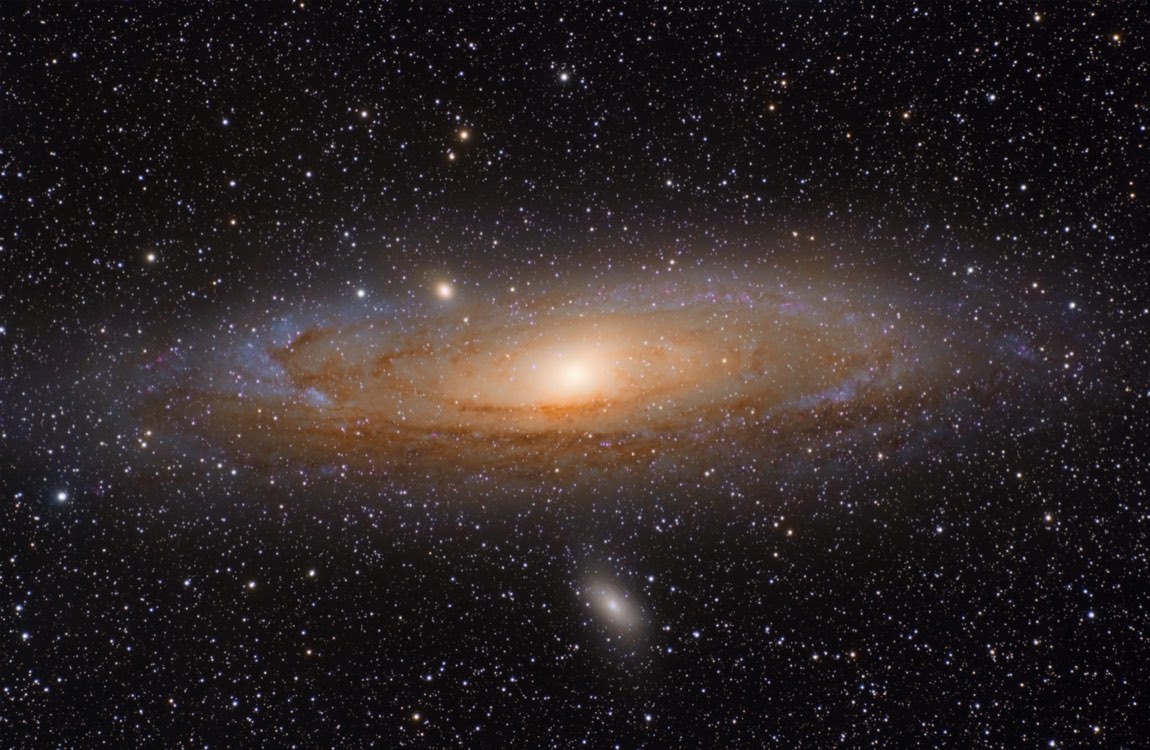
Even without a telescope, Andromeda rewards the patient observer. With an apparent magnitude of 3.4 it is among the brightest Messier objects, and on a moonless night away from city lights it appears as a faint elongated smear roughly the width of several full Moons. Binoculars bring out the galaxy's oval glow more clearly and can reveal both M32 and M110 as faint companions flanking the main disk. In the Northern Hemisphere, Andromeda climbs highest around midnight in October and is best located by hopping from the distinctive W-shape of Cassiopeia or the Great Square of Pegasus. From the Southern Hemisphere it is observable between October and December, though it stays low and is best seen from as far north as possible within the southern latitudes. The galaxy is inclined about 77 degrees from our line of sight — nearly edge-on — which is why it appears as an elongated oval rather than a full face-on spiral.
 ⤢
⤢
Could life exist here?
A trillion stars presumably means hundreds of billions of planets; nothing more specific can honestly be said. Any civilization there asking about us faces the same 2.5-million-year light delay.
Our labels: Confirmed · Strong Evidence · Estimated · Hypothesis · Theoretical · Speculative (see Methodology).
How would we get there?
2.5 million years at light speed. Intergalactic travel has no engineering literature — only imagination.
Weird & wonderful
- The light hitting your eye from Andromeda is older than the human species.
- Andromeda appears six times wider than the full Moon — cameras reveal what eyes miss.
- It seems to have eaten a large galaxy ~2 billion years ago; the leftovers form a vast stream of stars.
- When it merges with the Milky Way, Earth's night sky will blaze with newborn stars — if anyone is here to look.