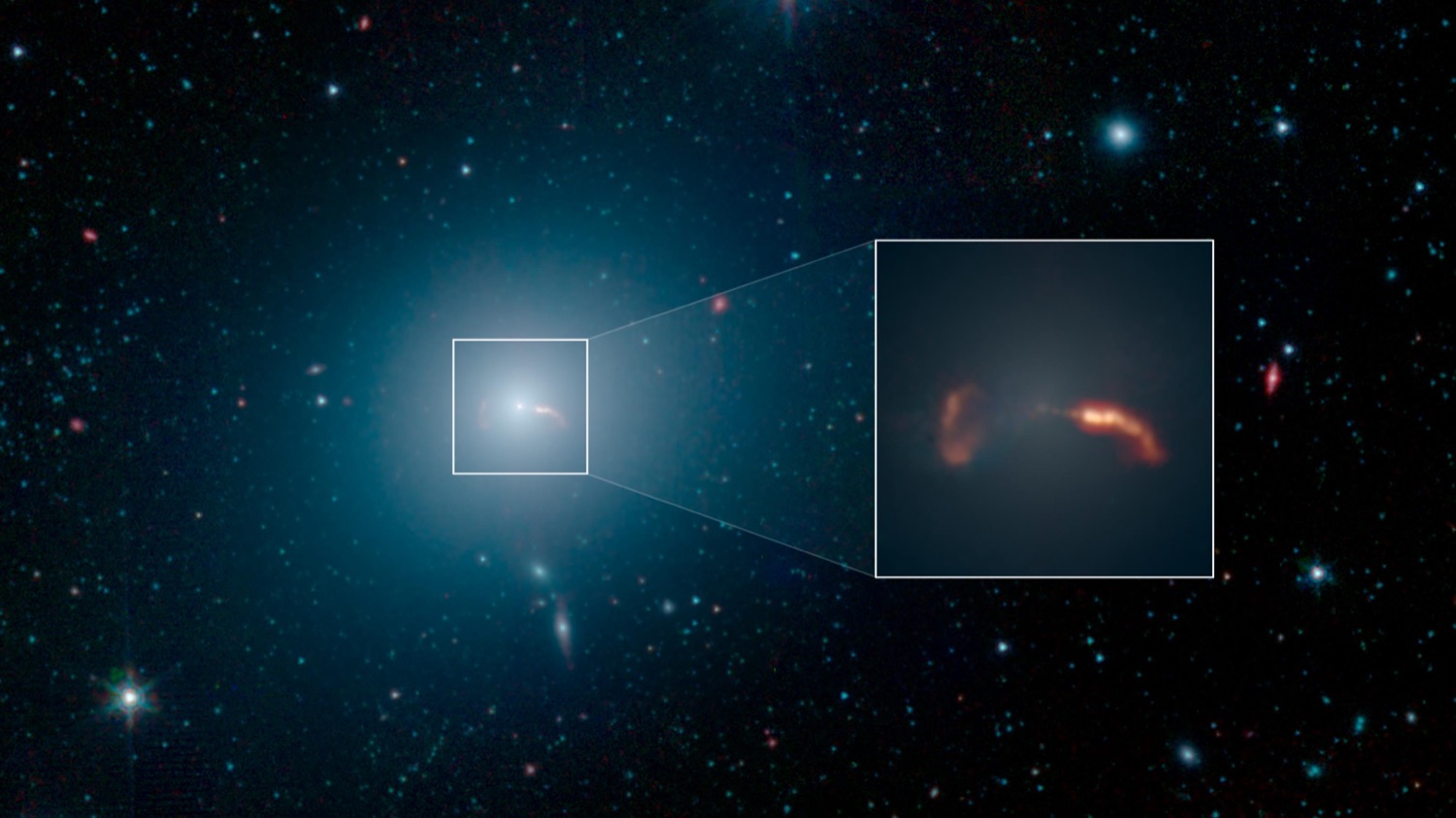
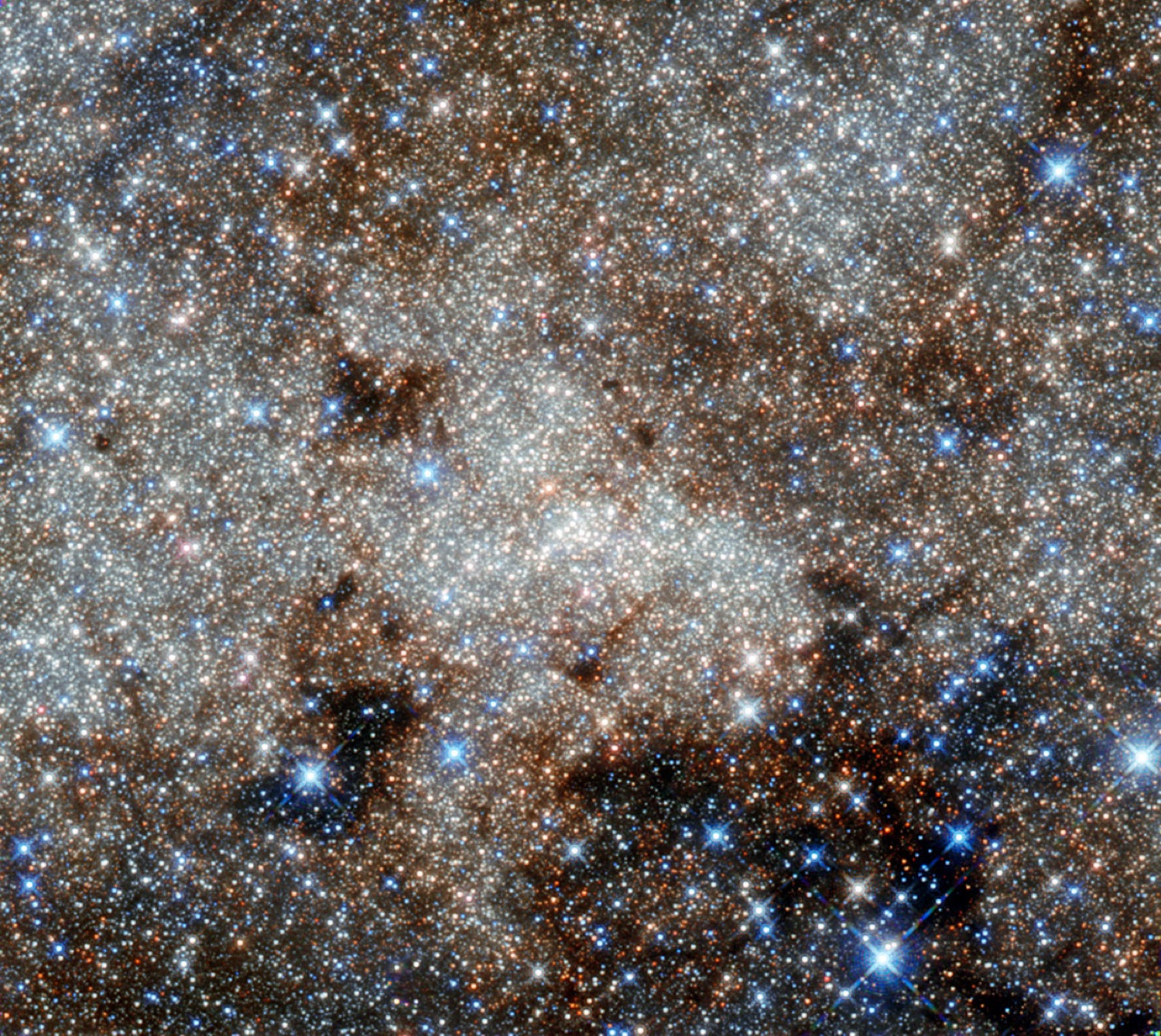
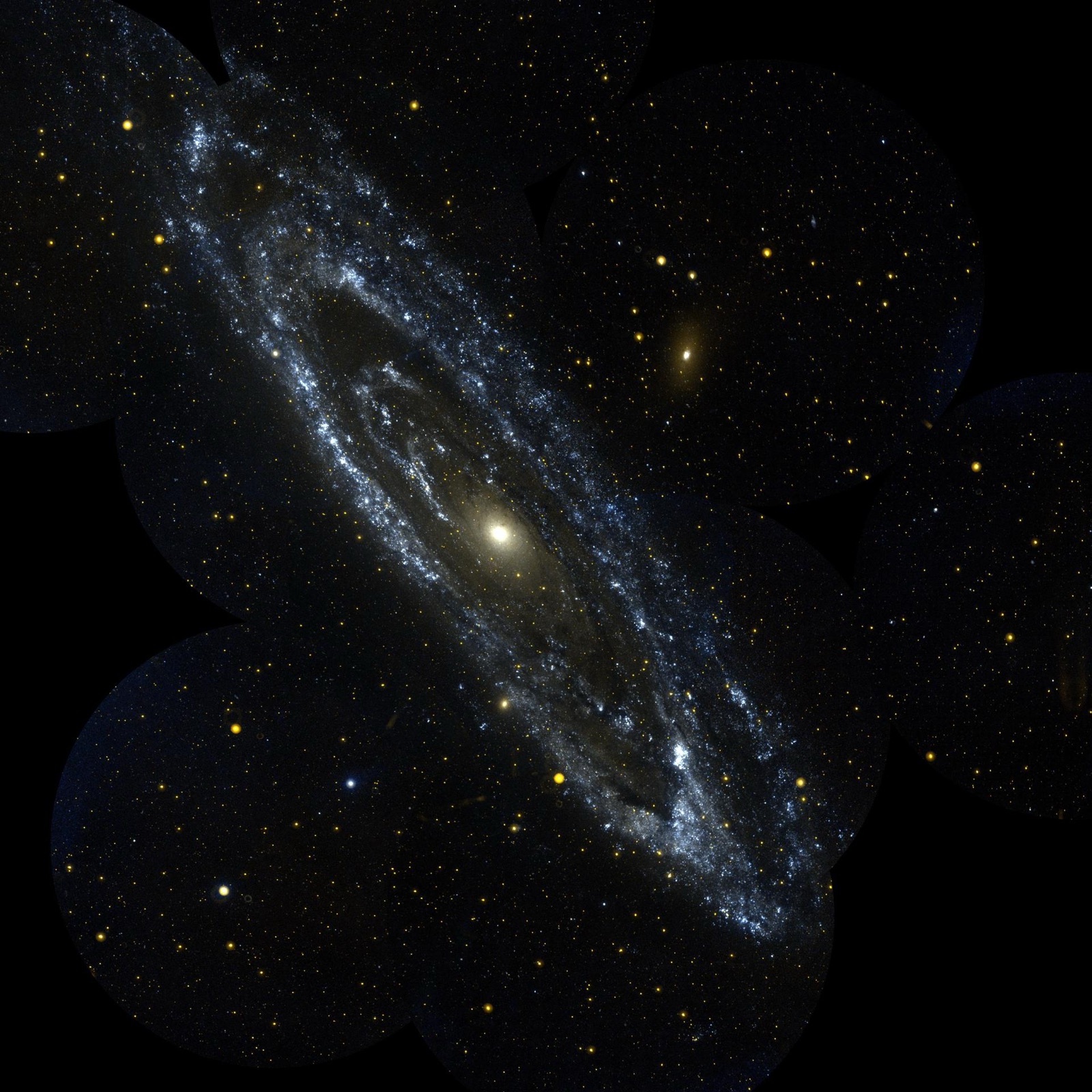
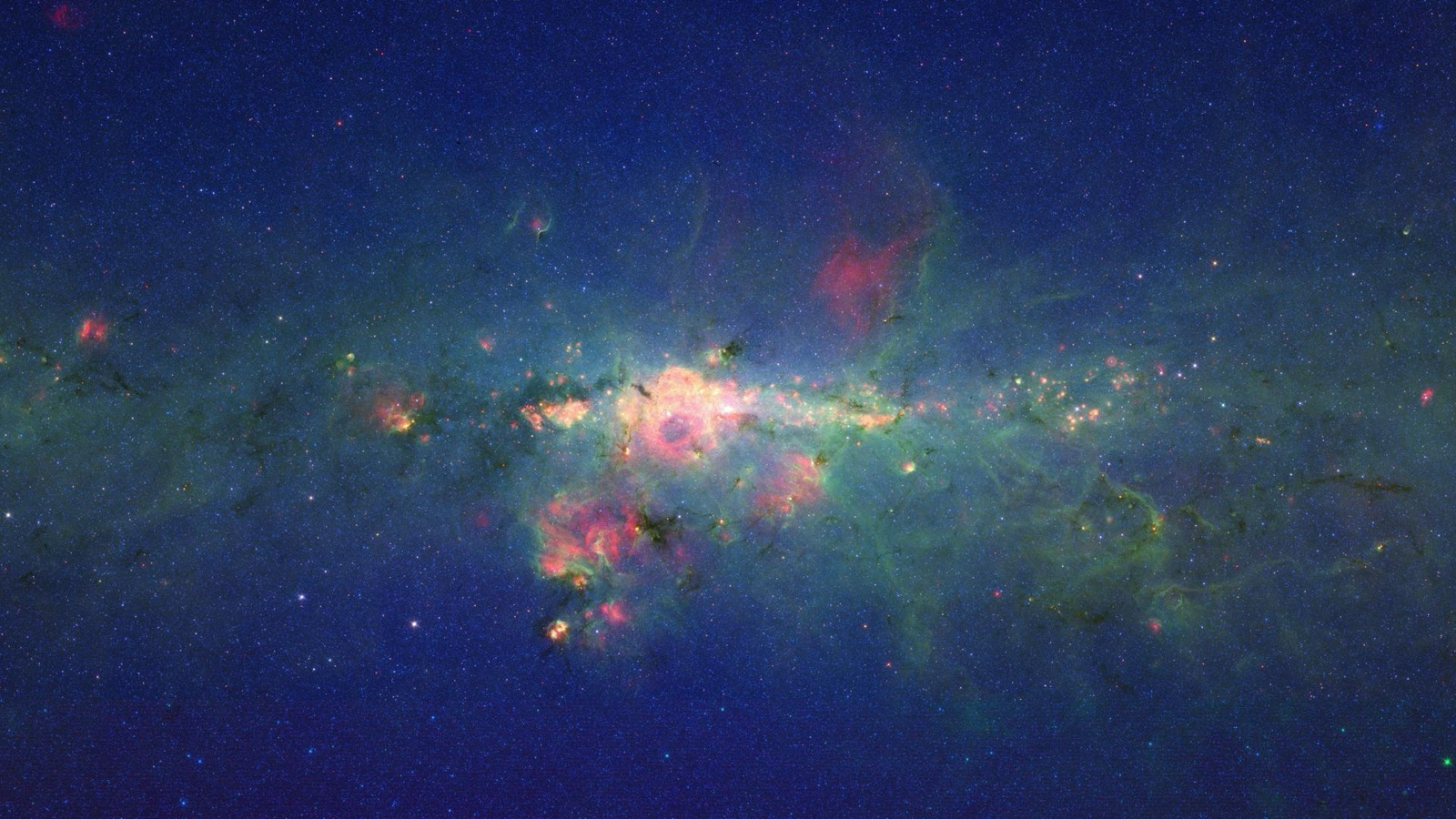
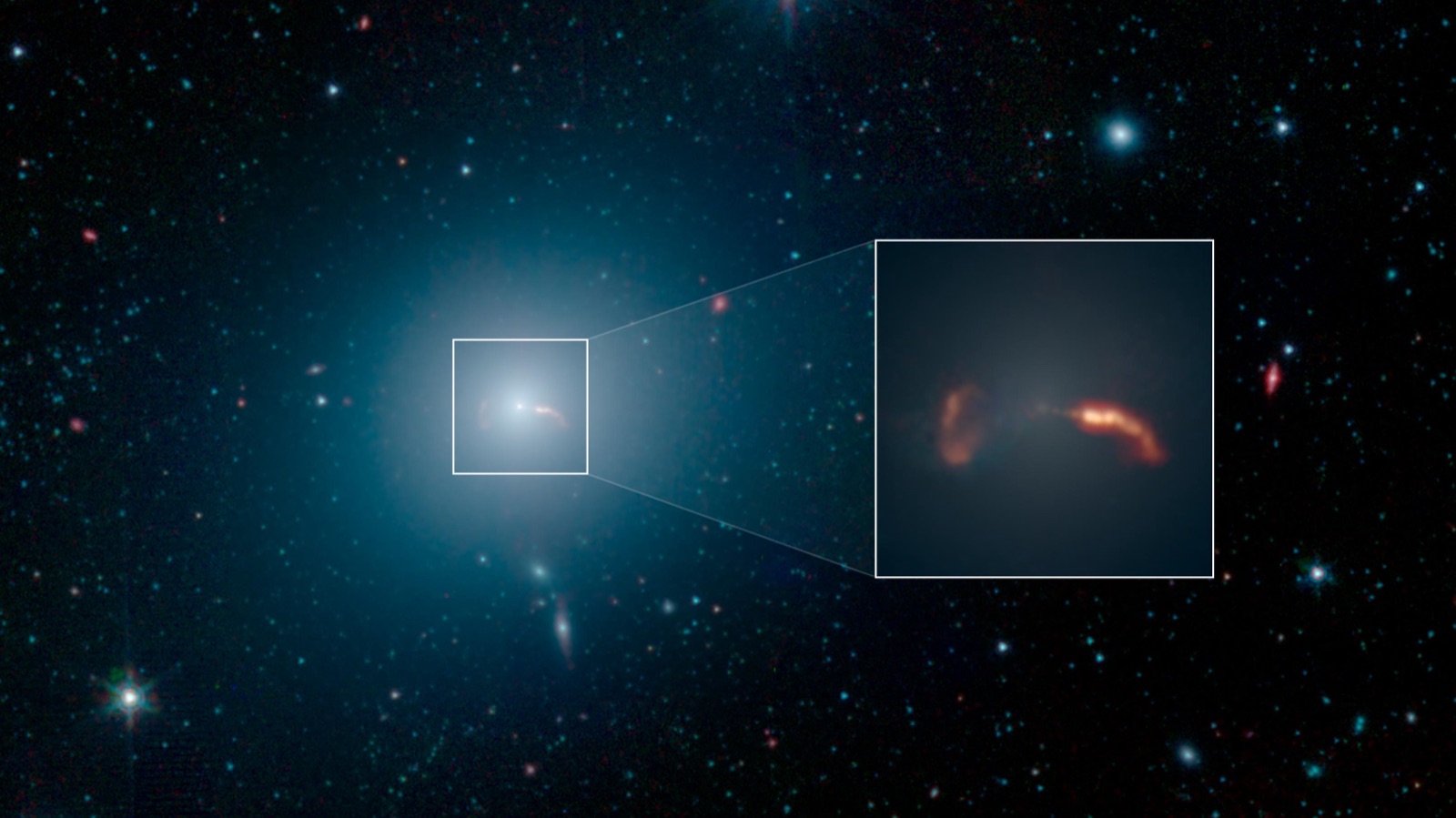
 Photograph · NASA/JPL-Caltech/IPAC/Event Horizon Telescope Collaboration
Galaxy · Deep guide
Messier 87
Also called: M87 · Virgo A
A giant elliptical galaxy with the first black hole humanity ever photographed.
What is it?
M87 is a monster: a giant elliptical galaxy of several trillion stars at the heart of the Virgo Cluster, 55 million light-years away. It became world-famous in April 2019, when the Event Horizon Telescope unveiled the first image of a black hole — M87's central giant, 6.5 billion times the Sun's mass, glowing as an orange ring of superheated gas around a shadow.
Go deeper
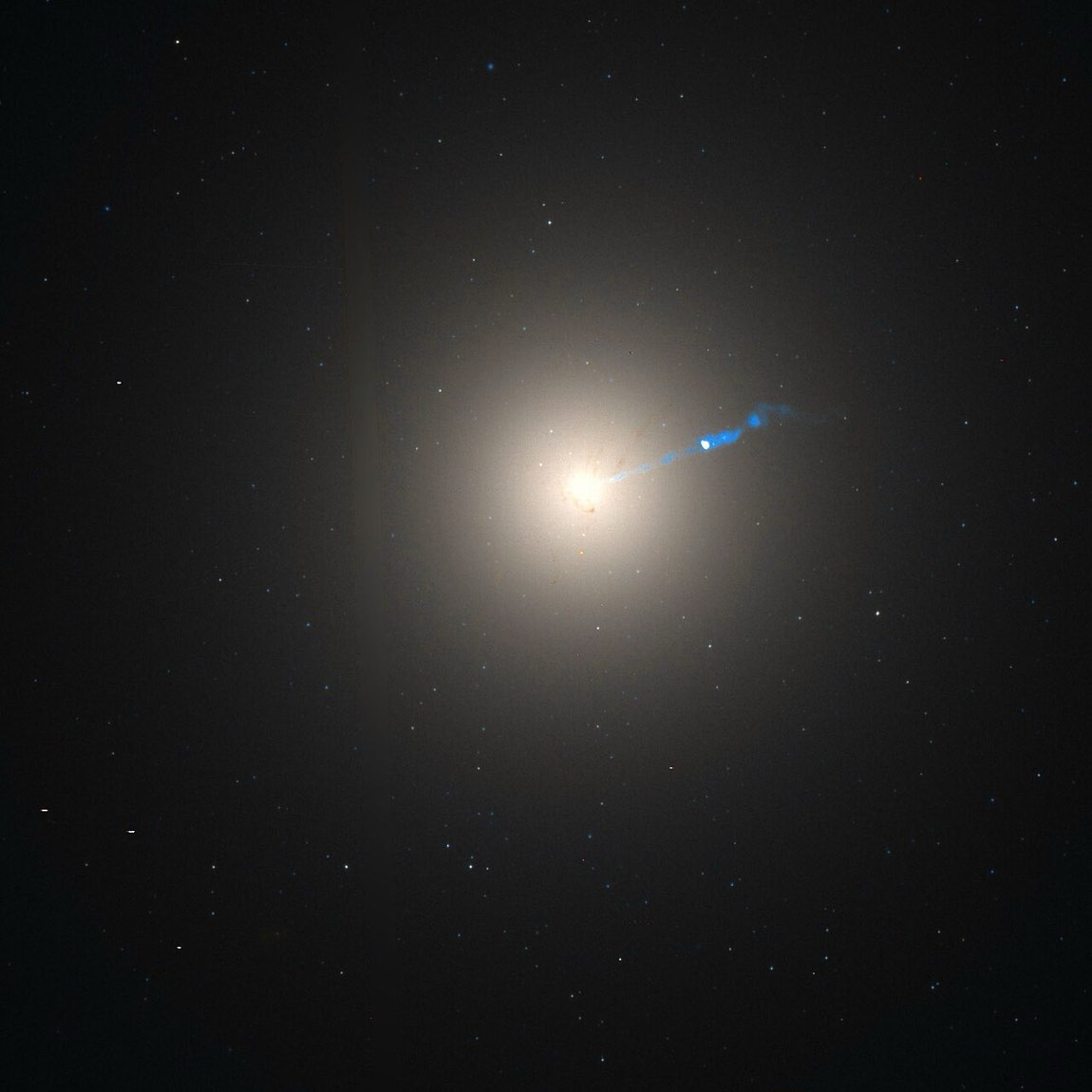
M87 is the archetypal radio galaxy: its black hole drives a relativistic plasma jet 5,000 light-years long (visible in Hubble images, discovered photographically in 1918). Ellipticals like M87 are merger end-states — old red stars, little gas, swarmed by ~15,000 globular clusters. The EHT image tested general relativity at the event-horizon scale: ring diameter matched Kerr-metric predictions within uncertainty; 2021 polarization maps added the magnetic-field structure that launches the jet.
01 The photograph of the invisible
A black hole emits no light — but gas spiraling in glows ferociously, and the hole's gravity bends that glow around itself, leaving a dark 'shadow.' To resolve something so small so far away, astronomers linked radio dishes from Hawaii to the South Pole into one Earth-sized virtual telescope. The orange ring published on April 10, 2019 was the first direct look at a black hole in human history.
02 Why ellipticals are 'red and dead' Deeper
Giant ellipticals formed through repeated mergers that used up or expelled cold gas, quenching star birth; what remains are ancient stars orbiting every-which-way, no disk, no arms. M87's central engine helps keep it dead: jet outbursts reheat the surrounding gas before it can cool into new stars — black-hole 'feedback' regulating a trillion-star system.
The deep dive
Researched for the Atlas from Wikipedia — Messier 87 (26,899 characters read) · updated Sep 20, 2026
03 Charles Messier's accidental catalog entry
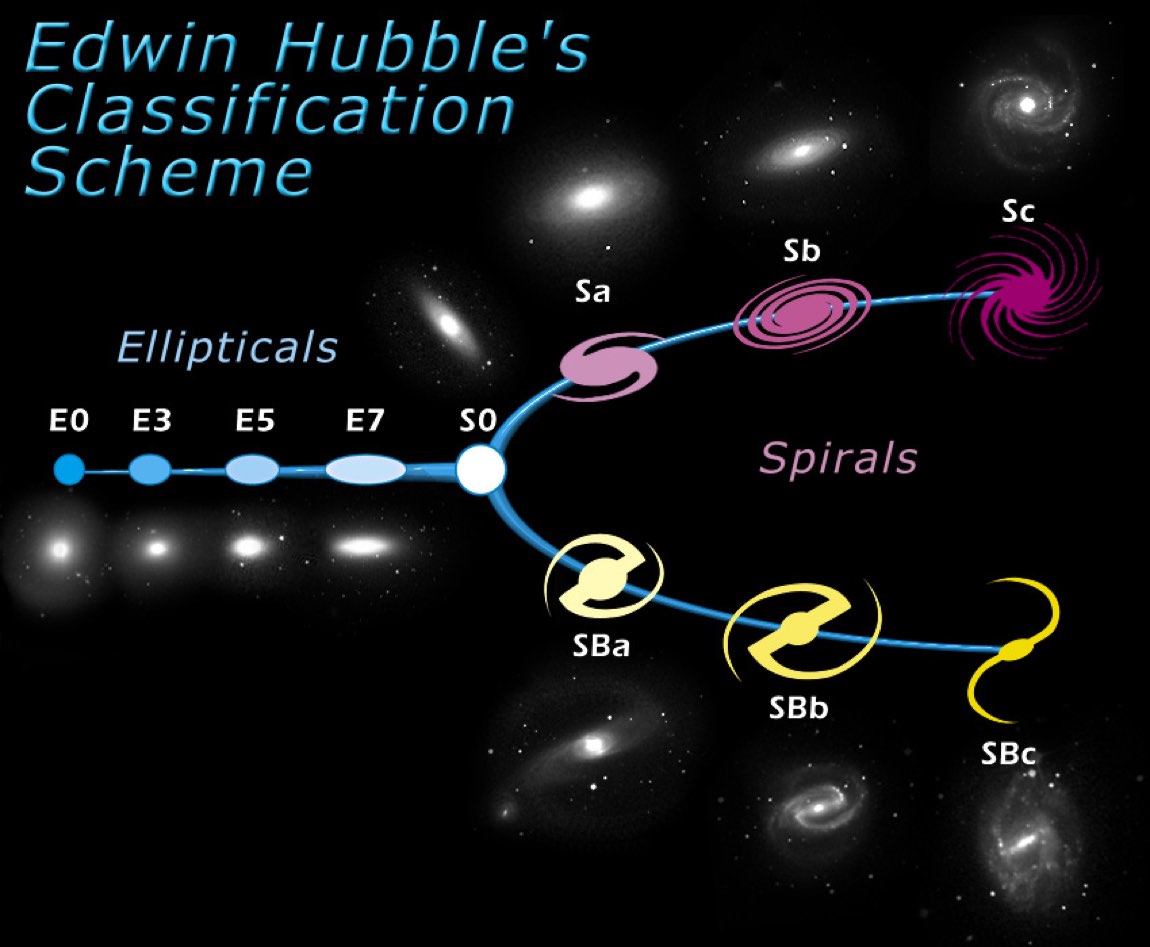
In 1781, Charles Messier was hunting comets, and his catalog existed purely to stop astronomers from being fooled by fuzzy, comet-like smudges that refused to move. M87 was entry eighty-seven on that list of things-that-are-not-comets. Messier recorded it simply as a nebula — a cloud of gas, presumably — because nothing in eighteenth-century astronomy could suggest it was an entirely separate stellar city trillions of stars strong. Decades later, during the 1880s, the Danish-Irish astronomer John Dreyer folded it into his New General Catalogue as NGC 4486, drawing primarily on observations by the English astronomer John Herschel. It was not until 1922 that Edwin Hubble formally classed it as an elliptical extragalactic nebula of type E0, and even then the word "galaxy" was still considered a synonym for the Milky Way alone. M87 continued to be labeled an extragalactic nebula in the literature at least until 1954 — meaning nearly two centuries passed between its discovery and its secure identity as a galaxy in its own right.
04 The jet that puzzled astronomers for decades
In 1918, astronomer Heber Curtis at Lick Observatory noticed something strange protruding from M87: a "curious straight ray apparently connected with the nucleus by a thin line of matter," brightest near the galactic center. Nobody knew what to make of it. It took until 1947 before a prominent radio source dubbed Virgo A was tentatively linked to M87, and not until 1953 was that identification confirmed, with the relativistic jet fingered as the cause. The jet extended from the core at a position angle of 260 degrees, reaching an angular distance of 20 arcseconds with a width of 2 arcseconds. In 1969–1970, a strong component of the radio emission was found to closely align with the optical source of the jet, cementing the connection. For most of that intervening half-century, astronomers had a photograph of one of the most energetic structures in the observable universe and no framework to explain it — a reminder of how long it can take for observations to find their theory.
05 Anatomy of a relativistic jet Deeper
M87's jet is not a simple, uniform beam. It is highly collimated close to the black hole — confined to an angle of just 60 degrees within 0.8 parsecs (2.6 light-years) of the core — and gradually broadens to about 16 degrees at two parsecs (6.5 light-years) and 6 to 7 degrees at twelve parsecs (39 light-years). Its base has a diameter of 5.5 ± 0.4 Schwarzschild radii. The jet is also precessing, which winds the outflow into a helical pattern extending out to 1.6 parsecs (5.2 light-years), and it is surrounded by a slower, non-relativistic component. Walter Baade found that the jet's light is plane-polarized, indicating that its energy comes from electrons accelerating at relativistic speeds through a magnetic field — a process called synchrotron radiation. The total energy stored in those electrons is estimated at 5.1 × 10⁵⁶ ergs (5.1 × 10⁴⁹ joules), which is roughly 10¹³ times the energy the entire Milky Way radiates in one second. Lobes of expelled matter eventually spread out to 80 kiloparsecs (260,000 light-years) from the nucleus, and a counter-jet almost certainly exists on the far side but is hidden from Earth by relativistic beaming.
 ⤢
⤢
06 When a jet appears faster than light
Photographs taken by the Hubble Space Telescope in 1999 showed M87's jet appearing to move at four to six times the speed of light. This sounds like a violation of physics, but it is an optical illusion known as superluminal motion. Because the jet is aimed partly toward Earth and traveling at 80 to 85 percent of the speed of light, each successive pulse of light has a shorter distance to travel than the previous one. Signals therefore pile up, and an observer registers the pulses arriving far faster than they were emitted. The geometry compresses time intervals, making the apparent sideways motion look impossible. This effect has real scientific value: detecting superluminal motion in M87 supports the idea that quasars, BL Lacertae objects, and radio galaxies are all the same class of active galaxy seen from different viewing angles. M87's nucleus is thought to be a BL Lacertae object of lower luminosity than its surroundings, observed from a relatively large angle — meaning that if we were positioned along the jet's axis, M87 would blaze as a quasar rather than the familiar elliptical galaxy we see today.
07 Black-hole eruptions and their lasting scars Deeper
The rate at which material is ejected from M87's black hole is not steady, and those fluctuations leave permanent marks on the galaxy's hot gas. Chandra X-ray Observatory observations have revealed loops, rings, and cavities in that gas. The pattern implies minor eruptions occurring every few million years. One ring, produced by a particularly major outburst, is a shock wave 26 kiloparsecs (85,000 light-years) in diameter centered on the black hole — larger than the entire visible disk of the Milky Way. A large cavity in the hot gas traces an eruption that took place 70 million years ago. The Chandra data also show narrow X-ray-emitting filaments stretching up to 31 kiloparsecs (100,000 light-years). These eruptions do more than carve cavities: they continuously reheat the surrounding gas reservoir, preventing it from cooling enough to collapse into new stars. Astronomers believe this feedback mechanism has fundamentally shaped M87's history, potentially stopping it from ever developing into a large spiral galaxy. A single knot in the jet designated HST-1, located about 65 parsecs (210 light-years) from the core, brightened by a factor of 50 in X-ray intensity over just four years before 2006, then began a variable decay — a dramatic demonstration of how dynamic these structures are on human timescales.
08 Reading the chemistry of M87's interstellar gas Deeper
The nuclear spectrum of M87 reveals emission lines from hydrogen, helium, oxygen, nitrogen, magnesium, and sulfur in various ionization states. Crucially, weakly ionized species such as neutral atomic oxygen (OI) produce stronger lines than highly ionized species like doubly ionized oxygen (OIII). This signature classifies M87's nucleus as a LINER — a low-ionization nuclear emission-line region — though the precise mechanism driving that ionization pattern remains debated. Possible explanations include shock-induced excitation in the outer disk or photoionization in the inner region powered by the jet. Beyond the nucleus, the interstellar gas between M87's stars has been chemically enriched over the galaxy's history. Carbon and nitrogen are continuously supplied by intermediate-mass stars passing through the asymptotic giant branch. Heavier elements from oxygen to iron come primarily from supernova explosions: about 60 percent from core-collapse supernovae and the remainder from Type Ia supernovae. Oxygen is distributed roughly uniformly throughout at about half the solar abundance, while iron peaks near the center approaching the solar value — a spatial fingerprint of when and where each type of supernova contributed its ejecta over billions of years.
09 A surprisingly dust-poor environment
At far-infrared wavelengths longer than 25 micrometers, M87 shows an excess of emission that would normally suggest warm dust. But astronomers determined that in M87's case the emission is entirely explained by synchrotron radiation from the jet rather than any thermal glow from dust grains. The actual dust content is remarkably low: the combined mass of all dust in M87 is no more than 70,000 times the mass of the Sun. To put that in context, the Milky Way contains about one hundred million solar masses of dust — more than a thousand times as much. The explanation for M87's dust poverty is the hostile radiation environment created by the active nucleus: silicate grains are expected to survive for no more than 46 million years before being destroyed by the intense X-ray emission from the core. Any dust that is not destroyed is likely expelled from the galaxy altogether. Optical filaments do exist inside M87, but these arise from ionized gas falling inward toward the core, not from dust lanes, and they carry an estimated mass of only about 10,000 solar masses.
10 The hypervelocity globular cluster that escaped
M87's roughly 15,000 globular clusters — compared with 150 to 200 orbiting the Milky Way — are themselves a scientific resource. A 2006 survey out to an angular distance of 25 arcminutes from the core counted 12,000 ± 800 of them. Their sizes and metallicities shift with distance: within about four kiloparsecs (13,000 light-years) of the core, cluster metallicity is around half the solar value and declines further outward, while cluster diameters gradually grow with distance from the center. In 2014, astronomers discovered HVGC-1, the first hypervelocity globular cluster ever found, streaming away from M87 at 2,300 km/s. The leading explanation is that HVGC-1 passed close to a binary pair of supermassive black holes at the galaxy's center and received a powerful gravitational kick that launched it on an escape trajectory. M87 also hosts nearly a hundred ultra-compact dwarf objects that resemble globular clusters but exceed ten parsecs (33 light-years) in diameter — far larger than the accepted three-parsec maximum for globular clusters — and astronomers have not yet settled whether they are captured dwarf galaxies or a new class of massive cluster.
 ⤢
⤢
11 M87 as the heart of a supercluster
M87 sits at or very near the center of the Virgo Cluster, a tightly packed collection of approximately 2,000 galaxies, which itself forms the core of the larger Virgo Supercluster. The Local Group — the small gathering of galaxies that includes the Milky Way — is merely an outlying member of that supercluster, making M87 in some sense a gravitational anchor of our cosmic neighborhood. The Virgo Cluster is organized into at least three distinct subsystems built around the large galaxies M87, M49, and M86. M87 is likely the most massive member of the cluster and moves very little relative to the cluster as a whole, consistent with its role as the dynamical center. The cluster's combined mass is estimated between 0.15 and 1.5 × 10¹⁵ solar masses. Intracluster planetary nebulae measured between M87 and M86 suggest the two galaxies are moving toward each other and that this may be their first encounter. M87 may also have interacted with M84, an event that could account for the truncation of M87's outer halo at about 150 kiloparsecs (490,000 light-years), though unseen infalling dark matter and early feedback from the active nucleus are competing explanations.
12 Evidence that M87 ate a spiral galaxy
Elliptical galaxies are generally thought to grow by merging with other galaxies, and M87 preserves fresh evidence of at least one such meal. Using the Very Large Telescope to track the motions of about 300 planetary nebulae in M87's outer regions, astronomers determined that the galaxy absorbed a medium-sized star-forming spiral galaxy sometime within the last billion years. The absorbed galaxy added a population of younger, bluer stars to what would otherwise be an almost uniformly old stellar system. More visibly, the merger left behind a chevron-like structure in M87's halo — a subtle geometric pattern produced when stars from the disrupted galaxy have not yet fully mixed into the host galaxy's phase space. This kind of incomplete mixing is a time-sensitive tracer of past mergers: given enough time, the chevron would dissolve. There is also a filament of hot ionized gas in the northeastern outer region of M87 that may be the remnant of a small gas-rich galaxy disrupted by M87's gravity, potentially feeding material into the active nucleus even now. Linear streams of stars to the northwest of the galaxy further hint at ongoing tidal stripping of smaller satellites.
13 How to find and observe M87 yourself
M87 is located in the constellation Virgo near its high-declination boundary with Coma Berenices, and it lies along the line connecting the star Epsilon Virginis to Denebola (Beta Leonis). Despite being 53 million light-years away, it is accessible to small instruments: a telescope with a 6 centimeter (2.4 inch) aperture will show it as an elliptical glow spanning 7.2 by 6.8 arcminutes at a surface brightness of 12.9, with a distinctly bright core of about 45 arcseconds across. That bright core is one of the galaxy's most recognizable features and reflects the concentration of stars and energetic radiation pouring from the active nucleus. Seeing the relativistic jet is an entirely different challenge. Until 1991, the only person known to have seen the jet visually was astronomer Otto Struve, using the 254-centimeter (100-inch) Hooker telescope at Mount Wilson Observatory. More recently, observers with large amateur telescopes under exceptional sky conditions have glimpsed it, but for most people the jet remains a photographic target. M87 is also one of the brightest radio sources in the entire sky, meaning it plays a role in professional radio astronomy far beyond its visual appearance.
14 Naming the shadow: Pōwehi
When the Event Horizon Telescope collaboration released the first image of a black hole on 10 April 2019, the shadowy central object gained an official name: Pōwehi. The name is Hawaiian, meaning "the adorned fathomless dark creation," and was drawn from the Kumulipo, an ancient Hawaiian creation chant. The choice of a Hawaiian name carried particular significance because two of the eight telescopes that contributed data to the EHT array — the James Clerk Maxwell Telescope and the Submillimeter Array — are located on Maunakea in Hawaiʻi, making the islands a literal foundation of the image. The image itself shows the shadow of the black hole surrounded by an asymmetric emission ring with a diameter of 690 AU (103 billion kilometers). The shadow's radius is 2.6 times the black hole's Schwarzschild radius, and the brightness asymmetry around the ring is caused by relativistic beaming: material on the side moving toward Earth appears significantly brighter than material on the receding side. The visible material rotates predominantly clockwise as seen from Earth, causing the bottom portion of the emission ring to be the brighter arc in the published image.
15 Open questions that still keep researchers busy Deeper
Despite decades of study and the landmark 2019 image, M87 leaves several important questions unresolved. The mechanism that ionizes the gas in M87's LINER nucleus — whether shocks from infalling gas or photoionization driven by the jet — remains actively debated. The nature of the nearly one hundred ultra-compact dwarf objects around M87 is unsettled: they may be captured dwarf galaxies or a previously unrecognized class of massive globular cluster. Whether M87's black hole is truly centered on the galaxy or displaced by about seven parsecs was a live controversy from 2010 onward; a 2018 high-resolution study concluded the apparent offset was caused by brightness variations in the jet rather than a real physical displacement, but this illustrates how hard it is to pin down the geometry at such distances. The truncation of M87's outer halo at roughly 150 kiloparsecs — possibly from a past galactic encounter, possibly from infalling dark matter, possibly from early AGN feedback — has no definitive answer. And the polarized-light image of the black hole released in March 2021, which encodes information about the magnetic field structure near the event horizon, is still being used to understand how M87 manages to launch and sustain a relativistic jet across thousands of light-years.
 ⤢
⤢
Could life exist here?
Old stars mean stable, ancient planetary systems — but ellipticals' violent central regions and radiation jets complicate the picture. Pure unknown, weighted pessimistic near the jet.
Our labels: Confirmed · Strong Evidence · Estimated · Hypothesis · Theoretical · Speculative (see Methodology).
Weird & wonderful
- M87's jet was discovered in 1918 — nobody knew what it was for half a century.
- Its black hole's event horizon would swallow the entire Solar System several times over.
- The EHT's virtual telescope could read a newspaper in Paris from New York.