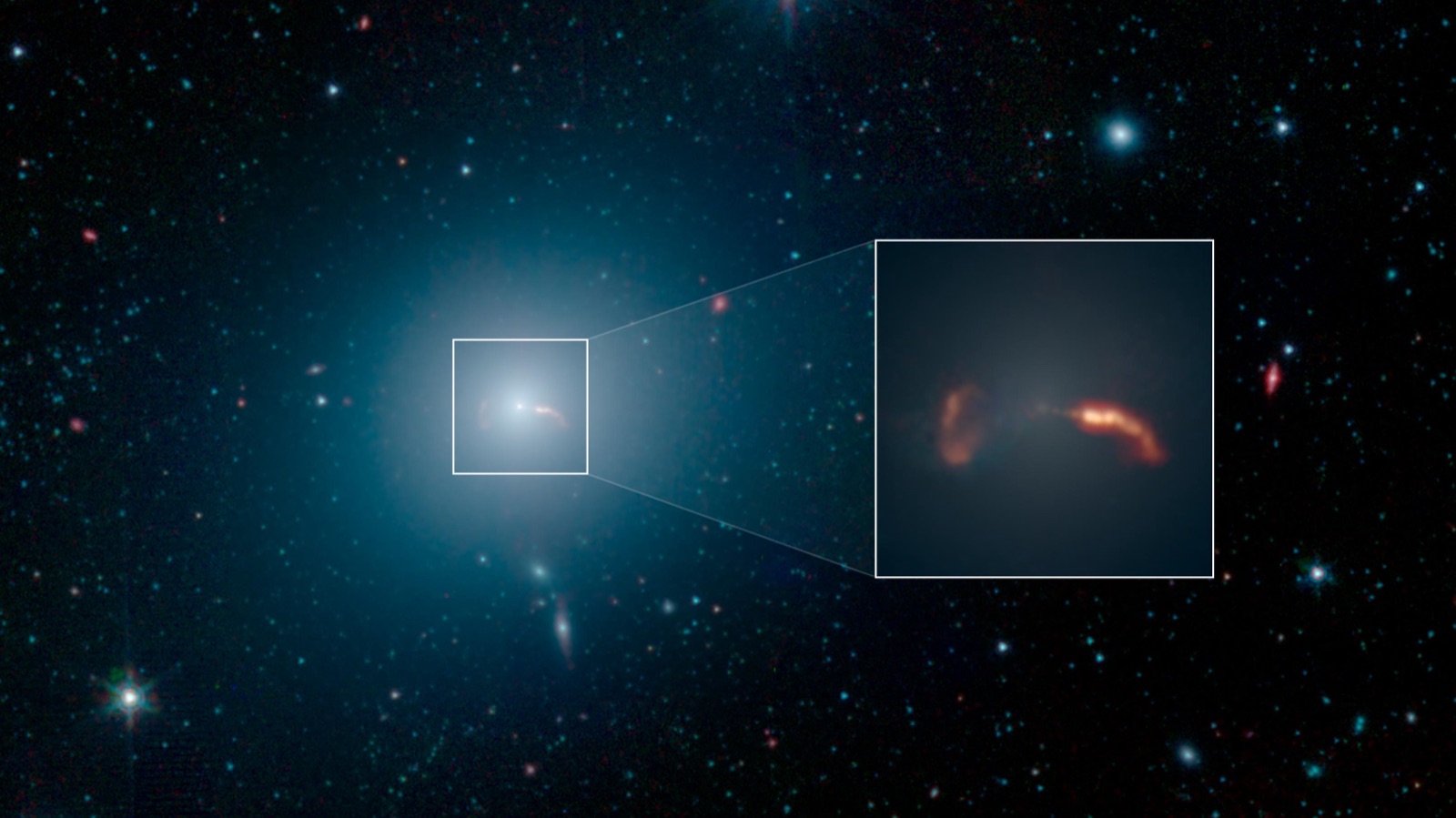
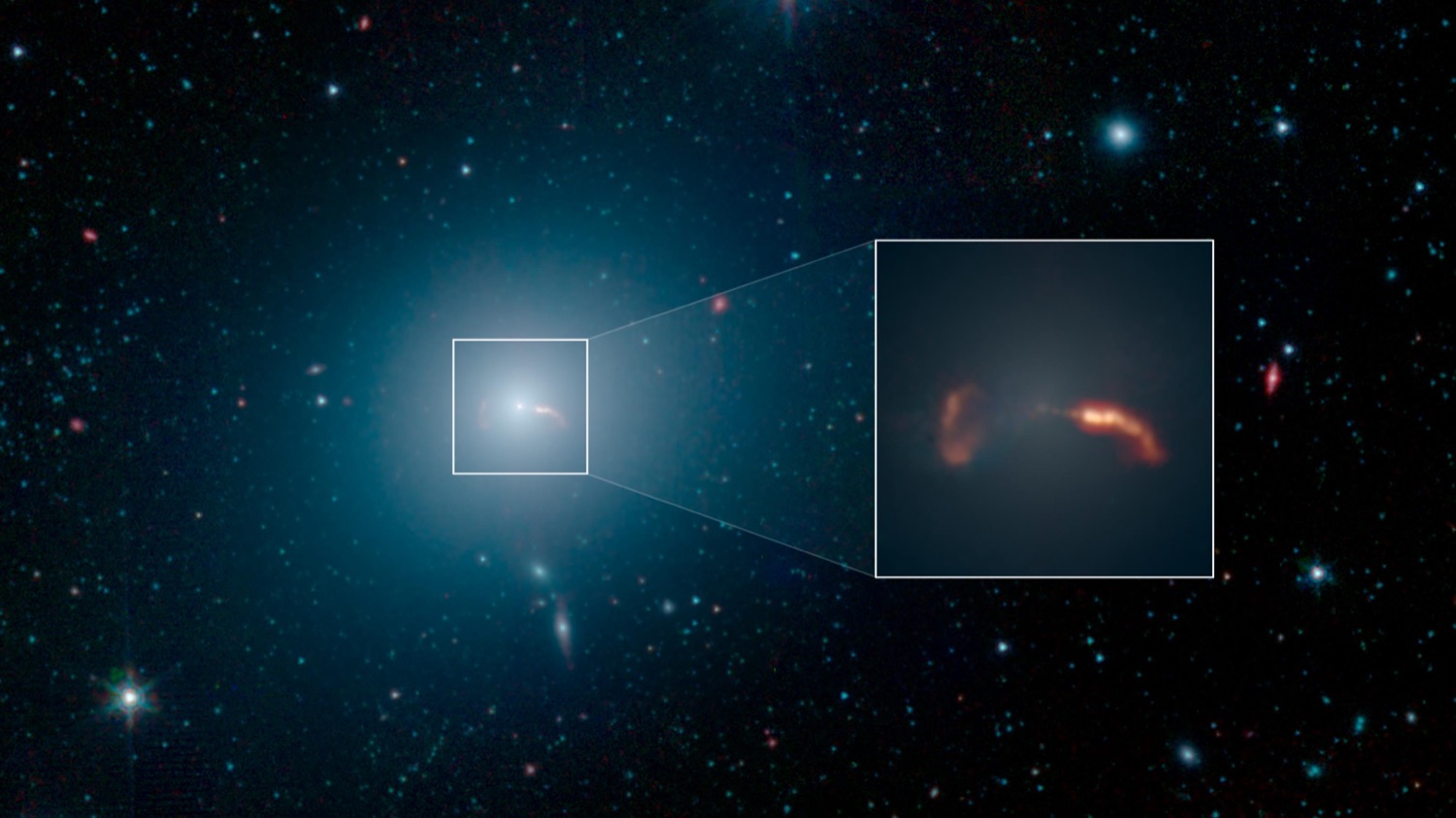
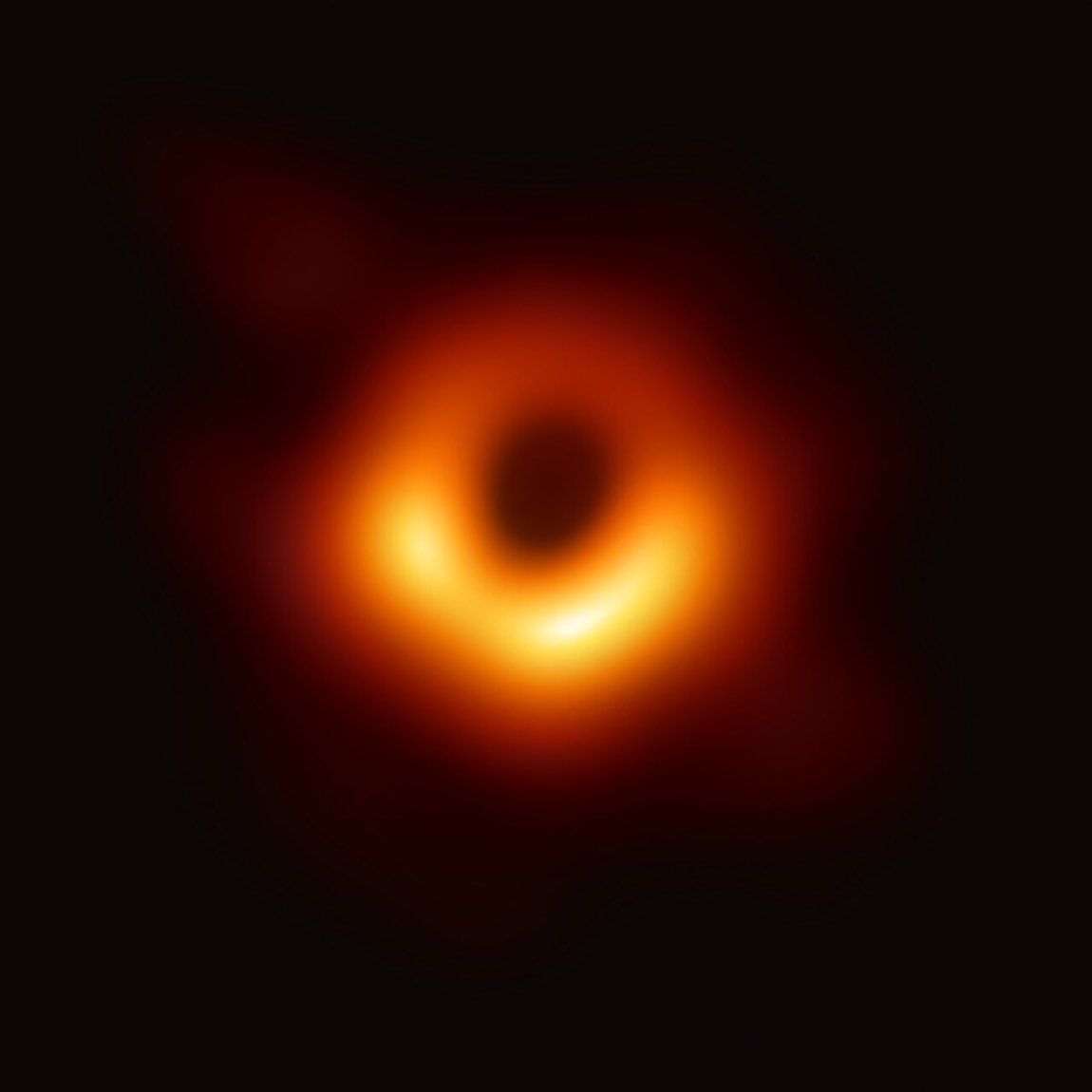
 Radio image · NASA/JPL-Caltech/IPAC/Event Horizon Telescope Collaboration
Black Hole · Deep guide
M87*
Also called: Powehi
The first black hole ever photographed is 6.5 billion Suns wearing a ring of fire.
What is it?
M87* is the supermassive black hole at the center of galaxy M87 — and the subject of the most famous scientific image of the century: the orange ring unveiled on April 10, 2019 by the Event Horizon Telescope. At 6.5 billion solar masses it is over a thousand times heavier than our galaxy's black hole, with an event horizon wider than the entire Solar System.
Go deeper
M87* was the EHT's first target precisely because it is huge: though 2,000 × farther than Sgr A*, its horizon is ~1,500 × larger, so both subtend similar angles (~40 microarcseconds — a doughnut on the Moon). Gas near it varies over days (vs minutes at Sgr A*), making imaging cleaner. The photographed ring is lensed emission at ~2.6 Schwarzschild radii; its measured diameter, brightness asymmetry (Doppler-boosted approaching side), and 2021 polarization all match a spinning Kerr black hole feeding a magnetically arrested disk that launches the 5,000-ly jet.
01 What the photo actually shows
Not the black hole itself — nothing escapes to show. The ring is superheated gas orbiting just outside, its light bent by gravity so we see behind the hole; the dark center is the 'shadow', the region from which light cannot reach us. One side glows brighter because that gas streams toward us at near light speed. Every part of the image is physics you can compute from Einstein's 1915 equations — and it matched.
02 Why this image mattered Deeper
Black holes were inferred for decades from orbits and X-rays; skeptics could still ask whether some exotic alternative lurked instead. Imaging the shadow at horizon scale closed that gap: size, shape, and polarization agree with a Kerr black hole and rule out most impostors. It turned the most extreme prediction of general relativity into something you can print on a poster.
The deep dive
Researched for the Atlas from Wikipedia — Messier 87 (26,899 characters read) · updated Sep 20, 2026
03 How Charles Messier stumbled onto M87
On a winter night in 1781, French comet-hunter Charles Messier added M87 to his growing list of fuzzy objects that might fool astronomers into thinking they had found a comet. He catalogued it simply as a nebula — a smear of light with no obvious structure. The object collected a second name in the 1880s when Danish-Irish astronomer John Dreyer entered it as NGC 4486 in his New General Catalogue, relying heavily on observations by English astronomer John Herschel. The real nature of M87 began to emerge in 1918, when Heber Curtis at Lick Observatory noticed something strange: a "curious straight ray ... apparently connected with the nucleus by a thin line of matter," brightest near the galactic center. That ray is the relativistic plasma jet we now know extends at least 1,500 parsecs. Then in 1922, Edwin Hubble classed M87 as a "brighter globular nebula," and by 1926 he refined the category to an elliptical extragalactic nebula of class E0 — a spherical, featureless system outside the Milky Way. The galaxy was still being labelled an extragalactic nebula in scientific papers as late as 1954, decades after astronomers suspected it was an independent star system of enormous scale.
04 A galaxy built from collisions
Elliptical galaxies like M87 are thought to grow by cannibalizing smaller galaxies over cosmic time. Astronomers using the Very Large Telescope tracked the motions of roughly 300 planetary nebulae and concluded that M87 absorbed a medium-sized, star-forming spiral galaxy within the last billion years — geologically recent by cosmic standards. That merger left fingerprints: a scattering of younger, bluer stars mixed into M87's predominantly old stellar population, and a chevron-like structure in the galaxy's halo produced by the incomplete phase-space mixing of the disrupted galaxy. Streams of stars stretching to the northwest of M87 may be debris from tidal stripping of orbiting galaxies, while a filament of hot ionized gas in the northeastern outer halo may be the remnant of a small, gas-rich galaxy still being torn apart. M87 is also estimated to have at least 50 satellite galaxies, including NGC 4486B and NGC 4478, suggesting the cannibalization process is ongoing. The galaxy's random stellar orbits — unlike the orderly spin of a disk galaxy — are a direct consequence of this violent merger history.
05 The jet's energy and strange light speed illusion Deeper
The plasma jet erupting from M87's core carries staggering energy. Walter Baade discovered that light from the jet is plane-polarized, indicating the energy comes from electrons accelerating at relativistic speeds through a magnetic field — a process called synchrotron radiation. The total energy stored in those electrons is estimated at 5.1 × 10⁵⁶ ergs (5.1 × 10⁴⁹ joules), roughly 10¹³ times the total energy the entire Milky Way produces in one second. In Hubble Space Telescope images taken in 1999, the jet's motion was measured at four to six times the speed of light — an apparent violation of physics. This is actually an illusion called superluminal motion: the jet travels at 80–85% the speed of light, and because it is aimed partly toward Earth, successive pulses of light arrive with compressed time intervals, making the motion appear faster than light. The jet is also precessing, winding its outflow into a helical pattern out to 1.6 parsecs (5.2 light-years). Radio-emitting lobes of expelled matter span roughly 80 kiloparsecs (260,000 light-years) in total. Scientists argue that M87's nucleus may be a BL Lacertae object — an active galactic core seen from a relatively wide angle — and that quasars, BL Lac objects, and radio galaxies may all be the same phenomenon viewed from different orientations.
06 Eruptions that reshape the galaxy
The black hole at M87's center does not swallow gas at a steady rate. Observations show that the rate of material ejection is variable, and those variations send pressure waves rolling outward through the hot gas surrounding the galaxy. The Chandra X-ray Observatory has mapped loops and rings in this gas, with evidence suggesting minor eruptions occur every few million years. One ring stands out dramatically: a shock wave 26 kiloparsecs (85,000 light-years) in diameter, caused by a major eruption. Chandra also detected narrow X-ray-emitting filaments up to 31 kiloparsecs (100,000 light-years) long, and a large cavity in the hot gas produced by a particularly powerful eruption roughly 70 million years ago. Scientists believe these repeated blasts are critical to M87's evolution: they continuously pump energy into the surrounding gas, preventing it from cooling enough to collapse into new stars. Without these eruptions, M87 might have accumulated far more stellar mass and potentially evolved into a large spiral galaxy rather than the giant elliptical it is today. A jet knot designated HST-1, located about 65 parsecs (210 light-years) from the core, had its X-ray intensity increase by a factor of 50 over just four years before beginning a variable decay — a vivid marker of this eruptive activity.
07 The spinning disk around the black hole Deeper
Encircling M87* is a rotating disk of ionized gas oriented roughly perpendicular to the relativistic jet. This disk spans a maximum diameter of 25,000 AU — for comparison, Pluto averages just 39 AU from the Sun, meaning this disk could swallow roughly 640 Pluto-sized orbits end to end. Its outer edges whip around at velocities of up to roughly 1,000 km/s, about one three-hundredth the speed of light. Gas spiraling inward accretes onto the black hole at an estimated rate of one solar mass every ten years, equivalent to about 90 Earth masses per day. The Schwarzschild radius of M87* — the radius of no return — is 120 AU (18 billion kilometres). The jet itself is rooted in this system: its base has a diameter of just 5.5 ± 0.4 Schwarzschild radii, and the jet is probably powered by a prograde accretion disk around the spinning black hole. In 1978, stellar-dynamical modeling first gave evidence for a central mass of five billion solar masses. After the 1993 Hubble Space Telescope servicing mission installed corrective optics, the Faint Object Spectrograph refined the estimate to 2.4 billion solar masses with 30% uncertainty. Later measurements pushed the figure higher, reaching (6.5 ± 0.2 statistical ± 0.7 systematic) × 10⁹ solar masses in the 2019 Event Horizon Telescope results.
08 Polarized light and magnetic fields Deeper
On 24 March 2021, the Event Horizon Telescope collaboration released a landmark image showing M87*'s shadow in polarized light for the first time. Polarization reveals the orientation and strength of magnetic fields threading the glowing ring of plasma around the black hole — information invisible in ordinary intensity images. Understanding those magnetic fields is essential because scientists believe ordered magnetic fields are what focus and launch the relativistic jet of plasma that extends hundreds of thousands of light-years beyond the galaxy. This polarized view offered the first direct observational window onto the mechanism connecting the accreting gas disk to the jet. The 2021 result built on an earlier March 2021 announcement by the EHT Collaboration presenting a polarization-based image described as potentially helping "better reveal the forces giving rise to quasars." Then in April 2023, a team applied a new technique called principal-component interferometric modeling (PRIMO) to the original 2017 EHT data, producing sharper image reconstructions and enabling closer testing of how well observations match theoretical predictions. Each of these imaging advances has moved the science from simply confirming that M87* exists to probing the physical processes operating in its immediate environment.
09 M87's extraordinary globular cluster swarm
The Milky Way hosts somewhere between 150 and 200 globular clusters — ancient, densely packed balls of stars scattered around our galaxy. M87 has approximately 15,000. A 2006 survey estimated 12,000 ± 800 clusters within 25 arcminutes of M87's core alone. These clusters span a range of sizes similar to those in the Milky Way, most with effective radii of 1 to 6 parsecs, though M87's clusters grow gradually larger with distance from the galactic center. Within about 4 kiloparsecs (13,000 light-years) of the core, the clusters show metallicity — elemental richness beyond hydrogen and helium — at roughly half the solar value; beyond that radius, metallicity declines steadily. In 2014, astronomers discovered HVGC-1, the first known hypervelocity globular cluster, escaping M87 at 2,300 km/s. One proposed explanation is that it received a gravitational kick from a binary pair of supermassive black holes in the galactic center. M87 also hosts nearly a hundred ultra-compact dwarf objects that resemble globular clusters but have diameters of ten parsecs (33 light-years) or more, well exceeding the roughly three-parsec maximum of typical globular clusters. Whether these objects are captured dwarf galaxies or a new class of massive globular cluster remains an open question.
10 What M87's chemistry tells us Deeper
The space between M87's stars is not empty — it is permeated by a diffuse interstellar medium enriched over billions of years by dying stars. Carbon and nitrogen arrive continuously from intermediate-mass stars as they pass through the asymptotic giant branch. Heavier elements from oxygen through iron come mostly from supernova explosions: about 60% from core-collapse supernovae and the remainder from Type Ia supernovae. The distribution of these elements tells a story. Oxygen is spread fairly uniformly throughout M87 at about half the solar abundance, consistent with an early burst of core-collapse supernovae during the galaxy's formation, mostly in outer regions. Iron, by contrast, peaks near the center approaching solar values, reflecting a long, steady contribution from Type Ia supernovae throughout M87's history. Despite looking like it might harbor warm dust — based on excess far-infrared emission beyond 25 micrometres — careful analysis shows that emission is fully explained by synchrotron radiation from the jet. Silicate dust grains are expected to survive in M87 for no more than 46 million years because of intense X-ray emission from the core. The combined dust mass is no more than 70,000 solar masses, a striking contrast to the Milky Way's roughly 100 million solar masses of dust.
11 M87's position in the cosmic web
M87 sits at or very near the center of the Virgo Cluster, a concentrated knot of about 2,000 galaxies roughly 16.4 megaparsecs (53 million light-years) away. That cluster is itself the gravitational heart of the larger Virgo Supercluster, of which our own Local Group — including the Milky Way — is merely an outlying member. The Virgo Cluster is organized into at least three distinct subsystems anchored by the giant galaxies M87, M49, and M86. M87's mass is likely the largest in the cluster, and it moves very little relative to the cluster as a whole, a hallmark of a true cluster center. The cluster is filled with a sparse hot gas that emits X-rays, cooler near the middle, with a combined mass estimated at 0.15 to 1.5 × 10¹⁵ solar masses. Nearby, M86 appears to be falling toward M87 — measurements of intracluster planetary nebulae between the two galaxies suggest this may be their first encounter. M87 may also have tidally interacted with M84, contributing to the truncation of M87's outer halo at a radius of about 150 kiloparsecs (490,000 light-years). That truncation could alternatively result from an infalling unseen mass — possibly dark matter — or from early feedback from the active galactic nucleus suppressing further halo growth.
12 How the black hole got its name
After the Event Horizon Telescope collaboration released the first image of M87* on 10 April 2019, the black hole was formally named Pōwehi. The name comes from the Hawaiian language and means "the adorned fathomless dark creation." It was drawn from the Kumulipo, an ancient Hawaiian creation chant, a fitting choice given that the EHT's collecting power depended critically on the Submillimeter Array and James Clerk Maxwell Telescope located on Maunakea in Hawai'i. The naming reflects both scientific collaboration with Hawaiian institutions and a broader cultural acknowledgment of the islands where key observations were gathered. The scientific designation M87* uses the asterisk convention to denote a confirmed black hole associated with the galaxy M87, paralleling the notation Sgr A* for the Milky Way's central black hole. The shadow itself, as seen from Earth, subtends just 42 microarcseconds in diameter — smaller than an orange sitting on the surface of the Moon would appear from Earth — making the image one of the most technically demanding achievements in the history of observational astronomy.
13 Open questions scientists are still debating Deeper
Despite decades of study and a historic first image, M87* and its host galaxy leave many questions unanswered. The mechanism powering the low-ionization emission lines seen in M87's nuclear spectrum — a LINER signature — is still debated: candidates include shock-induced excitation in the outer disk or photoionization driven by the jet. The exact spin of the black hole is not pinned down; the rotation parameter is estimated at a = 0.9 ± 0.1 from the image, consistent with the outflow-method value of a = 1.00 ± 0.15, but uncertainties remain large. Whether M87* is physically displaced from the galactic center is contested: a 2010 paper claimed an offset of about seven parsecs in the direction opposite the jet, possibly from a past black-hole binary merger, but a 2011 study found no statistically significant displacement, and a 2018 analysis attributed the apparent offset to temporal brightness variations in the jet rather than physical movement. The nature of the ultra-compact dwarf objects surrounding M87 — captured dwarf galaxies or a new class of massive globular cluster — is unresolved. And what ultimately truncated M87's outer halo remains a three-way debate between a tidal encounter with another galaxy, infalling dark matter, and early active-nucleus feedback.
14 How to observe M87 from your backyard
M87 is surprisingly accessible to amateur astronomers. It lies in the constellation Virgo, near the boundary with Coma Berenices, and can be located by tracing the line between the stars Epsilon Virginis and Denebola (Beta Leonis). A telescope with an aperture as small as 6 centimetres (2.4 inches) is enough to detect the galaxy, which spans roughly 7.2 × 6.8 arcminutes on the sky at a surface brightness of 12.9 — faint but within reach of small instruments. Its core is noticeably bright, covering about 45 arcseconds. The jet, however, is a far harder target. For most of observational history, the 254-centimetre (100-inch) Hooker Telescope was required to see it visually, and astronomer Otto Struve was reportedly the only person known to have done so before 1991. In more recent years, experienced observers using larger amateur telescopes under excellent dark-sky conditions have reported glimpsing it, though photography remains the reliable route to capturing the jet. Unlike a spiral galaxy, M87 shows no dust lanes or spiral arms — it appears as a smooth, gradually brightening ellipse centered on that brilliant core, a featureless beauty that rewards patient observation.
 ⤢
⤢
Could life exist here?
See Sagittarius A* — same verdict, bigger monster.
Our labels: Confirmed · Strong Evidence · Estimated · Hypothesis · Theoretical · Speculative (see Methodology).
Weird & wonderful
- The EHT's data was too big for the internet — half a tonne of hard drives flew on planes to be combined.
- M87*'s horizon is so large that a beam of light would take more than a day to cross it.
- Its 'photo' required a telescope with the resolving power to spot an orange on the Moon.