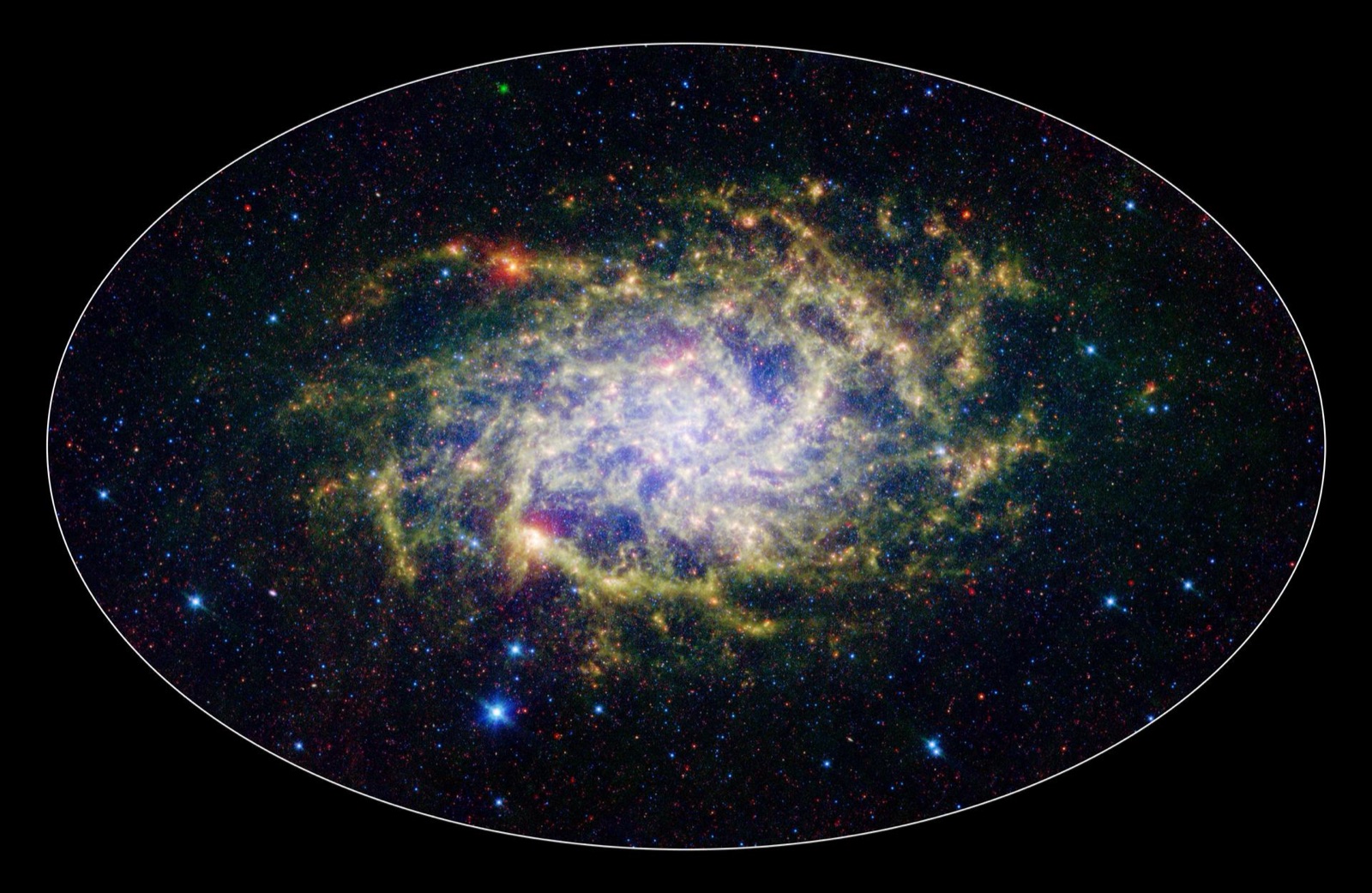
 Photograph · NASA/JPL-Caltech/Univ. of Ariz.
Galaxy · Deep guide
The Triangulum Galaxy
Also called: M33
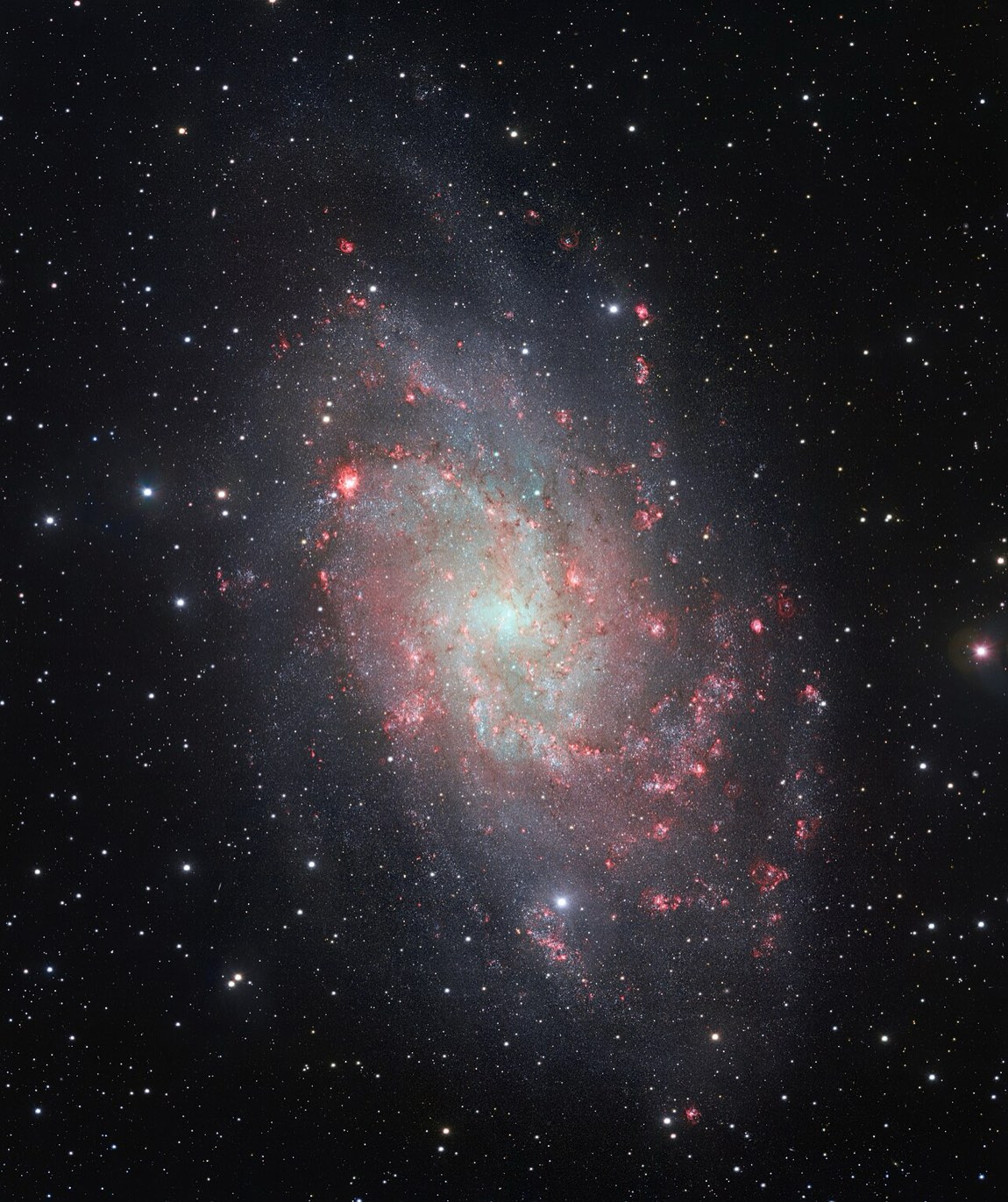
The Local Group's third spiral. Seen face-on, it is a pinwheel bursting with newborn stars.
What is it?
The Triangulum Galaxy (M33) is the third-largest member of our Local Group, after Andromeda and the Milky Way — a graceful spiral 2.7 million light-years away that we happen to view nearly face-on, like a pinwheel laid flat. It is a factory of star formation, studded with pink nebulae, including one of the largest star-birth regions known anywhere (NGC 604).
Go deeper
M33 holds ~40 billion stars and probably orbits Andromeda as a massive satellite (their gas bridges suggest past interaction). Unusually for a big galaxy, it shows no clear supermassive central black hole — its upper limit is a few thousand solar masses, a genuine puzzle for co-evolution models. Its ordered rotation made it a proving ground for dark-matter rotation curves; its future is likely absorption into the Milky Way–Andromeda merger remnant.
01 The transparency test
M33 is famous among stargazers as the ultimate dark-sky test: its light is spread so thin that any haze or light pollution erases it. Spot it naked-eye and you have certified world-class skies. In binoculars from a dark site it is a soft round glow one Moon-width across.
02 The missing monster Deeper
Nearly every substantial galaxy hosts a central supermassive black hole whose mass tracks the galaxy's bulge — a relationship so tight it suggests they grow together. M33 breaks the pattern: no bulge, and no detectable central black hole down to stringent limits. Why some spirals skip the monster is an open question M33 personifies.
The deep dive
Researched for the Atlas from Wikipedia — Triangulum Galaxy (16,457 characters read) · updated Sep 20, 2026
03 A name mix-up that still causes confusion
Ask a casual stargazer to name the Pinwheel Galaxy and many will point you toward Messier 33. The nickname appears in some astronomy references, in computerized telescope software, and across public outreach websites — but professional astronomers regard it as misapplied. The SIMBAD Astronomical Database, the field's authoritative catalogue of formal designations, assigns "Pinwheel Galaxy" to Messier 101, a completely different spiral that lives inside the borders of Ursa Major rather than Triangulum. The confusion is harmless enough in a backyard setting, but it illustrates how informal names can drift unpredictably through popular culture. M33's official catalogue identities are unambiguous: Messier 33, from Charles Messier's 1771 Catalog of Nebulae and Star Clusters, and NGC 598, from the New General Catalogue. The galaxy takes its common name — the Triangulum Galaxy — simply from the small constellation in which it sits, a constellation whose name Hodierna himself invoked in 1654 when he described the object as lying "near the Triangle hinc inde," a cryptic Latin phrase referencing a pair of triangles.
04 Three centuries of measuring the same distance Deeper
Pinning down exactly how far away the Triangulum Galaxy is has occupied astronomers for decades, and the answer keeps shifting. The average of 102 published distance estimates made since 1987 yields a distance modulus of 24.69, corresponding to 0.883 megaparsecs or 2.878 million light-years. Yet individual measurements span a surprisingly wide range: from 2.38 million to 3.07 million light-years depending on the technique used. Cepheid variable stars gave 2.770 ± 0.130 million light-years in 2004; the tip of the red-giant branch method in the same year produced 2.590 ± 0.080 million light-years. An eclipsing binary star discovered in 2006 allowed astronomers to work out stellar sizes and temperatures from the eclipses, yielding 3.070 ± 0.240 million light-years. Blue supergiants measured in 2009 suggested 940 kiloparsecs, or about 3.2 million light-years. Then in 2023, fresh Cepheid photometry tightened the figure to 840 ± 11 kiloparsecs. Each method carries its own assumptions and systematic errors, which is precisely why the spread persists even after a century of work.
 ⤢
⤢
05 Hodierna, Messier, and Herschel: a discovery in layers
The Triangulum Galaxy has the rare distinction of having been noticed, re-noticed, and then catalogued at least three times before anyone fully understood what it was. The Italian astronomer Giovanni Battista Hodierna probably spotted it before 1654, describing a cloud-like nebulosity in a work whose full Latin title translates roughly as "About the systematics of the cometary orbit, and about the admirable objects of the sky." His description was cryptic enough that certainty is impossible, though the stated magnitude matches M33 well. Charles Messier independently found it on the night of August 25–26, 1764, and published it as object 33 in his 1771 catalogue. William Herschel then went further: not only did he log the galaxy on September 11, 1784, cataloguing it as H V-17, but he separately catalogued its brightest star-forming nebula as H III.150 — treating the giant gas cloud we now call NGC 604 as a distinct object in its own right. That layered history means the galaxy's largest H II region effectively has its own independent discovery story, predating any understanding that both the galaxy and the nebula were millions of light-years away.
06 How Hubble used M33 to reshape cosmology
In the early 1920s, the status of the "spiral nebulae" was one of the biggest unsettled questions in astronomy. Were they clouds of gas within the Milky Way, or entire island universes of stars in their own right? M33 helped settle the argument. John Charles Duncan and Max Wolf discovered variable stars inside the nebula in 1922–23. Edwin Hubble then identified 35 of those variables as classical Cepheids in 1926. Cepheids are luminous pulsating stars whose intrinsic brightness is tied to the period of their variation, making them reliable distance markers. Hubble's distance estimate from those 35 stars was consistent with M33 lying far outside the Milky Way — confirming that spiral nebulae were independent galactic systems of gas and dust rather than local features of our own galaxy. The Triangulum Galaxy therefore stands alongside the Andromeda Galaxy as one of the twin pillars on which the modern understanding of a universe filled with billions of galaxies was built.
07 Morphology: loosely wound, bulgeless, slightly warped Deeper
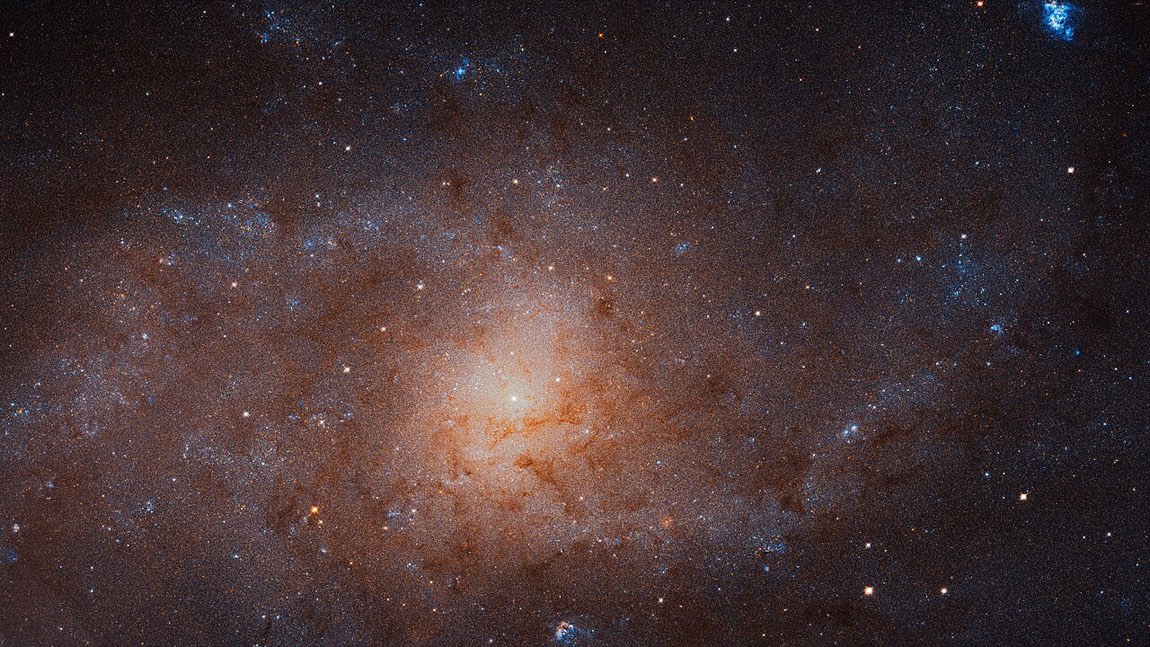
In Gérard de Vaucouleurs's revised morphological classification system, M33 carries the type designation SA(s)cd. Each letter and symbol in that string carries precise meaning. "S" identifies it as a spiral; "A" means the nucleus lacks a bar-shaped structure; "(s)" indicates the spiral arms emerge directly from the nucleus rather than from an inner ring; and "cd" places it toward the loosely wound end of the spiral sequence, meaning its arms are relatively open and unwound compared to tighter-armed spirals. The galaxy's disk is tilted 54° to our line of sight — enough to reveal its internal structure clearly without the heavy dust obscuration that would hide a more edge-on system. That disk appears warped out to a radius of about 8 kiloparsecs, and there is no bulge at the nucleus whatsoever. The lack of a bulge is scientifically important: it may directly explain why the galaxy lacks a supermassive black hole at its center, since the mass of such objects appears to scale with bulge size. Although Triangulum is formally classified as unbarred, a weak bar-like structure of roughly 0.8 kiloparsecs in radial extent has been identified around the nucleus.
08 A hydrogen bridge connecting two galaxies
The Triangulum Galaxy does not sit in empty space unconnected to its neighbors. In 2004, astronomers announced evidence for a clumpy stream of hydrogen gas physically linking M33 to the much larger Andromeda Galaxy, roughly 0.75 million light-years away. The stream suggested the two galaxies had already experienced a tidal interaction sometime between 2 and 8 billion years ago, when their gravity pulled material from each other. That discovery was independently confirmed in 2011. Today, M33 is moving toward Andromeda at a velocity of 190 ± 60 km/s relative to the Milky Way — a measurement made in 2005 using observations of two water masers on opposite sides of M33 via the Very Long Baseline Array (VLBA). This was the first time researchers had been able to estimate Triangulum's angular rotation and proper motion in this way. The proximity of the two galaxies and this inward velocity led researchers to consider whether M33 may be a gravitationally bound satellite of Andromeda, though 2019 astrometric data from the Gaia spacecraft appears to suggest M33 may instead be on its first true infall into Andromeda rather than an established orbital companion.
 ⤢
⤢
09 NGC 604: a star factory 1,500 light-years across
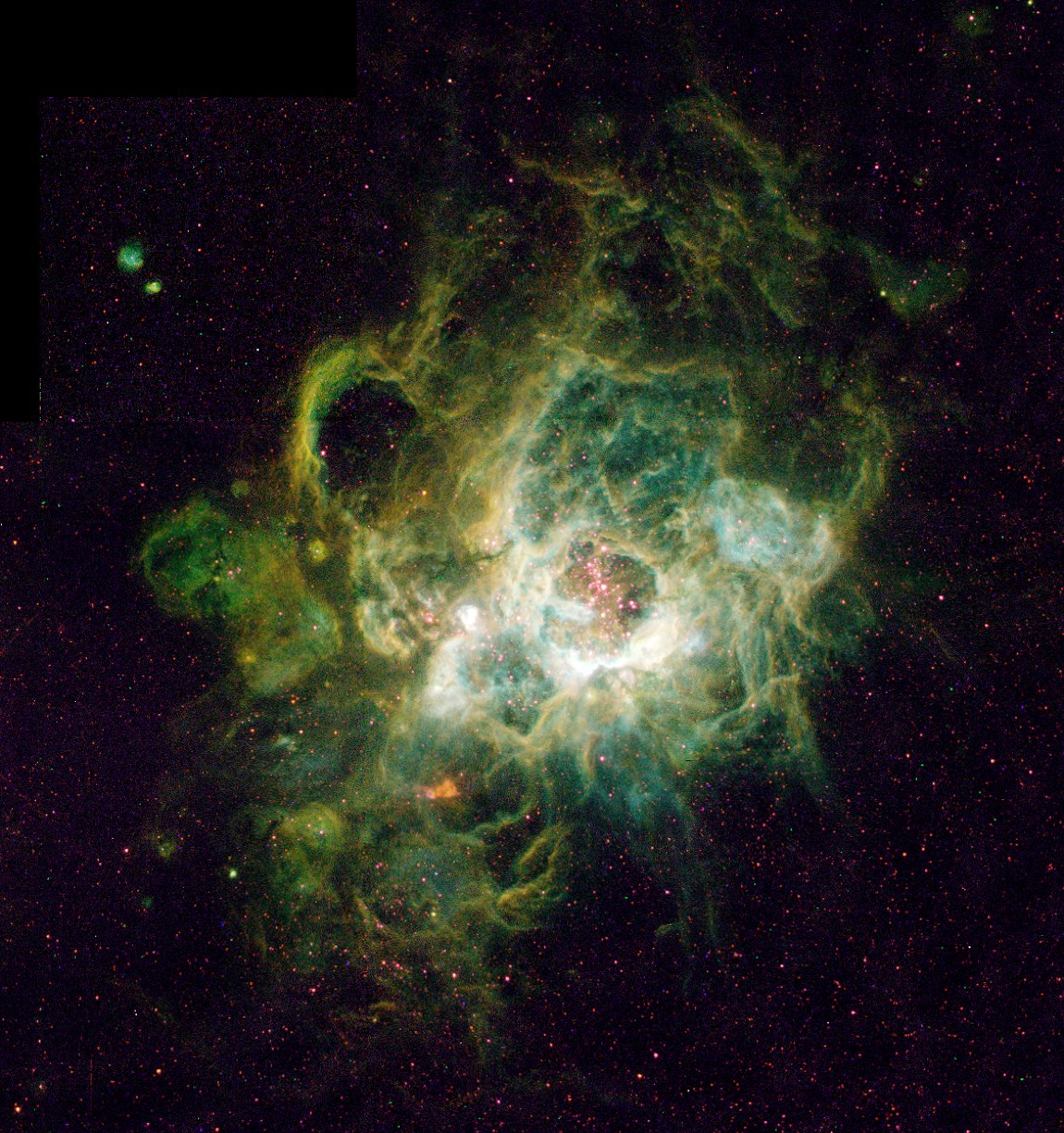
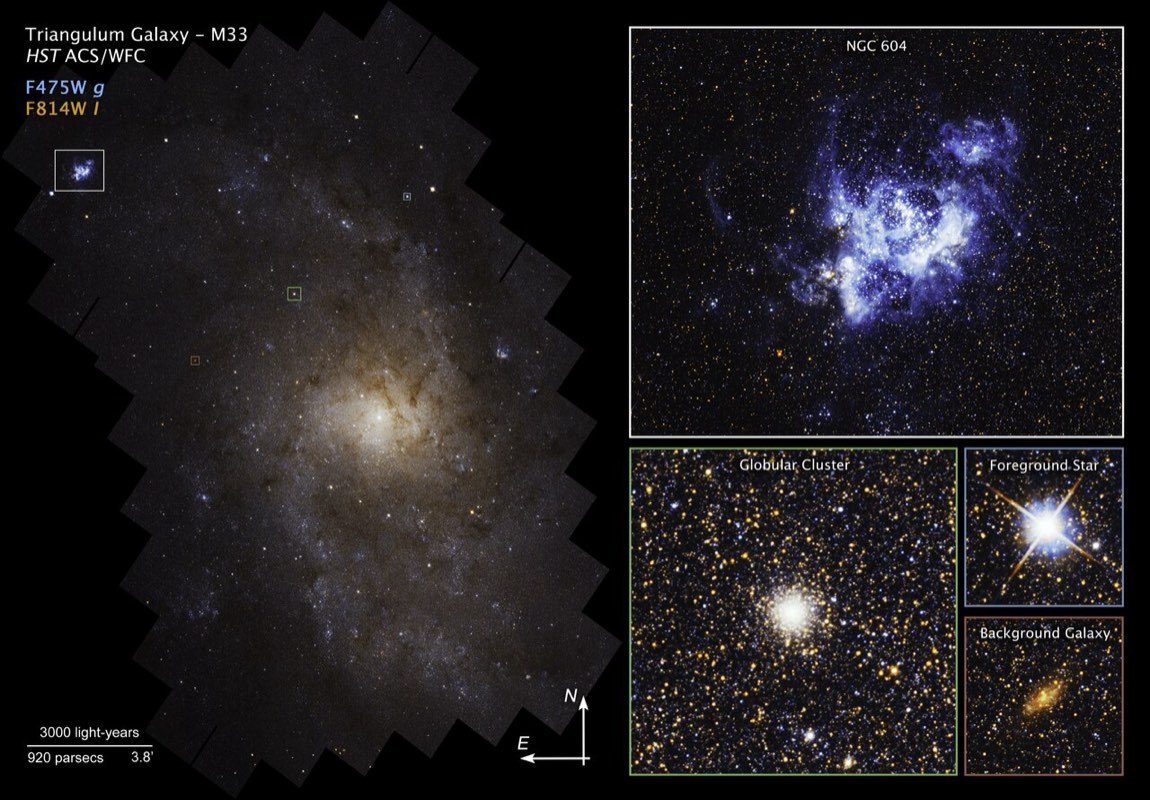
When William Herschel pointed his telescope at the Triangulum Galaxy in 1784, he catalogued its brightest nebula as a separate object entirely. That nebula eventually received the designation NGC 604, and it sits northeast of the galaxy's central core as seen from Earth. Its scale is staggering: nearly 1,500 light-years in diameter, which is roughly 40 times the size of the Orion Nebula, though its spectrum is described as similar to Orion's. NGC 604 is one of the largest H II regions known anywhere, and within the Local Group it ranks as the second most luminous, shining at 45 ± 15 million times the luminosity of the Sun. Evidence suggests this particular nebula may have experienced a discrete burst of star formation about three million years ago. Three other H II regions that Herschel also noted — NGC 588, NGC 592, and NGC 595 — are associated with molecular clouds containing between 120,000 and 400,000 solar masses each. Together, these four named regions are the brightest of the 515 discrete candidate sources of 24-micron emission catalogued within M33 by 2007 using infrared data from the Spitzer Space Telescope.
10 Dark matter outweighs all the visible stars Deeper
Add up every star, every gas cloud, and every other form of ordinary matter in the Triangulum Galaxy and you arrive at a combined baryonic mass that may reach around 10 billion solar masses. The disk itself carries an estimated 3 to 6 billion solar masses of stellar material, and the gas component contributes roughly 3.2 billion solar masses more. But ordinary matter is only a fraction of the story. Estimated out to a radius of 55,000 light-years (17 kiloparsecs), the dark matter component alone is equivalent to about 50 billion solar masses — five times greater than all the visible baryonic matter combined. This enormous unseen mass dominates the gravitational budget of the galaxy and controls the motions of stars and gas at large radii in ways that visible matter alone could never explain. For comparison, Triangulum is estimated to host around 40 billion stars total, versus 400 billion for the Milky Way and roughly 1 trillion for the Andromeda Galaxy, making it the smallest of the three main Local Group spirals by stellar population as well as by diameter.
11 Star formation runs hotter here than in Andromeda Deeper
Despite being a relatively modest galaxy, Triangulum forms stars at a pace that, per unit area, outstrips its much larger neighbor Andromeda. The rate of star formation per unit area in M33 is approximately 3.4 solar masses per gigayear per square parsec, compared to just 0.74 in Andromeda. The total integrated rate across the whole galaxy is about 0.45 ± 0.1 solar masses per year, and astronomers have not yet determined whether this rate is currently decreasing or holding steady. The process is not uniform across the disk. In the central 4-arcminute region, atomic gas is being converted to molecular gas very efficiently, producing a strong spectral emission of carbon monoxide as giant molecular clouds condense from the surrounding interstellar medium. Further out, the same process continues but at a lower efficiency. About 10 percent of the galaxy's total gas is in molecular form. Chemical analysis reveals a distinct boundary near a radius of 30,000 light-years (9 kiloparsecs): inside that boundary, the composition gradient decreases linearly from the core as expected; beyond it, out to roughly 82,000 light-years (25 kiloparsecs), the gradient flattens significantly. This two-zone structure is consistent with an "inside-out" formation scenario, where gas at the core is consumed first while fresh gas accumulates at large radii later.
12 M33 X-7: the heaviest stellar black hole known
In 2007, astronomers using data from the Chandra X-ray Observatory detected a remarkable object inside the Triangulum Galaxy: a stellar-mass black hole about 15.7 times the mass of the Sun. Named M33 X-7, it orbits a companion star and eclipses that companion every 3.5 days as it passes in front of it. At the time of discovery it held the record as the largest known stellar-mass black hole. To put its mass in context, most stellar black holes detected through X-ray binary systems are typically in the range of 5 to 10 solar masses, so M33 X-7 sits well above the typical range. The nucleus of M33 also hosts an ultraluminous X-ray source emitting at 1.2 × 10³⁹ ergs per second — the most luminous X-ray source in the entire Local Group of galaxies. This source fluctuates in brightness by 20 percent over a 106-day cycle. Meanwhile, the galaxy's supernova rate has been estimated at 0.06 Type Ia and 0.62 Type Ib or Type II events per century, averaging out to roughly one supernova every 147 years. By 2008, a total of 100 supernova remnants had been identified within M33, with the majority concentrated in the southern half of the galaxy.
 ⤢
⤢
13 Globular clusters younger than expected Deeper
The Triangulum Galaxy contains a population of globular clusters, though the exact count remains uncertain. About 54 have been confirmed, but the true number may be 122 or more. What makes these clusters scientifically interesting is their age. The confirmed clusters appear to be several billion years younger than their counterparts in the Milky Way, suggesting a different formation history. More striking still, the rate of cluster formation seems to have increased during the past 100 million years — a very recent uptick on cosmic timescales. This acceleration is correlated with an observed inflow of gas toward the center of the galaxy, implying that fresh fuel arriving at the core has triggered new rounds of cluster assembly. The southern spiral arm, meanwhile, contains greater concentrations of young, hot stars than the northern arm, and the center of the distribution of prominent features — H I regions, H II regions, and luminous O-type stars — is offset about two arcminutes to the southwest of the geometric center. Whether this asymmetry is a product of the galaxy's past interaction with Andromeda remains an open question.
14 Seeing M33 with the naked eye — harder than it sounds
The Triangulum Galaxy is often listed as a naked-eye object, which is technically true but requires serious qualification. Under pristine conditions with no light pollution and full dark adaptation, some observers can detect it without any optical aid, making it the most distant permanent object that some humans can see without a telescope — roughly half again as far as the Andromeda Galaxy. But "some observers" is the key phrase. Although the galaxy's total apparent V-magnitude is 5.72, its light is spread across a large patch of sky rather than concentrated to a stellar point, giving it an effective visual magnitude of approximately 6.6 according to work by Crumey. Seeing a star at 6.6 magnitude is already beyond the capability of many people even at a very dark site. The practical range of difficulty stretches from relatively straightforward direct-vision detection in deep rural locations under a dark, clear, transparent sky, all the way to requiring averted vision from sites beyond the suburbs in shallower rural settings. Because it sits at such a reliable position near the boundary of naked-eye detectability, M33 has become one of the reference objects on the Bortle Dark-Sky Scale, used to calibrate how dark a given observing site truly is.
15 The uncertain future of a small galaxy in a crowded neighborhood
The long-term fate of the Triangulum Galaxy is genuinely unresolved. As of 2009, astronomers had mapped out several plausible futures, none definitively ruled out. One scenario has M33 being gravitationally torn apart by the Andromeda Galaxy and absorbed, its hydrogen gas fueling a new wave of star formation in its larger neighbor. Another has the galaxy gradually exhausting its own gas supply and losing the ability to form new stars entirely. A third scenario places M33 as a participant in the coming collision between the Milky Way and Andromeda — an event expected roughly 4 to 5 billion years from now — with M33 eventually fusing with the merger remnant. Two additional possibilities that cannot yet be dismissed are a collision with the Milky Way before Andromeda arrives, or an outright ejection from the Local Group. The 2019 release of astrometric data from the Gaia mission added a new constraint: it appears to rule out the possibility that M33 and M31 are currently in a stable mutual orbit. If that conclusion holds, M33 is likely on its first true gravitational infall into Andromeda, a one-way journey with consequences that will unfold over billions of years.
 ⤢
⤢
Could life exist here?
Tens of billions of stars; the same honest shrug as Andromeda.
Our labels: Confirmed · Strong Evidence · Estimated · Hypothesis · Theoretical · Speculative (see Methodology).
Weird & wonderful
- Its giant nebula NGC 604 would fill Orion's whole belt region if placed at the Orion Nebula's distance.
- M33 may be the most distant object ever seen with the naked eye — under perfect skies.
- It has no supermassive black hole — one of the biggest galaxies without one.