 Photograph · Sloan Digital Sky Survey/Canadian Astronomy Data Centre · CC BY 4.0
Asteroid · Deep guide
10199 Chariklo
Also called: 10199 Chariklo · (10199) Chariklo · 1997 CU26
The largest known centaur and the first minor planet found to have rings.
What is it?
Chariklo is an icy body about 250 km across orbiting between Saturn and Uranus. In 2013, astronomers watching it pass in front of a star saw the starlight dim briefly on either side of the body — revealing two narrow rings of icy particles. It was the first minor planet found with rings. Nobody yet knows what keeps them from spreading out; unseen shepherd moons are one idea.
The deep dive
Researched for the Atlas from Wikipedia — 10199 Chariklo (14,221 characters read) · updated Nov 14, 2026
01 How Chariklo's rings were found
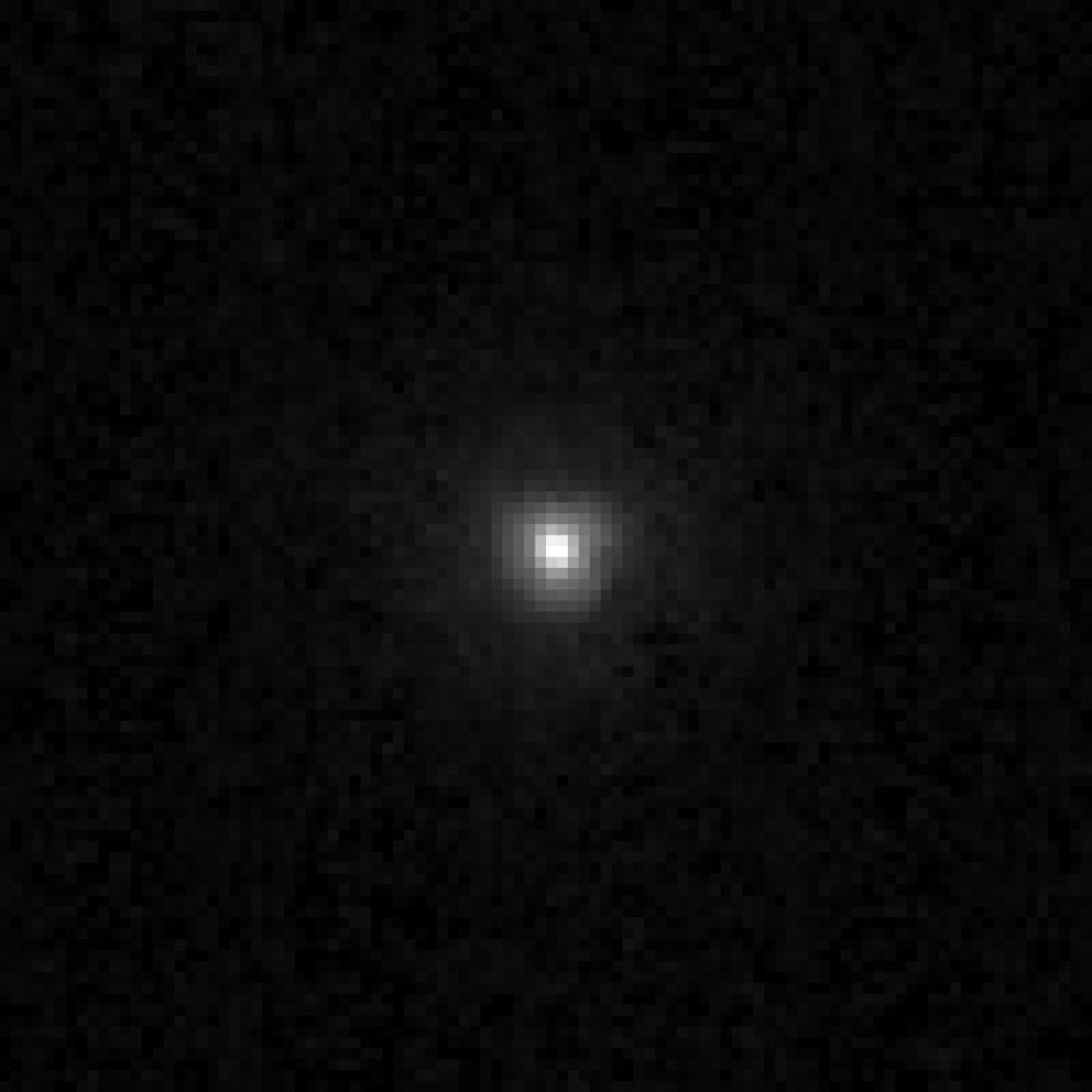
The discovery came not from a telescope image but from a carefully watched shadow. On 3 June 2013, Chariklo passed in front of a distant star — an event called a stellar occultation — and observers noticed the star briefly flickered twice before Chariklo blocked it and twice again after it reappeared. Those four extra dips, two on each side of the main event, were caused by two separate rings intercepting the starlight. This technique delivers kilometre-scale precision about an object's shape and surroundings even when the object itself is far too small to image directly. Chariklo's rings span only 80 milliarcseconds across the sky, near the absolute diffraction limit of the Hubble Space Telescope, so direct imaging remains impossible with current hardware. The 2013 occultation campaign was the first to reveal a ring system around any minor planet, overturning the assumption that stable rings required a massive planet as a host body.
02 The ring pair in detail Deeper
The two rings sit at radii of 386 km and 400 km from Chariklo's center, separated by a gap of roughly 14 km — a distance comparable to the width of a large city. The inner ring, nicknamed Oiapoque after the river forming Brazil's northern coastal border, is the more substantial one, about 6.9 km wide. The outer ring, nicknamed Chuí after the river at Brazil's southern tip, is a mere 0.12 km wide — barely the length of a city block. Both rings are composed of icy particles. Their edge-on orientation as seen from Earth in 2008 explains why Chariklo appeared dimmer that year (absolute magnitude H = 7.3) and why water-ice absorption features in its spectrum faded before 2008 and then strengthened again afterward. Formal names for the rings have not yet been submitted to the International Astronomical Union.
03 Why the rings shouldn't still exist
Models predict that Chariklo's rings should spread and disperse within at most a few million years — a blink in Solar System time — so their presence today raises a genuine puzzle. One leading hypothesis is that unseen shepherd moons, with masses comparable to the rings themselves, gravitationally herd the ring particles and prevent them from dispersing. No such moons have been detected yet. An alternative explanation is that Chariklo's own elongated shape combined with its fast rotation clears material through Lindblad resonances, keeping the rings confined without needing any moons. This same mechanism has been proposed to explain the ring of the dwarf planet Haumea. The two ideas are not mutually exclusive, and astronomers have not yet settled the question. The origin of the rings is equally open: leading candidates include outgassing that ejected surface material and the tidal disruption of a former moon.
04 A lumpy, tilted world Deeper
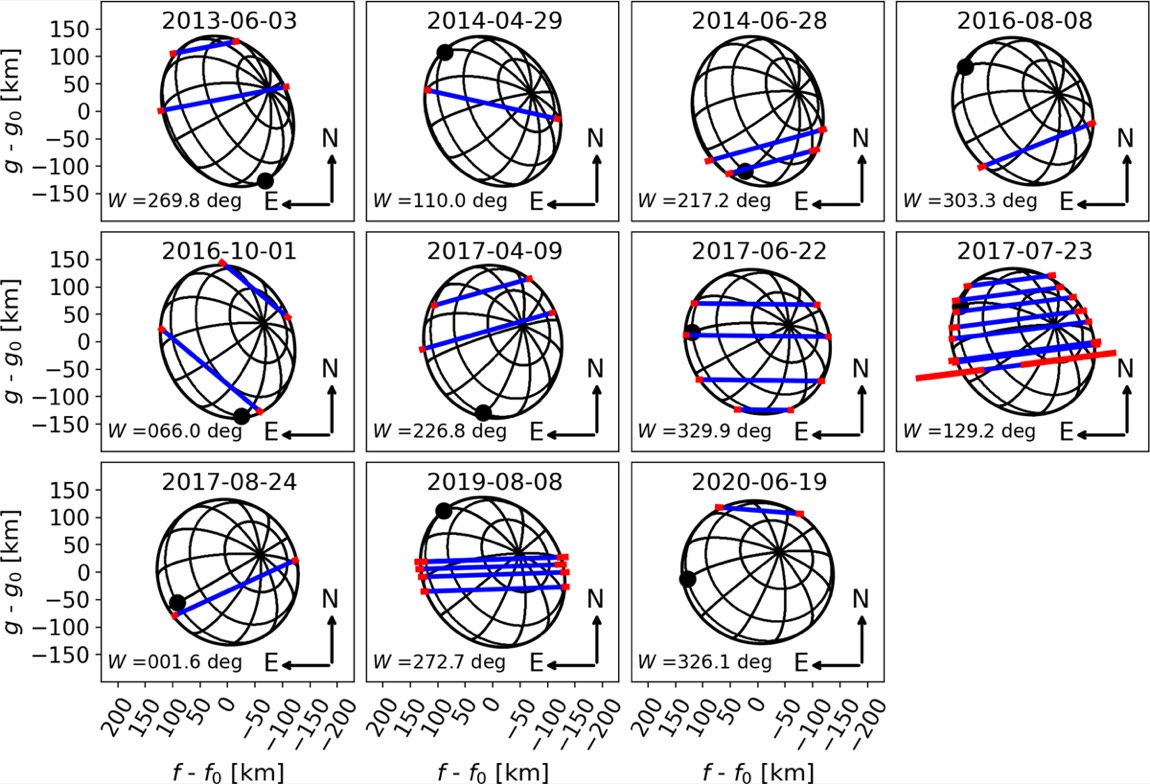
Occultation measurements have built up a detailed picture of Chariklo's shape over many observing campaigns. It is a flattened, triaxial ellipsoid with dimensions of approximately 288 km × 270 km × 198 km. Surface topography deviates from a perfect ellipsoid by as much as 7.78 km in one direction and −5.52 km in another, with a standard deviation of 4.11 km — a level of bumpiness similar to that of Saturn's small icy moons Phoebe and Hyperion. Chariklo also carries a significant axial tilt of 62.1° with respect to the ecliptic, meaning it leans dramatically compared to Earth's 23.5°. Its rotational north pole points toward the sky coordinates RA 151.0°, Dec +41.8°. Simulations additionally suggest that ring particles may gradually drift inward and pile up along Chariklo's equator, potentially building an equatorial ridge reminiscent of the one on Saturn's moon Iapetus.
05 Mass and density without a moon to measure Deeper
Because no natural satellite has been confirmed around Chariklo, its mass cannot be measured directly through gravitational perturbations of an orbiting body. Instead, astronomers have estimated its density by assuming Chariklo's rings sit at a 1:3 spin-orbit resonance with the body's rotation — a pattern observed in other ringed minor planets. That assumption yields a density range of 0.73–0.85 g/cm³, consistent with an icy composition and roughly comparable to the density of water ice. The corresponding mass range is (5.9–6.9) × 10¹⁸ kg. For reference, that is roughly 1,000 times less massive than the dwarf planet Ceres. Chariklo's dimensions and 7.004-hour rotation period suggest it is not in hydrostatic equilibrium; if it were, models predict a somewhat higher density of 0.8–1.25 g/cm³ and a mass of (6–8) × 10¹⁸ kg.
06 Surface chemistry and the JWST surprise
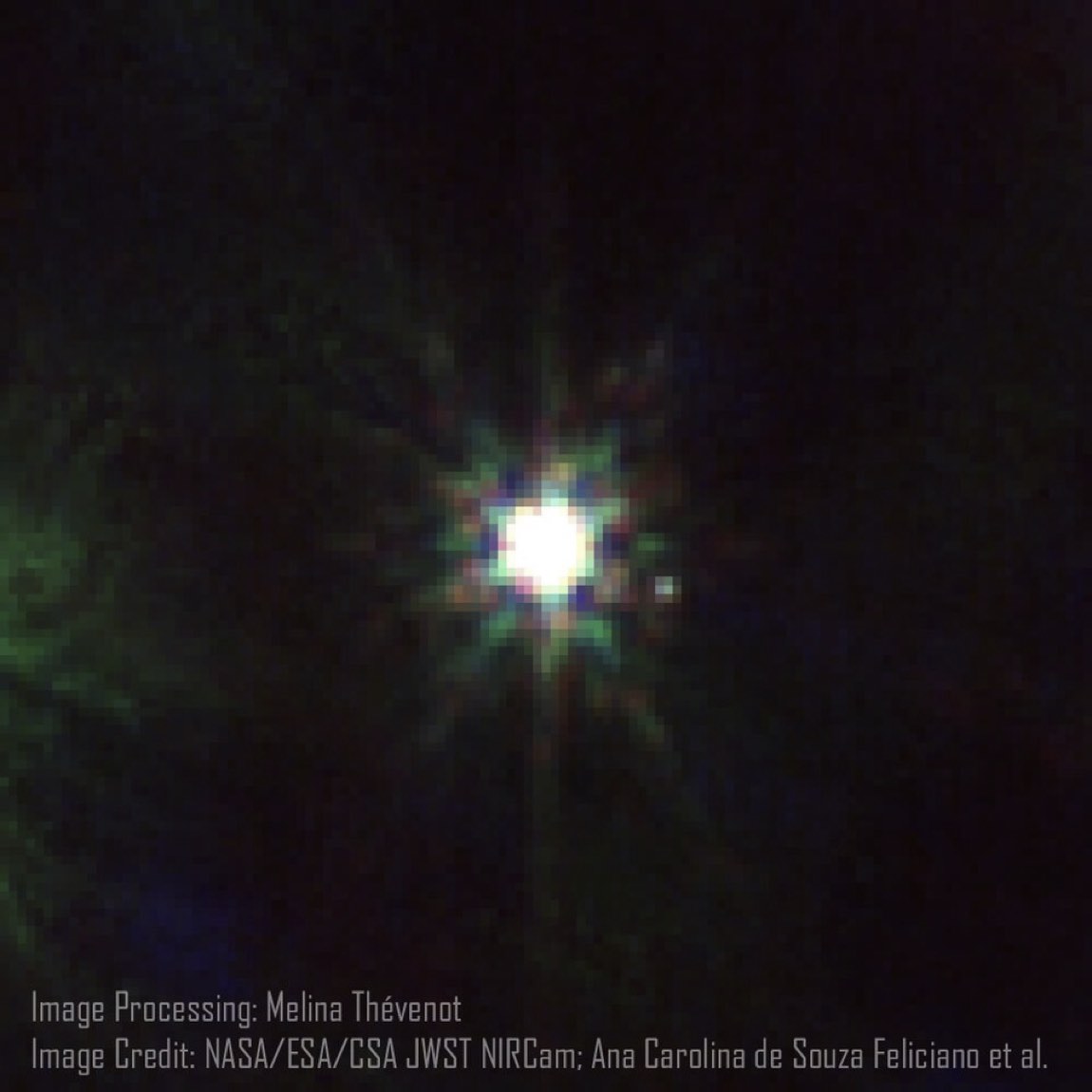
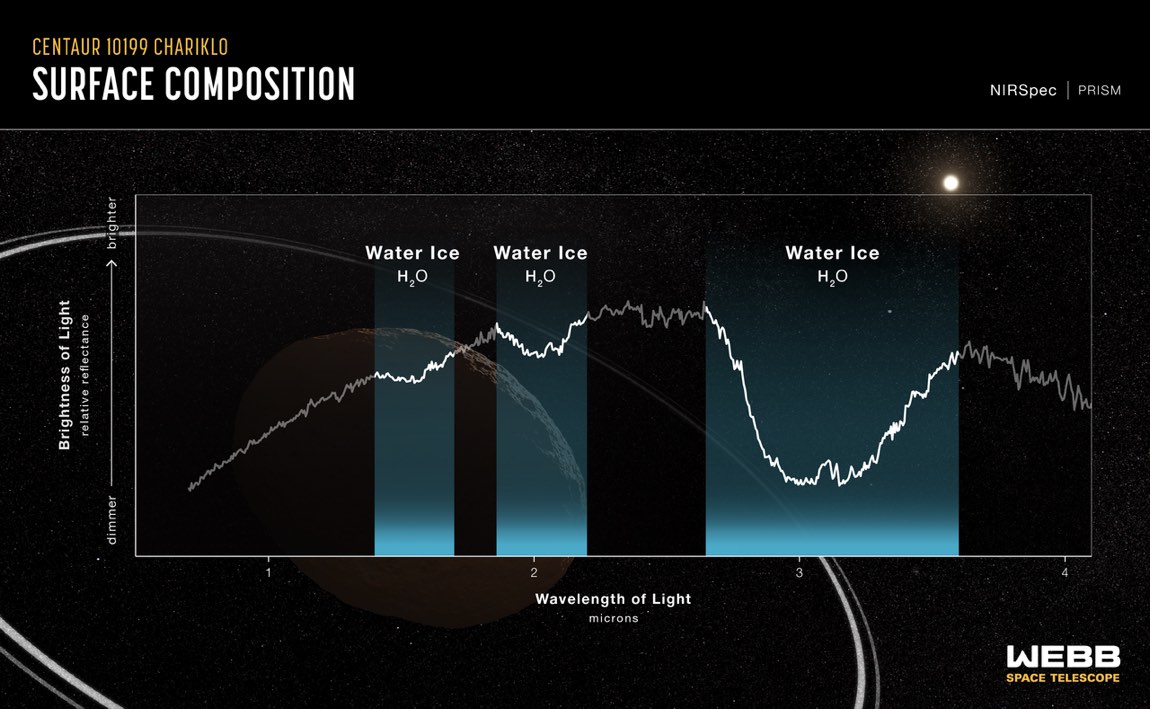
Chariklo's surface reflects only 3.7% of the sunlight that hits it — darker than most asphalt roads — and in visible light its spectrum is featureless, earning it a classification as a D-type asteroid. In near-infrared wavelengths the picture becomes richer: absorption features reveal water ice, silicate minerals, amorphous carbon, and complex organic molecules called tholins. The relative strength of water-ice features has varied across different years of observation, an effect now attributed to the changing tilt of the ice-rich rings relative to Earth's line of sight. A striking finding came from James Webb Space Telescope observations in 2022: Chariklo's surface contains water ice in crystalline form, not just within its rings. Because high-energy particle radiation in space should quickly destroy crystalline structure, astronomers hypothesize that continuous micrometeorite impacts either expose fresh subsurface material or trigger local recrystallization, keeping the crystalline ice continuously renewed.
 ⤢
07 Chariklo's unstable cosmic address
Centaurs are dynamically restless objects, and Chariklo is no exception — just a little more stable than most. It has a 50% chance of escaping the centaur region in either 7 or 10.3 million years. The primary day-to-day orbital influence comes from Uranus, with which Chariklo will make frequent close approaches over the next 100 million years. Its average orbital distance of 15.7 AU places it tantalizingly close to a 4:3 orbital resonance with Uranus — just 0.09 AU away from the exact resonance. Despite Uranus's regular nudges, it is rarer encounters with Jupiter and Saturn that could most dramatically reshape Chariklo's orbit or potentially destabilize its ring system entirely. Simulations suggest Chariklo was delivered to its current orbit within the past 20 million years, with a 50% chance the implantation happened as recently as 9.38 million years ago. Whether Jupiter and Saturn or Neptune was responsible for that transfer remains a matter of active debate between studies published in 2016 and 2017.
08 Measuring Chariklo's spin — a 16-year wait
When astronomers first tried to measure Chariklo's rotation period in 1997, they came away empty-handed. The reason was geometric bad luck: Chariklo happened to be oriented pole-on toward Earth at the time, so its elongated shape produced no detectable brightness variation as it spun. It was not until 2013 that a successful measurement was finally made. Chariklo rotates once every 7.004 hours, with an uncertainty of just 0.036 hours — about 2.2 minutes. The brightness variation caused by the rotation reaches a maximum of 0.13 magnitudes when Earth views Chariklo equator-on, but diminishes to undetectable levels when viewed pole-on, which explains the 1997 failure. This rotation rate, combined with the body's elongated shape, is one of the key pieces of evidence that Chariklo is not in hydrostatic equilibrium — meaning it is not round enough for gravity to have fully reshaped it into a sphere or symmetric ellipsoid.
09 Observing Chariklo from Earth Deeper
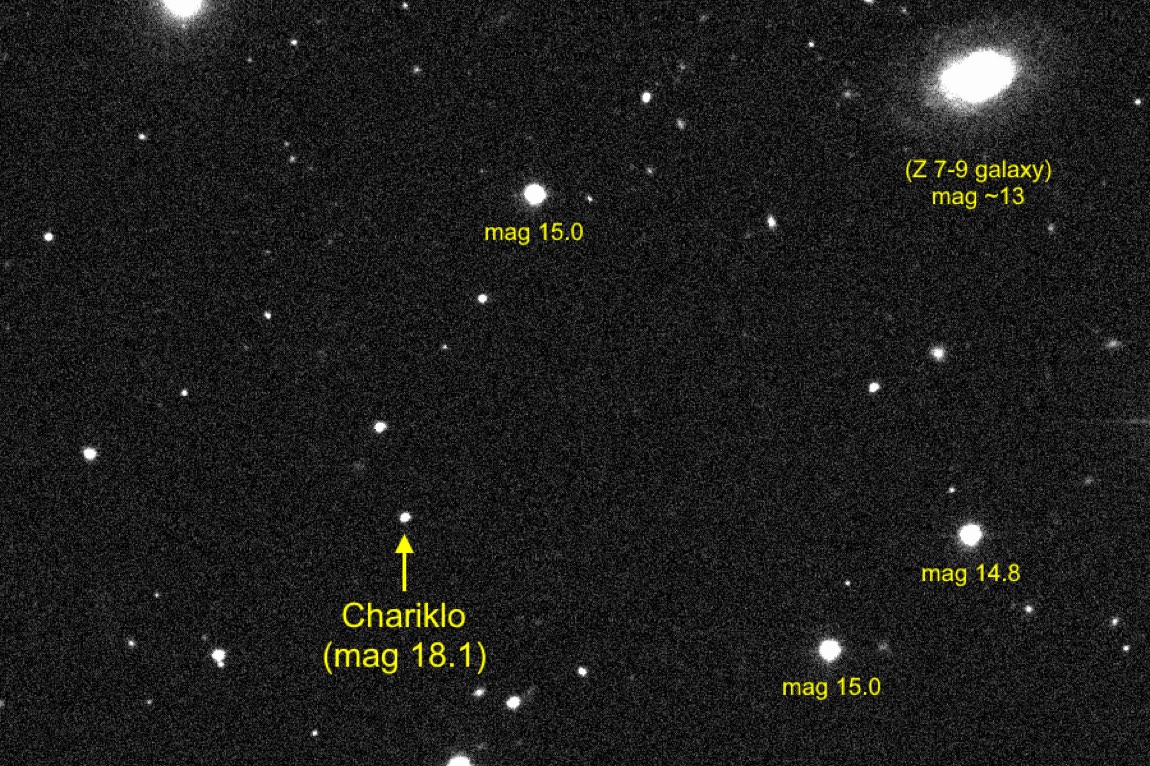
Chariklo's apparent magnitude ranges between 17 and 19 depending on its distance from Earth — far beyond naked-eye visibility and even challenging for modest telescopes. It appeared brightest in 2003, when perihelion and opposition coincided. Even setting aside distance, Chariklo's intrinsic brightness shifts over time: during the late 1990s and early 2000s, its absolute magnitude was approximately H = 6.8 because the rings presented a larger face toward Earth; by 2008 that value had faded to H = 7.3 as the rings turned edge-on. Between 2013 and 2022, Chariklo happened to be crossing the direction of the Galactic Center in the sky, a region so densely packed with stars that roughly twenty occultation campaigns could be organized during that period. These events, involving both professional and amateur astronomers in international collaborations, produced a steady stream of precise measurements of Chariklo's position, shape, and ring geometry at kilometre-scale resolution.
10 Discovery, naming, and mythology
James V. Scotti spotted Chariklo on 15 February 1997 using the Spacewatch 0.9-meter telescope at Kitt Peak National Observatory, making it the seventh centaur ever found. The Minor Planet Center announced the discovery on 24 February 1997, assigning the provisional designation 1997 CU26. Its catalog number, 10199, was assigned on 2 March 1999, and the official name followed on 28 September 1999. Chariklo is named for the nymph Chariclo from Greek mythology, described variously as a sea nymph, a female centaur, and the wife of the centaur Chiron. She is also sometimes identified as the mother of the blind prophet Tiresias. In the late 1990s, German astrologer Robert von Heeren devised an astrological symbol for Chariklo by modifying the existing symbol for Chiron — replacing the letter K with C — though this symbol carries no scientific standing.
11 The Camilla mission concept
No spacecraft has yet visited Chariklo, but a detailed mission concept called Camilla was published in June 2018. The plan envisions launching a robotic probe in September 2026 and using gravity assists from Venus in February 2027 and Earth in December 2027 and December 2029 to build up enough speed to reach the outer Solar System. The spacecraft would perform a single flyby of Chariklo and deploy a 100 kg tungsten impactor — roughly the mass of a large adult bear — to punch a crater approximately 10 m deep. Remote sensing during the flyby would analyze the excavated material for compositional clues about Chariklo's interior. The mission was designed to fit within NASA's New Frontiers cost cap but had not been formally proposed to compete for funding as of the article's information. If flown, Camilla would be the first dedicated mission to any centaur.
12 Chariklo among the ringed minor planets
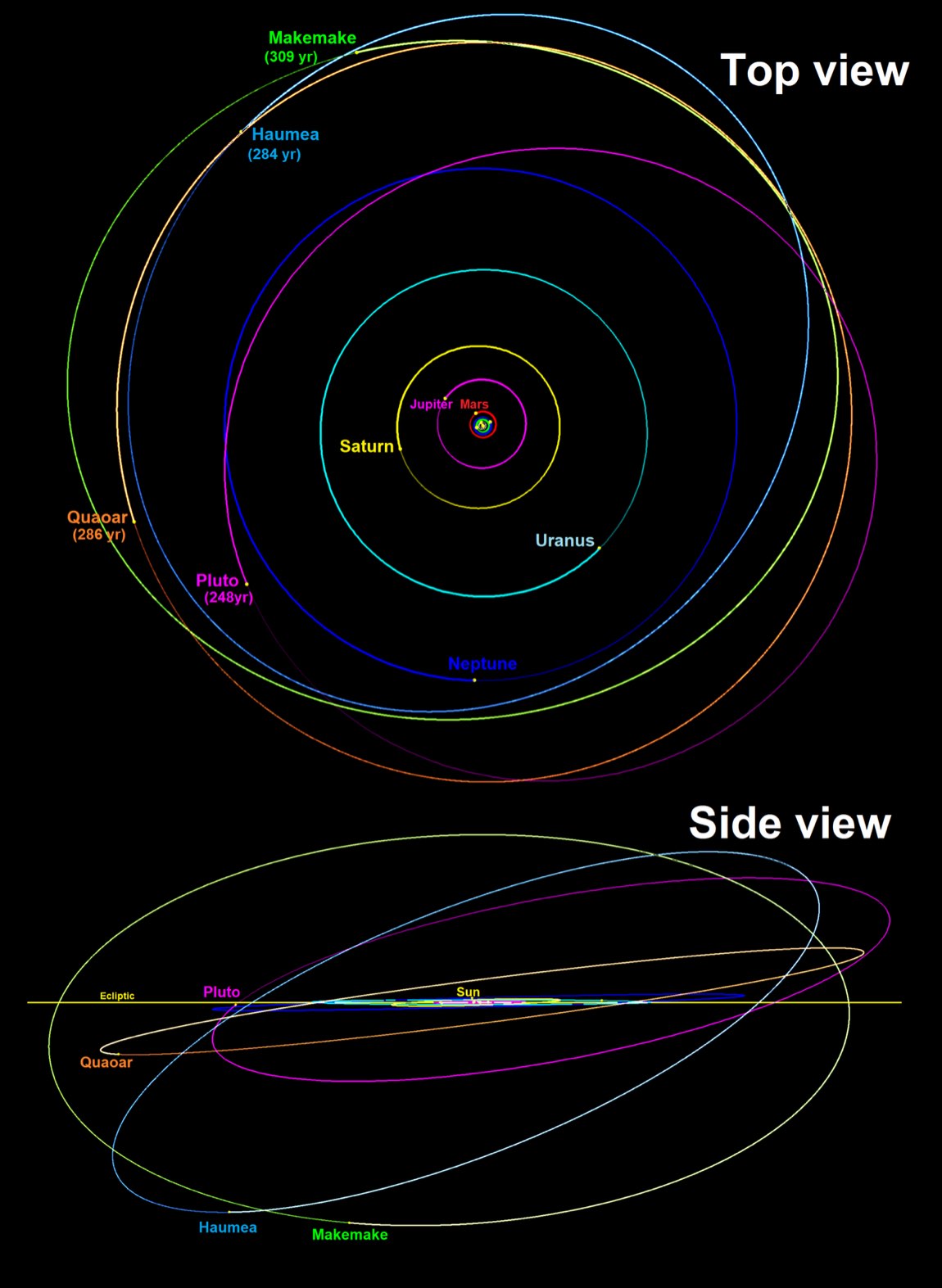
When Chariklo's rings were confirmed in 2013, it became the first minor planet known to possess a ring system. As of 2025, it shares that distinction with only three others: the centaur 2060 Chiron, the dwarf planet Haumea, and the trans-Neptunian object Quaoar. Chiron, Chariklo's mythological spouse in Greek legend, may host a similar pair of rings, confirmed by later analysis. Despite its rings, Chariklo shows no cometary activity, unlike Chiron. High-resolution telescope images taken between 2007 and 2013 found no dust coma surrounding Chariklo, placing an upper limit on dust production of 2.5 kg/s. Observations with the Very Large Telescope and the Hubble Space Telescope in 2015 found no cometary jets or dust beyond 300 km from the body. Chariklo is likely too cold and too distant from the Sun to be active today, though its chaotic orbital history means it could have passed closer to the Sun — and been warmer — in the past.
 ⤢