 Photograph · ESO · CC BY 3.0
Dwarf Planet · Deep guide
28978 Ixion
Also called: 28978 Ixion · (28978) Ixion · 2001 KX76
A dark red plutino that sits on the borderline between lumpy minor planet and round dwarf world.
What is it?
Ixion is a Kuiper belt object about 700 km across that, like Pluto, orbits the Sun twice for every three orbits of Neptune. Its surface is dark and moderately red from organic compounds, possibly hiding a little water ice below. It appears to be a transitional object between irregular small bodies and round dwarf planets. With no known moon, its mass and density are unknown, and the IAU does not recognize it as a dwarf planet.
The deep dive
Researched for the Atlas from Wikipedia — 28978 Ixion (15,594 characters read) · updated Nov 14, 2026
01 How Ixion Was Found in the Night Sky
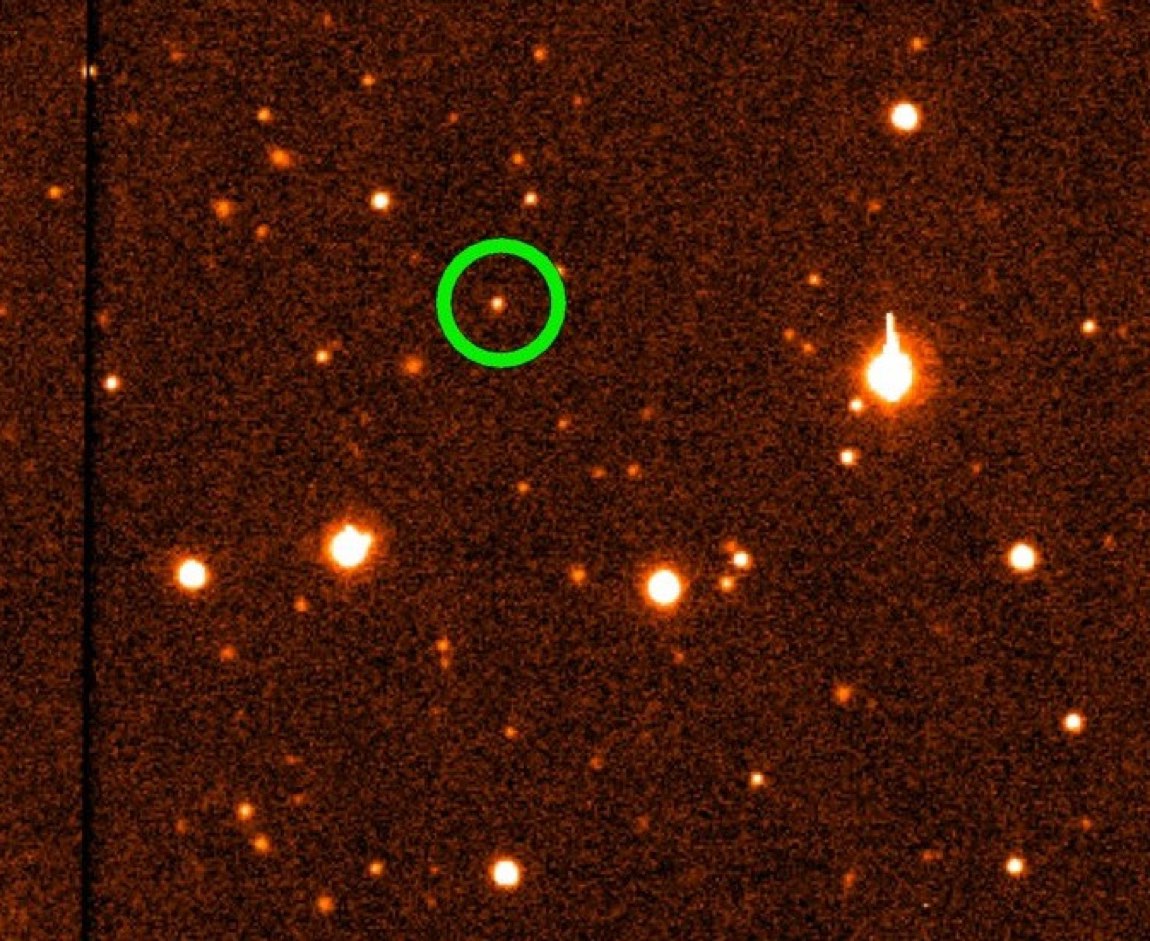
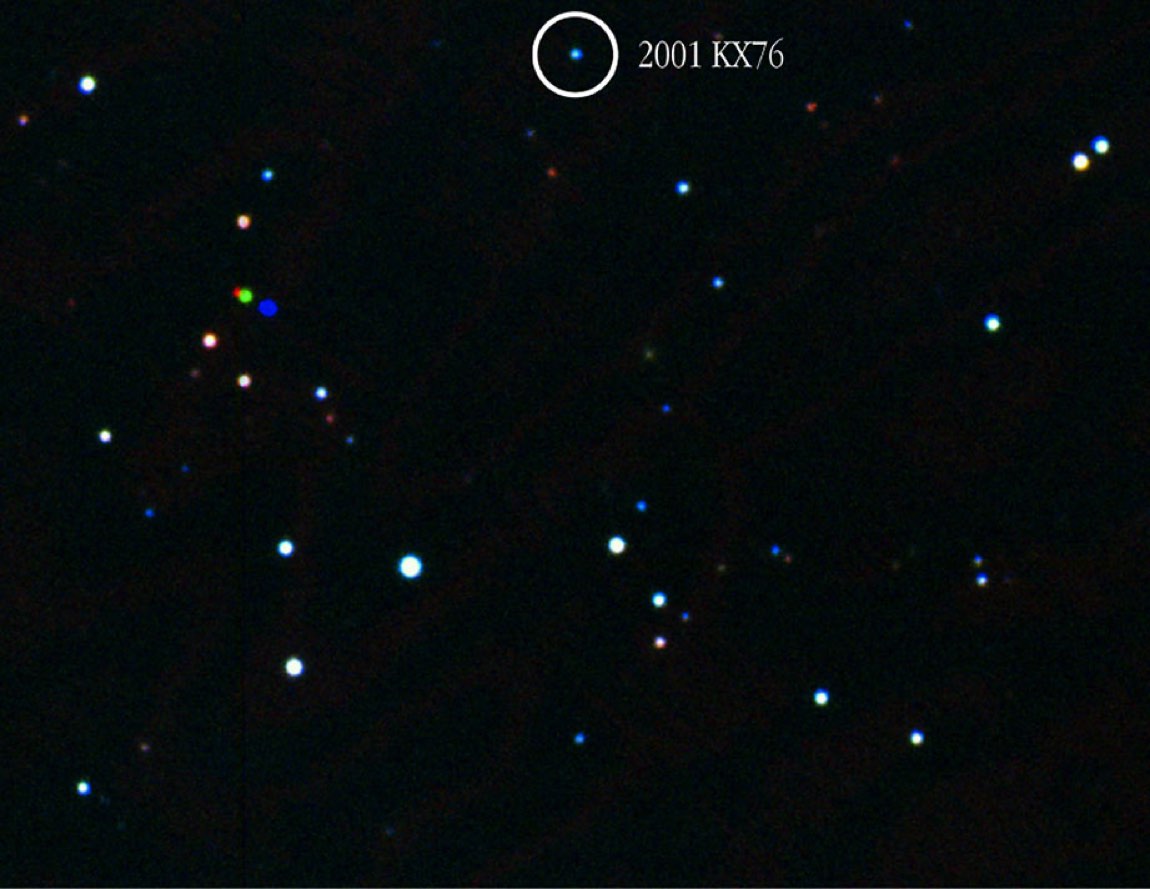
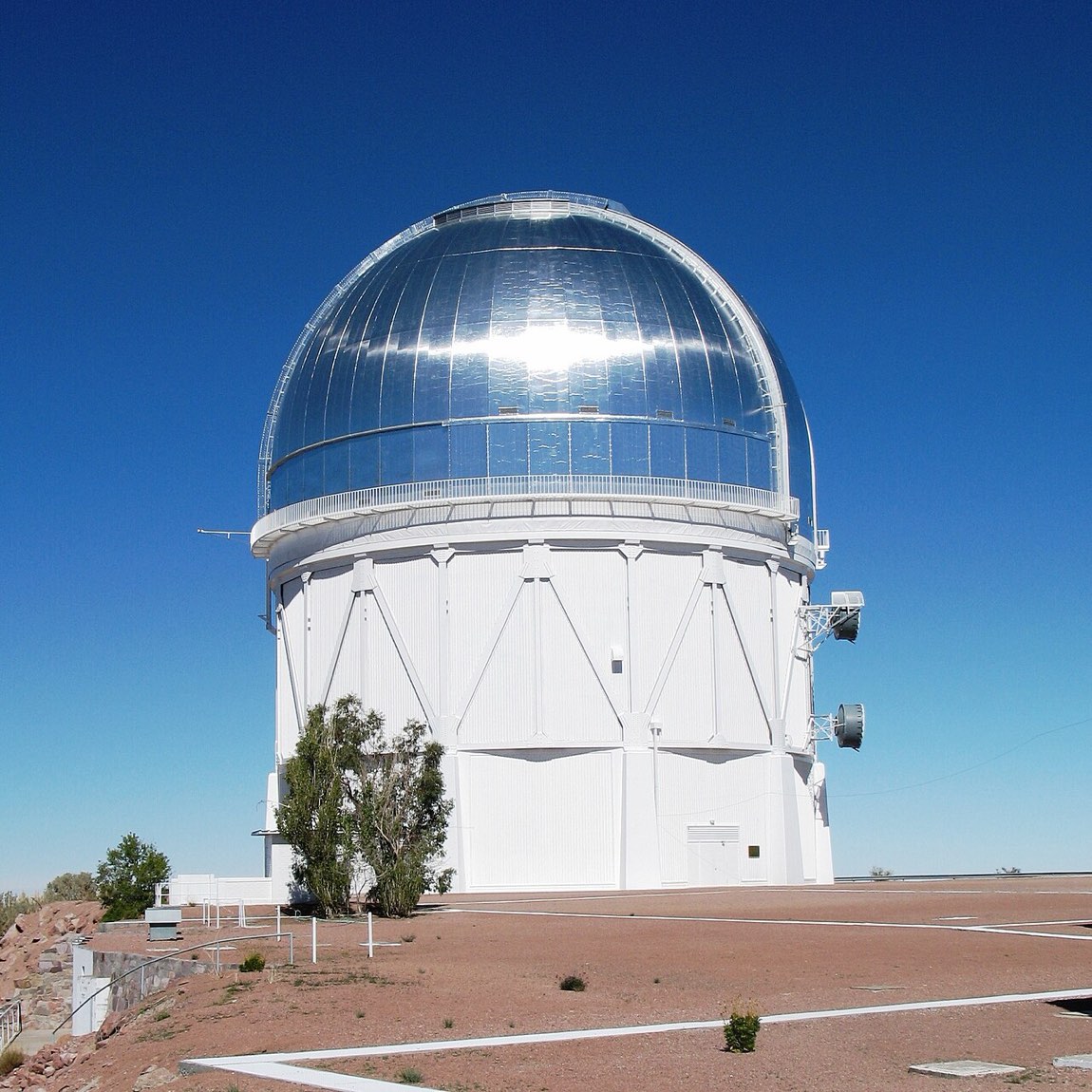
Ixion's discovery on 22 May 2001 came through the Deep Ecliptic Survey, a systematic hunt for Kuiper belt objects lurking near the plane of the Solar System. Working at the Cerro Tololo Inter-American Observatory in Chile, astronomers James Elliot and Lawrence Wasserman used the 4-meter Víctor M. Blanco Telescope to photograph the southern sky. Elliot spotted Ixion by comparing two digital images taken roughly two hours apart — the giveaway was its slow, steady crawl against the fixed background stars, the classic signature of a distant Solar System body. At that moment it was positioned in the constellation Scorpius. The discovery team, led by Robert L. Millis, was struck by how relatively bright the object appeared for something so far away, hinting that it might be unusually large. The Minor Planet Center formally announced it on 1 July 2001, assigning the provisional designation 2001 KX76 — a code revealing it was the 1,923rd object found in the second half of May that year. The permanent number 28978 followed just two months later, on 2 September 2001, once a lengthy observation arc had been secured.
02 Precovery: Finding It Before It Was Found Deeper
Even before Ixion officially existed as a named object, it had already been photographed dozens of times without anyone knowing it. In August 2001, astronomers used the European Southern Observatory's Astrovirtel virtual observatory — a system designed to automatically search archival image collections — to mine photographs from multiple observatories worldwide. The team recovered nine pre-discovery images of Ixion, with the oldest traced back to a plate taken by the Siding Spring Observatory on 17 July 1982, nearly two decades before the official discovery. Follow-up observations with the La Silla Observatory's 2.2-meter MPG/ESO telescope in 2001 added further data points. Together, these precovery images extended Ixion's observation arc by over 18 years — roughly the same span as a full Saturn orbital period — giving astronomers enough positional data to pin down its orbit with the precision required for the Minor Planet Center to assign it a permanent number. This technique of raiding archival sky photographs is now routine for newly found outer Solar System objects, and Ixion's case illustrated just how effectively it can compress what would otherwise be decades of patient waiting.
03 Locked in Step with Neptune
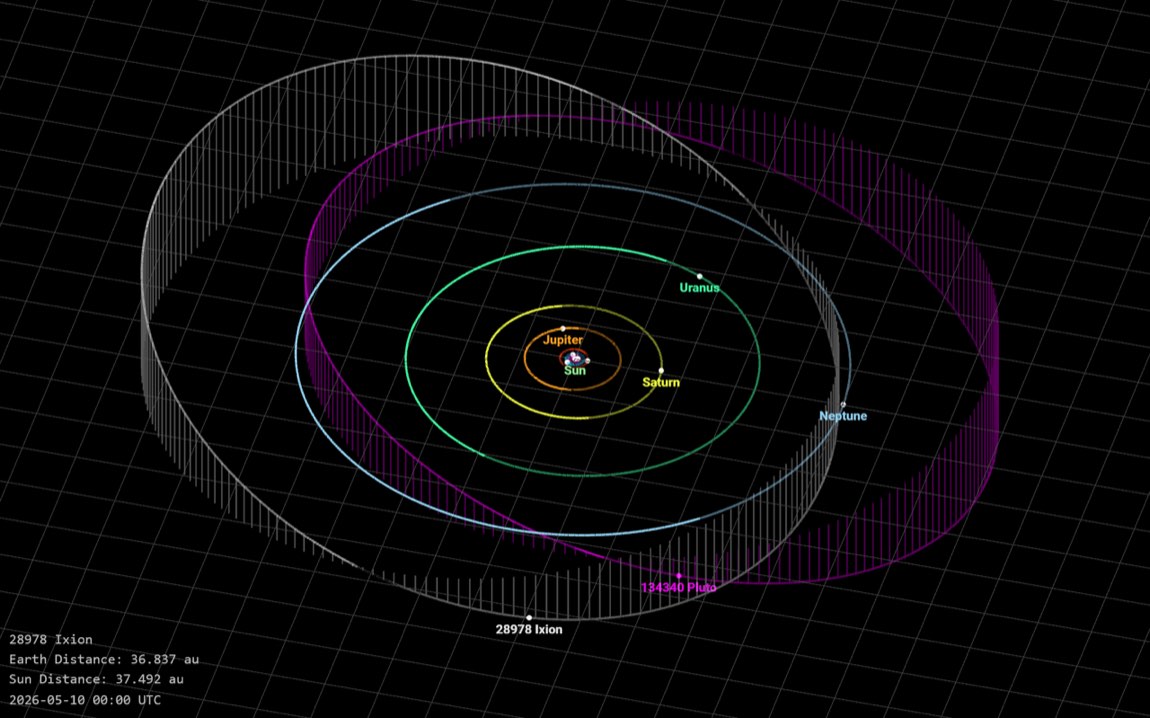
Ixion belongs to the plutinos, a family of objects caught in the same gravitational rhythm that governs Pluto itself. For every two complete orbits Ixion makes around the Sun, Neptune completes exactly three — a 2:3 mean-motion resonance that has held these bodies in a stable gravitational partnership across billions of years. With a semi-major axis of 39.5 AU, Ixion's orbital path closely mirrors Pluto's in both size and shape. Its orbital eccentricity is 0.24 and its tilt to the ecliptic plane is 19.6°, just slightly steeper than Pluto's 17°. That eccentricity means the distance from the Sun swings considerably: from 29.9 AU at its closest point (perihelion, next due on 24 September 2070) to 49.1 AU at its farthest. One full trip around the Sun takes 248 years — longer than any nation-state has existed. Gravitational nudges from the giant planets gradually shift these numbers: simulations show that over 10 million years, Ixion's perihelion could dip as low as 27.5 AU and its aphelion could stretch to 51.9 AU, while its inclination oscillates between 15.0° and 19.5°.
04 A Surface Coated in Dark Organic Gunk
If you could scoop up material from Ixion's surface, you would likely find yourself holding something that looks like a dark, reddish crust — not rock or clean ice, but a thick layer of complex organic compounds called tholins. These form when ultraviolet sunlight and high-energy cosmic rays bombard simple molecules such as water and organic compounds locked into clathrate structures, breaking and reassembling chemical bonds over millions of years into dark, sticky heteropolymers. The result is a surface with a geometric albedo of just 0.11, meaning it reflects only 11% of the sunlight that hits it — roughly as dark as worn asphalt. In visible wavelengths, Ixion appears moderately red, with a reddening trend running from 0.4 to 0.95 micrometers. Beyond about 0.85 micrometers, however, the spectrum flattens out and becomes essentially featureless into the near-infrared, with no obvious signature of water ice at the characteristic wavelengths of 1.5 and 2 micrometers. This featureless darkness is itself the message: Ixion's surface has been chemically processed by radiation for a very long time, and nothing — no recent impact, no internal eruption — appears to have refreshed it.
 ⤢
05 The Water Ice Debate Deeper
Whether water ice hides beneath or within Ixion's surface is one of the genuinely unresolved questions about this world. The near-infrared spectrum shows none of the absorption signatures at 1.5 and 2 micrometers that water ice would normally produce, strongly suggesting it is either absent or buried too deeply to detect. Yet in 2007, Barkume and colleagues reported a weak absorption feature that they attributed to water ice, and a 2003 Very Large Telescope study tentatively identified a feature at 0.8 micrometers that could signal material aqueously altered by water. A follow-up study by Boehnhardt and colleagues in 2004 failed to confirm that 0.8-micrometer feature, and they concluded that Ixion's surface is likely heterogeneous — meaning different patches of the surface have meaningfully different compositions. Supporting that idea, VLT observations in 2006 and 2007 found Ixion to be paradoxically bluer than earlier measurements, which the researchers interpreted as evidence of surface patchiness. Boehnhardt's team proposed a best-fit compositional model: approximately 65% amorphous carbon, 20% cometary ice tholins, 13% nitrogen and methane-rich Titan tholins, and just 2% water ice, with a mixing ratio of 6:1 dark to bright material.
06 Shape: Almost a World, Not Quite
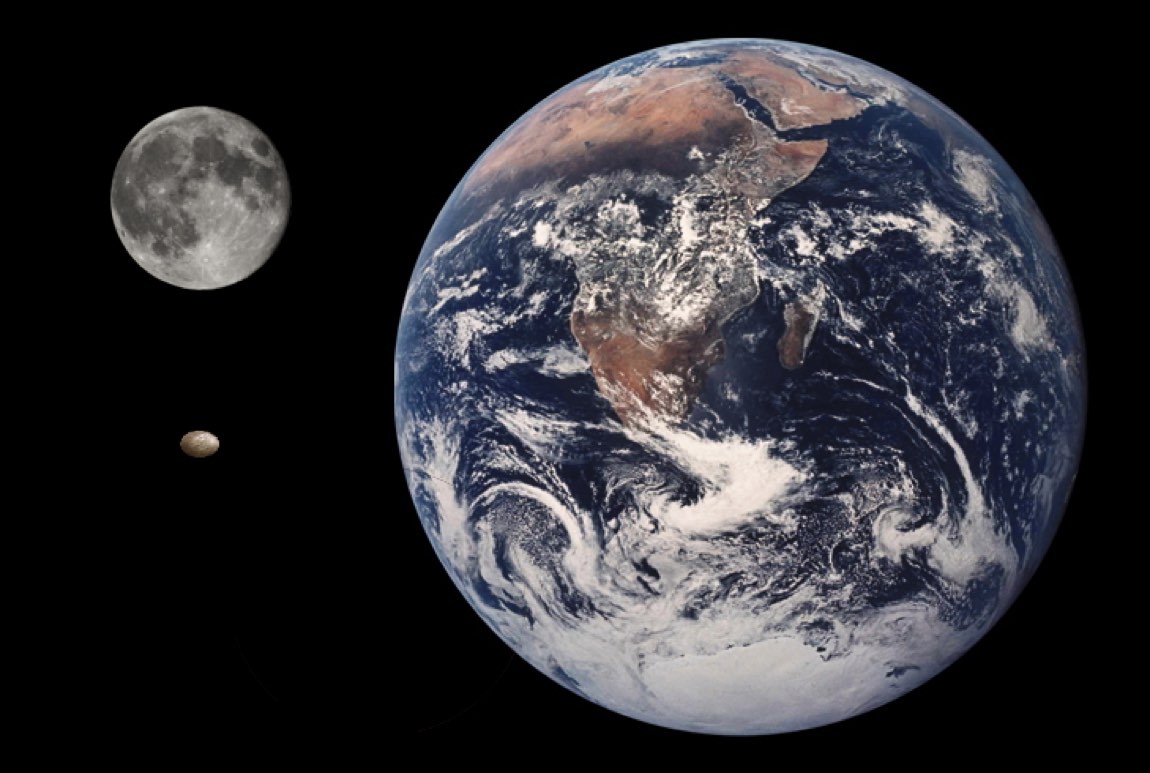
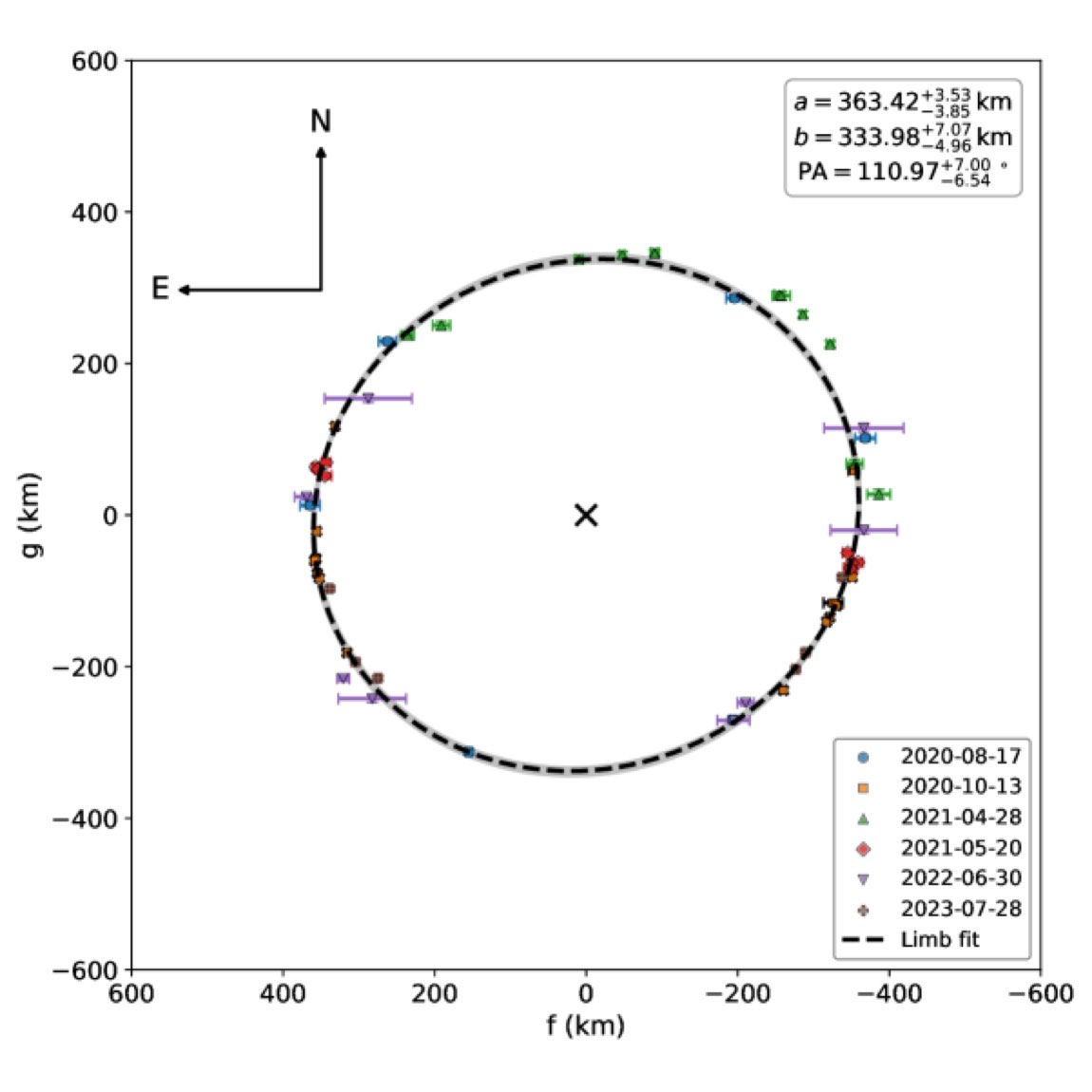
Stellar occultations — the precise moments when Ixion passes in front of a distant star and briefly dims it — have produced the sharpest picture yet of Ixion's physical form. Observations carried out between 2020 and 2023 reveal a body that is nearly, but not perfectly, spherical. Its longest diameter stretches 727 km (452 mi) while its shortest is 668 km (415 mi), giving an area-equivalent diameter of 697 km (433 mi). That slight flattening places Ixion in an interesting transitional zone: it is large enough that gravity has pulled it close to a round shape, yet it retains a subtle departure from a true sphere. For comparison, it is less than one-third the diameter of Pluto and roughly three-fifths the diameter of Pluto's moon Charon. Among the plutinos with measured diameters, only Achlys, Orcus, and Pluto are definitively larger. Astronomer Gonzalo Tancredi has argued that Ixion is large enough to have reached hydrostatic equilibrium — the state where gravity dominates over material strength — which would qualify it as a dwarf planet. Michael Brown also places it in the "highly likely" dwarf planet category, though formal classification remains pending.
07 Why Ixion Has No Known Moons Deeper
One of the most scientifically frustrating things about Ixion is the absence of any known satellite. For most large Kuiper belt objects, a moon is not just an interesting companion — it is the key that unlocks mass and density measurements through orbital mechanics. Without a moon, astronomers have no leverage point for calculating these fundamental quantities, so Ixion's mass and density remain entirely unknown. This is not for lack of trying: the Hubble Space Telescope examined Ixion in both 2002 and 2006, searching for any companion brighter than 0.5% of Ixion's own brightness at angular separations greater than 0.5 arcseconds. Nothing was found. The 2020–2023 occultation campaign added another constraint: no rings thicker than one kilometer in width with an optical depth of 0.1 or greater were detected. Ixion's size range — 400 to 1,000 km — is where trans-Neptunian objects are often observed with densities lower than water ice (below 1 g/cm³), but until a satellite is found or another mass-measurement method is applied, that density range is merely an expectation rather than a confirmed fact for Ixion specifically.
08 A Sluggish Spin With a Disputed Period Deeper
Measuring how fast Ixion rotates has proved surprisingly difficult. The challenge lies in the fact that Ixion shows very little brightness variation as it spins — its light curve amplitude is less than 0.15 magnitudes, and possibly as small as 0.05 magnitudes. Early attempts by Ortiz and colleagues in 2001 were inconclusive, as was work by Sheppard and Jewitt in 2003, though that latter study did tighten the amplitude constraint to below 0.05 magnitudes. The first firm rotation period came in 2010, when Rousselot and Petit observed Ixion with the European Southern Observatory's New Technology Telescope and measured a rotation period of 15.9 ± 0.5 hours, with a light curve amplitude of about 0.06 magnitudes. A more recent 2016 study by Galiazzo and colleagues produced a shorter period of 12.4 ± 0.3 hours, though the team calculated a 1.2% probability that their measurement is inaccurate. The near-featureless light curve is consistent with a nearly axisymmetric shape — Ixion simply does not present very different cross-sections to the observer as it rotates, making the spin hard to clock precisely.
 ⤢
09 The Myth Behind the Name
The International Astronomical Union names plutinos — objects in the same 2:3 orbital resonance as Pluto — after mythological figures connected to the underworld, and Ixion fits the theme dramatically. In Greek myth, Ixion was the king of the Lapiths and a figure of spectacular moral failure: he was the first mortal to murder a kinsman, and later attempted to seduce Hera, queen of the gods. For his crimes, Zeus condemned him to spin for eternity bound to a burning solar wheel in Tartarus, the deepest pit of the underworld. The name was proposed by Elaine K. Elliot, wife of one of the Deep Ecliptic Survey's discoverers, and the naming citation was published by the Minor Planet Center on 28 March 2002. The solar wheel of myth has even inspired proposed astrological symbols for Ixion. Sandy Turnbull designed a symbol incorporating the initials I and X alongside a depiction of the wheel. Denis Moskowitz, a software engineer in Massachusetts who created symbols for most of the dwarf planets, substituted the Greek letters iota and xi for I and X, producing a stylistic variant. Neither symbol has been adopted broadly beyond astrological circles.
10 New Horizons Glanced Its Way
On 13 and 14 July 2016, exactly one year after its historic flyby of Pluto, the New Horizons spacecraft turned its long-range imager toward Ixion. At that moment, the probe was 15 AU — about 2.2 billion km — away from its target, and it detected Ixion at magnitude 20.2. That distance is roughly the gap from the Sun to Uranus, illustrating that even our best outer Solar System explorer was still a vast way off. What made the observation scientifically interesting despite the distance was the viewing geometry: New Horizons caught Ixion at a phase angle of 64°, a high angle that is impossible to achieve from Earth because we sit so close to the Sun relative to distant Kuiper belt objects. This unusual angle allowed astronomers to study how Ixion's surface scatters light at geometries never otherwise accessible, helping constrain its photometric phase curve — information useful for understanding surface texture and porosity.
11 Planning a Future Mission to Ixion Deeper
Mission planners have given serious thought to what it would take to actually visit Ixion. A 2012 study by Ashley Gleaves and colleagues evaluated an orbiter concept, potentially launched on an Atlas V 551 or Delta IV Heavy rocket, with a projected launch date of November 2039. Using a gravity assist from Jupiter, such a spacecraft would need 20 to 25 years to reach Ixion, arriving sometime in the 2060s. Gleaves identified Ixion and the plutino Huya as the most practical orbiter targets because the trajectories demand the fewest complex maneuvers to achieve orbital insertion. For a less ambitious flyby mission, planetary scientist Amanda Zangari calculated that a launch in 2027 or 2032, again leveraging Jupiter's gravity, could reach Ixion in just over 10 years, finding the object at approximately 31 to 35 AU from the Sun on arrival. A 2040 launch with a Jupiter assist would also take just over 10 years, arriving around 2050 when Ixion would be 31 to 32 AU from the Sun. Trajectories combining Jupiter and Saturn gravity assists from a 2035 or 2040 launch could complete the journey in under 22 years, while a Saturn-only assist from a 2038 or 2040 launch would take at least 19 years, with Ixion near 30 AU in both cases.
12 Early Size Estimates and Why They Were Wrong
When Ixion burst onto the scene in 2001, it caused genuine excitement because it appeared to be enormous. Astronomers at the time assumed a low surface albedo — a reasonable guess for an unknown object — and that assumption, combined with Ixion's measured brightness, produced an estimated diameter of around 1,200 km (750 mi). That would have made it larger than the dwarf planet Ceres and nearly as big as Pluto's moon Charon, potentially a truly Pluto-class world. It was briefly considered the largest and brightest Kuiper belt object known. The excitement faded as better data arrived. Infrared space telescopes, which measure the heat an object radiates and therefore give a more direct size estimate, began trimming the number down. The most precise data came from stellar occultations conducted between 2020 and 2023, which pinned the area-equivalent diameter at 697 km (433 mi) — barely more than half the original estimate. The lesson is a familiar one in planetary science: apparent brightness alone is an unreliable size proxy, because it conflates the object's size with its unknown reflectivity.
 ⤢
13 Open Questions and What We Still Don't Know Deeper
Despite more than two decades of observation, Ixion leaves researchers with a surprisingly long list of unknowns. Its mass is entirely unconstrained because no moon has been found. Its density — a key indicator of whether it is a rocky-icy mix or predominantly ice — therefore remains unknown. The debate over water ice on its surface has not been settled: different observing runs with different telescopes have produced contradictory results, and the apparent patchiness of the surface means that any single observation may be sampling only one type of terrain. Its rotation period is disputed between 12.4 ± 0.3 hours and 15.9 ± 0.5 hours, two studies that have not been reconciled. Whether Ixion formally qualifies as a dwarf planet — that it has achieved hydrostatic equilibrium — has not been definitively confirmed, though both Tancredi and Michael Brown consider it highly likely. And no spacecraft has ever flown close enough to image its surface in any detail. For now, Ixion sits at the edge of the Solar System as a world known mostly in outline, its interior, surface texture, composition, and history still waiting to be read.