Dwarf Planet · Deep guide
307261 Máni (2002 MS4)
Also called: 307261 Máni · Mani · 2002 MS4 · (307261) 2002 MS4
A Kuiper belt body with a 25-km-tall peak and a giant 320-km crater visible in its silhouette.
What is it?
Máni, long known only as 2002 MS4, is a Kuiper belt object about 800 km across that was finally named in 2025 after the Norse personification of the Moon. When it passed in front of stars, its outline revealed huge features: a peak about 25 km high and a depression roughly 320 km wide and 45 km deep. Its irregular shape suggests it may not be round enough to count as a dwarf planet, and the IAU does not recognize it as one.
The deep dive
Researched for the Atlas from Wikipedia — 307261 Máni (17,914 characters read) · updated Nov 14, 2026
01 How Máni Was Found in the Dark
Máni's discovery in 2002 was part of a deliberate hunt rather than a lucky stumble. Chad Trujillo and Michael Brown were systematically scanning the sky with the Samuel Oschin telescope at Palomar Observatory — a 1.22-meter instrument equipped with a wide-field CCD camera — searching specifically for Pluto-sized objects lurking in the Kuiper belt. The same survey turned up some of the solar system's most famous outer worlds, including the dwarf planets Eris, Sedna, and Quaoar. Máni was among the fainter catches, sitting just below the survey's limiting magnitude at an observed brightness of magnitude 20.9. It was spotted through manual review of objects flagged by the team's automated image-searching software. Follow-up observations were made two months later with Palomar's larger 1.52-meter telescope, and the Minor Planet Center formally announced the discovery on 21 November 2002, assigning it the provisional designation 2002 MS4.
02 A 1954 Photo Hides a 2002 Discovery Deeper
After its August 2002 follow-up observations, Máni vanished from astronomers' attention for more than nine months. It was recovered by Trujillo himself at Palomar on 29 May 2003, then observed by Wolf Bickel at Bergisch Gladbach Observatory in Germany during June 2003. Those recovery observations shrank the uncertainty on Máni's orbit enough to allow scientists to work backwards through archival sky surveys — a technique called precovery. In 2007, astronomer Andrew Lowe identified seven precovery observations of Máni in Digitized Sky Survey photographic plates, with the earliest dating all the way back to 8 April 1954, also from Palomar Observatory. That single old plate extends Máni's observational baseline to over 68 years as of 2025 — roughly 25 percent of its full 269-year orbital period. A longer baseline translates directly into a more precisely known orbit, which matters enormously for predicting when and where Máni will pass in front of background stars.
03 The Norse Moon-God Behind the Name
For more than two decades after its discovery, the object carried only its dry catalog label, 2002 MS4. That changed on 9 June 2025, when the International Astronomical Union's Working Group for Small Bodies Nomenclature officially christened it Máni. The naming citation describes Máni as a personification of the Moon from Old Norse mythology, as recorded in the Prose Edda. He is the son of Mundilfari and the brother of Sól, who personifies the Sun. The choice is deliberate: the IAU recommends that classical Kuiper belt objects be named after mythological creation figures, and Máni fits neatly into that tradition. The object also received its permanent minor planet catalog number, 307261, from the Minor Planet Center back on 10 December 2011 — fourteen years before anyone bothered to give it a proper name.
04 An Orbit Shaped by Neptune's Ancient Kick Deeper
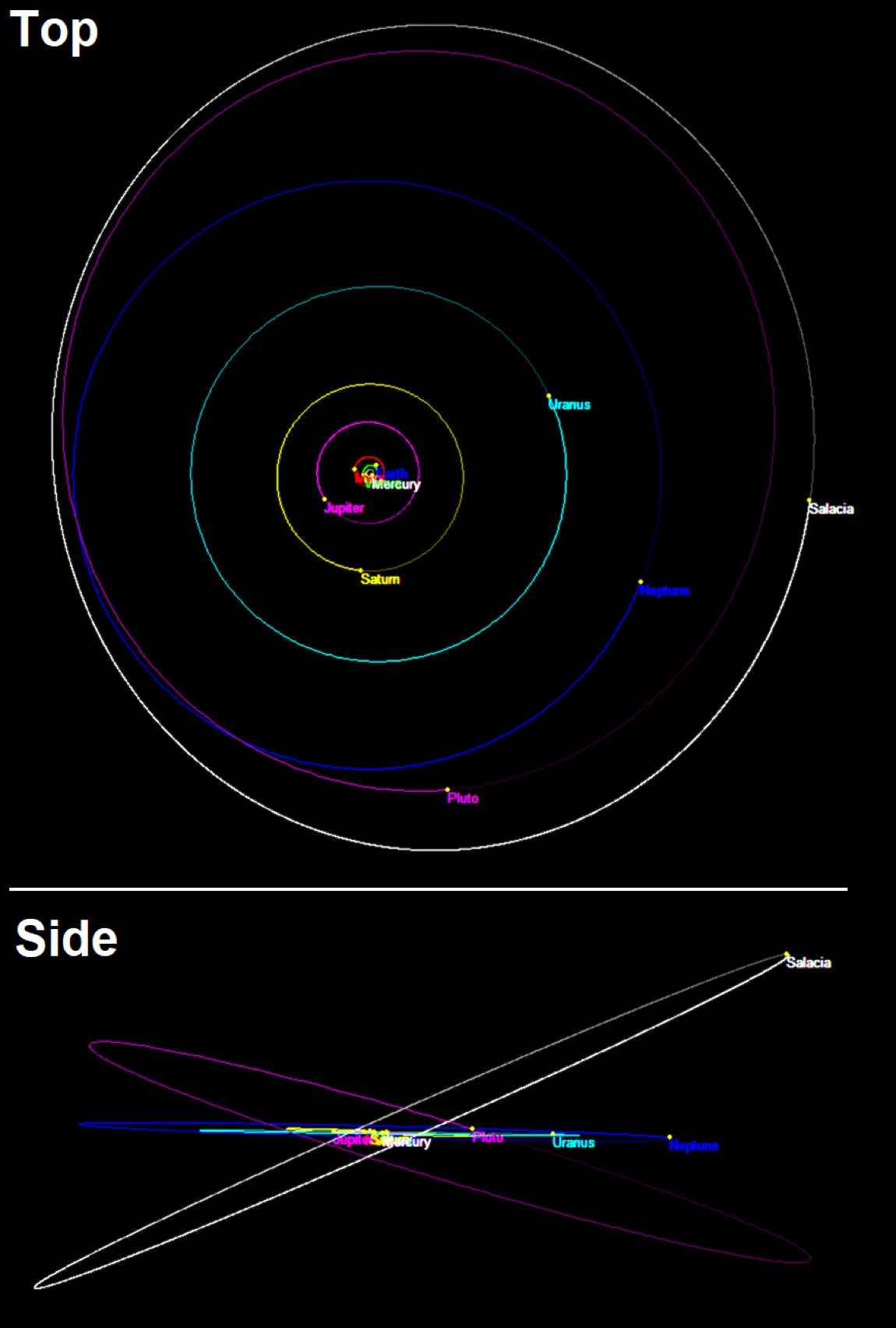
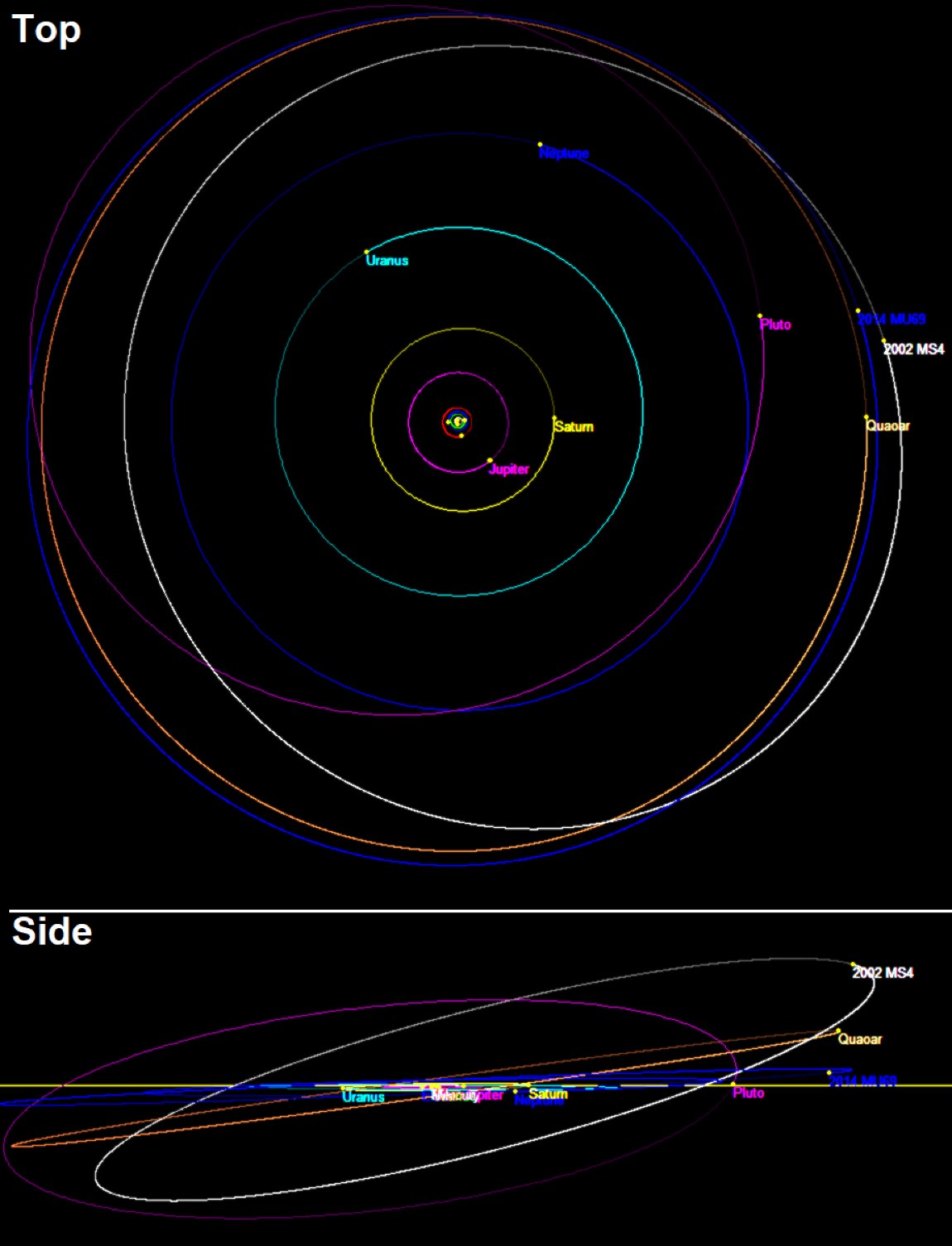
Máni travels in a moderately elliptical orbit with an eccentricity of 0.15 around a semi-major axis of 41.7 astronomical units, swinging between 35.7 AU at perihelion and 47.8 AU at aphelion — keeping it firmly within the classical Kuiper belt region of 37–48 AU. Its orbital inclination of nearly 18 degrees above the ecliptic classifies it as a dynamically "hot" classical Kuiper belt object, a label that carries a specific historical implication: the inclination is thought to reflect gravitational scattering by Neptune as the giant planet migrated outward early in the solar system's history. Today Máni is safe from Neptune's influence, with a minimum orbit intersection distance of 6.6 AU — far enough that close encounters no longer disturb it. A 2007 dynamical study simulating 10 million years of Máni's orbital evolution found hints of an intermittent 18:11 mean-motion resonance with Neptune that may cause irregular fluctuations in its inclination and eccentricity, though researchers stop short of calling Máni a resonant object. Its last perihelion was in April 1853; the next is due in June 2123.
 ⤢
05 Topographic Extremes on a Frozen World
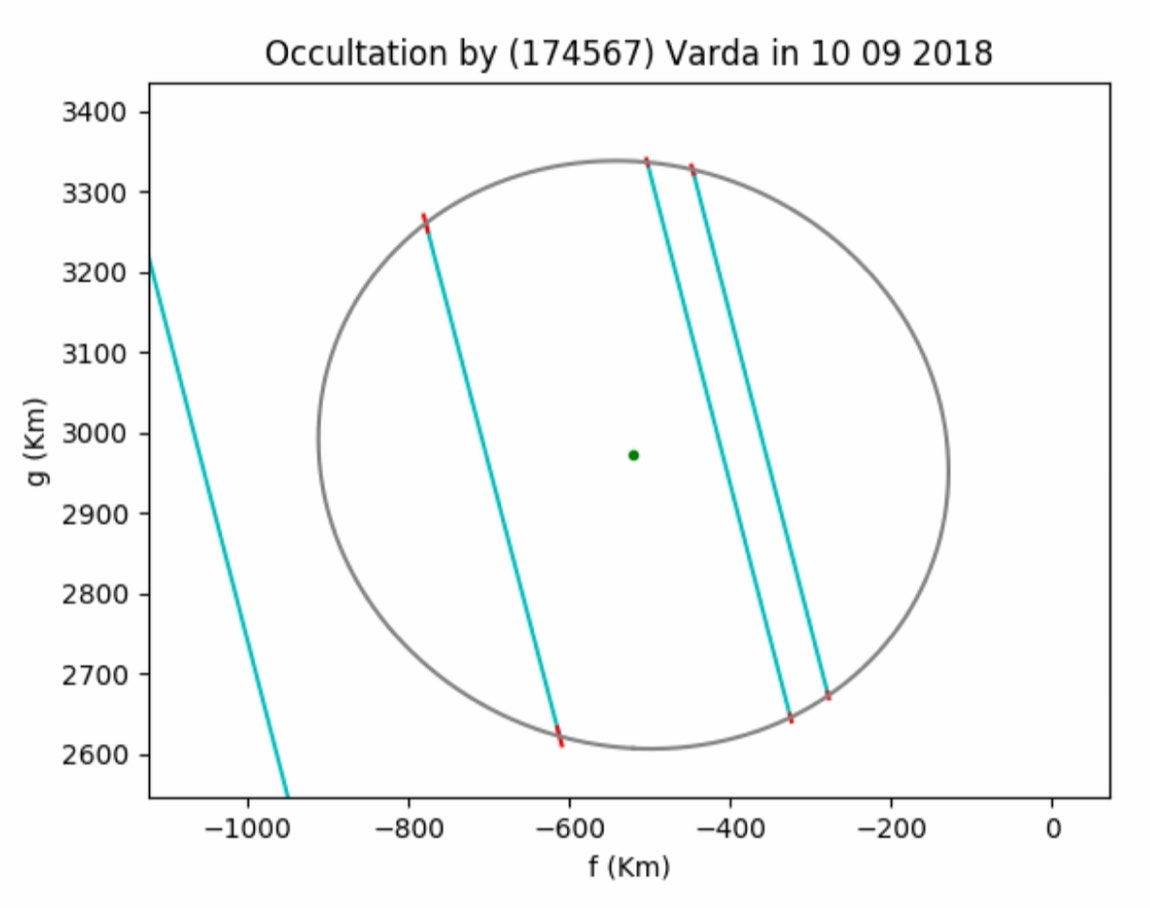
The most dramatic thing about Máni may be its surface relief. The extensively observed occultation of 8 August 2020 revealed a crater-like depression 322 ± 39 km wide and 45.1 ± 1.5 km deep — a hole so broad it spans roughly 40 percent of Máni's entire diameter, comparable to the largest crater-to-diameter ratios seen on Saturn's moons Tethys and Iapetus. Near the rim of that depression rises a mountain-like peak standing 25 km tall, comparable in height to Mars's Olympus Mons and the central mound of asteroid Vesta's Rheasilvia crater. For an icy body of Máni's size, gravity and material strength should limit surface relief to around 6–7 km — yet these features tower far beyond that ceiling. Scientists interpret the excess as evidence of a major impact in Máni's past, and suggest that the object's material strength increasing toward its core may help support these extraordinary heights.
06 Why the Depression Could Be Historic Deeper
If Máni's massive depression is confirmed as an impact crater, it would be the first direct observation of a large crater on a trans-Neptunian object — a significant first in planetary science. Its depth of 45.1 km is striking in comparative context: the largest crater on Saturn's moon Mimas reaches only 10–12 km deep, and Vesta's enormous Rheasilvia crater is at most 25 km deep. Máni's putative crater also dwarfs those of Pluto and Charon in proportional terms; Pluto's largest craters reach only 10.5 percent of its diameter, and Charon's reach 18.9 percent, while Máni's depression covers about 40 percent of its diameter. A second, smaller depression — roughly 10 km wide and 11 km deep — was detected by a single telescope in Varages, France during the same occultation. Its presence caused the star to brighten gradually rather than instantly as Máni moved away, a telltale sign that the feature only partially covered the stellar disk.
07 A Surface of Ice and Dark Gray Dust
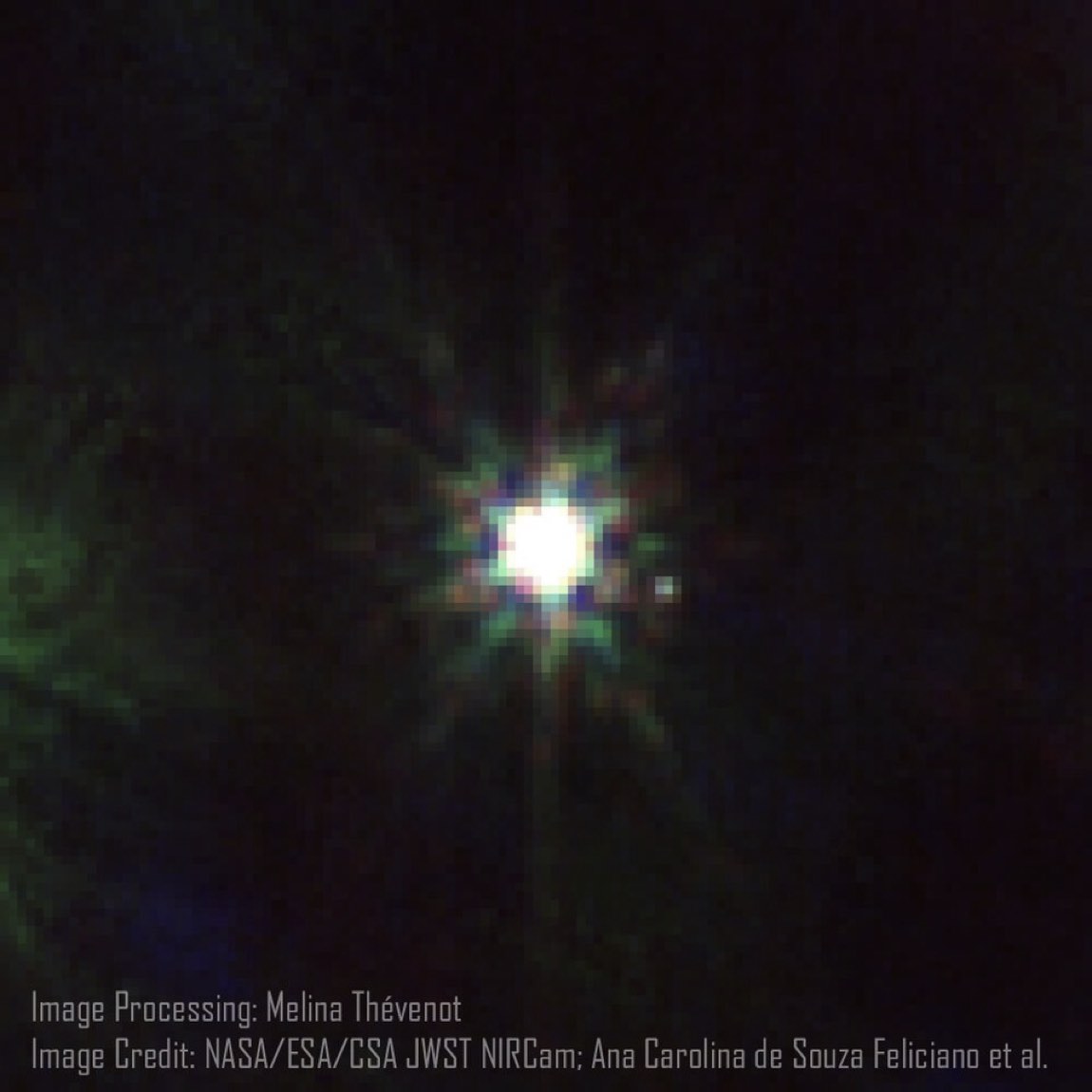
Máni's surface reflects only about 10 percent of the sunlight that strikes it — a low geometric albedo that makes it quite dark by solar system standards. Its color is spectrally neutral or gray, meaning it reflects similar amounts of light across the visible spectrum without favoring red or blue wavelengths. Near-infrared spectroscopy by the James Webb Space Telescope in 2022 showed that the surface is rich in both crystalline and amorphous water ice, as well as carbon dioxide ice, while being notably deficient in volatile substances like methane or hydrocarbons. This composition places Máni in a category called "prominent water" (H2O)-type TNOs alongside Orcus, Salacia, and Achlys. Among the larger members of this group, including Máni, the concentration of surface water ice is comparatively high. A 2025 study led by Ian Wong speculated that this concentrated water ice may have been deposited by cryovolcanism — icy eruptions driven by internal heat rather than the rocky volcanism familiar from Earth.
08 Grain Size Clues from Infrared Light Deeper
Beyond simply identifying which ices are present on Máni's surface, astronomers have begun probing their physical texture through spectral analysis. A preliminary 2023 study by Jason Cook and collaborators suggested that Máni's water ice consists of micrometer-sized grains, while its carbon dioxide ice is a mixture of coarser micrometer-scale grains and finer sub-micrometer-scale grains. These grain sizes influence how light scatters off the surface, leaving measurable imprints in the spectrum. Additional clues about surface texture come from New Horizons observations of Máni's phase curve — the way its brightness changes with viewing angle. Those measurements indicate that the icy regolith grains on Máni's surface are rough and irregularly shaped rather than smooth and round. Together, these findings paint a picture of a rugged, textured icy surface at the microscopic scale, even if the dominant impression from afar is simply dark and gray.
 ⤢
09 The 116-Telescope Campaign of 2020
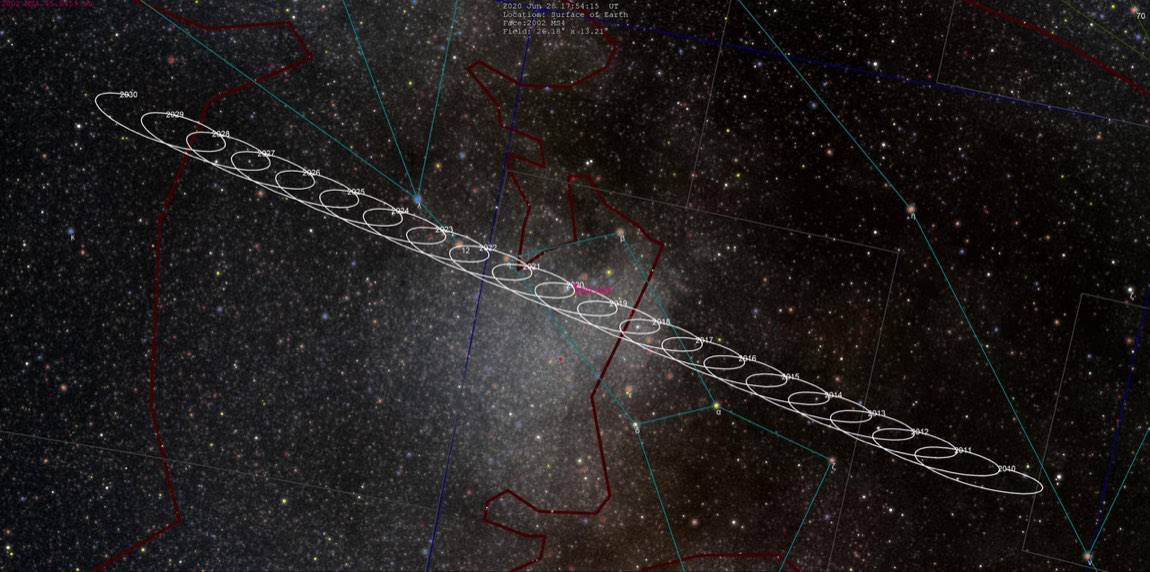
Observing Máni is tricky: it sits near the dense star fields around the Milky Way's Galactic Center in the southern celestial hemisphere, its faint apparent magnitude of 20.5 challenges most telescopes, and parallax means any given occultation is only visible from a narrow strip of Earth's surface. The European Research Council's Lucky Star project tackled this by collecting astrometric observations of Máni from 2009 to 2019 and cross-referencing them with the high-precision Gaia star catalogs to sharpen occultation predictions. The payoff came on 8 August 2020, when a campaign mobilized 116 telescope locations across Europe, North Africa, and Western Asia to watch Máni pass in front of a relatively bright magnitude-14.6 star. Sixty-one sites recorded positive detections, 40 recorded negative detections (meaning Máni missed their line of sight), and 15 were lost to weather or technical problems. As of 2023, this remains the most extensive participation in any TNO occultation campaign ever organized. Crucially, the observers found no evidence of rings, cometary jets, or satellites during the event.
10 An Invisible Moon Betrayed by Heat Deeper
Máni has no confirmed moon — Hubble Space Telescope images from 2006 showed nothing, and the 2020 occultation campaign found no satellite within 1,000 km. Yet something strange turned up after Máni's diameter was nailed down through occultations: the object radiates more thermal energy than a single body of its measured size should produce. That excess thermal emission cannot be explained by a single highly emissive object. It can be explained, however, if Máni has a thermally emitting companion. Working from the discrepancy between measured and predicted thermal output, astronomers inferred a possible moon with a diameter of 534 +58/−54 km — roughly two-thirds of Máni's own diameter. A system like this would qualify as a binary, with an origin possibly tied to either the streaming instability process during the solar system's formation or a large impact. The moon candidate may simply be hiding behind or in front of Máni during observations, making direct confirmation difficult.
11 New Horizons Watched from Inside the Belt
After its historic Pluto flyby in 2015, the New Horizons spacecraft turned its instruments on Máni as part of its extended Kuiper belt mission, observing the object from 13 July 2016 to 1 September 2019. At the start of observations Máni was 15.3 AU away from the spacecraft; by the end it was 12.0 AU away. Being physically inside the Kuiper belt gave New Horizons a unique advantage: it could view Máni at phase angles greater than 2 degrees — angles simply not accessible from Earth — revealing how the surface scatters sunlight at geometries never before measured. This produced a substantially improved phase curve for Máni and, as a secondary benefit, dramatically refined the precision of its orbit. No other spacecraft has observed Máni at close range, and all direct imaging remains from great distance.
12 Planning a Future Mission to Máni Deeper
Máni has attracted attention as a potential destination for future deep-space missions, including NASA's Interstellar Probe concept. A 2019 study by Amanda Zangari and colleagues mapped out possible flight paths for spacecraft launched between 2025 and 2040. For launches in the 2027–2031 window, a single gravity assist from Jupiter could deliver a spacecraft to Máni in as little as 9.1 to 12.8 years, depending on how much launch energy is available. A 2040 launch using a single Jupiter assist could do it in a minimum of 13 years. Trajectories using Saturn as the slingshot point, feasible for 2038–2040 launches, would require 16.7 years at minimum with one assist, or 18.6–19.5 years using both Jupiter and Saturn in sequence. None of these missions has been approved or funded, but the trajectory options demonstrate that Máni is a reachable target within the planning horizons of current space agencies, particularly given its scientific value as a large, topographically extreme Kuiper belt object.
 ⤢
13 Open Questions About Máni's Interior Deeper
Despite everything astronomers have measured about Máni's shape, surface, and orbit, its interior remains almost entirely unknown. Without a confirmed moon, there is no way to calculate its mass through gravitational influence, which means its density is also unknown — and without density, the ice-to-rock ratio and internal porosity cannot be determined. If Máni is in hydrostatic equilibrium, its density could in principle be inferred from its oblateness and rotation period, but both of those properties are poorly constrained. Using a Maclaurin spheroid as the equilibrium model and two candidate rotation periods of 7.44 and 10.44 hours, the range of plausible densities spans 0.72–8.0 g/cm³ and 0.36–3.9 g/cm³ respectively — an enormous spread that illustrates just how uncertain things are. Máni falls in the 400–1,000 km size range where TNOs often appear to have densities lower than water ice (1 g/cm³), suggesting porous interiors that never fully melted or compressed, but whether Máni fits that pattern remains an open question.