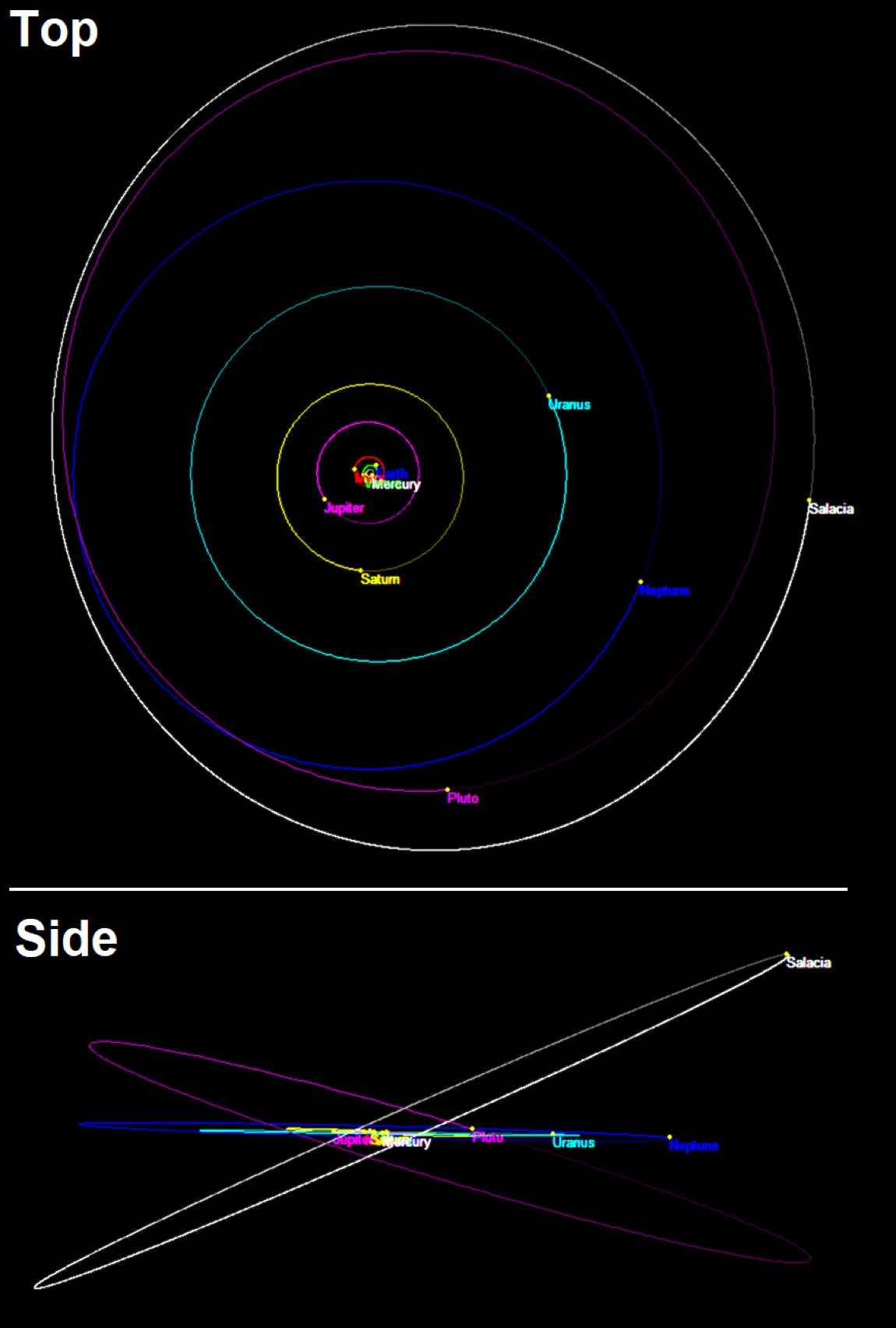
 Diagram · Tomruen · CC BY-SA 4.0
Dwarf Planet · Deep guide
120347 Salacia
Also called: 120347 Salacia · (120347) Salacia · 2004 SB60
A very dark, nearly round Kuiper belt object with a moon named Actaea.
What is it?
Salacia is a large Kuiper belt object about 840 km across, orbiting slightly farther from the Sun than Pluto on average. It is unusually dark, reflecting only about 4% of sunlight, and its gentle light curve suggests a nearly spherical shape. Webb telescope observations found water ice covers less than 5% of its surface, alongside carbon-dioxide ice. It is sometimes listed as a possible dwarf planet, but this is not an official IAU classification.
The deep dive
Researched for the Atlas from Wikipedia — 120347 Salacia (20,737 characters read) · updated Nov 14, 2026
01 How Salacia Was Found and Confirmed
Salacia's discovery unfolded in stages spread across more than two decades. Henry Roe, Michael Brown, and Kristina Barkume first spotted it on 22 September 2004 using the Hale Reflector at Palomar Observatory, recording it at a red-filter apparent magnitude between 20.1 and 20.6 — far too faint for any unaided eye. The formal announcement came in May 2005, published in Minor Planet Electronic Circular MPEC 2005-J26 alongside six other newly tracked trans-Neptunian objects. Crucially, the team was able to push the object's known history back dramatically through precovery: archival images from the Siding Spring Observatory dated all the way to 25 July 1982 contained Salacia's faint dot, giving astronomers a 22-year baseline before the official discovery night. Between 2001 and 2003, the Near-Earth Asteroid Tracking program and the Sloan Digital Sky Survey had also inadvertently imaged it. As of May 2026, a total of 490 observations spanning 37.16 years have refined its orbital path, with the most recent logged on 1 November 2025 by Pan-STARRS 1 at Haleakalā.
02 The Naming: A Marine Goddess and Her Nymph
Salacia takes its name from the Roman goddess of salt water, consort of Neptune and the Roman equivalent of the Greek sea goddess Amphitrite or Tethys. The permanent minor planet number 120347 was assigned on 16 November 2005, but the formal naming citation did not appear until 18 February 2011, published in M.P.C. 73984 by the International Astronomical Union. The theme carries through to its moon: Actaea (from the Ancient Greek Ἀκταία, meaning "the dweller on coasts") was named after one of the 50 Nereid sea-nymphs of Greek mythology, keeping the entire system within a coherent marine mythology. Planetary symbols fell out of fashion in modern astronomy before Salacia was named, so it never received an official one. Software engineer Denis Moskowitz — who designed most of the dwarf planet symbols in informal use — proposed a stylised hippocamp as Salacia's symbol, though it has not gained wide adoption. The provisional designation 2004 SB60 reflects the survey half-month and sky region in which it was first catalogued.
03 A Peculiar Orbit in the Kuiper Belt's Hot Zone Deeper
Salacia orbits the Sun between 37.7 and 46.7 AU with a semi-major axis of 42.2 AU, completing one full revolution every 274.0 years. Its orbital eccentricity is a moderate 0.11, but what distinguishes it is a steeply inclined path of 23.9° relative to the ecliptic — roughly twice the inclination of Pluto's orbit. That tilt places Salacia in the dynamically "hot" sub-population of classical Kuiper belt objects. Unlike the cold classical members that formed on nearly circular, low-inclination paths right where they now reside, hot classicals like Salacia almost certainly formed closer to the Sun and were flung outward to their current distant orbits during the early outward migration of Neptune. Its orbit currently sits near its most northern point above the ecliptic plane. Interestingly, the orbit resembles Pluto's in shape and distance, except for a nearly opposite longitude of ascending node. The object also passes close in orbital space to the Haumea collisional family, but spectral and tracking data confirm it is an unrelated background body — a coincidence of geometry, not ancestry.
04 The Long Debate Over Salacia's Classification Deeper
Whether Salacia is a scattered object or a classical Kuiper belt object has been a genuine academic disagreement, one that highlights how much classification depends on the framework chosen. The Deep Ecliptic Survey system developed by Elliot and colleagues automatically routes highly inclined orbits into the scattered category, so it labels Salacia a scattered-extended object. Brett Gladman and his team took a different approach: they ran a 10-million-year computer simulation of Salacia's orbital evolution and found it completely stable and entirely uninfluenced by Neptune's gravity over that entire span. On that basis, Gladman et al. formally call it a hot classical Kuiper belt object — a cubewano. The distinction matters because it carries implications for where and how the object formed. The debate is not merely semantic; it shapes assumptions about Salacia's internal composition and thermal history. Neither camp disputes the basic orbital numbers, only the interpretive framework applied to them, making Salacia a useful case study in how astronomers negotiate classification at the edges of well-defined categories.
 ⤢
05 Catching Salacia Crossing a Star: Occultations
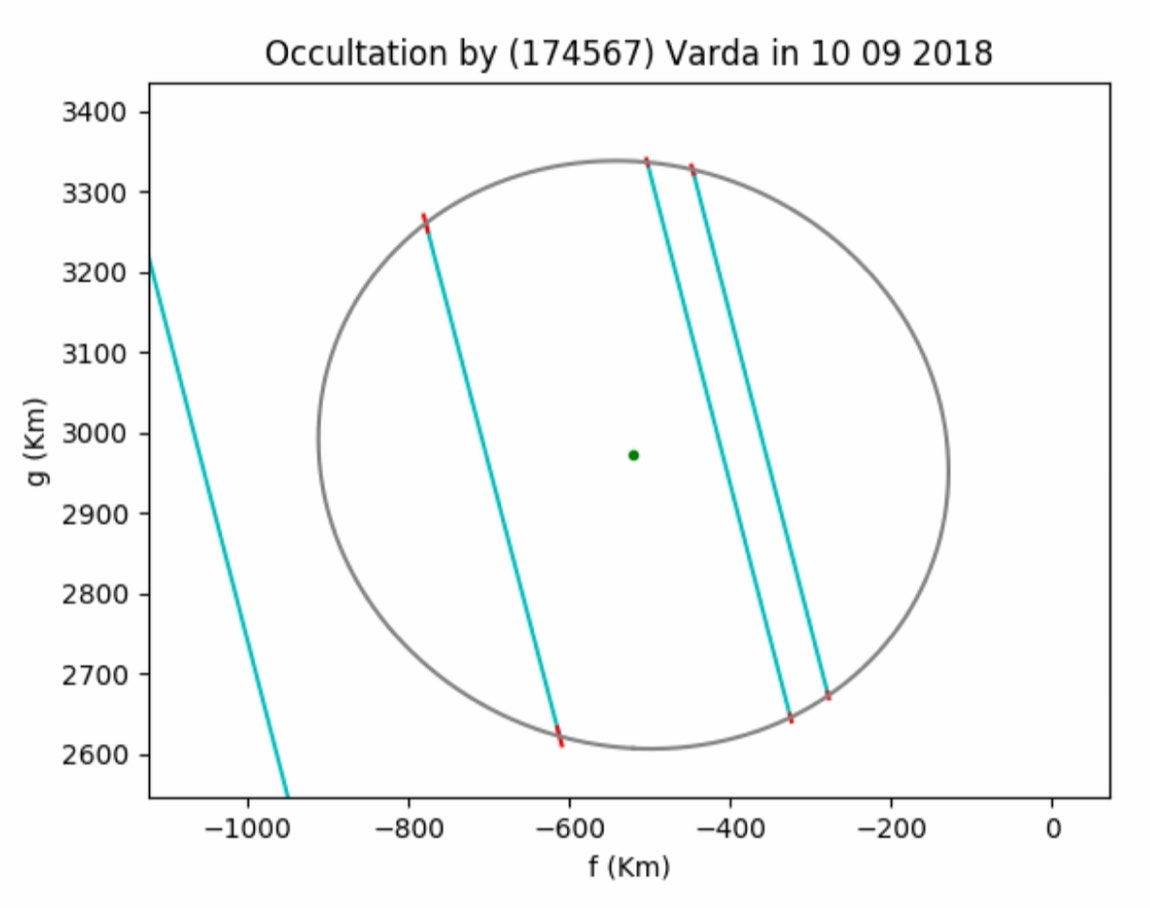
When Salacia drifts directly in front of a background star, the brief dimming of starlight — a stellar occultation — gives scientists a rare direct measurement of the object's size and shape without sending a spacecraft. Early campaigns carried orbital uncertainties of around 2,300 km, but each event has sharpened the picture. On 27 December 2018, an event monitored by the LESIA at the Observatoire de Paris against a Gaia magnitude 15.5 star produced a 4.8-magnitude brightness drop, cutting the orbital uncertainty from 4,214.9 km down sharply. A 28 July 2023 occultation, captured by the 1.54-meter Danish Telescope at La Silla, recorded a light drop lasting 31.2±0.3 seconds at a relative crossing speed of 25.24 km/s, yielding a direct single-chord size measurement of 786.5±7.8 km. The most dramatic event came on 17 August 2024: both Salacia and Actaea blocked the same Gaia magnitude 15.9 star within five minutes of each other. Hubble Space Telescope images taken under Proposal 17848 beforehand reduced the initial 1,842.8 km path uncertainty to just 300 km, allowing ground stations to record a sharp 5.0-magnitude drop for each body in turn. A future occultation of a magnitude 13.9 star is scheduled for 26 January 2027, targeted by the RECON network.
06 Solving a Spin Mystery: 6 Hours or 5.5 Days?
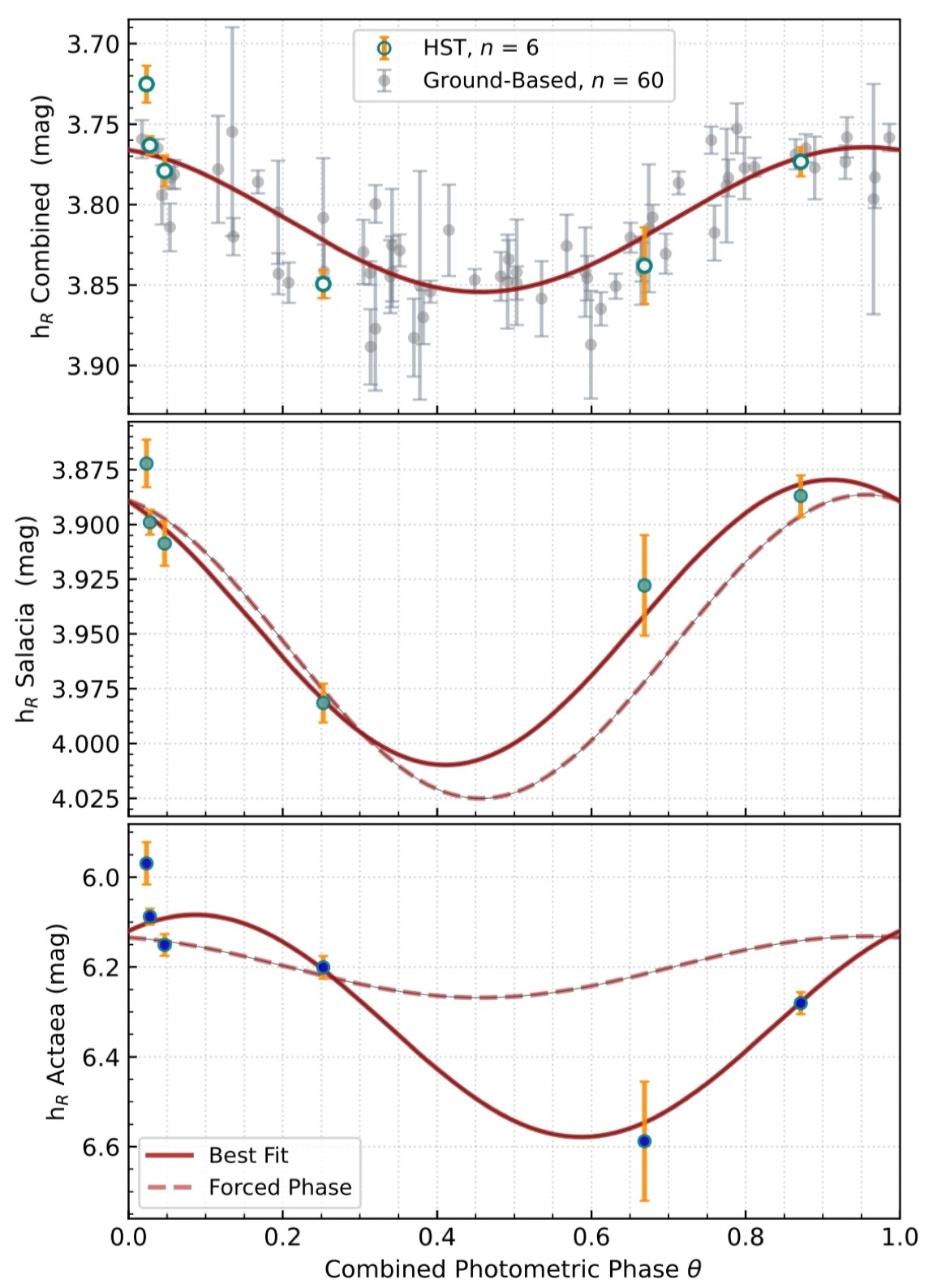
For roughly a decade after Salacia's discovery, astronomers believed it rotated very rapidly — completing a full spin in just 6.09 to 6.5 hours, comparable to many asteroids. A long-term study published in 2025 showed that figure was an illusion produced by "observational aliasing." Because ground-based telescopes could only observe Salacia for a few days at a stretch, the data gaps caused the analysis software to mistake a slow 5.49-day rotation for a fast 6.5-hour one — a common statistical trap when sampling periodic signals at insufficient cadence. The 2025 team resolved the ambiguity by analyzing 165 hours of data collected over 16 years, combining ground-based photometry with Hubble Space Telescope images. The true rotation period turned out to be 5.49 days — exactly matching Actaea's orbital period of 5.49389±0.00001 days. The two bodies are therefore mutually tidally locked, forever showing the same hemisphere to each other. This corrected spin rate also implies that Salacia once rotated much faster, around once every 10 hours, before Actaea's gravity gradually braked its spin through tidal friction.
07 Mutual Tidal Lock: A Pluto-Charon Echo Deeper
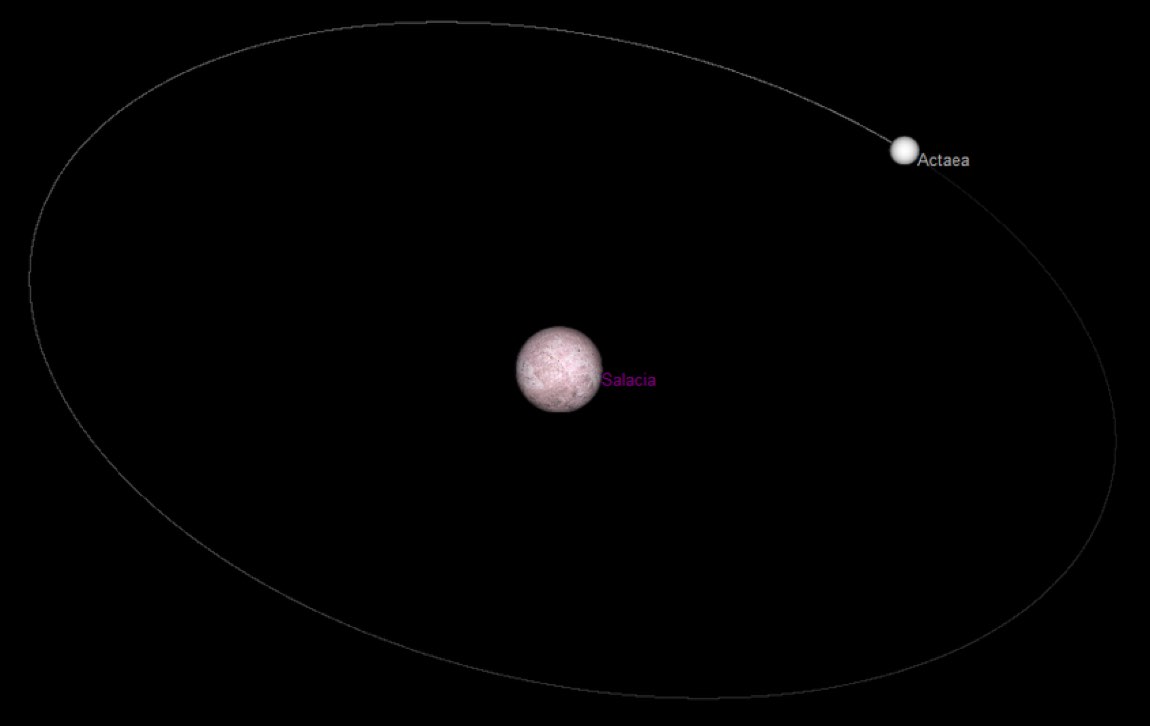
The Salacia–Actaea system has achieved what planetary scientists call doubly synchronous rotation: both bodies orbit their shared center of mass every 5.49389±0.00001 days while each spinning on its own axis in that same period, so they permanently face each other. This is exactly what Pluto and Charon do, and the dynamics are driven by the same mechanism. Because Actaea is relatively large compared to Salacia, its gravitational pull raised persistent tidal bulges on Salacia's surface, dissipating energy as internal heat and angular momentum transferred from Salacia's spin into Actaea's orbit. Models show that if Salacia's interior never differentiated, this tidal braking would have taken up to 1 billion years. But if the body underwent an early, brief internal melting episode that separated rock from ice, the same process could have completed in roughly 100 million years — meaning the system could have settled into its current locked configuration very early in Solar System history. The Salacia–Actaea pair is only the third confirmed doubly synchronous binary in the entire trans-Neptunian population, joining Pluto–Charon and Eris–Dysnomia. It also has the tightest orbit relative to its primary's Hill radius among all known trans-Neptunian binaries, with that ratio standing at just 0.0023.
08 Actaea: A Moon Darker Than Coal
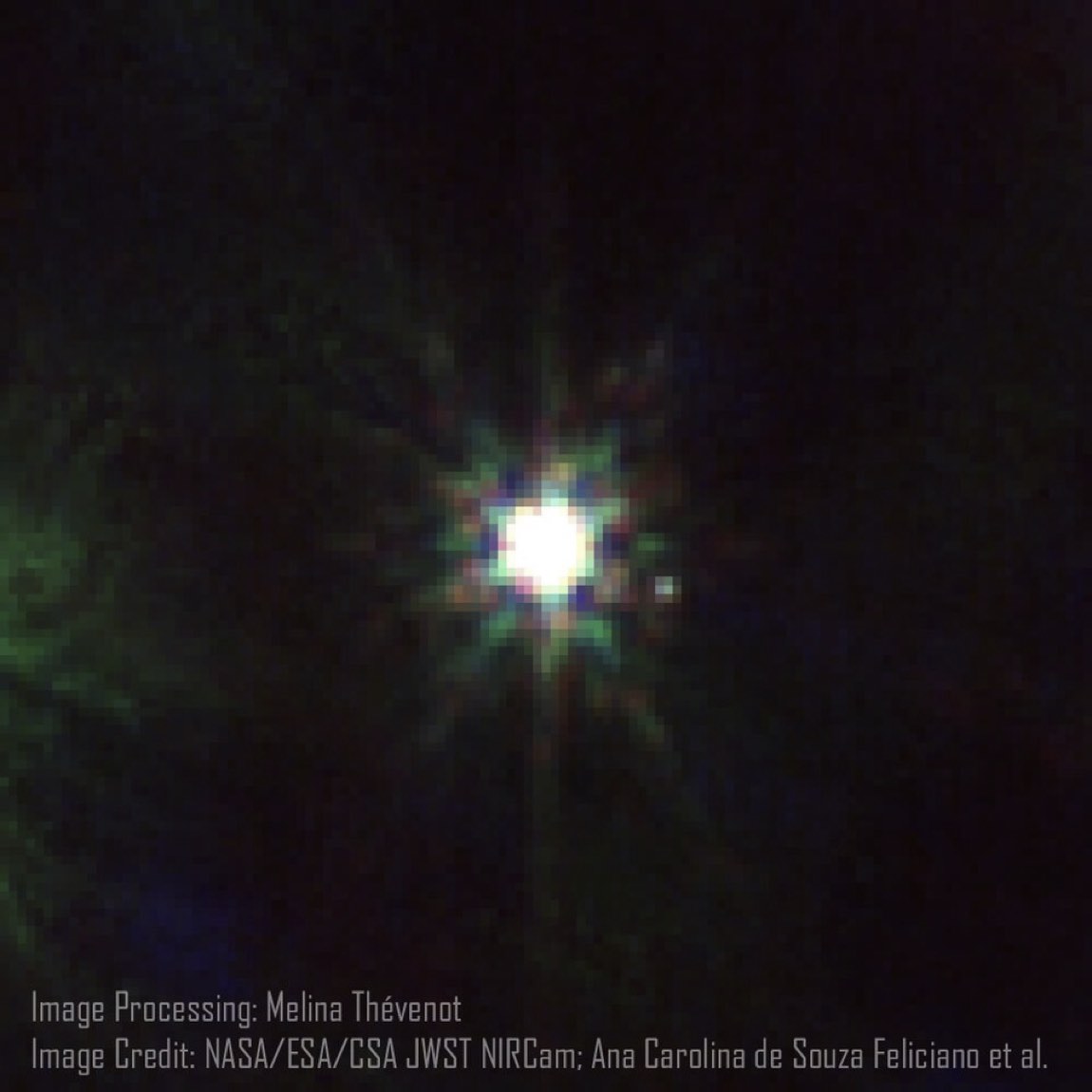
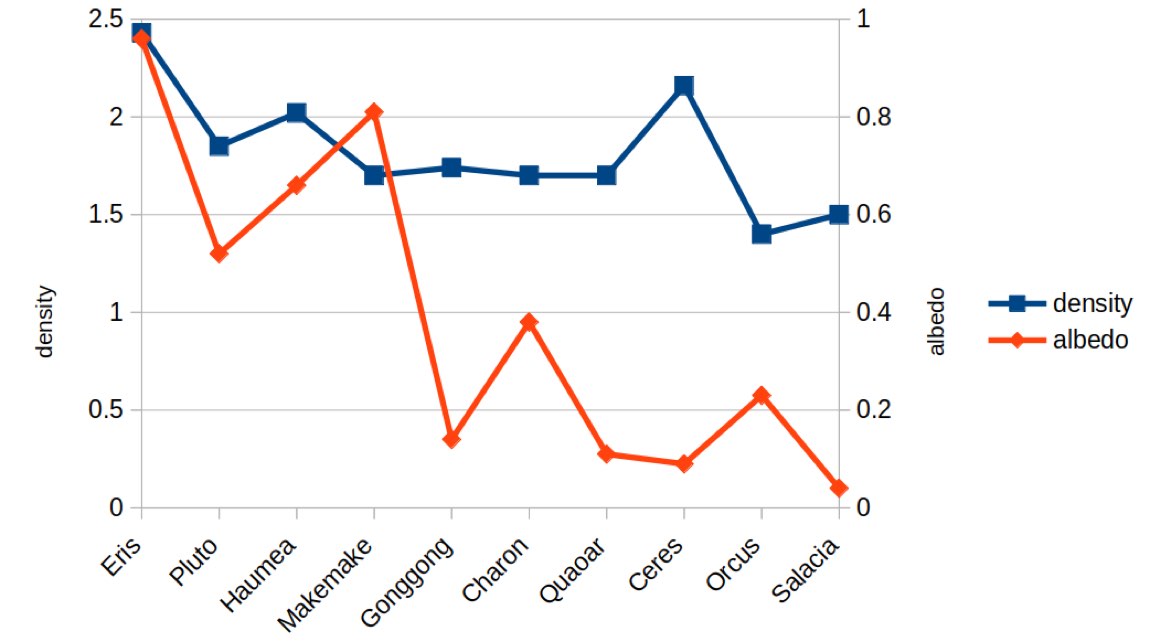
Discovered on 21 July 2006 by Keith Noll, Harold Levison, Denise Stephens, and William Grundy using the Hubble Space Telescope, Actaea ranks as the fifth-largest known moon of any trans-Neptunian object. Its diameter is estimated at 393±33 km — smaller than Charon (1,212±1 km), Dysnomia (615+60−50 km), Vanth (442.5±10.2 km), and Ilmarë (403±40 km), but still a substantial world in its own right. What makes Actaea remarkable is its surface darkness: an albedo of just 0.021±0.004, which is only about half that of its already very dark primary. That makes it one of the least reflective objects known in the outer Solar System — darker than fresh asphalt. Actaea orbits Salacia every 5.49389±0.00016 days at a distance of 5,700+30−29 km with an eccentricity of only 0.008±0.003, indicating a nearly circular, tidally circularized orbit. Its light curve amplitude of at least 0.95 magnitudes is surprisingly large, suggesting either a highly elongated shape or extreme contrasts between dark and bright surface patches — a dramatic feature that future observations or a close flyby could resolve.
 ⤢
09 What JWST Revealed About the Surface Deeper
On 31 August 2023, the Near-Infrared Spectrograph aboard the James Webb Space Telescope turned toward Salacia under Guaranteed Time Observations program 1191, with the object sitting 45.1 AU from the Sun at a phase angle of 0.94°. The resulting spectrum was far more detailed than any previous dataset. JWST detected clear water-ice absorption bands at 1.5, 2, 3, and between 4–5 μm, with an especially sharp drop at 3 μm so deep it is nearly 100% optically saturated — meaning almost all light at that wavelength is absorbed. The diagnostic band for crystalline water ice at 1.65 μm is weak and hard to verify, implying the surface holds a complex mixture of both amorphous and crystalline ice rather than a single pure phase. Carbon dioxide ice was detected through its strong ν3 fundamental vibrational band at 4.25 μm, appearing as a distinctive V-shaped absorption feature bottoming out at 4.27 μm; this shape indicates the CO2 is not a pure crystal layer but is likely trapped as an amorphous mixture within surrounding water ice. Notably, the 2.6–2.8 μm range showed no hydrogen peroxide signatures — a compound radiation typically generates on pure water ice — and the search for the heavier isotope 13CO2 at 4.37 μm was inconclusive due to noise. Volatile ices like methane and carbon monoxide are entirely absent.
10 Why Salacia Is So Dark and What That Means
Salacia's albedo of 0.041±0.004 makes it the darkest large trans-Neptunian object known — reflecting only about 4% of sunlight, compared to roughly 60% for Pluto's nitrogen-ice surface. For context, fresh asphalt reflects around 4–5%, so standing on Salacia would feel like standing on a dimly lit road. This extreme darkness is interpreted as a sign of an ancient surface that lacks the widespread geological activity — such as resurfacing cryovolcanism or frost deposition — that brightens other large TNOs. Despite this darkness, JWST confirms that water ice does exist there, making up less than 5% of the surface. The apparent contradiction is explained by the dominant dark component, thought to be complex irradiated organic material called tholins, which masks the ice. The surface escape velocity of only 385–542 m/s is too low to retain volatile gases like methane or carbon monoxide that could otherwise brighten or chemically alter the crust. The color index B-V of approximately 0.66±0.06 is classed as neutral, meaning the surface neither reddens nor bluens significantly across visible wavelengths — consistent with a tholin-rich, ice-poor outer layer.
11 Interior Structure and the Density Debate Deeper
Understanding Salacia's interior has been complicated by evolving measurements. Early estimates pointed to a low density and a highly porous, uncompressed interior — the picture one would expect from a body that never melted and simply accreted as a loose mix of ice and rock. William Grundy and colleagues built a theoretical framework around this, arguing that mid-sized TNOs in the 400–1,000 km range remain cold and undifferentiated, in contrast to larger bodies like Orcus or Charon that underwent internal melting. They initially placed Salacia outside the dwarf planet category on this basis. However, newer mass and size measurements revised the picture substantially. The 2019 density estimate of 1.50±0.12 g/cm3 and the 2025 estimate of 1.45 g/cm3 both point to a significantly denser interior, higher than Orcus at 1.4±0.2 g/cm3. A higher density implies a greater proportion of rock relative to ice and suggests some degree of internal differentiation. The tidal evolution models reinforce this: the system's orbital circularization and the speed at which it reached mutual tidal lock are both more consistent with a body whose interior separated into distinct rock and ice layers relatively early in Solar System history, rather than remaining a homogeneous primordial mixture.
12 The 2067 Mutual Occultation Season
Because Salacia and Actaea are mutually tidally locked, they orbit in the same plane — and periodically that plane aligns with Earth's line of sight. When it does, the two bodies pass directly in front of and behind each other as seen from Earth, producing a series of mutual occultations and eclipses that can last for a season spanning several years. Such events are exceptionally rare: the geometry only lines up once per orbital cycle around the Sun, which for Salacia means roughly once every 274 years. Calculations show the next mutual occultation season for the Salacia–Actaea system begins in 2067. These events are scientifically valuable out of all proportion to their simplicity: by measuring exactly how much light the system loses and how quickly, astronomers can independently determine the sizes, albedos, and shapes of both bodies — information that is otherwise accessible only through dedicated spacecraft. The Pluto–Charon system had a similar mutual event season in the 1980s, and those observations laid crucial groundwork for understanding that system long before New Horizons arrived.
 ⤢
13 Proposed Missions and How Long to Get There
No spacecraft has visited Salacia, but mission designers have worked out several credible trajectories. A 2019 study by Amanda Zangari and colleagues showed that a probe launched between 2025 and 2027 with a single Saturn gravity assist could arrive in 15.4 to 24.2 years depending on launch vehicle capability. Samuel Walters and James Lyne identified a 2031 launch using an unpowered Jupiter gravity assist for a 25-year transit, arriving in February 2056. More advanced Earth-plus-Jupiter gravity-assist trajectories studied by James Evans Lyne and colleagues pinpointed a 15 January 2029 launch window with an 18.4-year flight time, and a 27 February 2042 window with 18.2 years. Bryan Holler's team proposed a multi-target mission departing around 2040 that would first fly by Neptune before reaching Salacia in December 2046. A dual-probe concept analyzed by Anderson and colleagues envisions an 800 kg Salacia flyby probe launched alongside a Neptune flagship mission on 28 February 2042, using a Jupiter swingby to arrive at Salacia in October 2059. Even orbital capture has been evaluated: a 2013 university study showed that a 100 to 380 kg orbiter could be inserted into a permanent orbit around Salacia via a Jupiter swingby maneuver.