 Photograph · Felipe Braga-Ribas · CC BY 4.0
Dwarf Planet · Deep guide
174567 Varda
Also called: 174567 Varda · (174567) Varda · 2003 MW12
A Kuiper belt body covered in frozen carbon dioxide, with a moon named Ilmarë.
What is it?
Varda is a large Kuiper belt object, roughly 650–740 km across, named after a figure from J. R. R. Tolkien's legendarium. Webb telescope data show its surface is dominated by frozen carbon dioxide. Its moon, Ilmarë, lets astronomers weigh the pair, though Varda's density is still uncertain. Some astronomers have called it a possible dwarf planet, but others argue bodies this size never fully compacted, and the IAU has not recognized it.
The deep dive
Researched for the Atlas from Wikipedia — 174567 Varda (19,575 characters read) · updated Nov 14, 2026
01 How Varda Was Found and Confirmed
Jeffrey A. Larsen discovered Varda on 21 June 2003 as part of a United States Naval Academy Trident Scholar project, using the 0.9-meter Spacewatch telescope at Kitt Peak National Observatory. His survey ran for 34 months and swept roughly 8,000 square degrees of sky — an area about twenty times the size of the entire constellation Orion — hunting for objects that crept slowly against the background stars. At the time of its announcement on 7 January 2006, Varda was the only large body found through that specific program and was thought to be the tenth-largest known classical Kuiper belt object. The Minor Planet Center assigned it the permanent number 174567 on 22 January 2008. Astronomers later discovered that Varda had been photographed decades earlier: precovery images from the Siding Spring Observatory date back to 19 March 1980, extending the total observation arc to an impressive 39 years. That long baseline, supplemented by data from Palomar Observatory and Near-Earth Asteroid Tracking datasets, allowed its orbital path to be pinned down with high confidence.
02 A Name Drawn from Middle-earth
Before receiving its permanent name, the object was simply known by the provisional designation 2003 MW12. The names for both Varda and its moon were announced by the Minor Planet Center on 16 January 2014. The object is named after Varda, the queen of the Valar in J. R. R. Tolkien's Middle-earth writings. Within Tolkien's legendarium, Varda functions as an "angelic power" or creator deity subordinate to the supreme God Eru Ilúvatar, and is specifically responsible for shaping the stars to illuminate the world — a fitting tribute for a distant body glinting in the outer Solar System. The moon was named Ilmarë, after a chief of the Maiar and Varda's handmaiden, maintaining the thematic pairing. International Astronomical Union guidelines allowed the discoverer to propose a name to a committee that judged its suitability. Because planetary symbols are no longer widely used in modern astronomy, Varda never received an official one, though astrologer Zane Stein proposed an unofficial stylized star glyph for it.
03 An Orbit Stable for Longer Than the Sun Will Live Deeper
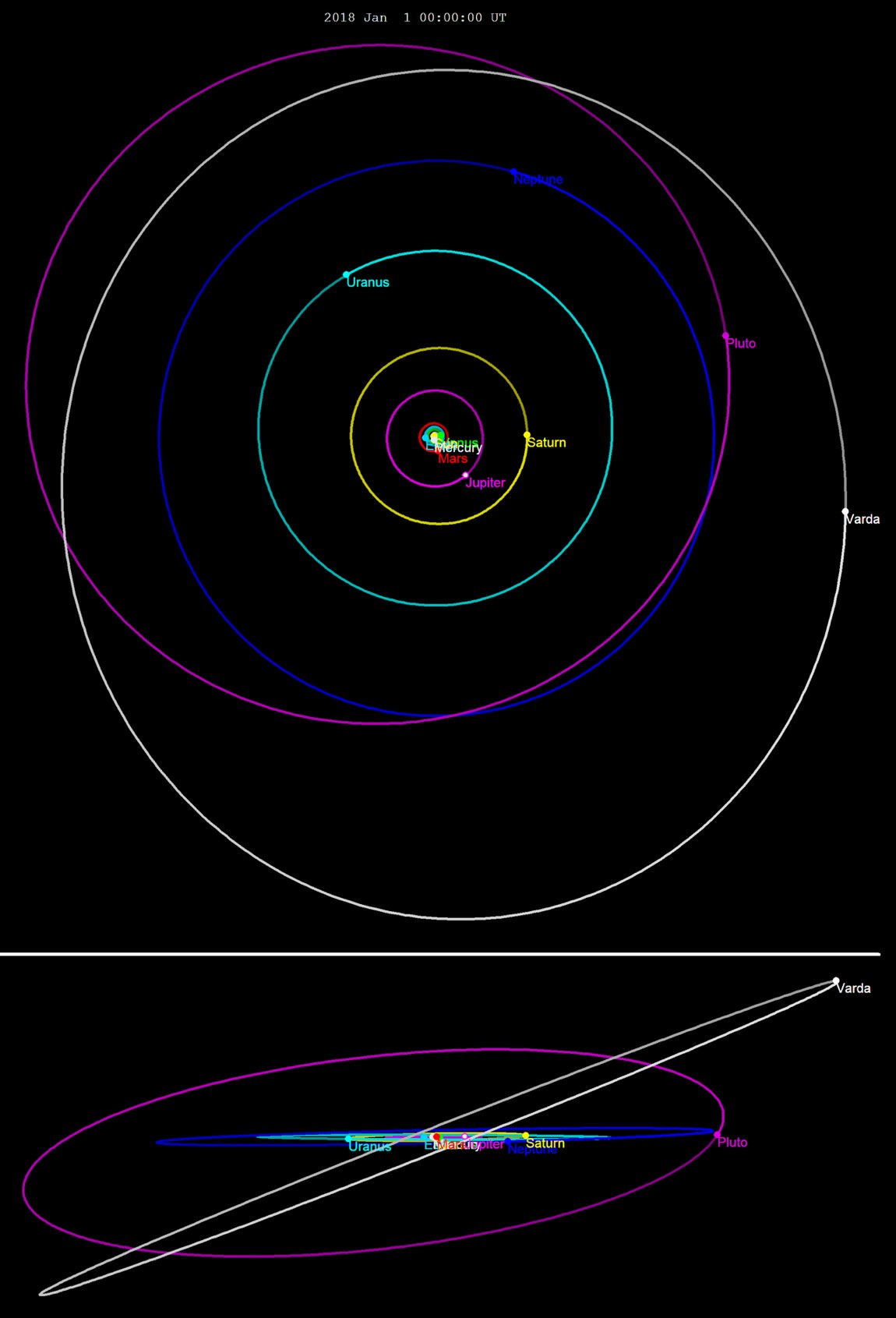
Varda takes 309.2 years to complete one lap around the Sun at an average distance of 45.7 AU — roughly 45 times farther out than Earth. Its orbit is not perfectly circular: it swings as close as 39.3 AU at perihelion, which it will next reach around 28 July 2096, and as far as 52.1 AU at aphelion. The orbital eccentricity is approximately 0.14, and the inclination of 21.5° with respect to the ecliptic stamps it as a dynamically "hot" classical Kuiper belt object, well above the 5° threshold that separates hot from cold classical members. That tilted path is thought to have been stirred up by Neptune's gravitational influence during the Solar System's early history. A 2025 study further found that Varda may be in a 15:8 mean-motion resonance with Neptune, meaning for every 15 orbits Neptune completes, Varda completes exactly 8. Most remarkably, computer simulations tracking the outer planets over one billion years found Varda's orbit to be extraordinarily stable, with an estimated stability time of approximately 22.1 billion years — longer than the remaining lifespan of the Sun itself.
04 What Stellar Occultations Revealed About Its Shape Deeper
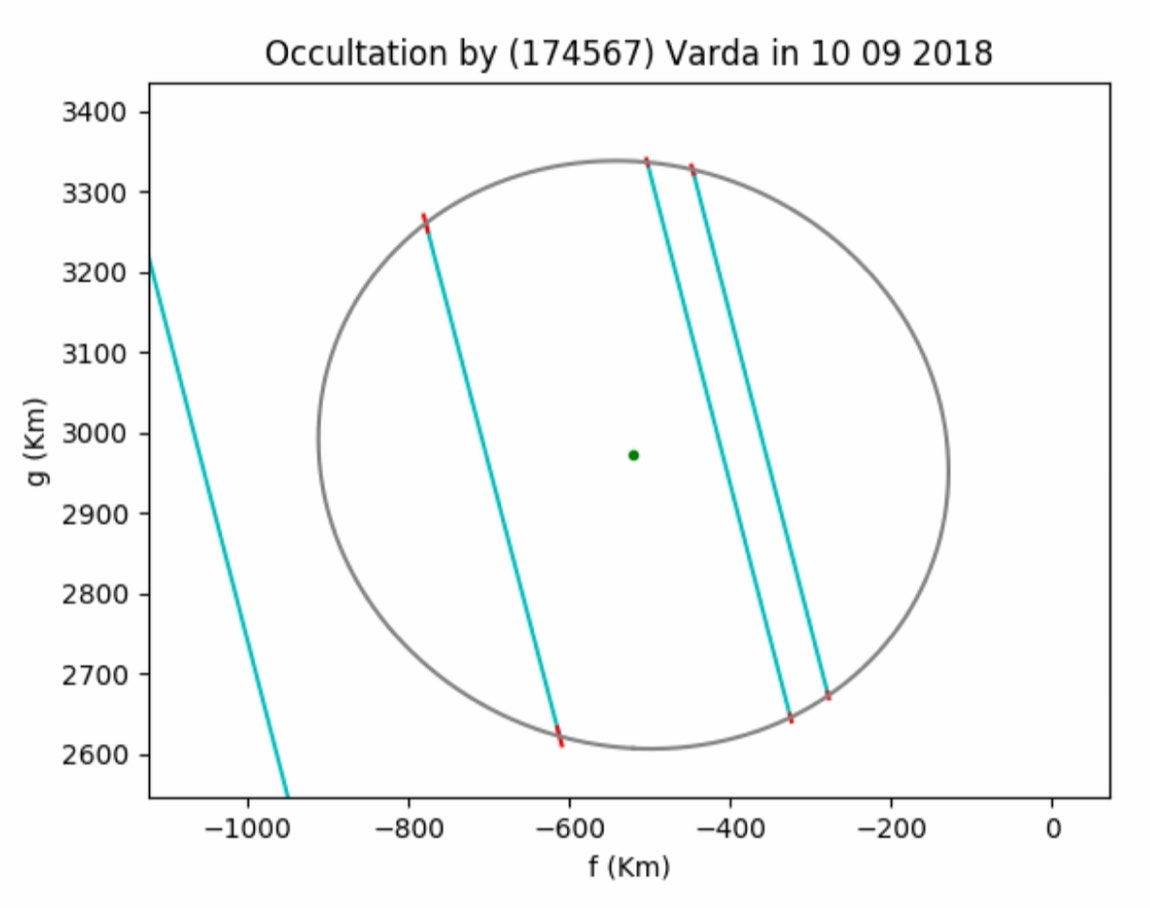
The clearest picture of Varda's true size and shape came from a stellar occultation on 10 September 2018, when Varda drifted in front of a background star and its shadow swept across the United States. By timing exactly how long the starlight disappeared at multiple monitoring sites, astronomers mapped the object's silhouette and derived an area-equivalent diameter of 740±14 km, an equatorial diameter of 766±6 km, and an apparent projected oblateness of 0.066±0.047 — consistent with an oblate spheroid with a flattening of about 0.07. A 2026 reanalysis went further, suggesting a highly flattened triaxial ellipsoid with body dimensions of 778 × 706 × 496 km, yielding a volume-equivalent diameter of only 648 km — considerably smaller than earlier estimates. Under a different formula the axes shift to 778 × 706 × 432 km. The near pole-on viewing geometry from Earth means Varda's short c-axis runs almost directly along our line of sight, leaving it essentially unmeasured. Occultation data also tested for a thin nitrogen atmosphere similar to Pluto's, but results remained inconclusive due to potential camera instrumentation issues. The 2018 starlight cutoff was itself abrupt, strongly suggesting no global atmosphere is present.
 ⤢
05 The Dwarf Planet Debate: Does Varda Qualify?
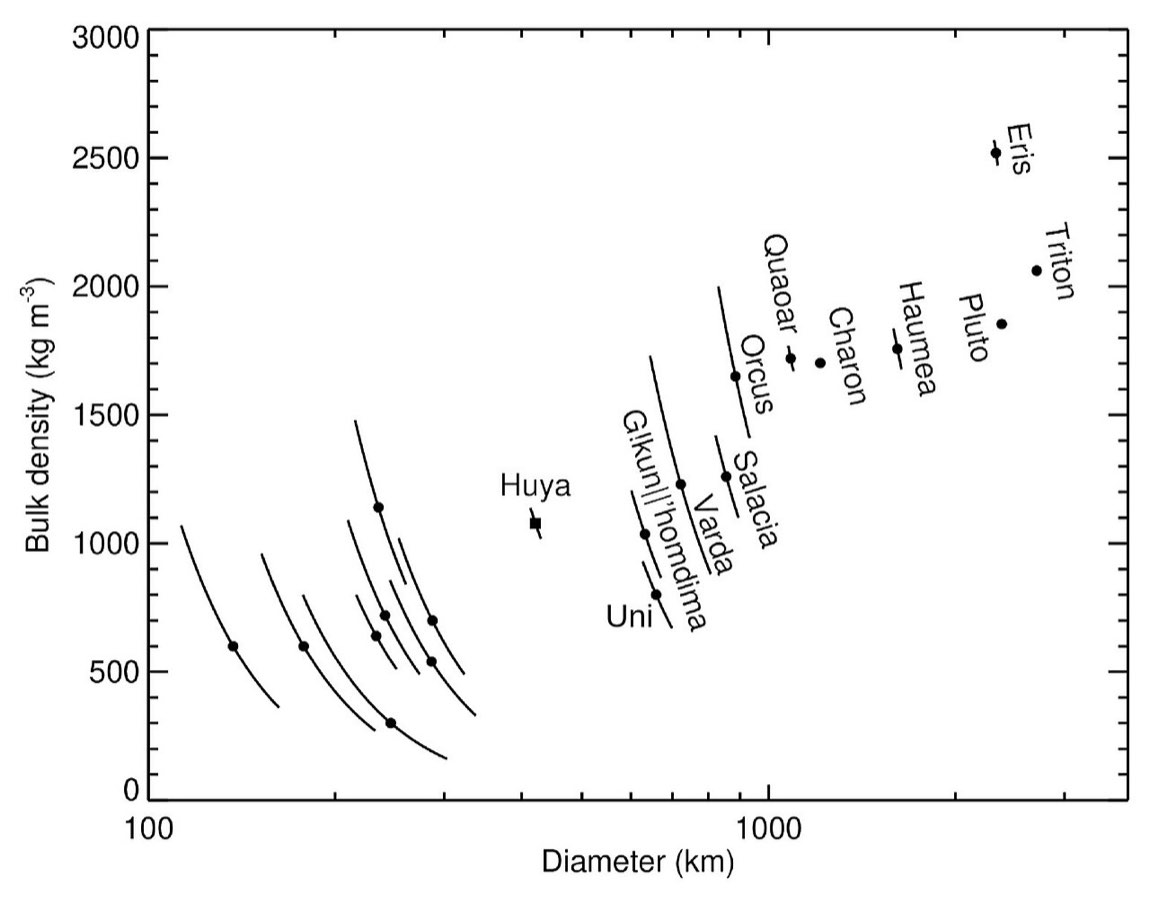
Varda sits in a contested zone. Its large size has led astronomers including Michael E. Brown and Noemi Pinilla-Alonso to consider it a possible dwarf planet, since an object massive enough to pull itself into a roughly spherical shape under its own gravity — a state called hydrostatic equilibrium — qualifies under the standard definition. However, William M. Grundy has hypothesized that trans-Neptunian objects in the size range of 400–1000 km, including Varda, have probably never compressed into fully solid bodies, let alone achieved hydrostatic equilibrium, making them unlikely dwarf planets. The uncertainty is sharpest in the density estimates: different shape models and rotation assumptions produce bulk densities ranging from as low as 1.15 g/cm³ to as high as 1.9 g/cm³ — a spread large enough to completely change the answer. A 5.91-hour single-peaked rotation period yields one density, while a double-period model of 11.82 hours yields another. Adding to the ambiguity, Varda's low geometric albedo of 0.099±0.002 is consistent with a surface lacking the geological activity thought to accompany larger, geologically active dwarf planets. The question remains genuinely open.
06 A Surface Dominated by Frozen Carbon Dioxide Deeper
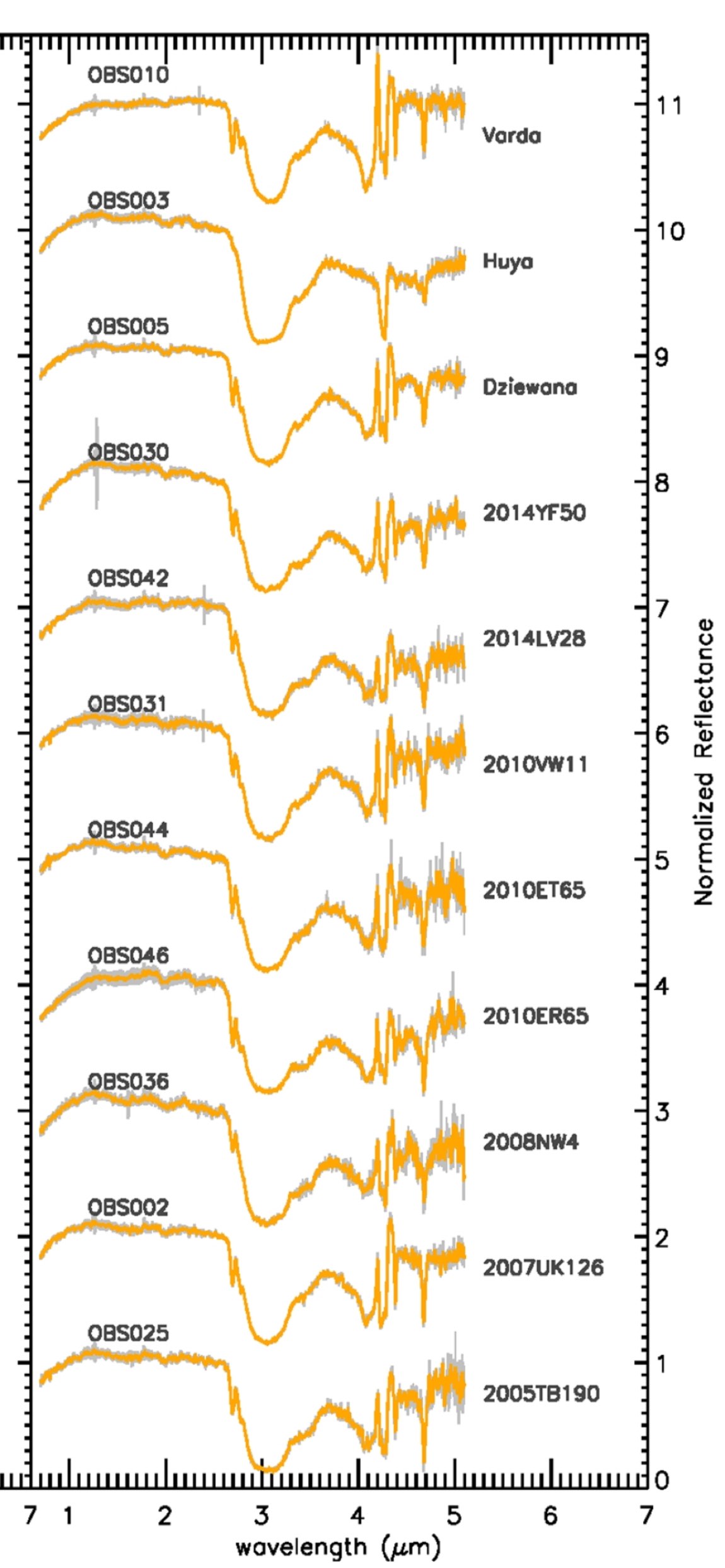
James Webb Space Telescope observations revealed that Varda belongs to the "double-dip" or CO2-type group of trans-Neptunian objects, named for the characteristic pair of carbon dioxide absorption features in their spectra. Varda's independent carbon dioxide ice produces a signal at 2.7 μm, with a measured absorption area of 0.00548 μm. The main group absorption appears at 4.27 μm and another at 4.06 μm, while a rarer carbon dioxide type shows near 4.38 μm. The carbon dioxide ice matrix also traps volatile carbon monoxide gas. Strikingly, Varda completely lacks frozen methane and ammonia — consistent with its intermediate formation distance in the early protoplanetary disk, where it was massive enough to retain CO2 but not the more volatile ices. Water ice is virtually absent: its water ice band index is only −0.00072 μm. Earlier ground-based observations from 2008 had suggested methanol was present, but newer JWST data shows those weak signals likely came from complex organic materials rather than methanol ice, with the precise methanol band area measuring just 0.00008 μm. Complex organics show up clearly near 3.4 μm, and small signals near 4.93 μm hint at trace olivine rock on the surface.
07 Ilmarë: One of the Largest Known TNO Moons
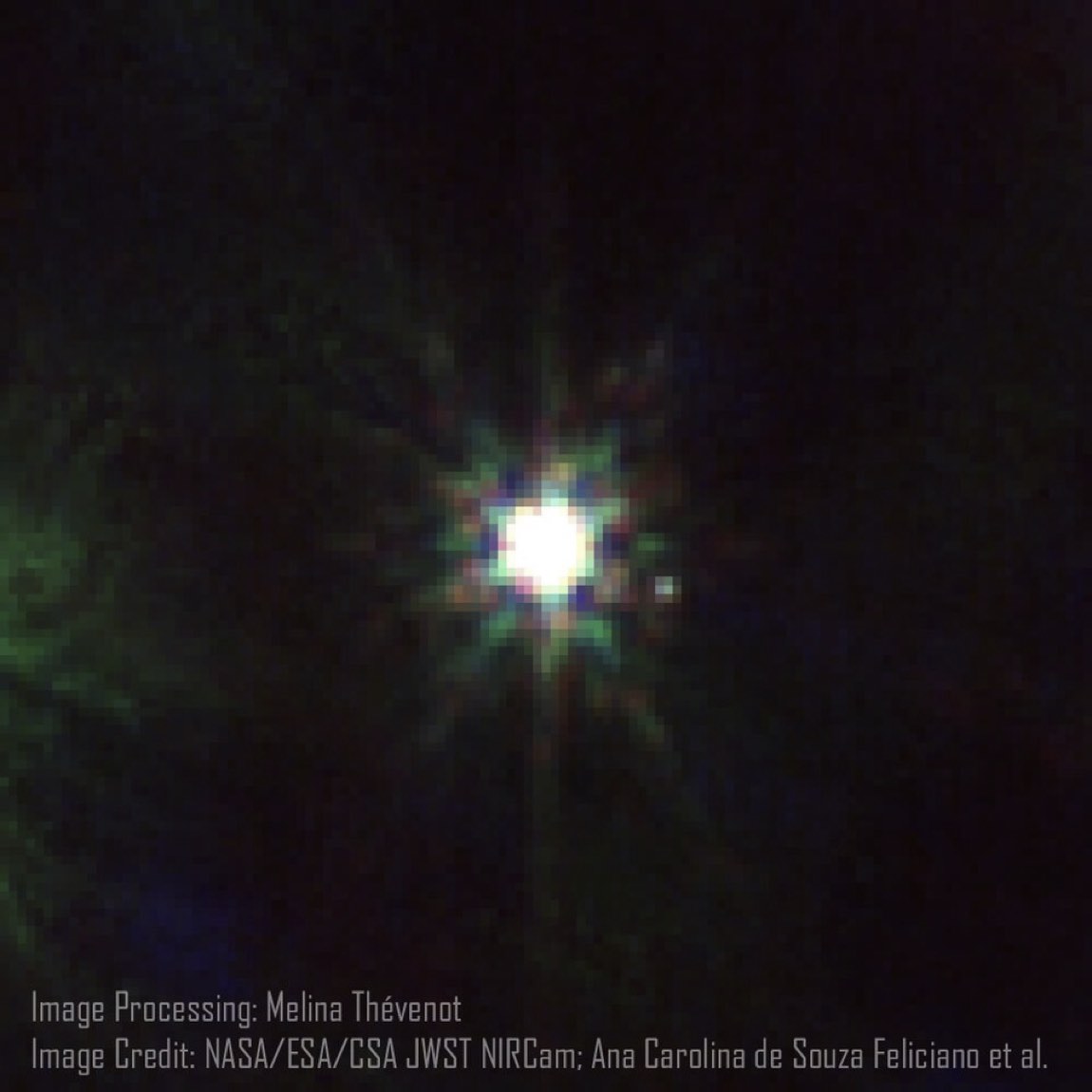
Varda's moon Ilmarë was discovered on 26 April 2009 by Keith Noll using the Hubble Space Telescope, spotted at a separation of about 0.12 arcseconds, though the discovery was not formally reported until 2011. With a diameter of approximately 403±40 km, Ilmarë ranks as the fourth-largest known moon of a trans-Neptunian object, behind Charon, Dysnomia, and Vanth — a remarkable distinction for a world orbiting another world that is itself not formally recognized as a dwarf planet. Ilmarë has a low geometric albedo of 0.068±0.011, making its surface even darker than Varda's. It orbits Varda at a distance of 4,815±29 km — closer than the Moon is to Earth by a factor of roughly 80 — with an orbital period of 5.750824±0.000016 days and a nearly circular orbit with eccentricity of just 0.016±0.004. Its orbital inclination is 77.4±1.9° with respect to the ecliptic. The combined absolute magnitude of the Varda–Ilmarë system is 3.097±0.060, while Ilmarë alone is approximately 1.7 magnitudes fainter than Varda in visible light.
08 A Tidally Locked Pair, Frozen Face to Face Deeper
One of the most striking findings from the 2018 stellar occultation is that Varda's longest equatorial axis points almost directly toward Ilmarë. Varda's elongated axis has a measured position angle of 67°±8°, while Ilmarë sits at 60.8°±0.7° — a difference of less than 7°. If Varda were tumbling freely and not tidally locked, the probability of this alignment occurring by chance is calculated to be only about 2%. This strongly implies that Varda is tidally locked to Ilmarë, with the same face perpetually pointing toward its moon, in the same way that Earth's Moon always shows us one hemisphere. A 2026 study confirmed that mutual tidal locking is likely, meaning Ilmarë also keeps one face pointed toward Varda. The small orbital separation and large size ratio of the pair mean tidal synchronization would have occurred quickly, similar to the Salacia-Actaea system. The mass ratio between the two bodies is quite similar to that of Pluto and Charon — the most famous tidally locked binary in the outer Solar System — making Varda-Ilmarë one of the more extreme known mass-ratio binary systems among trans-Neptunian objects.
 ⤢
09 Why Varda's Shape May Be a Fossil from the Past Deeper
The 2026 triaxial ellipsoid model, with dimensions of 778 × 706 × 496 km, poses a puzzle. If Varda is tidally locked to Ilmarë and therefore rotating with a 5.75-day period, standard hydrostatic equilibrium theory says that rotation is far too slow to produce the elongated shape observed. A much faster rotation of about 4.5 hours would be needed to explain that degree of triaxiality through rotational flattening alone. This mismatch leads astronomers to consider non-hydrostatic explanations. One idea is that the shape represents a primordial fossil bulge — the body was distorted when it rotated rapidly early in its history, then froze in that shape as it cooled and slowed down, similar to what has been proposed for the dwarf planet Quaoar. Alternatively, internal friction and uneven distributions of dense rocky material could maintain an unconstrained triaxial shape over billions of years. Neither explanation is proven, and because the nearly pole-on viewing geometry leaves the short c-axis unmeasured, three-dimensional shape models remain mathematically unconstrained by current data.
10 Formation in the Middle of the Early Solar Disk
Varda formed approximately 4.5 billion years ago as an icy body in the protoplanetary disk, before the outer planets had migrated to their current positions. The double-dip spectral signature detected by the James Webb Space Telescope tells a detailed story about where in that disk Varda coalesced. Its formation zone was situated between the primordial water ice line and the carbon dioxide ice line — far enough from the Sun for CO2 to freeze out and become incorporated into the growing body, but not cold enough or massive enough to retain the most volatile ices like methane and ammonia over billion-year timescales. That intermediate formation distance also explains why Varda's surface CO2 ice acted as a matrix capable of trapping and preserving highly volatile carbon monoxide molecules. Early models had expected classical Kuiper belt objects to form on flat, nearly circular orbits, but Varda's high inclination of 21.5° suggests that planetary embryos with masses between those of Mars and Earth disrupted the early disk before being scattered outward by the outer planets, stirring objects like Varda into their current tilted paths.
11 Planning a Flyby: Mission Concepts to Varda
No spacecraft has visited Varda, but scientists have run detailed computer simulations to map out realistic flight paths. A 2019 study by Amanda Zangari found that a spacecraft launching between 2027 and 2031 could use Jupiter's gravity as a slingshot and reach Varda in 10.1 to 12.3 years, arriving at a flyby speed of 16.3 km/s. Testing a path that also swung past Saturn in launches between 2037 and 2040 actually increased travel time to 14.9 years, showing that the extra gravity assist from Saturn is counterproductive on this particular route. A separate 2021 study by James Lyne identified an especially fuel-efficient option: a spacecraft launching on 8 January 2051, using gravity assists from both Earth and Jupiter, would coast for exactly 17 years before flying past Varda and Ilmarë in 2068 at a relative speed of 12.66 km/s. At that speed, the encounter would last only minutes, so any probe would need to record data autonomously and transmit it back across roughly 47 AU of space — a one-way signal travel time of more than six hours.
12 How Difficult Is Varda to Observe?
With an apparent magnitude of approximately 20.5, Varda is far beyond the reach of backyard telescopes; even a large amateur instrument under dark skies would struggle. Professional telescopes or specialized imaging setups are required to detect it at all. Its absolute magnitude is 3.81±0.01. Resolving Varda and Ilmarë as two separate objects is an additional challenge: the moon is located very close to Varda from Earth's perspective and is approximately 1.7 magnitudes fainter, requiring high-resolution imaging such as that provided by the Hubble Space Telescope — which is exactly how Ilmarë was discovered in 2009. Future occultation campaigns offer the best opportunities to refine Varda's physical properties without sending a spacecraft. Multiple occultations were predicted between 2022 and 2025, with two campaigns specifically designed to track separate shadow chords for both Varda and Ilmarë using stars with apparent magnitudes of around 15, and further campaigns planned through 2027 targeting stars with magnitudes between 16.6 and 17.0. Each occultation adds a new cross-sectional slice of information that gradually sharpens the picture of the system's true shape.
 ⤢