Moon · Deep guide · orbits Haumea
Namaka
Also called: Haumea II · S/2005 (2003 EL61) 2 · Blitzen
Haumea's small inner moon, whose orbit is pushed and pulled by Hiʻiaka.
What is it?
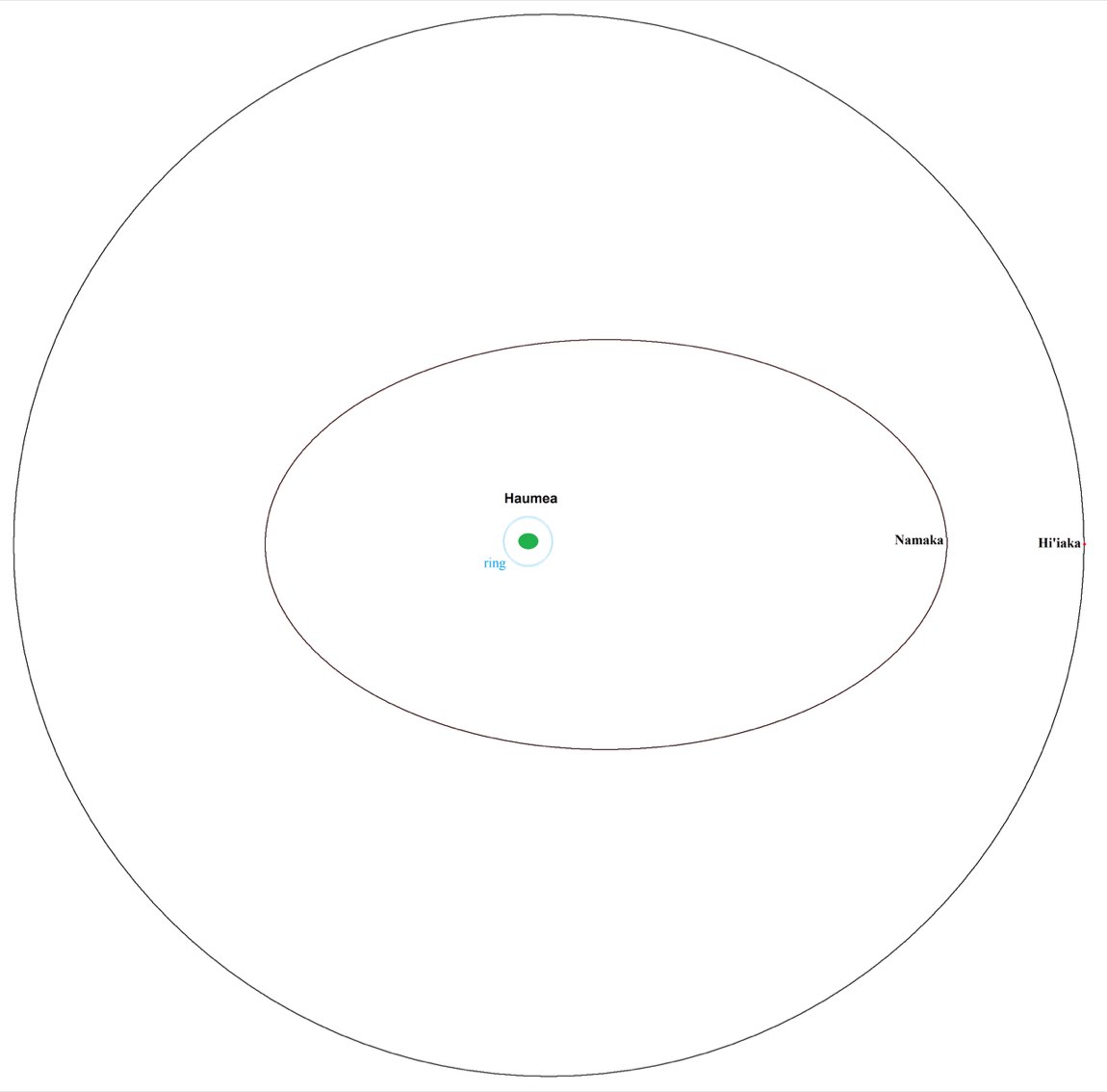
Namaka was spotted in 2005 in sharp Keck II telescope images of Haumea by Mike Brown and the Keck adaptive optics team. It is roughly 150 km across and orbits Haumea every 18.3 days on a noticeably elliptical, tilted path. The gravity of the outer moon Hiʻiaka, together with Haumea's stretched shape, strongly disturbs Namaka's orbit, and the two moons are thought to be in or near an 8:3 resonance.
The deep dive
Researched for the Atlas from Wikipedia — Namaka (moon) (9,951 characters read) · updated Nov 15, 2026
01 How Namaka Was Found in Plain Sight
Namaka hid in the glare of its parent world for months before anyone noticed it. Michael E. Brown and the Keck Observatory adaptive optics team had already spotted Haumea's larger moon Hiʻiaka in January 2005, but Namaka was so much fainter and so much closer to Haumea in the sky that it blended into the noise. The team eventually identified it in high-resolution images taken on 1 March, 28 May, and 30 June 2005 by the Keck II telescope on Mauna Kea, Hawaii. The formal announcement came from the Central Bureau of Astronomical Telegrams on 1 December 2005. While waiting for an official name, Brown gave the moon the informal nickname "Blitzen," continuing a Christmas-themed tradition he had been applying to the whole Haumea system. Its clunky provisional designation was S/2005 (2003 EL61) 2 — shorthand for "the second moon of Haumea discovered in 2005."
02 The Hawaiian Myth Behind the Name
When the International Astronomical Union formally named the Haumea system on 17 September 2008, every member received a name rooted in Hawaiian mythology — a deliberate tribute to Mauna Kea, the Hawaiian mountain whose summit hosted the Keck telescopes that made the discoveries possible. Brown's team had proposed the names to the IAU back in September 2006. In Hawaiian tradition, Nāmaka is a water spirit born directly from the body of the fertility goddess Haumea. The choice is fitting in an astronomical sense too: Namaka's surface is coated in fresh water ice, making it, in a literal way, a small world made of water. The name links the moon's physical reality to the culture of the place where it was first seen — an unusually close correspondence between myth and material composition.
03 An Orbit Pulled in Three Directions Deeper
Namaka's path around Haumea is anything but clean. It orbits at an average distance of 25,500 km — closer to its parent than the Moon is to Earth — completing one circuit in roughly 18.3 days. Its orbit is both highly elliptical, with an eccentricity of about 0.22, and steeply tilted about 13 degrees relative to Haumea's equator and to the orbital plane of the outer moon Hiʻiaka. Three distinct forces conspire to warp this path continuously. First, Hiʻiaka's gravity tugs on Namaka from farther out. Second, Haumea itself is not a sphere but an elongated ellipsoid, so its gravitational field varies depending on which side faces Namaka at any moment. Together these forces produce a time-varying eccentricity and inclination, as well as nodal and apsidal precession — meaning both the tilt and the orientation of Namaka's orbital ellipse slowly rotate over time, never quite repeating the same path twice.
04 The 8:3 Resonance and What It Built Deeper
The ratio of Namaka's orbital period to Hiʻiaka's is 2.689 ± 0.004, tantalizingly close to the fraction 8/3. This suggests the two moons may be locked in — or at least hovering near — an 8:3 mean-motion orbital resonance, in which Namaka completes 8 orbits for every 3 completed by Hiʻiaka. Whether this resonance is strictly active today remains uncertain. What simulations do show is that this gravitational coupling has almost certainly shaped the system's history dramatically: over the past few hundred million years, Hiʻiaka appears to have steadily transferred orbital eccentricity and inclination to Namaka through this resonance, sculpting the tilted, elliptical orbit we observe today. Researchers are still working out exactly when the resonance began and how long it persisted, leaving a key chapter of Namaka's orbital biography unresolved.
05 How Namaka Nudges Haumea Itself Deeper
Even a small moon can leave fingerprints on its parent world. Namaka's gravity exerts a slight torque on Haumea that causes the dwarf planet's rotation axis to precess — a slow wobble, like a spinning top winding down — by less than one degree. The timescale for this precession is equivalent to the nodal precession period of Namaka's own orbit, which plays out over several decades. Namaka also has a theoretical influence on Haumea's ring, though in practice that influence is overwhelmed. Because Namaka has a low mass and orbits well outside the ring, its inclined orbit could in principle tilt the ring or scatter its particles, but the far stronger gravitational perturbations from Haumea's own flattened shape undo those effects before they accumulate. The ring, in essence, listens to Haumea far more than it listens to Namaka.
06 Seeing Namaka from Earth: A Real Challenge
From Earth, Namaka is an extraordinarily difficult target. It shines at only about 1.5% of Haumea's brightness — roughly 67 times fainter than its already-dim parent. Even Hiʻiaka outshines it by a factor of 3.7. Because Namaka orbits so close to Haumea, its angular separation from the dwarf planet is less than 1 arcsecond as seen from Earth — smaller than the finest detail a typical ground-based telescope can distinguish. Only instruments like the Hubble Space Telescope or Keck's adaptive optics system can resolve it as a separate point of light. Attempts to detect predicted eclipses and occultations of Haumea by Namaka between 2009 and 2011 came up empty, though later recalculations confirmed the timing predictions were roughly correct, just slightly offset. The first confirmed stellar occultation by Namaka — a brief dimming of a background star as the moon passed in front of it — was finally observed on 16 March 2025.
07 A Porous Little World of Ice
Namaka is estimated to be somewhere between 100 and 200 km in diameter, with 150 km (93 mi) used as the best working average — roughly half the diameter of its sibling Hiʻiaka. Its mass is about 1 × 10¹⁸ kg, which is about ten times less than Hiʻiaka's and roughly 3,000 times less than Haumea's. If the 150 km diameter estimate is correct, the implied bulk density is only 0.650 g/cm³ — lower than liquid water and far lower than solid ice. Such a low density strongly suggests that Namaka is not a solid, coherent chunk of ice but instead a loosely packed, highly porous body, riddled with internal voids, more like a rubble pile than a rock. This is consistent with the idea that it formed gently from a low-velocity disk of debris rather than from a violent, high-speed ejection.
08 Chaotic Spin: Namaka's Unpredictable Rotation Deeper
Namaka's rotation may be one of the strangest in the Solar System. Hubble Space Telescope observations in 2008 showed brightness fluctuations of 0.3 magnitudes, suggesting an elongated body tumbling as it orbits. But observations in 2009 and 2010 detected no significant periodic brightness variation, which points either to a highly tilted rotation axis or a rotation period longer than one day. Haumea's tidal forces should have braked Namaka's spin over billions of years, but here lies a paradox: a slow spin combined with an eccentric orbit exposes Namaka to multiple competing spin-orbit resonances, and simulations predict the rotation becomes chaotic rather than settled. The axial tilt and rotation period are expected to vary unpredictably on timescales of years — an analogy to Saturn's moon Hyperion, which also tumbles chaotically. Confirming this behavior requires a long baseline of high-resolution observations that remain beyond current capabilities.
09 Born from a Spinning, Shedding Parent
The leading explanation for Namaka's origin begins 4.4 billion years ago — roughly 77 to 82 million years after the Solar System formed — when two large Kuiper Belt objects of similar size collided obliquely and merged into a single fast-spinning body that became Haumea. That giant impact alone cannot explain how the moons formed, because such a violent collision would have flung debris far beyond Haumea's gravitational reach. Instead, a 2022 study led by Jessica Noviello proposed a two-stage process: Haumea kept differentiating internally, its rocky core growing denser, which spun it up faster through conservation of angular momentum. Eventually centrifugal force at Haumea's equator grew strong enough to fling icy surface material into orbit. This disk of shed material, formed roughly 147 to 162 million years after the Solar System's birth, eventually coalesced into Namaka, Hiʻiaka, and Haumea's ring. About 3% of Haumea's original mass and 14% of its angular momentum left with that ejected material.
10 Namaka, the Haumea Family, and Lost Siblings Deeper
When the disk of icy debris collected around the newly spun-up Haumea, it did not all stay. Some of the moonlets that condensed from the disk were gravitationally kicked onto escape trajectories by close encounters with each other, scattering away from the Haumea system entirely. Those escaped fragments are now recognized as the "Haumea family" — a cluster of Kuiper Belt objects on similar orbits whose water-ice surfaces betray a common origin. Namaka and Hiʻiaka were the objects that stayed behind. The two moons likely formed with nearly circular, coplanar orbits close to their current distances from Haumea. Tidal interactions with Haumea and gravitational nudges from passing trans-Neptunian objects gradually altered those orbits until Namaka and Hiʻiaka fell into their 8:3 resonance, which then reshaped Namaka's orbit into the tilted, elliptical path it follows today.
11 Open Questions Namaka Still Holds
Despite two decades of study, Namaka keeps its deepest secrets. Its diameter is still only pinned down to a range of 100 to 200 km, and no direct measurement of its surface reflectivity exists — only estimates between 50% and 80%. Whether Namaka and Hiʻiaka are truly locked in an 8:3 orbital resonance today, or merely passing through its vicinity, remains unresolved. The precise timeline of that resonance — when it started, how long it lasted — is unknown. Namaka's rotation remains unconfirmed as chaotic. The first stellar occultation, observed on 16 March 2025, holds promise for finally pinning down Namaka's size with precision; more such events would help resolve the density puzzle. For a moon discovered in images taken in 2005, Namaka has revealed remarkably little of itself, a consequence of being small, faint, and perpetually huddled close to a world far brighter than it.
 ⤢