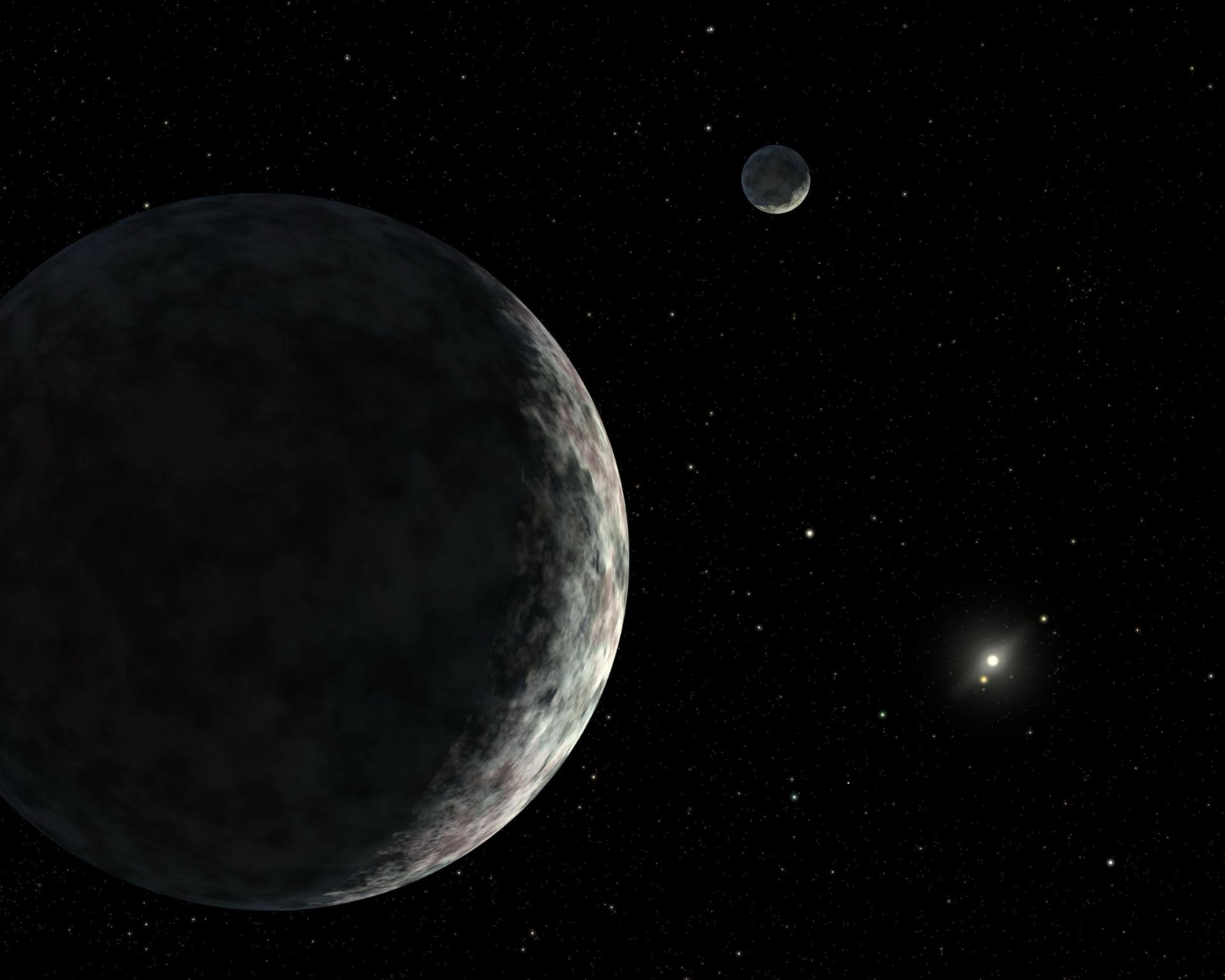
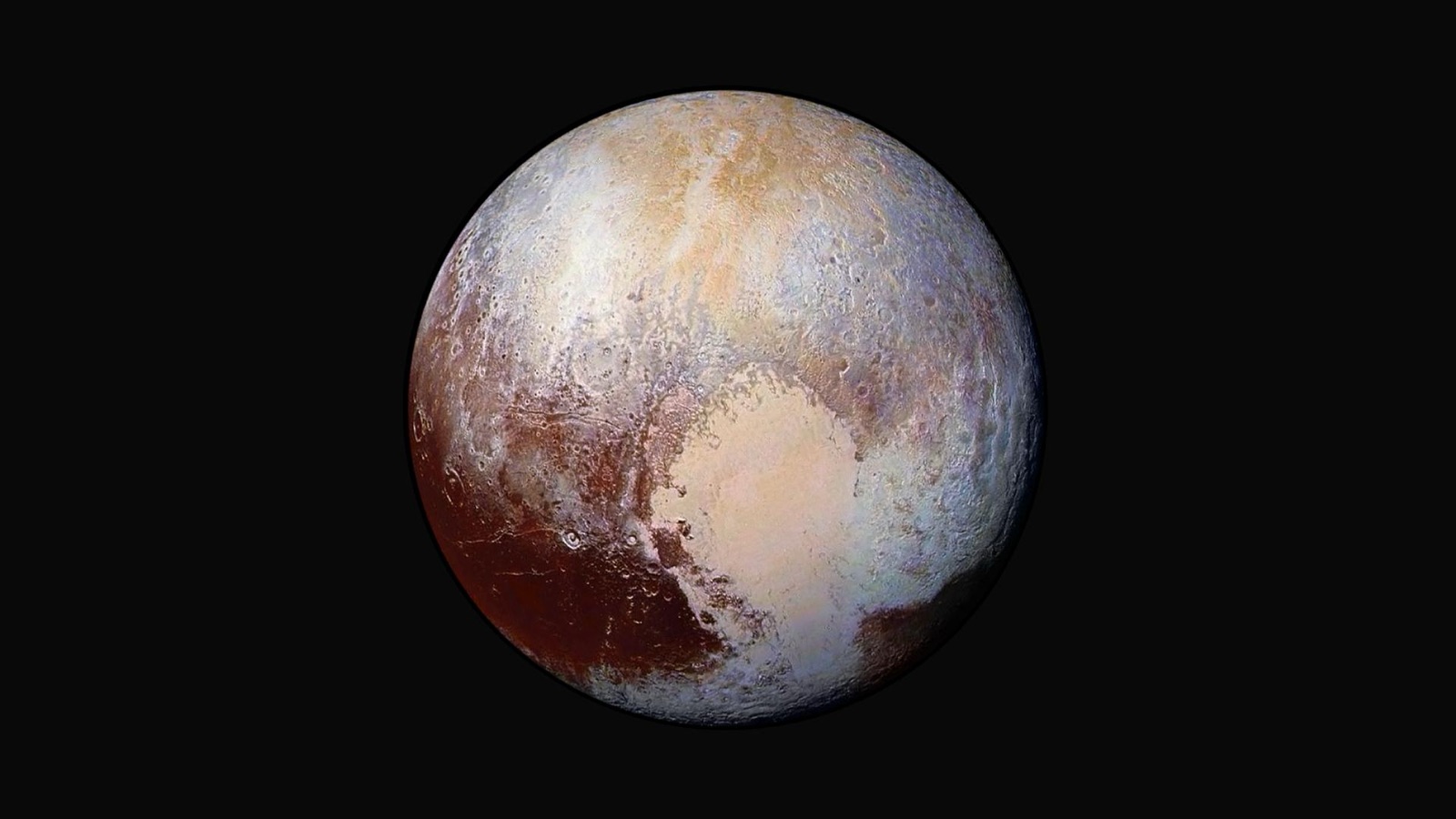
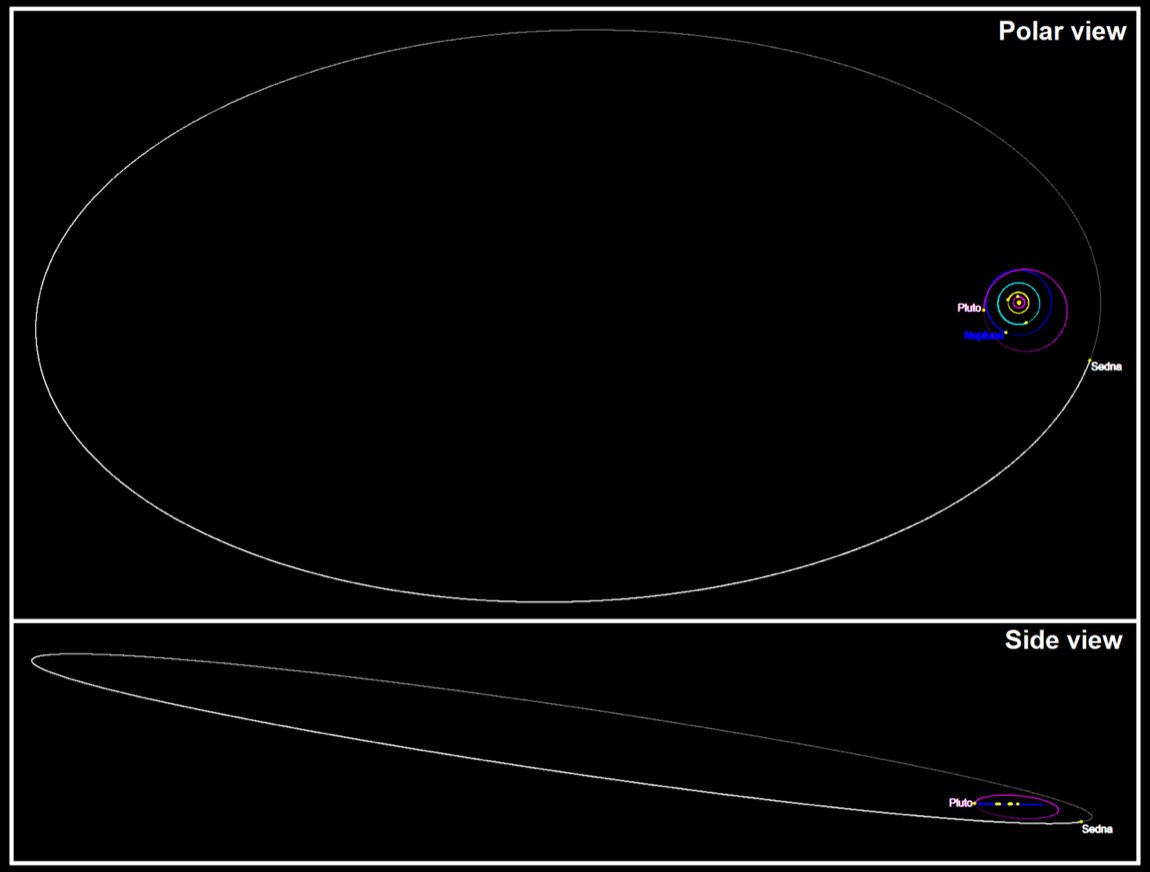
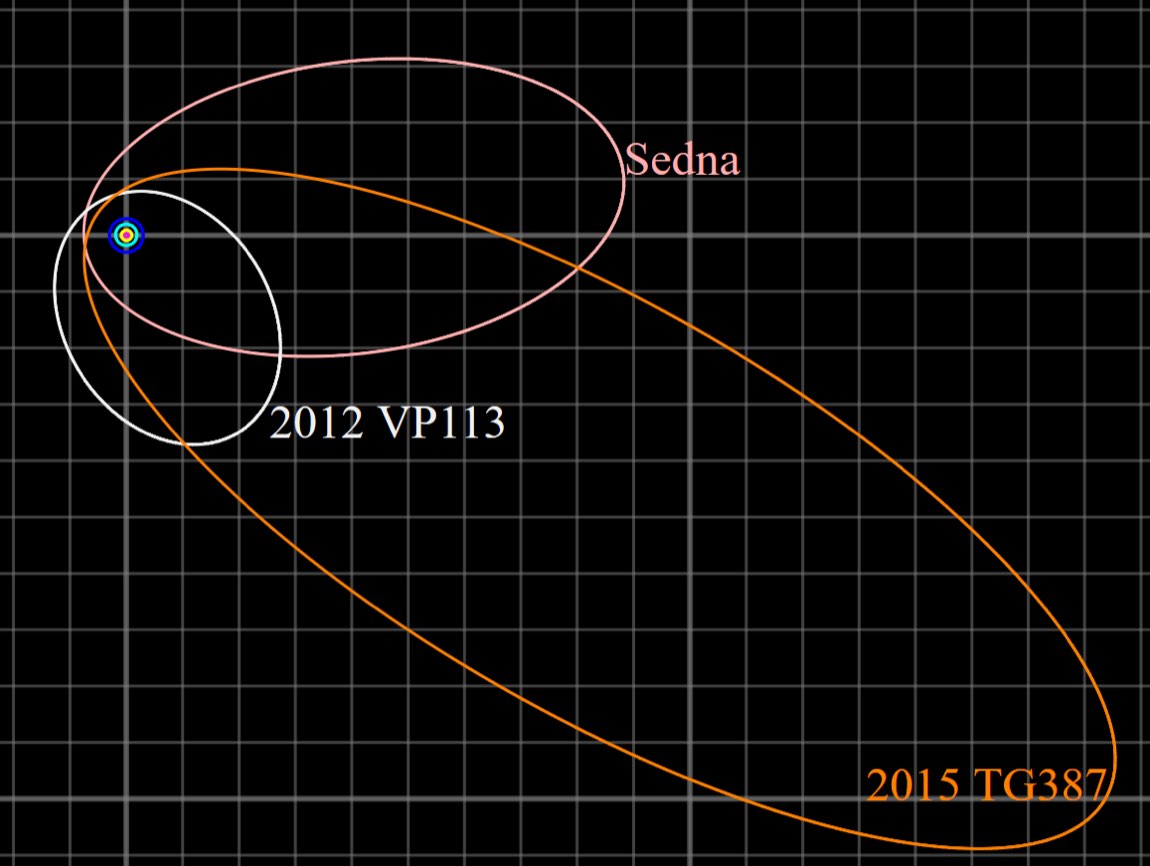
 Diagram · Tomruen · CC BY-SA 4.0
Dwarf Planet · Deep guide
90377 Sedna
Also called: 90377 Sedna · (90377) Sedna · 2003 VB12
A distant, red world on an 11,000-year orbit that never comes closer to the Sun than about 76 AU.
What is it?
Sedna is a reddish body roughly 1,000 km across in the far outer Solar System. Its stretched orbit takes about 11,400 years and swings out to around 937 AU — about 19 times Pluto's greatest distance. Even at its closest it stays far beyond Neptune. Many astronomers consider it a likely dwarf planet, though the IAU has not officially recognized it.
The deep dive
Researched for the Atlas from Wikipedia — Sedna (dwarf planet) (24,020 characters read) · updated Nov 14, 2026
01 Sedna's Staggering Orbit by the Numbers
Sedna's orbit is a record-setter in almost every dimension that matters. Its aphelion sits at approximately 937 AU from the Sun — roughly 19 times farther out than Pluto's own aphelion. At that remote turning point, Sedna crawls along at just 377 metres per second, a mere 1.3 percent of Earth's average orbital speed. The orbit's eccentricity of 0.85 makes it one of the most elongated paths of any known Solar System body, stretching from a perihelion of 76.19 AU — itself the largest perihelion of any known Solar System object until 2012 VP113 was found — out to that vast aphelion nearly a thousand AU away. The full journey around the Sun takes approximately 11,400 years. To put that in human terms, the last time Sedna was anywhere near its current position in space, anatomically modern humans were just beginning to settle parts of Europe after the last ice age. Sedna is currently 83.0 AU from the Sun, about 2.5 times as far away as Neptune, and it is slowly approaching its next perihelion, due around July 2076.
02 What It Looks Like From the Surface
Standing on Sedna's surface would offer a sky unlike anything in the inner Solar System. Near aphelion, temperatures never exceed −240 °C, making it one of the coldest places in the entire Solar System. Even the Sun would be unrecognizable: at aphelion it appears as an exceptionally bright star, not a disc, shining at about 45 percent of the brightness of the full Moon as seen from Earth — brilliant among the stars, but offering almost no warmth. As Sedna nears its perihelion in mid-2076, the Sun would still appear as nothing more than a very bright pinpoint, too distant to resolve as a disc with the naked eye. The sky itself would otherwise be black, with no other large body overhead, since no moon has ever been confirmed in orbit around Sedna. The surface homogeneity — Sedna is uniformly red and shows no bright fresh patches — suggests that impacts from other bodies are extremely rare out at this distance, leaving that ancient organic crust undisturbed for billions of years.
03 A Surface Stained Dark Red by Deep Time Deeper
In visible light, Sedna is one of the reddest objects known anywhere in the Solar System, nearly as red as Mars. That deep ruddy hue comes from tholins — a reddish, amorphous, heterogeneous organic mixture produced when simpler organic compounds are bombarded for billions of years by ultraviolet radiation and interstellar particles. Chad Trujillo and colleagues described this as an extensive surface coating of hydrocarbon sludge. Trujillo and colleagues placed upper limits of 60 percent for methane ice and 70 percent for water ice in Sedna's surface composition. A more detailed model proposed by Barucci and colleagues suggested roughly 24 percent Triton-type tholins, 7 percent amorphous carbon, 10 percent nitrogen ices, 26 percent methanol, and 33 percent methane. The detection of methane and water ice was later confirmed by Spitzer Space Telescope mid-infrared photometry in 2006, and the European Southern Observatory's Very Large Telescope found further indications of tholins and water ice using the SINFONI near-infrared spectrometer. The weak methane absorption bands indicate that the methane present is ancient, not freshly deposited, implying Sedna's surface never gets warm enough for methane to evaporate and snow back down — a process that does occur on both Triton and Pluto.
04 What the James Webb Space Telescope Revealed Deeper
In 2022, low-resolution near-infrared spectroscopic observations by the James Webb Space Telescope, covering 0.7 to 5 micrometres, significantly updated the picture of Sedna's surface chemistry. The JWST spectra revealed significant amounts of ethane ice (C₂H₆) and complex organics — a finding not clearly established by earlier instruments. The data also showed evidence for ethylene (C₂H₄), acetylene (C₂H₂), and possibly carbon dioxide (CO₂). Notably, the new observations found little evidence for methane (CH₄) or nitrogen ices, in contrast with earlier spectroscopic results that had suggested both were present. This discrepancy between the JWST findings and older data reflects how difficult it is to characterize a body this faint and distant, and it illustrates that Sedna's surface chemistry remains an active area of debate. The confirmed presence of ethane is particularly significant: ethane is itself an organic compound whose existence on the surface is consistent with the broader picture of a world where billions of years of radiation chemistry have transformed simpler molecules into an increasingly complex organic inventory.
05 Three Competing Theories for Sedna's Strange Orbit
Sedna's perihelion at 76 AU is so distant that none of the known planets could have flung it there through gravitational scattering — Neptune's reach simply doesn't extend that far. This puzzle has generated three main competing explanations. The first, favored by co-discoverer Michael Brown and supported by Morbidelli and Levison, holds that a close pass by another star — roughly 800 AU away — during the first 100 million years of the Solar System's existence nudged Sedna into its current orbit, when the Sun still lived within a dense open stellar cluster. The second idea involves an unseen planet: in 2006, simulations showed Sedna's orbit could result from a Jupiter-mass object at 5,000 AU, a Neptune-mass object at 2,000 AU, or even an Earth-mass object at 1,000 AU. Caltech researchers Batygin and Brown have more recently proposed Planet Nine, a super-Earth roughly six times Earth's mass orbiting at about 15 times Neptune's distance, to explain Sedna and similar objects. A third, more exotic possibility suggested by Morbidelli and Kenyon is that Sedna was captured from a passing extrasolar planetary system, either a brown dwarf about one-twentieth the Sun's mass or a main-sequence star 80 percent more massive, in an encounter within 100 million years of the Solar System's formation.
06 The Sednoid Family and What It Implies Deeper
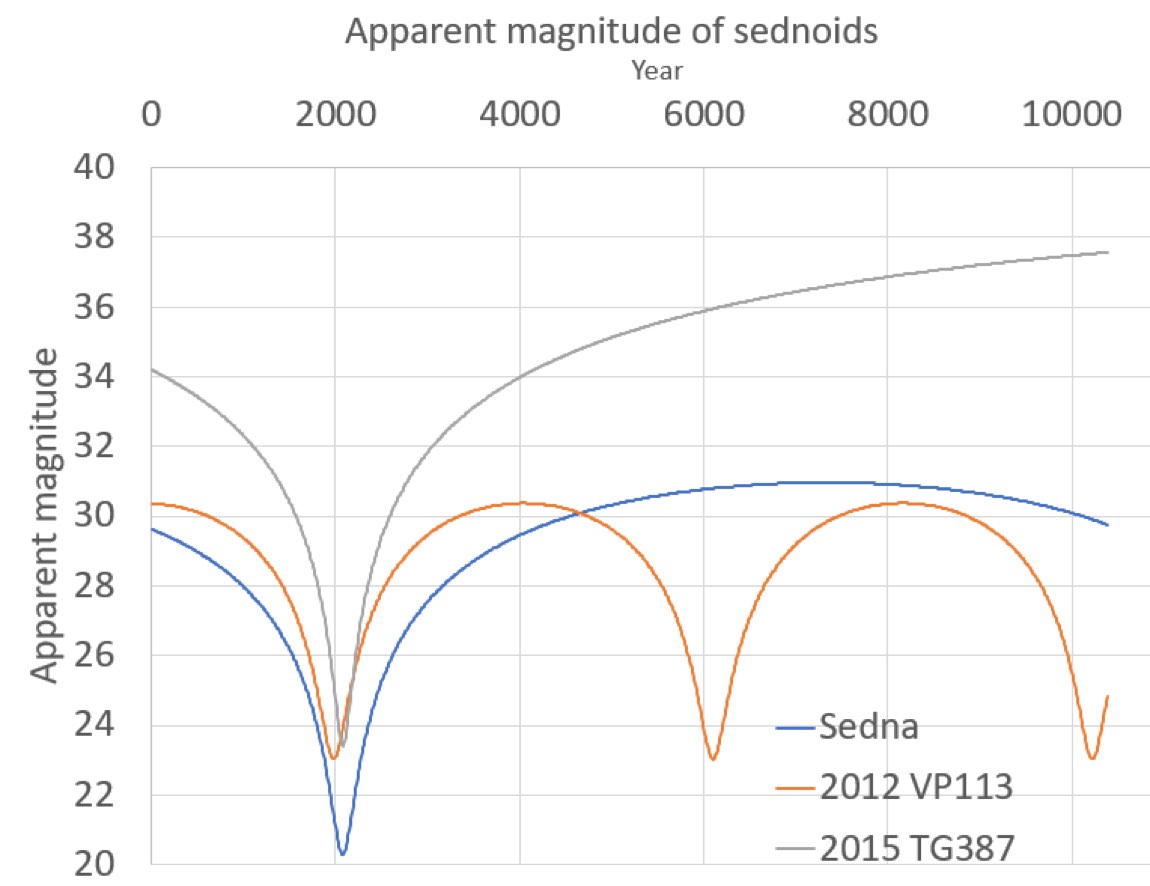
Sedna is not unique. It has become the prototype for a class of objects called sednoids, defined by highly eccentric orbits with very distant perihelia. The first confirmed companion in this class was 2012 VP113, announced in 2014 by Chad Trujillo and Scott Sheppard: roughly half Sedna's size, it has a 4,200-year orbit and a perihelion within Sedna's range of about 80 AU. A third object, 2015 TG387 — now named Leleākūhonua — was announced in 2018 with a perihelion of 65 AU and an orbital period of 40,000 years. Crucially, the longitudes of perihelion of Sedna, 2012 VP113, and Leleākūhonua appear to be aligned, strengthening the statistical case for orbital clustering that some astronomers attribute to Planet Nine's gravitational shepherding. Based on the detection probability of roughly 1 in 80 for Sedna itself, researchers expect 40 to 120 Sedna-sized objects with similar orbital parameters to exist. A study tied to Leleākūhonua's discovery estimated a population of about 2 million inner Oort Cloud objects larger than 40 km, with a total mass in the range of 1×10²² kg — several times the mass of the entire asteroid belt and about 80 percent the mass of Pluto.
 ⤢
07 How Sedna Was Found — and Almost Missed
Sedna was discovered on 14 November 2003 by Michael Brown of Caltech, Chad Trujillo of Gemini Observatory, and David Rabinowitz of Yale University. The discovery grew out of a sky survey begun in 2001 using the Samuel Oschin telescope at Palomar Observatory near San Diego, California, equipped with Yale's 160-megapixel Palomar Quest camera. On the discovery night, the team observed an object moving 4.6 arcseconds across the sky over 3.1 hours relative to background stars — slow enough to indicate a distance of around 100 AU. Brown had initially nicknamed it "The Flying Dutchman" or simply "Dutch," after the legendary ghost ship, because its sluggish motion had masked its presence from his team during earlier observations. Follow-up work was carried out at the SMARTS telescope at Cerro Tololo Inter-American Observatory in Chile, the Tenagra IV telescope in Arizona, and the Keck Observatory in Hawaii. When older archival images were searched, precovery images were found in the Palomar Digitized Sky Survey dating back to 25 September 1990 — meaning Sedna had been lurking unseen in photographic plates for over a decade before anyone knew to look for it.
08 The Naming Controversy and Inuit Mythology
The road to Sedna's official name was anything but smooth. Brown settled on the name from Inuit mythology partly because he mistakenly believed the Inuit were the polar culture geographically closest to his home in Pasadena, and partly because the name would be easy for English speakers to pronounce — unlike the team's earlier discovery, Quaoar. In Inuit tradition, Sedna is a goddess associated with the bottom of the Arctic Ocean, a mythological location Brown felt appropriately reflected the object's vast distance from the Sun. He proposed to the IAU's Minor Planet Center that future objects found in Sedna's orbital region should be named after entities from Arctic mythologies. However, Brown's team made the name public before the object had been officially numbered, which was considered a violation of protocol by Brian Marsden, then head of the Minor Planet Center, who warned that IAU members might vote against it. One amateur astronomer, Reiner Stoss, even attempted to register "Sedna" for one of his own asteroid discoveries as a protest. Despite the friction, no formal competing names were proposed, and the IAU's Committee on Small Body Nomenclature accepted the name in September 2004, noting that in future cases of extraordinary public interest, pre-numbering announcements might be permitted.
09 Interior Structure and the Ocean Question Deeper
Sedna's internal structure can only be inferred indirectly, because no spacecraft has visited it and it has no known moons from which a mass could be derived. Without a moon, direct gravitational measurement of its mass is impossible unless a probe is sent or a nearby object is found that is measurably perturbed by Sedna's gravity. Diameter estimates have evolved considerably: a 2004 upper limit of 1,800 km was revised by Spitzer Space Telescope observations to below 1,600 km by 2007. The Herschel Space Observatory suggested 995 ± 80 km in 2012, and a re-analysis of thermal data with an improved model the following year produced 906 with uncertainties of +314 and −258 km. Australian stellar occultation observations in 2013 gave chord lengths of 1,025 ± 135 km and 1,305 ± 565 km. The article notes that Sedna's size suggests it could have undergone differentiation — the separation of a body into layers of differing density — and may have a sub-surface liquid ocean, as well as possible geologic activity. These remain speculative possibilities rather than confirmed findings; the mass and density of Sedna are entirely unknown.
10 The Rotation Rate Mystery
Sedna's rotation rate turned out to be far more complicated than it first appeared. When Sedna was initially discovered, early measurements suggested an unusually long rotation period of 20 to 50 days — far slower than typical bodies of its size. Because such slow rotation is otherwise seen in tidally locked binary systems, astronomers initially speculated that an unseen companion moon might be dragging Sedna's spin down through gravity, in the same way Pluto's large moon Charon has synchronized Pluto's rotation. The Hubble Space Telescope was used in March 2004 to search for such a satellite, but found nothing. Subsequent measurements from the MMT telescope then showed Sedna's true rotation period to be approximately 10 hours — well within the normal range for a body of its size. A period of around 18 hours has also been considered possible but is thought to be unlikely. The initial slow-rotation measurement remains puzzling in retrospect, and the failed satellite search means that as of 2024, the 2004 Hubble observations are the only published attempt to find a companion — with the caveat that a small moon could conceivably have been lost in the glare from Sedna itself.
11 A Narrow Window for Exploration
Sedna will reach perihelion around July 2076, and this close approach represents a once-in-11,400-year opportunity to study it from a spacecraft. Because Sedna spends most of its orbit beyond the heliopause — the boundary where the solar wind gives way to the interstellar particle wind — examining its surface would reveal not only the chemical effects of interstellar radiation but also information about the properties of the solar wind at its farthest extent. Calculations published in 2011 found that a flyby mission using a Jupiter gravity assist could reach Sedna in 24.48 years, with launch windows on 6 May 2033 or 23 June 2046; under those trajectories, the spacecraft would arrive near the end of 2057 or 2070, finding Sedna 77.27 or 76.43 AU from the Sun respectively. Other proposed trajectories use gravity assists from Venus, Earth, Saturn, and Neptune. A 2025 study identified options to shorten transit times substantially: a fusion rocket could place a large spacecraft into orbit around Sedna in just 10 years, while a solar sail could achieve a flyby in 7 years with a smaller payload — both options allowing arrival well before perihelion.
12 Sedna as a Fossil of Solar System History
Because Sedna's perihelion is too distant to have been shaped by any known planet, and its orbit appears to preserve conditions from the Solar System's infancy, researchers treat it as an unusually pristine record of the Sun's earliest environment. Michael Brown himself described Sedna in 2006 as "a fossil record of the earliest Solar System," suggesting that when other objects with similar extreme perihelia are found, the collective population will help constrain how many stars were near the Sun when it formed and how densely packed that birth cluster was. The detection probability for any single Sedna-like object was estimated at roughly 1 in 80, meaning the discovery of even one such body strongly implies a substantial hidden population. A 2007–2008 survey by Brown, Rabinowitz, and Megan Schwamb was sensitive to movement out to 1,000 AU and discovered the likely dwarf planet Gonggong, but found no new sednoid. Sedna was later recovered in Transiting Exoplanet Survey Satellite data in 2020, as part of a broader all-sky survey effort aimed at finding Planet Nine and other unknown trans-Neptunian objects, demonstrating that existing datasets continue to yield new information about this remote object.
 ⤢