Taurus ☉ Zodiac
“The Bull” · Northern · best around January evenings
Real star positions and magnitudes (HYG database via D3-Celestial, BSD-3). Lines are the conventional stick figure; north is up.
The story
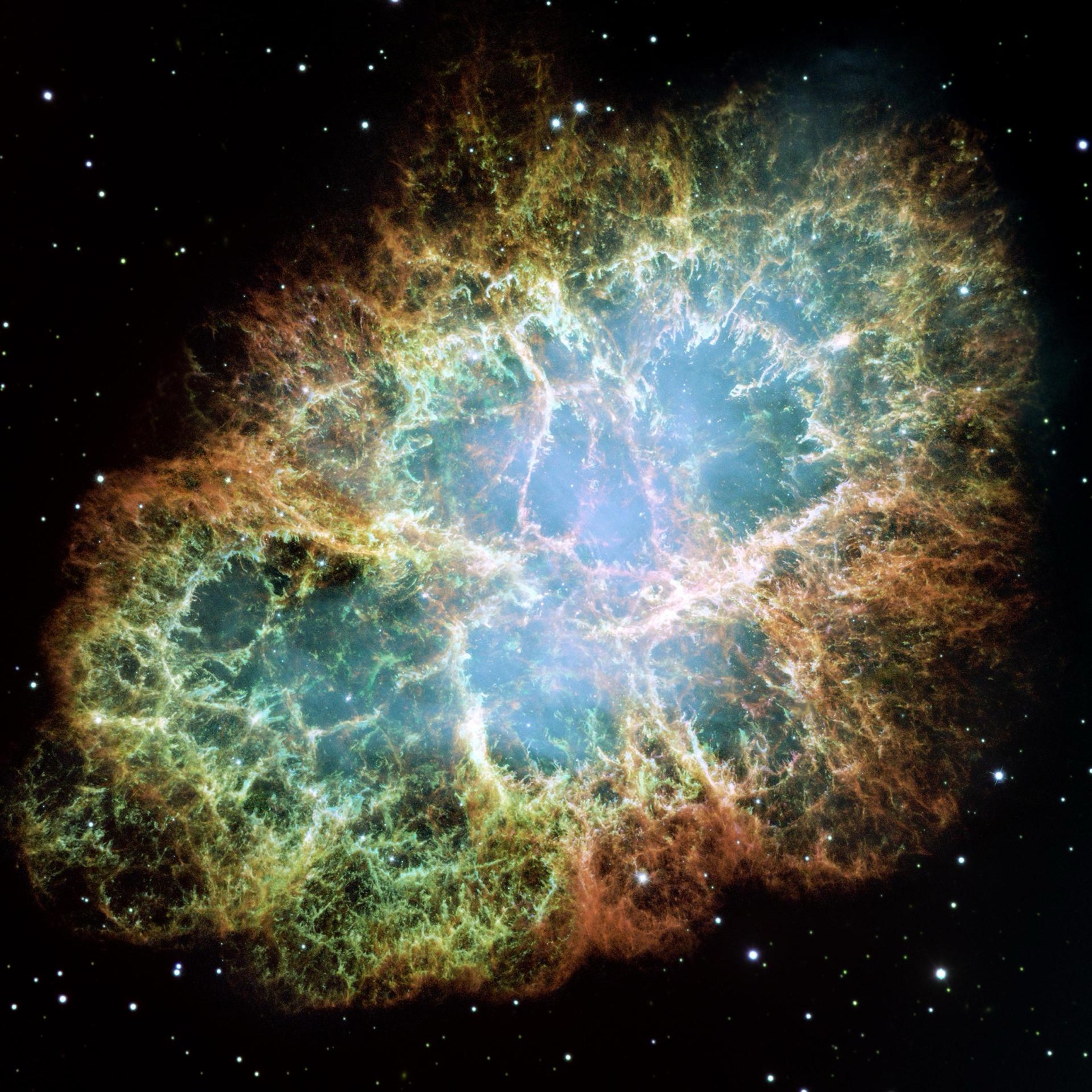
The charging bull — one of the oldest constellations, possibly painted 17,000 years ago on the walls of Lascaux. Orange Aldebaran is its glaring eye, the V-shaped Hyades cluster its face, and on its shoulder ride the Pleiades, the Seven Sisters, the most famous star cluster in the sky. Near its horn-tip sits the Crab Nebula, wreckage of the supernova of 1054.
How to find it
Winter evenings: follow Orion's Belt up-right to the bright orange star (Aldebaran), then on to the little dipper-shaped Pleiades.
✦ What lives inside it
- The Pleiades (M45)
- The Hyades cluster
The deep dive
Researched for the Atlas from Wikipedia — Taurus (constellation) (15,102 characters read) · updated Sep 20, 2026
01 The oldest star picture we may have
The bull shape in Taurus may be the most ancient constellation image that survives anywhere. Michael Rappenglück of LMU Munich argues that a cave painting in the Hall of the Bulls at Lascaux, dated to roughly 15,000 BC, depicts Taurus alongside a cluster of dots representing the Pleiades. If correct, that pushes the constellation's origin back to the Upper Paleolithic, making it at least 17,000 years old. The case is strengthened by linguistics: the name "seven sisters" for the Pleiades appears independently in Aboriginal Australian languages, in languages of indigenous North American peoples, and among Siberian groups. The wide geographic spread of an identical nickname suggests the name predates the separation of those cultures, pointing toward a very deep common origin — though the claim remains debated rather than settled.
02 When the Bull marked the start of spring
For roughly two thousand years, from about 4000 BC to 1700 BC, the Sun stood in Taurus at the moment of the spring equinox. This made the constellation enormously important to early agricultural societies across the ancient Near East and Mediterranean. Farmers and priests used the equinox to calibrate planting calendars, and a constellation that hosted it carried deep sacred weight. The Pleiades cluster within Taurus was closest to the Sun at the vernal equinox around the 23rd century BC, reinforcing the cluster's ritual significance. After 1700 BC, the slow wobble of Earth's rotational axis — the precession of the equinoxes — shifted the equinox point westward into Aries, demoting Taurus. The Babylonian astronomical catalog known as the MUL.APIN recorded the constellation as GU4.AN.NA, meaning "The Bull of Heaven," preserving its prestige long after the equinox had moved on.
03 Bulls, gods, and epic poetry
The Bull of Heaven in Taurus appears as a character in the Old Babylonian Epic of Gilgamesh, one of the oldest narrative poems known. The goddess Ishtar sends the Bull to kill Gilgamesh after he rejects her. His companion Enkidu tears off the bull's hind quarters and hurls them skyward, where they become Ursa Major and Ursa Minor. Some scholars place Gilgamesh himself in the neighboring constellation Orion, where he faces Taurus as if locked in combat. In early Mesopotamian art, the Bull of Heaven was closely linked to Inanna, the Sumerian goddess of love, fertility, and warfare. One of the oldest depictions shows the bull standing before her symbol, with three stars marked on its back using the cuneiform sign for star-constellation — a strong hint that ancient Mesopotamians recognized exactly the same asterism we call Taurus today.
04 Greek myths behind the bull shape
Greek tradition attached two separate myths to Taurus. In the more famous story, the god Zeus transformed himself into a magnificent white bull to abduct Europa, a Phoenician princess, carrying her across the sea to Crete. This explained why ancient illustrations showed only the front half of a bull — Taurus was depicted as partly submerged in the ocean. A second tradition identified the constellation with Io, another lover of Zeus, whom the god turned into a heifer to conceal from his jealous wife Hera. A third connection appears in the work of the mythographer Acusilaus, who equated the Taurus bull with the Cretan Bull — the beast that Heracles had to capture as one of his Twelve Labors. The Greek convention of portraying the horns pointing forward, rather than upward or backward as Egyptian and earlier cultures did, also distinguished their version of the figure.
05 Taurus across cultures: Druids to the Inuit
Beyond the Mediterranean, Taurus gathered meaning in widely separated traditions. The Druids treated Taurus as a significant object of worship, holding a religious festival called Tauric while the Sun was passing through the constellation. In Egyptian belief, Taurus was a sacred bull associated with the renewal of life in spring; as the equinox Sun covered the constellation in the western evening sky each year, this disappearance was interpreted as a sacrificial act that restored the land's fertility. The ancient Hebrews placed Taurus first in their zodiac and connected it to the first letter of their alphabet, Aleph. Among the Inuit of the Arctic, the constellation carries the name Sakiattiat, while the Hyades cluster is called Nanurjuk and represents the spirit of a polar bear — with Aldebaran as the bear itself and the surrounding Hyades stars as dogs holding it at bay. Buddhist tradition holds that Gautama Buddha was born under a full moon in Taurus, commemorated annually as the Wesak Festival.
06 A nebula that changed astronomy forever Deeper
The Crystal Ball Nebula, catalogued as NGC 1514, sits in the northern part of Taurus and carries an outsized place in the history of science. When German-born English astronomer William Herschel discovered it in 1790, he could clearly see a single star at its center wrapped in a surrounding cloud — something that contradicted the prevailing assumption that all nebulae were simply distant, unresolved groups of stars. This single observation forced astronomers to accept that some nebulae were genuinely extended structures of a different nature. The story continued in 1864, when English astronomer William Huggins analyzed the nebula's spectrum and demonstrated that the glow came from luminous gas rather than from stars. That spectroscopic result was foundational: it established that objects in the universe are made of matter that obeys the same physical laws as matter on Earth, and it launched the field of astrophysical spectroscopy.
07 Aldebaran: the bloodshot eye of the bull
Aldebaran is a spectral class K5 III red giant, and at first magnitude it is the brightest star in Taurus. Its name comes from the Arabic al-dabarān, meaning "the follower," because the star appears to trail the Pleiades across the night sky as Earth rotates. Ancient observers pictured it as the bull's bloodshot eye — described poetically as "glaring menacingly at the hunter Orion," the constellation that lies just to the southeast. Aldebaran has around 116 percent the mass of the Sun, and astronomers have identified a candidate exoplanet in the system. Although it appears to sit within the V-shaped Hyades cluster when viewed from Earth, Aldebaran is actually an unrelated foreground star. The Hyades themselves span about 5 degrees of sky — too wide to frame in a typical telescope eyepiece — making binoculars or the naked eye the best tools for taking in the full V shape that outlines the bull's face.
08 Light bending and a star cluster's finest hour Deeper
During the total solar eclipse of May 29, 1919, the Hyades cluster in Taurus became the stage for one of the most consequential observations in twentieth-century science. Arthur Eddington led an expedition to the island of Príncipe while a parallel team observed from Sobral, Brazil. Both groups photographed stars in the Hyades, including Kappa Tauri, at the moment the Moon blocked the Sun's disk. The whole point was to see whether starlight passing close to the Sun would be deflected by the Sun's gravity, as Albert Einstein had predicted in his general theory of relativity published in 1915. The measurements confirmed the predicted bending. The result made headlines worldwide and transformed Einstein from a specialist's theorist into a global scientific celebrity. The fact that these confirming stars happened to lie inside Taurus, in the same cluster that ancient Inuit elders called Nanurjuk, links deep mythological time to one of the pivotal moments of modern physics.
09 T Tauri and the birth of a stellar class Deeper
About 1.8 degrees west of Epsilon Tauri lies T Tauri, a star so unusual that it gave its name to an entire category of objects. T Tauri is a newly formed stellar object that is still emerging from its surrounding envelope of gas and dust, but has not yet settled onto the main sequence where it will spend most of its life fusing hydrogen. Its behavior is erratic: the star's brightness swings unpredictably between magnitude 9 and magnitude 13 over timescales of weeks to months, a range of four full magnitudes. The reflection nebula immediately surrounding it, catalogued as NGC 1555, is illuminated entirely by T Tauri's light and therefore varies in brightness along with the star. Any star caught in this same in-between developmental stage — post-collapse but pre-main-sequence — is now called a T Tauri star in its honor. The Taurus-Auriga star-forming complex, at a distance of 490 light-years (150 parsecs), provides an ideal nearby laboratory for studying these young objects.
10 The Taurus-Auriga cloud: a nearby stellar nursery Deeper
Crossing into the northern part of Taurus is a star-forming region called the Taurus-Auriga complex, sometimes referred to as the Taurus dark clouds. It spans a diameter of 98 light-years (30 parsecs) and contains 35,000 solar masses of gas and dust arranged in sparse, filamentary structures rather than the dense, compact form seen in more famous nurseries. At 490 light-years (150 parsecs) away, it ranks among the nearest active star-forming regions known, making it invaluable for detailed observation. For comparison, the Orion Nebula is both larger and more massive than the Taurus-Auriga complex, yet Taurus-Auriga's proximity compensates by allowing astronomers to resolve individual protostars. Located within this region, roughly 10 degrees northeast of Aldebaran, is the asterism NGC 1746, which spans 45 arcminutes on the sky — about one and a half times the width of a full Moon.
11 Three great circles cross in one constellation Deeper
Taurus holds a unique geometric distinction among all the 88 official constellations: it is the only one crossed by all three of the galactic equator, the celestial equator, and the ecliptic simultaneously. Each of these circles represents a different reference frame — the flat disk of the Milky Way, the projection of Earth's equator onto the sky, and the apparent annual path of the Sun, respectively. The galactic plane intersects the constellation's northeast corner, and the galactic anticenter — the point in the sky directly opposite the Milky Way's core — lies near the border between Taurus and Auriga. A large ring-like structure called Gould's Belt also passes through Taurus. This convergence of fundamental astronomical reference lines in one region of sky is a consequence of coincidental geometry, but it means that researchers studying the structure of the galaxy, the dynamics of the solar system, and the local stellar neighborhood can often point their instruments at the same general patch of winter sky.
12 The Crab Nebula's long road to discovery
The supernova that created the Crab Nebula was witnessed on July 4, 1054, and was bright enough to be seen in full daylight. Chinese historical records documented it, and evidence from a painting in a New Mexican canyon and from decorated pottery indicates that North American peoples also observed the event. At peak brightness, the exploding star reached magnitude −4 — comparable to Venus at its brightest. Yet the nebula it left behind, currently glowing at magnitude 8.4, went unnoticed for 677 years until the English astronomer John Bevis found it in 1731. The remnant, catalogued as Messier 1, was produced by a Type II supernova and contains the Crab Pulsar at its heart. Today a telescope is required to see it at all — a reminder of how dramatically supernovae fade. The Crab Nebula sits about 1.15 degrees northwest of Zeta Tauri, one of the bull's horn stars, giving observers a useful pointing landmark.
13 Pioneer 10's long farewell toward the bull
After completing its mission through the outer solar system, the space probe Pioneer 10 is now drifting outward through interstellar space in the general direction of Taurus. The journey, however, is on a scale that humbles human timekeeping: Pioneer 10 will not come anywhere near any of the constellation's actual stars for many thousands of years. By that point, the article notes plainly, its batteries will be long dead. The probe carries no propulsion and is simply coasting on the velocity given to it by its 1972 launch and the gravitational assists it received along the way. That this small, silent machine is heading toward one of humanity's oldest star pictures — a constellation that Paleolithic people may have painted on cave walls and Bronze Age farmers used to time their planting — adds a quiet symmetry to its fate, even if no one will ever be there to observe the encounter.