 Photograph · Giuseppe Donatiello · CC0
Star · Deep guide
Aldebaran
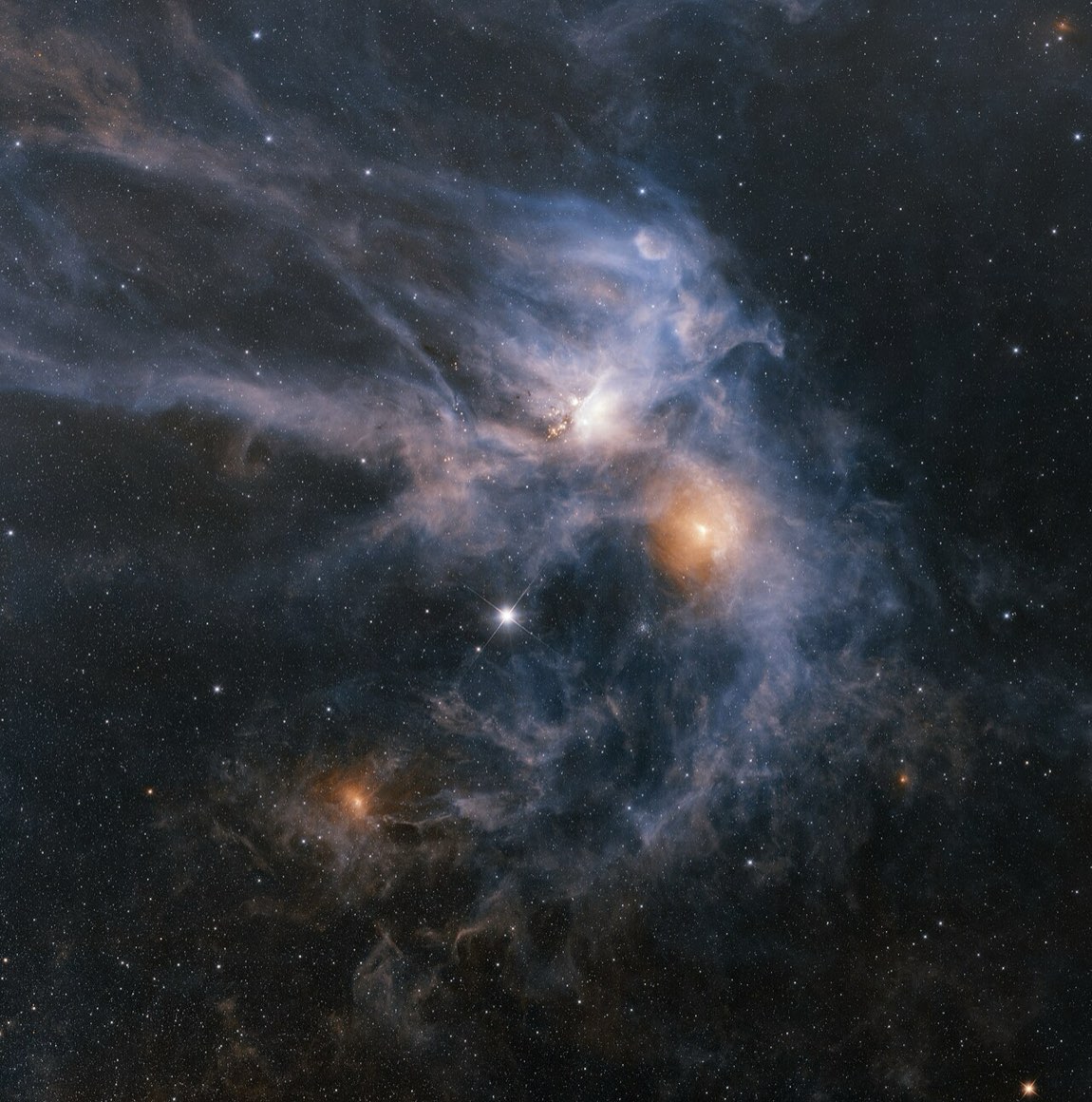
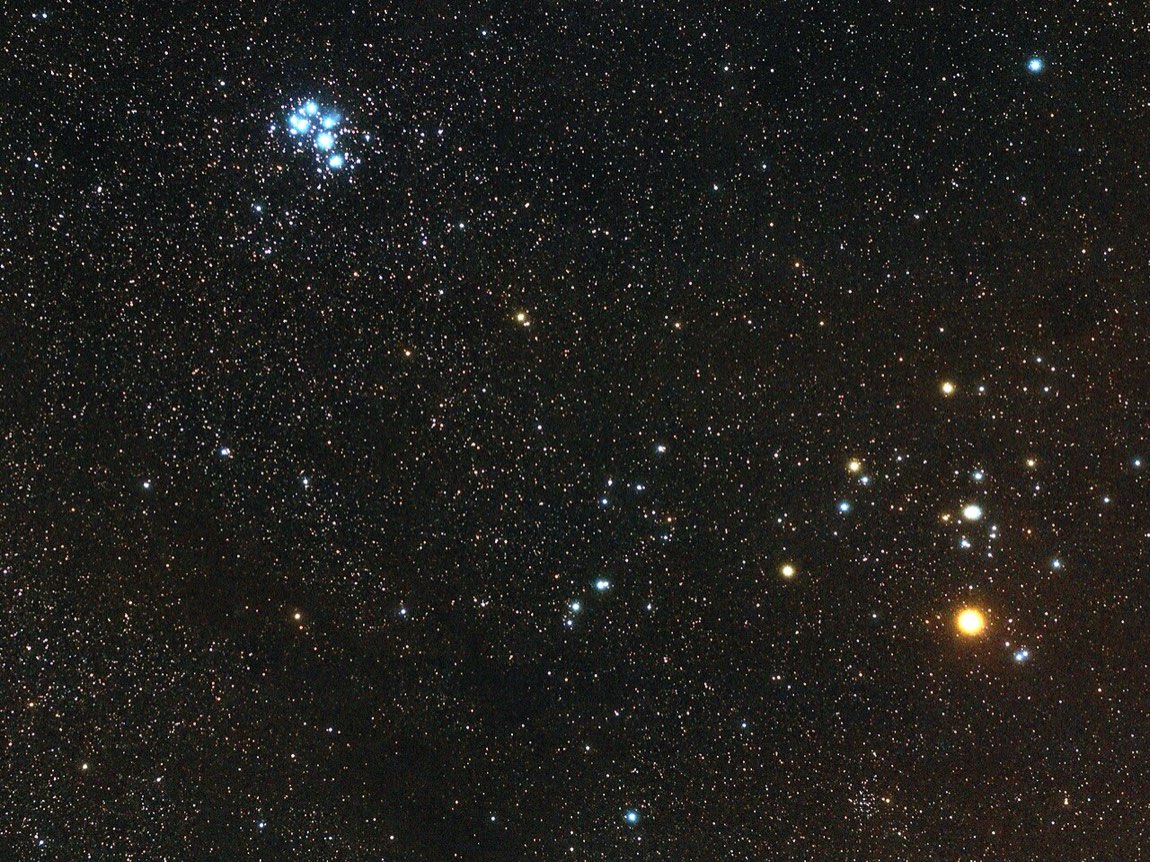
The Bull's glaring orange eye. This giant star is photobombing a famous cluster.
What is it?
Aldebaran burns orange as the eye of Taurus, 65 light-years away. It looks like the brightest member of the V-shaped Hyades cluster behind it, but that's a trick of perspective — the cluster is twice as far. It is a red giant 44 times the Sun's width; claims of a giant planet around it have come and gone, and remain unsettled.
The deep dive
Researched for the Atlas from Wikipedia — Aldebaran (19,084 characters read) · updated Sep 20, 2026
01 The Name and Its Starry Logic
Aldebaran carries an Arabic name that encodes a precise observation: al-Dabarān means "the follower," because the star appears to chase the Pleiades star cluster across the sky as Earth rotates. The original full Arabic name was Nayyir al-Dabarān — "the bright one of the follower" — a phrase that acknowledged both its role and its brilliance in a single breath. The International Astronomical Union's Working Group on Star Names formally enshrined the name Aldebaran in 2016, making it official for global scientific use. Beyond Arabic, the star has accumulated names in nearly every astronomical tradition. Ancient Greek astronomers called it Lampadias, meaning "torch-like" or "torch-bearer," a description Ptolemy used in his Tetrabiblos. Medieval Latin astronomers recorded it as Cor Tauri, "the heart of the bull," in the Alfonsine Tables. Persian astronomers listed it among the four royal stars and called it Tascheter. In Chinese astronomy it is 畢宿五, "the Fifth Star of Net." In Hindu tradition it marks the lunar station Rohini, "the red one," associated with the favourite wife of the moon god Chandra. Its Flamsteed number, 87 Tauri, gives it yet another identity in the cataloguing tradition.
02 How Aldebaran Revealed Stellar Motion Deeper
One of the most consequential discoveries in the history of astronomy began with Aldebaran. On 11 March AD 509, an observer in Athens watched the Moon pass in front of the star — a lunar occultation — and recorded the timing. More than twelve centuries later, English astronomer Edmund Halley studied that ancient record alongside contemporary measurements and in 1718 concluded that Aldebaran must have shifted position, moving several minutes of arc further to the north since the original observation. Combined with similar discrepancies he found for Sirius and Arcturus, this led directly to the discovery of proper motion — the idea that stars are not fixed points but are actually moving through space. Based on modern observations, Aldebaran's position has shifted 7 arcminutes over the last 2,000 years, roughly a quarter the apparent diameter of the full Moon. On a much longer timescale, the geometry works in reverse: due to the precession of the equinoxes, the vernal equinox was close to Aldebaran some 5,000 years ago. Between 420,000 and 210,000 years ago, Aldebaran was actually the brightest star in the entire night sky, reaching a peak apparent magnitude of −1.54 around 320,000 years ago — outshining everything visible today.
03 Spectrum Science: Iron, Light, and Velocity Deeper
Aldebaran has served as a scientific instrument in its own right, helping astronomers pioneer the tools of astrophysics. In 1864, working at his private observatory in Tulse Hill, England, William Huggins performed the first spectral analysis of the star, identifying the absorption lines of nine elements including iron, sodium, calcium, and magnesium. It was an early demonstration that stars are made of recognisable chemical ingredients. In 1886, Edward C. Pickering at the Harvard College Observatory used a photographic plate to capture fifty absorption lines in Aldebaran's spectrum, work that became part of the Draper Catalogue published in 1890. Just a year later, in 1887, the photographic technique had advanced far enough that astronomers could measure a star's radial velocity from the Doppler shift in its spectral lines. Using this method at the Potsdam Observatory, Hermann C. Vogel and his assistant Julius Scheiner estimated Aldebaran's recession velocity as 30 miles per second — 48 km/s. Today, Aldebaran's long observational pedigree made it one of 33 stars selected as benchmark calibrators for the Gaia space mission, and it had previously been used to calibrate instruments aboard the Hubble Space Telescope.
04 Inside a Dying Star: Aldebaran's Structure Deeper
Aldebaran is the spectral standard for type K5+ III stars — the definitive example of its class. Its interior tells a story of stellar old age. With an age of over six billion years, the star has exhausted the hydrogen fuel in its core. What remains at the centre is a degenerate helium core surrounded by a shell where hydrogen still undergoes nuclear fusion via the CNO cycle — a chain of reactions involving carbon, nitrogen, and oxygen acting as catalysts. This shell-burning process pumps enormous energy outward, causing the outer layers to expand dramatically. The star has ballooned to 45.1 times the diameter of the Sun, a sphere approximately 63 million kilometres across. If placed at the centre of our solar system, it would engulf Mercury and nearly reach Venus. Yet its mass, determined through asteroseismology to be about 16% more than the Sun's, has barely changed — it is just spread across an incomparably larger volume. This gives Aldebaran a surface gravity of only 1.45 cgs, roughly 35 times lower than Earth's and nearly a thousand times lower than the Sun's. The star's metallicity — the abundance of elements heavier than hydrogen and helium — is about half the Sun's, reflecting its age and origin in an earlier, less chemically enriched era of the galaxy.
05 The Molecular Fog Beyond the Surface
Past Aldebaran's visible photosphere lies a series of increasingly strange atmospheric layers. The photosphere itself glows at 3,900 K — far cooler than the Sun's roughly 5,778 K surface — giving the star its distinctive orange-red colour. Beyond the chromosphere, temperatures drop further rather than rising, allowing something unusual to exist: a molecular outer atmosphere that astronomers call a MOLsphere. This region sits at about 2.5 times the star's radius from the centre and has a temperature of around 1,500 K — cool enough for molecules to form and survive. Spectroscopic analysis of this zone reveals the presence of carbon monoxide, water vapour, and titanium oxide. Beyond the MOLsphere, a stellar wind streams outward at 30 km/s, carrying away mass at a rate of between 1 and 1.6 times 10⁻¹¹ solar masses per year — roughly the equivalent of one Earth mass every 300,000 years. This outflow continues until it meets the termination shock boundary where the hot, ionised interstellar medium of the Local Bubble begins. The resulting structure, called an astrosphere, is roughly spherical with a radius of around 1,000 astronomical units centred on Aldebaran.
06 Magnetic Fields, X-rays, and a Quiet Star Deeper
Aldebaran's slow rotation has profound consequences for its magnetic life. It takes 520 days to complete a single rotation — by comparison, the Sun rotates in roughly 25 days at its equator. This leisurely spin means Aldebaran cannot sustain the internal dynamo mechanism that generates a powerful corona in faster-rotating stars. As a result, it does not emit hard X-rays. However, the star is not magnetically inert: small-scale magnetic fields are thought to arise in the lower atmosphere through convective turbulence near the surface, with a measured field strength of 0.22 Gauss. These weak fields may drive the observed stellar wind. The star does produce ultraviolet emission detectable in its spectrum, but any soft X-ray emissions originating near the surface are believed to be absorbed and attenuated by the overlying chromosphere before they can escape. The photosphere's chemical abundances — particularly the relative proportions of carbon, oxygen, and nitrogen — indicate that Aldebaran has already completed what stellar physicists call the first dredge-up, a phase of evolution in which deep convective mixing carries material processed by nuclear reactions up to the visible surface.
 ⤢
⤢
07 A Companion Star Hidden in the Distance
Aldebaran is not entirely alone. The Gaia spacecraft identified a proper motion companion — a second star sharing a similar distance and remarkably similar motion through space, both of which are strong indicators of a genuine physical association. This companion, named Alpha Tauri B or Aldebaran B, sits at an angular separation of 33 arcseconds from Aldebaran at a position angle of 117°, which at Aldebaran's distance corresponds to a projected physical separation of at least 680 astronomical units — 680 times the average Earth-Sun distance, or about 17 times the distance from the Sun to Neptune. It has an apparent magnitude of 13.2, making it between 80,000 and 96,000 times fainter than Aldebaran itself and completely invisible to the naked eye. The companion is a small, cool star with a spectral type of M2.5, a radius just 0.35 times the Sun's, and a mass of 0.400 times the Sun's. The story of this companion has a complex history: William Herschel first noted a faint companion in 1782, but subsequent proper motion measurements showed that star was not physically associated. It was the companion identified by S. W. Burnham in 1888 — with almost exactly matching proper motion — that is now recognised as the genuine gravitational partner.
08 The Planet That Probably Isn't There
The question of whether Aldebaran hosts a planet has been one of the more instructive scientific debates of recent decades. In 1993, radial velocity measurements suggested a long-period oscillation in the star's motion, implying a companion with a minimum mass 11.4 times that of Jupiter in a 643-day orbit at a separation of 2.0 AU — but since three similar stars showed similar signals, the authors concluded the variation was intrinsic to the stars themselves, not caused by an orbiting body. In 2015, a study led by Artie P. Hatzes argued for a genuine planetary companion, designated Aldebaran b, with a minimum mass of 5.8 ± 0.7 Jupiter masses. Asteroseismic modelling suggested that when Aldebaran was a younger, main-sequence star, this planet would have received Earth-like levels of illumination, potentially placing it in the habitable zone. However, a 2019 follow-up found that additional data weakened the planetary case significantly. A two-planet model fits better mathematically but would be dynamically unstable. The more probable explanation is that stellar oscillations mimic the radial velocity signature of a planet — a phenomenon also seen at Gamma Draconis and 42 Draconis. By 2025, even Hatzes himself, as lead author of a new study, classified Aldebaran b as doubtful or disproven.
09 Watching Aldebaran Hide Behind the Moon
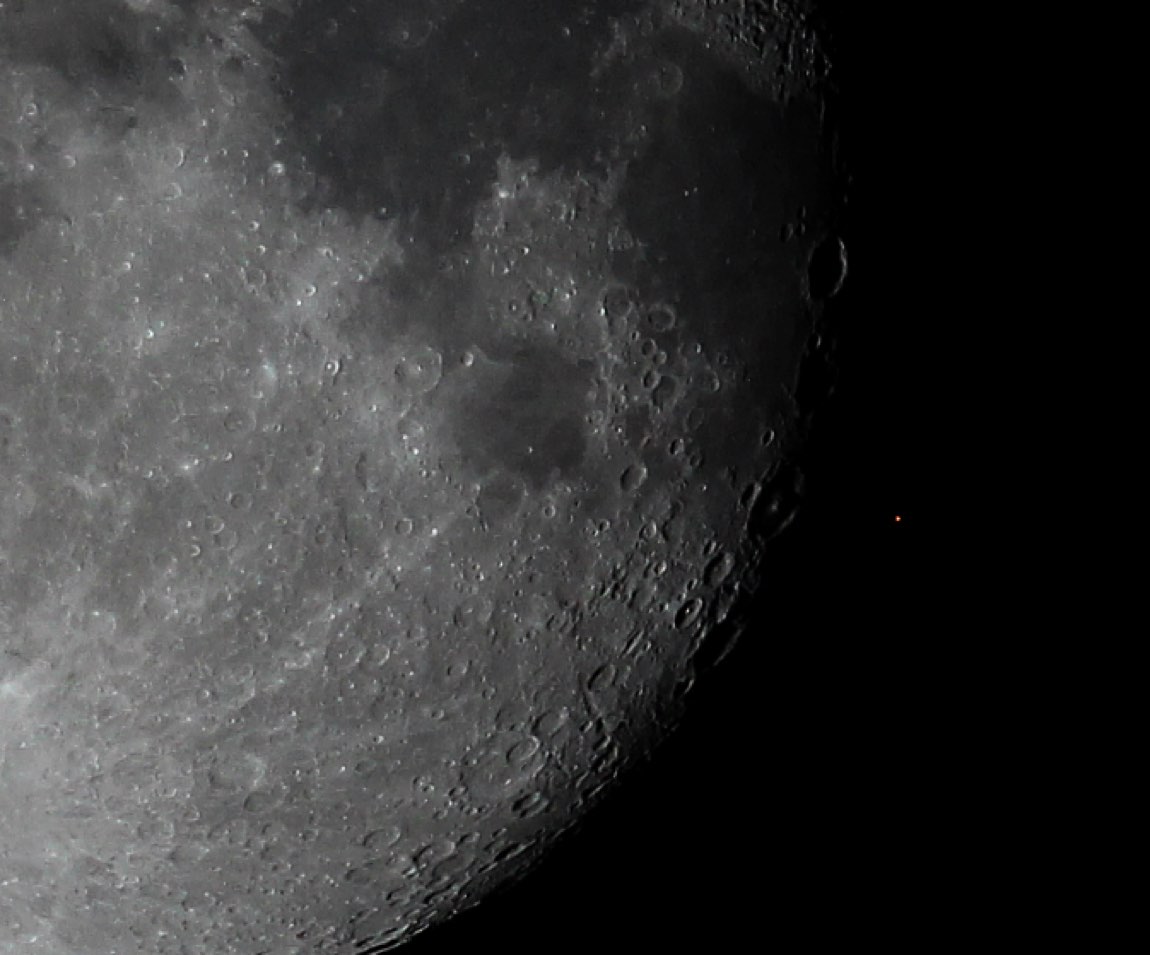
Because Aldebaran sits only 5.47 degrees south of the ecliptic — the Sun's apparent path across the sky — the Moon regularly passes in front of it, creating events called occultations. These happen in predictable series when the Moon's ascending node aligns near the autumnal equinox. A recent series of 49 such occultations began on 29 January 2015 and concluded on 3 September 2018. Each event was observable from somewhere in the northern hemisphere or near the equator. Observers in Australia or southern Africa, however, can never see Aldebaran occulted: parallax shifts the Moon's apparent position enough relative to the star that the Moon's disc passes just above it from those latitudes. These occultations are scientifically useful: a reasonably accurate estimate of Aldebaran's angular diameter was obtained during the occultation of 22 September 1978. The best modern measurement, adopted for the Gaia benchmark calibration, is 20.580 ± 0.030 milliarcseconds. Aldebaran is also straightforward to find visually: tracing the three belt stars of Orion in the direction away from Sirius, the first bright star you encounter is Aldebaran. It is best observed at midnight in late November to early December each year.
10 Myths from Three Continents
As one of the brightest and most recognisably placed stars in the sky, Aldebaran has drawn human stories for millennia across wildly different cultures. For the Seri people of northwestern Mexico, Aldebaran provides light for the Pleiades women giving birth, and the star carries three separate names in their language: Hant Caalajc Ipápjö, Queeto, and Azoj Yeen oo Caap, meaning "star that goes ahead." Their lunar month corresponding to October is even named Queeto yaao, "Aldebaran's path." Among the indigenous people of the Clarence River in northeastern New South Wales, Australia, the star is the ancestor Karambal, who stole another man's wife. Tracked down, he hid in a tree that his pursuer set alight; he rose to the sky as smoke and became Aldebaran. In Persian astronomical tradition, Aldebaran is one of four royal stars, carrying great authority over celestial affairs. The Ancient Greek name Lampadias — torch-like — appeared in Ptolemy's Tetrabiblos, while the Latin name Palilicium connected it to the agricultural feast of Parilia on April 21, the date when the star would disappear into twilight. The medieval Alfonsine Tables called it Cor Tauri, the heart of the bull, placing it at the emotional centre of the constellation.
11 Pioneer 10's Two-Million-Year Journey There
Aldebaran has a peculiar footnote in the history of space exploration. Pioneer 10, the planetary probe launched in 1972 that became the first spacecraft to pass through the asteroid belt and fly by Jupiter, is no longer powered or in contact with Earth. Its trajectory, however, is carrying it in the general direction of Aldebaran. The probe is expected to make its closest approach to the star in approximately two million years. At 67 light-years away, that is an immense gulf — and Pioneer 10 will still be nowhere near the star even then, given the scale of interstellar distances. The journey serves as a vivid illustration of just how far a star that appears brilliant in our night sky actually is. Closer to home, Aldebaran's name has spread into human culture in concrete ways: there is an Aldebaran Rock in Antarctica, a United States Navy stores ship USS Aldebaran, an Italian frigate Aldebaran, a French robotics company of that name, and a proposed micro-satellite launch vehicle. The Austrian chemist Carl Auer von Welsbach once proposed naming a newly discovered rare earth element "aldebaranium," chemical symbol Ad. The element was eventually named ytterbium instead.
12 Aldebaran and the Hyades: A Chance Alignment
One of the most visually convincing illusions in the night sky is the apparent membership of Aldebaran in the Hyades star cluster. The Hyades form the distinctive V-shaped face of Taurus the Bull, and Aldebaran sits at the tip of that V, looking every part the cluster's brightest and most prominent member. The reality is entirely different. The Hyades cluster lies at roughly 150 light-years from Earth — more than twice as far as Aldebaran, which sits at approximately 65.3 light-years away as measured by the Hipparcos satellite. The two are completely unrelated: Aldebaran simply happens to lie along the same line of sight. The star is also considerably older than the young Hyades cluster. A further subtlety involves two stars that are true Hyades members: the visual companions designated C and D in Aldebaran's double star records form a gravitationally bound binary system, Alpha Tauri CD, but they are located far beyond Aldebaran and genuinely belong to the cluster. They share no physical relationship with Aldebaran other than appearing nearby in the sky. The in-the-sky brightness comparison is striking: at near-infrared J-band wavelengths, Aldebaran has a magnitude of −2.1, making it the fourth brightest object at that wavelength, surpassed only by Betelgeuse, R Doradus, and Arcturus.
 ⤢
⤢