 Photograph · NASA, ESA, and STScI · CC BY 4.0
Star Cluster · Deep guide
The Hyades
Also called: Caldwell 41 · C41 · Melotte 25 · Collinder 50 · Hyades Cluster
The nearest open star cluster to Earth, forming the V-shaped face of Taurus the Bull.
What is it?
The Hyades is the closest open star cluster to the Sun, about 153 light-years away, and one of the best-studied. Its brightest stars form the V-shaped head of Taurus together with the orange giant Aldebaran, which is actually much closer to us and not a member. The cluster's hundreds of stars were born together about 625 million years ago and still share the same motion through space. Because it is so near, astronomers can measure its distance directly by parallax, and the Hipparcos satellite and Hubble Space Telescope have done so with great accuracy.
The deep dive
Researched for the Atlas from Wikipedia — Hyades (star cluster) (14,437 characters read) · updated Nov 15, 2026
01 The V Shape in the Sky and What It Hides
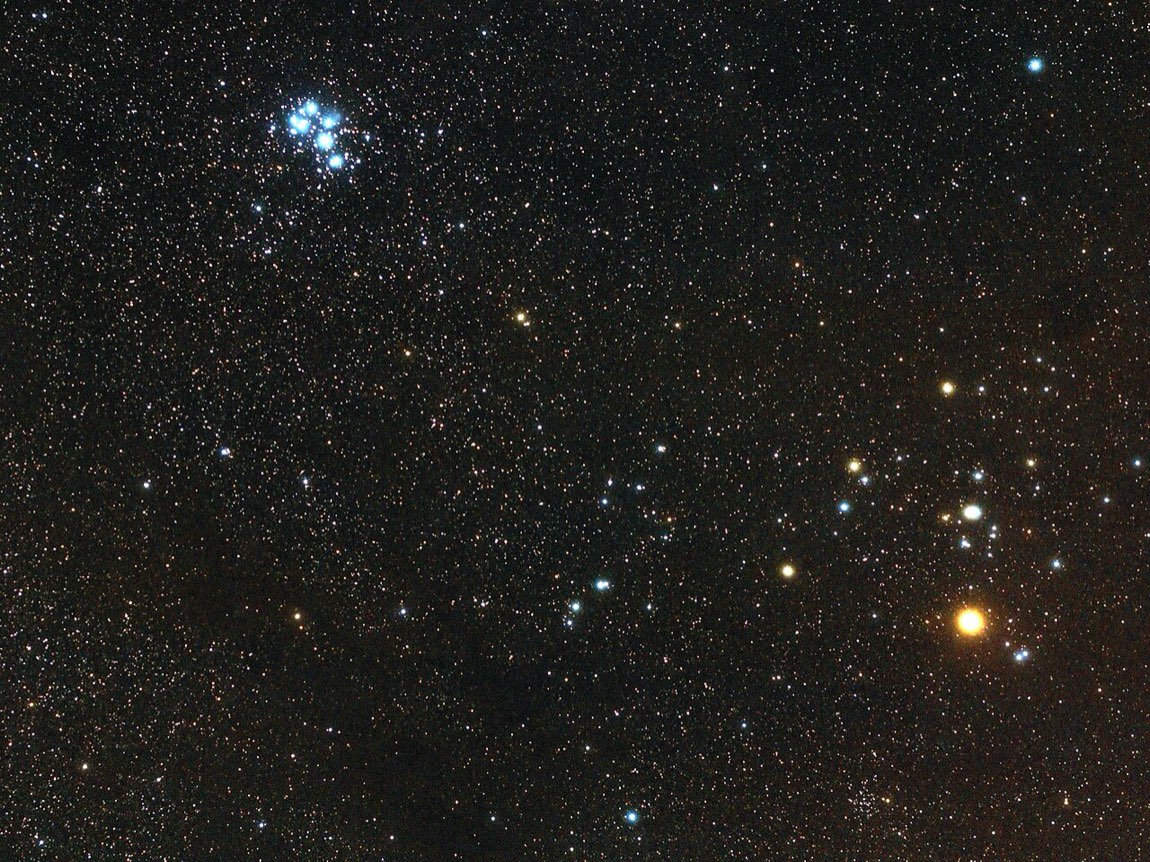
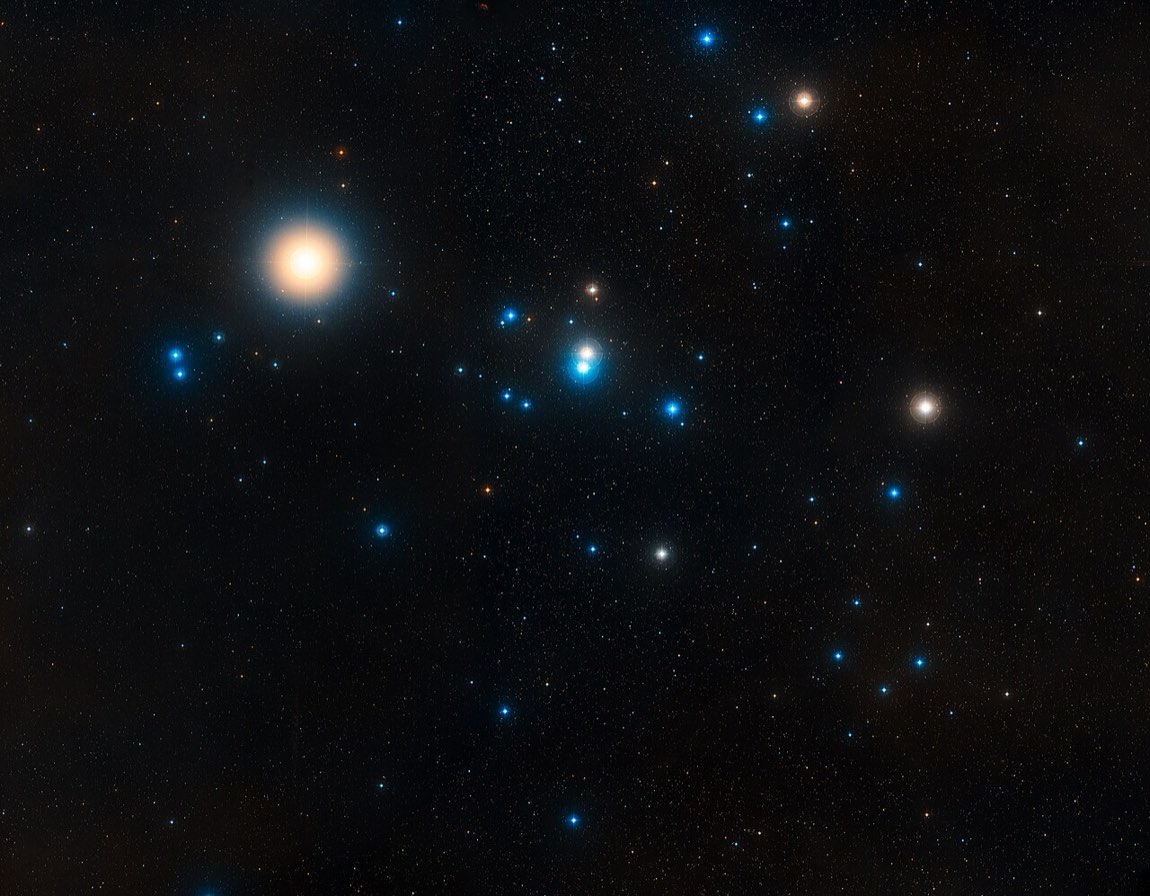
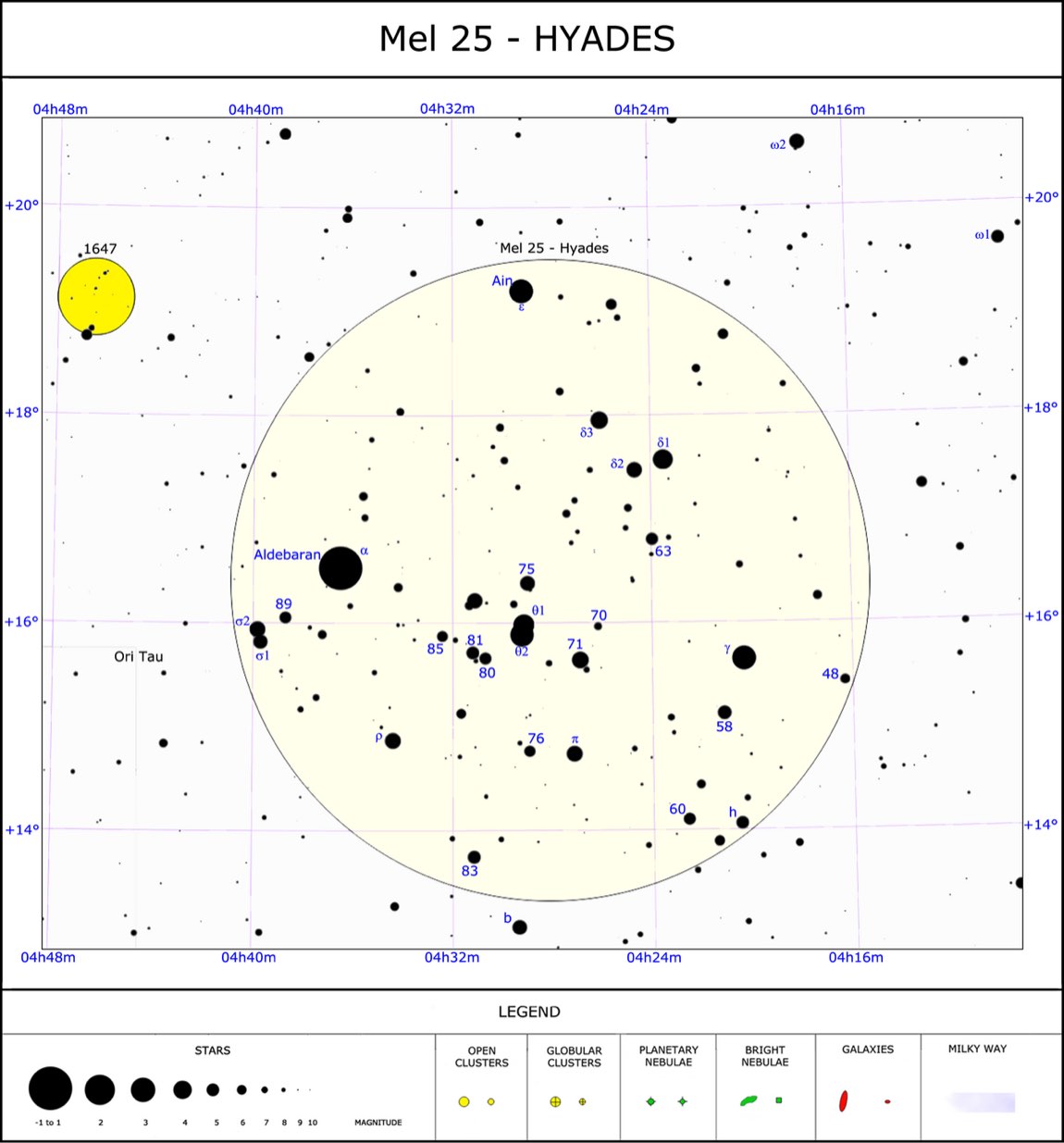
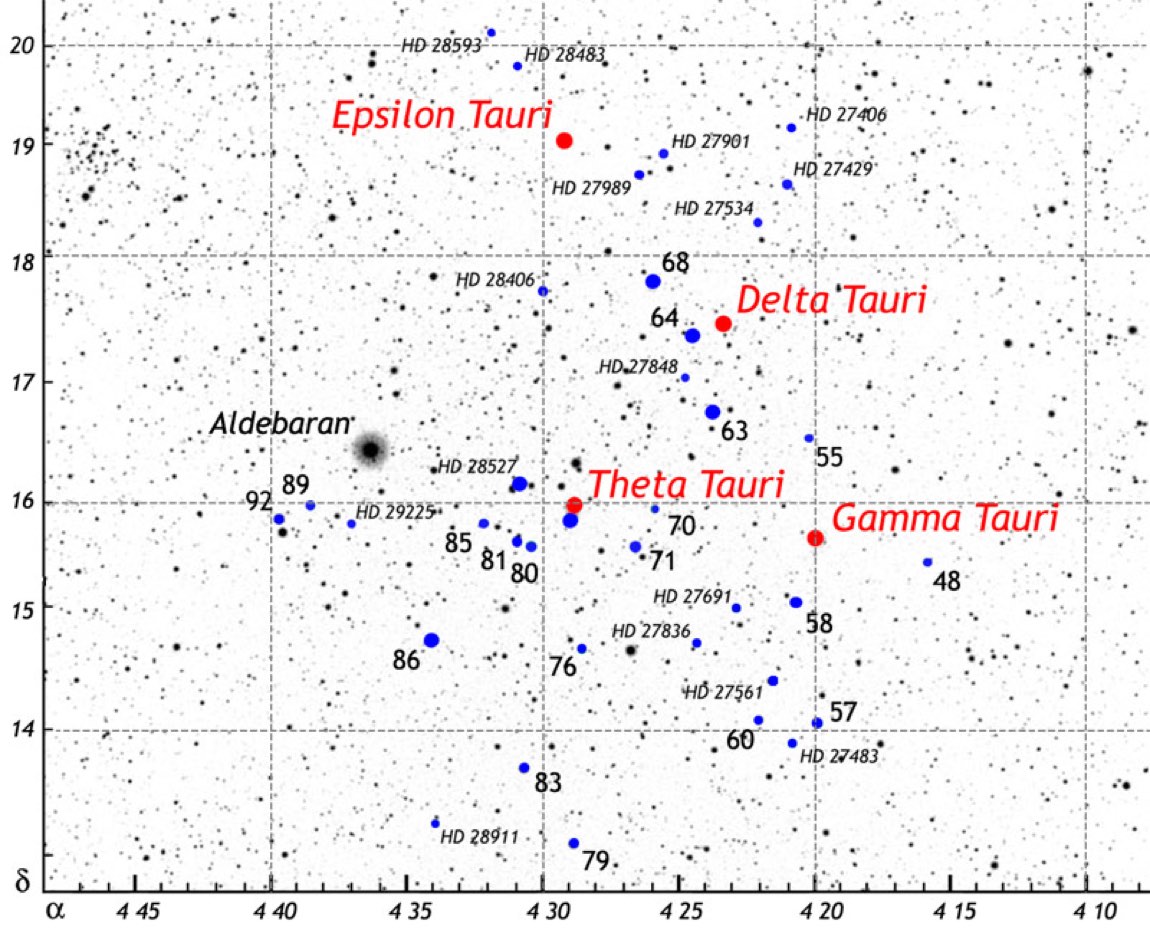
When you look at the Hyades on a clear night, the first thing that strikes you is a bright V-shaped pattern in Taurus. The five giants of the cluster trace one side of that letter, and the blazing orange star Aldebaran appears to anchor the whole figure. Here is the trick: Aldebaran is a complete impostor. It sits only 65 light-years from Earth, less than half the 153-light-year distance to the cluster, and simply happens to fall along the same line of sight. It is a foreground object with no physical connection to the Hyades whatsoever. A second coincidence hides in the same patch of sky: the moving group CWNU 1242 also overlaps the Hyades visually but lies a full 949 light-years away — more than six times farther than the cluster itself. So the charming V in Taurus is actually three completely unrelated stellar populations piled on top of one another from our vantage point, a cosmic illusion that fooled observers for millennia.
02 Why the Hyades Is a Rung on the Cosmic Ladder Deeper
Measuring distances to remote galaxies requires a chain of overlapping techniques, each calibrated against the step below — astronomers call this the cosmic distance ladder. The Hyades occupies a uniquely valuable position near the bottom of that ladder precisely because it is the nearest open cluster, close enough for two independent distance methods to be checked against each other. The first method is trigonometric parallax: as Earth orbits the Sun, nearby stars appear to shift slightly against the background sky, and the size of that shift gives a direct geometric distance. The Hipparcos satellite and the Hubble Space Telescope both performed this measurement with high accuracy. The second method fits cluster members onto a standardized infrared color-magnitude diagram, compares their apparent brightness to their inferred intrinsic luminosity, and derives distance from the difference. Both approaches converge on 153 light-years (47 parsecs). That agreement between a purely geometric method and a photometric one validates the photometric technique, which can then be extended outward to star clusters and galaxies far too distant for parallax to work.
03 A Cluster Born with Siblings: Praesepe and the Stream
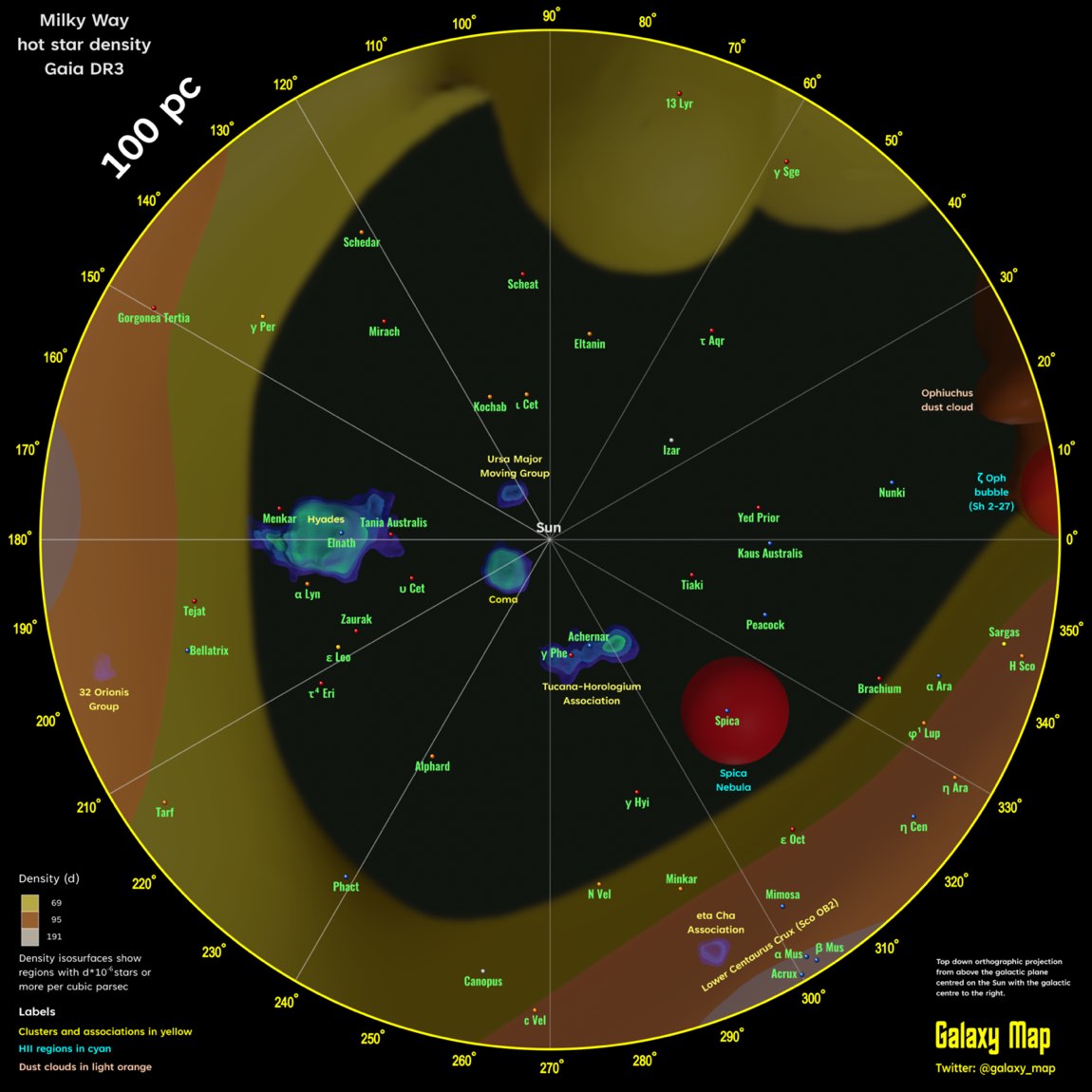
The Hyades did not form alone. Its age, metallicity, and direction of motion through the galaxy match those of Praesepe — the Beehive Cluster, catalogued as M44 — to a remarkable degree, and tracing the two clusters' trajectories backward through time points them to the same birth region of space. They appear to be genuine siblings, hatched from the same giant molecular cloud hundreds of millions of years ago. The Hyades also shares its direction of travel with the much larger Hyades Stream, a scattered river of stars spread across a wide swath of the sky. For a long time astronomers thought most Stream stars were also escapees from the original cluster, but careful chemistry has complicated that story: only about 15% of Stream stars share the same chemical fingerprint as confirmed Hyades members. The other 85% turn out to be unrelated stars whose paths happen to have been bent into a similar direction by gravitational interactions with the massive rotating bar at the Milky Way's center. One compelling refugee candidate is the exoplanet-hosting star Iota Horologii, recently proposed as a star that escaped the primordial Hyades cluster long ago.
04 Metals, Chemistry, and What They Reveal Deeper
Every star carries a chemical signature inherited from the gas cloud it was born in, and that signature changes only slowly over a star's lifetime. The Hyades stars are noticeably richer in elements heavier than hydrogen and helium than the Sun and typical stars in the solar neighborhood, with the cluster's overall metallicity measured at +0.14 on the standard logarithmic scale — meaning the Hyades contain roughly 38% more heavy-element content than the Sun by that measure. This elevated metallicity is one of the key properties that ties the Hyades to Praesepe, which shares the same chemical abundance pattern. It also provides the chemical fingerprinting tool used to decide whether stars in the sprawling Hyades Stream are genuine cluster escapees or merely coincidental travelers. The finding that only about 15% of Stream stars match the Hyades' chemical fingerprint was a significant result, sharply reducing the estimated number of true escapees and shifting the explanation for most of the Stream's coherent motion to galactic-bar dynamics rather than cluster dissolution.
 ⤢
05 How the Cluster Is Slowly Coming Apart
The Hyades is dying, though on a timescale that makes geological epochs look brief. The cluster's tidal radius — the boundary beyond which the Milky Way's gravity overpowers the cluster's own pull — is 33 light-years (10 parsecs). Yet about one-third of confirmed member stars have already been found well outside this boundary, drifting through the extended halo and almost certainly on their way out forever. The process is driven partly by gravitational scattering: when a lightweight star interacts with heavier neighbors, it can be flung outward like a ball from a sling. Once in the halo, stars are further nudged away by tidal forces from the galactic core and by shocks from collisions with drifting hydrogen clouds. Theory suggests that 90% of open clusters dissolve within 1 billion years of formation, and the Hyades, at 625 million years old, is well along that road. Its original mass is estimated to have been between 800 and 1,600 times the mass of the Sun, implying the present cluster is a diminished remnant of something once far grander.
06 Mass Segregation: Why Heavy Stars Cluster in the Core Deeper
Over hundreds of millions of years, gravitational interactions among cluster members act like a slow statistical engine, transferring energy from heavier stars to lighter ones. The heavy stars sink toward the center while lighter ones drift outward — a process called mass segregation. In the Hyades the effect is dramatic: the central two parsecs (6.5 light-years) of the cluster contain only star systems with at least 1 solar mass. The core radius is 2.7 parsecs (8.8 light-years, slightly larger than the distance between the Sun and Sirius), and the half-mass radius — the sphere containing half the cluster's total mass — is 5.7 parsecs (19 light-years). Binary star systems, which are on average more massive than single stars, are also preferentially concentrated in this central region. The fraction of binary systems climbs steeply with stellar mass: 26% among K-type stars but 87% among the more massive A-type stars. Most Hyades binary pairs orbit each other with semimajor axes smaller than 50 astronomical units, keeping them tightly coupled even as the cluster evolves.
07 The Missing M Dwarfs: A Population Mystery Deeper
In the solar neighborhood, red M dwarf stars are overwhelmingly dominant, making up at least 239 of the known stars within 10 parsecs and roughly 76% of all nearby stars. If the Hyades followed the same distribution, it should be swarming with M dwarfs — but it is not. Only about a dozen M dwarfs of spectral types M0 through M2 are confirmed members, a number strikingly small for a cluster of this richness in A, F, and G stars. Astronomers believe that mass segregation and the evaporation process preferentially stripped lower-mass stars from the cluster over its 625-million-year lifetime, sending M dwarfs into the halo and eventually out of the cluster entirely. The situation at the very bottom of the mass range is similarly sparse: studies report roughly 35 L-type and 15 T-type brown dwarfs as members or candidates, while the Gaia DR2 survey identified 23 candidate objects with estimated masses between 60 and 80 Jupiter masses within 30 parsecs of the cluster center. These substellar populations remain poorly understood despite the Hyades' proximity and centuries of observation.
08 Five Giants and the Exoplanet in Their Midst
The five brightest stars in the Hyades have exhausted the hydrogen fuel in their cores and ballooned into giant stars, tracing the fate that awaits the Sun billions of years from now. Four of them — Gamma, Delta 1, Epsilon, and Theta 2 Tauri — combine with the unrelated Aldebaran to form the asterism traditionally called the head of Taurus the Bull, one of the sky's most ancient recognized patterns. The fifth giant, Theta 1 Tauri, is a tight naked-eye companion to the brighter Theta 2 Tauri. These four red clump giants are classified as K0 III but are really retired A-type stars, each weighing in at around 2.5 solar masses. Among them, Epsilon Tauri — also called Ain, meaning the Bull's Eye — earned a historic distinction: its gas-giant exoplanet candidate was the first planet ever discovered in any open cluster. The Hyades as a whole now hosts confirmed planets around five member stars, including a hot Jupiter orbiting HD 285507, a Neptune-sized planet around K2-25, a three-planet system at K2-136, and a mini-Neptune at TOI-4364.
 ⤢
09 White Dwarfs: Ghosts of the Original Cluster Deeper
Eight white dwarfs have been identified within the Hyades cluster core, and they carry important information about the cluster's past. White dwarfs are the dense, cooling embers left behind when stars of roughly 1 to 8 solar masses complete their evolution — they shed their outer layers and collapse to a compact remnant. The Hyades' eight core white dwarfs correspond to the final evolutionary stage of its original population of B-type stars, each of which had a mass of about 3 solar masses. Their current existence tells astronomers that the cluster once contained enough high-mass stars to produce at least that many stellar corpses, consistent with the estimated original cluster mass of 800 to 1,600 solar masses. A 2019 Gaia DR2 study extended the search and identified 17 white dwarfs total out to 30 parsecs from the cluster center, including 9 single stars and 4 binary systems. This population of stellar remnants provides a fossil record of stellar evolution that can be used to test and calibrate theoretical models of how stars age and die.
10 From Hodierna to Gaia: Centuries of Study
Although the Hyades have been part of human sky-lore since prehistoric times — Homer, Hesiod, and Ovid all mention them, and the cluster appears on the shield of Achilles in the Iliad — systematic scientific study began much later. The cluster was probably first formally catalogued by Giovanni Battista Hodierna in 1654. Curiously, Charles Messier omitted it from his famous 1781 catalog of deep-sky objects, so the Hyades has no Messier number, unlike its sibling Praesepe (M44) or the Pleiades (M45). In 1869, R. A. Proctor noticed that many distant stars shared the Hyades' motion, and in 1908 Lewis Boss published nearly 25 years of observations arguing for a co-moving Taurus Stream and produced a chart tracing scattered stars back to a common convergence point. The modern era arrived with the Hipparcos satellite, which measured stellar parallaxes with unprecedented precision and nailed the cluster distance at 153 light-years. Subsequent Gaia data releases — DR1 in 2018, DR2 in 2019, and EDR3 in 2022 — have refined the cluster's space velocity to remarkable precision and swelled the census of candidate members to 1,764 stars and substellar objects out to 30 parsecs.
11 The Cluster's Velocity Through the Galaxy Deeper
Because the Hyades is so close and so well studied, its motion through the Milky Way has been measured with exceptional precision using successive releases of data from the European Space Agency's Gaia spacecraft. The cluster moves through the galaxy with a space velocity expressed in three components: in the 2019 Gaia DR2 analysis these are U = −42.24, V = −19.00, and W = −1.48 kilometers per second, where U, V, and W represent motion toward the galactic center, in the direction of galactic rotation, and perpendicular to the galactic plane respectively. A 2018 Gaia DR1 study based on 138 core stars gave U = −41.92 ± 0.16, V = −19.35 ± 0.13, and W = −1.11 ± 0.11 km/sec, and a 2022 analysis using Gaia EDR3 found U = −42.11 ± 6.50, V = −19.09 ± 4.37, and W = −1.32 ± 0.44 km/sec — all three epochs in close agreement. This consistency across independent analyses demonstrates both the quality of Gaia data and the coherence of the cluster as a physical group. The same velocity measurements, when traced backward through time, help reconstruct the cluster's birth location and its relationship to Praesepe.
12 Old Norse Wolf Jaws and the Myth of Ragnarök
The Hyades have accumulated rich cultural meaning across many civilizations. In Greek myth they were the five daughters of Atlas and half-sisters to the Pleiades; after their brother Hyas died, the grieving sisters were transformed into stars, and their association with weeping gave rise to the connection with rain. In England the cluster was called the April Rainers, linked to April showers and preserved in the folk song "Green Grow the Rushes, O." In Old Norse tradition the Hyades carried the evocative name Úlfs Keptr — the wolf's jaw — an image very different from the Greek one. A 2018 archaeoastronomical paper went further, suggesting that the Hyades may have provided the celestial inspiration for the Norse myth of Ragnarök, the apocalyptic wolf-swallowing-the-sun narrative. The claim attracted scrutiny: astronomer Donald Olson publicly questioned the findings, pointing out minor errors in the paper's astronomical data. The Hyades also appear in modern fiction; in works by Robert W. Chambers and H. P. Lovecraft, the mysterious city of Carcosa is located on a planet within the cluster, lending the star group an aura of cosmic dread in horror literature.
 ⤢
13 What the Future Holds for the Hyades
In a few hundred million years the Hyades will be a shadow of what it is today. Its most massive remaining stars — the red giants and the white giant Theta 2 Tauri — will complete their evolution, with some ending as additional white dwarfs. Meanwhile the ongoing drizzle of lighter stars escaping through the tidal boundary will continue to thin the halo. The cluster's brightest members, those that most define the V shape in Taurus, will be gone. Models suggest the Hyades may eventually be reduced to a remnant of roughly a dozen star systems, most of them binary or multiple, too gravitationally stubborn to evaporate quickly but too sparse and dim to be recognized as a cluster by eye. Even this remnant will remain vulnerable to tidal shocks from the galactic environment. As a point of reference, surveys indicate that 90% of open clusters dissolve within 1 billion years of formation, and the Hyades at 625 million years has used more than half that typical lifespan. Only an extremely small fraction of open clusters survive to the present age of the Solar System, approximately 4.6 billion years, so the Hyades' long-term prospects are bleak by any statistical measure.