 Photograph · NASA, ESA, AURA/Caltech, Palomar Observatory The science team consists of: D. So · Public domain
Star Cluster · Deep guide
The Pleiades (Messier 45)
Also called: M45 · Messier 45 · Seven Sisters · Melotte 22 · Mel 22
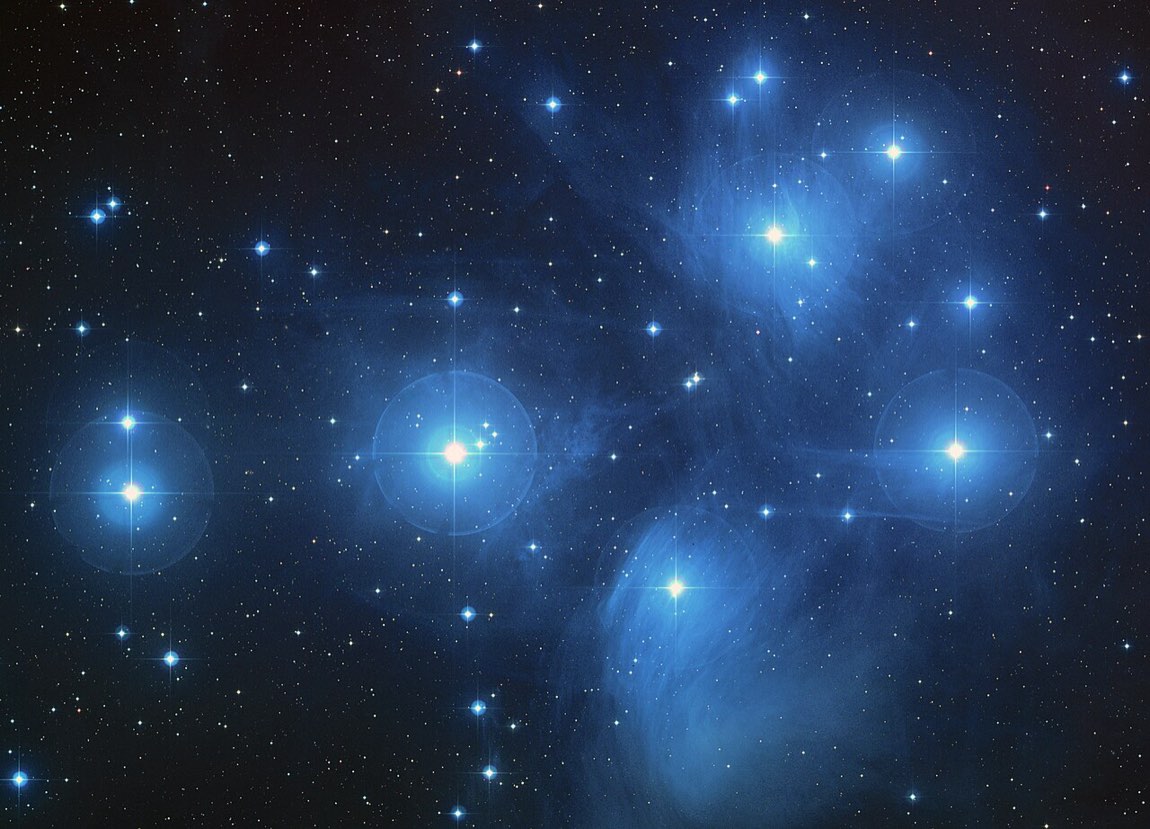
The Seven Sisters: the nearest and most famous star cluster, easy to see even from towns.
What is it?
The Pleiades, or Seven Sisters, is an open cluster in Taurus and the nearest Messier object to Earth, about 444 light-years away. It holds more than 1,000 stars, and six or seven of the brightest are easy to see without optical aid, even under light-polluted skies. Its hot blue stars are young, formed within roughly the last 100 million years. The wispy blue nebulae around them were once thought to be leftover birth material, but are now considered an unrelated dust cloud the cluster is passing through.
The deep dive
Researched for the Atlas from Wikipedia — Pleiades (20,206 characters read) · updated Nov 15, 2026
01 A Cluster Born Like the Orion Nebula
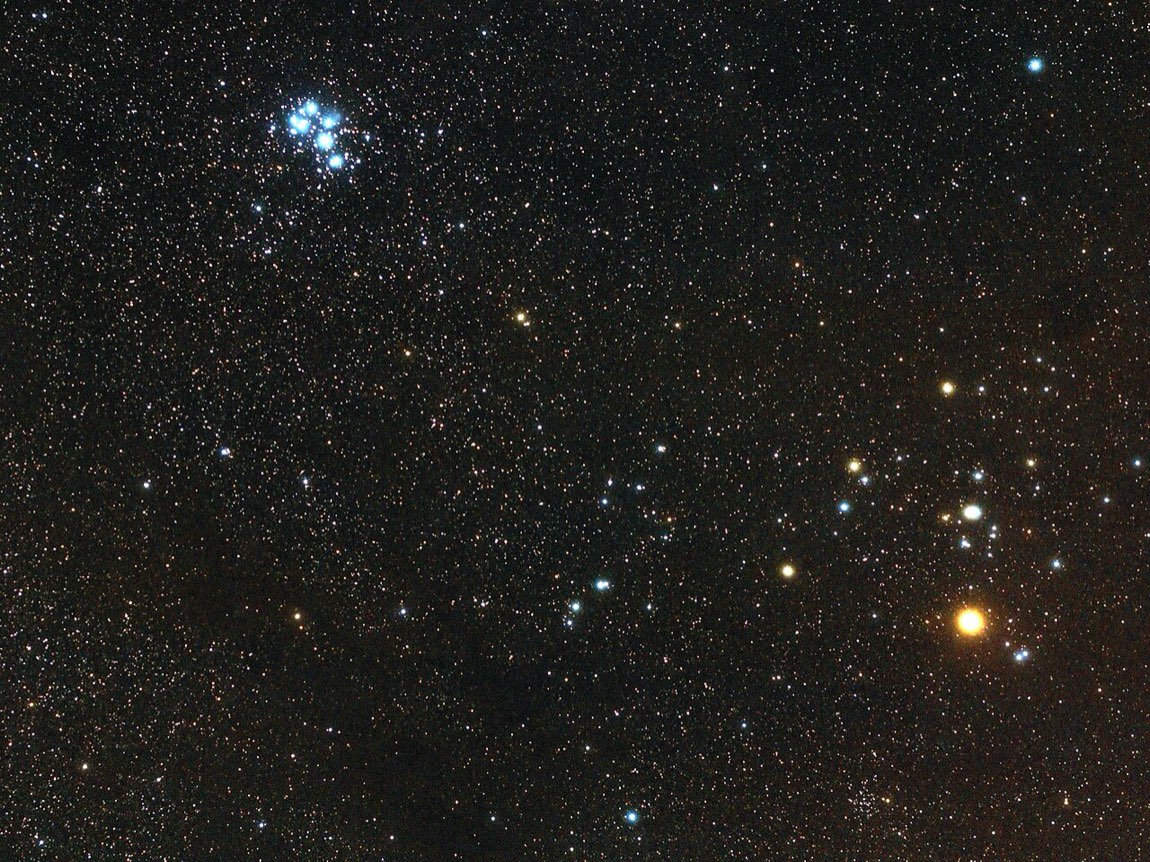
The Pleiades did not always look the way they do today. Computer simulations indicate that the cluster was probably born from a compact, dense configuration of gas and dust that closely resembled the Orion Nebula — one of the most spectacular stellar nurseries visible in the night sky. That origin story gives astronomers a living comparison: by studying the Orion Nebula now, they can glimpse something like the Pleiades in its infancy. All the hot blue stars that dominate the cluster today formed within the last 100 million years, making the Pleiades genuinely young by cosmic standards — roughly one-fiftieth the age of the Sun. Despite that youth, the cluster is already on a slow road to dissolution. Gravitational tugs from giant molecular clouds and the spiral arms of the Milky Way are gradually pulling it apart, and calculations suggest the clustering will be entirely lost in approximately another 250 million years. For now, the cluster is slowly drifting in the direction of the feet of the constellation Orion.
02 The Distance Controversy That Shook Astronomy Deeper
Few measurements in modern astronomy have sparked as much argument as the distance to the Pleiades. Before the Hipparcos satellite flew, most estimates placed the cluster at approximately 135 parsecs from Earth. When Hipparcos measured stellar parallaxes directly — in principle the most reliable geometric technique available — it returned a surprisingly small value of only 118 parsecs. The discrepancy of roughly 17 parsecs may sound modest, but it had cascading consequences because the Pleiades serves as a critical first rung of the cosmic distance ladder. Independent lines of evidence pushed back hard: observations with the Hubble Space Telescope, infrared color–magnitude diagram fitting, and interferometric measurements of the inner pair of stars within Atlas all favored distances between 133 and 140 parsecs. The revised Hipparcos catalog of 2007–2009 reasserted a value near 120 parsecs. Resolution finally came from very-long-baseline interferometry in 2014, which gave 136.2 ± 1.2 parsecs, and from Gaia satellite data releases in 2016 and 2018, which gave 134 ± 6 pc and 136.2 ± 5.0 pc respectively. The most precise figure to date, from Gaia Data Release 3, is 135.74 ± 0.10 parsecs — firmly supporting the pre-Hipparcos consensus and confirming that Hipparcos made a systematic error for this cluster.
03 The Nebula That Isn't a Birth Cloud
Long-exposure photographs of the Pleiades reveal soft, wispy reflection nebulae wrapped around the brightest stars. The cluster contains two catalogued nebulae: NGC 1432, an HII region, and NGC 1435, known as the Merope Nebula. For a long time astronomers assumed this glowing dust was simply leftover material from star formation — the cosmic equivalent of sawdust still lying on a carpenter's floor. The idea seemed intuitive but turned out to be wrong. By the time a cluster reaches roughly 100 million years of age, radiation pressure from its hot stars would have dispersed almost all the original dust. Instead, the Pleiades appear to be passing through an entirely unrelated dusty region of the interstellar medium. Studies show the dust is not evenly spread but concentrated mainly in two distinct layers along our line of sight to the cluster. Those layers may have been shaped by deceleration as radiation pressure slowed incoming dust particles near the stars. The dust cloud itself is estimated to be moving at approximately 18 km/s relative to the cluster stars — a brisk pace compared with typical interstellar drift.
04 Brown Dwarfs: Failed Stars in Abundance Deeper
Hidden among the Pleiades' thousand-plus confirmed members is an unexpectedly large population of brown dwarfs — objects with less than approximately 8 percent of the Sun's mass, too lightweight to ignite sustained hydrogen fusion in their cores. One of the first confirmed Pleiades brown dwarfs is Teide 1, which became a landmark discovery in the study of substellar objects. Brown dwarfs may account for up to 25 percent of the total population of the cluster, though because of their low mass they contribute less than 2 percent of the cluster's total mass. The cluster's total mass is estimated at approximately 800 solar masses, dominated by faint, red, low-mass stars rather than the brilliant blue giants that catch the eye. The Pleiades is especially valuable for brown dwarf research because, at roughly 100 million years old, these objects are still relatively luminous and detectable. In older clusters they have faded to near invisibility. Astronomers use a clever tool called the lithium test to help date the cluster: brown dwarfs retain lithium (which ordinary stars rapidly destroy in nuclear reactions), and because lithium has an ignition temperature of about 2.5 million K, the most massive brown dwarfs will eventually burn it off. Measuring which brown dwarfs in the Pleiades still hold their lithium yields an estimated cluster age of about 115 million years.
 ⤢
05 How Old Is the Cluster, Really? Deeper
Pinning down the age of the Pleiades is trickier than it sounds. The standard method is to plot the cluster's stars on a Hertzsprung–Russell diagram — a graph of luminosity against temperature — and compare the pattern against theoretical models of stellar evolution. Stars of different masses evolve off the main sequence at different rates, so the point where stars begin to leave tells astronomers roughly how long the cluster has been shining. Applying this technique to the Pleiades gives ages ranging from 75 to 150 million years, a spread that reflects genuine uncertainties in the models rather than sloppy observation. One significant source of uncertainty is convective overshoot, a process where a convective zone inside a star penetrates into a region that would otherwise remain still, mixing material that the simpler models assume stays put. This mixing makes stars appear older than they are in the simplest models. The lithium-depletion boundary method, described by the brown dwarf population, provides a partially independent check and settles on approximately 115 million years. No single technique gives a definitive number, but the range of roughly 75 to 150 million years is broadly consistent across methods, all confirming the Pleiades as a genuinely young cluster.
06 Galileo's Sketch and Messier's Catalogue
Galileo Galilei was the first person to point a telescope at the Pleiades, and what he saw immediately overturned an ancient assumption. Where the naked eye perceived only six or seven stars, his instrument revealed dozens more lurking in the dark between them. He published his observations — including a careful sketch showing 36 stars — in his treatise Sidereus Nuncius in March 1610, one of the most famous scientific publications in history. More than 150 years later, Charles Messier measured the cluster's position and catalogued it as M45 in his 1771 list of comet-like objects. Messier's inclusion of the Pleiades has puzzled historians, since his catalogue was intended to prevent confusion between faint fuzzy comets and fuzzy permanent objects. The brilliant Pleiades could hardly be mistaken for a comet. One popular theory is that Messier was competing with his rival Lacaille, whose 1755 catalogue contained 42 objects, and simply padded his own list with bright, well-known objects to surpass that number. In 1782, astronomer Edme-Sébastien Jeaurat produced a detailed map of 64 Pleiades stars from observations he had made in 1779, publishing it in 1786.
07 Naming the Stars: Riccioli's Gift to the Sky
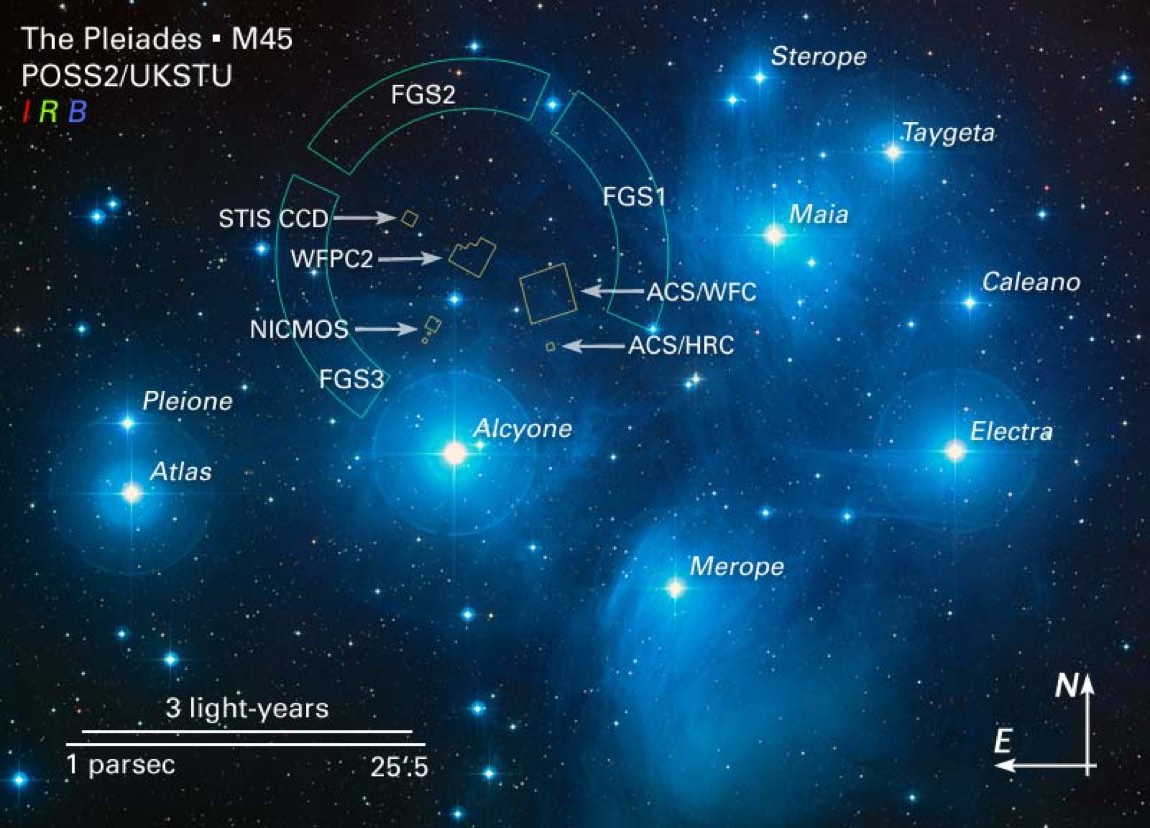
The nine brightest stars of the Pleiades carry the mythological names familiar today — Alcyone, Maia, Electra, Taygeta, Celaeno, Asterope, and Merope for the seven sisters, plus Atlas and Pleione for their parents. Despite the great antiquity of the cluster's fame, these individual names are surprisingly modern. The ancient Greeks did not assign personal names to the individual stars; they simply called the whole group the Pleiades. The first recorded use of the current names appeared in Giovanni Battista Riccioli's 1665 book Astronomia Reformata, which credited Vicente Mut Armengol with naming the seven sisters and Michael van Langren with naming Atlas and Pleione. Even after publication, the names remained obscure for nearly two more centuries, only coming into widespread use during the nineteenth century. They are now officially recognized by the International Astronomical Union. As daughters of Atlas in Greek mythology, the Hyades — another nearby open cluster — were considered sisters of the Pleiades, a family connection that gave rise to the poetic name the Golden Gate of the Ecliptic for the region of sky the two clusters share.
08 The Pleiades Across Human Civilizations
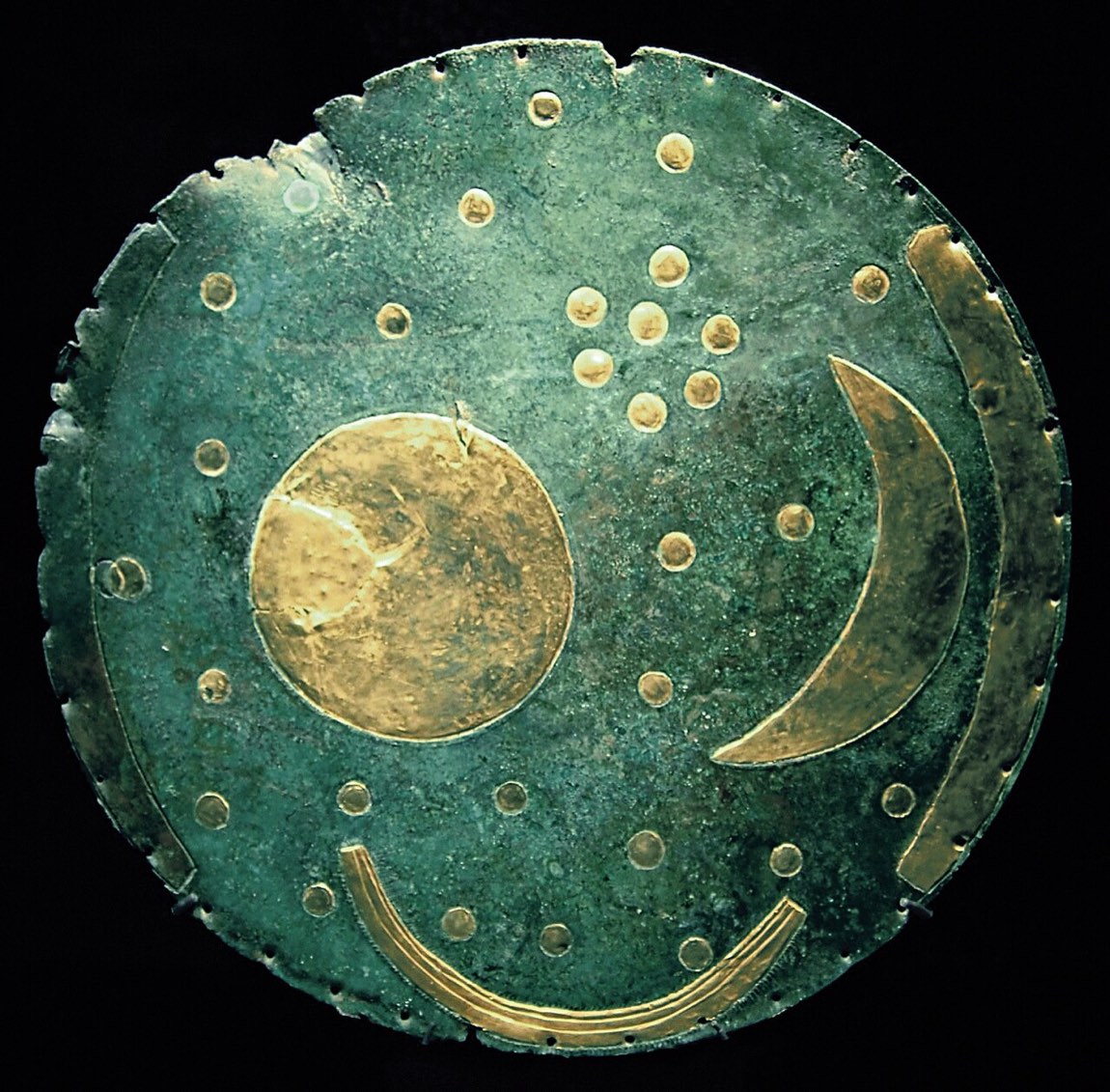
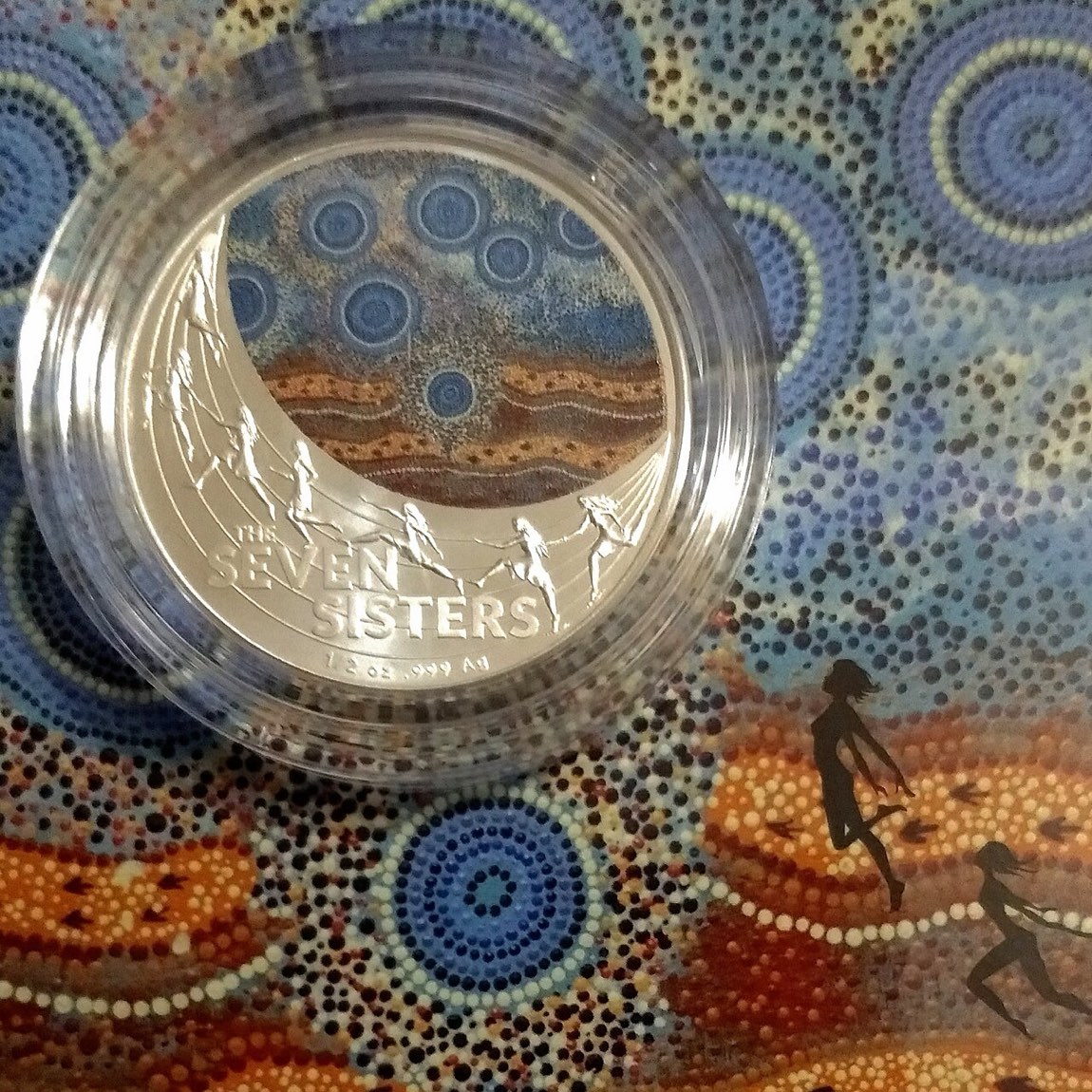
Few objects in the sky have been watched, named, and celebrated by as many independent cultures as the Pleiades. Around 2330 BC, the cluster marked the vernal point — the position of the Sun at the spring equinox — giving it unique calendrical power. The Nebra sky disc, a Bronze Age artifact found in Germany and dated to around 1600 BC, displays the cluster prominently between the Sun and Moon, making it one of the earliest known astronomical depictions. In ancient India the cluster was the first nakṣatra (lunar station) in the Atharvaveda, compiled roughly 1200–1000 BC, under the name Kṛttikā, meaning "the Cuttings" — those that mark the break of the year. Babylonian star catalogues called it MULMUL, literally "star star," and placed it at the head of their list of ecliptic stars. Pre-Islamic Arabs considered it the most famous star in the sky, often referring to it simply as "the Star." The Māori know the cluster as Matariki; Hawaiians as Makaliʻi; the Quechua as Qullqa, meaning storehouse; and the Japanese as Subaru. The cluster is also mentioned three times in the Bible using the Hebrew name Kimah. This remarkable breadth of independent recognition reflects the cluster's genuine visual prominence across the whole inhabited Earth.
 ⤢
09 Subaru: From Star Cluster to Brand Name
The Japanese word for the Pleiades is Subaru, derived from an intransitive verb meaning "to cluster together." The cluster was already mentioned under the name Mutsuraboshi — "six stars" — in the eighth-century Japanese chronicle Kojiki, one of the oldest surviving Japanese texts. That ancient star group lent its name to Subaru automobiles, chosen to reflect the firm's origins as the merger of five companies; the company's logo depicts six stars in a direct reference to the cluster. The same name graces one of the world's most important telescopes: the Subaru Telescope, an 8.2-meter instrument operated by the National Astronomical Observatory of Japan at Mauna Kea Observatory on the island of Hawaii. When it was commissioned in 1998, it held the record for the largest monolithic primary mirror in the world, a distinction it kept until 2005. The cultural reach of the Pleiades even extends to contemporary fiction: Natsuki Subaru, the protagonist of the light novel series Re:Zero, was named after the cluster, and the story includes a location called the Pleiades Watchtower as an explicit homage.
10 Possible Planet Formation Around HD 23514 Deeper
The Pleiades may be home to more than just stars and brown dwarfs. Astronomers analyzing deep-infrared images captured by the Spitzer Space Telescope and the Gemini North telescope found that one cluster member, the star HD 23514, is surrounded by an extraordinary number of hot dust particles. HD 23514 has a mass and luminosity slightly greater than those of the Sun, putting it in a class of stars where planet formation is considered plausible. The dense warm dust detected around it is interpreted as a possible signature of active planet formation — the kind of collisional grinding between rocky bodies that planetary scientists believe occurred in our own solar system during its early history. The finding adds the Pleiades to the list of stellar environments where the raw ingredients and apparent processes of planet-building have been identified, though the evidence is indirect and further observations would be needed to confirm what stage of planet formation, if any, is actually underway around HD 23514.
11 How to Find and Observe the Pleiades
The Pleiades sit in the northwest of the constellation Taurus and are a prominent feature of winter skies in the Northern Hemisphere, though they are also easily visible from mid-southern latitudes. Because the cluster's stars are so bright, they are viewable from most places on Earth, even under significant light pollution. Naked-eye observers typically see six or seven stars clearly, though up to 14 may be detected under ideal dark skies by observers with keen vision. The cluster has been compared to a tiny dipper, though it should not be confused with the Little Dipper, the common name for Ursa Minor. Through binoculars or a small telescope, the number of visible stars rises dramatically, echoing Galileo's first telescopic surprise in 1610. With larger amateur instruments under dark skies, the reflection nebulosity around the brightest stars — especially around Merope — becomes detectable, and long-exposure photographs reveal the full extent of the glowing dust cloud. The core of the cluster spans roughly 8 light-years, while its tidal radius reaches approximately 43 light-years, so the cluster subtends a region of sky several times larger than the Moon.
12 John Michell and the Proof of Clustering Deeper
Long before proper motions or parallax measurements could confirm that the Pleiades stars are physically associated, an English geologist and natural philosopher named John Michell made a compelling statistical argument. In 1767 he calculated that the probability of so many bright stars appearing this close together by pure chance was only 1 in 500,000. That vanishingly small probability led him to conclude that the Pleiades, and many other apparent clusters, must consist of genuinely related stars rather than accidental alignments along the line of sight. This was a remarkable leap of probabilistic reasoning at a time when the tools of observational astronomy were still rudimentary. Later measurements of proper motion — the slow drift of stars across the sky over years and decades — confirmed Michell's intuition directly: all the Pleiades stars move together across the sky at the same rate and in the same direction, a physical signature of a true family of stars. The binary star fraction within the cluster is estimated at approximately 57 percent, further evidence of the complex gravitational relationships within what began as a single compact stellar nursery.
 ⤢