Sagittarius ☉ Zodiac
“The Archer” · Southern · best around August evenings
Real star positions and magnitudes (HYG database via D3-Celestial, BSD-3). Lines are the conventional stick figure; north is up.
The story
An archer-centaur aiming at the Scorpion's heart — though modern eyes see the Teapot, complete with Milky Way 'steam' rising from its spout. That steam marks the center of our galaxy: Sagittarius A*, the Milky Way's supermassive black hole, hides behind those star clouds. No region of sky is richer in clusters and nebulae.
How to find it
August evenings, low in the south (northern hemisphere) or high overhead (southern). Find the Teapot; the galactic center sits just off its spout.
✦ What lives inside it
- The galactic center & Sagittarius A*
- Omega Nebula (M17)
The deep dive
Researched for the Atlas from Wikipedia — Sagittarius (constellation) (14,301 characters read) · updated Sep 20, 2026
01 The Teapot hiding in the Archer's bow
Long before the word asterism entered the vocabulary of casual stargazers, observers in the northern hemisphere quietly noticed that eight of Sagittarius's brighter stars trace a remarkably convincing kitchen teapot. The stars delta, epsilon, zeta, and phi Sagittarii form the pot's body, lambda Sagittarii marks the pointed lid, gamma2 Sagittarii sits at the tip of the spout, and sigma plus tau Sagittarii curve into a handle. What makes the pattern especially satisfying on a clear, moonless summer night is that the Milky Way itself — specifically the Large Sagittarius Star Cloud — billows up from behind the spout in a north-westerly arc, looking uncannily like a plume of steam escaping a boiling kettle. These same stars were always there in the original figure too: they trace the archer's bow and the arrow nocked in it, waiting to fly. The teapot and the archer coexist in the same pattern, a double vision that rewards anyone who takes the time to look twice.
02 Why alpha is not the brightest star here
Bayer's Greek-letter naming system was meant to rank stars by brightness within a constellation, but Sagittarius is a famous exception. Alpha Sagittarii, called Rukbat — Arabic for "the archer's knee" — has a magnitude of only 3.96, nowhere near the top of the class. The true brightest star is Epsilon Sagittarii, Kaus Australis, the "southern part of the bow," which shines at magnitude 1.85. That makes Kaus Australis approximately seven times as bright as the star that carries the constellation's alpha designation. Second place belongs to Sigma Sagittarii, Nunki, at magnitude 2.08. Nunki is a hot B2V star sitting about 260 light-years away and may carry the oldest star name still in active use: it derives from the Babylonian name for the sacred city of Eridu on the Euphrates. Third in line is Zeta Sagittarii, Ascella, magnitude 2.61 — itself a double star whose two components shine at magnitudes 3.3 and 3.5, meaning what looks like a single point of light is actually a stellar pair.
03 Baade's Window: a gap in the dust Deeper
The inner regions of the Milky Way are normally buried behind such thick clouds of interstellar dust that visible light cannot penetrate them. Baade's Window is a rare exception — a region of unusually low dust obscuration that opens a sight line much closer to the galactic center than would otherwise be possible. Through this natural peephole, two globular clusters, NGC 6522 and NGC 6528, become accessible. NGC 6522 has a magnitude of 8.6 and lies about 20,000 light-years from Earth; NGC 6528 is slightly fainter at magnitude 9.5 and about 24,000 light-years away. Both are moderately concentrated at their cores, rated Shapley classes VI and V respectively. Particularly striking is NGC 6528's proximity to the galactic core itself — it sits only approximately 2,000 light-years from it, making it one of the innermost globular clusters observable in visible wavelengths. For an observer with a modest telescope, pointing into Baade's Window is as close as visible-light astronomy gets to peering into the heart of the galaxy.
04 The Lagoon Nebula and the birth of a concept Deeper
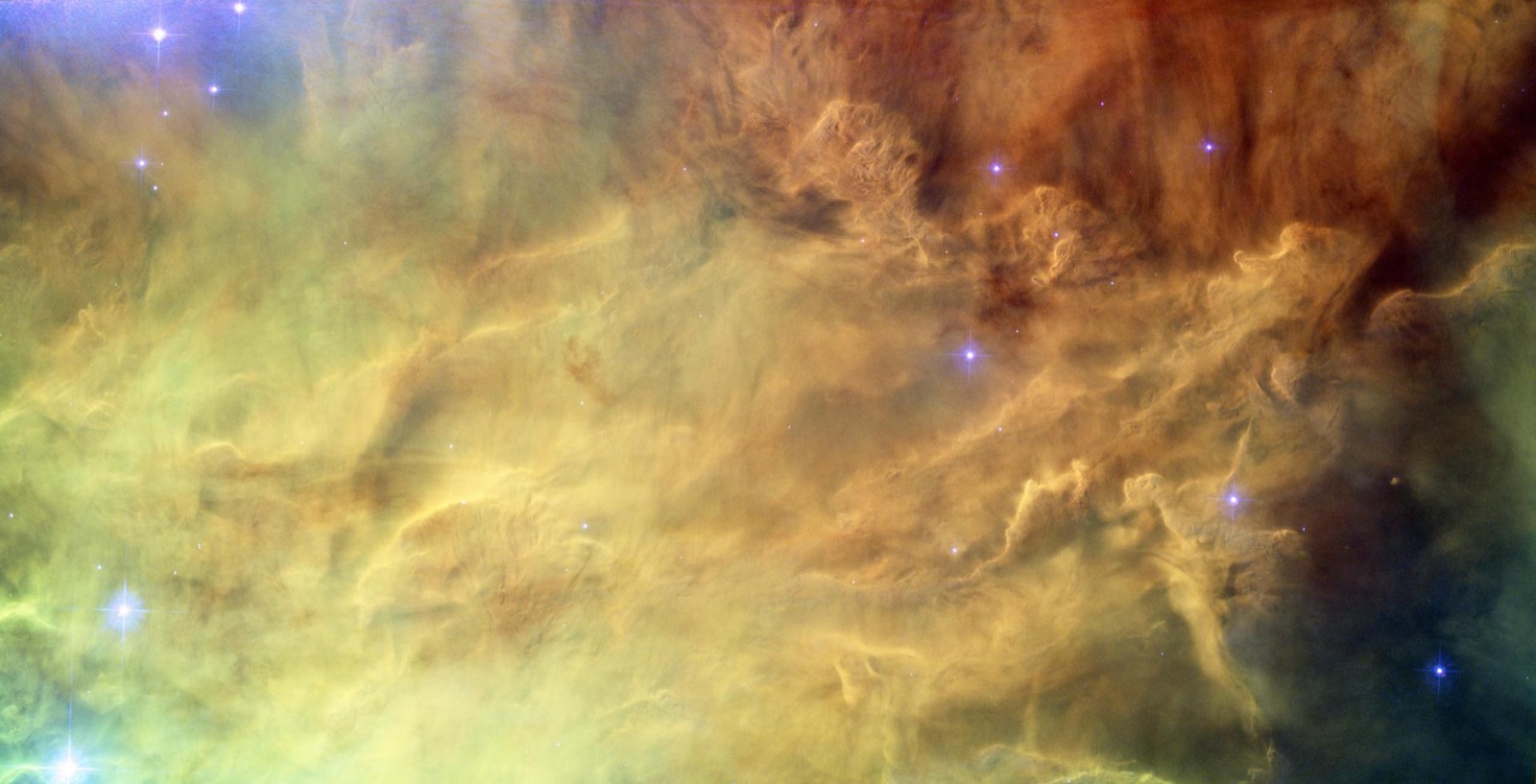
The Lagoon Nebula, Messier 8, was discovered independently three times — by John Flamsteed in 1680, Guillaume Le Gentil in 1747, and Charles Messier in 1764 — which speaks to how naturally it draws the eye. It sits 5,000 light-years away and spans 140 by 60 light-years, covering 1.5 degrees of sky, and its integrated magnitude of 3.0 makes it one of the brighter nebulae in the night sky. To the eye at the eyepiece it appears grey, but long-exposure photographs reveal the pink glow typical of emission nebulae. Its central region is called the Hourglass Nebula, a shape sculpted by matter propelled outward from the star Herschel 36. The nebula's scientific legacy extends beyond its beauty: in 1947, Bart Bok studied photographic prints of the Lagoon intensively and developed his hypothesis that small dark condensations — later named Bok globules — were sites of protostellar formation. Nine years later, roughly 17,000 such globules were found in the nebula during the Palomar Sky Survey, and subsequent studies confirmed Bok's idea that they harbor protostars.
05 The Omega Nebula and its many names
The Omega Nebula, Messier 17, is a case study in how much an observer's imagination shapes what they see. Philippe Loys de Chésaux discovered it in 1746, and in the centuries since, no two prominent astronomers could quite agree on what shape it resembled. It has been called the Horseshoe Nebula, the Swan Nebula, the Checkmark Nebula, described as a loon by Roy Bishop, and likened to a curl of smoke by Camille Flammarion. George F. Chambers saw a swan in 1889. The nebula sits 4,890 light-years from Earth and has an integrated magnitude of 6.0, placing it just at the edge of naked-eye visibility under ideal conditions, and comfortably within the reach of binoculars. It lies near the border between Sagittarius and Scutum. That a single object has accumulated so many names across different eras is a reminder that astronomy has always been entangled with human perception and metaphor, even when the subject is a glowing cloud of ionized gas tens of light-years across.
06 Sagittarius A* and the supermassive center Deeper
Just beyond the western boundary of Sagittarius, near its border with Ophiuchus, lies the complex radio source known as Sagittarius A. One of its components, Sagittarius A*, is identified by astronomers as a supermassive black hole at the very center of the Milky Way, estimated to carry a mass of 2.6 million solar masses — that is roughly 2.6 million times the mass of our Sun compressed into a single gravitational object. It is not visible to the naked eye, but its location in the sky corresponds to a point just off the top of the Teapot asterism's spout. The region also produced one notable false alarm: in 1999, a violent outburst at the object V4641 Sgr was initially interpreted as evidence of the closest known black hole to Earth, but later investigation pushed its estimated distance outward by a factor of 15. Also notable in the region is the Sagittarius Dwarf Elliptical Galaxy, a small satellite galaxy located just outside the Milky Way itself, and the globular cluster 2MASS-GC02, discovered in 2000 by Joselino Vasquez and confirmed by a team led by R. J. Hurt.
07 Babylonian Sagittarius: wings, two heads, a stinger
The Greek centaur with a bow is the image most people carry for Sagittarius, but the figure is far older and considerably stranger. The Babylonians identified this region of the sky with Nergal, a centaur-like deity who was depicted with wings, two heads — one human and one panther — and a scorpion's stinger raised above a conventional horse's tail. The Sumerian name for the figure was Pabilsag, a compound of Pabil, meaning "elder paternal kinsman," and Sag, meaning "chief" or "head," giving the overall sense of "Forefather" or "Chief Ancestor." This is not a minor folkloric variant; the Babylonian astronomical tradition is significantly older than the Greek one, and the physical form of Pabilsag — armed, composite, powerful — clearly informed what the Greeks inherited. Even Nunki, the name of the constellation's second-brightest star, is a Babylonian survivor: thought to represent the sacred city of Eridu on the Euphrates, it may be the oldest star name still in use anywhere in the world.
08 Two myths, one archer: Chiron or Crotus?
Greek mythology never fully settled on who the Archer actually was, and the debate was alive in antiquity itself. One tradition identified Sagittarius as Chiron, the learned centaur son of Philyra and Cronus, tutor to Jason and many other heroes. According to one version, Cronus transformed himself into a horse to escape the jealousy of his wife Rhea, and Chiron was the result. But because the sky also contains the constellation Centaurus, some ancient sources reassigned Chiron there and proposed instead that Chiron himself devised both constellations — Sagittarius and Centaurus — to help the Argonauts navigate on their quest for the Golden Fleece. A competing tradition, championed by Eratosthenes, identified the Archer as Crotus, a satyr who was the son of Pan. Crotus was credited by the Greeks with inventing archery, regularly hunted on horseback, and lived among the Muses on Mount Helicon. The Muses, so the story goes, petitioned Zeus to place him in the sky, where he can be seen forever demonstrating the skill he invented.
09 The precessing solstice and a shifting Sun Deeper
Sagittarius occupies a particularly significant position in the zodiac because the December solstice — the moment when the Sun reaches its southernmost point — currently falls within its boundaries. This has not always been the case. In classical antiquity, the December solstice Sun stood in Capricornus, the neighboring constellation to the east. The slow wobble of Earth's rotational axis, known as the precession of the equinoxes, gradually shifted that point westward into Sagittarius by the time of the Roman Empire. The same precession continues today, and by approximately 2700 AD the December solstice Sun will have moved further west into Scorpius. Because of this, the Sun appears in Sagittarius from 18 December to 18 January as of 2002, and the June full moon — sitting opposite the Sun in the sky — appears in Sagittarius. Tropical astrology, which fixes signs to the seasons rather than the stars, still places the Sun in the sign of Sagittarius from 22 November to 21 December, creating a growing gap between the astrological sign and the actual constellation.
10 The Trifid: pink interior, blue exterior, dark lanes
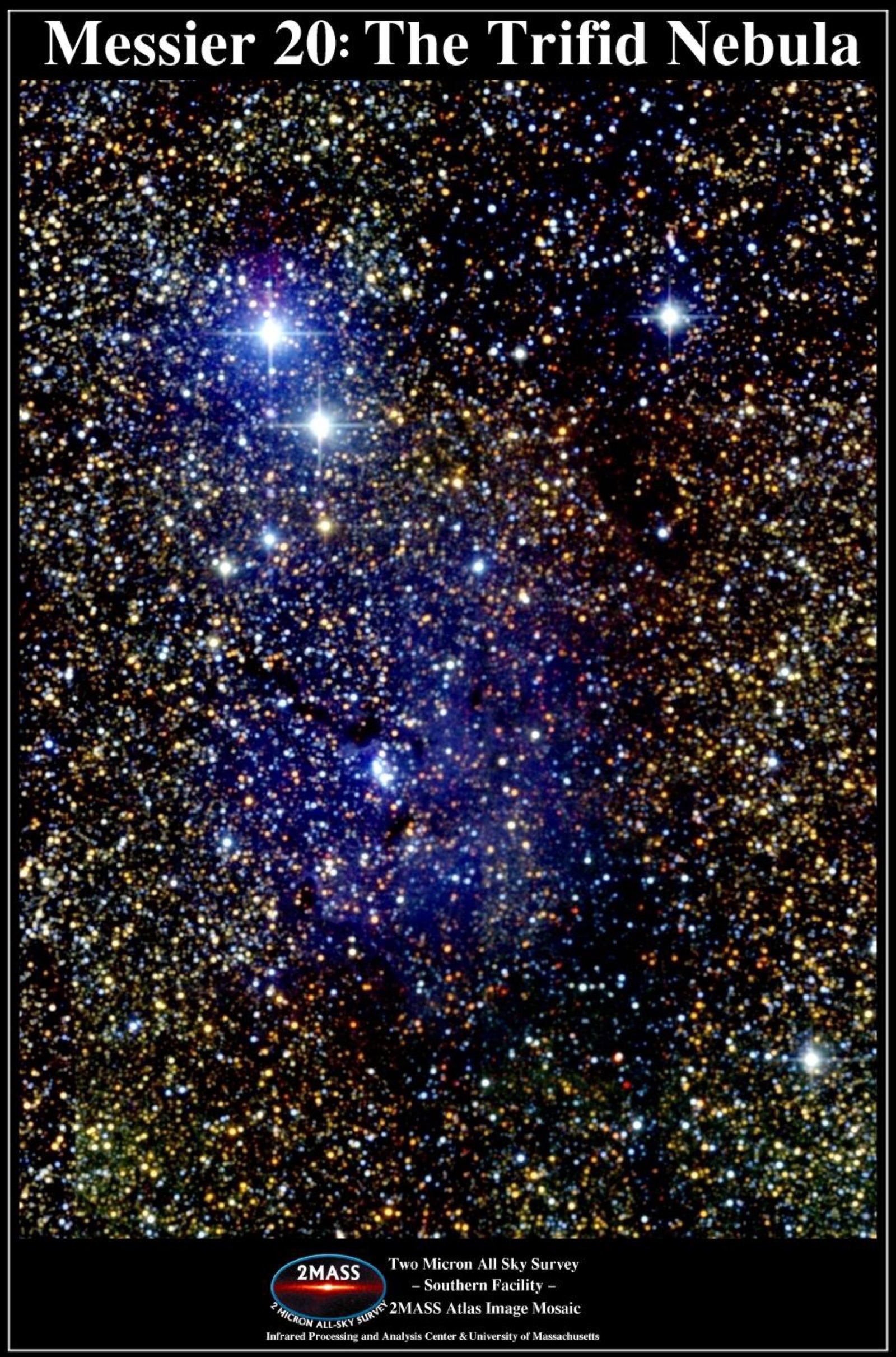
The Trifid Nebula, Messier 20 or NGC 6514, packs several different types of nebula into a single object less than two degrees from the Lagoon Nebula. Its outer shell is a bluish reflection nebula, shining because dust scatters starlight in the same way Earth's atmosphere scatters sunlight to produce a blue sky. Its interior glows pink — the emission color produced when hydrogen gas is ionized by radiation from hot young stars, in this case a central triple star system that formed at the intersection of two dark dust lanes. Those lanes are what give the nebula its name: they divide the glowing interior into three regions, sometimes called lobes. The Trifid was discovered by French comet-hunter Charles Messier, and its distance remains uncertain — estimates range from 2,000 to 9,000 light-years. Its diameter is approximately 50 light-years. An associated star cluster carries a magnitude of 6.3. The coexistence of reflection, emission, and dark nebula components in one object makes the Trifid an unusually instructive target for understanding how different physical processes can operate side by side in the same cloud of interstellar material.
11 The Wow! signal and a probe pointing at the Archer
Sagittarius has attracted attention beyond conventional astronomy. The Wow! signal — a strong, narrowband radio signal detected only once and never repeated or explained — appeared to originate from the direction of Sagittarius, making the constellation a landmark in the history of the search for extraterrestrial intelligence. The signal remains unexplained. Meanwhile, the space probe New Horizons, which completed its flyby of Pluto before heading into the outer solar system, was moving on a trajectory that as of 2016 placed it in front of Sagittarius as seen from Earth — meaning the constellation provides the backdrop against which humanity's most distant active spacecraft was receding. New Horizons will exhaust its radioisotope thermoelectric generator long before it comes anywhere near another star system, so the Archer's stars it appears to approach are purely a line-of-sight coincidence, separated by incomprehensible distances from the probe itself.
12 The Terebellum and a medieval asterism Deeper
On the western side of Sagittarius, Ptolemy noted a small quadrilateral of four roughly fourth-magnitude stars and called it τετράπλευρον, meaning "quadrilateral." The name was Latinized to Terebellum by Johann Bayer in his 1603 star atlas Uranometria. The group consists of Omega Sagittarii — now individually named Terebellum by the International Astronomical Union — along with 59, 60, and 62 Sagittarii. The same four stars were recognized independently in Chinese astronomy under the name Gouguo, meaning "land of dogs" or "dog kingdom," illustrating how different cultures identified the same stellar groupings while attaching entirely different meanings to them. The medieval author Michael Scot described a separate constellation also called Terebellum, this time meaning "the Drill," suggesting the name traveled and mutated through scholarly tradition. The survival of Ptolemy's informal label into modern IAU nomenclature — applied to a single star rather than the whole group — is a small example of how ancient observational habits leave fingerprints on contemporary star catalogs.