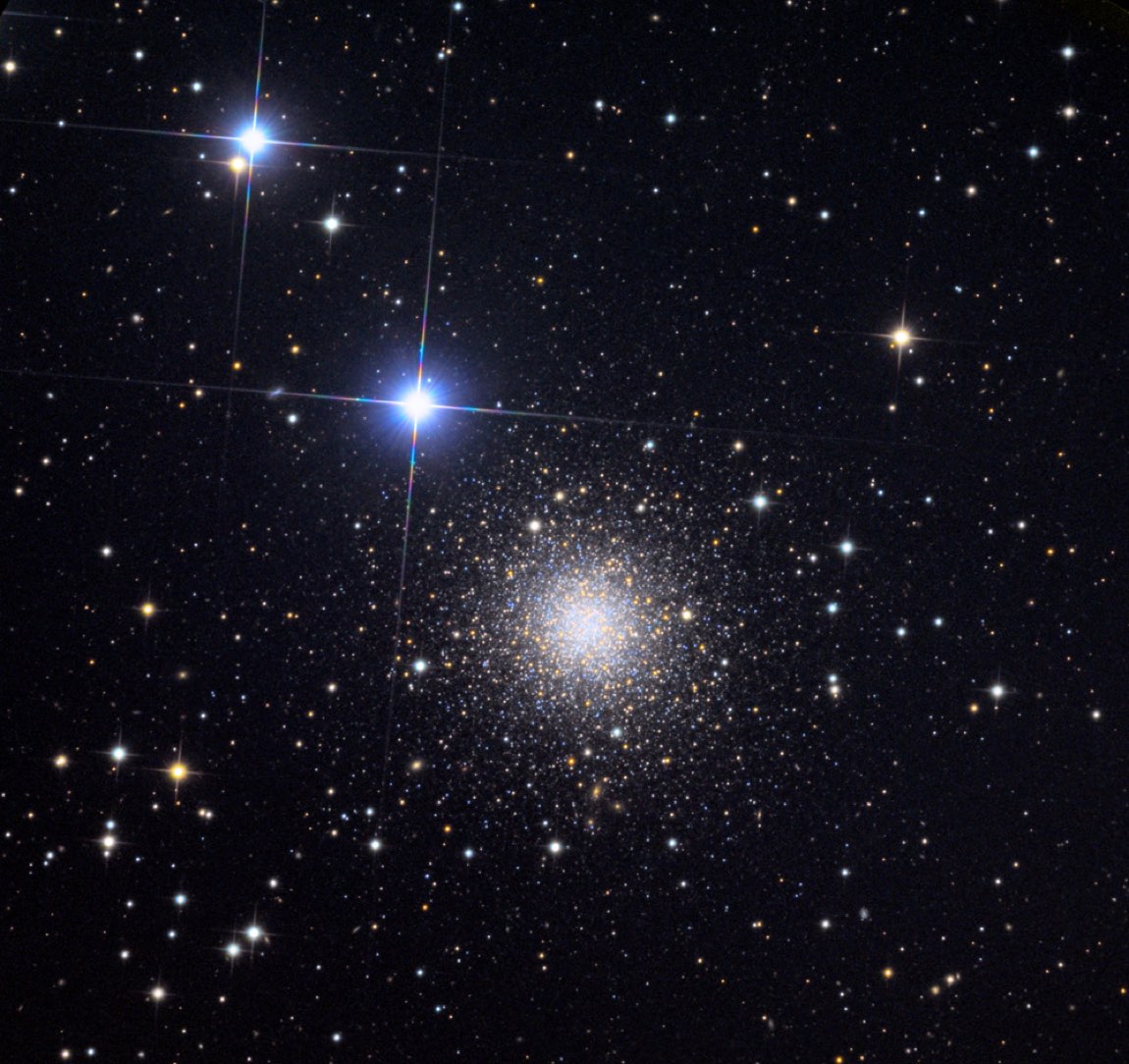
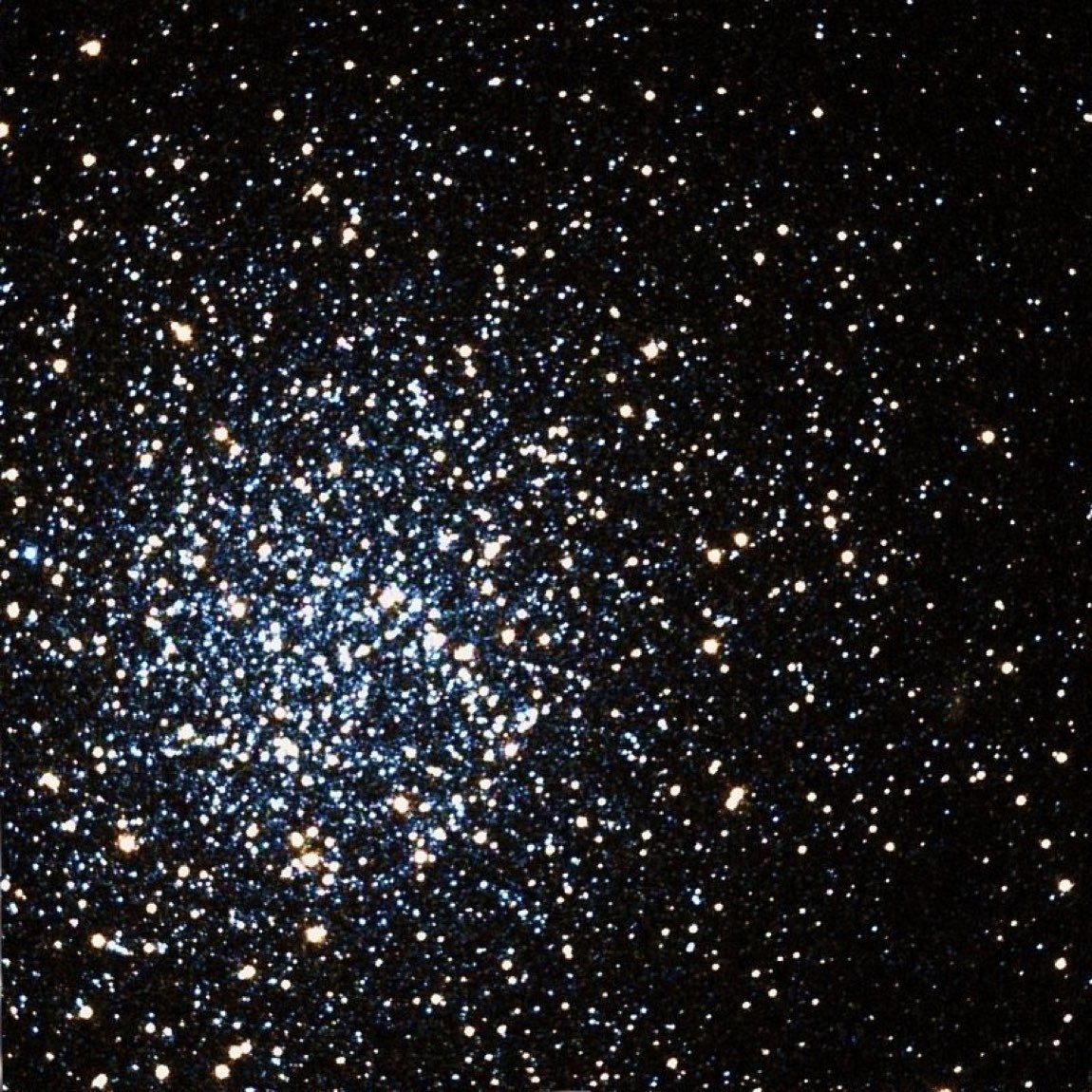
 Photograph · Adam Block/Mount Lemmon SkyCenter/University of Arizona · CC BY-SA 3.0
Star Cluster · Deep guide
NGC 2419 (Intergalactic Wanderer)
Also called: Caldwell 25 · C25 · Intergalactic Wanderer · GCl 112
A massive globular cluster so far out that one lap around the Milky Way takes three billion years.
What is it?
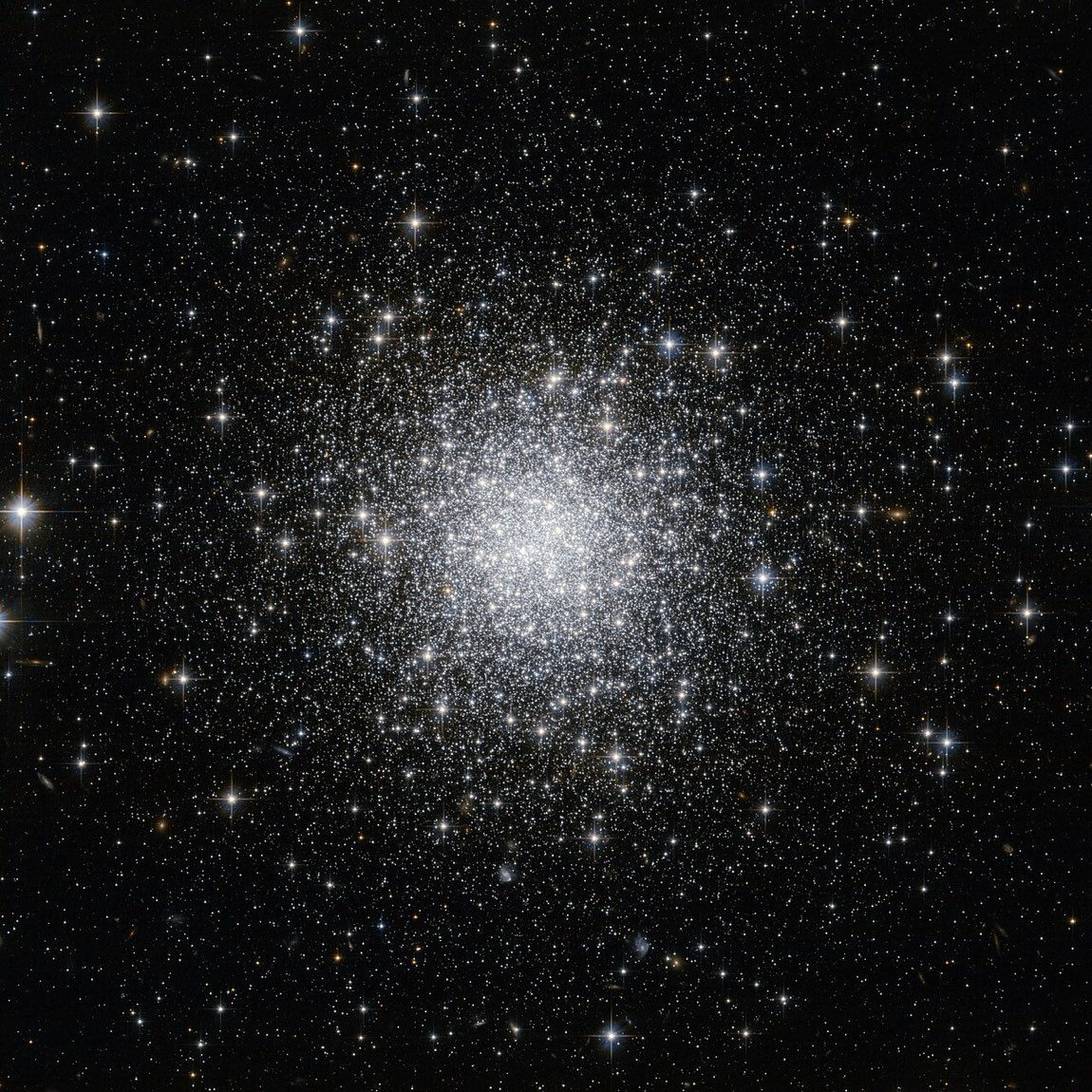
NGC 2419 is a globular cluster in Lynx, roughly 300,000 light-years from both the Sun and the centre of our galaxy, farther out than the Magellanic Clouds. It was nicknamed the Intergalactic Wanderer when astronomers wrongly thought it was not bound to the Milky Way; it does orbit our galaxy, taking about three billion years per lap. Although it looks dim from Earth, it is one of the brightest and most massive globular clusters of the Milky Way, at roughly 900,000 Suns. William Herschel discovered it on 31 December 1788.
The deep dive
Researched for the Atlas from Wikipedia — NGC 2419 (2,318 characters read) · updated Nov 15, 2026
01 A New Year's Eve discovery in 1788
William Herschel, the German-British astronomer who had already reshaped humanity's picture of the cosmos, logged NGC 2419 on the last night of 1788 — December 31. It was one entry among thousands he methodically swept from the sky over decades, yet this particular smudge of light turned out to be one of the most remote star clusters anyone had ever catalogued. Herschel could not have known that the faint glow he recorded belonged to a cluster sitting roughly 300,000 light-years away, far beyond the main body of the Milky Way. The discovery was assigned the number 2419 in the New General Catalogue compiled later, and it also earned the designation Caldwell 25 in the amateur-friendly Caldwell Catalogue. For nearly two centuries after Herschel's observation, the cluster's true nature and extreme distance remained subjects of debate, and the science surrounding it has only grown more complicated — not less — with modern telescopes.
02 Why "Intergalactic Wanderer" is a misnomer
The nickname "the Intergalactic Wanderer" was attached to NGC 2419 when astronomers erroneously believed it was not gravitationally bound to the Milky Way at all — a true intergalactic exile drifting between galaxies. That picture turned out to be wrong. The cluster is, with certain qualifications, considered part of the Milky Way system. What earned the dramatic nickname is still real enough: its orbit carries it farther from the galactic center than even the Magellanic Clouds, our galaxy's most famous satellite companions. At that extreme distance, the gravitational leash holding it to the galaxy is very long and very weak, which is precisely why early observers suspected it had broken free entirely. The "wanderer" label stuck even after the science moved on, a reminder that colorful astronomical names often preserve the history of a misunderstanding rather than a confirmed fact.
03 An orbit measured in billions of years
Most globular clusters complete an orbit around the Milky Way in a few hundred million years, looping through the halo and back. NGC 2419 operates on an entirely different timescale. Sitting roughly 300,000 light-years from both the Solar System and the galactic center simultaneously, it takes three billion years to complete a single trip around the galaxy. For context, three billion years ago on Earth, only single-celled life existed and the continents looked nothing like they do today. During the entire span of complex animal evolution — from the Cambrian explosion to the present — NGC 2419 has not even finished one full lap. This extraordinarily slow orbit is a direct consequence of its distance; the weaker gravitational pull at the cluster's location means it moves far more slowly relative to the galactic center than clusters nestled closer to home.
04 Intrinsic brilliance hidden by sheer distance Deeper
To a casual observer, NGC 2419 appears modest — a 9th magnitude object, visibly dimmer than showpiece clusters like M13 in Hercules. But apparent faintness is deceptive when the source is 300,000 light-years away. Strip away the distance and the cluster's true luminosity emerges: an absolute magnitude of −9.42, ranking it among the intrinsically brightest globular clusters in the entire Milky Way. Its mass reinforces that status — NGC 2419 contains about 900,000 times the mass of the Sun packed into a single gravitationally bound system. That is roughly comparable to a small dwarf galaxy. The disconnect between its lackluster apparent brightness and its genuine power illustrates how profoundly distance misleads our intuitions about the cosmos. The cluster is not a minor curiosity best viewed with large apertures; it is an enormous, ancient stellar city that simply has the misfortune of being extraordinarily far away.
05 Observing a remote giant from your backyard
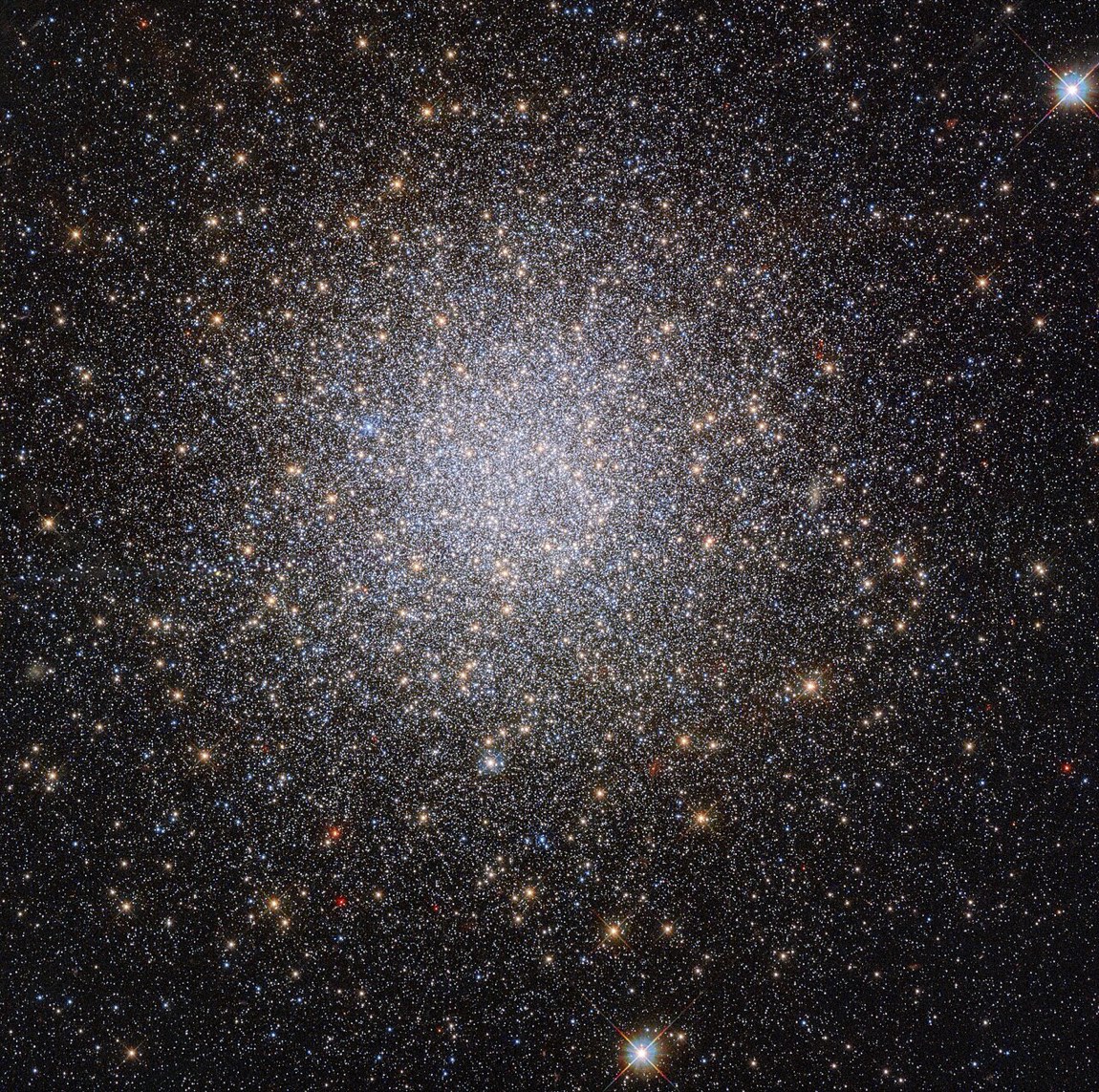
Despite its extreme distance, NGC 2419 is accessible to amateur astronomers with surprisingly modest equipment. Under good sky conditions — dark skies, steady seeing — a telescope with an aperture as small as 102 mm (four inches) is enough to pick it out in the constellation Lynx. At 9th magnitude it sits comfortably within the range of small refractors and compact reflectors alike. What the observer will not see, at least not easily, is the resolution into individual stars that makes clusters like M13 so visually spectacular in larger instruments; at 300,000 light-years, the cluster presents a compact, slightly fuzzy disc. Lynx is not the most prominent constellation, so star-hopping to the right field of view requires a decent finder chart. For those who do track it down, there is a quiet satisfaction in knowing that the photons hitting the eye have traveled three times farther than the Magellanic Clouds.
 ⤢
06 A possible relic of a devoured dwarf galaxy Deeper
One of the most intriguing proposals about NGC 2419 is that it may not be a "true" globular cluster at all in the conventional sense. Some researchers proposed that it could be, like Omega Centauri, the surviving dense nucleus of a dwarf spheroidal galaxy that was disrupted and gradually absorbed — accreted — by the Milky Way over cosmic time. Under this scenario, what we see today as a compact star cluster would be all that remains after tidal forces stripped away the surrounding galaxy's outer stars. It would explain why the cluster is so extraordinarily massive and luminous compared to typical globular clusters. However, this hypothesis has been disputed, and there is no scientific consensus on the matter. The debate places NGC 2419 in a broader ongoing conversation about the origins of the Milky Way's most extreme globular clusters and their possible connections to now-vanished dwarf satellite galaxies.
07 Two stellar populations that break the model Deeper
Among the most scientifically disruptive findings about NGC 2419 is the discovery that it harbors two distinct stellar populations, one measurably more helium-rich than the other. This directly conflicts with the standard model of globular cluster formation, which predicts that stars within a single cluster should share a very homogeneous chemical composition — essentially born from the same well-mixed reservoir of gas. When a cluster contains populations with significantly different helium abundances, it implies a more complex, multi-stage formation history that the standard model cannot easily accommodate. NGC 2419 is not unique in showing multiple populations — Omega Centauri does too — but the degree and character of the variation here is striking. This discovery raises active, unresolved questions about how the cluster formed, whether it experienced multiple bursts of star formation, and what physical mechanisms could produce such internal chemical diversity in a system once thought to be chemically uniform.
08 The mass-to-light puzzle and hidden dark objects Deeper
NGC 2419 has been scrutinized for signs of a central black hole, motivated in part by an unusually high mass-to-light ratio — the cluster contains more mass than its visible starlight alone would suggest. A central intermediate-mass black hole could in principle explain this discrepancy by contributing mass without contributing light. However, astronomers are careful not to jump to that conclusion, because several other explanations are equally viable given current data. A high concentration of stellar-mass black holes — the compact remnants of massive stars that lived and died long ago — could collectively add significant unseen mass. Alternatively, a centrally concentrated population of intrinsically faint stars could inflate the mass-to-light ratio without requiring any black hole at all. Dark matter is also listed as a possible contributor. As of the article's information, no single explanation has been confirmed, leaving the internal mass distribution of NGC 2419 an open and active area of research.
09 The view from Andromeda's astronomers
Astronomer Leos Ondra pointed out a remarkable consequence of NGC 2419's unusual position: for any hypothetical observers in the Andromeda Galaxy looking for globular clusters orbiting the Milky Way, NGC 2419 would stand out as the "best and brightest" candidate. The reason is elegant — because the cluster orbits so far outside the dense, obscuring disk of the Milky Way, it is not hidden behind the layers of gas, dust, and crowded stars that would mask clusters embedded in or near the galactic plane. It sits in clear space, visible against an uncluttered background. Ondra drew an analogy to G1, a massive globular cluster associated with the Andromeda Galaxy that can be observed from Earth precisely because it orbits outside Andromeda's obscuring main disk. The comparison is a pleasing reminder that our view of other galaxies' clusters, and their hypothetical view of ours, depends heavily on geometry and obscuration as much as raw brightness.
 ⤢