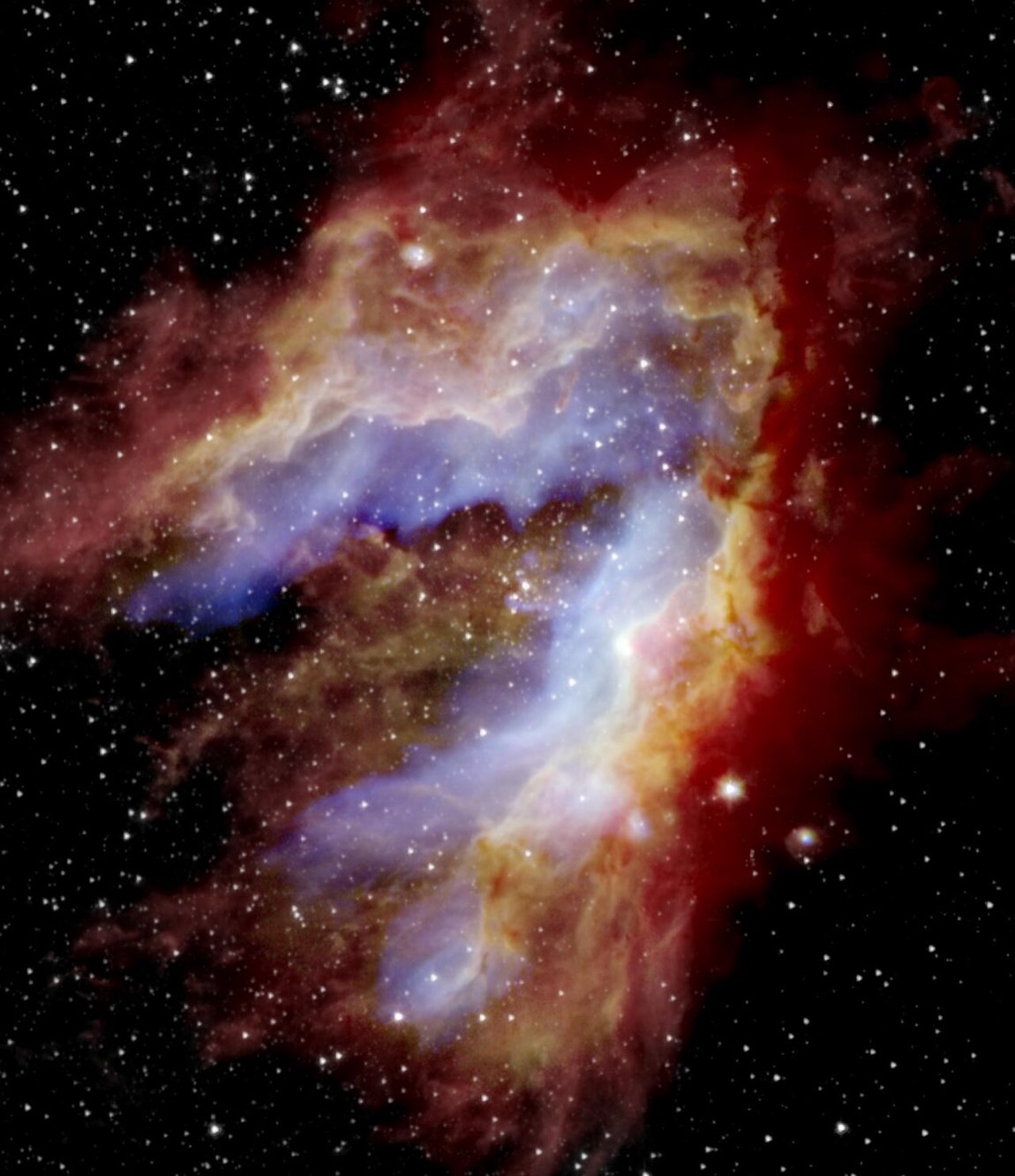
 Photograph · NASA/SOFIA/Lim, De Buizer, & Radomski et al.; ESA/Herschel; NASA/JPL-Caltech · CC0
Nebula · Deep guide
The Omega Nebula (Messier 17)
Also called: M17 · Messier 17 · NGC 6618 · Swan Nebula · Checkmark Nebula · Lobster Nebula · Horseshoe Nebula
A glowing cloud of star-forming gas in Sagittarius that some see as a swan.
What is it?
The Omega Nebula is an H II region, a cloud of hydrogen gas lit up by hot young stars inside it, in the rich star fields of Sagittarius. Philippe Loys de Chéseaux discovered it in 1745, and Messier catalogued it in 1764. Its shape has earned many nicknames, including the Swan, Checkmark, Lobster and Horseshoe Nebula. It lies roughly 5,000 to 6,000 light-years away, and at magnitude 6 it is one of the brighter nebulae for binoculars and small telescopes.
The deep dive
Researched for the Atlas from Wikipedia — Omega Nebula (5,640 characters read) · updated Nov 15, 2026
01 A nebula discovered by candlelight
The Omega Nebula's recorded history stretches back to 1745, when Swiss astronomer Philippe Loys de Chéseaux first spotted it. Nearly two decades later, in 1764, Charles Messier catalogued it as the 17th entry in his now-famous list, giving it the designation M17. What is striking about Messier's observation is that he perceived only the bright eastern branch of the nebula, missing the larger, more complex structure that surrounds it. It was John Herschel who, beginning in 1833, made the first serious attempt to accurately draw the full nebula as part of a series of sketches. Herschel's drawings were published in 1836, and he returned to the subject with a more detailed sketch made during his expedition to South Africa in 1837, published in 1847. That later paper already raised a tantalizing question: had the nebula's brightness actually changed between his two visits, or were differences in the drawings simply errors of observation? The debate pulled in testimony from at least two other observers, an undergraduate named Mason at Yale College and Johann von Lamont, making M17 one of the earliest nebulae seriously studied for the possibility of real, measurable change over human timescales.
02 Why it has so many names
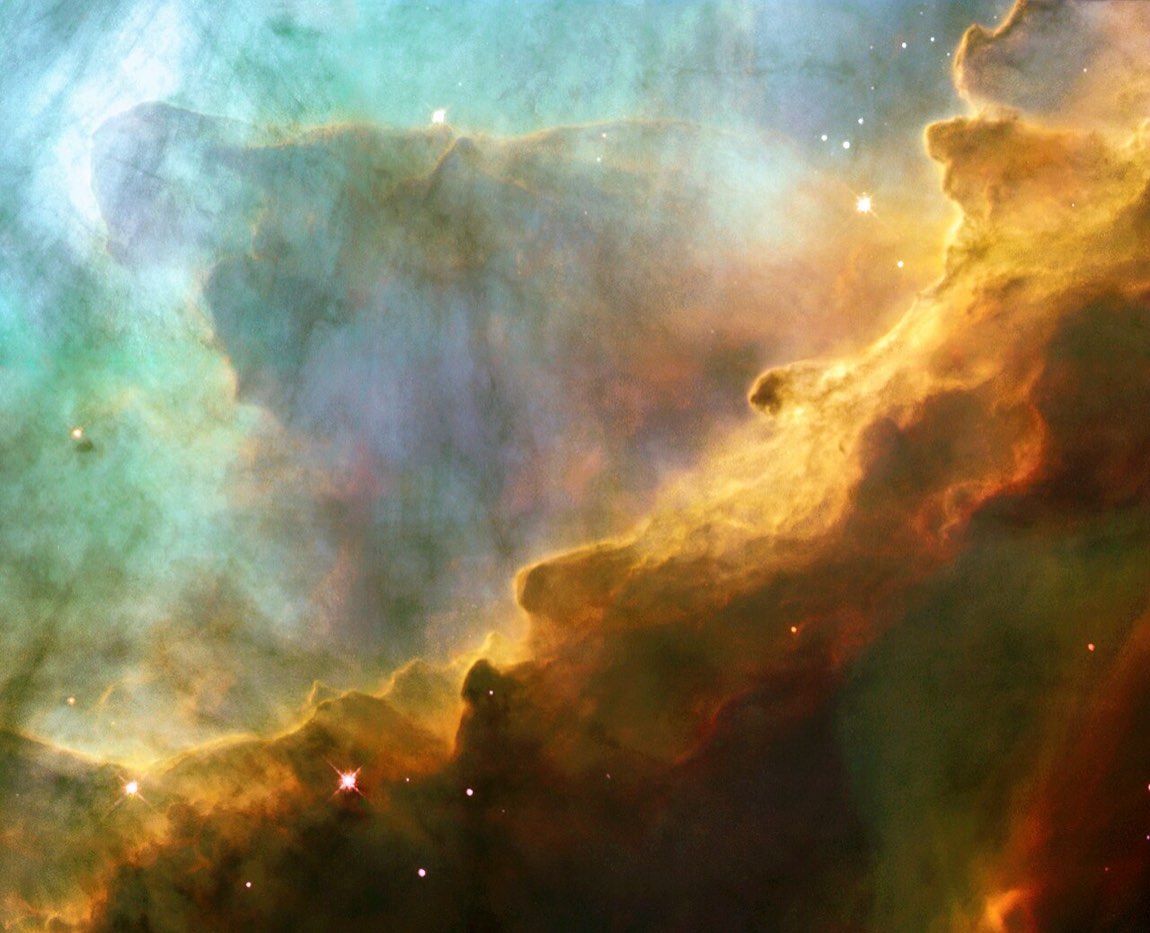
Few objects in the Messier catalogue carry as many nicknames as M17. It is formally catalogued as both Messier 17 and NGC 6618, but observers over the centuries have also called it the Swan Nebula, the Checkmark Nebula, the Lobster Nebula, and the Horseshoe Nebula. The name Omega Nebula comes from John Herschel's description: he wrote that the figure of the nebula is "nearly that of a Greek capital omega, Ω, somewhat distorted, and very unequally bright." That omega shape — the large horseshoe-shaped arc combined with the bright eastern streak — is what gives the object its most scientifically formal common name. The Swan nickname arises because the same curved bright region, particularly the portion sometimes described as resembling a barber's pole, can also be read as the graceful neck and body of a swan floating on a bright band of gas. The Horseshoe name focuses on just the arc component. Each nickname essentially describes a different part of the same complex, uneven structure, which itself hints at how irregular and multi-component this star-forming region truly is.
03 The scale of the star-forming cloud
The glowing portion of the Omega Nebula that we see in images spans roughly 15 light-years in diameter — comparable in size to the distance light travels in fifteen years, or about 88 trillion miles. But the visible nebula is just the illuminated skin of a far larger cloud of interstellar matter. That surrounding cloud stretches approximately 40 light-years across, nearly three times the width of the bright nebula itself, and carries a mass of some 30,000 solar masses — meaning it contains material equivalent to thirty thousand copies of our Sun packed into an invisible reservoir of gas and dust. The glowing nebula accounts for only an estimated 800 solar masses of that total. The gap between those two numbers tells an important story: the vast majority of this star-forming complex is cold, dark, and not yet lit up by young stars. It is essentially a warehouse of raw stellar material, most of which has not yet begun to collapse and ignite. This makes M17 not merely a snapshot of star formation in progress, but a preview of star formation yet to come.
04 An embedded cluster hiding in plain sight Deeper
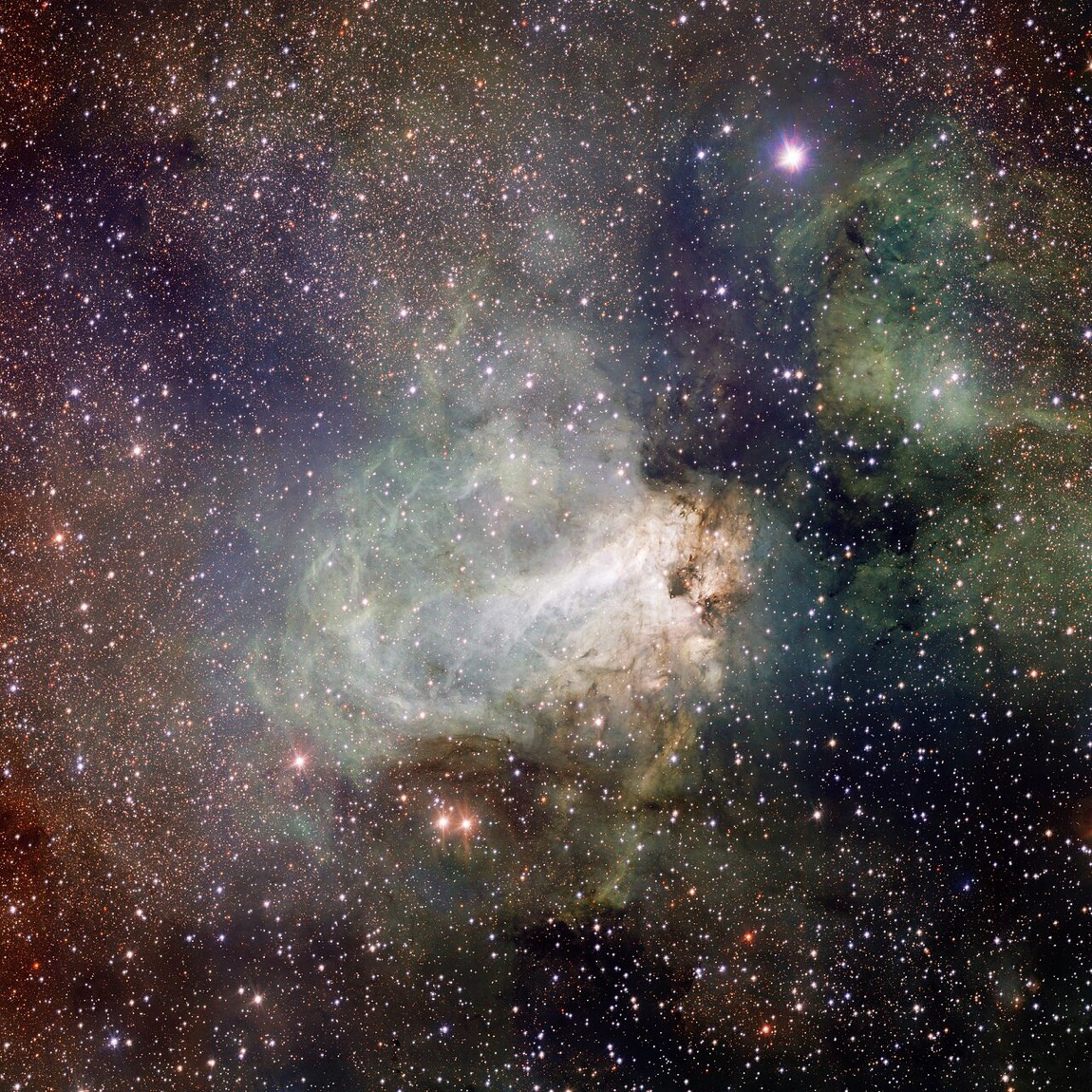
At the heart of the Omega Nebula lies the open cluster NGC 6618, whose hot young stars are the engines powering the entire glowing structure. Radiation from these stars ionizes the surrounding hydrogen gas, causing it to fluoresce — which is precisely what defines an H II region. The number of stars embedded in the nebula is remarkably high: estimates reach up to 800, of which at least 100 are of spectral type earlier than B9, meaning they are massive, luminous, and very hot. Nine of those stars are classified as spectral type O, the hottest and most energetic category of ordinary stars. Beyond the confirmed stellar population, over a thousand additional stars are believed to be in the process of forming in the outer regions of the nebula. The age of the cluster is estimated at just 1 million years — an extraordinarily short time by cosmic standards, making NGC 6618 one of the youngest known open clusters in the galaxy. For comparison, our Sun is about 4.6 billion years old, meaning this cluster is roughly 4,600 times younger. It is, in a very real sense, a newborn stellar nursery caught in the first moments after the lights turned on.
 ⤢
05 Extreme stellar residents: LBVs and hypergiants Deeper
Among the many stars associated with the Omega Nebula, two stand out for their extraordinary nature. In the south-east part of the nebula lies HD 168607, classified as a luminous blue variable, or LBV — a category of star representing one of the most massive and unstable phases of stellar evolution. LBVs are known for dramatic, irregular outbursts and are thought to be in a transitional stage before becoming Wolf-Rayet stars or exploding as supernovae. HD 168607 is generally assumed to be physically associated with the Omega Nebula. Its close neighbor, HD 168625, is classified as a blue hypergiant, an even rarer and more luminous type of massive star. The article notes that HD 168625 "may" also be associated with M17, though with less certainty than its neighbor. The presence of objects like these in or near M17 reinforces its status as a region of extreme, high-mass star formation. Both stars are so massive that their lifetimes will be measured in millions of years rather than billions, and both are candidates for spectacular endings. Their proximity to each other is itself a subject of interest — whether they formed together or are merely aligned along the line of sight remains an open question.
06 How M17 compares to the Orion Nebula
The Orion Nebula, M42, is by far the most studied and most photographed H II region in the sky, so astronomers frequently use it as a reference point when describing other star-forming regions. The Omega Nebula shares a similar local geometry with Orion — a dense cluster of hot young stars illuminating and carving into a surrounding cloud of gas and dust. The key observational difference is orientation: the Orion Nebula is oriented roughly face-on toward us, meaning we look almost directly into the cavity that the young Trapezium stars have blown in their surrounding cloud. The Omega Nebula, by contrast, is viewed edge-on. This edge-on perspective is part of why M17 appears as it does — a bright, elongated streak rather than a sweeping bowl of luminosity. It also means that the structure we see in M17 represents a cross-section through its gas layers rather than a top-down view of the cavity interior. Despite this geometric difference, the underlying physics of illumination, ionization, and star formation are closely analogous between the two regions, which is why comparing them has been scientifically productive for understanding how such nebulae work.
07 A location rich in Milky Way starfields
The Omega Nebula sits in the constellation Sagittarius, at a distance of between 5,000 and 6,000 light-years from Earth. That places it at a relatively modest distance within our own galaxy, which is about 100,000 light-years across. Its location within the northern two-thirds of Sagittarius is significant: Sagittarius is the direction toward the galactic center, and that region of the sky is threaded with some of the richest and most densely packed starfields in the entire Milky Way. Looking toward the Omega Nebula means looking through or near the dense spiral arms of the galaxy, which is precisely where the conditions for large-scale star formation are most favorable — high gas densities, frequent cloud-cloud interactions, and the compressive shock waves from spiral arm passages. The apparent magnitude of M17 is bright enough to make it visible through binoculars under dark skies, and it appears set against a backdrop that itself rewards slow scanning. For observers in the northern hemisphere, the nebula is a summer object, reaching good viewing height when Sagittarius climbs above the southern horizon during the warm months.
08 What SOFIA's infrared eyes revealed in 2020 Deeper
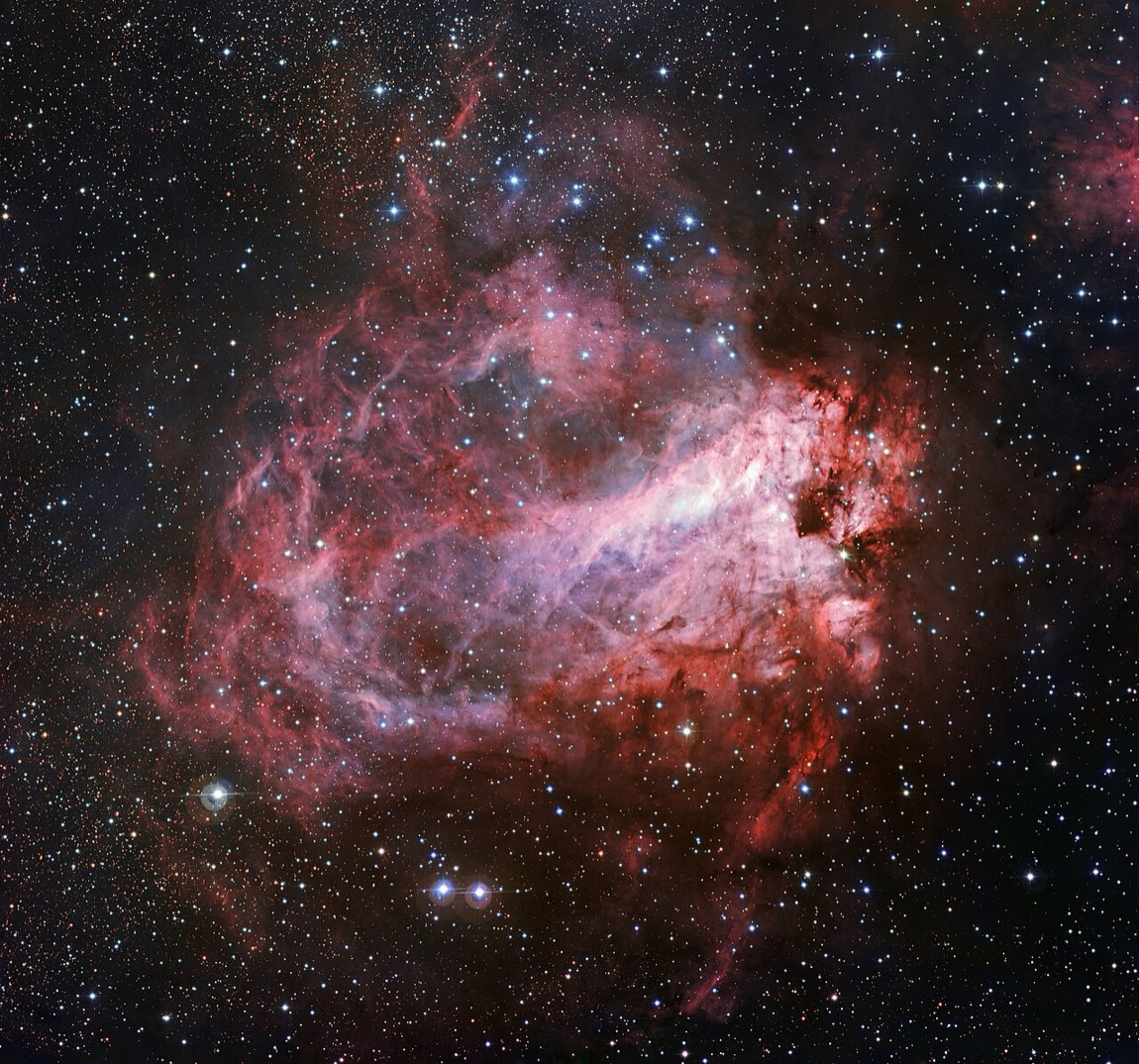
In January 2020, the Stratospheric Observatory for Infrared Astronomy — SOFIA, an airborne telescope carried aboard a modified Boeing 747 — produced a composite infrared portrait of the Omega Nebula that revealed structure invisible to ordinary optical telescopes. The composite image layered observations at multiple wavelengths: blue regions at 20 microns traced gas heated directly by massive stars near the nebula's center; green regions at 37 microns mapped dust warmed by both massive stars and newborn stars; red regions near the edges, captured by the Herschel Space Telescope at 70 microns, revealed cold dust not yet significantly heated; and a white star field background came from the Spitzer Space Telescope at 3.6 microns. Perhaps most notably, nine previously unseen protostars — stars in the earliest stages of formation, still embedded in their natal cocoons of dust — were discovered primarily in the southern regions of the nebula. The SOFIA observations also suggested that different parts of the nebula may have formed separately from one another, a finding that helps explain the distinctive, asymmetric swan-like shape that has puzzled observers since Herschel's first sketches nearly two centuries earlier.
 ⤢
09 Early debates over whether the nebula changed Deeper
John Herschel's 1847 paper on the Omega Nebula contains one of the earliest serious discussions in astronomical literature about whether a nebula might visibly change over a human lifetime. After comparing his 1833 and 1837 sketches, Herschel noted that the nebulous diffusion at the western angle and base-line of the omega shape appeared far less conspicuous in his 1837 drawing than it had been four years earlier. He wrote that this induced "a suspicion that some real change may have taken place in the relative brightness of this portion compared with the rest of the nebula." He weighed this seriously, acknowledging the "considerable weight" of arguments for real change, before conceding that the case was weakened by contrary testimony from Mason and his collaborator Smith, who reported clearly seeing both nebulous knots on August 1, 1839 — two years after Herschel's last drawing. He also noted that Lamont's figure showed the western diffusion as "very conspicuous," more so than Herschel himself recalled it. The episode illustrates how difficult it is to separate genuine physical change from differences in telescopes, atmospheric conditions, and the inherent subjectivity of hand-drawn astronomical sketches — a methodological problem that persisted well into the photographic era.
10 Nineteenth-century observers and their tools
The Omega Nebula attracted serious observational attention throughout the nineteenth century, drawing astronomers with a range of instruments. John Herschel made two sets of sketches, the first in England around 1833 and the second during his landmark expedition to South Africa in 1837, specifically to observe the southern sky. Johann von Lamont studied the nebula separately and produced his own figure. An undergraduate at Yale College named Mason, working alongside a collaborator named Smith, also independently observed and recorded the nebula starting around 1836. In 1862, William Lassell made sketches using his four-foot telescope at Malta — an instrument substantial enough to have been used for major discoveries. Then in 1875, M. Trouvelot in Cambridge, Massachusetts, and Edward Singleton Holden used the twenty-six-inch Clark refractor at the United States Naval Observatory to study the object. The Clark refractor was one of the largest and finest telescopes of its era. This succession of observers, spread across three continents and covering several decades, reflects how prominently M17 featured in the working agenda of nineteenth-century observational astronomy, particularly as astronomers began to grapple seriously with the nature and possible variability of nebulae.
11 Open questions still surrounding M17 Deeper
Despite centuries of observation, the Omega Nebula still presents astronomers with genuine uncertainties. The association of HD 168625, the blue hypergiant near the nebula's south-east edge, with M17 itself is described only as a possibility rather than a confirmed physical relationship — the article uses the word "may" explicitly. The SOFIA observations of 2020 raised the provocative possibility that distinct parts of the nebula formed separately from one another, implying that M17's shape is not simply the product of a single star-forming event but perhaps of multiple overlapping events or cloud interactions. The total stellar population embedded within the nebula is known only approximately — estimates reach up to 800 confirmed stars, plus over a thousand more in formation — but deep infrared surveys continue to refine these counts as new protostars are found. The question of whether the nebula's appearance genuinely changed during the nineteenth century, which Herschel raised and could not resolve, remains technically unanswered because the data from that era are too coarse and subjective to settle the matter definitively. Taken together, these open threads make M17 an active research target, not simply a well-understood showpiece.
12 How to find and observe the Omega Nebula
The Omega Nebula lies in the constellation Sagittarius, one of the most rewarding regions of the summer sky for observers in the northern hemisphere. At its distance of between 5,000 and 6,000 light-years, the nebula still manages to be bright enough to detect with binoculars under reasonably dark conditions, and a small telescope reveals the characteristic elongated streak that Messier first recorded in 1764. Larger amateur instruments begin to show the broader structure — the horseshoe arc and the surrounding fainter glow — that Herschel worked to document in his detailed sketches. The nebula sits among some of the richest starfields in the Milky Way, in the northern portion of Sagittarius, so sweeping the region with any optical aid is rewarding even independent of M17 itself. Infrared observations have been especially revealing for this object, since much of its stellar population is embedded in dust that blocks ordinary visible light. The SOFIA and Spitzer and Herschel space telescope observations demonstrated that the full extent of the star-forming activity in M17 is only apparent when you observe at wavelengths from about 3.6 microns out to 70 microns — a range far beyond what human eyes or conventional ground-based optical telescopes can reach.
 ⤢