 Photograph · GSFC / NASA Image Library
Nebula · Deep guide
The Lagoon Nebula
A naked-eye star factory in the heart of the Milky Way's summer band.
What is it?
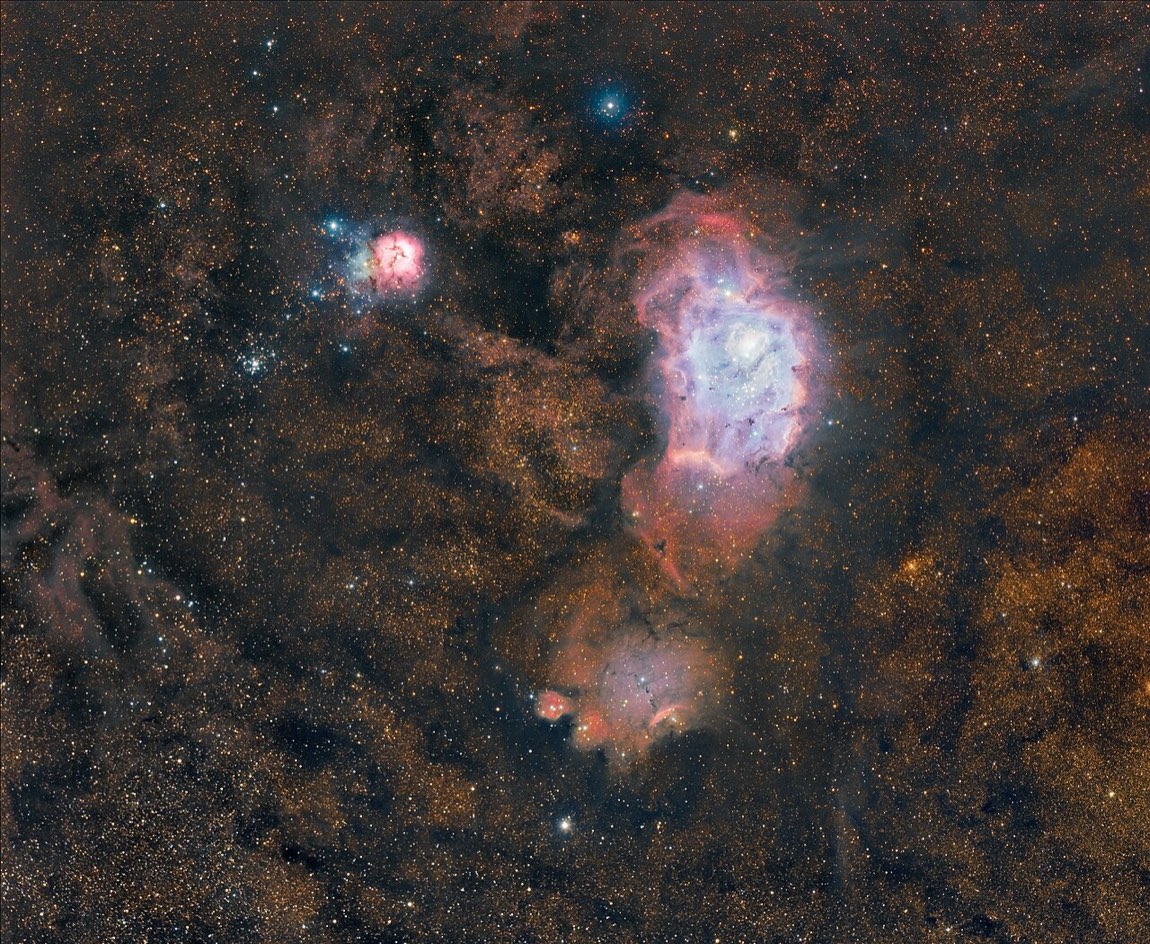
The Lagoon (M8), roughly 4,100 light-years toward Sagittarius, is one of only two star-forming nebulae faintly visible to northern naked eyes. It spans over a hundred light-years, split by the dark channel that earned its name, and its core hides the Hourglass — a knot of gas being blasted into shape by a newborn giant star.
The deep dive
Researched for the Atlas from Wikipedia — Lagoon Nebula (1,323 characters read) · updated Sep 20, 2026
01 A Nebula You Can Actually See Tonight
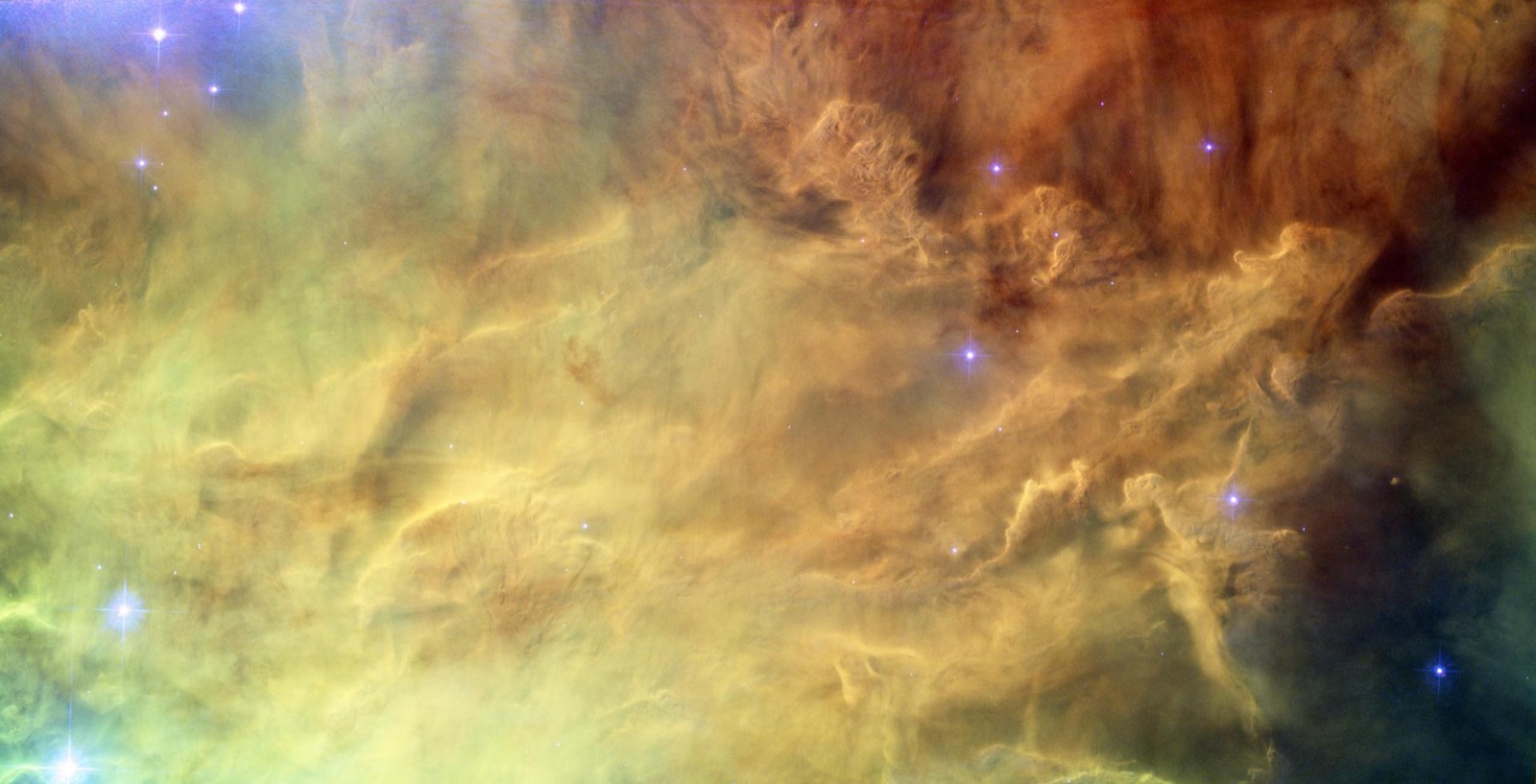
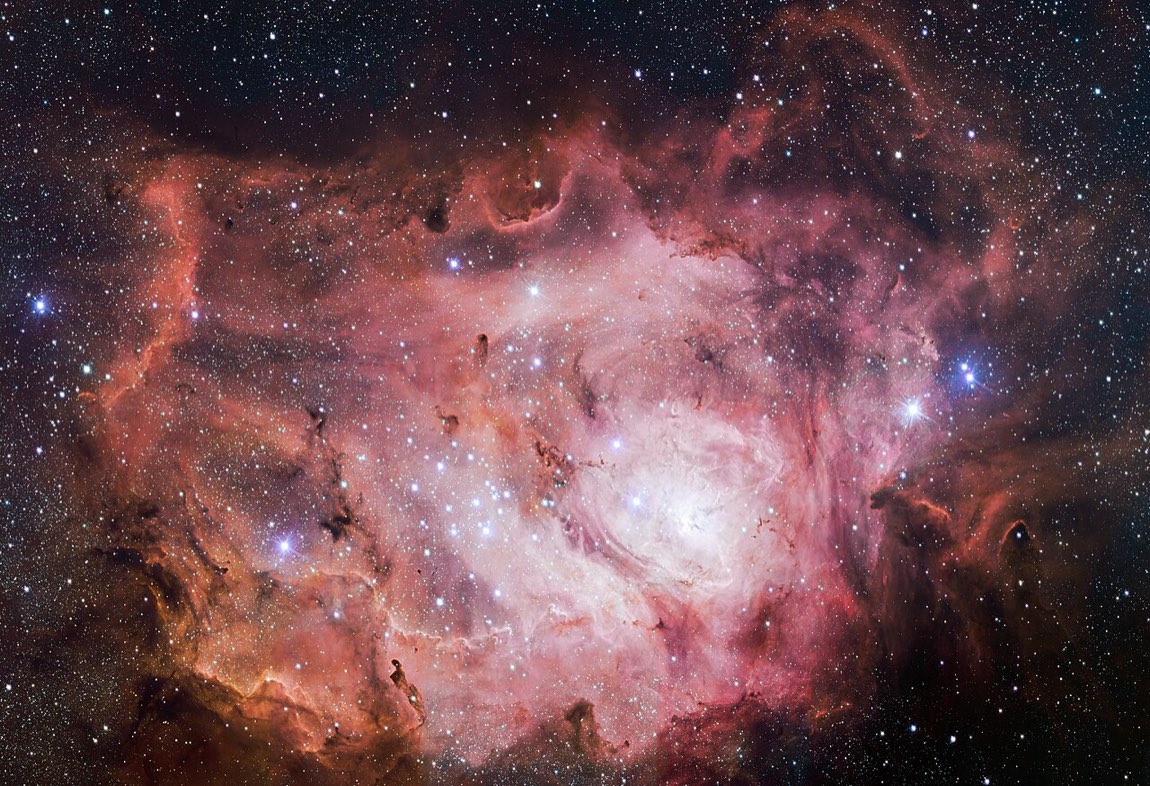
The Lagoon Nebula holds a rare distinction among the thousands of nebulae catalogued in our galaxy: it is one of only two star-forming nebulae faintly visible to the naked eye from mid-northern latitudes, the other being the famous Orion Nebula. That means on a clear, dark night, you can look toward the constellation Sagittarius and glimpse, without any optical aid, a cloud of gas actively birthing new stars. Through binoculars or a small telescope the view improves dramatically, though here comes a humbling quirk of human biology — the nebula will appear gray rather than the vivid pink seen in photographs. That is not a camera trick. Long exposures capture hydrogen-alpha emission that the eye's color receptors simply cannot register at such low light levels. The pink glow is real; our eyes in the dark just lack the sensitivity to see it. Photographs and the naked-eye experience are equally honest, just filtered through very different detectors.
02 How Big Is the Lagoon, Really?
Stretched across 110 by 50 light-years, the Lagoon Nebula is an enormous structure — its longer axis alone is roughly 26 times the distance from the Sun to its nearest stellar neighbor. From Earth it subtends 90 by 40 arcminutes of sky, meaning it covers an area more than nine times the apparent size of the full Moon. Its distance is known only within a fairly wide range: somewhere between 4,000 and 6,000 light-years away. That uncertainty of 2,000 light-years is not a small margin — it spans a range larger than many entire star-forming regions — and it reflects genuine difficulty in pinning down distances to dusty, complex nebulae embedded in the crowded inner reaches of the Milky Way. Whether the true distance is closer to 4,000 or 6,000 light-years affects estimates of its intrinsic brightness and physical size, so pinning it down more precisely remains a worthwhile scientific goal.
03 Giovanni Hodierna and the Discovery
The Lagoon Nebula was discovered by the Sicilian astronomer Giovanni Hodierna in 1654, placing its recorded history at nearly four centuries old. Hodierna was a meticulous observer who documented several deep-sky objects at a time when systematic cataloguing of the night sky was still in its infancy and before Charles Messier would later popularize such lists. The nebula would go on to receive a remarkable number of catalogue designations — Messier 8, NGC 6523, Sharpless 25, RCW 146, and Gum 72 — each reflecting a different survey or classification scheme built up over the centuries. The Messier designation, M8, is today the most commonly used and places it among the iconic objects Messier compiled to help comet hunters avoid confusing fuzzy permanent objects with new discoveries. That one cloud of glowing gas carries five separate formal names is itself a small history of how observational astronomy developed and how different scientific communities independently found it worth cataloguing.
 ⤢
⤢
04 The Hourglass Inside the Lagoon Deeper
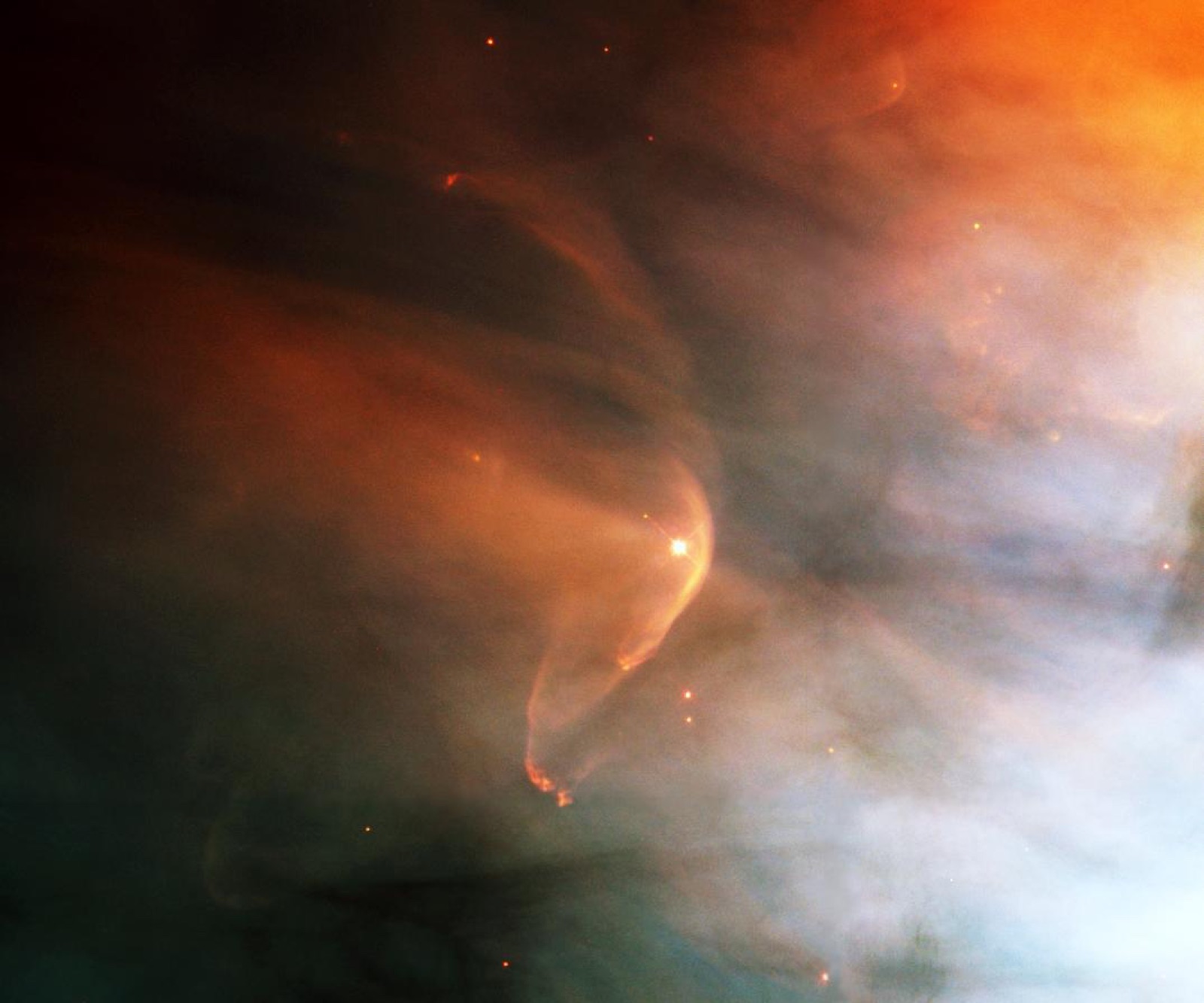
Buried within the broader Lagoon Nebula is a smaller, distinctly shaped structure called the Hourglass Nebula — not to be confused with the unrelated Engraved Hourglass Nebula located in the southern constellation Musca. This inner Hourglass was named by the astronomer John Herschel, son of the famous William Herschel, who recognized its pinched, symmetrical form. The shape is driven by energetic ultraviolet radiation streaming from a nearby hot O-type star, which carves and sculpts the surrounding gas. O-type stars are among the most massive and luminous in the universe, and their intense radiation fields can reshape nebular material over timescales short by cosmic standards. The Hourglass region proved scientifically pivotal in 2006, when observations revealed four Herbig-Haro objects embedded within it. These compact, glowing knots of gas form when jets ejected by newly forming protostars slam into surrounding material, producing shockwaves. Their presence provided direct observational evidence that star formation through accretion processes is actively happening inside the Lagoon right now.
05 Herbig-Haro Objects: Catching Stars Being Born Deeper
The 2006 discovery of four Herbig-Haro objects within the Hourglass structure of the Lagoon Nebula was a significant observational milestone. Herbig-Haro objects are transient phenomena — they glow because energetic jets of material, flung outward by a young star still in the process of accumulating mass through accretion, collide violently with the slower-moving gas of the surrounding nebula. The shockwaves from these collisions excite the gas, causing it to emit light. Finding four such objects clustered within one compact region of the Lagoon tells astronomers that multiple protostars are simultaneously in active accretion phases there. These are not ancient relics but dynamic events unfolding on timescales of years to centuries. The Lagoon is therefore not merely a nursery in the passive sense of containing young stars; it is a live delivery room where the process of stellar birth can be directly observed and measured in real time.
06 Bok Globules: Dark Seeds of New Stars Deeper
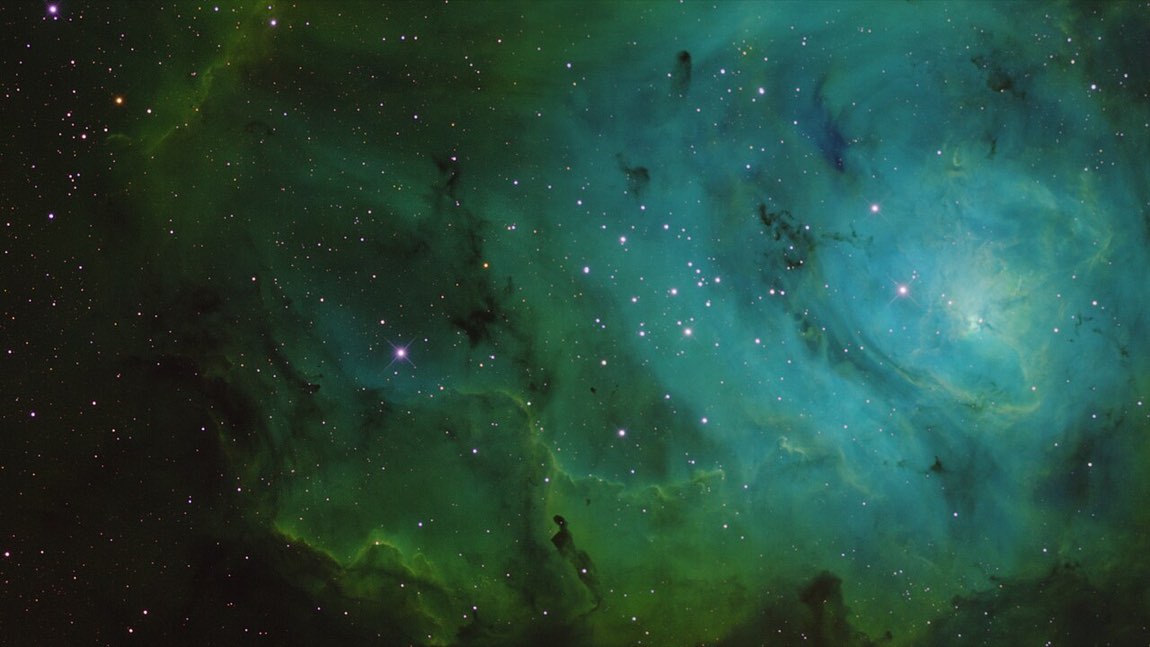
Scattered within the Lagoon Nebula are several Bok globules, dark and dense pockets of gas and dust that stand out as opaque patches against the brighter glowing nebula behind them. Three specific globules were catalogued by the pioneering astronomer E. E. Barnard and carry his designations: B88, B89, and B296. Barnard was a master of dark nebula identification, and his catalogues remain in active scientific use more than a century after they were compiled. Bok globules — named for astronomer Bart Bok who studied them extensively — are thought to be sites where gravity is slowly winning its battle against outward pressure, compressing gas until protostars ignite. They are cold, dense, and largely opaque to visible light, making their interiors difficult to study without infrared or radio telescopes. Their presence inside the Lagoon reinforces the picture of a nebula at multiple simultaneous stages of star formation, from open clusters of already-born stars to these dark cocoons where the next generation is still assembling.
 ⤢
⤢
07 The Young Star Cluster Inside the Cloud
The Lagoon Nebula is not simply a cloud waiting to form stars — it has already produced a notable family of them. The young open cluster NGC 6530 sits within the nebula's structure, its stars recently ignited from the same material that still glows around them. Open clusters like NGC 6530 are gravitationally loose collections of stars born from the same parent cloud at roughly the same time, making them invaluable for stellar age studies since all members share a common origin. The fact that NGC 6530 is embedded within the nebula rather than having dispersed far from it signals that the cluster is genuinely young — it has not yet had time to drift away from its birthplace or to blow away all of the surrounding gas. The nebula and its cluster together form a self-contained story of star formation: glowing gas, dark globules still contracting, Herbig-Haro jets from protostars in mid-birth, and a freshly minted cluster of stars that emerged from the same process just a cosmological moment ago.
08 What Makes It an Emission Nebula
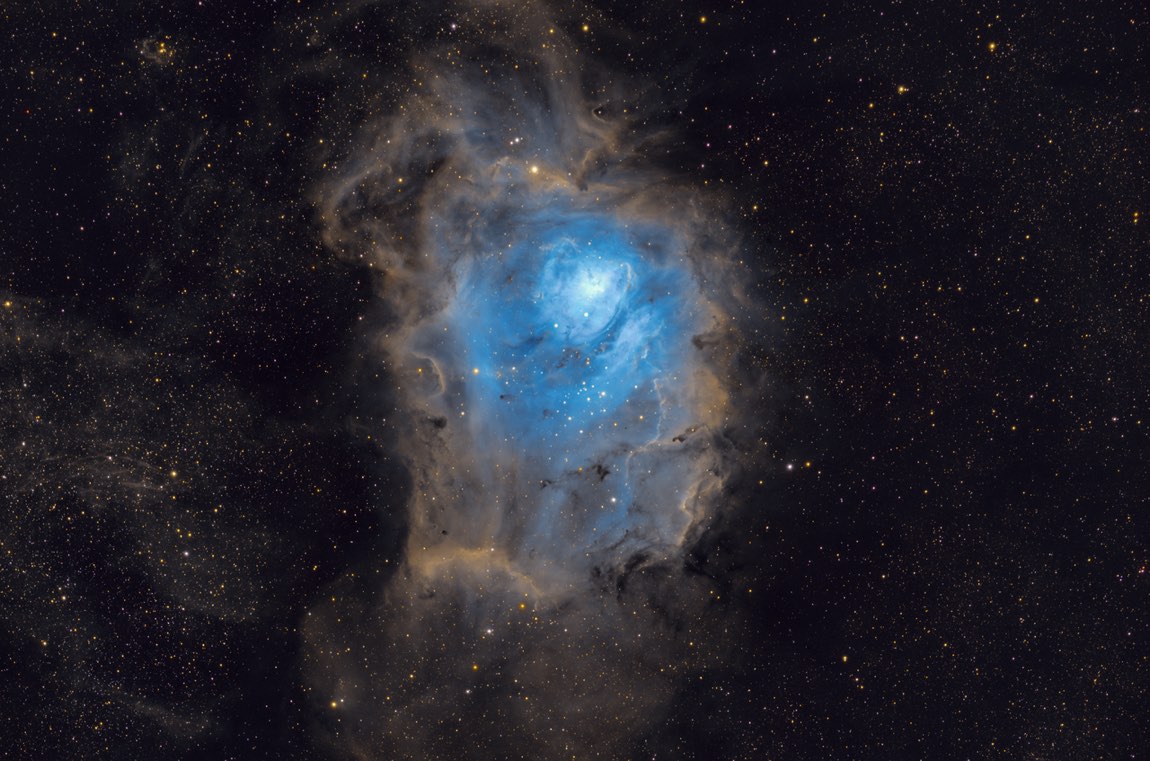
The Lagoon Nebula is classified as a giant emission nebula containing an H II region — the H II designating ionized hydrogen, which is the fundamental ingredient behind its glow. When ultraviolet light from hot, massive stars floods the surrounding gas, it strips electrons from hydrogen atoms. When those electrons eventually recombine with protons, they cascade through energy levels and emit light at very specific wavelengths, most notably the red hydrogen-alpha line at 656 nanometers. This process is what produces the striking pink color visible in long-exposure photographs. H II regions are reliable beacons of active or recent star formation across the universe because only very young, very hot stars — O-type and B-type — produce enough ultraviolet radiation to ionize the surrounding gas on large scales. The funnel-shaped structure carved by ultraviolet radiation from one hot O-type star within the Lagoon illustrates this sculpting process in action, showing how the very stars born from the nebula then reshape and erode the material around them.
09 Five Names for One Cloud of Gas
Few objects in the sky wear as many official labels as the Lagoon Nebula. Its full roster of designations includes Messier 8, NGC 6523, Sharpless 25, RCW 146, and Gum 72 — five separate catalogue entries reflecting five separate surveys carried out for different purposes by different teams across different eras. The Messier number comes from Charles Messier's eighteenth-century list of objects that could fool comet hunters. NGC 6523 comes from John Dreyer's New General Catalogue of 1888. Sharpless 25 comes from Stewart Sharpless's 1959 catalogue of H II regions. RCW 146 comes from the 1960 catalogue by Rogers, Campbell, and Whiteoak focused on southern-sky emission nebulae. Gum 72 comes from Colin Gum's earlier southern-sky survey. Each catalogue had its own selection criteria, telescope, and scientific context, and the Lagoon met all of them. The multiplication of names is a small inconvenience for students but a rich record of how thoroughly this nebula has captured scientific attention over more than three centuries.
 ⤢
⤢
10 Where in the Sky to Find It
The Lagoon Nebula resides in the constellation Sagittarius, one of the richest and most visually complex regions of the night sky as seen from Earth because looking toward Sagittarius means looking roughly in the direction of the Milky Way's central bulge. This positioning makes it a summer-sky object for observers in the northern hemisphere, climbing highest in July and August evenings. Its apparent size of 90 by 40 arcminutes means it covers a substantial patch of sky — large enough that low-power, wide-field binoculars or a rich-field telescope at low magnification show it better than high magnification, which would zoom past the nebula's full extent. The embedded open cluster NGC 6530 provides a helpful visual anchor, a sparkling of stars set against the glowing haze. Observers at mid-northern latitudes catch the Lagoon low on the southern horizon, while those closer to the equator or in the southern hemisphere see it ride higher and with less atmospheric blurring, revealing more detail in both the nebula and the dark lanes that give it its name.
11 Why the Lagoon Has a Lagoon
The name "Lagoon Nebula" is not merely poetic — it reflects a real visual feature. A dark lane of dust cuts across the glowing emission nebula in a way that, in long-exposure images and even in telescopic views, resembles a dark body of water surrounded by bright shore. These dark lanes are not empty space but rather concentrations of dust dense enough to block the light of the glowing gas behind them, the same principle behind the Bok globules catalogued by Barnard. The contrast between the illuminated nebular gas and the obscuring dust creates the lagoon impression that gave the object its common name. This interplay between emission and absorption — between gas that glows because it is ionized and dust that darkens because it is opaque — is a recurring feature of active star-forming regions, where newly formed stars and still-forming clumps coexist in a turbulent, uneven medium. The visual drama is a direct readout of physical complexity.
 ⤢
⤢