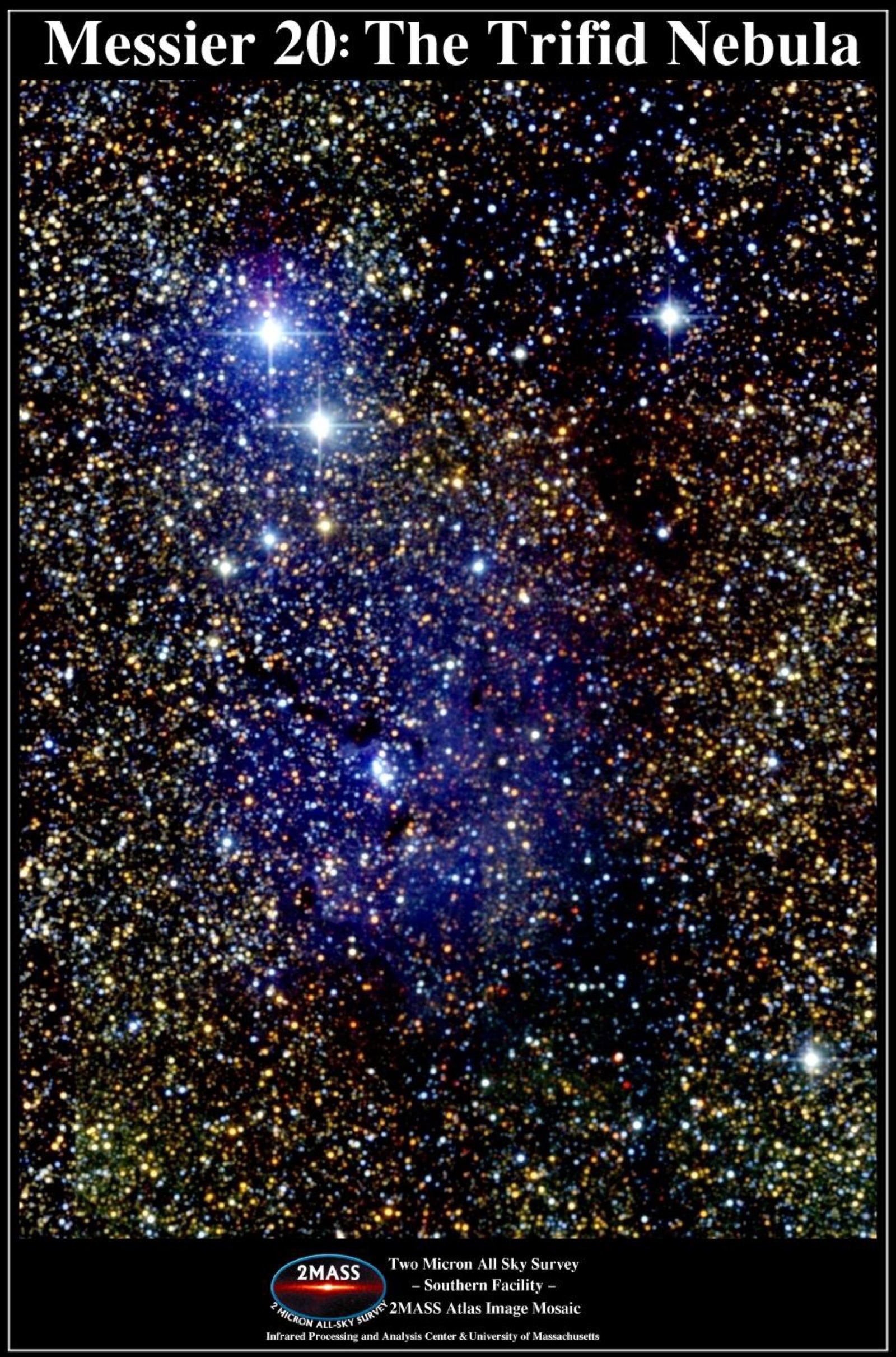
 Photograph · 2MASS / NASA Image Library
Nebula · Deep guide
The Trifid Nebula
Three nebulae in one: glowing red, shining blue, and split by darkness.
What is it?
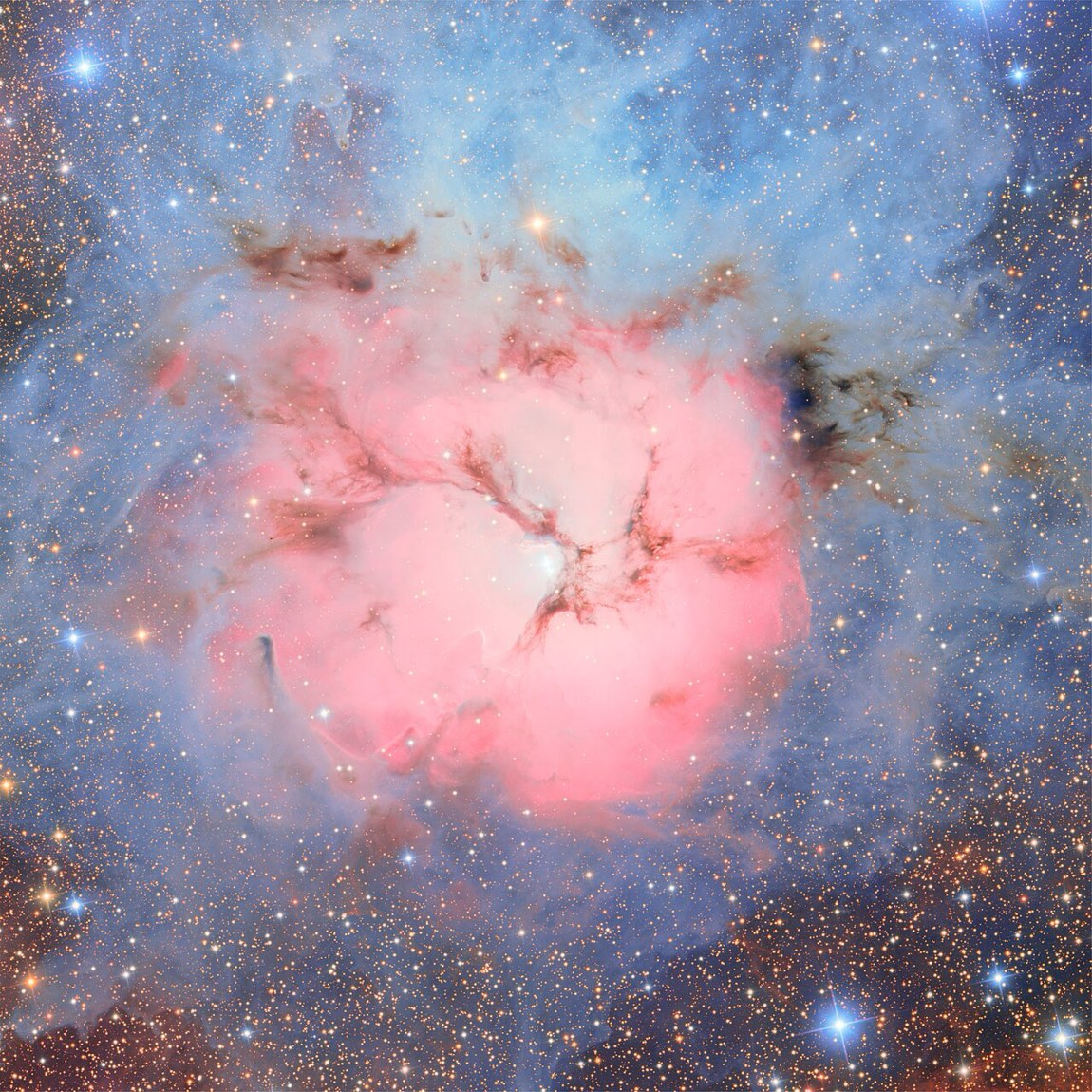
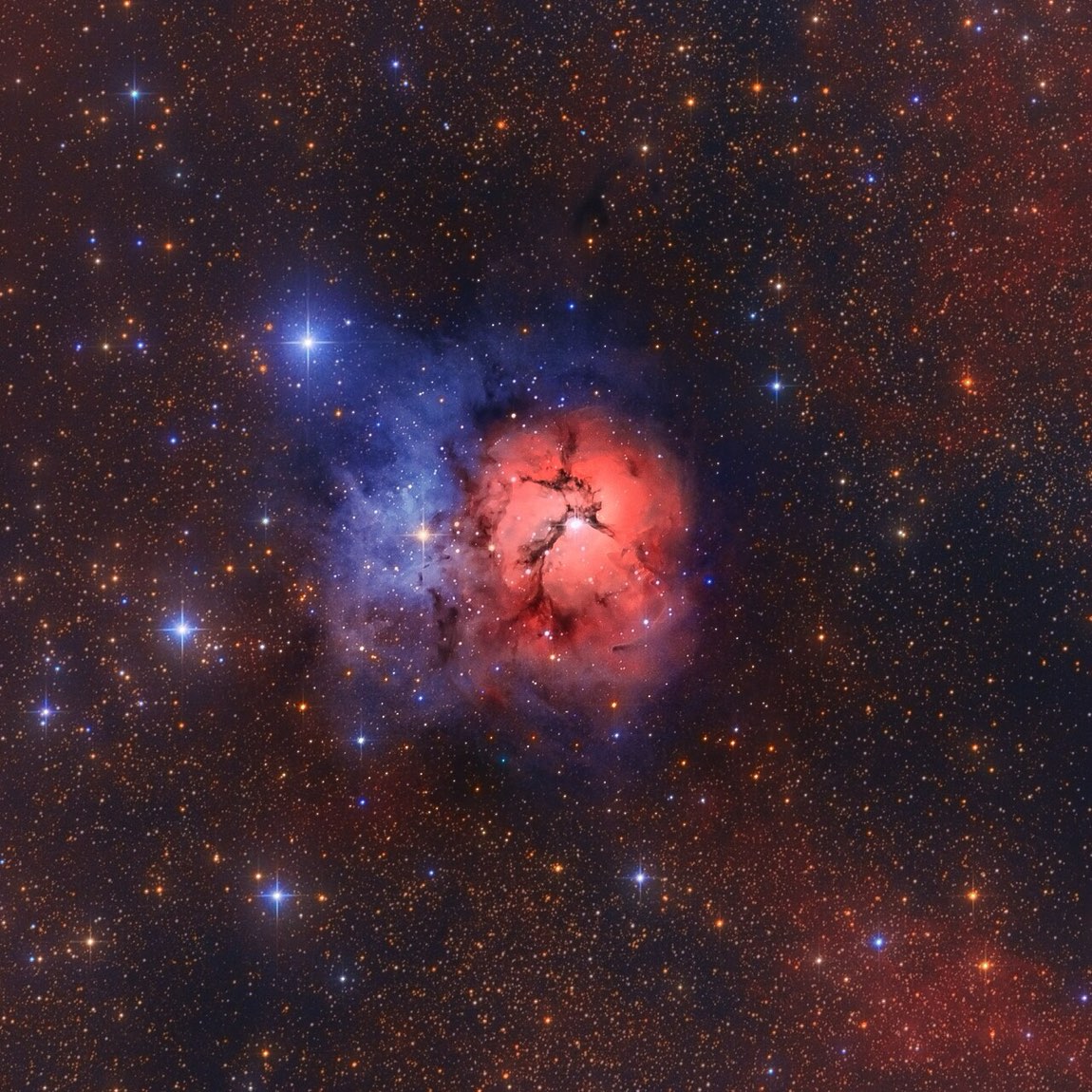
The Trifid (M20), near the Lagoon in Sagittarius, packs astronomy's whole nebula taxonomy into one object: a rose-red emission nebula, a blue reflection nebula, and the three dark dust lanes that trisect it and give it its name. It is young — likely only a few hundred thousand years — and its newborn stars are still carving it.
The deep dive
Researched for the Atlas from Wikipedia — Trifid Nebula (2,330 characters read) · updated Sep 20, 2026
01 A nebula that is actually three nebulae
Most nebulae belong to a single category, but the Trifid is a rare triple act occupying the same patch of sky. Its reddish-pink core is an emission nebula — a cloud so energized by ultraviolet radiation that its hydrogen gas glows on its own. Wrapping around the north-northeast edge is a reflection nebula, appearing blue not because it emits blue light but because tiny dust grains scatter blue starlight toward us, the same physical reason Earth's sky is blue. Threading through both regions are lanes of dark nebula, catalogued separately as Barnard 85, which block the light behind them and carve the three-lobed silhouette that gives the object its name. Sharing this same volume of space is an open cluster of roughly 3,100 young stars. Finding all four of these distinct object types — emission, reflection, dark nebula, and open cluster — bundled together in one view is genuinely unusual, and it is a large part of what has made the Trifid a perennial favorite among amateur astronomers since Charles Messier logged it in 1764.
02 Charles Messier and the discovery moment
Charles Messier added the Trifid Nebula to his famous catalogue on June 5, 1764, giving it the designation M20, which it still carries today. Messier was primarily a comet hunter, and his catalogue was originally compiled as a practical nuisance list — fuzzy objects that could be mistaken for comets through the modest telescopes of the eighteenth century. The Trifid qualified because, like a comet, it appears as a soft, extended glow rather than a sharp point of light. Its additional designation, NGC 6514, comes from the later New General Catalogue compiled by John Louis Emil Dreyer in 1888. The name 'Trifid' itself simply means 'three-lobe,' a direct description of its visual appearance when the dark lanes of Barnard 85 divide the glowing emission region into three distinct sections. Even through a small modern telescope, the object remains bright enough and peculiar enough in shape to reward a first-time observer immediately.
03 The star that powers everything
At the heart of the Trifid sits HD 164492A, classified as an O7.5III star — one of the hottest and most luminous stellar types that exist. Its mass exceeds 20 times the mass of the Sun, placing it firmly in the category of massive stars whose lifetimes are measured in millions rather than billions of years. It is this single star that provides the ferocious ultraviolet radiation responsible for ionizing the surrounding hydrogen gas and making the emission nebula glow. The same radiation scatters off dust to produce the reflection nebula's blue halo, and the same energy is slowly eroding the dark clouds within the complex. HD 164492A is also responsible for illuminating and sculpting the remarkable structures — jets, stalks, and globules — that Hubble photographed in detail. In short, one extraordinarily energetic star is simultaneously lighting up, ionizing, sculpting, and slowly destroying the very cloud from which it and its neighbors were born.
 ⤢
⤢
04 Stellar jets: the exhaust of star birth Deeper
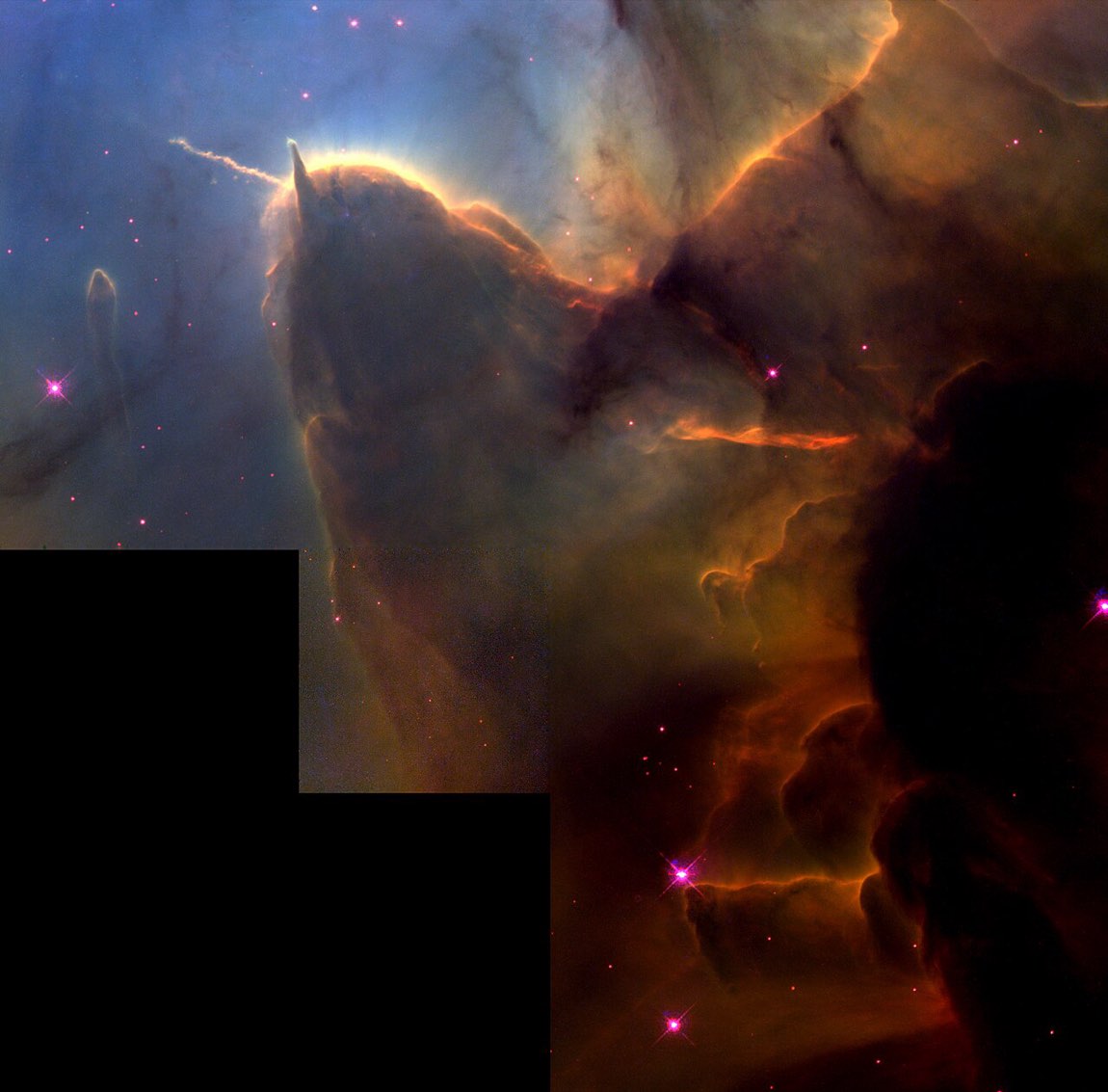
One of the most striking details revealed in Hubble Space Telescope observations from 1997 is a stellar jet protruding from the head of a dense cloud located about 8 light-years from the Trifid's central star. The jet itself extends roughly 0.75 light-years in length — nearly 44,000 times the distance from Earth to the Sun. Its source is a young stellar object buried deep within the cloud, still in the process of accumulating mass. Jets like this are essentially the exhaust byproduct of star formation: material falls inward onto the protostar, and physics compels some of that material to be flung outward along the rotation axis at high velocity. What makes this particular jet visible is that radiation from HD 164492A floods into the region and ionizes the jet's gas, causing it to glow. Without that external irradiation, the jet would be invisible at optical wavelengths, hidden inside its dusty natal cloud.
05 Evaporating gaseous globules and why they survive Deeper
Immediately to the right of the stellar jet, Hubble's 1997 images revealed a finger-like stalk of gas and dust pointing directly toward HD 164492A, the star that powers the entire nebula. This structure is classified as an evaporating gaseous globule, or EGG — a term describing dense condensations of interstellar material that are being sculpted and eroded by intense stellar radiation. The mechanism is straightforward: radiation and stellar winds strip away the surrounding lower-density material, but the tip of this particular stalk hosts a knot of gas dense enough to resist being eaten away. That denser knot acts as a shield, and the column of material in its shadow survives longer than the unprotected surroundings. The result is the pointed, pillar-like finger shape. EGGs are significant because many of them harbor embryonic stars inside; the resistance to erosion may give those embedded protostars just enough time to accumulate mass and complete their formation before the protective knot is finally destroyed.
06 What the Spitzer telescope found in the dark
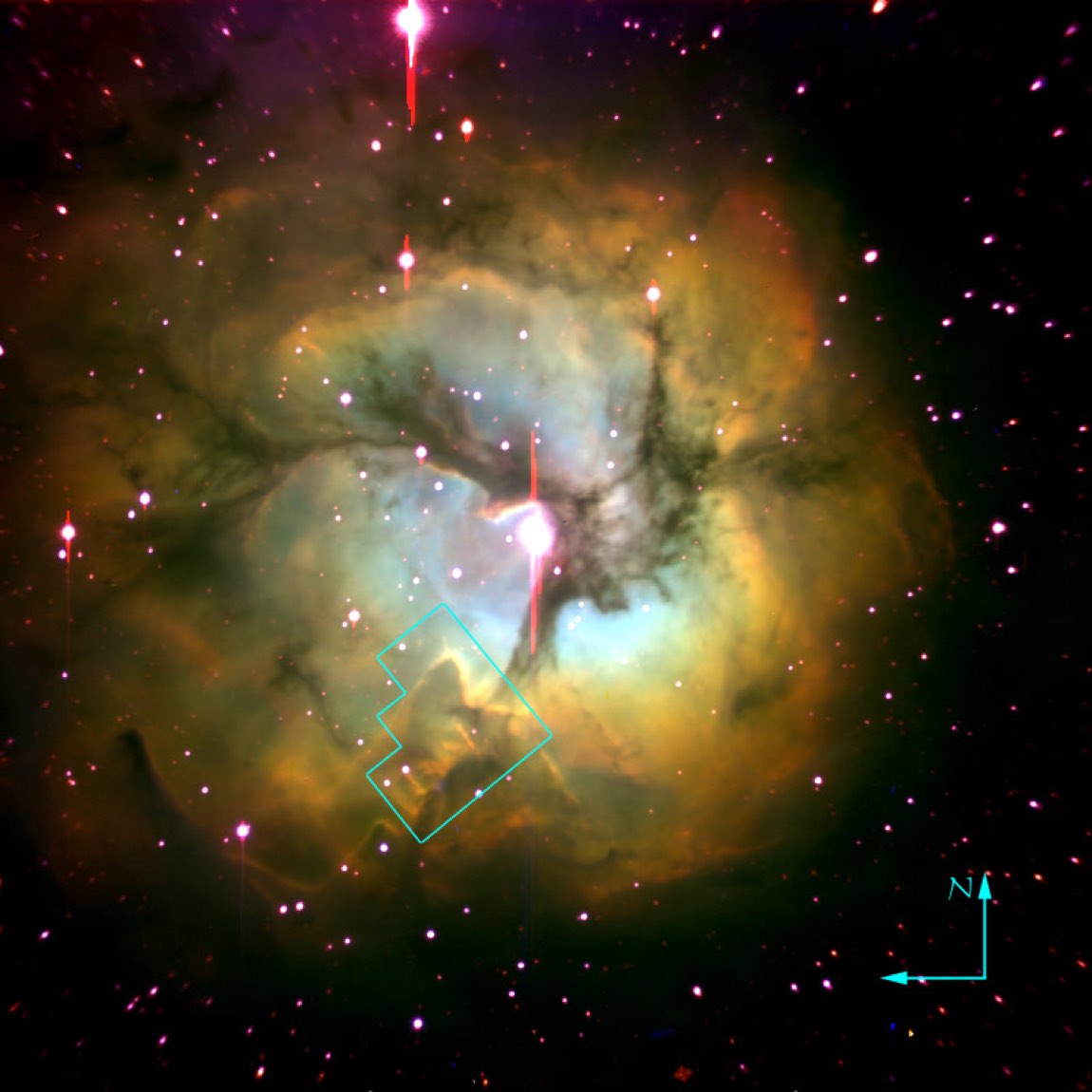
Visible light images of the Trifid, no matter how sharp, are fundamentally limited: dust absorbs and scatters optical wavelengths, hiding whatever lies behind or within dense clouds. In January 2005, NASA's Spitzer Space Telescope changed the picture entirely by observing the Trifid in infrared light, which penetrates dust far more effectively than visible wavelengths. The result was striking. Spitzer discovered 30 embryonic stars and 120 newborn stars that had been completely invisible in all previous optical images. These objects are at the earliest stages of stellar life, still enshrouded in the cocoons of gas and dust from which they are condensing. Their existence confirms that the Trifid is not merely a relic of past star formation but an active stellar nursery where the process is happening right now. The combination of Hubble's optical sharpness and Spitzer's infrared penetration gave astronomers two complementary windows onto the same complex, revealing a population of young stars far larger than anyone had counted from the ground.
 ⤢
⤢
07 A stellar nursery inside a glowing cloud
The 1997 Hubble observations used filters tuned to the specific wavelengths emitted by hydrogen atoms, ionized sulfur atoms, and doubly ionized oxygen atoms. By isolating these distinct emission lines and combining them into a false-color composite, astronomers could map which gases dominated different regions of the nebula and create an image that suggests how the structure might appear to a hypothetical eye sensitive enough to see it all. What emerged from this process was a detailed portrait of a dense cloud of dust and gas functioning as a stellar nursery packed with embryonic stars. This cloud sits about 8 light-years from HD 164492A, close enough that the central star's radiation is actively reshaping it. The embryonic stars within are not yet generating energy through nuclear fusion; they are still contracting under gravity, and their eventual fate — whether they ignite as full stars or remain as failed brown dwarfs — depends partly on whether the radiation from HD 164492A disperses their birth material before they can accumulate enough mass.
08 Where the Trifid lives in the galaxy
The Trifid Nebula resides in the constellation Sagittarius, specifically in the northwestern part of that constellation. Sagittarius is one of the richest constellations for deep-sky objects because looking toward it means looking roughly toward the center of the Milky Way, through some of the galaxy's densest star-forming regions. The Trifid is part of one of those regions, situated within the Milky Way's Scutum–Centaurus Arm — one of the galaxy's major spiral arms, distinct from the Orion Arm where our own Solar System sits. The nebula is centered approximately 4,100 light-years from Earth, close enough that its apparent magnitude reaches 6.3, which sits right at the threshold of naked-eye visibility under very dark skies. That combination of relative proximity and intrinsic brightness is exactly why Messier could find it with eighteenth-century equipment, and why it remains accessible to modern amateur astronomers with small telescopes.
09 Reading the Trifid's apparent magnitude Deeper
The Trifid Nebula carries an apparent magnitude of 6.3 on the standard astronomical scale, where lower numbers indicate brighter objects. Magnitude 6 sits very close to the accepted limit of what a human eye can detect under ideal dark-sky conditions, meaning the Trifid hovers at the edge of naked-eye visibility. In practice, its light is spread across an extended area of sky rather than concentrated at a point like a star, which makes it harder to perceive without optical aid than its numerical magnitude alone suggests. Through binoculars, the glow becomes clearly apparent; through even a modest telescope, the trilobed structure and color contrasts become discernible. The combined light reaching that magnitude figure represents contributions from all four components simultaneously — the glowing emission nebula, the scattered light of the reflection nebula, and the unobscured stars of the associated open cluster — making the apparent magnitude a blended summary of a genuinely complex object.
 ⤢
⤢
10 The young stellar cluster embedded within
Surrounding HD 164492A is a cluster of approximately 3,100 young stars, making the Trifid complex far more populated than its famous images usually suggest. Most of these stars are not visible in standard optical photographs because they are either still embedded in dust or simply too faint to register against the bright nebular background. Their youth is central to the entire story of the Trifid: because they formed recently, the gas and dust of their birth environment has not yet been fully dispersed. The massive central star HD 164492A is in the process of doing exactly that — its radiation and stellar winds are gradually photoionizing and blowing away the surrounding material. This self-clearing mechanism is common to H II regions across the galaxy, and it means the Trifid as we see it today is a transient structure. Over millions of years, the gas will dissipate, the dark lanes will vanish, and what will remain is an aging open cluster scattered across a wider region of sky.
11 How to observe the Trifid yourself
From a mid-latitude location in the northern hemisphere, the Trifid Nebula is best observed on summer evenings when Sagittarius climbs as high as it will get above the southern horizon. Its position in the northwestern part of Sagittarius places it near the distinctive Sagittarius Star Cloud and several other Messier objects, making the region rewarding for a single evening's sweep. The nebula's apparent magnitude of 6.3 means binoculars will show it as a soft glow, but a small telescope begins to reveal the dark lanes that give it its trilobed shape. The blue reflection nebula to the north-northeast is a subtler target that benefits from darker skies and slightly more aperture. Larger amateur telescopes under dark skies can hint at the color contrast between the reddish emission region and the blue reflection component. The Hubble images used narrowband filters to isolate specific atomic emissions, but even without those tools, the Trifid rewards patient observation with a distinctly structured and visually unusual appearance compared to most other nebulae.
 ⤢
⤢