Orion
“The Hunter” · Both (straddles the celestial equator) · best around January evenings
Real star positions and magnitudes (HYG database via D3-Celestial, BSD-3). Lines are the conventional stick figure; north is up.
The story
The most recognizable constellation in the sky, visible from every inhabited place on Earth. In Greek myth Orion was a giant huntsman placed in the sky opposite the scorpion that killed him — the two constellations never share the sky. Nearly every culture saw a figure here: an Egyptian god (Osiris), a Chinese warrior (Shen), an Aboriginal canoeist. Its three-star belt is the sky's best signpost, and below it hangs the Orion Nebula, a stellar nursery visible to the naked eye. Red Betelgeuse (shoulder) and blue Rigel (foot) show star colors at a glance.
How to find it
Winter evenings: face south (north from the southern hemisphere) and find three equally bright stars in a short, straight row — nothing else in the sky looks like the Belt. Extend the Belt line down-left to blazing Sirius, up-right to orange Aldebaran.
✦ What lives inside it
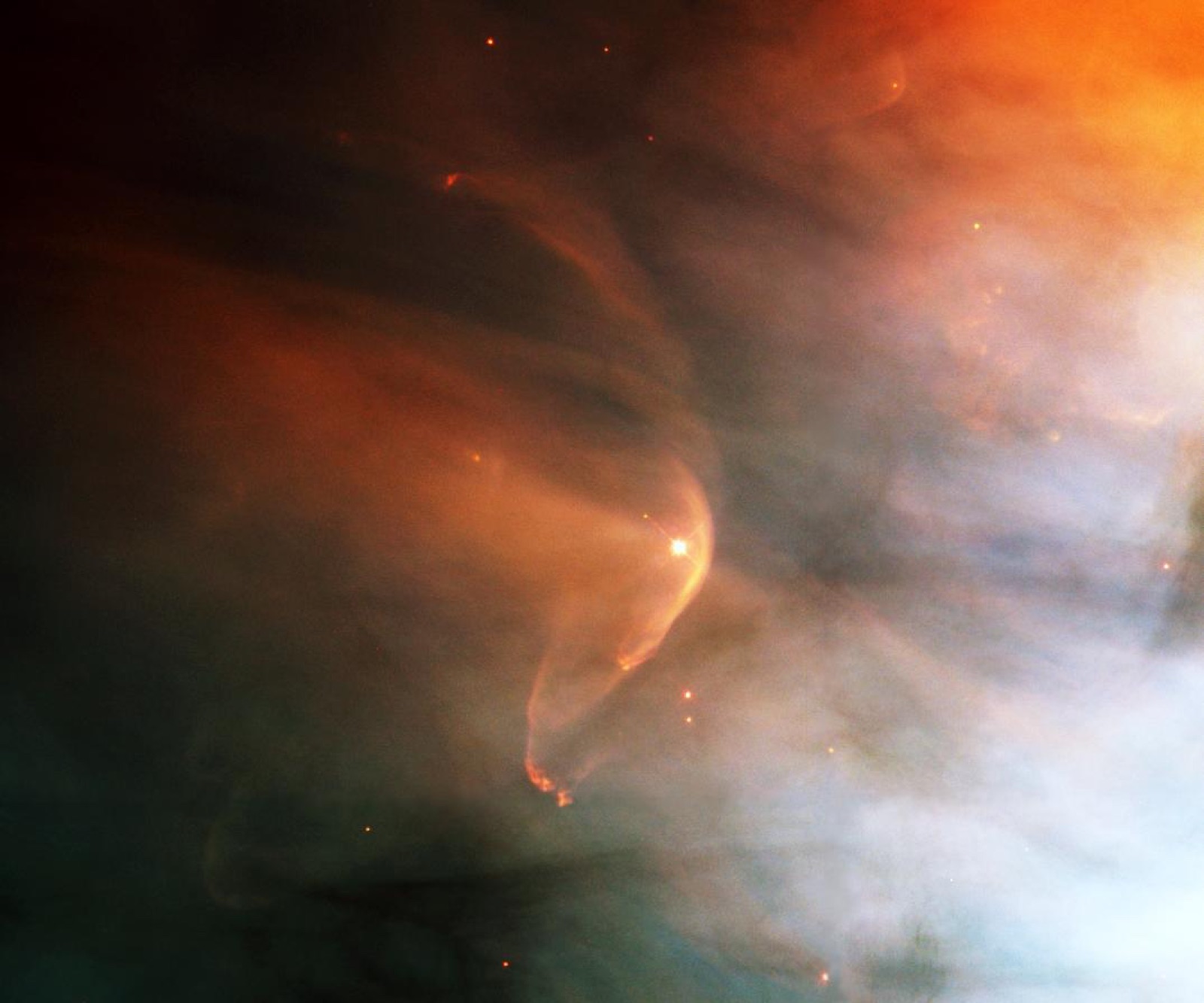
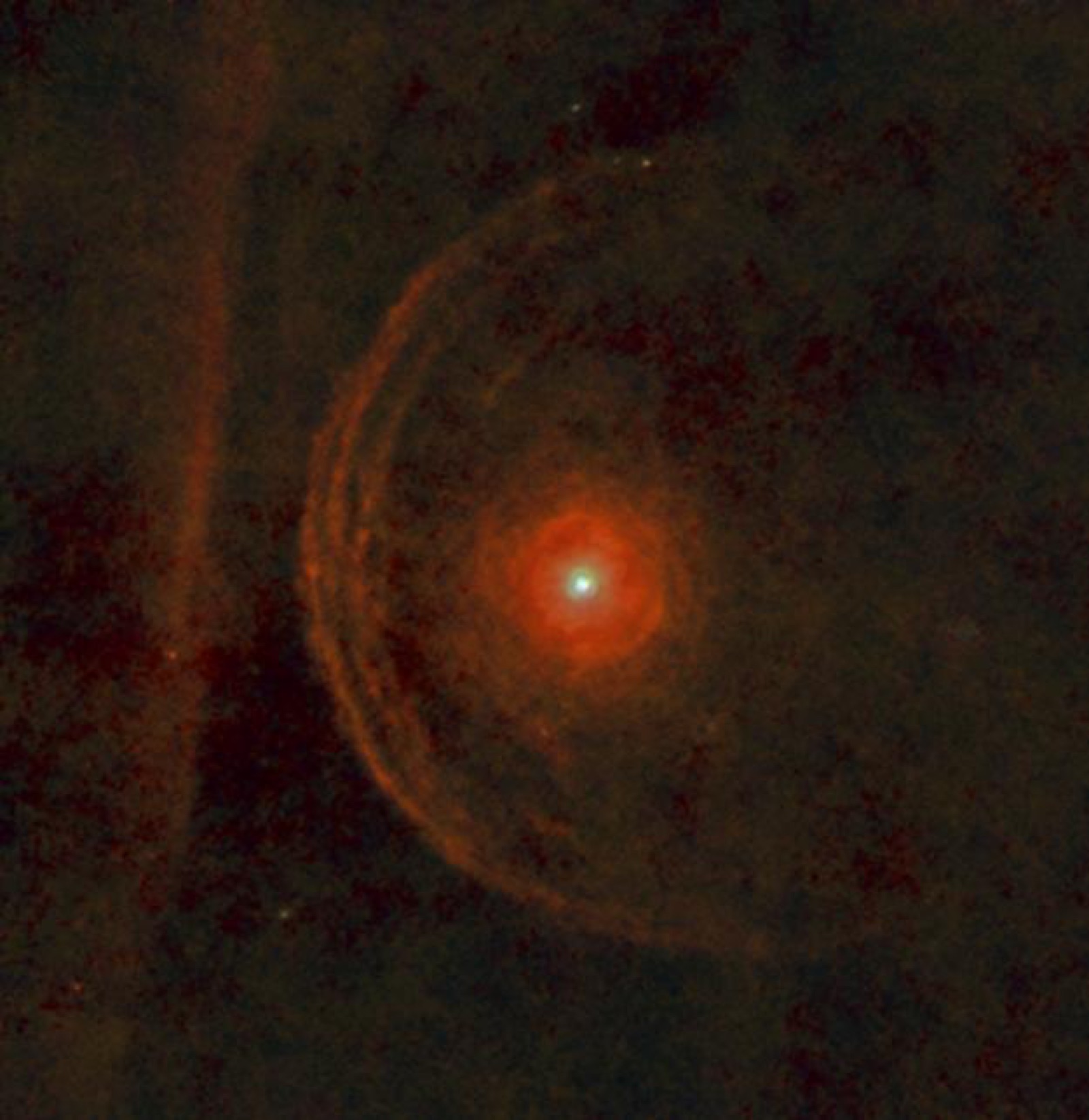
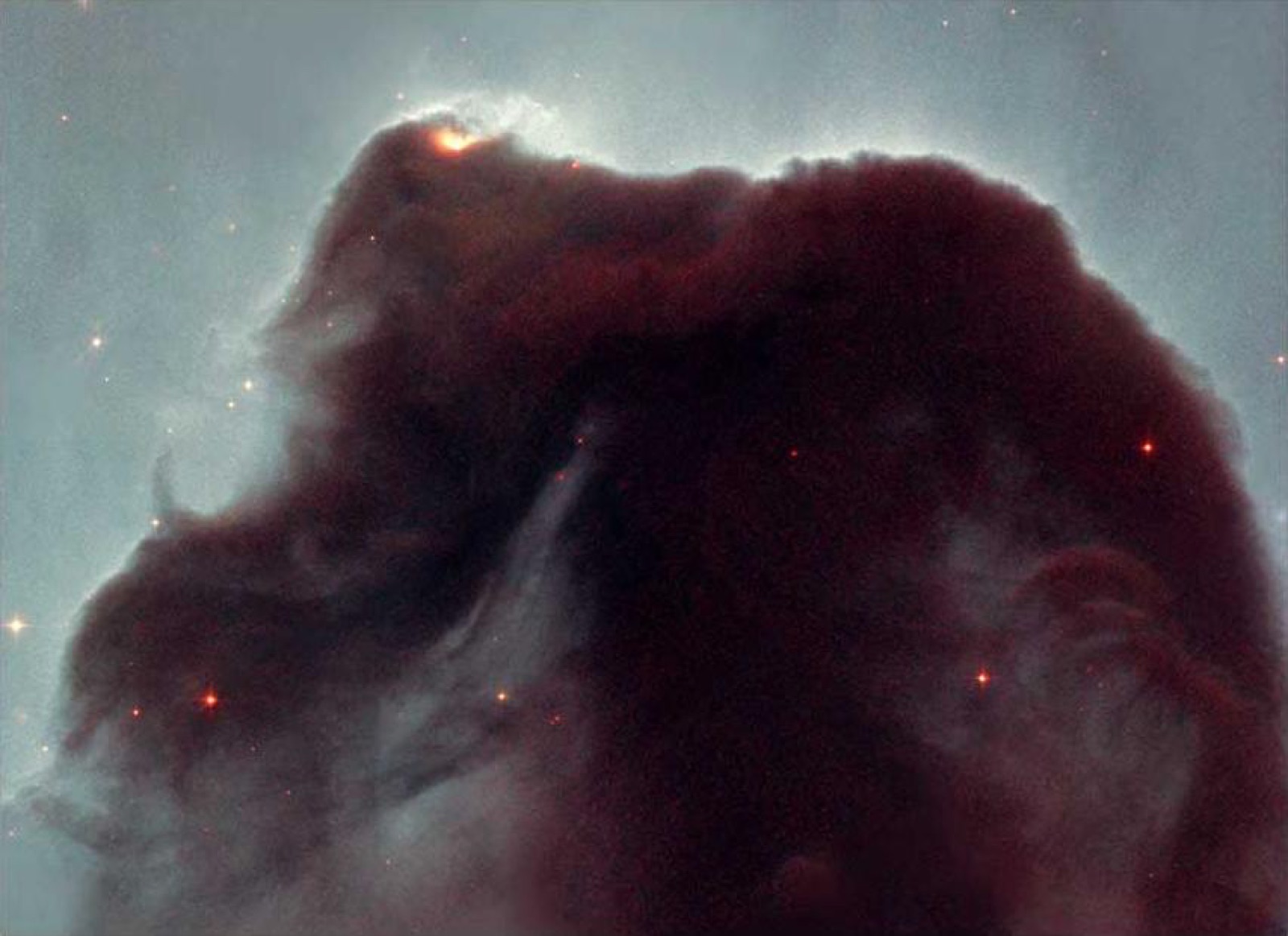
- Trapezium cluster
The deep dive
Researched for the Atlas from Wikipedia — Orion (constellation) (25,066 characters read) · updated Sep 20, 2026
01 A constellation built from supergiants
Most constellations are patchworks of unrelated stars at wildly different distances, but Orion has an unusual coherence. Many of its brilliant points belong to a single loose family called the Orion OB1 association — a sprawling fraternity of luminous hot blue supergiants whose members include the stars of both the Belt and the Sword. Betelgeuse may be a runaway member of this same group, having been flung outward long ago. These are not ordinary stars. Alnitak alone is 100,000 times more luminous than the Sun, and much of that energy pours out as ultraviolet light invisible to human eyes. Alnilam, the middle Belt star, is 375,000 times more luminous than the Sun in ultraviolet. The sheer concentration of such extreme objects in one patch of sky is why Orion dominates winter nights so completely, and why the region around it seethes with glowing gas excited by the stars' fierce radiation.
02 The Belt stars up close: distance and light Deeper
The three Belt stars look evenly matched in the sky, but they sit at noticeably different distances from Earth. Mintaka, the westernmost and faintest of the three at magnitude 2.21, lies 915 light-years away and shines with 90,000 times the Sun's luminosity. Alnitak, the easternmost at magnitude 1.8, is around 800 light-years distant. Alnilam, the middle and brightest at magnitude 1.70, is approximately 2,000 light-years away — nearly twice as far as its neighbors — yet its staggering luminosity keeps it competitive in apparent brightness. Mintaka adds another layer of complexity: it is a double star whose two components orbit each other every 5.73 days, and the system is an eclipsing binary, meaning each time one star passes in front of the other as seen from Earth, the combined light dips measurably. Just southwest of Alnitak, the five-star system Sigma Orionis shines at combined magnitude 3.7 from a distance of 1,150 light-years.
03 Betelgeuse: a star on borrowed time
Betelgeuse is a semiregular variable red supergiant so unpredictable that its ranking among the night sky's brightest stars shifts noticeably over years. By the end of 2019 it had faded enough to rank as low as 23rd brightest, though it is generally considered the 11th-brightest star in the sky. It marks Orion's right shoulder — assuming the hunter faces the observer — and its reddish hue sets it apart instantly from the blue-white stars surrounding it. The star is fusing heavy elements in its core, a sign that it is approaching the end of its life. When it finally exhausts its fuel, it will detonate as a supernova expected to outshine the Moon and remain visible in daylight. Astronomers estimate this will most likely happen within the next 100,000 years, though Betelgeuse is predicted to explode sometime within the next million years. On cosmic timescales that is imminent; on human timescales it is comfortably distant.
04 Rigel, Bellatrix, and Saiph compared Deeper
The four corner stars of Orion's rectangular frame each have a distinct personality. Rigel, the left foot of the hunter, is a B-type blue supergiant and the seventh-brightest star in the entire night sky. Like Betelgeuse, it is fusing heavy elements in its core and may eventually end in a supernova. Bellatrix, marking the left shoulder, is the 27th-brightest star in the sky and the closest major star in Orion at just 244.6 light-years from the Solar System. It is classed as a blue giant rather than a supergiant and is too small to produce a supernova; its brightness comes from a very high surface temperature rather than an exceptionally large radius. Its name means "the female warrior," sometimes rendered as the "Amazon Star." Saiph, the right foot, is of similar distance and size to Rigel yet appears much fainter to the eye. Its Arabic name means "the sword of the giant," a fitting if confusing label for a star that marks a foot. Together these four stars span a rectangle large enough to hold several full Moons across each side.
05 The Orion Nebula and its hidden nursery
At the heart of Orion's Sword hangs the Orion Nebula, catalogued as M42, one of the most studied objects in the entire sky. It is visible to the naked eye as a fuzzy patch and resolves in binoculars into swirling clouds of luminous gas and dust. Nested within it is the Trapezium cluster, named for four bright stars arranged in a trapezoid. These stars are only a few hundred thousand years old — stellar newborns — and their fierce radiation illuminates the surrounding nebula. The cluster also contains numerous brown dwarfs. Observations by the Chandra X-ray Observatory have recorded temperatures in the main Trapezium stars of up to 60,000 kelvins and have revealed ongoing star formation in the nebula around them. The Orion Nebula is part of the vast Orion molecular cloud complex, which lies approximately 1,500 light-years away and stretches hundreds of light-years across, making it one of the most intense stellar-formation regions visible from Earth.
06 Other nebulae hiding in Orion's borders Deeper
Beyond the famous M42, Orion shelters a remarkable collection of fainter nebulae. M78, formally NGC 2068, glows at overall magnitude 8.0 and sits about 1,600 light-years from Earth — close to the same distance as the Great Orion Nebula. Through a telescope eyepiece it can be mistaken for a comet, and it is associated with the variable star V351 Orionis, whose brightness changes over very short periods. NGC 1999, also near the Great Orion Nebula at 1,500 light-years, carries an integrated magnitude of 10.5 and contains the embedded variable star V380 Orionis. Near Alnitak lies IC 434, the Horsehead Nebula, a dark dust cloud whose silhouette against a bright emission background gives it its iconic shape. NGC 2174, an emission nebula, lies much farther out at 6,400 light-years. The Flame Nebula, NGC 2024, requires a larger telescope to appreciate. All of these objects belong to the Orion molecular cloud complex, which itself forms the eastern part of the even larger Orion–Eridanus Superbubble, detectable in X-rays and hydrogen emissions.
07 Orion across dozens of world cultures
Few star patterns have been independently named and storied by as many cultures as Orion. The Babylonians called it "The Heavenly Shepherd" or "True Shepherd of Anu," sacred to messenger gods. Ancient Egyptians saw a deity named Sah, syncretized with Osiris and mentioned in the Pyramid Texts of the 24th and 23rd centuries BC. Armenians identified the pattern with their legendary patriarch Hayk. In Hungary, Orion was the Archer, the Reaper, or the great hunter Nimród, father of the twins Hunor and Magor. The Irish and Scots called it An Bodach, a figure from folklore. Finnish tradition names the Belt "Väinämöinen's scythe." In China, Orion forms the lunar mansion Shen, meaning "three," a name whose written character dates back to the Shang dynasty more than three millennia ago. India's Rigveda calls it Mriga, the Deer, while Nataraja the cosmic dancer is sometimes interpreted as representing Orion. The Seri people of Mexico named the Belt stars for three animals — mule deer, pronghorn, and bighorn sheep — with one already struck by the hunter's arrow.
08 Indigenous American readings of the hunter
Across the Americas, Orion inspired vivid and distinct stories. The Ojibwa and Cree peoples both saw a giant figure — Mesabi or Mistâpêw — whose mythological role involved imprisoning souls within stones, with the first sweat lodge, represented by Corona Borealis, needed to free them. The Lakota saw not a hunter but a bison: Orion's Belt is the animal's spine, the great rectangle its ribs, the Pleiades in Taurus its head, and Sirius in Canis Major its tail. A separate Lakota story reads the lower half of Orion as the severed arm of a selfish chief, punished by the Thunder People. In this reading, Rigel is the index finger, the Orion Nebula is the thumb, Orion's Belt is the wrist, and the star Beta Eridani is the pinky finger. The daughter of the chief offered marriage to whoever could retrieve the arm, and the hero Fallen Star succeeded, the myth symbolizing harmony between gods and humanity. In Spain and much of Latin America, the Belt is simply "Las tres Marías" — The Three Marys.
09 The Orionid meteor shower and Halley's Comet
Every year around 20 October, Earth passes through a stream of debris left behind by Halley's Comet, producing the Orionid meteor shower. The radiant — the point from which meteors appear to diverge — lies near the border between Orion and Gemini. At peak activity, observers can see as many as 20 meteors per hour under good conditions. The Orionids hold the distinction of being the strongest meteor shower associated with Halley's Comet, a connection that gives a spectacular modern corollary to one of history's most famous celestial objects. The shower occurs because Halley's Comet, on its lengthy elliptical orbit, repeatedly shed dust and small rock fragments that now litter its orbital path; when Earth crosses that path, these fragments burn up as streaks of light in the upper atmosphere. The shower's radiant in Orion is what gives the Orionids their name, though the meteors themselves can appear anywhere across the sky.
10 Orion's shifting place over millennia Deeper
Orion currently straddles the celestial equator, making it visible from virtually every inhabited place on Earth. This position is not permanent. Precession — the slow wobble of Earth's rotational axis that completes one cycle over roughly 26,000 years — gradually shifts which part of the sky aligns with the equator. Orion lies well south of the ecliptic, and it sits near the equator today only because the June solstice point happens to fall near the border of Gemini and Taurus, just to Orion's north. As precession continues, Orion will drift southward relative to the equator. By AD 14000, the constellation will have moved far enough south that it will no longer be visible from the latitude of Great Britain. On an even longer timescale, the individual stars of Orion will drift apart through their own proper motions. However, because Orion's brightest stars lie at very large distances, they change apparent position slowly, meaning the constellation will remain recognizable long after most other constellations — built from closer, faster-moving stars — have distorted beyond recognition.
11 Navigating the winter sky from Orion
Orion functions as a master orientation tool for the winter sky, with lines drawn between its stars pointing reliably to other bright objects scattered across the season's canopy. Extending the Belt line southeastward leads directly to Sirius, the brightest star in the entire night sky. Extending it the opposite way, northwestward, points to Aldebaran, the ruddy eye of Taurus. Drawing a line eastward across Betelgeuse and Bellatrix, Orion's two shoulders, indicates the direction of Procyon in Canis Minor. A line from Rigel through Betelgeuse continued onward arrives at Castor and Pollux in Gemini. Rigel also belongs to the Winter Circle, a large asterism that connects six of the brightest winter stars. Sirius and Procyon, both reachable by following imaginary lines from Orion, are vertices of the compact Winter Triangle. For observers new to the night sky, learning Orion first effectively unlocks the entire winter sky, providing a reliable anchor from which to hop to constellation after constellation.
12 Orion's size, borders, and formal identity Deeper
Orion covers 594 square degrees of sky, ranking it 26th among the 88 modern constellations in area. Its formal boundaries were established by Belgian astronomer Eugène Delporte in 1930, drawn as a polygon of 26 sides. In the equatorial coordinate system these borders span right ascensions from 4 hours 43.3 minutes to 6 hours 25.5 minutes, and declinations from 22.87° north to 10.97° south. The three-letter abbreviation "Ori" was adopted by the International Astronomical Union in 1922. Orion is bordered by Taurus to the northwest, Eridanus to the southwest, Lepus to the south, Monoceros to the east, and Gemini to the northeast — a rich neighborhood that includes the brightest star in the sky (via Canis Major just beyond Lepus) and several major winter showpieces. Ptolemy included Orion among his canonical list of 48 constellations in the 2nd century AD, and it remains one of the most instantly recognized star patterns in the sky today.