 Photograph · JPL/NASA, NOAO, ESA and The Hubble Heritage Team, STScI/AURA
Nebula · Deep guide
The Horsehead Nebula
A chess knight of cold dark dust makes the sky's most famous silhouette.
What is it?
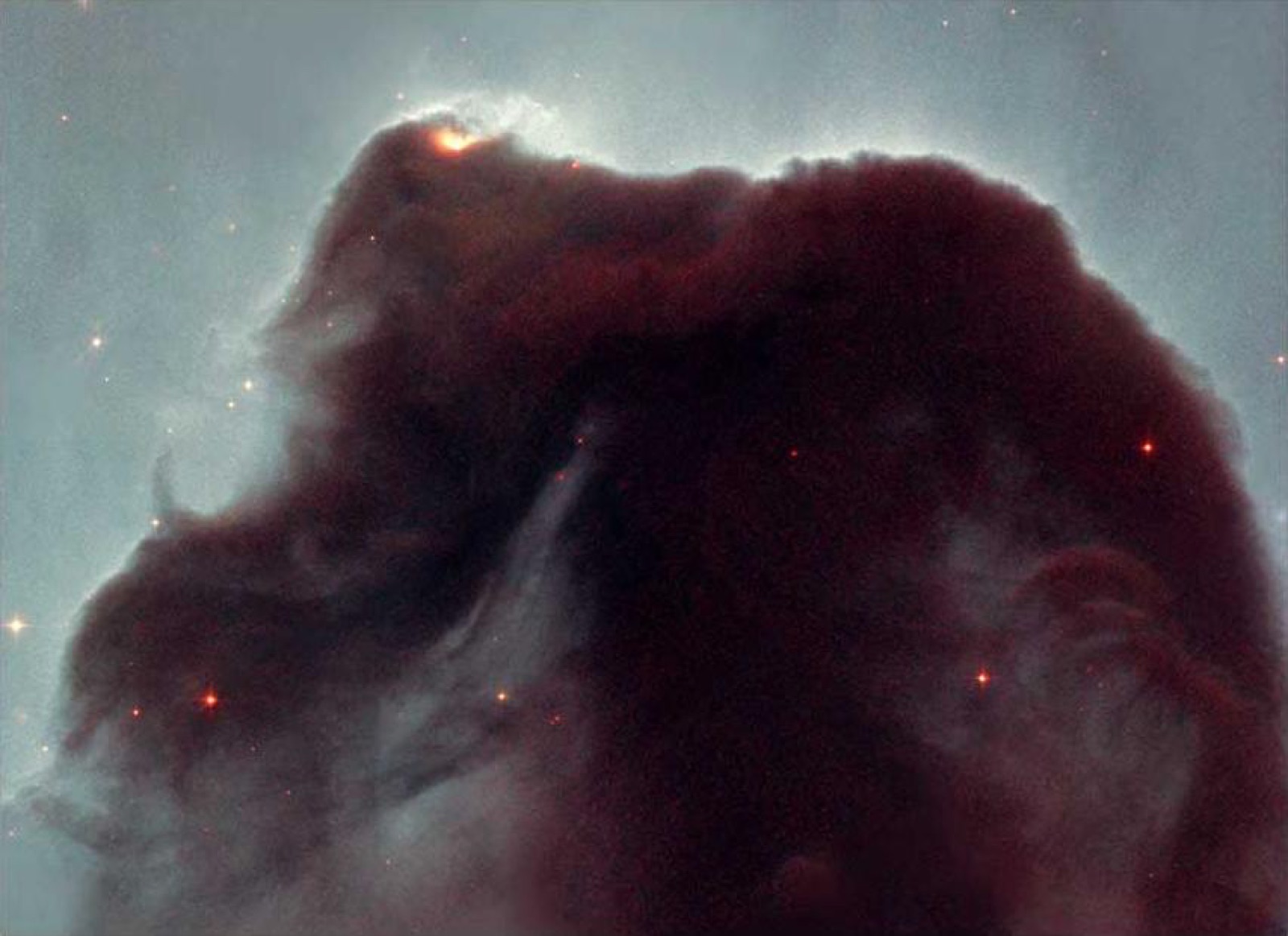
The Horsehead, 1,375 light-years away in Orion, is a pillar of opaque dust that happens to be sculpted into a perfect chess-knight profile, silhouetted against a glowing curtain of hydrogen. It is the sky's most recognizable dark nebula — first noticed by Williamina Fleming on an 1888 photographic plate — and JWST has now imaged the 'mane' dissolving strand by strand under ultraviolet light.
The deep dive
Researched for the Atlas from Wikipedia — Horsehead Nebula (2,684 characters read) · updated Sep 20, 2026
01 The Woman Who Found the Horsehead
The Horsehead Nebula was discovered in 1888 by Williamina Fleming, a Scottish astronomer working at the Harvard College Observatory. Fleming identified it not through an eyepiece on a clear night, but on a photographic plate — a glass sheet coated in light-sensitive emulsion. Photography had only recently become a serious astronomical tool, and Fleming was among the pioneers using it to catalog the sky systematically. It was the astronomer E. E. Barnard who gave the feature its enduring catalog designation, describing it as a "dark mass, diam. 4′, on nebulous strip extending south from ζ Orionis" and listing it as Barnard 33, or B33 for short. That four-arcminute diameter description — just one-eighth the width of a full moon — tells you how compact it appears from Earth, even though the structure it describes is truly enormous in physical scale. Fleming's discovery came during a broader effort to understand the nebulae of Orion, and what she found would eventually become one of the most recognized shapes in all of astronomy.
02 Where Exactly the Horsehead Sits
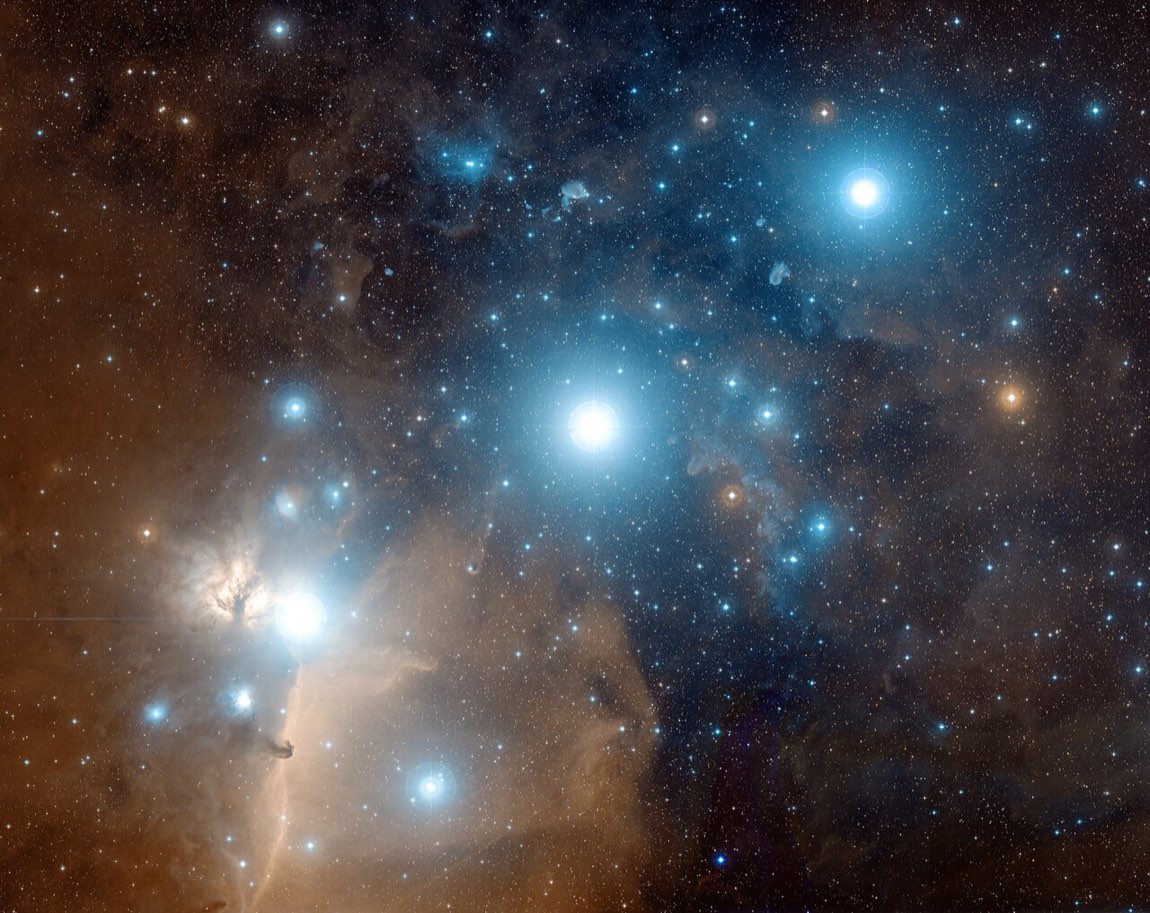
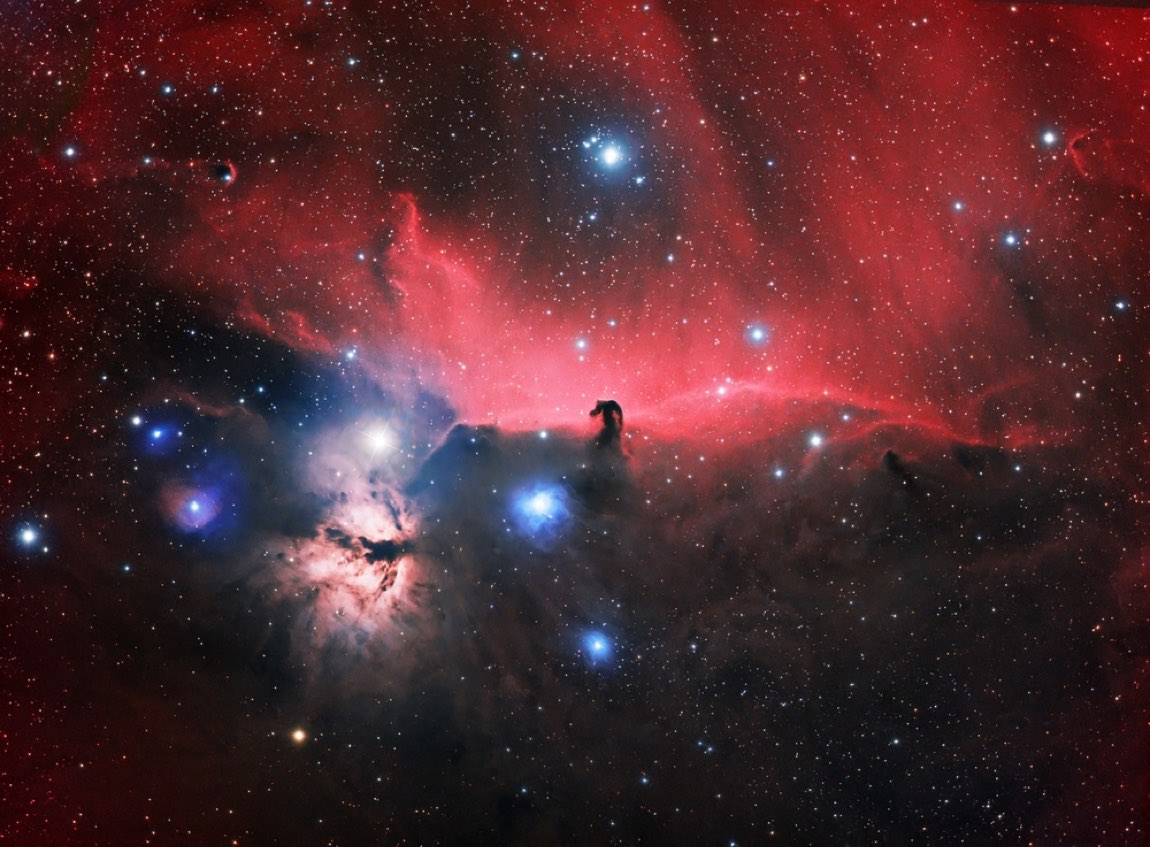
Pinpointing the Horsehead Nebula in the sky requires knowing a few landmarks. It sits just south of Alnitak, the easternmost of the three stars forming Orion's Belt — a star visible to the naked eye and a reliable pointer. The nebula itself lies about 1,375 light-years, or 422 parsecs, from Earth. To put that distance in perspective, light leaving the Horsehead right now will not reach us for more than a millennium. The nebula is embedded within Lynds 1630, a dense dust cloud, and sits along the edge of IC 434, a much larger and actively star-forming H II region — a zone of ionized hydrogen gas. All of this is part of the vast Orion molecular cloud complex, one of the closest large star-forming regions to our solar system. The Horsehead is therefore not an isolated object but a local feature within a sprawling molecular environment that includes the famous Orion Nebula not far away.
03 Why Darkness Makes a Silhouette
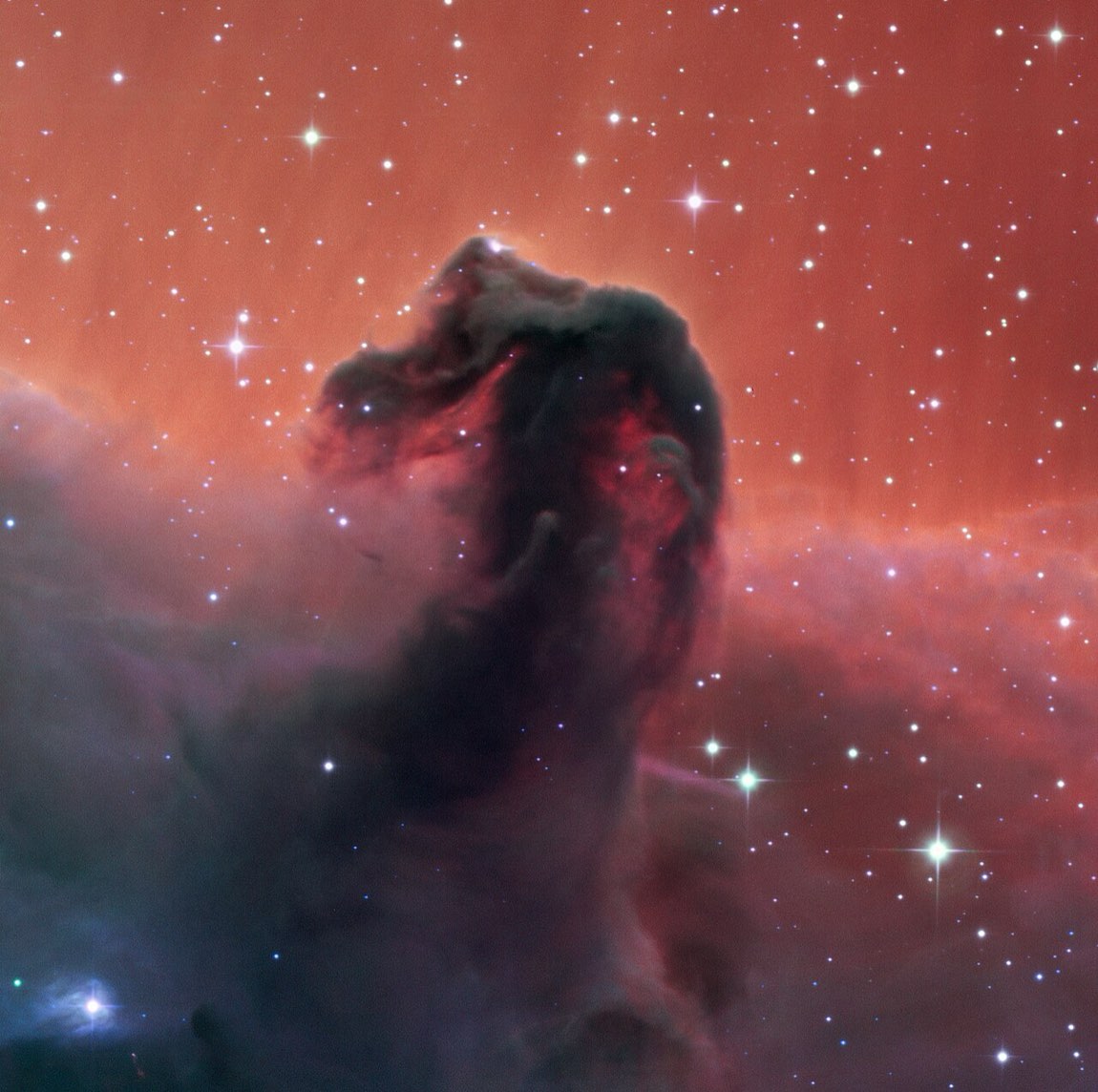
The Horsehead Nebula is classified as a dark nebula, which means it is visible not because it emits or reflects light, but because it blocks it. The darkness of the Horsehead is caused mostly by thick dust that absorbs and scatters the light of stars behind it. Behind this curtain of dust glows IC 434, the bright H II region that provides the luminous backdrop necessary to see the silhouette at all. The dust in this region is so densely packed that it creates what astronomers describe as alternating sections of nearly complete opacity and transparency. In plain terms: some areas let almost no light through, while neighboring patches are relatively clear. The lower part of the Horsehead's neck even casts a detectable shadow to the left, a detail that gives the structure genuine three-dimensional character. Without the bright ionized gas behind it providing contrast, the Horsehead would simply be invisible — a hidden mass in an unremarkable patch of sky.
 ⤢
⤢
04 The Red Glow and What Causes It Deeper
Color images of the Horsehead Nebula are dominated by a striking red hue that comes from ionized hydrogen gas — specifically hydrogen-alpha emission, abbreviated Hα. This glowing hydrogen is located predominantly behind the nebula rather than within the dark cloud itself. The energy source responsible for ionizing this gas is Sigma Orionis, a nearby bright star whose ultraviolet radiation is energetic enough to strip electrons from hydrogen atoms. When those electrons recombine with protons, they release photons at the characteristic red wavelength of Hα. This is the same emission mechanism responsible for the red color seen in many other nebulae throughout the galaxy. The boundary between the dark Horsehead cloud and the glowing red background is what defines the nebula's famous profile so sharply. Without Sigma Orionis, the hydrogen behind the Horsehead would not glow, and the silhouette would again be invisible. The nearby star is therefore as essential to the nebula's appearance as the dust cloud itself.
05 Magnetic Fields Shape the Nebula's Streams Deeper
One of the more subtle but scientifically significant features visible in detailed images of the Horsehead Nebula is a series of elongated streaks running across the glowing background. These foreground streaks are not random wisps of gas — they are streams created by magnetic fields channeling the movement of ionized gas as it leaves the nebula. Magnetic fields threading through molecular clouds are known to influence the structure and motion of gas and dust, and the Horsehead region appears to be a clear example of this effect. The streaks are visible against the bright Hα background, making the otherwise invisible magnetic architecture of the region at least partially legible. A glowing strip of hydrogen gas also marks the edge of the enormous cloud behind the Horsehead, and observers have noted that the density of nearby stars differs noticeably on either side of this boundary — a consequence of the cloud's physical influence on its local stellar environment.
06 A Nursery Hidden Inside the Dark
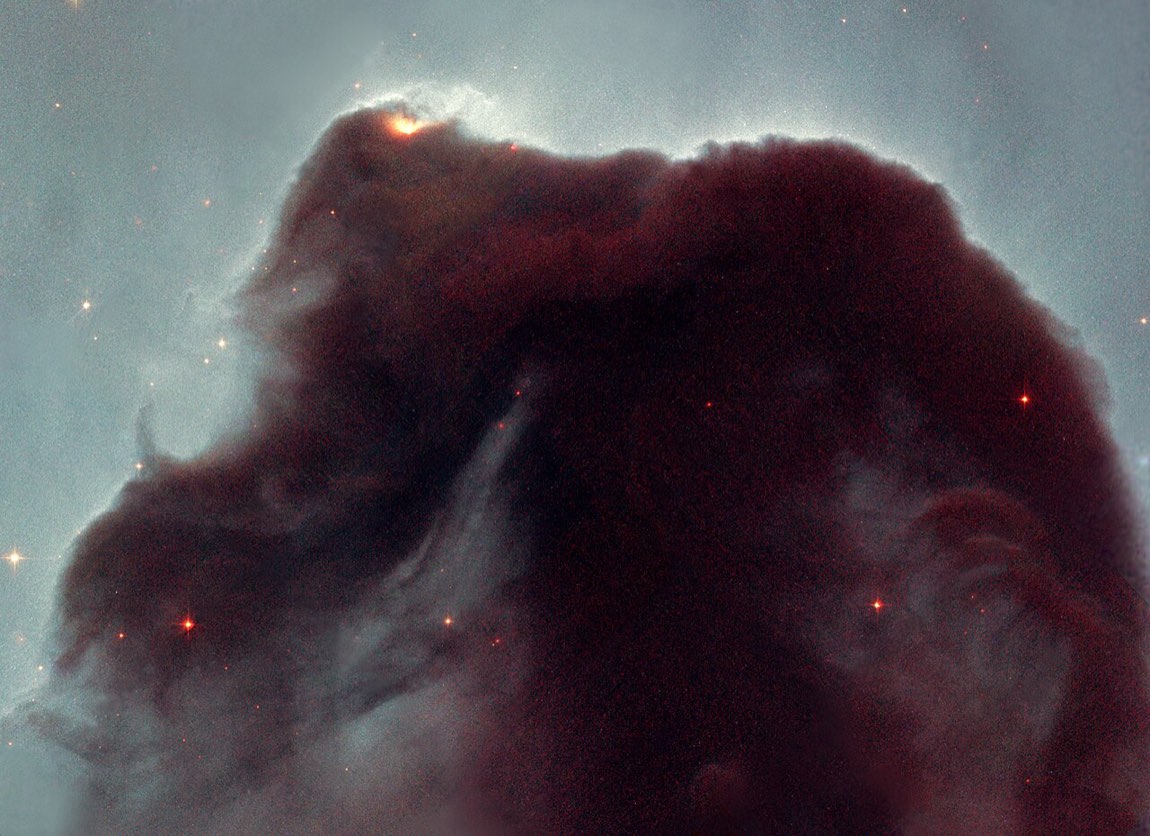
Despite its appearance as a solid, lightless wall, the Horsehead Nebula is anything but inert. The dark cloud of dust and gas is an active site of star formation, specifically of what astronomers call low-mass stars — objects with masses comparable to or smaller than our Sun. The base of the Horsehead contains bright spots that are young stars currently in the process of forming, caught in the very act of condensing out of the surrounding molecular material. These protostars are embedded so deeply in dust that they can often only be detected in infrared light rather than visible wavelengths. The Horsehead sits within the broader Orion molecular cloud complex, a region already well known for producing new stars, including those of the Orion Nebula. Star formation here is not a finished story but an ongoing process, and the Horsehead represents one chapter of it — a dense pocket where gravity is slowly winning against the pressure and turbulence that would otherwise keep the cloud from collapsing.
 ⤢
⤢
07 The Orion Context: A Much Larger Stage
The Horsehead Nebula cannot be fully understood in isolation. It is part of the Orion molecular cloud complex, one of the largest and most active star-forming regions in our galactic neighborhood. Within this complex, the Horsehead is a relatively small feature — embedded within Lynds 1630, a dense dust cloud, and abutting IC 434, an H II region that spans far beyond the nebula itself. The neighboring Orion Nebula is part of the same complex, making Orion's constellation not just a cultural landmark but a genuine physical hub of recent and ongoing stellar activity. The molecular cloud creates a structured environment in which different zones have very different characters: some are transparent, some are opaque, and the boundaries between them are sites of intense astrophysical interest. Heavy concentrations of dust in the Horsehead region and the neighboring Orion Nebula are localized into interstellar clouds that generate this patchwork of opacity. The Horsehead is, in essence, one dark tile in a much larger mosaic.
08 How to Find It in the Night Sky
For observers in the Northern Hemisphere, Orion is a winter constellation, prominent in the evening sky during the colder months. Southern Hemisphere observers see it in their summer evenings. In either case, locating the Horsehead begins with finding Orion's Belt, then identifying Alnitak — the belt's easternmost star. The Horsehead lies just to Alnitak's south. The challenge for visual observers is that, as a dark nebula, the Horsehead requires bright background nebulosity to be visible, and that background is faint. Photographing it is far more practical than viewing it visually; long-exposure images with hydrogen-alpha filters reveal the red glow of IC 434 and the Horsehead's silhouette clearly. Even modest amateur telescopes equipped with appropriate filters and camera sensors can capture the basic shape. Its angular size of approximately 4 arcminutes, as recorded by Barnard, means the shape is recognizable but requires reasonable image scale and good seeing conditions to resolve well.
09 The Shape That Made It Famous
The Horsehead Nebula is described as one of the most identifiable nebulae in the sky, and the reason is straightforward: it looks like a horse's head. The profile — a roughly vertical column of dark material with a curved top and a suggestion of a mane — is recognizable enough that it has become a cultural shorthand for the beauty of deep-sky astronomy. This recognizability has made it a frequent subject of astrophotography and a standard demonstration image for new telescopes and space observatories alike. The shape emerges from the irregular boundary where thick dust meets the glowing red background of IC 434. It is a silhouette defined entirely by the contrast between the opaque cloud and the luminous gas behind it. The lower neck region even casts a shadow, adding to the three-dimensional impression. Like all nebulae, the Horsehead is not a static form — over millions of years, stellar winds, radiation, and gravity will erode and reshape it — but on human timescales, this horse is not going anywhere.
 ⤢
⤢
10 Fiction Meets the Horsehead
The Horsehead Nebula has made at least one notable appearance in science fiction literature. In Isaac Asimov's 1951 novel The Stars, Like Dust, two characters debate the origin of the nebula's name. One character, educated on Earth, gives the straightforward explanation: it was named for its resemblance to a horse's head. The second character, who grew up on another planet far from Earth's cultural frame of reference, believes it was named after a person called Horace Hedd, described as the first man to enter it. The exchange is a small but telling moment — it uses a real astronomical object to illustrate how names and their meanings drift across cultures and distances. Asimov's use of the Horsehead as a recognizable cosmic landmark reflects the nebula's already prominent status in popular scientific consciousness by the mid-twentieth century, just decades after Williamina Fleming's photographic discovery and Barnard's catalog entry gave it its first formal descriptions.
More real images of The Horsehead Nebula
Genuine spacecraft and telescope imagery, every frame credited and licensed. Tap any photo to enlarge.