Centaurus
“The Centaur” · Southern · best around May evenings
Real star positions and magnitudes (HYG database via D3-Celestial, BSD-3). Lines are the conventional stick figure; north is up.
The story
The wise centaur Chiron, tutor of heroes — and keeper of the southern sky's treasures: Alpha Centauri, the nearest star system to our Sun; Omega Centauri, the grandest globular cluster in the heavens (10 million stars); and the active galaxy Centaurus A. From southern latitudes it wraps around the Southern Cross.
How to find it
Southern autumn: the two brilliant Pointers marking the centaur's forelegs lead to Crux.
✦ What lives inside it
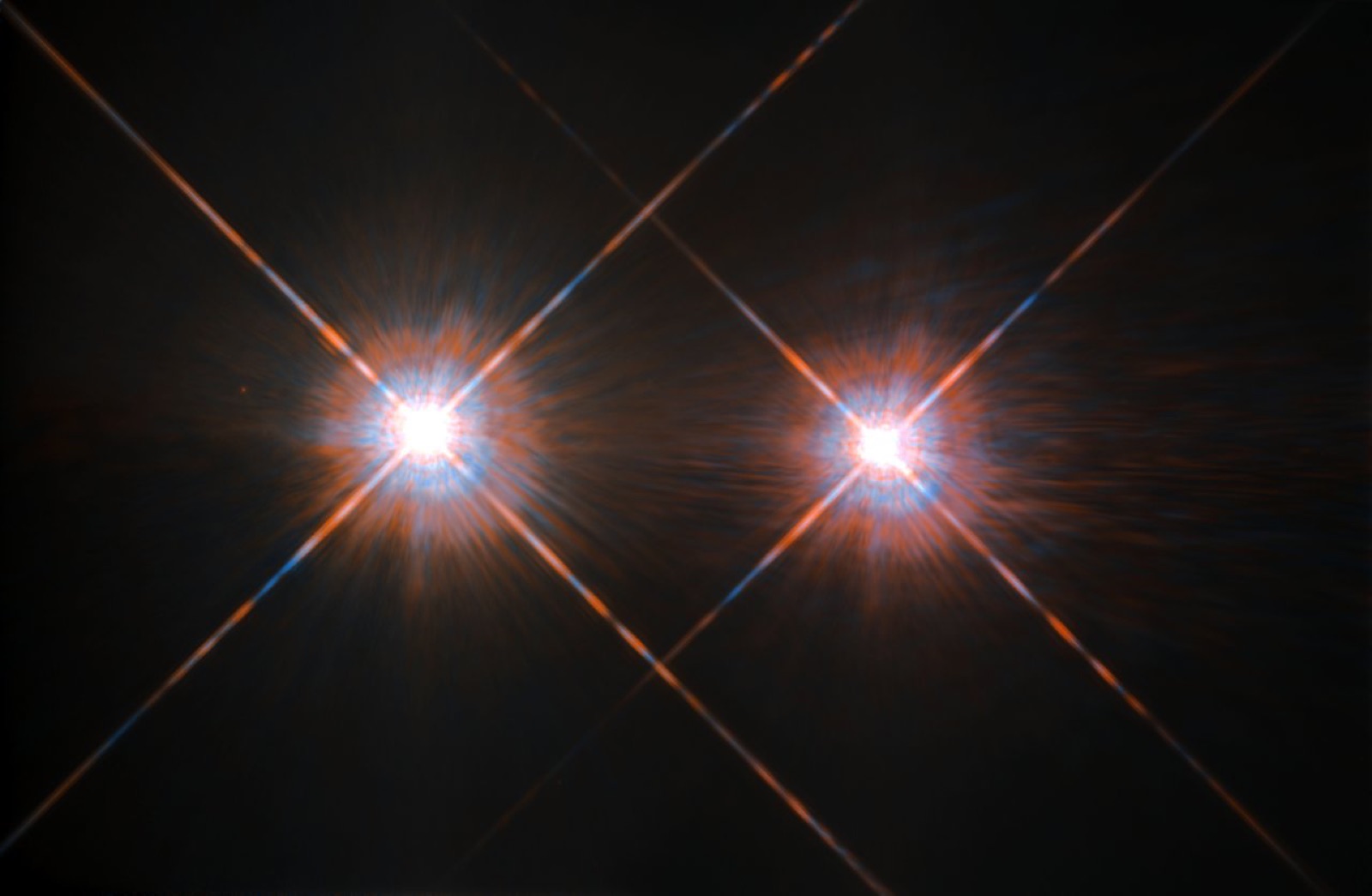
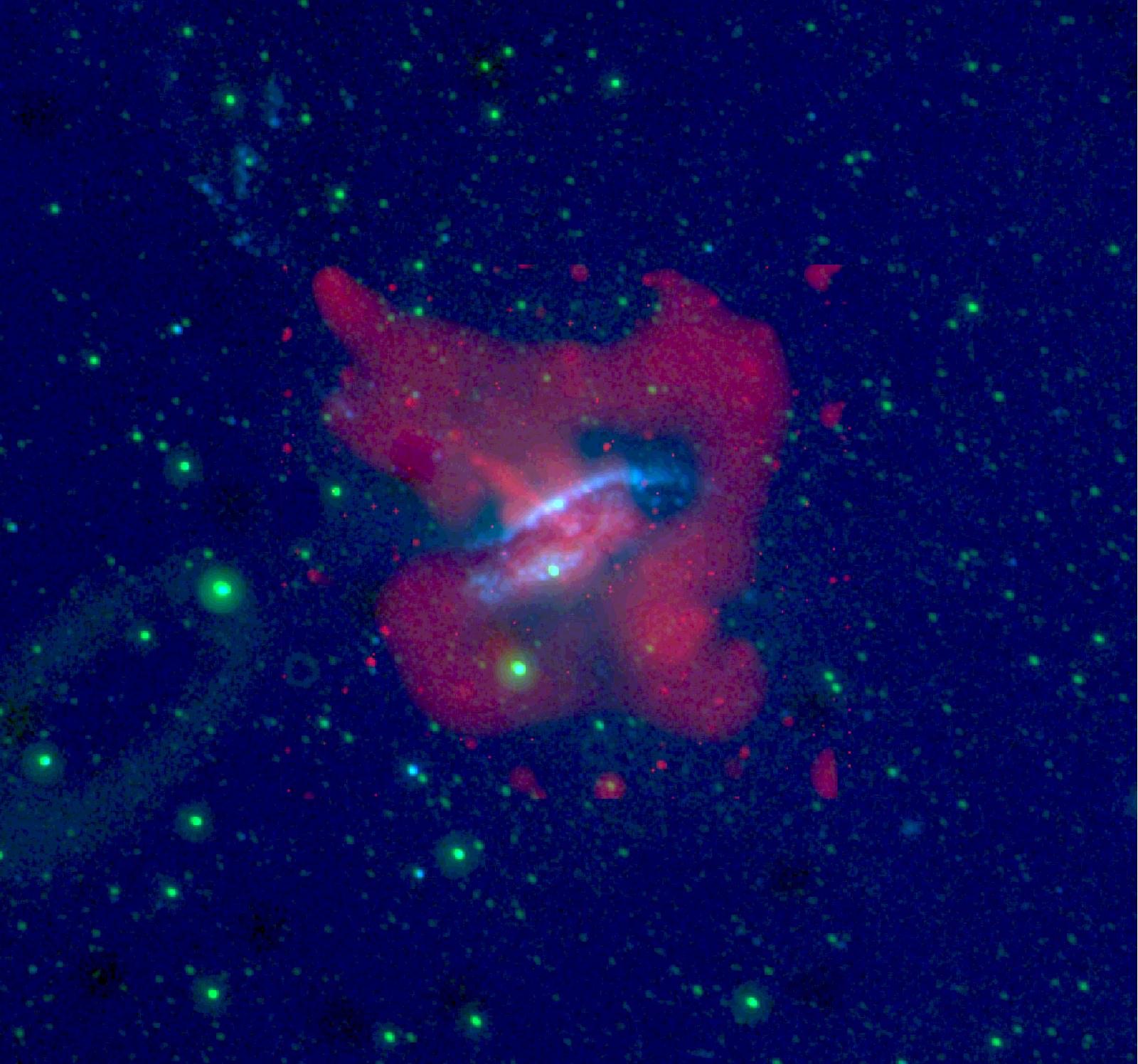
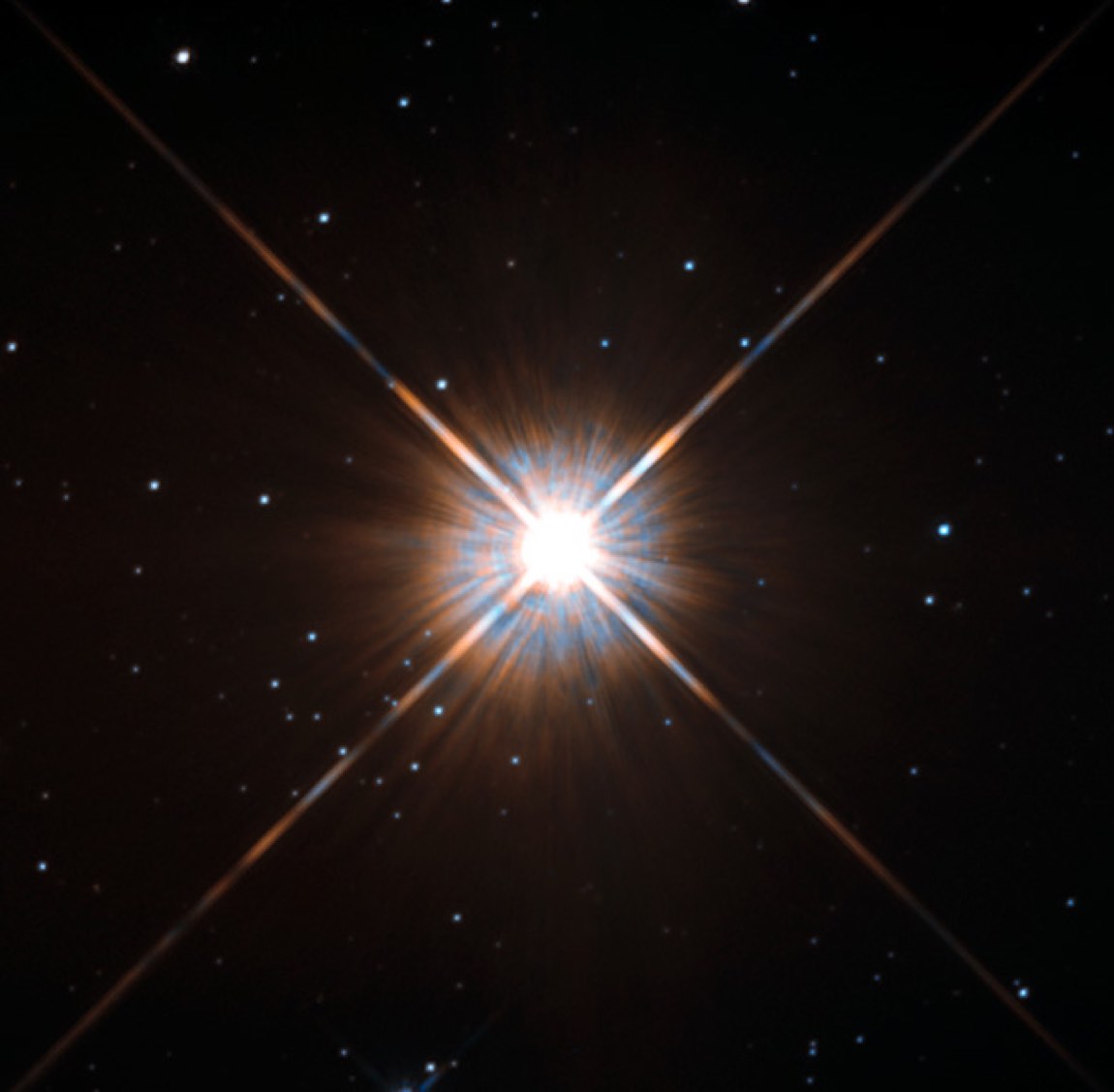
- Omega Centauri cluster
The deep dive
Researched for the Atlas from Wikipedia — Centaurus (14,435 characters read) · updated Sep 20, 2026
01 More stars than any other constellation
Centaurus holds a record that rarely makes headlines: it contains 281 stars brighter than magnitude 6.5, more naked-eye stars than any other constellation in the sky. That sheer stellar population reflects both its enormous angular area and its position along a richly populated arm of our galaxy. Yet the Milky Way itself does not lie within the constellation's formal borders — Centaurus is crowded with foreground and background stars rather than being a dense band of the galactic plane. Its two brightest stars, Alpha and Beta Centauri, are so prominent that they serve a navigational purpose beyond their own constellation: southern-hemisphere observers use them as pointer stars to locate the Southern Cross, Crux. Alpha Centauri will drift noticeably over human timescales — within about 4,000 years it will sit only half a degree from Beta Centauri in the sky, an alignment caused by the system's exceptionally high proper motion relative to background stars.
02 Alpha Centauri's three very different suns Deeper
The Alpha Centauri system packs three stars into one of astronomy's most studied addresses, 4.4 light-years from Earth. The two main members — magnitudes −0.01 and 1.35, both yellow-hued — orbit each other with an 80-year period and will appear closest together as seen through Earth's telescopes in 2037 and 2038. Together they form the third-brightest point of light in the night sky at a combined magnitude of −0.28. The third member, Proxima Centauri, is a red dwarf of magnitude 11.0, currently the single nearest star to the Sun, and orbits the central pair with a period of approximately one million years — so leisurely that it appears almost 2 degrees away from its companions on the sky. Proxima is also a flare star: it produces outbursts lasting only minutes yet bright enough to raise its total magnitude by more than one full step. These flares have direct implications for any planets that might exist in Proxima's habitable zone, bathing them in intense ultraviolet radiation during each event.
03 Omega Centauri: a galaxy eaten alive
Omega Centauri (NGC 5139) is the largest and brightest globular cluster in the Milky Way — and it may not have started life as a globular cluster at all. It sits 17,000 light-years away and spans 150 light-years across, ten times the diameter of the next-largest globular cluster, with a luminosity exceeding one million times that of the Sun. Its several million stars have an average age of about 12 billion years, and crucially they span a range of ages and chemical compositions rather than forming the single, uniform population typical of most globular clusters. This has led astronomers to suspect that Omega Centauri is actually the stripped core of a dwarf galaxy that the Milky Way absorbed long ago — its outer stars torn away by tidal forces while the dense nucleus survived. To the naked eye it appears fuzzy and unmistakably non-circular, roughly half a degree across, matching the apparent diameter of the full Moon. Edmond Halley established in 1677 that it was not a true star, and James Dunlop confirmed its globular nature in 1827.
04 Centaurus A: a radio giant next door
At roughly 11 million light-years away, Centaurus A (NGC 5128) is one of the closest active galaxies to Earth and one of the strongest radio sources in the sky. Its defining visual feature is a prominent dust lane cutting across what otherwise looks like a fairly large elliptical galaxy — dust lanes of this kind are unusual in elliptical galaxies, and astronomers believe they are the signature of a past merger with a spiral galaxy. At the galaxy's core sits a supermassive black hole that fires jets of matter outward; the particles in those jets emit radio waves through synchrotron radiation as they spiral around magnetic field lines. With an overall magnitude of 7.0, Centaurus A has reportedly been glimpsed with the naked eye under perfect conditions, making it one of the most distant objects any human eye has ever detected without optical aid. A small telescope reveals the elliptical body, but the dust lane only becomes visible with about 4 inches of aperture; instruments above roughly 12 inches show its west-northwest to east-southeast orientation clearly, along with a second, fainter dust lane on the galaxy's eastern side.
05 A diamond star and a planet being born Deeper
Two objects in Centaurus sit at extraordinary moments in stellar life. BPM 37093 is a white dwarf whose carbon atoms are believed to have crystallized under the enormous pressure inside the dead star — because diamond is also carbon arranged in a crystalline lattice (though in a different geometric configuration), scientists nicknamed it "Lucy," after the Beatles song "Lucy in the Sky with Diamonds." At the opposite end of the stellar timeline, PDS 70 — also catalogued as V1032 Centauri — is a young, low-mass T Tauri star still surrounded by the disk of gas and dust from which planets form. In July 2018 astronomers captured the first conclusive image of a nascent exoplanet, PDS 70b, embedded within that protoplanetary disk. The two objects together offer a rare opportunity to study stellar evolution at its two extremes: at one end, a sun-like star that has burned through its fuel and crystallized into a cosmic gemstone; at the other, a star so young that its planets are still assembling themselves from primordial material.
06 From Babylon to Greece: 4,000 years of the centaur
The stars of Centaurus have carried a recognizable figure for at least four millennia. Its earliest known ancestor is a Babylonian constellation called the Bison-man (MUL.GUD.ALIM), which took two forms: a four-legged bison with a human head, and a being with a man's head and torso fused to the hind legs and tail of a bull or bison. From early times this figure was closely linked to the sun god Utu-Shamash. By the late third millennium BCE the Bison-man had been replaced by a different constellation, the Wild Boar. The Greeks recast the figure as a centaur and gave it the name still used today; the constellation is mentioned by Eudoxus in the 4th century BC and by Aratus in the 3rd century BC. Ptolemy catalogued 37 of its stars in the 2nd century AD. The Roman poet Ovid, writing in his Fasti, identified the figure specifically with Chiron — the wise centaur who tutored Heracles, Theseus, and Jason — and described how Chiron was accidentally wounded by one of Hercules' poison arrows and subsequently placed among the stars.
07 How Centaurus once swallowed its neighbors Deeper
The modern Centaurus is large by any measure, but the ancient constellation was larger still, consuming regions now treated as entirely separate star patterns. The constellation Lupus — today a recognized figure in its own right — was formerly considered an asterism within Centaurus, depicted in star-atlas illustrations as an unspecified animal held in the centaur's grip or impaled on its spear. The Southern Cross, Crux, now one of the most celebrated constellations in the southern sky and a symbol on multiple national flags, was once merely an asterism marking the centaur's legs. And the small constellation Circinus, tucked beneath Centaurus today, occupied territory that earlier sky-mappers left undefined under the centaur's front hooves. The gradual carving-up of Centaurus reflects the broader history of constellation-making, in which large, loosely defined ancient figures were subdivided as astronomers needed more precise positional reference points. Centaurus also shifted dramatically in visibility over history: precession has moved it southward over millennia, and it is now near its maximum southern declination, though in roughly 7,000 years it will again be well placed for northern-hemisphere observers.
08 Pacific and Asian skies saw it differently
The stars of Centaurus were organized into very different pictures by cultures across Asia and the Pacific. Chinese astronomers divided them among three separate sky regions: the Azure Dragon of the East, the Vermillion Bird of the South, and the Southern Asterisms. Stars too far south to be observed from China — including some of Centaurus's fainter members — were catalogued among the Southern Asterisms by the scholar Xu Guangqi, who worked from western star charts to extend the Chinese system. Polynesian navigators also recognized Centaurus. On the atoll of Pukapuka the constellation carried two names: Na Mata-o-te-tokolua and Na Lua-mata-o-Wua-ma-Velo, while Tongan navigators used four different names for the same grouping. Hawaiian sky-watchers gave individual names to Alpha Centauri (either Melemele or Ka Maile-hope) and Beta Centauri (either Polapola or Ka Maile-mua). In the Tuamotu islands Alpha was Na Kuhi and Beta was Tere. Bugis sailors of the Indonesian archipelago used the Alpha-Beta pair as a navigation asterism called bintoéng balué, meaning "the widowed-before-marriage," and also knew it as bintoéng sallatang, "southern star."
09 A galaxy cluster with a mysterious plume Deeper
About 160 million light-years away lies the Centaurus Cluster, one of the nearest galaxy clusters to Earth, identifiable by its redshift of 0.0114. The cluster has a layered thermal structure: a cooler, denser core of gas at its center and a hotter, more diffuse envelope of gas further out. Its intracluster medium — the thin gas filling the space between galaxies — is unusually rich in metals, meaning elements heavier than helium. Astronomers attribute this abundance to an exceptionally high rate of supernovae throughout the cluster's history, each explosion seeding the surrounding gas with newly forged heavy elements. Perhaps most intriguingly, the cluster possesses a plume of gas whose origin remains unexplained. This unresolved puzzle makes the Centaurus Cluster an active target of X-ray telescope studies, since the hot intracluster gas radiates most strongly at X-ray wavelengths rather than in visible light, requiring space-based observatories to probe its structure in detail.
10 Peculiar galaxies that rewrite rotation rules Deeper
Centaurus hosts two galaxies that challenge simple models of how galaxies rotate and form. NGC 4622 lies 200 million light-years away and presents its face nearly directly toward Earth, yet its spiral arms wind in both directions simultaneously — a structure so unusual that astronomers cannot determine which way the galaxy rotates. One leading explanation is that a collision with a smaller companion galaxy near the core triggered the contradictory spiral pattern. NGC 4650A, 136 million light-years away, is a polar-ring galaxy: it has a central body of older stars resembling an elliptical galaxy, surrounded by an outer ring of young stars orbiting in a plane nearly perpendicular to the core. The ring's plane is distorted, suggesting the configuration arose from a galaxy collision about a billion years ago. Crucially, the stars in that outer ring move far too quickly given their combined mass — a discrepancy that researchers have cited as evidence for a dark matter halo surrounding the galaxy, providing the additional gravitational pull needed to explain the observed orbital speeds.
11 Variable stars spanning 18-month rhythms
Centaurus contains a variety of pulsating and flaring stars that give observers a chance to watch stellar behavior change on human timescales. R Centauri is a Mira-type variable, a class of cool giant stars that brighten and fade with long, regular rhythms. Sitting about 1,250 light-years from Earth, R Centauri cycles between a minimum magnitude of 11.8 and a maximum of 5.3 — a swing of more than six magnitudes, or a factor of roughly 250 in apparent brightness — over a period of 18 months. At maximum it is visible to the naked eye; at minimum it requires a telescope. V810 Centauri, by contrast, is a semiregular variable, a class that pulsates without the strict periodicity of Mira stars. Meanwhile, the flare star Proxima Centauri, technically a member of the Alpha Centauri system, produces sudden outbursts lasting only minutes in which its brightness jumps by more than one magnitude before subsiding, behavior driven by intense magnetic activity on its surface rather than internal pulsations.
12 HR 5171 and Centaurus's stellar extremes
Centaurus spans an extraordinary range of stellar sizes. At the small end sits Proxima Centauri, a red dwarf so faint at magnitude 11.0 that it is wholly invisible to the unaided eye despite being our nearest stellar neighbor. At the large end is HR 5171, flagged in the article as one of the largest stars yet discovered — a reminder that Centaurus, despite being dominated visually by its brilliant pointer stars, harbors objects at nearly every extreme the universe produces. The constellation's white dwarf BPM 37093 represents yet another extreme: the dense endpoint of stellar evolution, packing a sun's worth of mass into a volume roughly the size of Earth. PDS 70 shows the very beginning of that long process, a star still accreting matter from its disk. Taken together, these objects make Centaurus something of an accidental museum of stellar life stages — from a disk of planet-forming dust around a T Tauri star, through active main-sequence stars of many types, all the way to a white dwarf possibly crystallized into a cosmic diamond.