 Photograph · NASA/JPL/Caltech
Galaxy · Deep guide
Centaurus A
The nearest feeding giant is a galaxy wearing its last meal.
What is it?
Centaurus A, only 12 million light-years away, is the closest active galaxy: its central black hole is feeding, firing radio-bright jets nearly a million light-years long. The galaxy itself is a giant elliptical wrapped in a warped belt of dust — the visible remains of a spiral galaxy it swallowed. For southern observers it is a binocular object.
The deep dive
Researched for the Atlas from Wikipedia — Centaurus A (8,233 characters read) · updated Sep 20, 2026
01 A Galaxy Caught in the Act of Merging
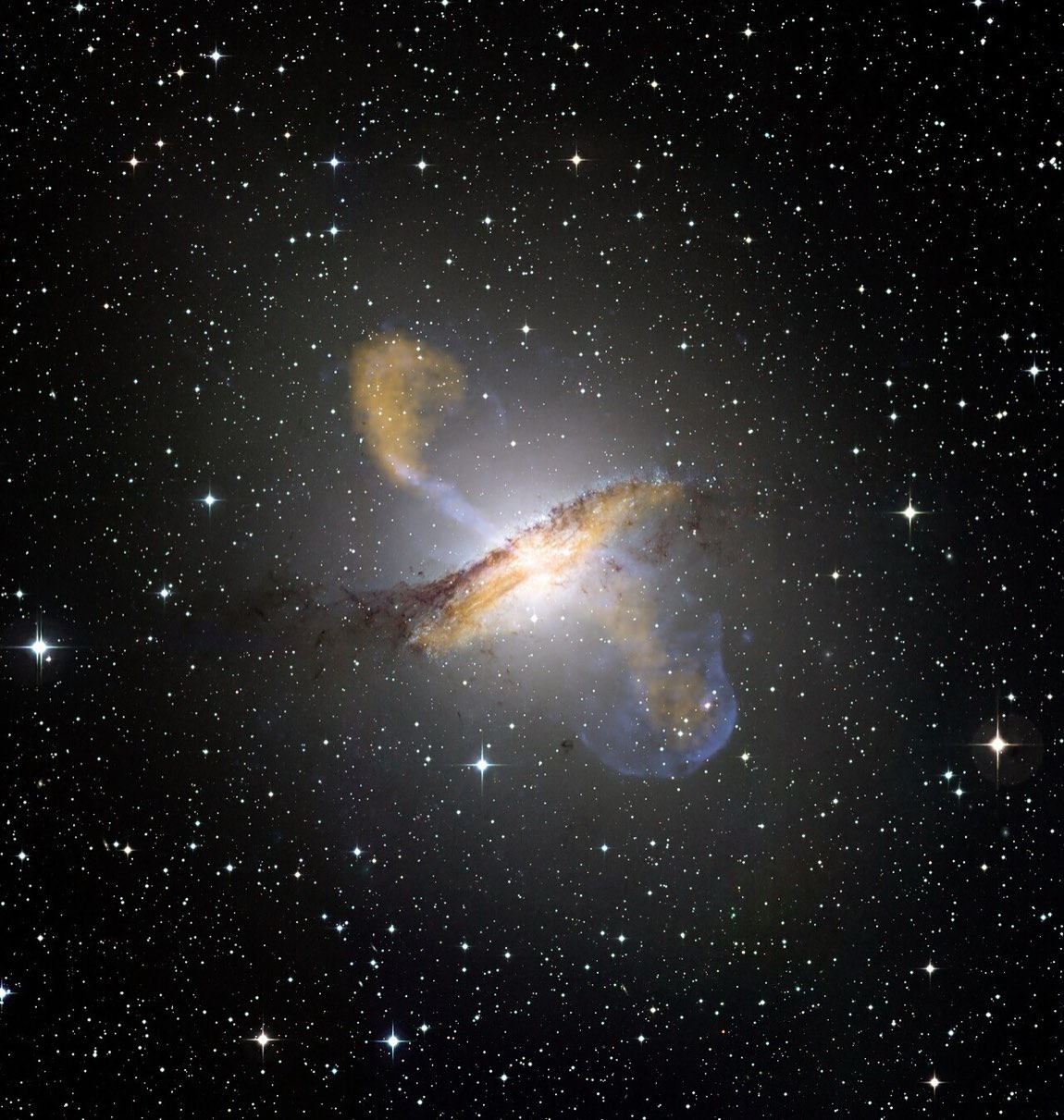
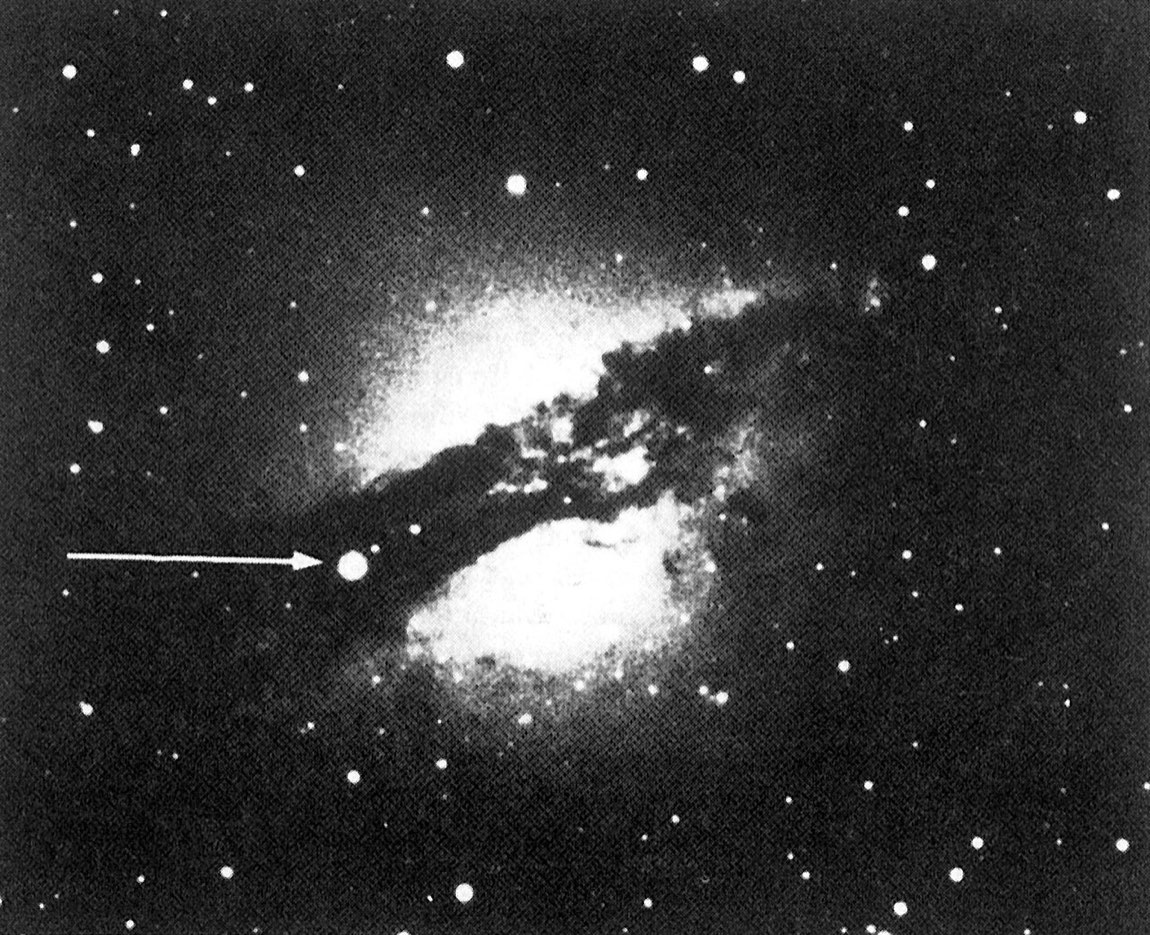
Centaurus A wears its turbulent past on its sleeve. The galaxy's strange appearance — an otherwise orderly elliptical or lenticular body slashed across the middle by a thick, dark dust lane — is not a trick of perspective. Astronomers generally recognise this peculiarity as the direct result of a collision between two smaller galaxies. Walter Baade and Rudolph Minkowski first proposed this interpretation in 1954, suggesting that a giant elliptical galaxy ploughed into a smaller spiral. That spiral's dusty disk is thought to be exactly what we see today as the famous obscuring band. Over 100 star-formation regions have since been identified within that dusty disk, confirming that the violence of the merger compressed gas and triggered intense bursts of new star birth. The bulge surrounding this chaos, by contrast, is composed mainly of old, evolved red stars — the quiet remnant of the original elliptical host. The collision is not finished: models indicate the two components will eventually merge completely, though what precisely happens when an elliptical swallows a spiral remains an open question in galactic astronomy.
02 Discovered from a Backyard in Parramatta
The story of Centaurus A's discovery is pleasingly unglamorous. On 29 April 1826, Scottish astronomer James Dunlop spotted the galaxy during a survey conducted from his home in Parramatta, in New South Wales, Australia — far from any grand European observatory. Two decades later, in 1847, John Herschel gave the first evocative written description, noting what looked like two semi-ovals of elliptical nebula appearing to be "cut asunder" by a broad, obscure band, with a faint streak of light running parallel through the middle. Herschel was the first to flag the galaxy's peculiarity, and that reputation for strangeness stuck: Centaurus A was eventually included in Halton Arp's 1966 Atlas of Peculiar Galaxies as one of the finest examples of a "disturbed" galaxy with dust absorption. From a purely practical standpoint, the galaxy is also the fifth-brightest in the entire sky, making it accessible to amateur astronomers with even modest equipment — though only from the southern hemisphere and low northern latitudes.
03 The Black Hole Engine at the Center
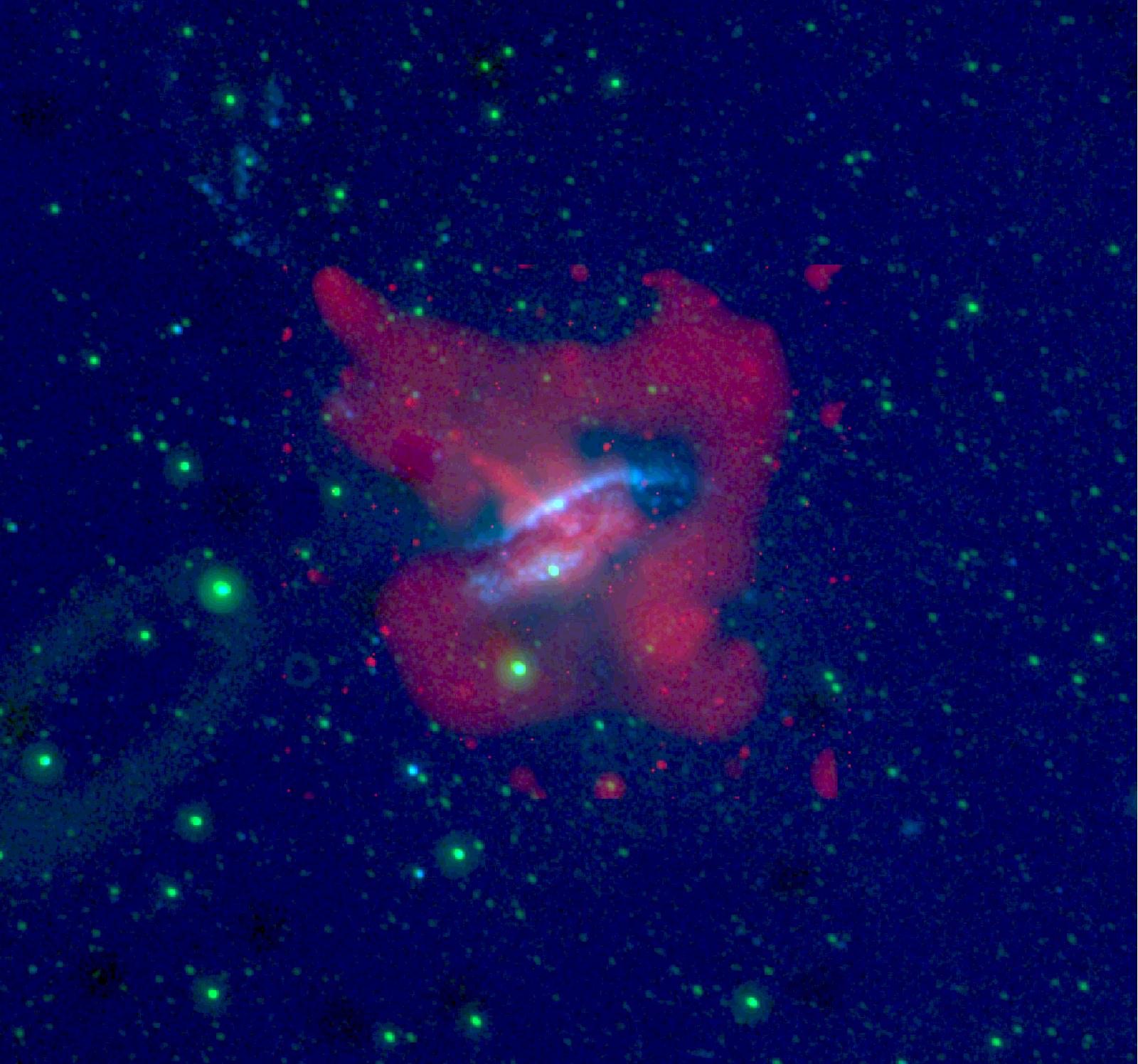
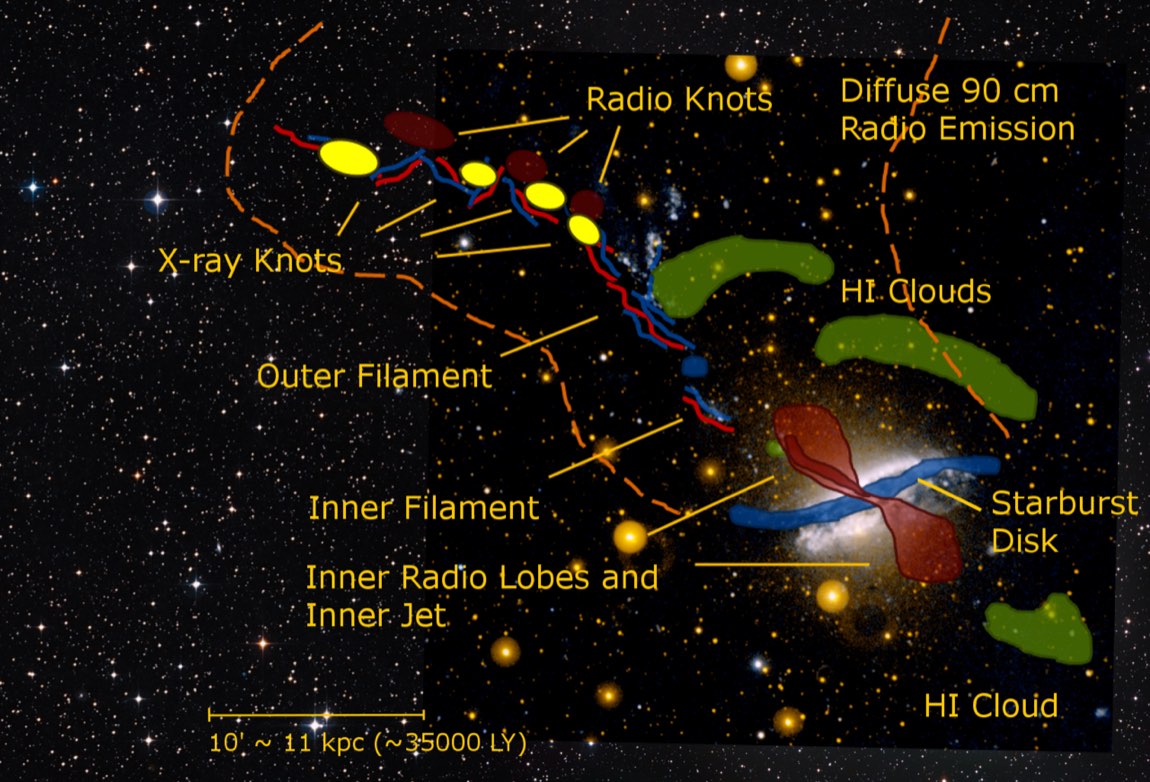
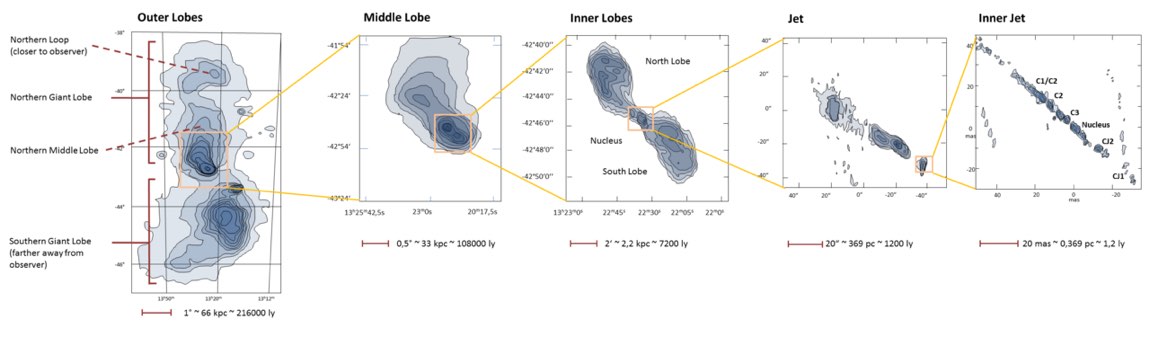
At the heart of Centaurus A sits a supermassive black hole weighing approximately 55 million solar masses — roughly 14 times the mass of the black hole at the centre of our own Milky Way. This engine drives everything that makes Centaurus A so scientifically compelling. It launches a relativistic jet: a tightly focused beam of plasma fired outward at roughly half the speed of light. Astronomers determined that remarkable speed by comparing radio observations of the jet taken a decade apart and watching how far the inner structures had moved. The jet does not travel quietly. As it punches outward and collides with surrounding gas, it generates X-rays in those outer collision zones. The X-ray jets stretch thousands of light-years from the nucleus, while the full radio-emitting jets extend over a million light-years — a distance so vast it would span roughly ten times the diameter of the Milky Way. In July 2021, the Event Horizon Telescope released a resolved image of Centaurus A that directly showed this jet emerging from the vicinity of the black hole.
 ⤢
⤢
04 From Radio Hiss to Gamma Rays: A Full-Spectrum Source Deeper
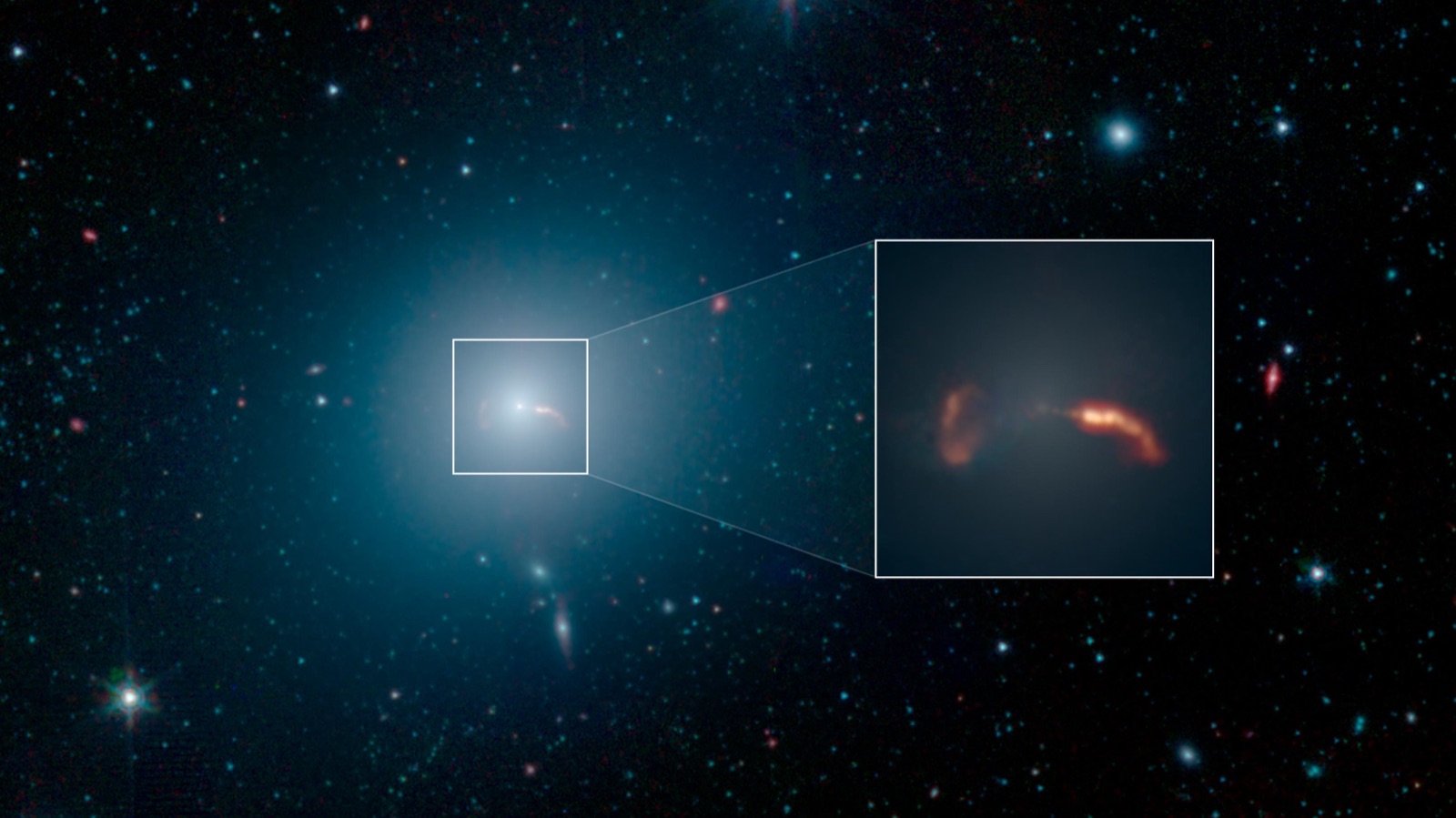
Centaurus A emits radiation across virtually the entire electromagnetic spectrum, and unpicking each wavelength has taken decades of work with a succession of instruments. In 1949, John Gatenby Bolton, Bruce Slee, and Gordon Stanley pinpointed the galaxy as one of the very first extragalactic radio sources ever localised — a landmark moment in the infant field of radio astronomy. X-ray emissions were first detected in 1970 using a sounding rocket, and in 1979 the Einstein Observatory resolved an actual X-ray jet streaming from the nucleus. Gamma-ray observations followed in 1975–76 via the atmospheric Cherenkov technique, and evidence of very-high-energy gamma rays exceeding 100 GeV was confirmed by the H.E.S.S. Observatory in Namibia in 2009. The Spitzer Space Telescope added another layer in 2006, revealing a parallelogram-shaped structure of dust in near-infrared images. Meanwhile, a 2016 review of data from the Chandra and XMM-Newton observatories uncovered unusually high energy flares in the galaxy; Jimmy Irwin of the University of Alabama hypothesised these might signal an unknown black hole process or an intermediate-mass black hole.
05 A Hotbed for Supernovae and Stellar Explosions
Because Centaurus A is relatively nearby, astronomers can detect individual stellar explosions that would be hopelessly faint in more distant galaxies. Two supernovae have been recorded there. The first, SN 1986G, was discovered on 3 May 1986 by Robert Evans, hidden within the dark dust lane. It turned out to be a Type Ia supernova — the kind produced when a white dwarf in a binary system steals enough gas from a companion to trigger runaway carbon fusion. SN 1986G proved scientifically important beyond its discovery: it demonstrated that Type Ia supernovae are not all identical in their spectra and that they can differ in how their brightness evolves over time, a finding that complicated their use as cosmological "standard candles." The second supernova, SN 2016adj, was found in February 2016 by the Backyard Observatory Supernova Search and was first classified as a Type II, though subsequent analysis suggested its spectrum more closely resembled the Type Ib supernova 1999dn. A luminous red nova designated AT 2020nqq was also discovered on 27 June 2020, and the galaxy is close enough that classical novae — far fainter events — can be detected individually as well.
06 Centaurus A as a Cosmic Ray Accelerator Deeper
One of the most dramatic findings connected to Centaurus A emerged not from a traditional telescope but from a vast array of particle detectors spread across the Argentine plains. After years of data collection, the Pierre Auger Observatory identified Centaurus A as a source of ultra-high-energy cosmic rays — the most energetic subatomic particles known to travel through space. This placed the galaxy in an extraordinarily select club of confirmed or suspected cosmic ray accelerators, with its powerful relativistic jet the prime candidate for the acceleration mechanism. Cosmic rays at these energies are so rare and their paths through intergalactic magnetic fields so deflected that tracing them back to a single source is extraordinarily difficult, which is part of why the Auger result attracted widespread attention. The finding aligns with Centaurus A's dual status as both the closest radio galaxy to Earth and the closest BL Lac object — classifications that both imply the presence of a powerful, relativistic, jet-driven nucleus pointed at least partially toward our line of sight, capable in principle of accelerating particles to extreme energies.
 ⤢
⤢
07 How Far Away Is It, Really? Deeper
Pinning down the distance to Centaurus A has proven surprisingly stubborn. Distance estimates established since the 1980s typically range between 3 and 5 megaparsecs, and different measurement techniques persistently give different answers. Classical Cepheid variable stars discovered in the heavily obscured dust lane yield distances of roughly 3 to 3.5 Mpc, depending on how astronomers handle the complex dust extinction along the line of sight. Mira variables and planetary nebulae, which probe less obscured regions, tend to favour a more distant value of around 3.8 Mpc. The galaxy even harbours Type II Cepheids — a class of pulsating star rarely detected beyond the Local Group — adding another independent ruler to the toolkit. The spread from 11 to 13 million light-years quoted in the literature reflects this genuine uncertainty. Resolving it matters not just for Centaurus A itself but for calibrating the cosmic distance ladder more broadly, since the galaxy sits at a useful intermediate distance where multiple standard candles can be tested and compared against one another.
08 The Galaxy Group Centaurus A Calls Home
Centaurus A is not an isolated wanderer. It sits at the gravitational centre of one of two subgroups that together form the Centaurus A/M83 Group, a collection of galaxies that is itself embedded within the much larger Virgo Supercluster. The other subgroup is anchored by Messier 83, the Southern Pinwheel Galaxy. Astronomers debate whether to count these as a single group or two, but the physical proximity of the member galaxies and the apparent lack of relative motion between the two subgroups suggests they are closely associated. Like most large galaxies, Centaurus A hosts a population of globular clusters in its halo. Some objects that look like globular clusters are suspected to be something stranger: the tidally stripped cores of former dwarf galaxies, their outer stars ripped away by Centaurus A's gravity over billions of years. The most extreme such object is VHH81-01, whose central black hole is estimated at around 800,000 solar masses — a relic nucleus left behind after its host galaxy was essentially cannibalized.
09 Young Blue Stars Born in a Lane of Darkness
One of the more visually counterintuitive facts about Centaurus A is that its imposing dark dust lane — the very feature that makes the galaxy look so dramatically "cut asunder," in John Herschel's phrase — is also a nursery of young stars. In the late 1980s, the Hubble Space Telescope found young blue stars distributed along the central dust band, a discovery that confirmed active, ongoing star formation in what might otherwise appear to be a region of pure obscuration. This makes sense in the merger picture: colliding galaxies compress their interstellar gas, and compressed gas collapses into new stars. More than 100 star-formation regions have been catalogued within the dusty disk. The contrast between these hot young blue stars and the ancient red stars of the surrounding elliptical bulge provides a vivid record of two very different stellar populations — from two very different galaxies — now occupying the same space and gradually mixing together into what will eventually be a single, merged system.
 ⤢
⤢
10 Observing Centaurus A With Your Own Eyes
For amateur astronomers in the southern hemisphere or at low northern latitudes, Centaurus A is one of the most rewarding targets in the sky. Because it has both a high surface brightness and a relatively large angular size, the galaxy responds well to small instruments. The bright central bulge and the dramatic dark dust lane cutting across it are visible even in finderscopes and large binoculars — a feature unique among galaxies at this detail level. Larger backyard telescopes reveal additional structure in the halo. For those in exceptionally dark locations, there are even claims that Centaurus A is faintly visible to the unaided eye, though this remains at the edge of credibility. A useful starting point for finding it is its position approximately 4 degrees north of Omega Centauri, a globular cluster that is itself visible without optical aid. The galaxy's fifth-place ranking among the brightest galaxies in the sky is a reminder that despite being a site of violent cosmic activity — jets, mergers, cosmic rays — it is also simply one of our nearest large galactic neighbours.
11 Open Questions That Keep Astronomers Busy Deeper
For all the observations that have piled up since James Dunlop's 1826 discovery, Centaurus A continues to generate genuine scientific controversy. The most basic descriptive question — is it a lenticular galaxy or a giant elliptical? — remains unsettled in the research literature. The distance, as detailed above, is uncertain by enough to affect calculations of the galaxy's true size and luminosity. The mechanics of what happens when an elliptical galaxy collides with a spiral are not fully understood, and Centaurus A is the best nearby laboratory for studying that process. The 2016 high-energy flares detected by Chandra and XMM-Newton are not yet explained: they could point to an unknown black hole process or to an intermediate-mass black hole, but no consensus has emerged. And while Centaurus A has been identified as a probable source of ultra-high-energy cosmic rays, the precise acceleration mechanism remains a subject of active research. Few galaxies this thoroughly observed still raise so many fundamental questions — which is precisely why professional astronomers continue to point instruments at it across every wavelength.
 ⤢
⤢