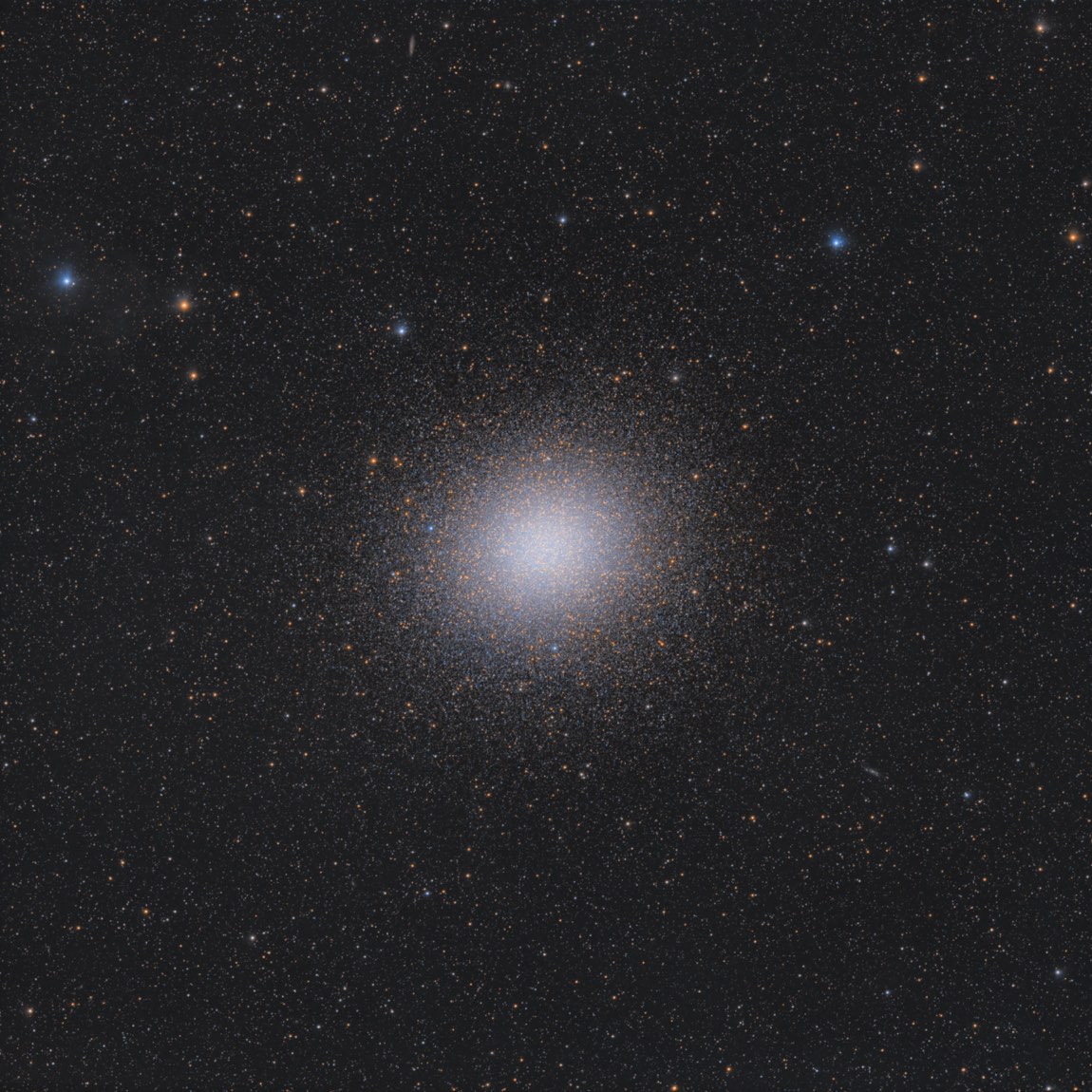
 Photograph · Chuck Ayoub · CC0
Star Cluster · Deep guide
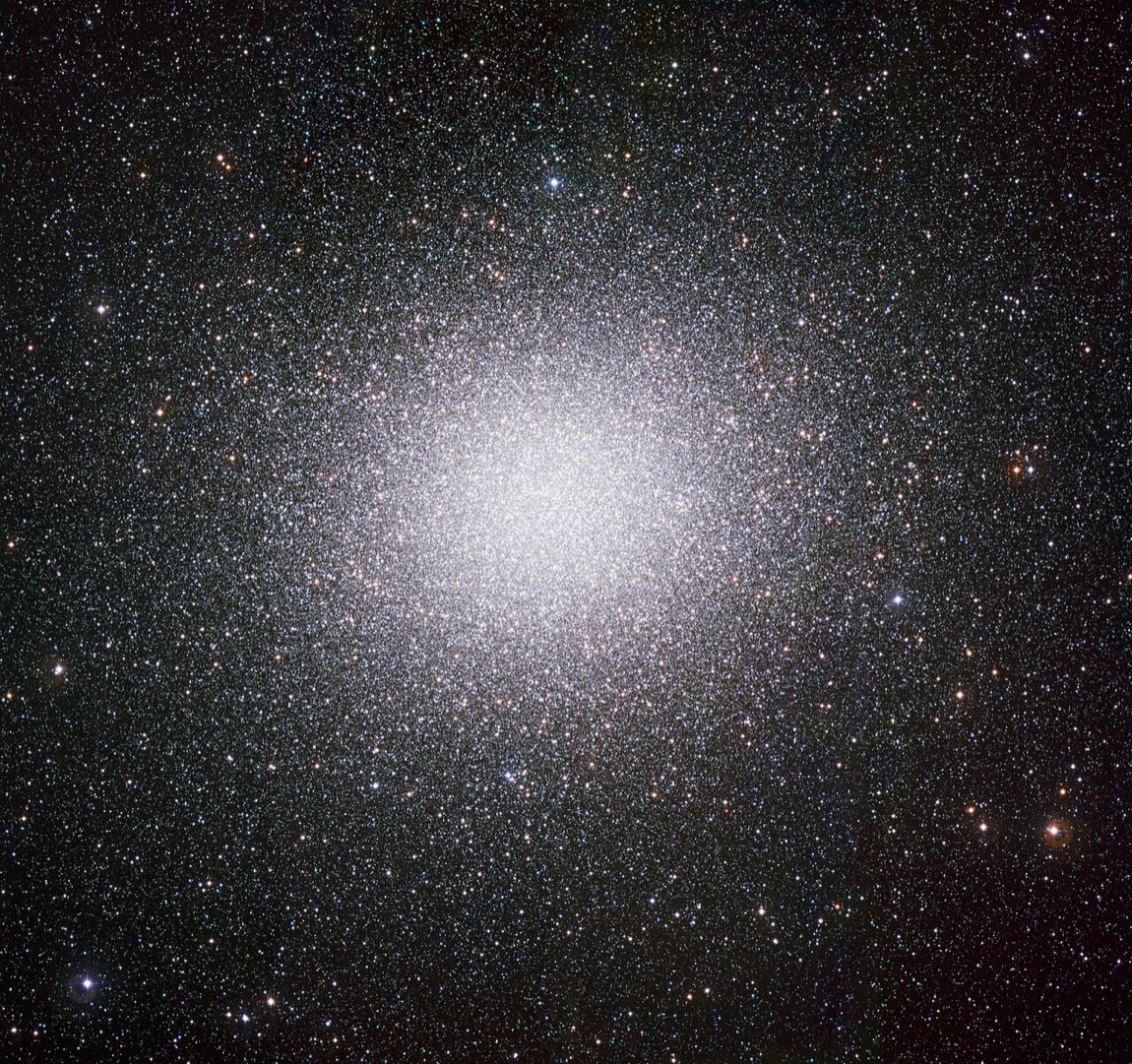
Omega Centauri
Also called: Caldwell 80 · NGC 5139 · ω Centauri · ω Cen
Ten million stars in one ball: the Milky Way's biggest globular cluster, maybe a cannibalised galaxy's core.
What is it?
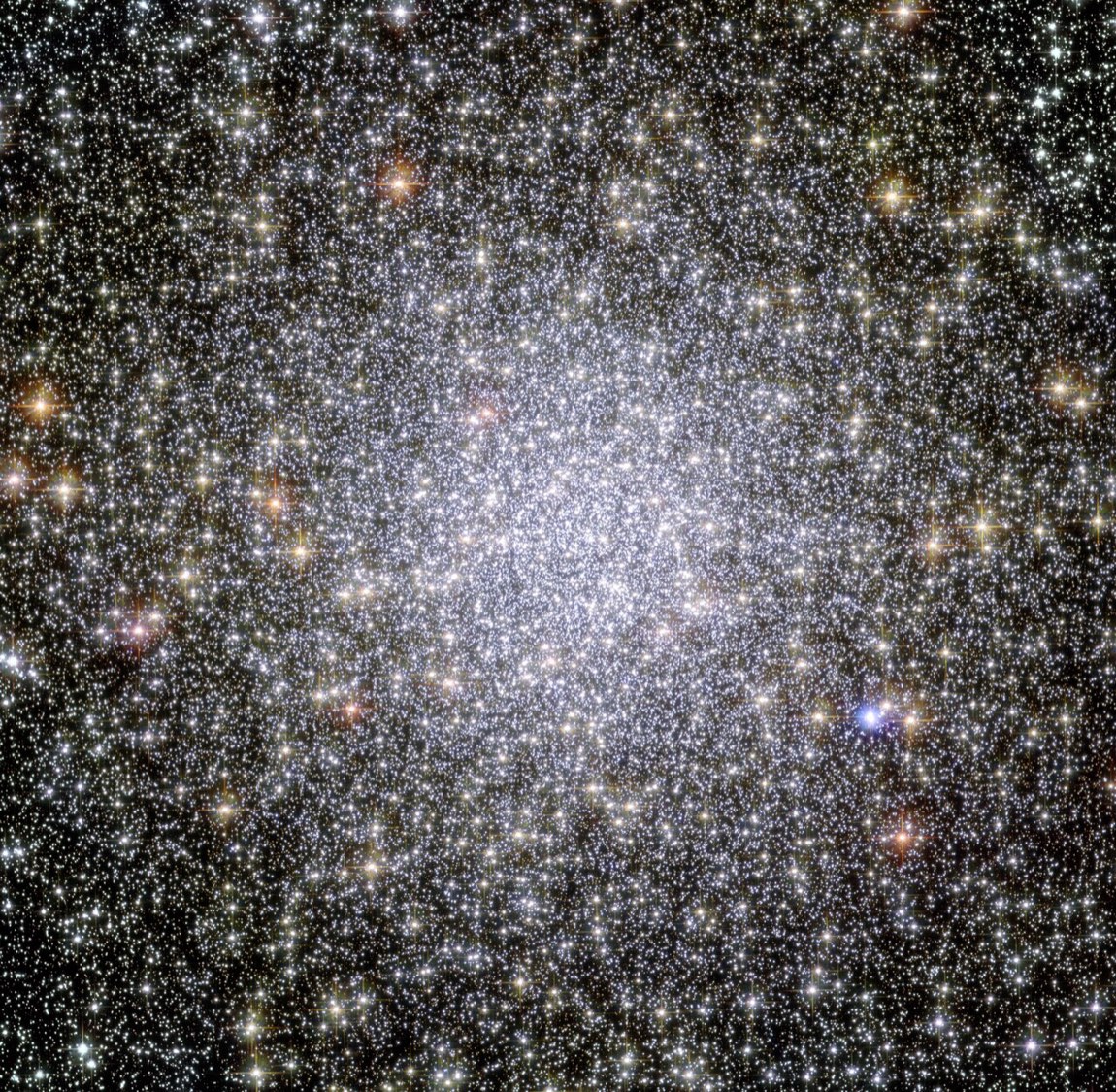
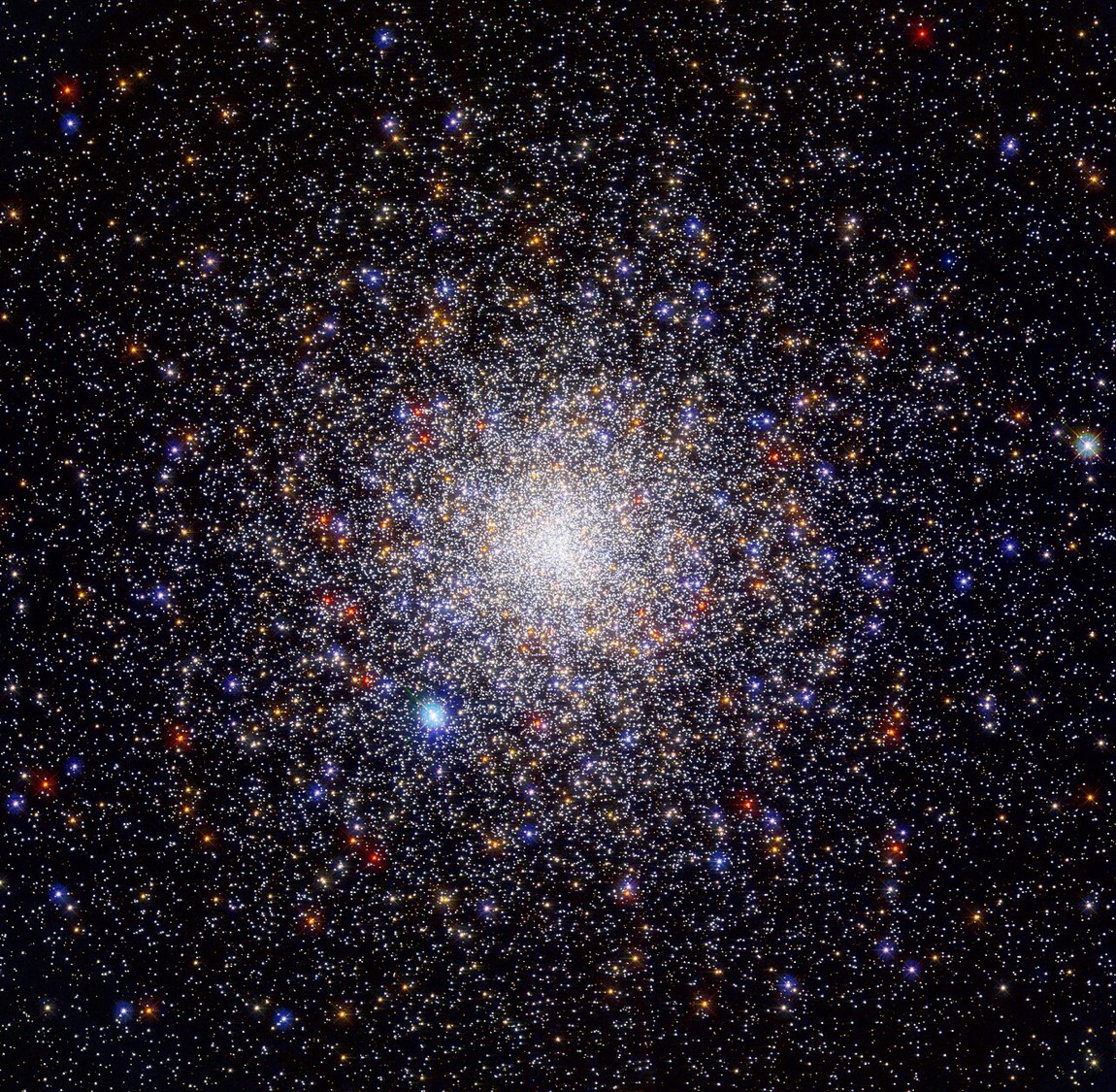
Omega Centauri is the largest and most massive known globular cluster in the Milky Way, roughly 150 light-years across with about 10 million stars. It is visible to the naked eye and was listed as a star by Ptolemy, which is why it carries a star-like Bayer name; Edmond Halley recognised it as non-stellar in 1677. It differs so much from ordinary globular clusters that many astronomers think it is the leftover core of a dwarf galaxy the Milky Way absorbed. A central intermediate-mass black hole has been proposed but is disputed.
The deep dive
Researched for the Atlas from Wikipedia — Omega Centauri (6,288 characters read) · updated Nov 15, 2026
01 From Star to Smudge: 2,000 Years of Naming
Omega Centauri's paper trail stretches back almost two millennia. Around 150 AD, Ptolemy catalogued it in his Almagest not as a cluster but simply as a star sitting on the centaur's back, labelling it in Latin "Quae est in principio scapulae" — roughly, the star at the beginning of the shoulder blade. That single misidentification persisted for centuries. When German cartographer Johann Bayer drew his landmark star atlas Uranometria in 1603, he borrowed Ptolemy's data and stamped the object with the Greek letter omega, giving us the name we still use today. It took a telescope to reveal the truth. English astronomer Edmond Halley observed it from the South Atlantic island of Saint Helena in 1677, immediately recognising it as something other than a point of light. By 1716 he published it among only six "luminous spots or patches" in the Philosophical Transactions of the Royal Society. Even then, its true nature eluded observers for another century, until Scottish astronomer James Dunlop in 1826 finally described it as a "beautiful globe of stars very gradually and moderately compressed to the centre" — the first recognition of its identity as a globular cluster.
02 Scale That Defies Easy Comparison
Raw numbers only go so far, so it helps to stack them against something familiar. Omega Centauri spans roughly 150 light-years in diameter — though one measurement of its full extent reaches about 450 light-years — and sits 17,090 light-years (5,240 parsecs) from Earth. Despite that enormous distance, it appears almost as large as the full Moon when viewed from a dark rural site, making it one of the very few globular clusters visible to the naked eye at all. Its total mass is 4 million solar masses, and it is estimated to hold approximately 10 million stars. No other globular cluster associated with the Milky Way comes close on either count: it is simultaneously the largest, the brightest, and the most massive of its kind in our galaxy. The only objects in the entire Local Group of galaxies that outshine and outweigh it are found in the Andromeda Galaxy — specifically Mayall II, which shares several of Omega Centauri's unusual properties, as described below.
03 A Relic Twelve Billion Years in the Making
Omega Centauri is approximately 12 billion years old, placing its formation deep in the early universe, less than 2 billion years after the Big Bang. Its stars belong to Population II, a stellar generation born when the cosmos contained far fewer heavy elements than it does today. What makes the cluster genuinely unusual among globular clusters is that it did not form all at once from a single burst of star formation, as standard models of globular cluster formation predict. Instead, Omega Centauri shows a conspicuous range of metallicities — that is, varying concentrations of elements heavier than hydrogen and helium — as well as a spread of stellar ages among its members. Some stars are notably abundant in metals and elements such as iron, carbon, and oxygen, while others are far more pristine. This spread is precisely what you would expect from a system that experienced multiple rounds of star formation over an extended period, drawing in fresh gas enriched by earlier generations of dying stars. That history points strongly away from a simple globular cluster origin and toward something far more complex.
04 The Cannibalised Galaxy Hypothesis Deeper
The leading explanation for Omega Centauri's odd chemistry and structure is dramatic: astronomers suspect it is not a globular cluster at all in the conventional sense, but rather the stripped core of a dwarf galaxy that the Milky Way gravitationally dismembered and swallowed long ago. Both its orbital motion through the Milky Way and its metallicity spread are consistent with this picture. The parallel with Mayall II in the Andromeda Galaxy is striking — that object also displays a range of metallicities and ages, and is similarly suspected of being a captured galactic remnant. Perhaps the most evocative piece of supporting evidence involves Kapteyn's Star, currently just 13 light-years from Earth and one of our nearest stellar neighbours. That star is thought to have originated from Omega Centauri, suggesting that tidal forces long ago stripped stars from the cluster's outer reaches and scattered them across the galaxy. If the hypothesis is correct, what we see today as Omega Centauri is only the dense, gravitationally bound heart of what was once an entire small galaxy — a ghost of a former world.
05 Stellar Traffic in the Core Deeper
Inside Omega Centauri, stars are packed so tightly that neighbours are, on average, only 0.1 light-years apart from one another. To put that in perspective, the nearest star to our Sun, Proxima Centauri, lies about 4.2 light-years away — meaning stars in Omega Centauri's core are roughly 42 times closer to their neighbours than we are to ours. That density has real consequences for orbital dynamics. Astronomers have measured the radial velocities of 469 individual stars to map how the cluster moves internally. The peak velocity dispersion — essentially how fast stars are moving relative to one another near the core — reaches 7.9 km per second. Analysis of this stellar motion shows that the mass distribution within the cluster is slightly more extended than the distribution of visible light, though not strongly so. In other words, mass and luminosity do not perfectly trace each other, hinting that some matter may lurk beyond where the brightest stars are concentrated — a clue that informed the ongoing debate about a central black hole.
06 The Black Hole That May or May Not Be There Deeper
The question of whether Omega Centauri harbours an intermediate-mass black hole at its centre is one of the most actively contested problems in star-cluster science. A 2008 study using the Hubble Space Telescope's Advanced Camera for Surveys and instruments at the Gemini Observatory on Cerro Pachón in Chile found two intriguing signals: starlight gradually increasing toward the core, and stars orbiting faster the closer they are to the centre. Researcher E. Noyola and colleagues interpreted this as the gravitational fingerprint of a hidden massive object and calculated its mass at 40,000 solar masses. Subsequent work struck back hard, disputing the precise location used for the cluster's centre. Using a revised centre, those studies found that core star velocities do not vary with distance — the expected signature of a black hole — and that central starlight does not rise but stays roughly flat. Those authors capped the maximum mass of any possible black hole at 12,000 solar masses without confirming one exists at all. Then in July 2024, a fresh study examined seven fast-moving stars near the core and found their speeds consistent with an intermediate-mass black hole of at least 8,200 solar masses — only for that conclusion to be questioned yet again. The debate remains genuinely open.
07 How Halley Turned a "Star" Into a Mystery
Edmond Halley's 1677 observation from Saint Helena was a watershed moment, though its significance took decades to fully register. Saint Helena is a remote volcanic island in the South Atlantic, and Halley had travelled there specifically to map southern hemisphere stars invisible from Europe. When he turned his telescope on what Ptolemy had catalogued as an ordinary star, he immediately saw something that could not be a star — a soft, extended glow rather than a sharp point of light. He listed it as a non-stellar object but could not resolve individual stars within it. Nearly forty years later, in 1716, he revisited his records and published Omega Centauri as one of only six "luminous spots or patches" he considered worthy of special note in the Philosophical Transactions of the Royal Society. Swiss astronomer Jean-Philippe de Cheseaux independently included it in his 1746 list of 21 nebulae, and French astronomer Lacaille catalogued it in 1755 — giving it the number L I.5 that still appears in older references. Each observer saw something remarkable; none yet had the resolution to see stars.
08 Observing Omega Centauri from Earth
For observers in the Southern Hemisphere or low northern latitudes, Omega Centauri is one of the night sky's most rewarding naked-eye targets. It sits in the constellation Centaurus and, under dark rural skies, appears comparable in angular size to the full Moon — a fuzzy, faintly glowing patch that immediately sets itself apart from any single star. Even a small telescope begins to resolve individual stars at the cluster's edges, and larger amateur instruments reveal a breathtaking, densely packed ball of light. Observers in the northern United States, central Europe, or similar latitudes will find it a challenging low-horizon object, but those in Florida, southern Spain, or anywhere south of about 35° North latitude can catch it grazing the horizon during spring evenings. Its brightness, size, and the sheer spectacle of resolving millions of stars in a single eyepiece field make it a consistent highlight of any southern sky tour. The cluster carries multiple catalogue identities — ω Cen, NGC 5139, and Caldwell 80 — reflecting how many independent observers found it noteworthy enough to list.
09 What the Sky Would Look Like from Inside
The question of what an observer inside Omega Centauri would actually see is not merely a thought experiment — it has been explored even in fiction, as in Ian Douglas's 2012 novel Singularity, which discusses the likely radiation environment inside the cluster and the appearance of the sky from within. The article's data gives a concrete basis for imagining the scene. With stars averaging only 0.1 light-years from their neighbours in the core, the sky would be studded with stars far brighter than anything in Earth's night sky. Our nearest stellar neighbour is about 4.2 light-years away; a hypothetical planet near Omega Centauri's core would have dozens or hundreds of stars within a fraction of that distance, some shining as brilliant beacons rather than mere points. The cumulative glow of 10 million stars packed into a volume 150 light-years across would make true astronomical darkness essentially impossible anywhere near the cluster's heart. The night — if it could even be called that — would glow perpetually with stellar light from every direction.
10 Kapteyn's Star: A Refugee in Our Backyard
Among the many stars astronomers believe were once part of Omega Centauri, one has ended up astonishingly close to home. Kapteyn's Star currently lies only 13 light-years from Earth, making it one of our nearest stellar neighbours, yet astronomers think it originated in Omega Centauri. This would mean tidal forces from the Milky Way stripped it — and presumably many other stars — from the cluster's outer regions during past gravitational encounters, flinging them into orbits that now carry them far from their birthplace. The fact that an ancient refugee from a possible disrupted dwarf galaxy now travels within 13 light-years of our Sun gives the abstract history of galactic cannibalism an unexpectedly personal dimension. It also demonstrates that the process of tidal stripping was thorough: stars shed from Omega Centauri have been scattered across a vast volume of the galaxy. What remains today as the cluster is the gravitationally bound core that survived repeated passages through the Milky Way's tidal field — a compressed, dense remnant of something once far larger.
11 Open Questions Astronomers Are Still Arguing Deeper
Omega Centauri sits at the intersection of several unresolved problems in astrophysics. The most immediate is the black hole question: despite three major rounds of investigation — the 2008 detection, subsequent refutations capping mass at 12,000 solar masses, and the 2024 fast-star study suggesting at least 8,200 solar masses — no consensus has emerged. The difficulty is partly technical: pinpointing the true geometric centre of the cluster, which underlies all velocity interpretations, is itself contested. A second open question involves the cluster's full origin story. The disrupted-dwarf-galaxy hypothesis is well supported by metallicity spreads and orbital kinematics, but the details of how and when that disruption happened, and how much mass the original galaxy contained, remain unclear. A third involves the mass distribution: the kinematics of 469 stars suggest mass extends slightly beyond the light distribution, but what accounts for that extra mass — dark remnants, an IMBH, or simply measurement uncertainty — is not settled. Each new instrument or survey technique reopens these questions rather than closing them.
 ⤢