Astrophysics
Supernovae
ConfirmedThe idea
The two ways a star can explode: a giant star's iron heart collapses in under a second and the rebound blows the star apart; or a white dwarf steals too much matter from a companion and detonates like a fusion bomb the size of Earth. Either way, for weeks a single star can outshine its entire galaxy of billions.
Go deeper Advanced
Core-collapse (Type II/Ib/Ic): ~99% of the energy leaves as neutrinos — 19 were caught from SN 1987A hours before its light, confirming the mechanism. Thermonuclear (Type Ia): standardizable brightness made them the candles that revealed dark energy (Nobel 2011). Galactic rate: ~1–2 per century; we are statistically overdue for a naked-eye show.
The deep dive
Researched for the Atlas from Wikipedia — Supernova (58,000 characters read) · updated Sep 20, 2026
01 Who named the supernova and when
The word supernova was coined by Walter Baade and Fritz Zwicky, who began using it in astrophysics lectures in 1931. Its first appearance in a journal article came the following year, in a 1932 publication by Knut Lundmark, who may have coined the term independently. Baade and Zwicky published their own journal paper using the name in 1934. Before that, these catastrophic stellar explosions were described with names like "upper-class Novae," "Hauptnovae," or "giant novae" — all acknowledging that they outshone ordinary novae but lacking a crisp, unified label. By 1938 the hyphen had been dropped and the modern single-word form was in standard use. The modern classification scheme, dividing supernovae into Type I and Type II based on spectral lines, was developed starting in 1941 by Rudolph Minkowski and Fritz Zwicky.
02 The oldest possible record of a supernova
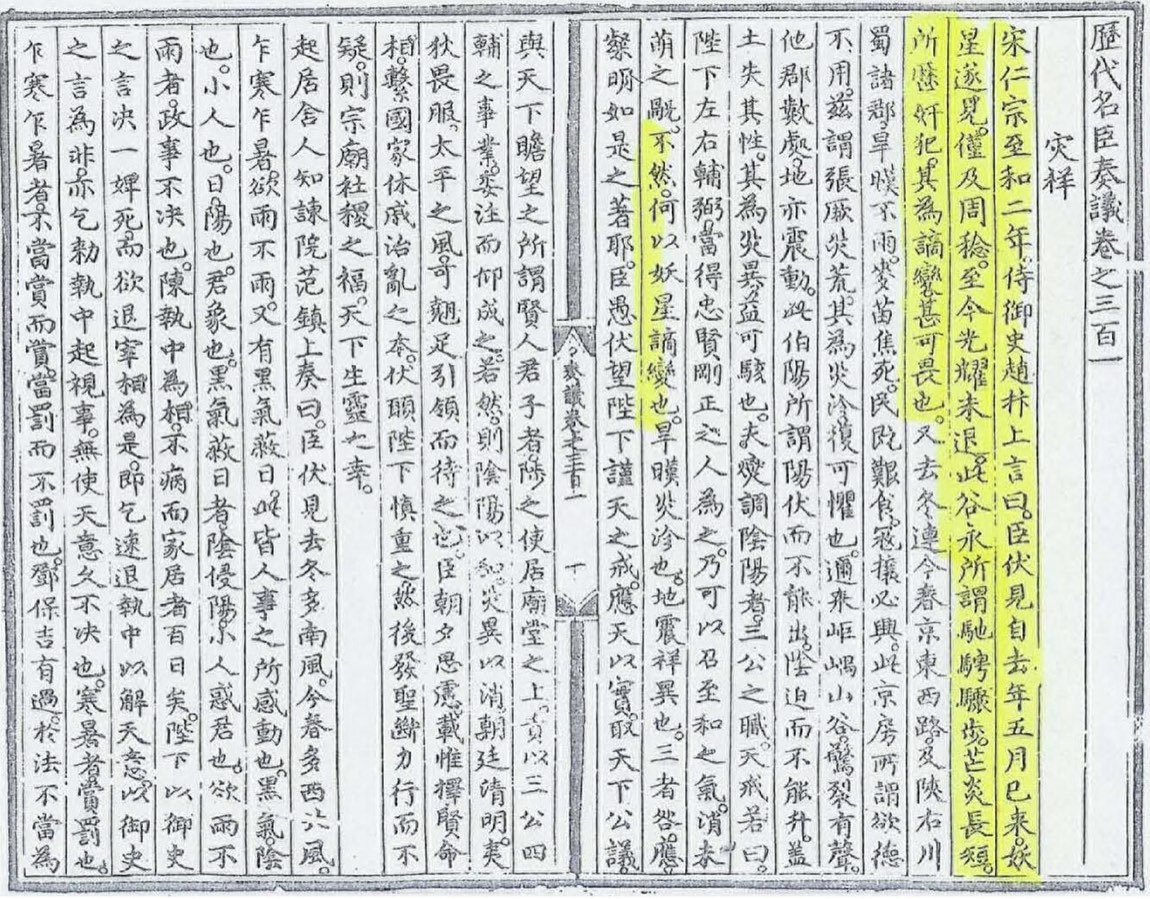
The earliest claimed record of a supernova is a rock carving in the Burzahama region of Kashmir, dated to 4500 ± 1000 BC, which some researchers interpret as depicting nova HB9. The article is careful to flag this as unverifiable. Far more securely documented is SN 1006, observed in AD 1006 in the constellation Lupus, which was described by observers in China, Japan, Iraq, Egypt, and Europe — making it the first widely recorded supernova. SN 1054, which produced the Crab Nebula, was recorded by Chinese astronomers in AD 1054. Analysis of the full historical record suggests that, across 2,000 years of written history, fewer than ten supernovae have been observed without the aid of a telescope. The rarity of naked-eye supernovae is straightforward: compared to a star's entire lifetime, the visual display of a supernova spans only a few months, making the chance of catching one roughly once in a lifetime for any individual observer.
03 How supernovae challenged an ancient worldview
SN 1572 and SN 1604 — Tycho's Supernova and Kepler's Supernova — were the last Milky Way supernovae observed with the naked eye, and their cultural impact extended far beyond astronomy. Both were used to argue against the Aristotelian doctrine that the universe beyond the Moon and planets was static and unchanging. If the heavens were perfect and immutable, bright new stars should not appear and disappear within them. Tycho Brahe observed SN 1572 in Cassiopeia, and Johannes Kepler began observing SN 1604 at its peak on 17 October 1604, continuing to estimate its brightness until it faded from naked-eye view a year later. These were the first supernovae studied by proper astronomical methods, and the fact that two appeared within a single generation gave European astronomers compelling observational ammunition for rethinking the structure of the cosmos.
04 The galaxy's two invisible recent supernovae Deeper
The last supernova observed in the Milky Way was Kepler's in 1604, but evidence suggests two more have occurred since then and simply went unnoticed. Cassiopeia A exploded around 1680, yet no reliable contemporary observation exists. Infrared light echoes have been detected from the remnant, and they show that Cassiopeia A was not in a region of exceptionally high dust extinction — so why it was missed remains unclear. Even more recently, the remnant G1.9+0.3 may have appeared in the late 19th century, making it the youngest known supernova remnant in the galaxy. In that case, high extinction from dust along the plane of the galactic disk could plausibly have dimmed the event enough to escape notice. Together, these examples illustrate how the Milky Way's geometry and dust distribution can hide events that would otherwise be spectacular, and they complicate estimates of the true supernova rate in our galaxy.
 ⤢
⤢
05 SN 1987A: a once-in-a-generation laboratory
When SN 1987A appeared in the Large Magellanic Cloud — a satellite galaxy of the Milky Way — in 1987, it gave astronomers a nearby explosion in an easily studied part of the sky. It was attributed to the collapse of a blue supergiant star, which itself was unexpected, since theoretical models had predicted red supergiants as the most likely progenitors. Crucially, SN 1987A provided the only measurements of astronomical neutrinos ever made from a source other than the Sun. Observations of its light curve gave direct confirmation of radioactive decay powering the brightness: the peak energy matched the decay of 56Ni to 56Co with a half-life of 6 days, while the later decline fit closely with the 77.3-day half-life of 56Co decaying to stable 56Fe. Space gamma-ray telescopes subsequently measured gamma-ray lines from the small fraction of 56Co and 57Co photons that escaped the remnant without absorption, confirming those two radioactive nuclei as the power sources.
06 Catching a supernova in the act: shock breakout
On 6 October 2013, the Intermediate Palomar Transient Factory recorded SN 2013fs just three hours after the explosion occurred. The star lies in a spiral galaxy called NGC 7610, 160 million light-years away in the constellation Pegasus. This is among the earliest post-detonation observations ever made, and it is the earliest supernova for which spectra were obtained, beginning just six hours after the actual explosion. Even more dramatic was SN 2016gkg, detected by amateur astronomer Victor Buso from Rosario, Argentina, on 20 September 2016. It was the first time the initial "shock breakout" — the moment the explosion's leading edge bursts through the star's surface — was captured from an optical supernova. The progenitor star had already been identified in archival Hubble Space Telescope images taken before its collapse, giving astronomers a before-and-after portrait of a star's final moments.
07 What radioactive nickel has to do with light curves Deeper
A supernova's ejecta would fade rapidly without a sustained heat source. The solution, worked out on nucleosynthesis grounds in the late 1960s, is radioactivity. In Type Ia supernovae, around half a solar mass of the ejected material is 56Ni produced by silicon burning. This nickel is radioactive and decays by beta-plus emission and gamma rays into 56Co with a half-life of 6 days; 56Co then decays into stable 56Fe with a half-life of 77 days. The gamma rays — primarily at energies of 847 keV and 1,238 keV — are absorbed by the expanding ejecta and converted into the optical light astronomers observe. These diagnostic gamma-ray lines from Type Ia supernovae were not directly detected until 2014. For core-collapse supernovae such as SN 1987A, the same chain dominates at intermediate to late times, while the initial peak is powered by shock-deposited energy and hydrogen recombination. Type Ib and Ic supernovae follow a similar radioactive-decay light curve but contain a much lower mass of ejected 56Ni, producing a lower average peak luminosity than Type Ia.
08 How supernovae became rulers of the universe
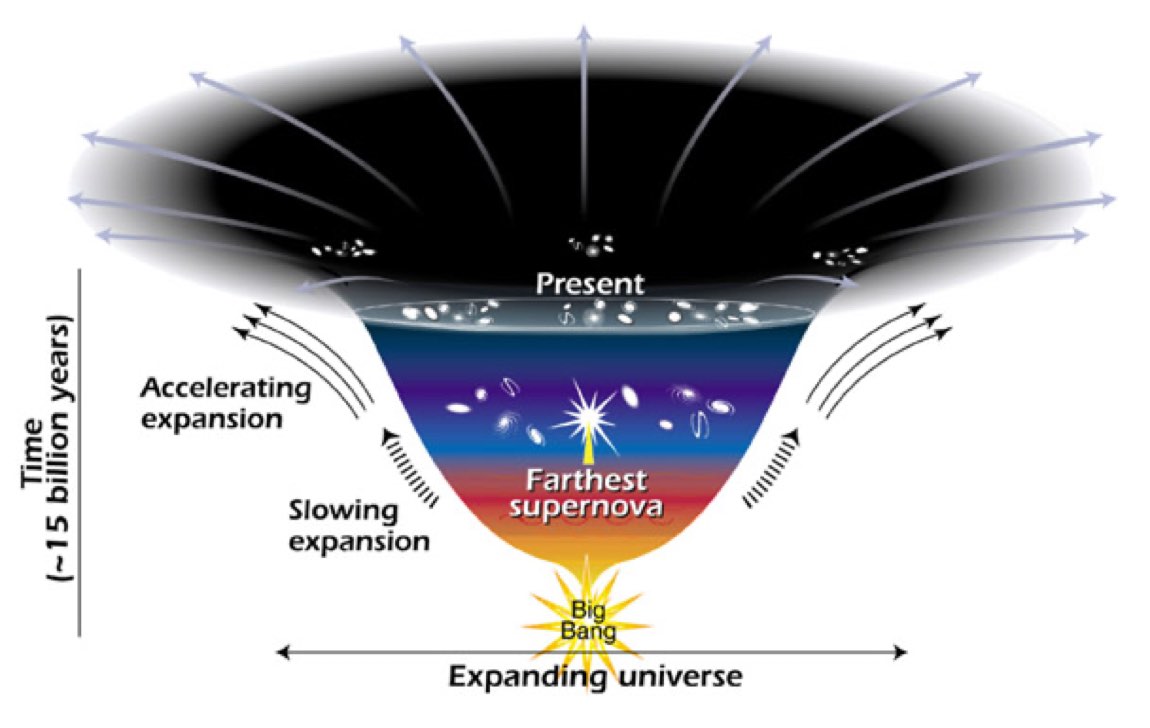
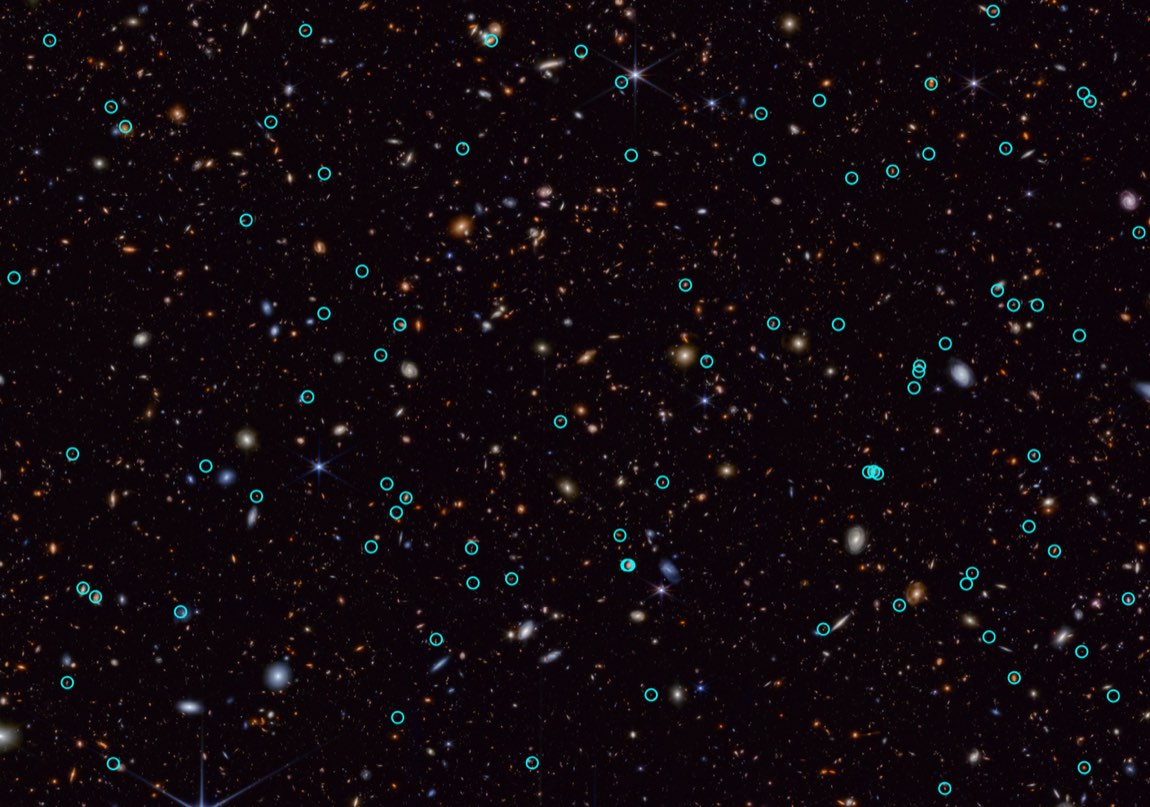
During the 1960s, astronomers recognized that the peak brightness of supernovae could serve as standard candles — objects of known intrinsic luminosity that reveal their distance by how bright they appear. Type Ia supernovae are especially useful because they arise from a consistent type of progenitor and explode when they acquire a consistent mass, producing a maximum absolute magnitude of about −19.3 — roughly 5 billion times brighter than the Sun — with little variation. Some calibrations are required to account for gradual changes in supernova properties at high redshift and small variations identified through light-curve shape or spectrum. The payoff was transformative: some of the most distant supernovae observed in 2003 appeared dimmer than expected, supporting the conclusion that the expansion of the universe is accelerating. Supernova searches are now divided into high-redshift and low-redshift programs, with the boundary around z = 0.1–0.3; the 2018 Pantheon dataset catalogued 1,048 supernovae, expanded by 2021 to 1,701 light curves for 1,550 supernovae drawn from 18 different surveys.
 ⤢
⤢
09 The neutron star kick: an unsolved puzzle Deeper
When a massive star explodes as a Type II supernova, the neutron star left behind is not stationary — it receives a powerful kick, sometimes being propelled at velocities of 500 km/s or greater, even though it contains more mass than the Sun. This phenomenon is inferred from the high peculiar velocities observed in pulsars. The mechanism transferring this momentum remains genuinely unsolved. One candidate is large-scale convection above the collapsing core, which creates density variations that alter how much energy is absorbed from the neutrino outflow in different directions; however, analysis suggests this produces only modest momentum transfer. Another proposal involves gas accreting onto the central neutron star forming a disk that drives highly directional jets, which expel matter at high velocity and drive transverse shocks through the star. Initial asymmetries in Type Ia supernovae have also been confirmed observationally, detectable by measuring the polarisation of emitted light, though these explosions become more symmetrical with time.
10 Failed supernovae: stars that vanish quietly Deeper
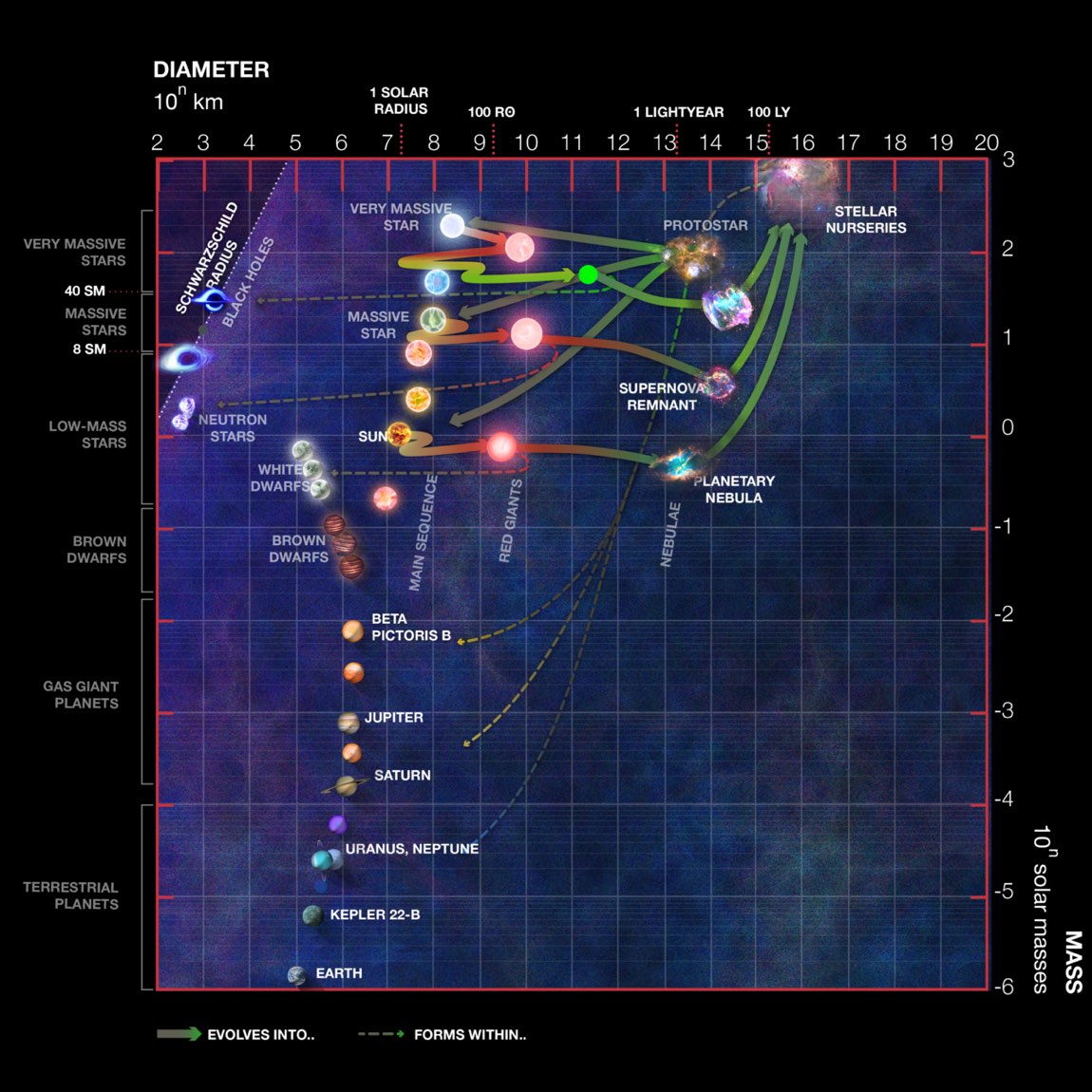
Not every stellar core collapse produces a visible supernova. If the collapsing core is too massive for the standard neutrino-reheating mechanism to reverse the implosion, the star may simply collapse into a black hole with little radiated energy — a "failed supernova." These events are inherently difficult to detect because they produce no bright optical display, but large surveys have found possible candidates by watching for stars that disappear. The red supergiant N6946-BH1, located in the galaxy NGC 6946, underwent a modest brightening outburst in March 2009 before fading from view entirely. Only a faint infrared source remains at its former position. The article notes that if the core mass exceeds about 15 solar masses, neutron degeneracy pressure is insufficient to halt the collapse, and a black hole forms directly. For cores above about 8 solar masses, even after a neutron star briefly forms, sufficient fallback material can eventually produce a black hole — and in some cases, relativistic jets driven by that black hole may instead produce an exceptionally luminous supernova or a gamma-ray burst.
11 Supernovae as the universe's element factories
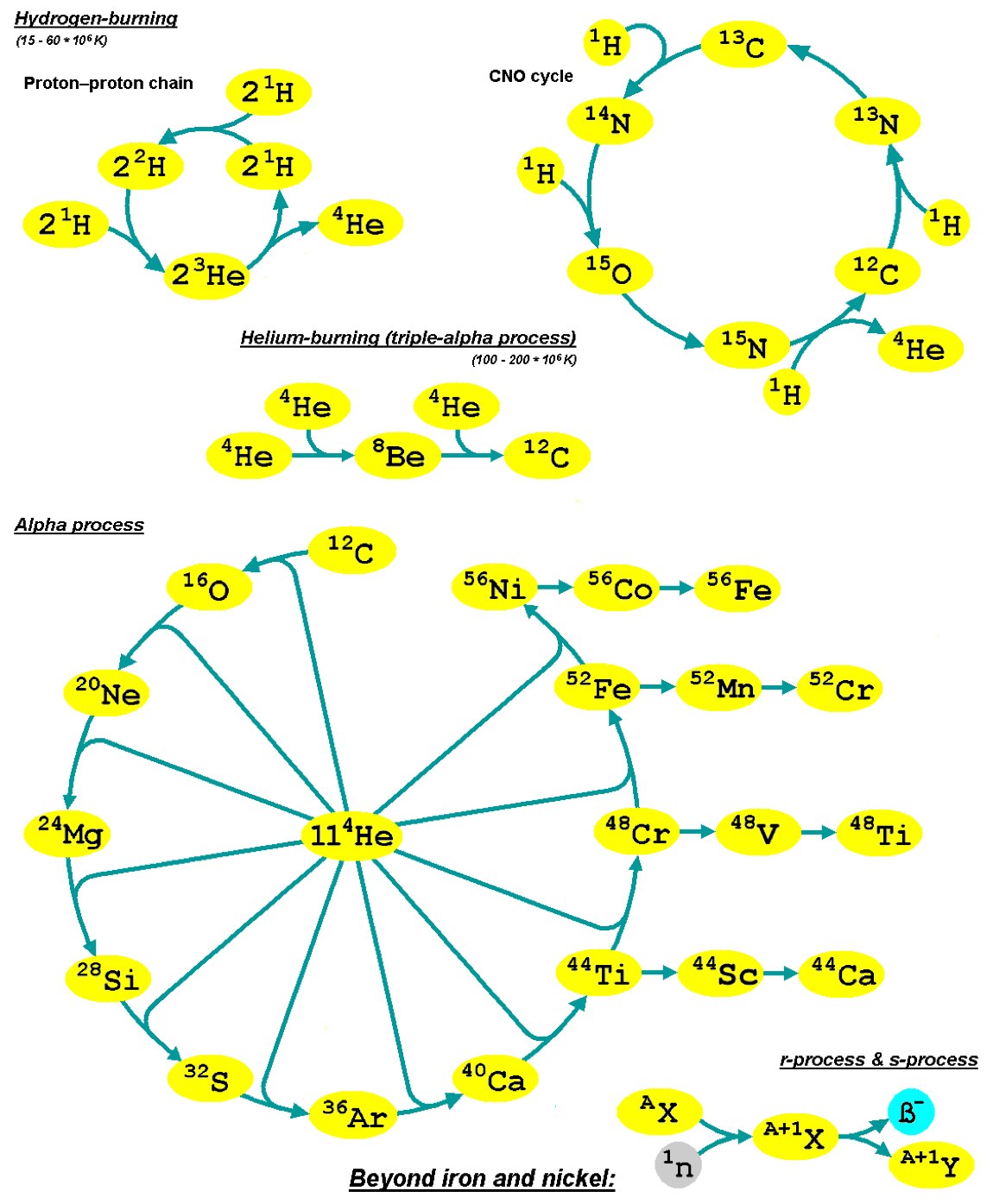
Supernovae are the dominant mechanism for distributing elements heavier than hydrogen and helium throughout the interstellar medium. Type Ia supernovae contribute mainly silicon and iron-peak elements such as nickel and iron, while core-collapse supernovae eject larger masses of light alpha elements — oxygen and neon — and elements heavier than zinc, with electron-capture supernovae being especially prolific producers of the latter. The heavy elements are built by three distinct processes: nuclear fusion for nuclei up to sulfur-34; silicon photodisintegration and quasiequilibrium during silicon burning for nuclei between argon-36 and nickel-56; and rapid neutron capture — the r-process — for elements heavier than iron. The r-process produces highly unstable neutron-rich nuclei that rapidly beta-decay into more stable forms, and is responsible for roughly half of all isotopes of elements beyond iron, though neutron star mergers may be the main astrophysical site for many of these. Every generation of stars formed from supernova-enriched clouds is therefore slightly more metal-rich than the last, tracing a chemical history that began with the almost pure hydrogen and helium left by the Big Bang.
12 The electron-capture supernova: a predicted rarity confirmed Deeper
In 1980, Ken'ichi Nomoto of the University of Tokyo predicted a third type of supernova mechanism. In stars with initial masses of roughly 8 to 10 solar masses — right at the boundary between those that form white dwarfs and those that undergo iron core collapse — a degenerate core of oxygen, neon, and magnesium can trigger a different kind of implosion. When the core exhausts its nuclear fuel, gravity compresses the electrons into atomic nuclei through electron capture, removing the pressure support and causing collapse to a neutron star. The 2021 paper in Nature Astronomy reported that SN 2018zd, in the galaxy NGC 2146 about 31 million light-years from Earth, appeared to be the first confirmed observational example of this mechanism. The paper also strengthened the long-held suspicion that the supernova of AD 1054, which created the Crab Nebula, was itself an electron-capture event — meaning the most famous supernova remnant in the sky may finally have its origin story confirmed.
13 The most luminous supernova ever recorded
The record for the brightest supernova ever observed belongs to ASASSN-15lh, located at a distance of 3.82 gigalight-years. First detected in June 2015, it peaked at 570 billion times the luminosity of the Sun — twice the bolometric luminosity of any other known supernova at the time of discovery. To put that in perspective, a typical Type Ia supernova already shines as brightly as an entire galaxy, yet ASASSN-15lh outstripped even that benchmark by an enormous margin. The nature of this event remains debated: several alternative explanations have been proposed, including the tidal disruption of a star by a black hole, rather than a conventional stellar explosion. This uncertainty is a reminder that the category of "superluminous supernova" is still being defined, and that extreme events can blur the boundary between different types of transient phenomena in ways that current models do not fully explain.