Astrophysics
Where the Elements Come From
ConfirmedThe idea
The Big Bang made only hydrogen, helium, and a whisper of lithium. Everything else was cooked later: carbon and oxygen in ordinary stars, iron in giants, and much of the heaviest matter — gold, platinum, uranium — in colliding neutron stars and supernovae. The iron in your blood and the calcium in your teeth were forged inside stars that died before the Sun was born. You are, literally, stardust.
Go deeper Advanced
Big Bang nucleosynthesis's light-element ratios match observation exquisitely — a pillar of cosmology. Stellar burning stops at iron (peak binding energy); slow neutron capture (s-process) in giant stars and rapid capture (r-process) in violent events build beyond. The 2017 neutron-star merger's kilonova spectra showed freshly minted heavy elements — gold factories, observed.
The deep dive
Researched for the Atlas from Wikipedia — Nucleosynthesis (25,493 characters read) · updated Sep 20, 2026
01 Three minutes that shaped all matter
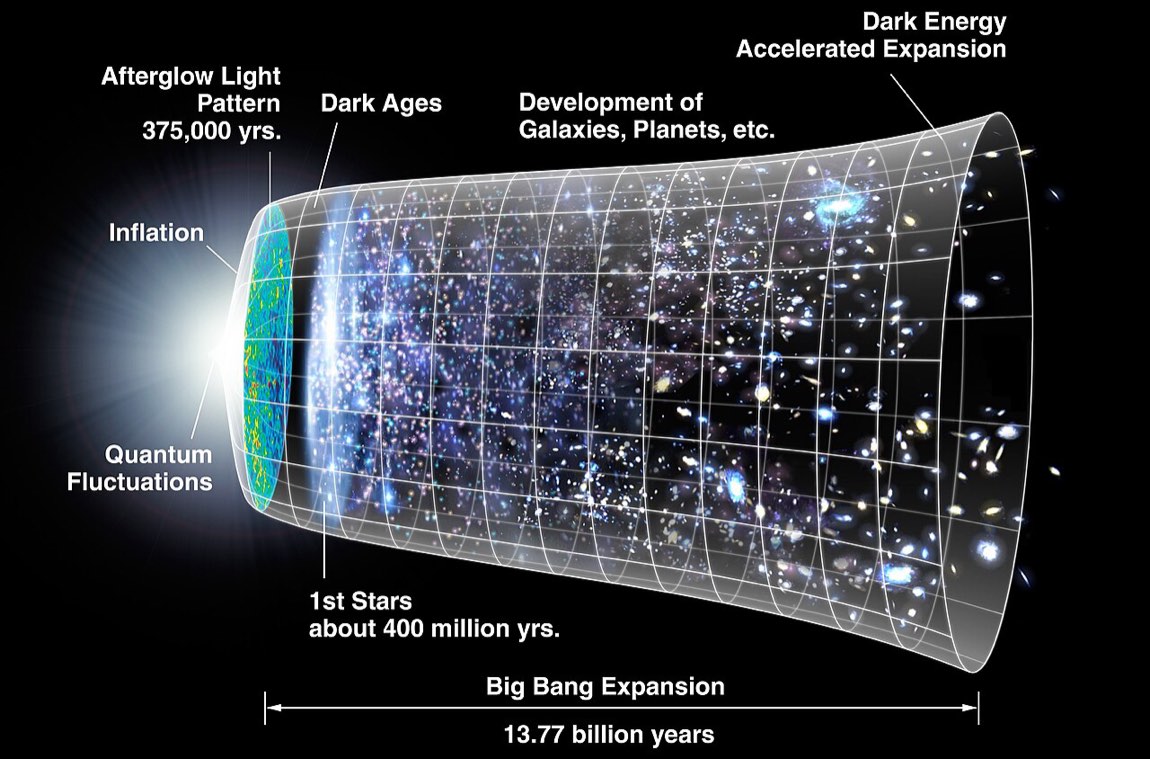
The story of every atom in your body begins in chaos. About 13.8 billion years ago, as the universe cooled below roughly ten billion Kelvin — about one MeV of energy — the first protons and neutrons condensed out of a quark-gluon plasma. Over the next few minutes these particles began sticking together, building hydrogen (including deuterium), helium, and traces of lithium. Then, after about 20 minutes, the universe had expanded and cooled so much that the energetic collisions needed to fuse nuclei became impossible. The entire window for Big Bang nucleosynthesis had slammed shut. More precisely, the nuclei recognized as products of this era formed between 100 and 300 seconds after the Big Bang. Nothing heavier than beryllium — possibly boron — had time to form. The proportions locked in during those minutes still define the cosmos today: roughly 74% of all matter by mass is hydrogen from this era, and another 24% is helium. Everything else — every carbon atom in DNA, every iron atom in blood — amounts to only a few percent of the universe's total mass.
02 How the B2FH paper rewrote chemistry
In 1957, four astrophysicists — E. M. Burbidge, G. R. Burbidge, William A. Fowler, and Fred Hoyle — published a landmark review paper known ever since by their initials: B2FH. The paper systematically catalogued the nuclear processes inside stars that could account for the observed abundances of the elements. It defined new processes for transforming one heavy nucleus into another within stellar interiors, processes precise enough that astronomers could go looking for their signatures. The paper was not without error — it described what it called an alpha process for elements between silicon and nickel that later turned out to be incorrect — but it set the agenda for nucleosynthesis research for decades. The correct picture for those intermediate elements, quasi-equilibrium synthesis anchored to silicon-28, came later and was recognized as the most important advance in that mass range since Hoyle's own 1954 paper. The B2FH paper also designated the r-process as a secondary process, a label later overturned when astronomers found ancient, metal-poor stars that nonetheless carried a full complement of r-process nuclei, proving the process can operate even in gas of nearly pure hydrogen and helium.
03 Why the element abundance plot is so jagged Deeper
One of the most powerful drivers of nucleosynthesis theory is not a telescope image but a graph. When you plot the abundance of each element against its atomic number, the result is a strikingly jagged sawtooth pattern — abundances that vary by factors of up to ten million from one element to the next. A particularly influential version of this graph was built by Hans Suess and Harold Urey using data from unfractionated abundances of non-volatile elements in unevolved meteorites, chosen precisely because meteorites preserve a relatively pristine chemical record of the early solar system. Even on the logarithmic scale needed to display the enormous range of abundances, the jagged structure is still obvious. Several features of the plot cry out for explanation: the high abundance of elements whose isotopes are composed of whole numbers of helium-4 nuclei (the so-called alpha nuclides), the pronounced peak around iron and nickel where nuclear binding energy is maximized, and the twin abundance peaks associated with neutron magic numbers in the r-process and s-process. The goal of nucleosynthesis theory, in the words of researchers in the field, is to explain the full shape of this plot through natural physical processes.
04 The slow path: s-process inside giant stars Deeper
Not all heavy-element production happens in explosions. Inside certain evolved stars, a quieter process called the slow neutron capture process — the s-process — steadily builds elements heavier than iron over thousands of years. Carbon plays a crucial enabling role: it is the main element responsible for releasing free neutrons within stars, and those neutrons are what the s-process relies on. An iron nucleus in a stellar interior absorbs one neutron at a time, each capture slow enough that if the resulting nucleus is radioactive, it has time to decay before the next neutron arrives. This ratchets nuclei up the periodic table step by step. Astronomers found direct proof of the s-process operating inside real stars when they observed barium abundances some 20 to 50 times greater than found in unevolved stars in the atmospheres of asymptotic giant branch stars. An even earlier smoking gun came in 1952, when technetium — a radioactive element with a half-life far shorter than the age of any star — was detected by spectroscopy in the atmosphere of a red giant. Since technetium cannot have survived from the star's formation, it had to have been manufactured inside the star recently and dredged to its surface.
05 Gold from a cosmic collision: GW170817
For decades, astronomers suspected that the rapid neutron capture process — the r-process — needed an extreme, neutron-rich environment that ordinary stars could not provide. The leading candidates were neutron star mergers, but direct proof was elusive. That changed in 2017 with the event catalogued as GW170817. Detectors including LIGO, Virgo, the Fermi Gamma-ray Space Telescope, and INTEGRAL simultaneously caught both gravitational waves and electromagnetic signals from what appeared to be two neutron stars colliding. As the ejected neutron-rich matter decayed and cooled, observatories around the world detected spectroscopic signals of numerous heavy elements, including gold. The event confirmed that binary neutron star mergers are a major — and as of the mid-2020s, believed to be the main — source of r-process elements. A separate class of merger, between a neutron star and a black hole, was first detected in July 2021, but analysis of these events suggests binary neutron star mergers contribute more to heavy-element production than neutron star–black hole mergers do.
06 Cosmic rays chipping atoms apart
Stellar fusion is famously efficient at building nuclei up — but nature also has a process that smashes them down. Cosmic ray spallation occurs when fast-moving cosmic rays, mostly protons, slam into atomic nuclei in the interstellar medium, on asteroids and meteoroids, or in Earth's own atmosphere and ground. The collisions fragment larger nuclei — carbon, nitrogen, and oxygen are the main targets — into lighter pieces. This process is the dominant origin of beryllium and boron in the cosmos, elements that stellar fusion cannot produce in significant quantities because the intermediate nucleus beryllium-8 has an extraordinarily short half-life of 8.2 × 10⁻¹⁷ seconds, far too brief to accumulate. Spallation is also responsible for most helium-3 and the isotopes boron-10 and boron-11. The same process continues today on Earth, producing what scientists call cosmogenic nuclides. The most familiar example is carbon-14, made when cosmic rays strike nitrogen-14 in the atmosphere — the very isotope that underpins radiocarbon dating. Iodine-129 is another cosmogenic nuclide produced by the same family of reactions.
07 Supernovae and the gamma-ray smoking gun Deeper
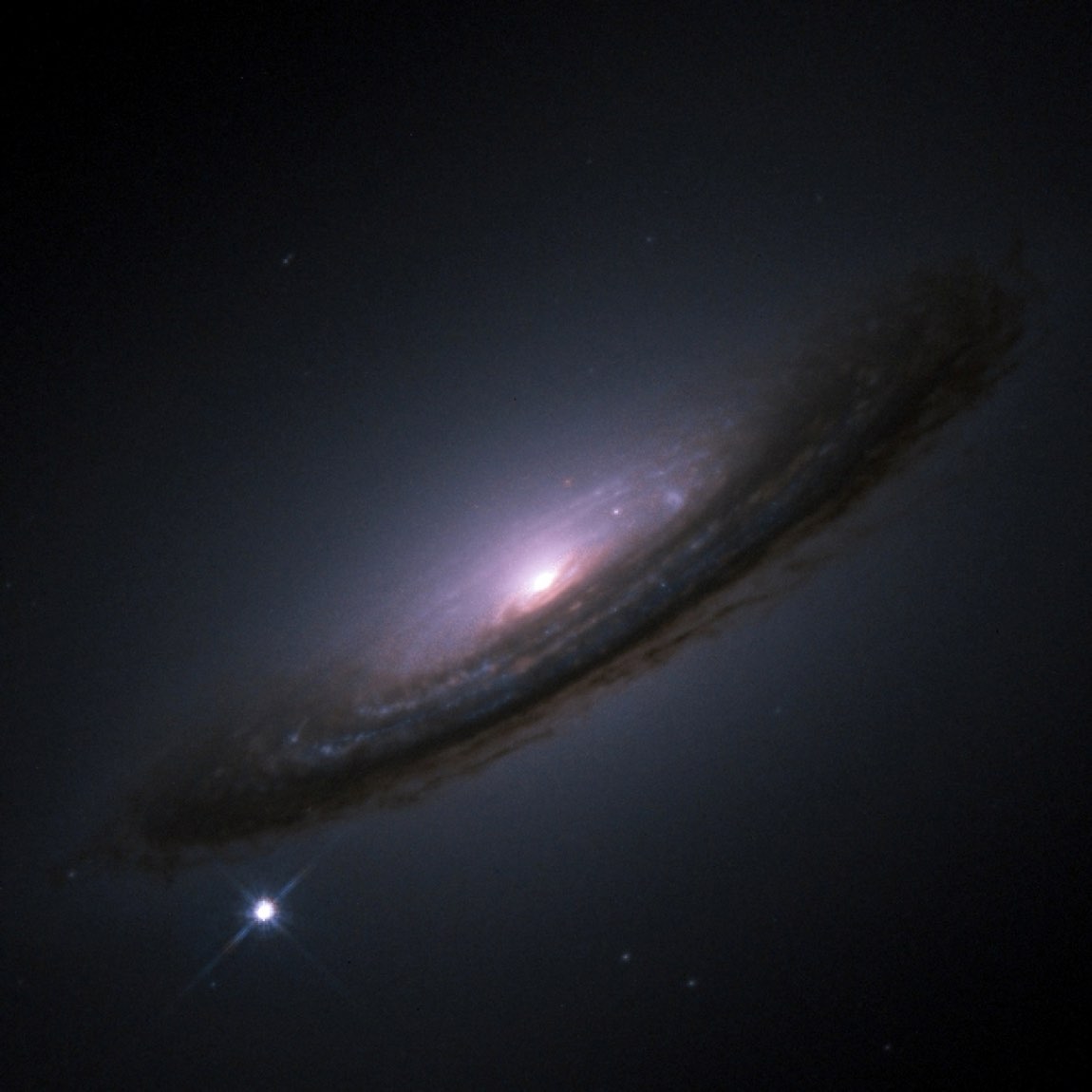
The most direct confirmation that supernovae forge elements came on February 23, 1987, when the explosion now called SN 1987A blazed into visibility in the Large Magellanic Cloud. In the months that followed, gamma-ray observatories detected specific spectral lines emerging from the expanding debris — lines identifying cobalt-56 and cobalt-57 nuclei. Both isotopes have half-lives short enough, roughly around a year, that their presence proved they had been freshly synthesized in the explosion itself rather than accumulated over the star's lifetime. This detection fulfilled a prediction made in 1969 that such gamma-ray lines could serve as a fingerprint of explosive nucleosynthesis. That 1969 prediction played a direct role in the scientific planning for NASA's Compton Gamma Ray Observatory. The underlying nuclear mechanism involves silicon quasi-equilibrium: during the explosion, oxygen and silicon fuse in a feverishly burning mix anchored to silicon-28, producing radioactive isobars including nickel-56 (which decays to cobalt-56, then to iron-56), nickel-48 leading to titanium-48, and chromium-52. The most stable end products of these decay chains — iron-56, chromium-52, and titanium-48 — account for much of the iron-group material scattered into the galaxy by every core-collapse supernova.
08 Presolar grains: stars trapped in meteorites Deeper
Some of the most concrete evidence for nucleosynthesis comes not from telescopes but from microscopes applied to primitive meteorites. As stars in their final evolutionary stages shed material through stellar winds, tiny solid grains condense within those outflows and eventually mix into the interstellar medium. A small fraction of these grains survived the formation of our solar system and can be found locked inside certain carbonaceous meteorites today — presolar grains, sometimes called stardust. When researchers measure the isotopic compositions of individual grains, they find ratios wildly different from solar-system averages, reflecting the specific nuclear environment inside the star from which each grain came. Barium isotope patterns in some grains carry the unmistakable signature of s-process operation. In supernova stardust grains — sometimes called SUNOCONs, a category predicted in 1975 — radioactive titanium-44 was measured to be very abundant at the time of condensation, consistent with the quasi-equilibrium nucleosynthesis expected in a supernova. These grains are, in a real sense, physical samples of individual stars that lived and died before the Sun was born, providing ground-truth data against which nucleosynthesis models can be checked.
09 Earth's own slow nuclear reactors
Nucleosynthesis does not only happen in stars and explosions. Inside Earth right now, long-lived radioactive nuclei left over from supernovae billions of years ago are quietly decaying and producing new isotopes — a process called radiogenesis. Uranium-235, uranium-238, and thorium-232 are the primary parents, each undergoing long chains of decay through many intermediate daughter nuclides before finally arriving at stable isotopes of lead. Along the way they produce Earth's entire natural supply of elements such as radon and polonium. Potassium-40 decays to argon-40, and this process accounts for most of the argon-40 in our atmosphere — very little of that atmospheric argon is primordial. Alpha decay continuously produces helium-4, and the helium trapped in Earth's crust is likewise mostly non-primordial, generated underground since the planet formed. Even spontaneous fission plays a small role: thorium-232, uranium-235, and uranium-238 all undergo it, and this is how nature produces tiny amounts of technetium and promethium — elements with no stable isotopes that would otherwise be completely absent from Earth.
10 Using element ratios to read galactic history Deeper
Because different elements are forged in different kinds of events that unfold on different timescales, the ratios of elements in a star act as a kind of timestamp recording when that star formed. Magnesium, for example, is produced predominantly in core-collapse supernovae — the violent deaths of massive stars that live only a few million years. Iron, by contrast, is produced largely in Type Ia supernovae, which occur when a white dwarf in a binary system accretes material from its companion until it ignites and explodes. The delay between the start of star formation in a galaxy and the typical occurrence of Type Ia supernovae is around 1 billion years. This means that stars born in the first billion years of a galaxy's star-forming life will, as a general rule, show higher ratios of magnesium to iron than stars born later, simply because magnesium was being stirred into the interstellar medium earlier. Europium traces yet another channel — neutron star mergers. Argon-40, to give a different example, forms through radioactive decay rather than any fusion process. Reading these chemical fingerprints allows astronomers to piece together a galaxy's star-formation history from the composition of its stars alone.
11 The r-process: still an open calculation Deeper
The rapid neutron capture process, the r-process, is responsible for creating the most neutron-rich isotopes of heavy elements and for producing the universe's natural radioactive elements, including uranium and thorium. The basic picture — free neutrons are captured faster than intermediate isotopes can decay, rapidly building nuclei up to and beyond lead — was laid out in the B2FH paper and first calculated quantitatively by Seeger, Fowler, and Clayton. Yet despite decades of work and the dramatic confirmation that neutron star mergers are a major site, researchers have not yet achieved a fully satisfactory calculation of r-process abundances that matches all observations. The question of whether supernovae or neutron star mergers dominate the r-process — or whether both are needed in different proportions at different epochs of galactic history — remains genuinely open. A further twist emerged in 2025 when some direct evidence was published suggesting that flaring magnetars might also drive r-process nucleosynthesis, with estimates that this mechanism could account for roughly 1% to 10% of the heavier elements in the universe. The r-process is perhaps the most active frontier in nucleosynthesis research today.
12 Population III stars: the universe's first furnaces
The very first stars to light up the universe — called Population III stars — formed from gas that Big Bang nucleosynthesis had left behind: almost entirely hydrogen and helium, with only trace amounts of lithium, beryllium, and boron. They had essentially no heavier elements at all, because none had yet been made. These stars formed a few hundred million years after the Big Bang, during the era astronomers sometimes call Cosmic Dawn. Because heavy elements act as cooling agents in collapsing gas clouds, their absence likely meant Population III stars were extraordinarily massive compared to stars forming today. When they exploded as supernovae, they seeded the interstellar medium with the first carbon, oxygen, magnesium, and iron — the raw material for the next generation of stars, called Population II, which formed with small but measurable quantities of metals. This progressive enrichment is why stars born early in a galaxy's history have very different chemical compositions from stars like the Sun, born billions of years later from gas that had already been through many cycles of stellar birth and death.