Astrophysics
Hawking Radiation
TheoreticalThe idea
Stephen Hawking's famous result: black holes aren't perfectly black. Quantum physics makes empty space fizz with particle pairs; at a horizon's edge, one partner can fall in while the other escapes — a faint glow that slowly bleeds the black hole's mass away. Small black holes would eventually evaporate entirely, ending in a flash.
Go deeper Advanced
The temperature is inversely proportional to mass: a solar-mass hole radiates at 60 nanokelvin — hopelessly below the CMB, hence unobservable today. The prediction stands on solid semiclassical ground and analog-system experiments, but has never been directly detected — 'Theoretical' is its honest label, and the information paradox it spawned drives quantum-gravity research.
The deep dive
Researched for the Atlas from Wikipedia — Hawking radiation (40,992 characters read) · updated Sep 20, 2026
01 How Bekenstein lit the fuse in 1972
Stephen Hawking did not arrive at his famous result alone or suddenly. The groundwork was laid in 1972 by Jacob Bekenstein, who argued that black holes must carry a finite entropy proportional to their surface area. At the time, Hawking actively opposed this idea, because classical physics treated a black hole as an almost featureless object with no entropy at all — a view pioneered by researchers such as Karl Schwarzschild and John Wheeler. The turning point came in 1973, when Hawking traveled to Moscow and met Soviet physicists Yakov Zeldovich and Alexei Starobinsky. They had already proposed in 1971 that rotating black holes should create and emit particles, reasoning by analogy with electromagnetic spinning metal spheres — a process now called Zeldovich amplification. Combining Bekenstein's entropy idea with Zeldovich and Starobinsky's particle-creation insight, and wrapping both in his own command of quantum field theory and general relativity, Hawking produced his landmark 1974 paper. If black holes have entropy they must have a temperature, and if they have a temperature they must radiate. Each idea was someone else's spark; Hawking provided the unified flame.
02 Why the temperature runs backwards
Almost every hot object cools as it loses energy, but a radiating black hole does the opposite. The Hawking temperature is inversely proportional to the black hole's mass: T ≈ 10²³ / M, where M is in kilograms. As the black hole sheds mass through radiation its temperature rises, which makes it radiate faster, which shrinks it further — a runaway feedback loop. For the smallest predicted stellar black hole, roughly 3 solar masses, this temperature works out to only 10⁻⁷ K, far colder than the cosmic microwave background at 2.7 K. Because the surrounding universe is warmer than the black hole, stellar-mass black holes actually absorb more radiation than they emit and cannot evaporate at all under present cosmic conditions. Only objects far smaller than any star could ever form — primordial black holes — might be warm enough to lose mass on a cosmologically interesting timescale. The endpoint of the feedback loop, reached when the black hole's mass approaches 1 Planck mass, is predicted to be a violent burst of gamma rays, though a complete description of that final instant requires a theory of quantum gravity that does not yet exist.
03 Putting numbers on black hole lifetimes Deeper
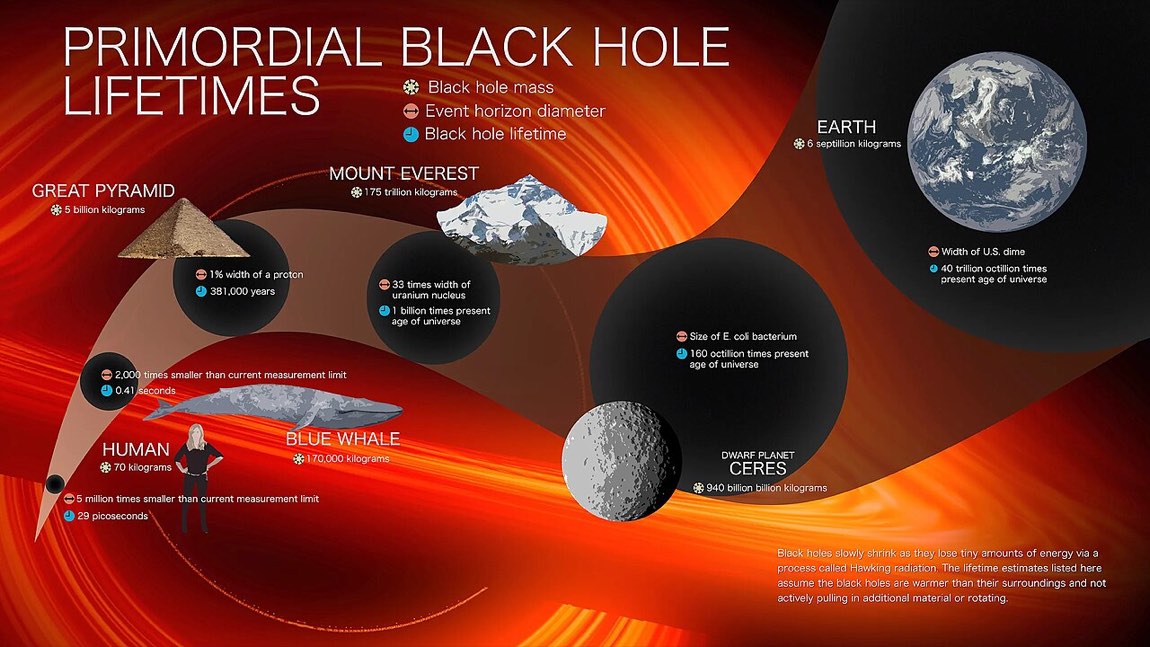
The evaporation time scales as the cube of the initial mass: t_ev = (5120π G² M³) / (ℏ c⁴), which approximates to 2.140 × 10⁶⁷ years × (M / M☉)³, where M☉ is one solar mass. A black hole of one solar mass (2.0 × 10³⁰ kg) therefore takes more than 10⁶⁷ years to evaporate — roughly 10⁵⁷ times the current age of the universe at 1.4 × 10¹⁰ years. Scale up to a supermassive black hole of 10¹¹ solar masses and the wait stretches to around 2 × 10¹⁰⁰ years. Theoretical monster black holes expected to grow to perhaps 10¹⁴ solar masses during the future collapse of galaxy superclusters would persist for up to 2 × 10¹⁰⁶ years. These figures come from pre-1998 calculations using outdated neutrino assumptions; the modern estimate for a solar-mass black hole is 10⁶⁷ years. Lifetime scales so steeply with mass because luminosity scales as M⁻², so halving a black hole's mass quadruples its power output, halving its remaining lifetime again and again in an accelerating cascade.
04 Primordial black holes and the 10¹² kg threshold
For a black hole to have evaporated completely since the Big Bang, its mass must have been small enough that radiation could drain it in under roughly 1.4 × 10¹⁰ years. Hawking estimated that any black hole formed in the early universe with a mass less than approximately 10¹² kg would have fully evaporated by today. That mass threshold — about the mass of a large mountain compressed to subatomic size — is far below anything a collapsing star can produce, so only primordial black holes created in the extreme density of the early universe qualify. In 1976, Don Page refined Hawking's estimate by carefully calculating the power output and evaporation time for a non-rotating, uncharged black hole. Page found that primordial black holes could survive to the present day only if their initial mass were roughly 4 × 10¹¹ kg or larger. A more careful 2008 calculation using the full particle content of the Standard Model and the WMAP value for the age of the universe placed the survival threshold at (5.00 ± 0.04) × 10¹¹ kg. Page's original 1976 result was slightly off because he assumed neutrinos are massless and that only two neutrino flavors exist; modern physics recognizes three flavors with nonzero masses.
05 Greybody factors: why the spectrum isn't perfect Deeper
At the event horizon itself, a black hole radiates like a perfect blackbody. By the time that radiation reaches a distant observer, however, it has been filtered by the curved spacetime it had to cross. Greybody factors are frequency- and angular-momentum-dependent functions that quantify exactly how much the emission spectrum deviates from a pure blackbody curve. The emission rate for particles with energy between ℏω and ℏ(ω + dω) and angular momentum quantum numbers ℓ and m contains a greybody factor σ(ω, ℓ, m) in the numerator alongside the standard Bose–Einstein or Fermi–Dirac thermal denominator. For bosons the denominator takes the form exp(ℏω / k_B T) − 1, and for fermions it is exp(ℏω / k_B T) + 1. The greybody factors arise because longer-wavelength radiation has more difficulty escaping the gravitational potential well around the black hole, and because radiation with higher angular momentum encounters a stronger centrifugal barrier. For a charged black hole, the greybody factors can also depend on the charge carried by the emitted particles. The practical effect is that what a distant telescope would detect is a somewhat suppressed and distorted spectrum rather than the clean blackbody curve that exists right at the horizon.
 ⤢
⤢
06 The Unruh effect: acceleration as heat Deeper
Hawking radiation is deeply connected to the Unruh effect, which says that an observer accelerating through ordinary empty space will detect a warm bath of particles, while an inertial observer sees none. Near a black hole's event horizon, any observer who wants to hover without falling in must fire rockets continuously, experiencing enormous acceleration. By the equivalence principle — which says acceleration and gravity are locally indistinguishable — that hovering observer is in exactly the situation described by the Unruh effect and sees a local thermal bath of particles at a temperature proportional to their acceleration. The acceleration diverges as the observer approaches the horizon, which is why the local temperature diverges there too. The key step in Hawking's derivation is then gravitational redshift: that fierce near-horizon temperature, when redshifted to the perspective of a far-away observer, settles down to the finite Hawking temperature T_H = 1 / (8πM) in natural units. The outgoing flux that the distant observer measures is Hawking radiation. Because the Unruh effect in flat spacetime is calculated from ordinary quantum field theory and is not controversial, the Hawking result inherits much of that credibility, even though the black hole version is harder to test directly.
07 The trans-Planckian headache Deeper
One of the most serious theoretical objections to Hawking's calculation is called the trans-Planckian problem. If you take a photon detected far from the black hole with a normal, measurable frequency and trace it backwards in time toward the horizon, its frequency is gravitationally blueshifted without limit. By the time the photon's history reaches the moment the black hole formed, its inferred wavelength is shorter than the Planck length — a scale where the known laws of physics break down entirely. Hawking himself handled this by using a black hole that forms at a finite time in the past, identifying the source of all outgoing radiation as quantum fluctuations packed into a microscopic point right at the moment of formation. Critics note that because we have no tested physics at sub-Planck scales, the calculation rests on extrapolating quantum field theory far beyond its domain of validity. Most modern theorists consider the trans-Planckian problem a mathematical artifact rather than a physical crisis, partly because the same kind of divergence appears in the Unruh effect, where the answer is independently confirmed and uncontroversial. Alternative formulations, including a tunneling picture developed by Parikh, Wilczek, Padmanabhan, and Srinivasan, reproduce the same Hawking temperature without running into the trans-Planckian issue so directly.
08 Entropy, information, and a paradox unsolved
Black hole evaporation sharpens one of the deepest unsolved problems in theoretical physics: the black hole information paradox. When matter falls into a black hole it carries information — the exact quantum states of every particle. Hawking radiation, in the simplest models, is completely random thermal noise with no connection to that original information. If the black hole eventually evaporates entirely, the information seems to vanish, violating a cornerstone of quantum mechanics that says information is always conserved. Several competing solutions have been proposed: that the outgoing Hawking radiation is subtly perturbed and secretly encodes the missing information; that evaporation leaves behind a stable remnant particle containing it; or that information genuinely is lost and quantum mechanics must be revised in the presence of gravity. None of these has won consensus. The evaporation also suggests a holographic picture: black hole entropy equals one-quarter of the horizon area in natural units, strongly implying that all the information about the interior can be encoded on the bounding surface — the holographic principle — though how exactly that encoding works during evaporation remains an active research frontier.
09 Attempts to see it: telescopes and labs
Detecting Hawking radiation from an astrophysical black hole is currently impossible — the signal is many orders of magnitude below what any existing telescope can measure. The most realistic observational hope involves primordial black holes small enough to be in their final evaporation stage today, which should produce a distinctive burst of gamma rays. In June 2008 NASA launched the Fermi space telescope specifically to search for these terminal flashes; as of January 2024, none have been detected. In 2023, the neutrino detector KM3NeT recorded an extremely energetic 120 PeV event labeled KM3-230213A, and one proposed explanation is the evaporation of a primordial black hole, though the origin remains under debate. In the laboratory, researchers have pursued sonic analogs: in certain ultracold Bose–Einstein condensates, sound waves in a flowing fluid mimic how light behaves near a gravitational horizon. Observations of an acoustic Hawking-like effect in such systems have been reported. In September 2010 an experimental group created a laboratory white-hole event horizon and claimed to observe an optical analog to Hawking radiation, but those results remain contested and have not achieved consensus as a confirmed detection.
10 Micro black holes and the Large Hadron Collider
Some speculative theories propose that the universe has large extra spatial dimensions beyond the familiar three — models that suggest ten or eleven dimensions in total. If such dimensions exist, the effective Planck scale could be as low as a few TeV rather than the standard ~10¹⁹ GeV, which would dramatically lower the minimum mass needed to form a black hole. In that case CERN's Large Hadron Collider might produce microscopic black holes in high-energy proton collisions and they would evaporate almost instantly — on a timescale around the "new Planck time" of roughly 10⁻²⁶ seconds — producing a detectable spray of particles consistent with Hawking radiation. The lifetime of such a micro black hole in an n-extra-dimension model scales as (1/M*) × (M_BH / M*)^((n+3)/(n+1)), where M* is the low-energy scale. Despite careful searching, no micro black hole has been observed at CERN. The standard Hawking formulas become internally inconsistent for black holes below the ordinary Planck mass (~10⁻⁸ kg), predicting lifetimes shorter than the Planck time (~10⁻⁴³ s), which is normally taken to mean the Planck mass is simply the lower mass limit for a conventional black hole.
11 Loop quantum gravity's different answer Deeper
Loop quantum gravity offers an alternative way to quantize spacetime and has been applied to the problem of black hole entropy and Hawking radiation with revealing results. When researchers carry out a detailed study of the quantum geometry of a black hole event horizon using this framework, they find that loop-quantization does not automatically reproduce the Bekenstein–Hawking entropy formula. Instead, a free parameter in the theory must be tuned specifically to cancel various constants and recover the standard result. This dependence on an adjustable parameter is seen as a weakness by some theorists. On the other hand, the loop quantum gravity approach does yield quantum gravitational corrections to both the entropy and the radiation spectrum of black holes, and those corrections have concrete observational implications. The theory predicts that a quantum black hole's emission would deviate from a smooth Hawking spectrum, showing instead a set of discrete, sharply pronounced emission frequencies layered on top of the continuous thermal background. If Hawking radiation from evaporating primordial black holes were ever detected as X-rays, these discrete spectral lines would in principle distinguish loop quantum gravity from other approaches to quantum gravity.