Astrophysics
Falling Into a Black Hole
ConfirmedThe idea
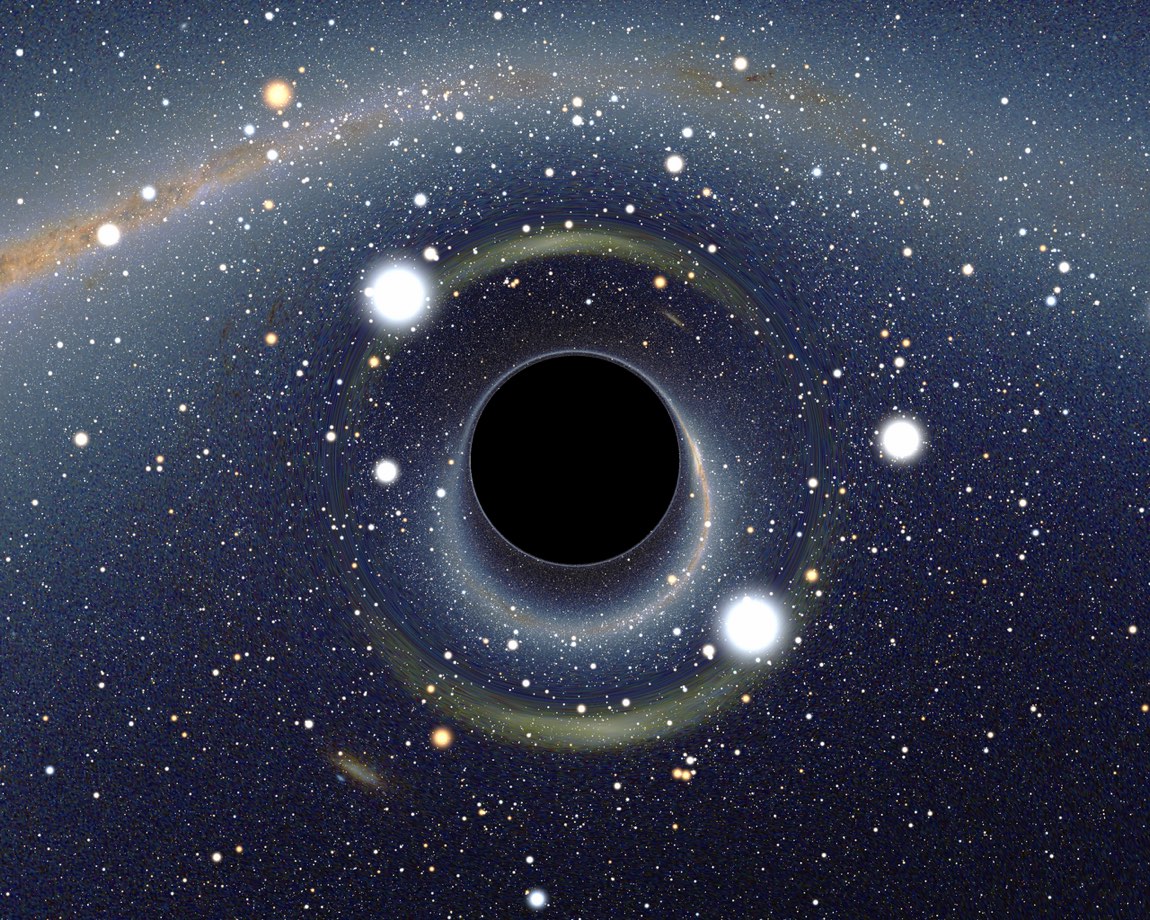
Fall feet-first toward a small black hole and gravity pulls your feet far harder than your head, stretching you like dough into a noodle. Scientists really do call it spaghettification. The counterintuitive twist: bigger is gentler. A supermassive black hole's horizon is so far from its center that you could cross it comfortably, noticing nothing special at the boundary — doomed, but intact for a while.
Go deeper Advanced
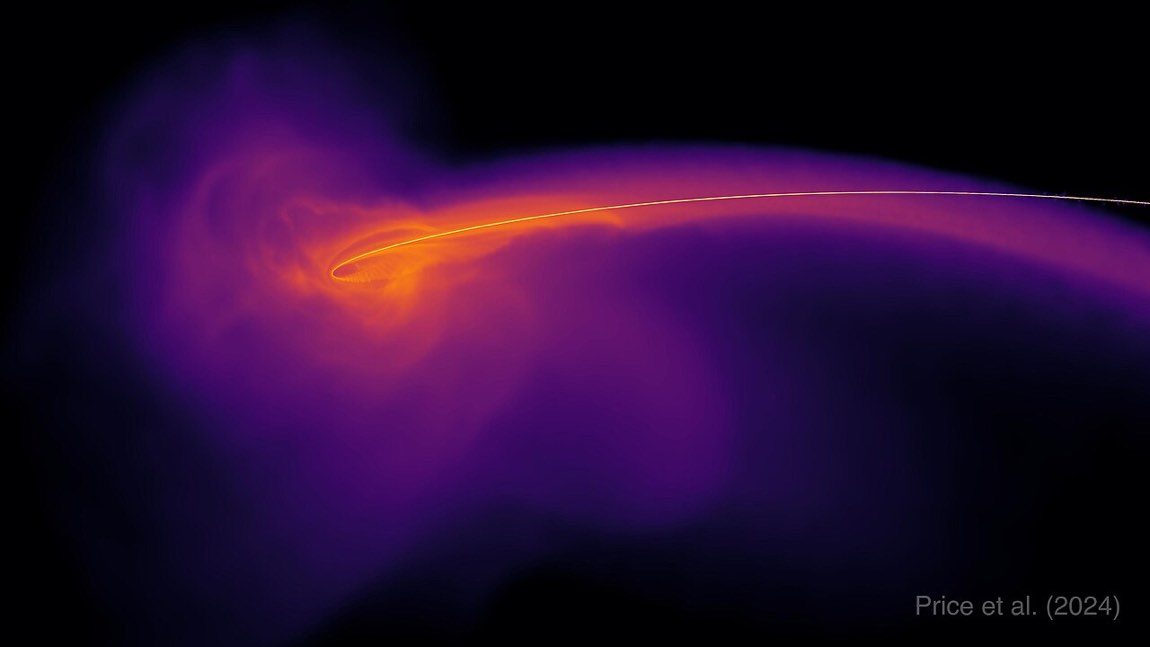
Tidal stress scales as M/r³: at a stellar hole's horizon it exceeds anything survivable; at Sgr A*'s it is milder than Earth's surface tides. The 2019 sight of a star being shredded (a 'tidal disruption event') is spaghettification observed at stellar scale. What happens at the center — the singularity — is where general relativity stops answering.
The deep dive
Researched for the Atlas from Wikipedia — Spaghettification (3,200 characters read) · updated Sep 20, 2026
01 Where the word spaghettification comes from
The vivid term was popularized by Stephen Hawking, who used it to describe a fictional astronaut crossing a black hole's event horizon and being "stretched like spaghetti." That image — familiar food, cosmic horror — turned an otherwise dry description of tidal physics into something immediately graspable. The underlying phenomenon had been understood mathematically long before Hawking gave it a name, but the coinage stuck because it captures both the geometry and the violence of the process. Today physicists use it freely in technical writing as well as popular science. The companion phrase "noodle effect" is sometimes preferred in contexts where the pasta metaphor feels too informal, but both terms refer to exactly the same physics: vertical stretching combined with horizontal compression driven by a strongly non-uniform gravitational field.
02 Tidal forces: the real engine behind stretching
Spaghettification is not caused by gravity being strong in some simple sense — it is caused by gravity being different from one part of an object to another. These differences are called tidal forces, and they follow a precise mathematical rule. The radial tidal force across an object of mass m and size Δr, sitting at distance r from a body of mass M, is estimated as ΔF = Δr × (2GmM) / r³, where G is the gravitational constant. Notice the r³ in the denominator: as r shrinks, the force grows with the cube of that shrinkage, making tidal effects ramp up ferociously close to a massive body. The same inverse-cube scaling governs the Moon's tidal stretching of Earth's oceans, so spaghettification is really an extreme version of something already at work every day on our own planet.
03 The diamond-formation thought experiment
A clean way to visualize tidal forces is to imagine four objects arranged in a diamond shape above a planet. The inverse-square law of gravity means the lowest object is pulled hardest toward the planet's center, while the topmost object is pulled least. The two objects on the sides, meanwhile, are each directed toward the planet's center along slightly converging lines, so they are drawn toward each other. The net result: the diamond stretches along the line pointing toward the planet and is compressed across its width. If the four objects are rigidly connected, internal elastic forces push back, keeping the shape intact — up to a point. If the tidal forces grow large enough, those internal forces are overwhelmed and the body breaks apart into a narrow chain of pieces, which is precisely what "spaghettification" looks like on an astronomical scale.
04 Volume is conserved during the stretching Deeper
One counterintuitive feature of spaghettification is that, within a small region, the horizontal compression exactly balances the vertical stretching, so a small object undergoing the process experiences no net change in volume. This is not coincidental — it follows from the mathematical structure of tidal forces in general relativity and Newtonian gravity alike. For a small enough volume element, the squeezing inward from the sides compensates precisely for the elongation along the radial direction. Of course, real objects are not infinitely small, and different parts of a body experience different tidal forces, so the overall object is torn apart even while each tiny piece is volume-preserving. The practical consequence for a falling astronaut is that the sensation would be of being pulled apart at the limbs, not of being crushed or inflated overall.
05 Feet first and the anatomy of the fall
Physicists often describe the spaghettification scenario with a person falling feet first toward a black hole, and the choice of orientation is deliberate. Gravity at the feet, being closer to the black hole, is significantly stronger than gravity at the head, so the body is pulled apart along its length. At the same time, the right side of the body is pulled leftward and the left side is pulled rightward — both sides converging toward the central line connecting the person to the black hole. The combined effect is elongation from head to toe and narrowing across the chest. No material known to science, biological or otherwise, could resist these forces in the most extreme environments near a black hole. The scenario makes the physics of tidal forces viscerally concrete in a way that abstract equations do not.
 ⤢
⤢
06 Supermassive vs. stellar black holes: a crucial difference Deeper
Not all black holes spaghettify an infalling astronaut at the same point in the journey, and this distinction matters enormously. For stellar-mass black holes, the spacetime curvature at the event horizon is extreme, meaning tidal forces are already powerful enough to spaghettify a person before they ever reach or cross the event horizon. The astronaut would be destroyed in open space. Supermassive black holes — the kind found at galactic centers — are a different story entirely. Because the tidal force scales with M/r³ and the event horizon radius grows with mass M, the tidal force at the event horizon actually decreases for more massive black holes. For a supermassive black hole, the point at which tidal forces become lethal lies inside the event horizon. An astronaut could therefore cross the event horizon of a supermassive black hole without noticing any squashing or pulling at all.
07 The event horizon is not the point of no return for stretching Deeper
A common assumption is that the event horizon — the boundary beyond which nothing can escape — is also the boundary at which spaghettification begins. The article makes clear this is wrong: the point at which tidal forces destroy an object or kill a person is proportional to the black hole's mass, and this point is explicitly stated to not be the event horizon. Depending on the black hole's mass, that lethal threshold can be far outside the event horizon, right at it, or well inside it. The event horizon is a causal boundary — cross it and escape becomes impossible — but tidal forces obey their own geometry. Once inside an event horizon, however, falling toward the center is described as inevitable, so the astronaut who crosses unscathed into a supermassive black hole is still doomed; spaghettification will come, just later.
08 Internal elastic forces and the limits of resistance Deeper
When an object enters a region of non-uniform gravity, tidal forces do not immediately destroy it. The body first responds by deforming slightly, and as it does, internal elastic forces build up — essentially the molecular bonds of the material pushing back against the distortion to restore mechanical equilibrium. A rocky asteroid, a steel spacecraft, or a human body all have some capacity to resist. This resistance is what allows Earth to remain roughly spherical despite the Moon's tidal pull. Near a black hole, however, tidal forces grow without practical limit as distance r decreases, following that r³ dependence. At some point, no material strength can maintain mechanical equilibrium, and the object yields. It does not merely bend; it is progressively torn into an increasingly narrow stream of matter, ultimately becoming a thin filament — the spaghetti of the metaphor.
09 A galaxy's center and the fate of nearby stars
The article notes that supermassive black holes are found at the centers of galaxies, and this context gives spaghettification a real observational setting. When a star wanders too close to a galactic-center black hole, tidal forces can overcome the star's own self-gravity and tear it apart — an event astronomers call a tidal disruption event. Because the lethal tidal threshold for a supermassive black hole lies inside the event horizon, stars can be disrupted at distances outside the event horizon where the debris can still escape, producing a brief flare of radiation detectable across the universe. This makes spaghettification not merely a thought experiment but an astrophysical process that telescopes have documented, connecting Hawking's pasta metaphor to real observational astronomy.
10 What "non-homogeneous" gravitational field really means
The formal definition in the article describes spaghettification as occurring in a "very strong, non-homogeneous gravitational field." The non-homogeneous part is the key ingredient. A perfectly uniform gravitational field — one where every part of an object feels exactly the same pull in exactly the same direction — would accelerate the object as a whole without deforming it at all. It is only because real gravitational fields vary in both strength and direction across the extent of an object that tidal forces arise. Near a point mass or black hole, the field varies dramatically over short distances because of the inverse-square law, making the non-homogeneity extreme. The stronger the field and the larger the object relative to the distance, the more severe the tidal difference and the more pronounced the stretching and compression.