Astrophysics
Gravity
ConfirmedThe idea
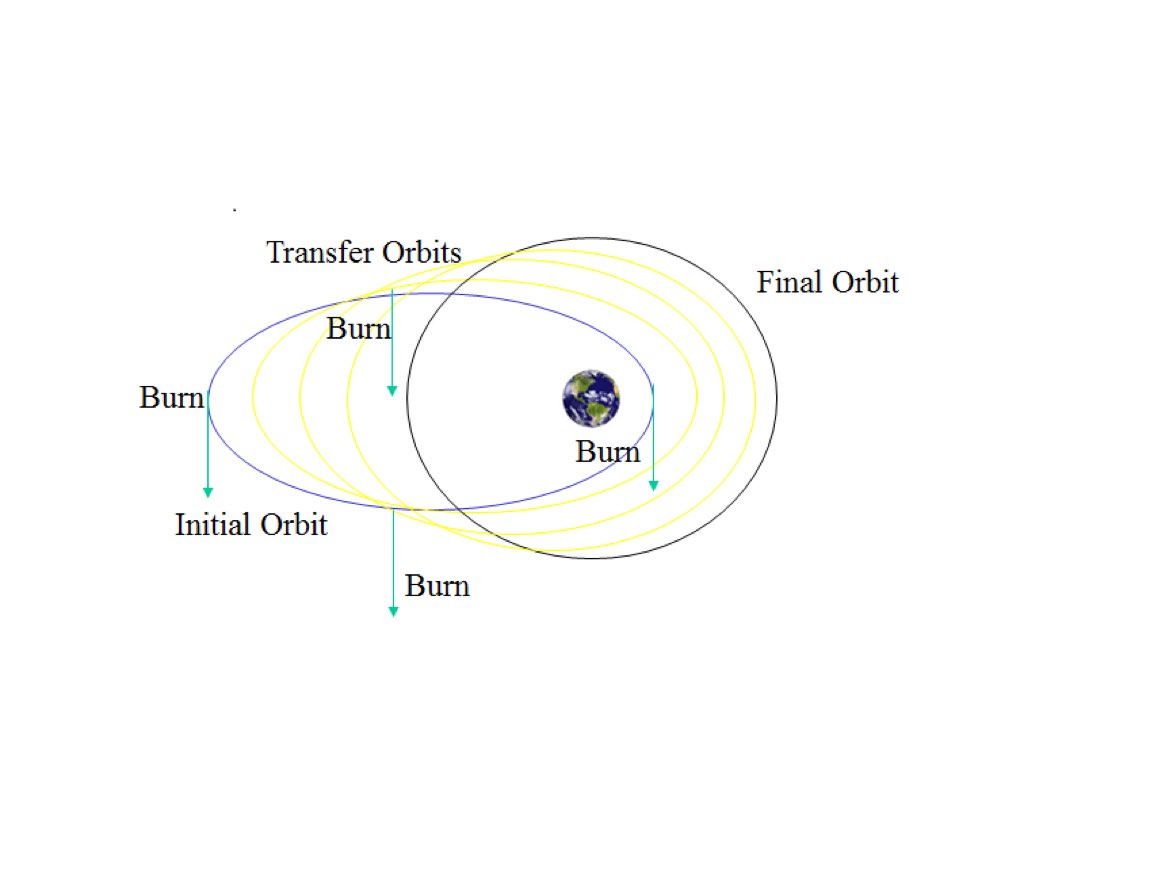
Gravity is the attraction between anything that has mass. Drop a ball and Earth pulls it; the ball pulls Earth too, but Earth barely notices. The Moon is a ball that keeps falling around Earth and keeps missing — that's an orbit. Gravity is by far the weakest force, yet with enough mass it runs the universe: it makes stars, holds galaxies, and shapes time itself.
Go deeper Advanced
Newton described gravity as a force with a precise formula — good enough to fly spacecraft. Einstein went deeper: mass curves space-time, and objects simply follow the straightest possible paths through curved geometry. The bends of starlight around the Sun (1919), GPS clock corrections, gravitational waves (2015), and black-hole images (2019) all confirm the geometric picture at every tested scale.
The deep dive
Researched for the Atlas from Wikipedia — Gravity (40,221 characters read) · updated Sep 20, 2026
01 How gravity compares to the other forces
Gravity is one of four fundamental interactions, alongside electromagnetism, the strong force, and the weak force. At first glance it might seem powerful — it holds galaxies together, after all — but on the scale of individual particles it is spectacularly feeble. The ratio of gravitational attraction between two electrons to their electrical repulsion is 1 to 4.17×10^42. That denominator is a 1 followed by 42 zeros, a number so vast it dwarfs the estimated number of atoms in the observable universe. This is why physicists can completely ignore gravity when calculating what happens inside an atom. The situation reverses completely at astronomical scales, where gravity dominates and electromagnetism largely cancels out because matter is electrically neutral in bulk. Gravity also differs from the others in one peculiar way: it has infinite range. Its effects weaken with distance following an inverse-square law, but they never actually reach zero, meaning every object in the universe is tugging on every other object, however faintly.
02 The equivalence principle and why it matters
One of the strangest and most consequential facts about gravity is that the mass that determines how hard gravity pulls on an object is exactly the same quantity as the mass that determines how reluctant that object is to accelerate — what physicists call inertial mass. Newton noticed this equivalence and tested it with pendulum experiments, but he could not explain it. Einstein later called the realization that flowed from it "the happiest thought of my life." If inertial and gravitational mass are identical, then in free fall there is no local gravitational field at all — every freely falling object is in a kind of weightless cocoon. This powerful insight became the foundation of general relativity, because it demands that any valid theory of gravity must look identical to a theory with no gravity at all when viewed from a free-falling frame. The equivalence has since been tested experimentally to better than one part in a trillion, making it one of the most precisely verified ideas in all of science.
03 Ancient and medieval thinkers got further than you think
Long before Newton, thinkers across several cultures probed the nature of gravity with surprising sophistication. In 628 CE the Indian mathematician and astronomer Brahmagupta described gravity as an attractive force that draws objects to the Earth, coining the term gurutvākarṣaṇ. The Persian scholar Al-Biruni correctly argued that the force of gravity was not unique to the Earth and that other heavenly bodies must exert gravitational attraction as well. In the 6th century CE, John Philoponus proposed the theory of impetus, modifying Aristotle's claim that motion requires continuous force by introducing a causative force that diminishes over time — a conceptual step toward inertia. Archimedes, working without any notion of gravity as a force, nonetheless discovered the center of gravity of a triangle and worked out rules for how the combined center of gravity of two equal weights lies midway between them. Even Aristotle, despite his wrong conclusion that heavier objects fall faster, was correct that the Earth is spherical — and his framework dominated natural philosophy for nearly two thousand years.
 ⤢
⤢
04 The experiments that overturned Aristotle
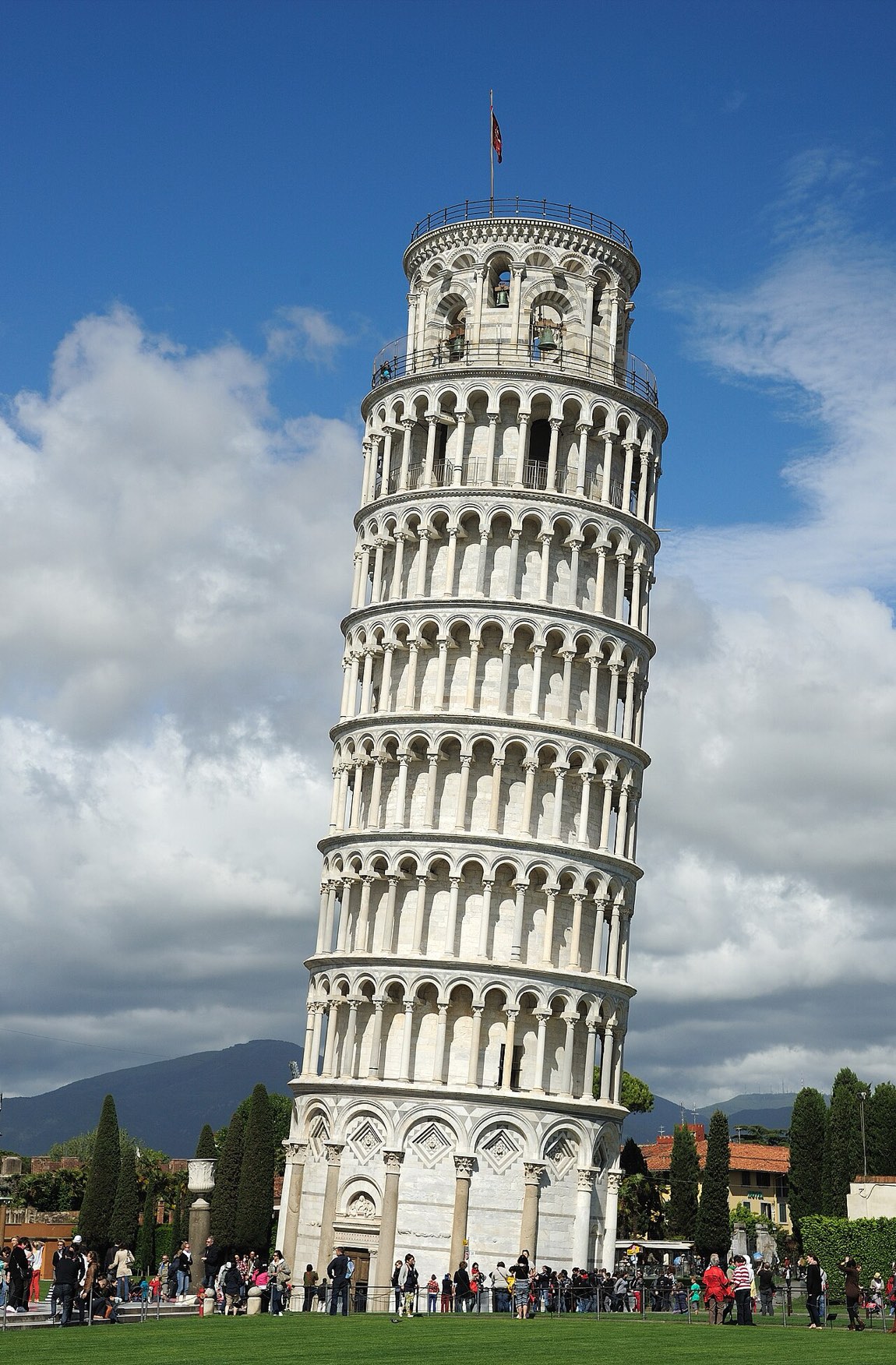
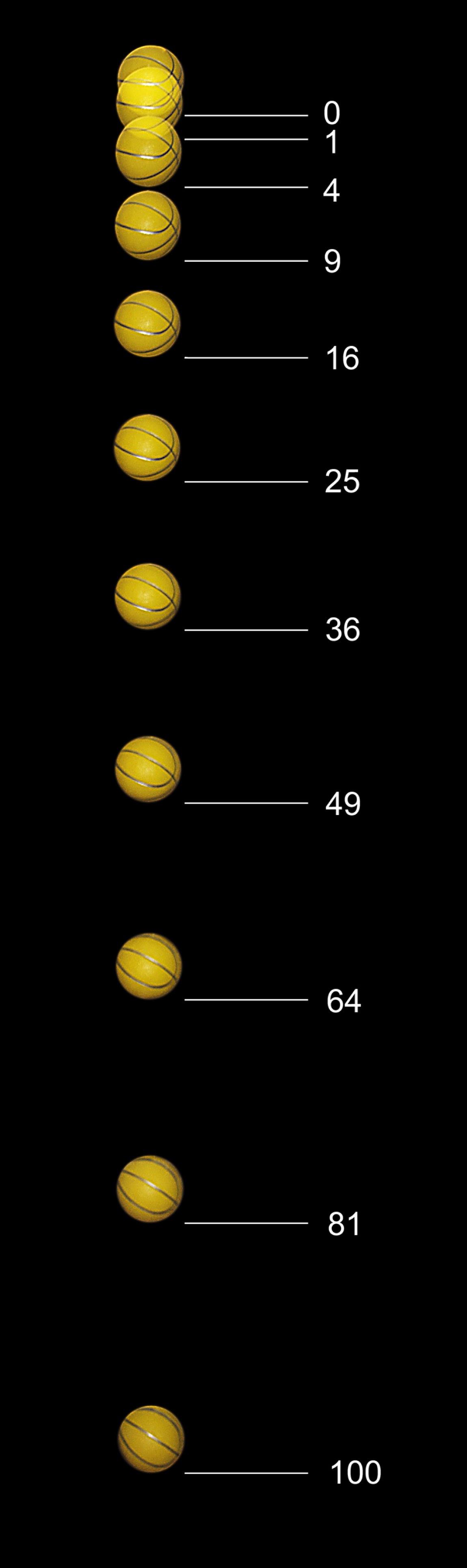
The idea that heavier objects fall faster than lighter ones seems obvious, which is probably why it persisted for nearly two millennia. The unraveling began in the mid-16th century. The Spanish Dominican priest Domingo de Soto wrote in 1551 that bodies in free fall uniformly accelerate, possibly influenced by earlier Italian Dominican experiments by Benedetto Varchi, Francesco Beato, Luca Ghini, and Giovan Bellaso. In 1586 the Flemish physicist Simon Stevin dropped two cannonballs of different sizes and weights from a tower in Delft and observed they hit the ground at the same time. Galileo Galilei then made the result quantitative by carefully measuring balls rolling down inclines, firmly establishing that gravitational acceleration is the same for all objects regardless of mass. His 1638 work Two New Sciences proved mathematically that the distance traveled by a falling object is proportional to the square of the time elapsed. Italian scientists Grimaldi and Riccioli confirmed this between 1640 and 1650, and also calculated the magnitude of Earth's gravity by timing the oscillations of a pendulum — an elegant method that required no dropping of anything at all.
05 Newton's crucial 20-year delay Deeper
Newton made his key quantitative analysis linking the Moon's orbit to objects falling on Earth around 1665, but he did not publish for two decades. The reason was surprisingly precise: he could not prove that a spherical body like the Earth attracts objects outside it as if all its mass were concentrated at a single central point. Without that proof, comparing the acceleration of a falling apple to the much gentler pull on the Moon — separated by vastly different distances — was mathematically shaky. It took Newton twenty years to solve that geometric problem. Once he had, his 1684 manuscript De motu corporum in gyrum, sent to Edmond Halley and later expanded into the Principia, followed rapidly. The value of the gravitational constant G that appears in his formula was not actually measured until Henry Cavendish did so in 1797, more than a decade after Newton's death. Meanwhile the astronomer Ismaël Bullialdus had proposed the inverse-square dependence of gravity on distance around 1640, and Robert Hooke claimed in 1679 that he had also arrived at the inverse-square idea — a priority dispute that left lasting bitterness.
06 Predicting Neptune: gravity's greatest forecast
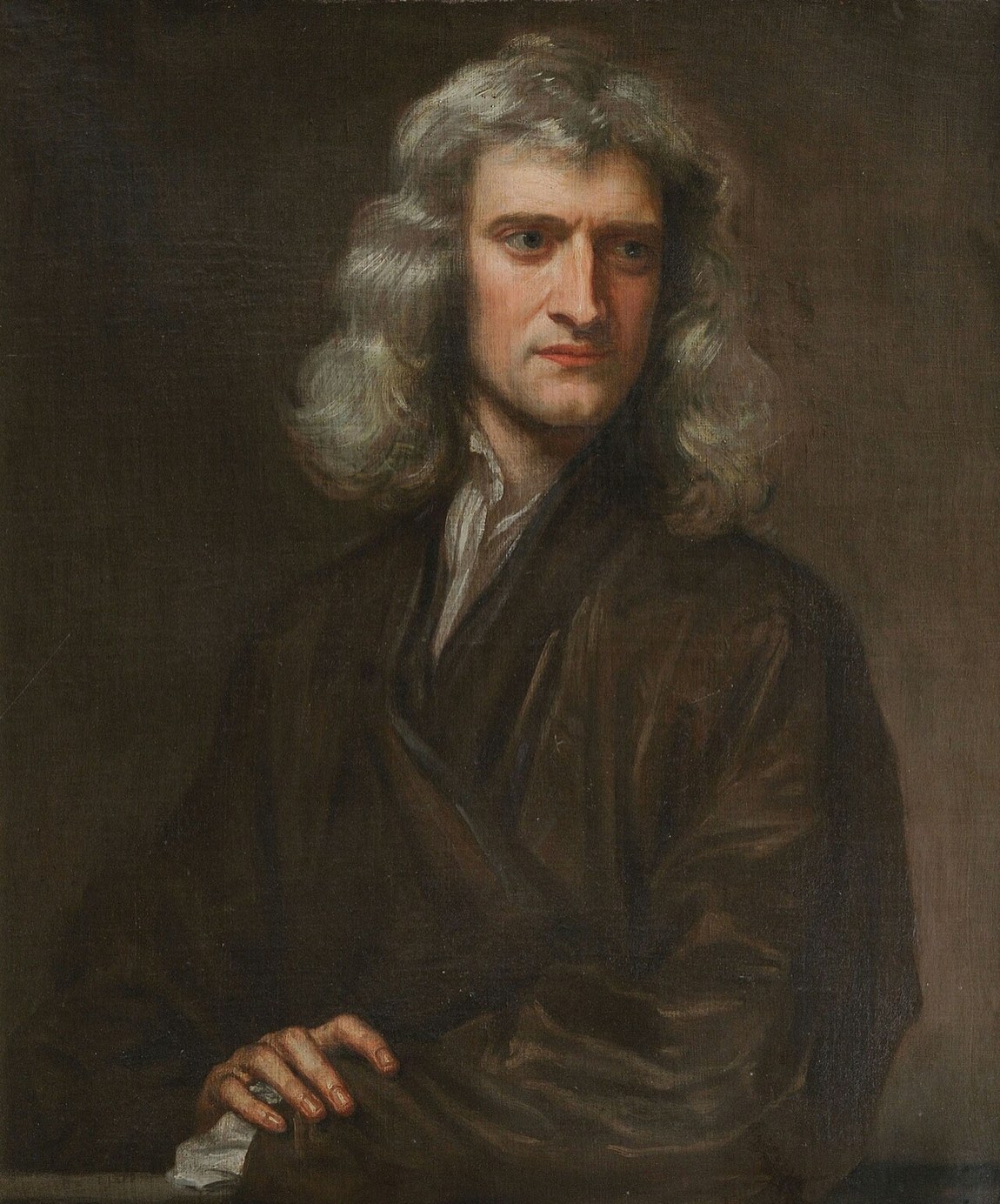
Newton's theory of gravitation scored one of science's most dramatic predictive triumphs more than a century after the Principia was published. In 1821 the French astronomer Alexis Bouvard used Newton's law to model the orbit of Uranus, but the planet's actual trajectory differed significantly from his predictions. Many astronomers suspected an unseen body beyond Uranus was gravitationally disturbing its path. In 1846, John Couch Adams and Urbain Le Verrier independently applied Newton's equations to calculate exactly where such a body should be in the night sky — and the planet Neptune was discovered there within a single day of Le Verrier's prediction being sent to observers. The episode demonstrated that Newton's law was not merely a description of known motion but a tool capable of revealing the unknown universe. It also illustrates the power of the inverse-square law: the gravitational tug of a planet billions of kilometers away leaves a measurable imprint on its neighbor's path, and mathematics alone can decode that imprint into a map coordinate.
 ⤢
⤢
07 Mercury's wobble and Einstein's opening Deeper
Newton's theory handled Neptune brilliantly, but it quietly failed on a smaller stage closer to the Sun. Astronomers noticed that Mercury's perihelion — the point in its elliptical orbit closest to the Sun — was drifting forward at a rate that Newton's equations could not fully account for. The unexplained excess amounted to about 42.98 arcseconds per century. To put that in perspective, one arcsecond is 1/3600 of a degree, so the discrepancy was genuinely tiny — yet precise measurements made it undeniable. The most natural Newtonian explanation was an undiscovered planet orbiting even closer to the Sun than Mercury, but every search for such a body failed. When Albert Einstein developed general relativity in 1915, his equations reproduced Mercury's actual orbit exactly, without any fudging. This match was one of the two main reasons the physics community accepted general relativity: it not only predicted new phenomena but explained an old, stubborn anomaly that Newton could not touch.
08 Light bending, time dilation, and frame dragging Deeper
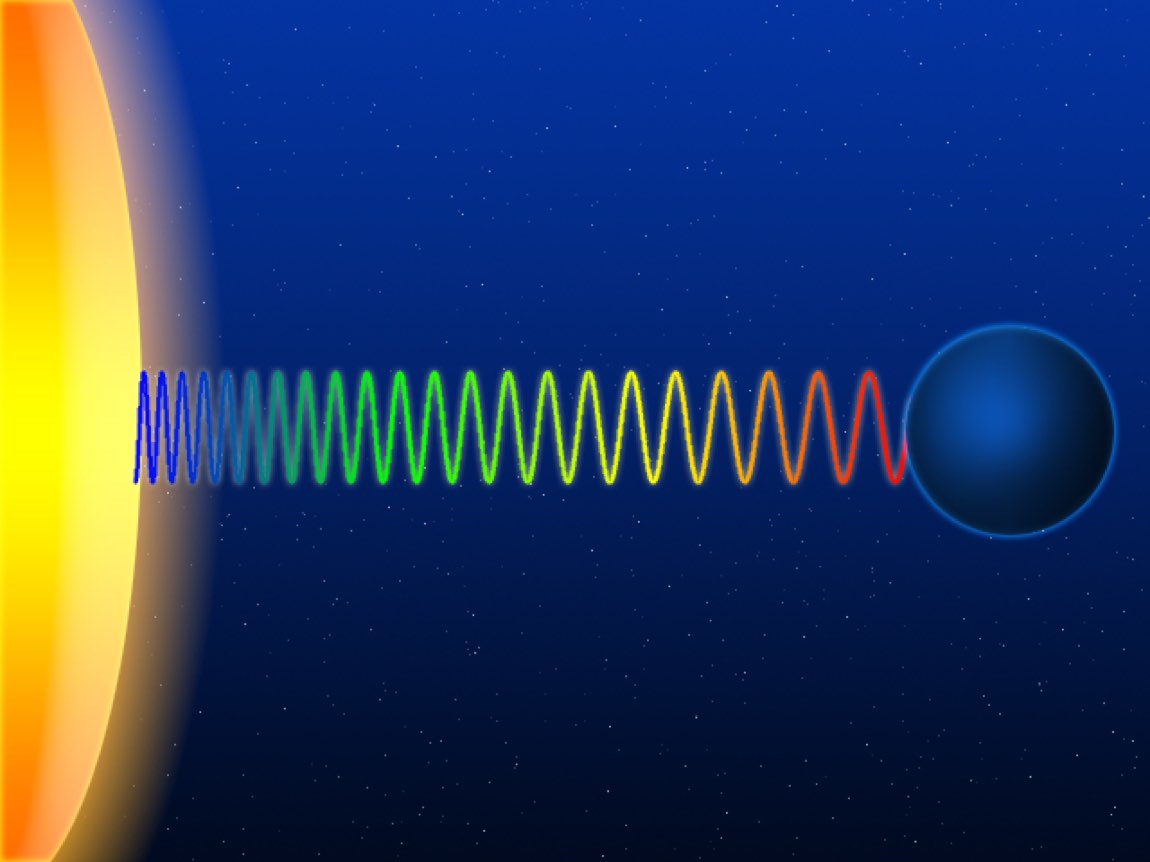
General relativity made several predictions that Newton's theory could not, and each was eventually confirmed by experiment. In 1919 Arthur Eddington measured the deflection of starlight during a solar eclipse and found it was twice the value predicted by Newtonian corpuscular theory, matching Einstein's prediction precisely — making Einstein famous almost overnight. In 1959, Robert Pound and Glen Rebka sent gamma rays down a 74-foot tower and confirmed gravitational time dilation: light shifts its frequency as it moves through a gravitational field, and time itself runs more slowly deeper in a gravitational well. Irwin Shapiro identified in 1964 that signals from interplanetary spacecraft are delayed when they pass close to a massive object — a time delay that also confirmed general relativity. In 2011, results from Gravity Probe B confirmed frame dragging: a rotating massive object such as the Earth actually twists the fabric of spacetime around it, exactly as Einstein's equations had forecast. Each of these tests probed a different facet of the same underlying geometry.
09 Gravitational waves: a century from prediction to proof
General relativity predicts that accelerating masses should radiate energy in the form of gravitational waves — ripples in the curvature of spacetime that travel at the speed of light. The first indirect evidence came in 1973 from the Hulse–Taylor binary, a system of a pulsar and a neutron star orbiting each other. Their orbital period decreased at exactly the rate expected if the system were losing energy to gravitational radiation, and this work was awarded the Nobel Prize in Physics in 1993. Direct detection had to wait until 14 September 2015, when the LIGO detectors measured waves emitted during the collision of two black holes 1.3 billion light-years from Earth — an event so energetic it briefly radiated more power than all the stars in the visible universe combined. This research earned the Nobel Prize in Physics in 2017. Then in October 2017, LIGO and the Virgo interferometer detected gravitational wave signals arriving 2 seconds before the gamma-ray and optical signals from a source about 130 million light-years away, confirming that gravitational waves travel at exactly the speed of light.
 ⤢
⤢
10 Gravity builds every structure in the cosmos
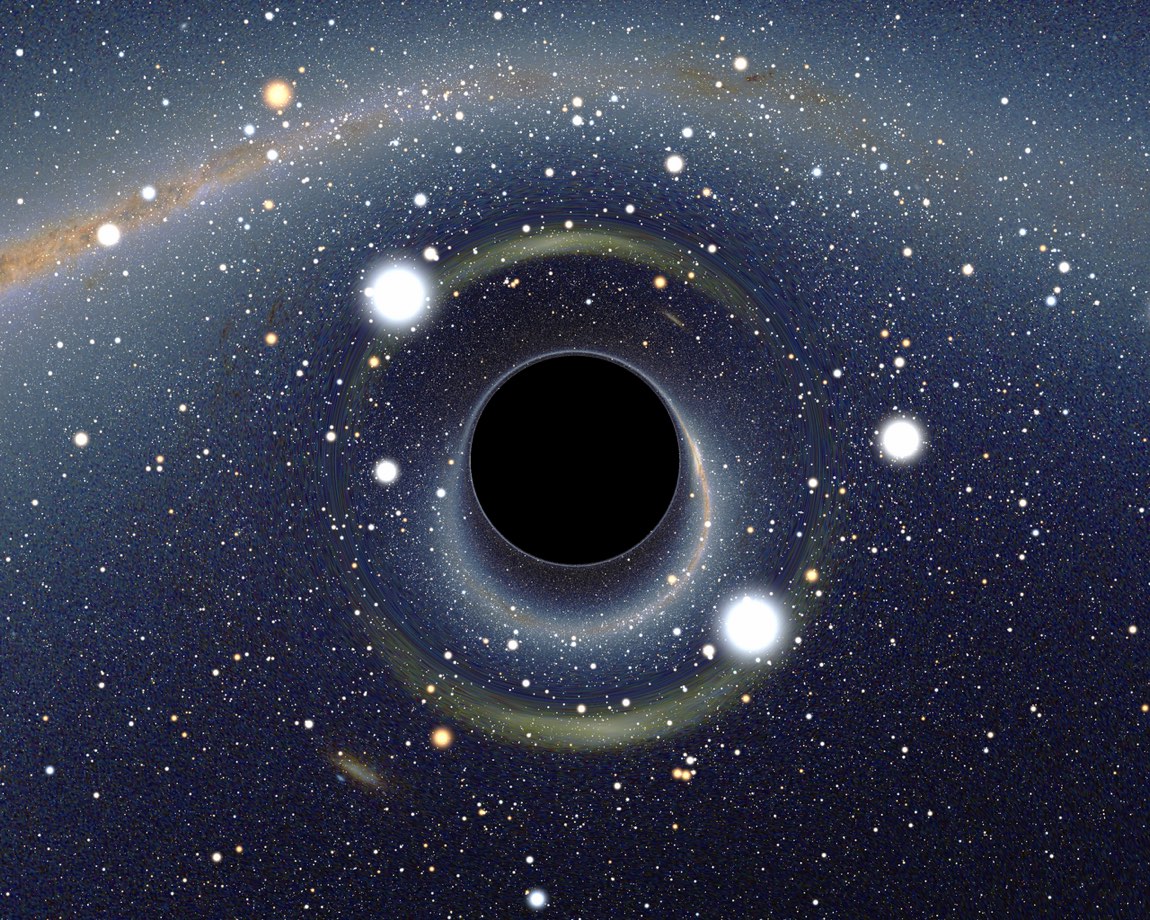
Gravity is the architect of the large-scale universe in a way no other force can match. In the early universe, clumps of dark matter — which makes up about five-sixths of all mass — created gravitational wells that drew in primordial hydrogen gas. Where the gas density grew high enough, temperatures rose, the gas radiated energy, and further collapse became possible. If the resulting mass was large enough, pressures at the core reached the threshold for nuclear fusion and a star ignited. At larger scales, the same process assembled stars into galaxies and galaxies into clusters. Inside stars, gravity competes continuously with thermal and radiation pressure in a balance called hydrostatic equilibrium. When a massive star exhausts its nuclear fuel, that balance collapses catastrophically, producing a supernova. The remnant may be a neutron star — where gravity is balanced by neutron degeneracy pressure — or, for the highest masses, a black hole where gravity is so intense that not even light can escape.
11 Gravitational lensing and the dark universe
Because gravity acts on light and matter equally, a sufficiently massive object bends light passing near it, acting as a gravitational lens. The first confirmed observation of this came in 1979, when astronomers using the 2.1-meter telescope at Kitt Peak National Observatory in Arizona detected two mirror images of the same quasar, whose light had been bent around the galaxy YGKOW G1. Unlike glass lenses that bring light to a point, gravitational lenses produce arc-shaped or ring-shaped images called Einstein rings. This phenomenon has become a crucial tool for mapping dark matter: observations of how much lensing occurs around galaxies consistently reveal far more mass than can be accounted for by visible stars and gas, providing strong evidence that about five-sixths of the universe's total mass is dark matter that interacts gravitationally but not electromagnetically. Galaxy rotation curves tell the same story — stars on the outskirts of galaxies orbit faster than Newton's law predicts from the visible mass alone, implying invisible matter is present throughout.
12 The open frontier: quantum gravity Deeper
Despite its extraordinary successes, general relativity is fundamentally incompatible with quantum mechanics. General relativity describes gravity as a smooth, continuous distortion of spacetime, while quantum mechanics insists that all forces arise from the exchange of discrete particles. The other three fundamental forces — electromagnetism, the strong force, and the weak force — were successfully reconciled with a quantum framework decades ago, but gravity has resisted every attempt. A quantum field theory approach would describe gravity as arising from the exchange of virtual particles called gravitons, and this reproduces general relativity in the classical limit, but the approach breaks down completely at distances on the order of the Planck length. Cosmological observations add further pressure: the standard model of cosmology, built on general relativity, requires dark matter and dark energy whose physical nature remains entirely unknown, and some cosmological observations are inconsistent with current models. Whether the resolution requires a theory of quantum gravity, a revision of quantum mechanics, or something stranger still, is one of the deepest open questions in all of physics.