Astrophysics
General Relativity
ConfirmedThe idea
Einstein's big idea: gravity isn't a force reaching across space. It's the shape of space and time. A heavy ball on a trampoline makes a dip; marbles roll along the curves. Mass makes such dips in space-time, and planets, light, and you follow them. Weirder consequence: time runs slower deeper in the dip. Clocks in your basement genuinely tick slower than in your attic.
Go deeper Advanced
GR's ledger: Mercury's orbit precession ✓, light bending ✓ (1919), gravitational redshift ✓, frame dragging ✓, waves ✓ (2015), horizon-scale imaging ✓ (2019). GPS must correct 38 μs/day for combined special+general relativistic effects or drift 10 km daily. The theory fails only where quantum effects dominate — inside black holes and at the Big Bang — which is exactly where physics hunts its successor.
The deep dive
Researched for the Atlas from Wikipedia — General relativity (58,000 characters read) · updated Sep 20, 2026
01 Eight years to a field equation
Einstein did not arrive at general relativity in a flash of inspiration. In 1907, a simple thought experiment stopped him cold: he imagined an observer in free fall and realized that person would feel no gravity whatsoever. That insight — that free fall and true weightlessness are locally indistinguishable — launched what became an eight-year search. Along the way he hit numerous dead ends. The crucial mathematical rescue came from his friend Marcel Grossmann, who pointed him toward Riemannian geometry, a non-Euclidean framework that could describe curved surfaces in any number of dimensions. Einstein and Grossmann published together on this approach in 1913. Even then Einstein made errors, temporarily abandoning field equations that turned out to be correct. Only in November 1915, in a series of presentations to the Prussian Academy of Science, did he finally set down what we now call the Einstein field equations. Henri Poincaré had already suggested in 1905 that gravitational waves propagate at the speed of light, but it was Einstein who embedded that idea inside a complete geometric theory of gravity.
02 What the field equations actually say Deeper
Einstein's field equations are a system of second-order partial differential equations that are famously nonlinear — meaning you cannot simply add two solutions to get a third valid one. On one side sits the Einstein tensor, a combination of the Ricci tensor and the metric that encodes how spacetime curves. On the other side sits the stress-energy tensor, which packages together energy density, momentum density, pressure, and shear stress of whatever matter or radiation is present. The two sides are linked by the constant κ = 8πG/c⁴, where G is Newton's gravitational constant and c is the speed of light. When no matter is present at all, the equations reduce to the elegant vacuum condition that the Ricci tensor equals zero, yet this vacuum can still contain gravitational waves and black holes. John Archibald Wheeler captured the mutual feedback in one sentence: spacetime tells matter how to move; matter tells spacetime how to curve. Because the equations are so difficult to solve exactly, Einstein himself used approximation methods for his first predictions, and numerical supercomputers are now routinely employed for scenarios like two merging black holes.
03 Schwarzschild's exact solution, found in 1916
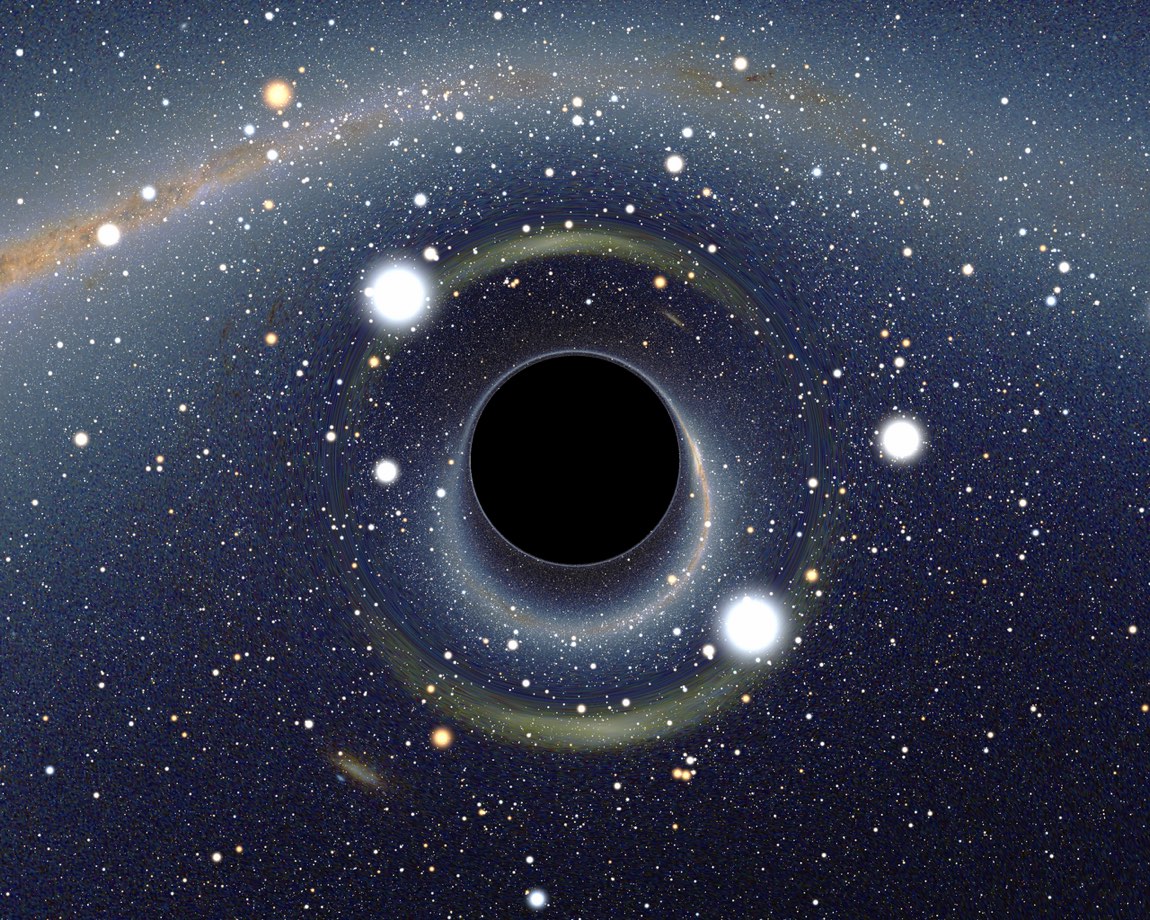
Einstein expected that exact solutions to his nonlinear field equations might never be found. He was wrong almost immediately. In 1916, astrophysicist Karl Schwarzschild derived the first non-trivial exact solution while serving on the Russian front during World War I. The Schwarzschild metric describes spacetime geometry around any non-rotating, electrically neutral, spherical mass. It laid the groundwork for understanding black holes, because it contains a special radius — now called the Schwarzschild radius — at which spacetime curvature becomes extreme. That same year, the first steps toward extending the solution to electrically charged objects were taken, eventually producing the Reissner-Nordström solution, which describes charged black holes. Later, the Kerr metric added rotation. These three solutions — Schwarzschild, Reissner-Nordström, and Kerr — remain the best-known exact solutions in all of general relativity and each corresponds to a different type of black hole in an otherwise empty universe.
 ⤢
⤢
04 Mercury's orbit: the first confirmed victory
Long before any dramatic eclipse expedition, general relativity had already solved a puzzle that had nagged astronomers for decades. Urbain Le Verrier had discovered in 1859 that Mercury's perihelion — the point of its closest approach to the Sun — drifts around the Sun by a small but stubbornly unexplained amount each century. Newtonian gravity and every known perturbation from other planets could not fully account for it. In 1915, Einstein showed that his new theory explained Mercury's anomalous perihelion advance exactly, without invoking any arbitrary fudge factors. The general relativistic formula for perihelion shift in radians per revolution depends on the orbit's semi-major axis, orbital period, speed of light, and eccentricity. Einstein described his reaction when the numbers matched as one of the most thrilling moments of his scientific life. The same relativistic precession effect has since been measured for Venus and Earth as well, and in binary pulsar systems the effect is larger by five orders of magnitude than in our solar system.
05 Eddington's 1919 eclipse and instant fame
General relativity predicts that light follows the curvature of spacetime as it passes a massive object, bending toward it. Crucially, this predicted deflection angle is exactly twice what you get by naively applying Newtonian gravity to a light particle — a key distinction the 1919 experiment was designed to test. On 29 May 1919, a total solar eclipse allowed an expedition led by Arthur Eddington to photograph stars whose light grazed the Sun's edge. By comparing those positions with photographs of the same stars taken months earlier, when the Sun was elsewhere, the team measured how much the starlight bent. The result matched Einstein's prediction, not Newton's halved value. The announcement made Einstein instantly world-famous. Later, the same class of light-deflection measurements — along with the Shapiro time delay — are used in the parameterized post-Newtonian formalism to pin down a parameter called γ that encodes how much gravity curves the geometry of space.
06 Gravitational time dilation and your GPS
One of general relativity's most counterintuitive predictions is that clocks run slower in stronger gravitational fields. A clock deep in a gravity well ticks at a rate t₀ = t_f √(1 − 2GM/rc²) compared with a clock far away, where M is the mass of the central body, r is the distance from its center, G is Newton's constant, and c is the speed of light. The effect has been measured directly in laboratory experiments and with atomic clocks in Earth's gravitational field. It is not merely an academic curiosity: the Global Positioning System depends on correcting for gravitational time dilation continuously. GPS satellites orbit at altitudes where gravity is weaker than at Earth's surface, so their clocks tick slightly faster. Without relativistic corrections, GPS position errors would accumulate at several kilometers per day. Ongoing satellite operations thus provide constant, real-world validation of Einstein's theory. Tests in even stronger fields come from binary pulsars, where the effect is far more pronounced than anything measurable in Earth's gravity.
 ⤢
⤢
07 Hulse, Taylor, and the first gravitational wave proof
General relativity predicts that an orbiting binary system radiates energy away as gravitational waves, causing the two bodies to spiral slowly inward and their orbital period to shrink. Within our solar system or around ordinary double stars the effect is immeasurably tiny. But in 1974, Russell Hulse and Joseph Taylor discovered the binary pulsar PSR1913+16 — a system of two neutron stars, one of which beams out radio pulses with clockwork regularity that can serve as an extraordinarily precise clock. Over years of observation, they measured the orbital period decreasing at exactly the rate general relativity predicts from gravitational wave energy loss. This was the first detection of gravitational waves, albeit indirect, and Hulse and Taylor were awarded the 1993 Nobel Prize in physics for it. A later system, the double pulsar PSR J0737-3039, where both stars are pulsars, was still in agreement with general relativity after 16 years of observations reported in 2021, providing an even sharper test of the theory.
08 LIGO's direct detection on 11 February 2016
Einstein predicted gravitational waves in 1916, describing them as ripples in the metric of spacetime propagating at the speed of light, analogous to electromagnetic waves. He doubted they would ever be detected because they are fantastically weak: typical cosmic events produce relative distance changes of 10⁻²¹ or less — stretching and squeezing a length equal to the distance from Earth to the nearest star by less than the width of a hydrogen atom. A century of effort culminated on 11 February 2016, when the Advanced LIGO team announced direct detection of gravitational waves from two merging black holes. Several land-based interferometric detectors are now in operation, including GEO 600, two LIGO detectors, TAMA 300, and VIRGO. Pulsar timing arrays also hunt for gravitational waves in the 10⁻⁹ to 10⁻⁶ hertz range, originating from binary supermassive black holes. A European space-based detector, eLISA/NGO, is under development, with the precursor mission LISA Pathfinder having launched in December 2015.
09 Gravitational lensing as a telescope
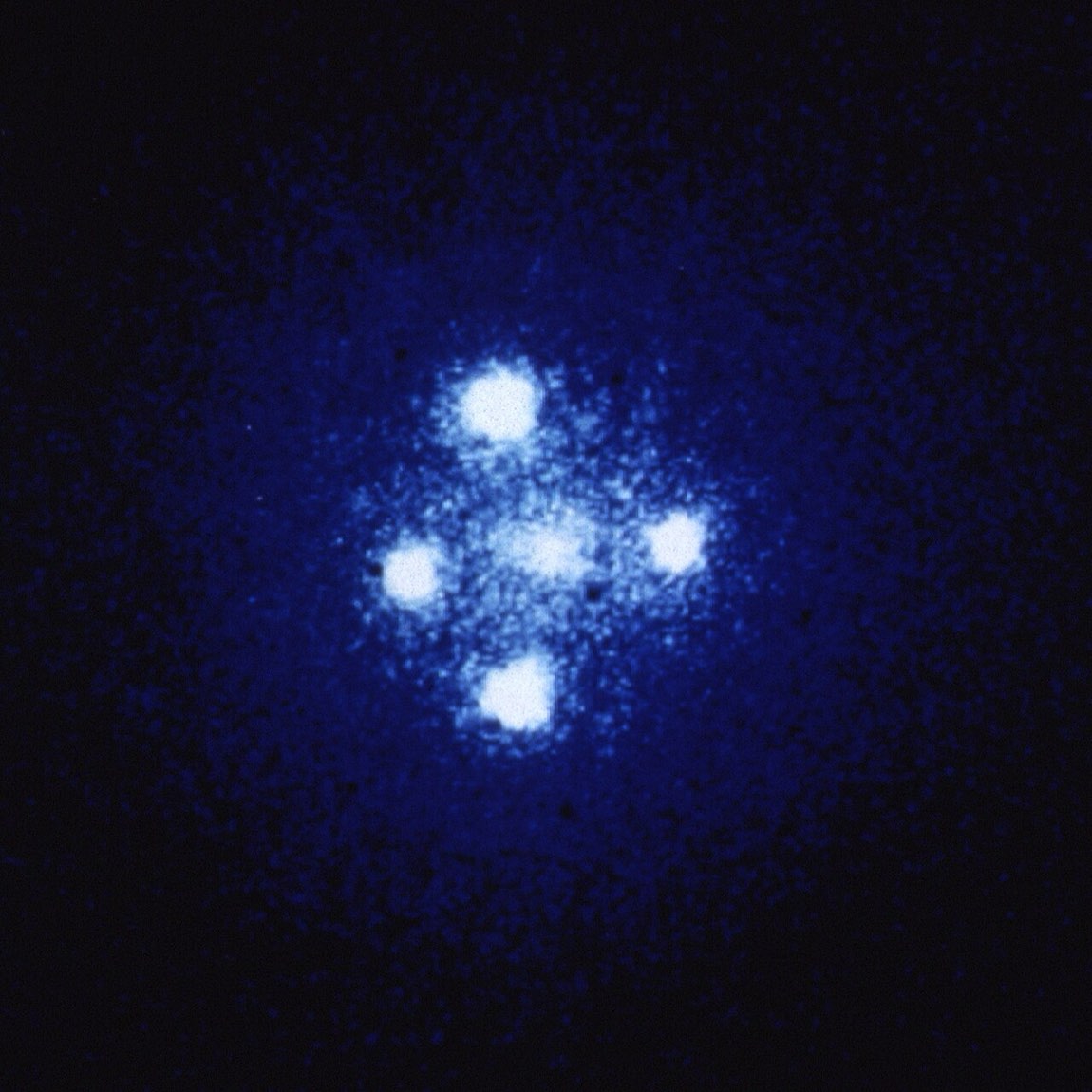
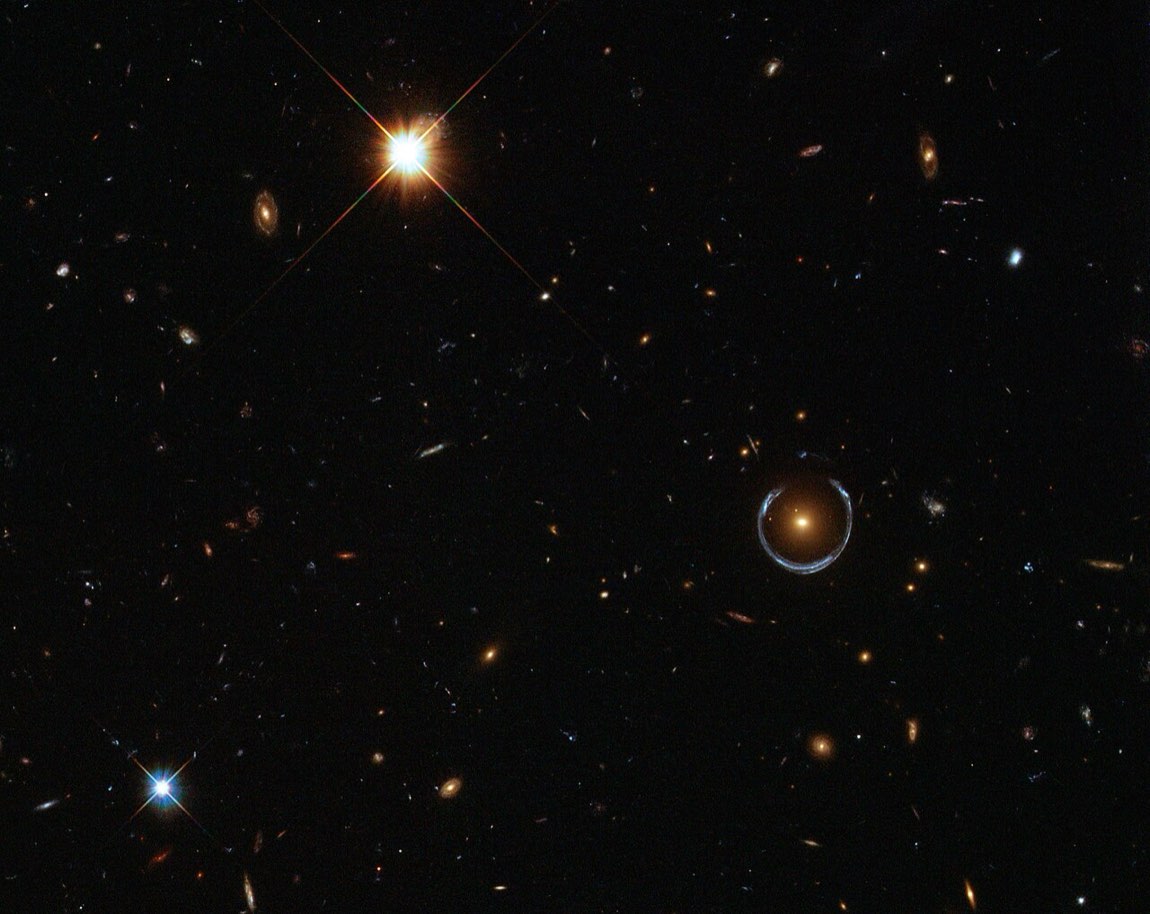
When a massive object sits between Earth and a distant source, its gravitational field bends the source's light along multiple paths, producing distorted or multiple images — a phenomenon called gravitational lensing. Depending on the geometry and mass distribution, observers may see two or more discrete images, a symmetrical bright ring called an Einstein ring, or partial arcs. The earliest gravitational lens was discovered in 1979, and since then more than a hundred have been catalogued. Even when individual images cannot be resolved, the total brightening of the source — a microlensing event — is detectable and has been observed many times. Gravitational lensing has grown into a powerful tool: it reveals the presence and distribution of dark matter that emits no light of its own, acts as a natural telescope to magnify distant galaxies that would otherwise be invisible, and provides an independent way to estimate the Hubble constant. Statistical analysis of large lensing surveys also gives insight into how the structure of galaxies has evolved across cosmic time.
 ⤢
⤢
10 The cosmological constant: blunder, then comeback
In 1917, when Einstein applied his field equations to the universe as a whole, contemporary astronomy considered the universe static and unchanging. To prevent the equations from predicting collapse or expansion, Einstein inserted an extra term — the cosmological constant Λ — that acted as a kind of repulsive pressure. By 1929, work by Hubble and others showed the universe is actually expanding. Alexander Friedmann had already found in 1922 the expanding cosmological solutions that describe this naturally, without any cosmological constant. Georges Lemaître used those solutions to formulate the earliest Big Bang models. Einstein reportedly called the cosmological constant the biggest blunder of his life and dropped it. Decades later, observations of distant supernovae and measurements of the cosmic microwave background revealed that the universe's expansion is accelerating, implying some form of energy — dark energy — with an unusual equation of state. The cosmological constant has returned to the field equations of modern cosmology and now plays a central role in describing the universe's large-scale dynamics across its roughly 14-billion-year history.
11 Frame-dragging: rotating mass warps direction Deeper
General relativity predicts that a rotating massive body does not merely curve spacetime — it drags spacetime itself around with it, like a spinning ball churning honey. This frame-dragging effect means that a gyroscope in free fall near a rotating mass will slowly precess relative to distant stars, beyond the geodetic precession already caused by curved spacetime alone. For a rotating black hole, the effect becomes extreme: within a region called the ergosphere, no object can remain stationary relative to distant observers — rotation is physically unavoidable. Frame-dragging has been tested using the LAGEOS satellites in Earth orbit, which confirmed the relativistic prediction, though the article notes those tests were somewhat controversial. The satellite mission Gravity Probe B measured the related geodetic precession for test masses to a precision of better than 0.3 percent. Geodetic precession — the simpler cousin of frame-dragging — has also been measured for the Moon-Earth system using lunar laser ranging, providing another precise confirmation of Einstein's geometric theory of gravity.
12 Open questions: quantum gravity and dark matter Deeper
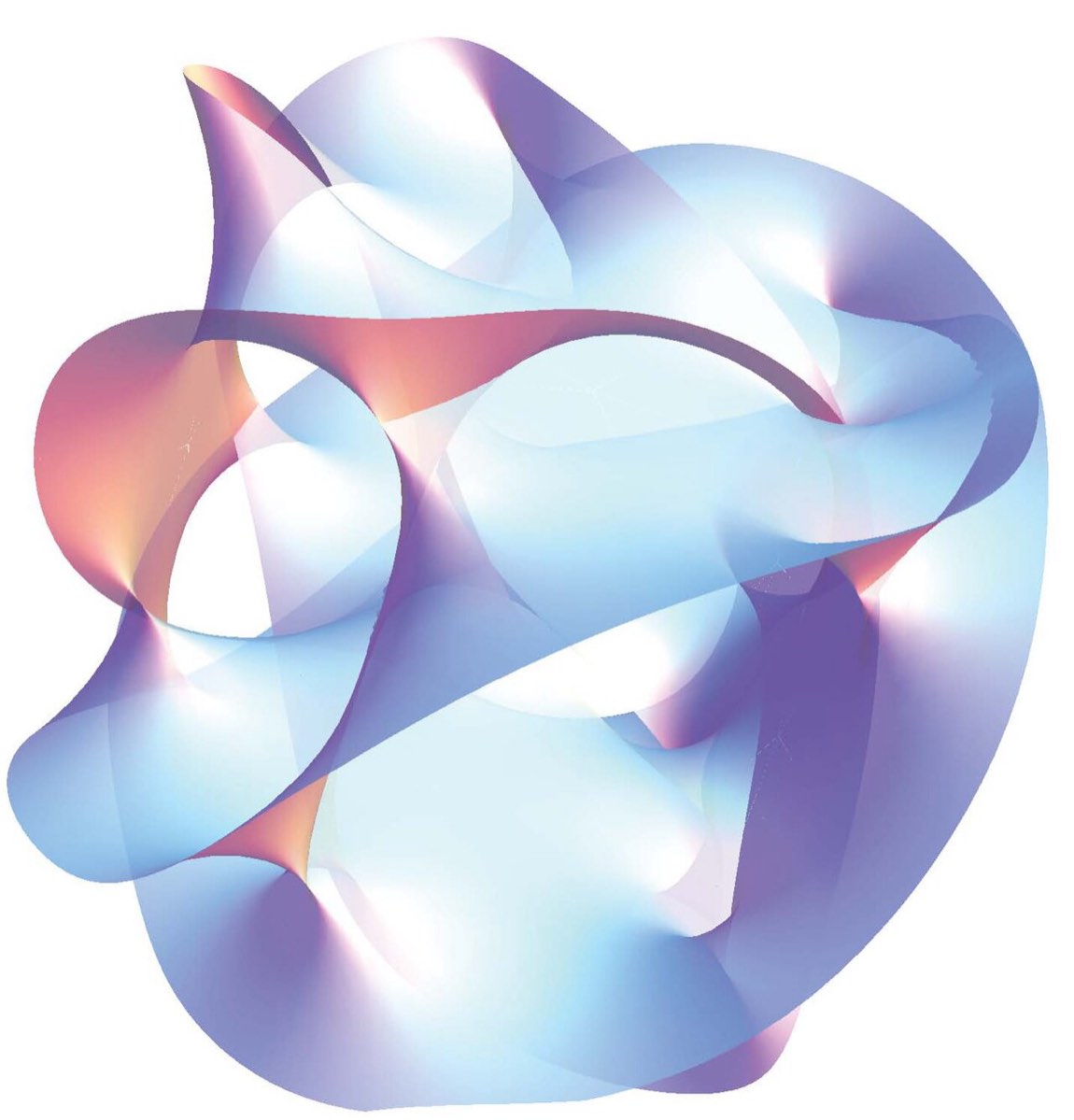
Despite its extraordinary success, general relativity sits in uneasy coexistence with the rest of modern physics. No self-consistent theory of quantum gravity has been found, and it remains unknown how gravity can be unified with the three other fundamental interactions — strong, weak, and electromagnetic. The physics of the earliest universe, prior to a hypothesized inflationary phase at around 10⁻³³ seconds after the Big Bang, lies beyond what classical general relativistic models can reliably describe, and an authoritative account would require exactly the quantum gravity theory that does not yet exist. Meanwhile, cosmological observations indicate that roughly 90 percent of all matter in the universe is dark matter — it has gravitational influence but does not interact electromagnetically and cannot be observed directly — and no generally accepted description of it exists within known particle physics. Dark energy, responsible for the accelerating cosmic expansion, is equally mysterious. Inflationary scenarios that explain the near-perfect homogeneity of the cosmic background radiation are numerous and cannot yet be distinguished by existing observations.