Cosmology
The Big Bang
ConfirmedThe idea
13.8 billion years ago, everything we can see was compressed into a state hotter and denser than anything imaginable — then space itself began expanding. Not an explosion INTO space; an expansion OF space, happening everywhere at once. As it stretched and cooled, particles froze out, then atoms, then — under gravity's patient pull — stars and galaxies.
Go deeper Advanced
Three independent pillars: the expansion itself (Hubble 1929), the cosmic microwave background (predicted, then found 1965 — the flash of first transparency at 380,000 years), and light-element abundances matching primordial nucleosynthesis. 'Before' the Bang is where the model honestly ends: the singularity marks the theory's breakdown, not necessarily a beginning of everything.
The deep dive
Researched for the Atlas from Wikipedia — Big Bang (51,869 characters read) · updated Sep 20, 2026
01 Who actually named the Big Bang
The phrase "Big Bang" was coined by astronomer Fred Hoyle during a BBC Third Programme broadcast in March 1949. Hoyle favored the competing steady-state model and used the term to contrast it with the expanding-universe idea, calling it "this Big Bang idea" and saying he found it "unsatisfactory." Popular accounts often claim he intended it as a put-down, but Hoyle explicitly denied this, saying it was simply a striking image to highlight the difference between the two models. Historian Helge Kragh describes the evidence for the pejorative reading as "unconvincing." The term itself has been criticized as a genuine misnomer: it implies an explosion expanding into surrounding space, whereas the Big Bang describes the intrinsic expansion of the universe's contents everywhere at once — not from a single point outward. An alternative name, "Everywhere Stretch," has been proposed to capture this distinction. When Sky and Telescope ran a competition in 1993 to find a better name, no alternative succeeded, and "Big Bang" stuck.
02 Lemaître's primeval atom: the real origin
The intellectual origin of the Big Bang belongs to Georges Lemaître, a Belgian physicist and Roman Catholic priest. Working independently of Alexander Friedmann, Lemaître derived the same expanding-universe equations in 1927 and proposed that the recession of galaxies was caused by cosmic expansion. Then in 1931 he went further, arguing that running the expansion backward in time meant the entire mass of the universe was once compressed into a single point he called the "primeval atom," the moment where space and time themselves came into existence. His words were striking: "the beginning of the world happened a little before the beginning of space and time." Many colleagues were deeply uncomfortable. Arthur Eddington, agreeing with Aristotle, considered matter eternal and called a beginning in time "repugnant." Critics also worried that a universe with a definite beginning smuggled religious concepts into physics — an objection made sharper by the fact that Lemaître was a priest. Despite this resistance, his framework, developed further by George Gamow, Ralph Alpher, and Robert Herman, became the foundation of modern cosmology.
03 The accidental discovery that changed everything
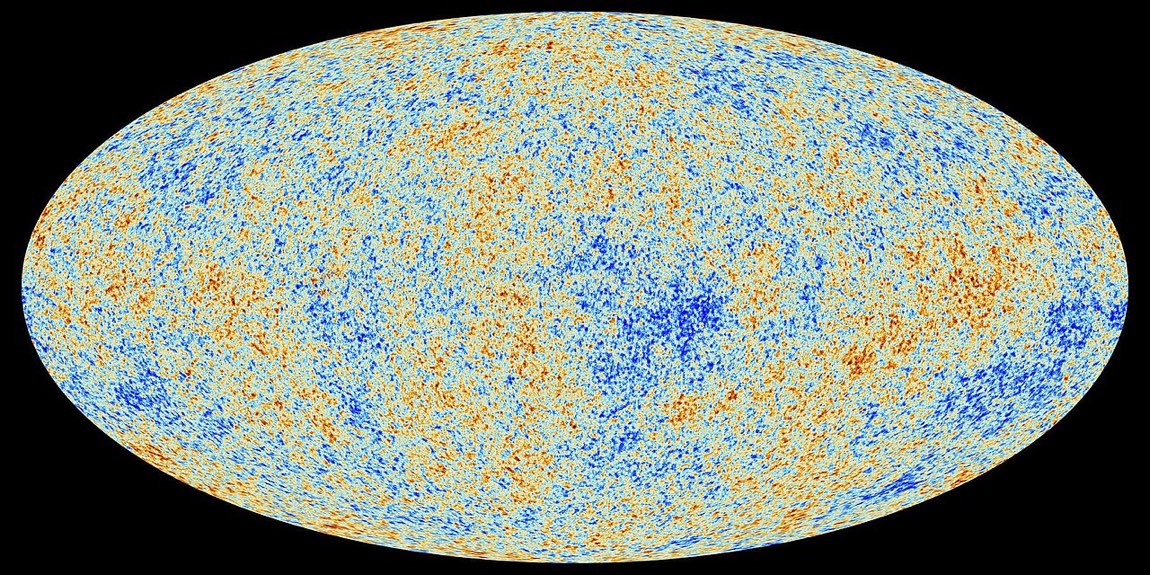
The decisive confirmation of the Big Bang came by accident. In 1964 Arno Penzias and Robert Wilson were working with a large microwave antenna at Bell Laboratories when they detected a persistent omnidirectional signal they could not explain. It turned out to be the cosmic microwave background (CMB) — radiation left over from when the universe first became transparent, roughly 380,000 years after the Big Bang. Their discovery confirmed predictions made around 1950 by Alpher, Herman, and Gamow. Through the 1970s, measurements showed the CMB to be consistent with a blackbody spectrum in all directions, today corresponding to approximately 2.725 K — a temperature colder than liquid helium, about as cold as anything in nature gets. This tipped the balance of scientific opinion decisively against the steady-state model. Penzias and Wilson received the 1978 Nobel Prize in Physics for the find. The next giant step came in 1989 when NASA launched the Cosmic Background Explorer (COBE); by 1992 it had detected tiny temperature anisotropies across the sky at just one part in 100,000, earning John C. Mather and George Smoot the 2006 Nobel Prize in Physics.
04 What the CMB actually tells us Deeper
The cosmic microwave background is not simply a uniform glow — its fine details carry an enormous amount of information. COBE showed in 1990 that its frequency spectrum matches a near-perfect blackbody with deviations no larger than one part in ten thousand, and measured a residual temperature of 2.726 K (later revised to 2.7255 K). The tiny anisotropies — temperature variations of about one part in 100,000 — discovered by COBE in 1992 and mapped in far greater detail by the Wilkinson Microwave Anisotropy Probe (WMAP) encode the seeds of all cosmic structure. The angular size of these fluctuations tells us the geometry of the universe: in 2000–2001, experiments including BOOMERanG measured that angular size and found the universe to be spatially almost flat. WMAP also measured the Hubble constant at 70.4 +1.3/−1.4 km/s/Mpc and showed the data fit a Lambda-CDM model in which cold dark matter makes up about 23% of the matter-energy budget and baryonic matter only about 4.6%. The CMB also confirms that the universe was hotter in the past, a prediction tested by observing low-temperature absorption lines in distant gas clouds at high redshift.
05 Big Bang nucleosynthesis: cooking the first elements Deeper
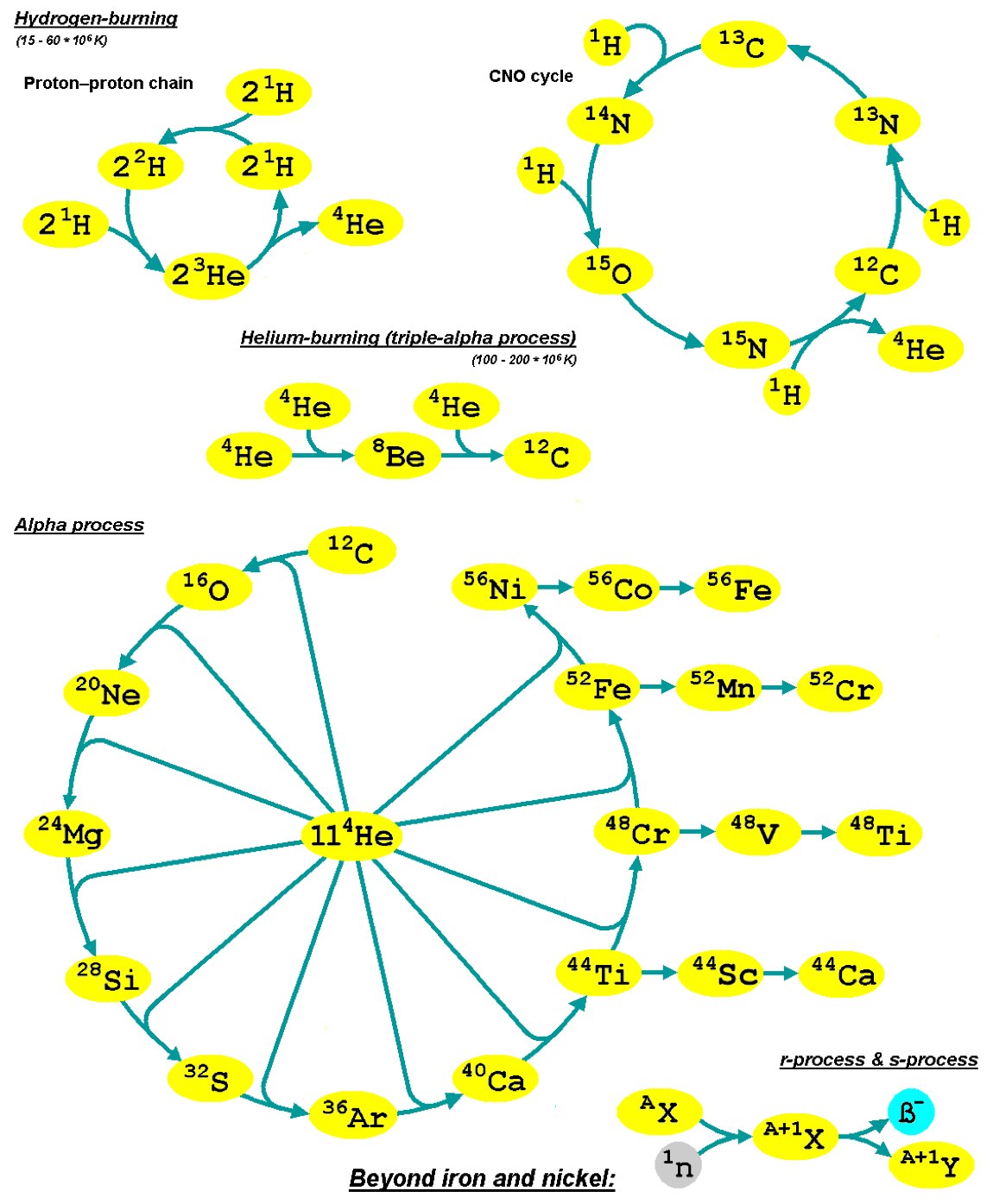
A few minutes after the Big Bang, when the temperature had fallen to about one billion kelvin and matter density was comparable to that of Earth's present atmosphere, protons and neutrons fused to build the lightest nuclei in a process called Big Bang nucleosynthesis (BBN). The predicted abundances of helium-4, helium-3, deuterium, and lithium-7 relative to hydrogen depend on a single parameter: the ratio of photons to baryons. That ratio can be measured independently from the fine structure of CMB fluctuations, making BBN predictions essentially parameter-free. The model predicts by mass roughly 0.25 for helium-4 to hydrogen, about 10⁻³ for deuterium to hydrogen, about 10⁻⁴ for helium-3 to hydrogen, and about 10⁻⁹ for lithium-7 to hydrogen. Agreement with observations is excellent for deuterium and close for helium-4, but lithium-7 is off by a factor of two — a persistent puzzle called the cosmological lithium problem. The helium abundance is especially constraining: it is virtually impossible to tune the Big Bang to produce much more or less than 20–30% helium, making BBN one of the strongest independent pillars of the entire model.
06 Inflation: a trillion times shorter than a trillionth of a second
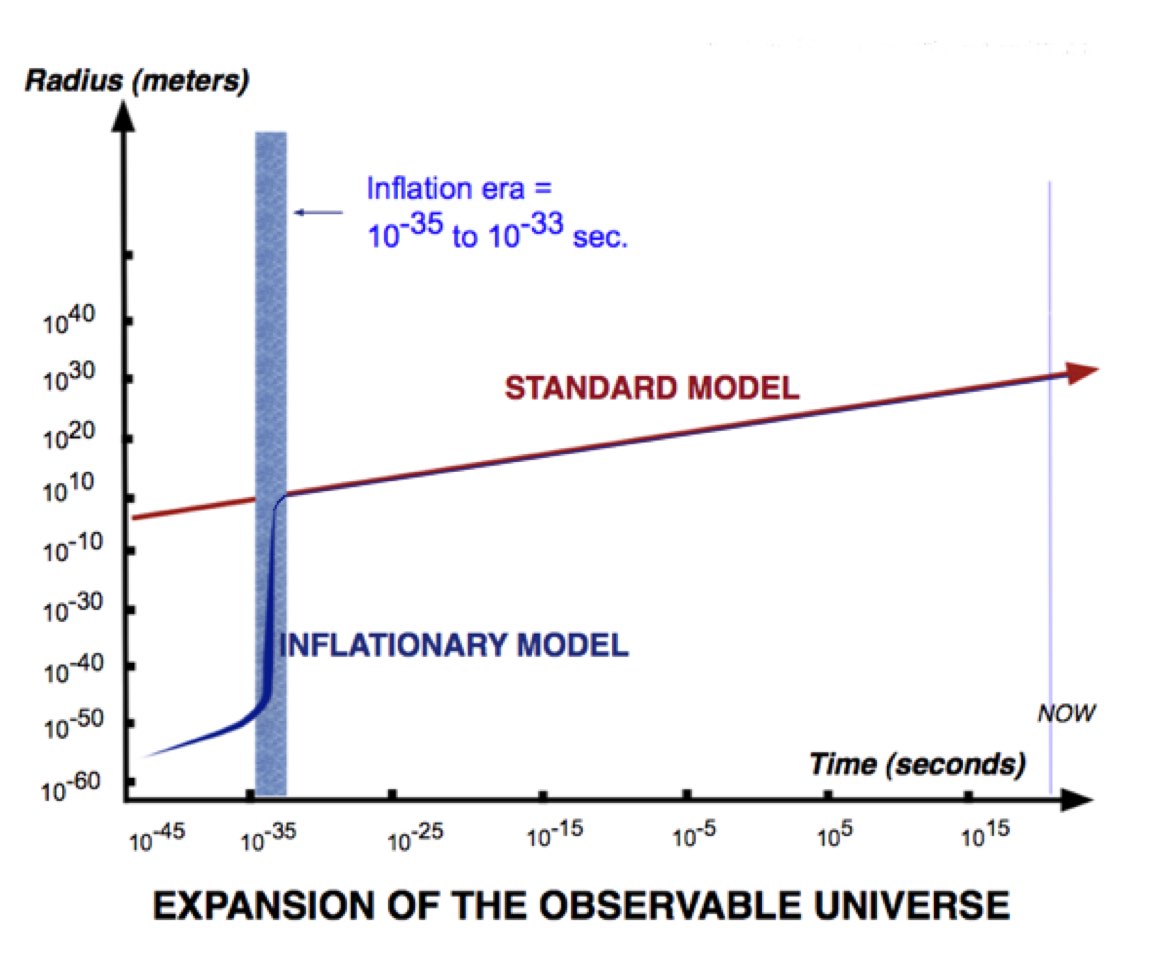
Before the hot Big Bang began, the universe is thought to have undergone a phase of cosmological inflation — a period of exponential expansion that lasted a time described as a billion trillion times shorter than a trillionth of a second. During this moment, the universe doubled in size more than 80 times. Inflation was proposed in 1981 by Alan Guth as a solution to several theoretical crises: the flatness problem (why the universe's density is so close to the critical value), the horizon problem (why opposite sides of the sky have the same CMB temperature despite apparently never being in contact), and the magnetic monopole problem (why no monopoles predicted by grand unified theories are observed). Inflation resolves all three by stretching any initial curvature to near-zero, expanding a tiny causally connected region to encompass our entire observable universe, and diluting away any exotic relics. It also magnified microscopic quantum fluctuations to cosmic scales, seeding the large-scale structure of the universe — the galaxy filaments and voids we observe today. After inflation, a reheating event converted the energy driving expansion into a hot plasma with a temperature somewhere between 10¹¹ and 10²⁹ K, initiating the hot Big Bang.
 ⤢
⤢
07 Matter winning over antimatter by a hair Deeper
One of the most consequential — and still unexplained — events in cosmic history is baryogenesis: the process by which the universe ended up with slightly more matter than antimatter. In the very early, extremely hot universe, matter and antimatter were continuously created and annihilated in equal measure. Then an unknown reaction violated the conservation of baryon number, producing a tiny asymmetry of approximately one part in 30 million — or equivalently, about one part in ten billion — in favor of matter. When the temperature fell far enough, the great annihilation happened: matter and antimatter collided and destroyed each other, leaving just one in 10⁸ of the original matter particles and none of the antiparticles. Everything visible in the universe today — every star, planet, and atom — descends from that tiny surviving fraction. For baryogenesis to have occurred, three conditions called the Sakharov conditions must have been met: baryon number must not be conserved, C-symmetry and CP-symmetry must be violated, and the universe must depart from thermodynamic equilibrium. All three conditions appear in the Standard Model of particle physics, but the effects are not strong enough to explain the observed asymmetry, leaving baryogenesis an open problem.
08 The flatness problem: a universe on a knife-edge Deeper
The flatness problem is one of the most striking fine-tuning puzzles in cosmology. General relativity allows the universe to have positive, negative, or zero spatial curvature depending on how its total energy density compares to a specific critical value. Observations consistently show the universe is very nearly flat — its density is extraordinarily close to that critical value. The problem is that any small departure from flatness grows over time. To be as flat as we observe today after roughly 13.787 billion years, the density of the universe at the time of Big Bang nucleosynthesis — just a few minutes in — must have been within one part in 10¹⁴ of the critical value. Given that a natural timescale for departure from flatness might be the Planck time, 10⁻⁴³ seconds, maintaining this balance across billions of years requires an explanation. Inflation resolves the problem because exponential expansion stretches any initial curvature to an unmeasurably small value, just as the surface of an enormous balloon appears flat even if the balloon itself is curved. Without inflation, the flatness we observe would be an extraordinary and unexplained coincidence requiring the universe to begin in an incredibly special state.
09 Dark energy: the universe's dominant mystery
Observations of Type Ia supernovae revealed in the late 1990s that the expansion of the universe is not slowing down as gravity would suggest — it is accelerating. The explanation invoked is dark energy, a component with large negative pressure that appears to permeate all of space homogeneously. According to WMAP results from 2008, dark energy constitutes 73% of the total energy density of the present universe, dwarfing dark matter at 23% and ordinary baryonic matter at just 4.6%, with neutrinos contributing less than 1%. In its simplest formulation, dark energy is represented by Einstein's cosmological constant — a term Einstein himself added then removed from his field equations. Unlike matter, whose energy density dilutes as the universe expands, the dark energy density remains roughly constant, meaning its dominance over matter will only grow in the far future. The origin and nature of dark energy remains one of the deepest open questions in physics. The discrepancy between the measured dark energy density and the value predicted from basic quantum field theory — sometimes called the "most embarrassing problem in physics" — spans many orders of magnitude and has no agreed resolution.
10 Horizons: what we can never see or reach
The finite age of the universe combined with the finite speed of light creates fundamental limits on observation called particle horizons. Because the Big Bang occurred approximately 13.787 billion years ago, light from objects beyond a certain distance simply has not had time to reach us — those objects lie beyond our past horizon. We cannot observe them regardless of how powerful our telescopes become. There is also a future horizon: because space is expanding and distant objects are receding ever faster, light we emit today may never catch up to the most distant regions of the universe, meaning there are parts of the cosmos we will never influence. If the accelerating expansion driven by dark energy continues, more and more of the currently visible universe will eventually pass beyond this future horizon and become permanently inaccessible. There is additionally a practical limit imposed by the early universe itself: before recombination at about 380,000 years, the universe was opaque to light, meaning no electromagnetic signal can carry information from earlier than that epoch, no matter how sensitive our instruments.
11 Pristine gas clouds: relics from the first minutes
In 2011, astronomers announced the discovery of what appear to be clouds of primordial gas in an essentially unaltered state since the earliest cosmic minutes. They identified these clouds by analyzing absorption lines in the spectra of distant quasars whose light passes through the gas on its way to Earth. Every other astronomical object previously studied had shown evidence of heavy elements — carbon, oxygen, silicon, and others — forged later in stars. These two clouds contained none of those elements at detectable levels despite the observations being sensitive to carbon, oxygen, and silicon. Their composition appears to consist purely of the light elements produced during Big Bang nucleosynthesis in the first few minutes after the Big Bang. If confirmed, they represent a direct chemical fossil of the earliest era of the universe, before any stars had lived and died to enrich the cosmos with heavier atoms. Their existence strongly supports the picture of an early universe that was chemically simple — dominated by hydrogen and helium in exactly the proportions the Big Bang model predicts.
12 Three unsolved problems that define the frontier Deeper
Despite the Big Bang model's extraordinary success, three major observational realities remain without adequate theoretical explanation. First is baryon asymmetry: the universe contains almost entirely matter with negligible antimatter, yet the Standard Model's CP-violation is far too weak to produce the observed imbalance — the mechanism of baryogenesis is unknown. Second is dark matter: observations from galaxy rotation curves, gravitational lensing, CMB anisotropies, galaxy cluster velocity dispersions, and X-ray measurements of clusters all point to a form of matter that neither emits nor interacts with light, making up roughly 27% of the universe's energy budget. No dark matter particle has ever been directly detected in a laboratory. The favored cold dark matter model also faces the dwarf galaxy problem and the cuspy halo problem — tensions between its predictions and observed galaxy structure. Third is dark energy, constituting 68% of the universe's energy and driving accelerating expansion, whose physical nature is entirely unknown. These three problems — baryon asymmetry, dark matter, and dark energy — together account for roughly 95% of the universe's contents and history, and none has a confirmed solution.
13 How the universe's fate depends on dark energy
The long-term fate of the universe hinges on the nature of dark energy. If the cosmological constant interpretation is correct, gravitationally bound systems like galaxies will remain together while the space between them continues to expand, eventually carrying most of the observable universe beyond our event horizon. Over immense timescales, stars will exhaust their fuel, leaving white dwarfs, neutron stars, and black holes. Collisions will build ever-larger black holes, which will eventually evaporate through Hawking radiation. The universe's entropy will increase until no organized energy can be extracted from it — the scenario called heat death or the Big Freeze. However, alternative dark energy models known as phantom dark energy theories predict a different outcome: an ever-increasing rate of expansion that ultimately overcomes not just cosmic distances but electromagnetic and nuclear forces too, tearing apart galaxy clusters, then stars, then planets, then individual atoms and nuclei, in an event called the Big Rip. Before the discovery of dark energy, a third scenario — the Big Crunch, in which a sufficiently dense universe reverses its expansion and collapses back to a hot dense state — was also seriously considered. Current observations favor continued expansion, but the ultimate fate remains genuinely open.
✦ Keep exploring