Cosmology
The Cosmic Microwave Background
ConfirmedThe idea
Turn the universe's clock back 380,000 years: it's a glowing fog, too hot for atoms. The moment it cooled enough for electrons to settle onto nuclei, the fog cleared and light flew free. That first-released light still fills the sky — stretched by expansion into faint microwaves. Old televisions caught a whisper of it as static.
Go deeper Advanced
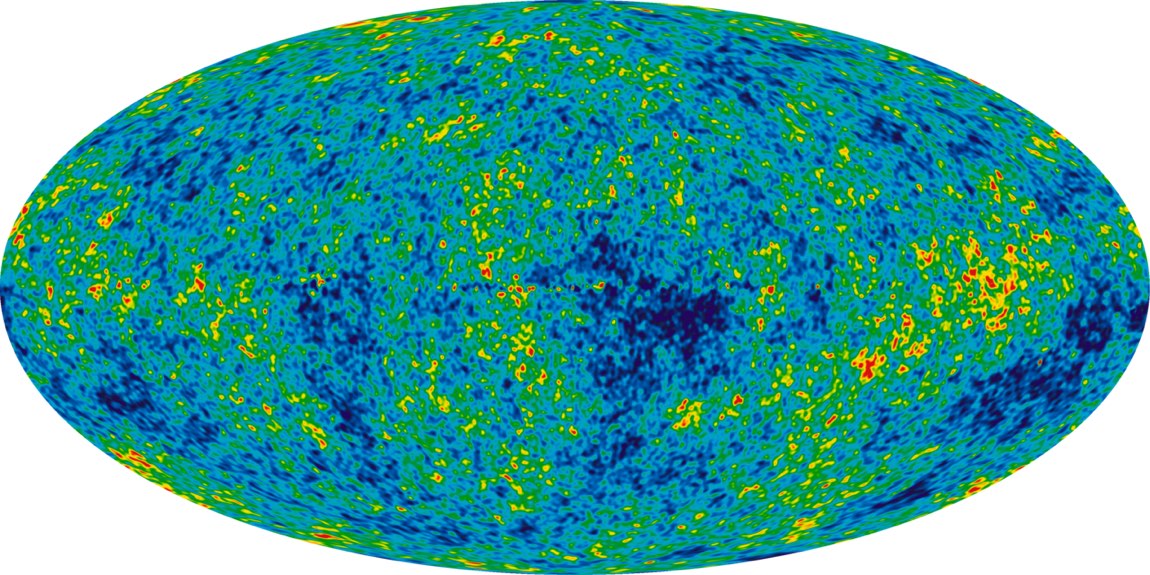
Discovered accidentally (Penzias & Wilson, 1965; Nobel). Its 2.725 K spectrum is the most perfect blackbody measured; its 1-in-100,000 temperature ripples are the seeds of all structure. Planck's ripple map fixes the universe's age, contents (5% ordinary, 27% dark matter, 68% dark energy) and geometry (flat) to percent precision — cosmology's baby picture and ledger at once.
The deep dive
Researched for the Atlas from Wikipedia — Cosmic microwave background (46,954 characters read) · updated Sep 20, 2026
01 A glow older than every star
The cosmic microwave background is not starlight. It predates every star, galaxy, and planet that has ever existed. Its energy density actually exceeds that of all the photons emitted by all the stars across the entire history of the universe — an astonishing fact that underscores how dominant this relic radiation really is. The CMB fills every cubic centimeter of observable space with roughly 411 photons, and the number density of those photons is one billion times the number density of matter in the universe. The CMB contains the vast majority of all photons in the universe by a factor of 400 to 1. If the universe had not been expanding and cooling those photons down into the microwave range, the night sky would shine as brightly as the surface of the Sun. Instead, the expansion has chilled the radiation to a temperature of just 2.72548 ± 0.00057 K — colder than the boiling point of liquid helium — spreading its glow invisibly across wavelengths the human eye cannot detect.
02 Who predicted it, and when
Credit for predicting the CMB belongs primarily to Ralph Alpher and Robert Herman, who in 1948 estimated that a relic thermal glow from the Big Bang would survive to the present day at a temperature of about 5 K. They worked in a correction to a paper by Alpher's PhD advisor George Gamow. Gamow himself estimated 7 K in 1953 using a model that required no free parameter. Remarkably, the first person to set eyes on something that was almost certainly the CMB may have been Tigran Shmaonov, who in 1957 reported an effective radio background temperature of 4 ± 3 K that was independent of both time and direction — though he did not recognize its cosmological significance. Even earlier, in 1941, Andrew McKellar detected a rotational temperature of 2.3 K in the interstellar medium through CN spectral lines, another measurement now understood to reflect the CMB. The theoretical prediction and the scattered early observations did not converge into a recognized discovery until 1964, when Arno Penzias and Robert Wilson stumbled on it accidentally while hunting for interference in a Bell Labs antenna.
03 The accidental Nobel Prize
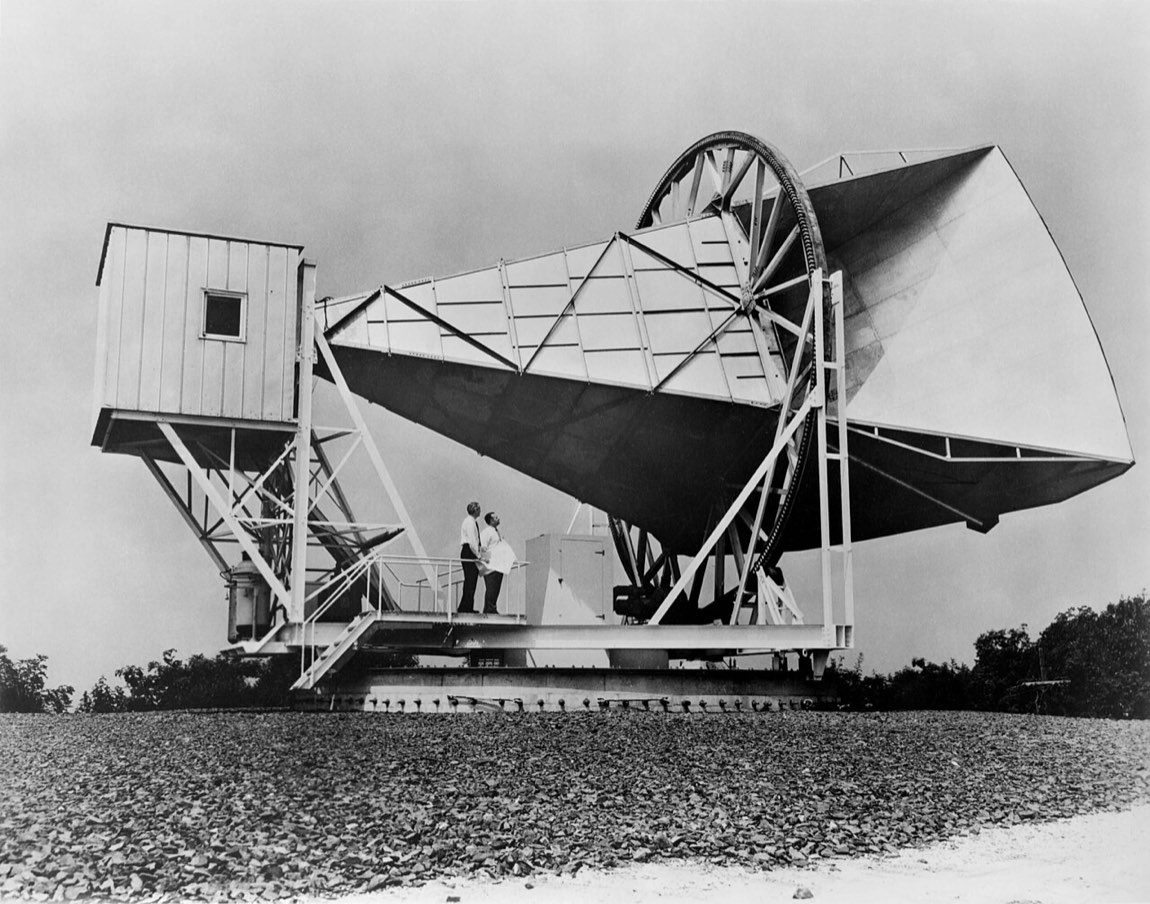
In 1964, Arno Penzias and Robert Woodrow Wilson were working at the Crawford Hill location of Bell Telephone Laboratories in Holmdel Township, New Jersey, using a Dicke radiometer antenna that had been built in 1959 to support Project Echo, NASA's passive communications satellites that used large Earth-orbiting aluminized plastic balloons as radio reflectors. On 20 May 1964 they recorded their first clear measurement showing an excess antenna temperature of 4.2 K that they could not attribute to any known source. They cleaned pigeon droppings from the antenna, checked every possible source of noise, and still could not make the signal disappear. Almost simultaneously, Robert Dicke's group at Princeton University was building their own instrument specifically to look for this radiation. When a phone call connected the two groups, Dicke famously told his colleagues, "Boys, we've been scooped." Their joint publication established the discovery. Penzias and Wilson received the 1978 Nobel Prize in Physics. Separately, COBE's principal investigators George Smoot and John Mather received the Nobel Prize in Physics in 2006 for their precision measurement of the CMB.
04 How perfectly thermal this radiation is Deeper
One of the most striking physical properties of the CMB is not its temperature but the precision with which it matches a perfect blackbody spectrum — the theoretical emission curve of an idealized object that absorbs and re-emits all radiation falling on it. The FIRAS instrument on the COBE satellite measured this spectrum with such precision that it is described as the most perfect blackbody spectrum ever measured. This matters enormously for cosmology: a truly thermal spectrum is a signature that the radiation originated in a state of complete thermodynamic equilibrium, exactly what a hot dense early universe would produce. The current monopole temperature — the uniform baseline — is measured as 2.7255 ± 0.0006 K. A blackbody temperature uniquely characterizes the intensity at every wavelength simultaneously, so measuring brightness at any single wavelength is enough to determine the full spectrum. Theorists also predict tiny departures from this perfect blackbody law, called spectral distortions, which encode information about the primordial universe and late-time structure formation. These distortions have not yet been measured but are the target of active experimental efforts hoped to yield a first detection within the coming decades.
 ⤢
⤢
05 Temperature ripples and the acoustic peaks Deeper
The CMB is isotropic to roughly one part in 25,000. After removing the dipole signal caused by the Sun's own motion through space, the root-mean-square temperature variations are just over 100 microkelvin. These ripples are not noise — they are a fossilized record of sound waves that rang through the hot plasma of the early universe. Before recombination, photon pressure and baryon gravity competed: photons pushed outward while gravity pulled baryons inward, creating acoustic oscillations in the plasma. When the universe became transparent roughly 380,000 years after the Big Bang, those oscillations were frozen in place. The resulting pattern, analyzed as a power spectrum of temperature fluctuations against angular scale, shows a sequence of peaks and valleys. The angular scale of the first peak reveals the overall curvature of the universe; the ratio of odd to even peaks reveals the baryon density; and the third peak encodes information about dark matter density. Observations are consistent with the primordial perturbations being entirely adiabatic — meaning that every particle species shared the same fractional density fluctuation at each point — providing key support for cosmic inflation and ruling out alternatives such as cosmic strings.
06 The dipole: our motion through the cosmos
The largest single anisotropy in the CMB is the dipole — one hemisphere of the sky appears very slightly warmer while the opposite hemisphere appears very slightly cooler. This is not a primordial feature; it is a Doppler effect caused by the motion of our Solar System through space. The amplitude of the CMB dipole is 3.3621 ± 0.0010 millikelvin, and it implies that the Sun is moving at 369.82 ± 0.11 km/s toward the constellation Crater, near its boundary with Leo. Looking further out, the Local Group — the galaxy cluster that contains the Milky Way — appears to be moving at 620 ± 15 km/s in the direction of galactic longitude 271.9° ± 2°, latitude 30° ± 3°. The dipole carries no information about the primordial universe; it is essentially a calibration signal telling us our own velocity relative to the cosmic rest frame. It is now routinely used to calibrate CMB mapping studies. A subtler complication arises from measuring quasar density with Wide-field Infrared Survey Explorer data, which finds a dipole significantly different from the CMB dipole — a discrepancy that is in tension with the cosmological principle and remains an active area of debate.
07 E-modes, B-modes, and hidden gravitational waves Deeper
Beyond temperature, the CMB carries a second channel of information: polarization. Polarization arises because Thomson scattering — the bouncing of photons off free electrons — imprints a preferred orientation on the scattered light when the incoming radiation has quadrupole anisotropy. CMB polarization is divided into E-modes (gradient-like patterns) and B-modes (curl-like patterns), by analogy with electric and magnetic fields. E-modes were first detected in 2002 by the Degree Angular Scale Interferometer (DASI). They are a factor of ten weaker than the temperature anisotropy but are correlated with it, providing complementary information about the early plasma. B-modes are expected to be an order of magnitude weaker still. They are important because standard scalar perturbations do not generate B-modes — but gravitational waves produced during cosmic inflation would. Detecting a primordial B-mode signal would therefore be direct evidence for inflation. A claimed detection by the BICEP2 instrument was later attributed to emission from cosmic dust in the Milky Way, based on Planck data. Gravitational lensing of E-modes also generates secondary B-modes; this gravitational-lensing B-mode signal was first detected in 2013 using the South Pole Telescope together with the Herschel Space Observatory.
08 How the universe grew transparent: the numbers Deeper
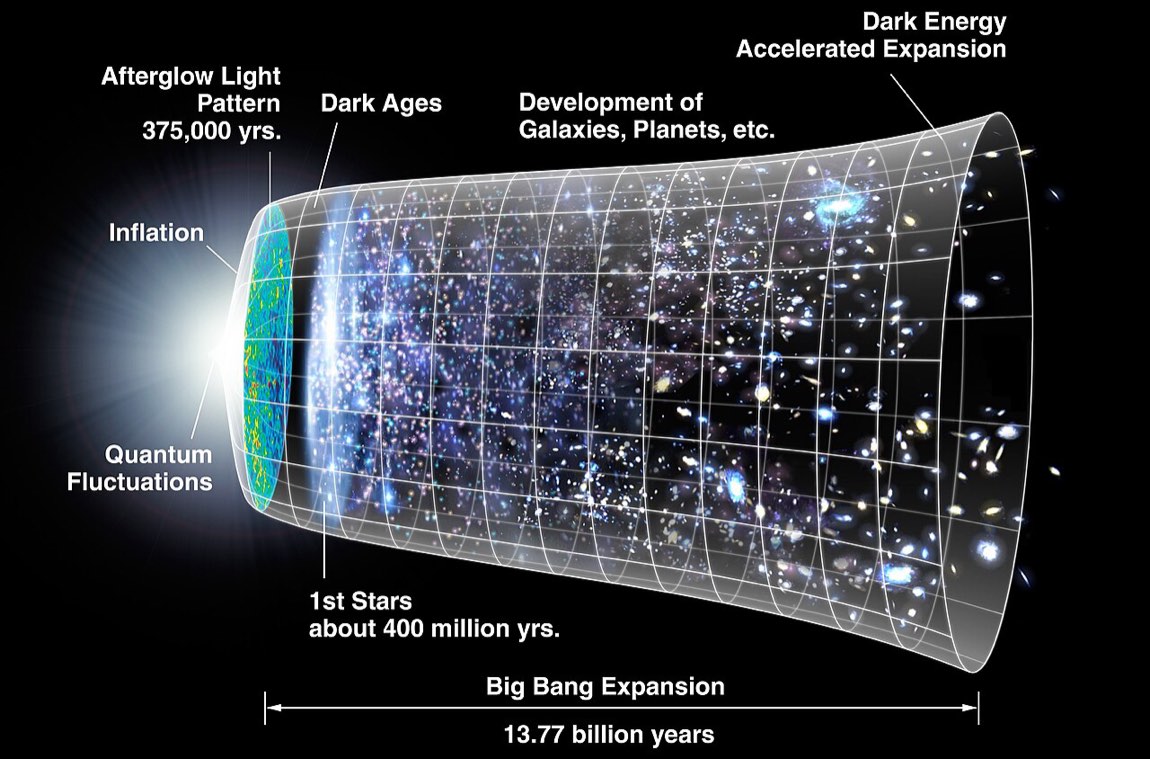
Recombination was not instantaneous. The process by which photons and baryons decoupled can be described using the photon visibility function, which expresses the probability that a given CMB photon scattered for the last time at a particular moment. According to first-year WMAP results, the peak of this function — the single most likely moment of last scattering — occurred 372,000 years after the Big Bang. But the full width at half maximum of that function spans 115,000 years, meaning decoupling was a prolonged process. By the time it was complete, the universe was roughly 487,000 years old. At that moment the temperature was around 3,000 K, corresponding to an ambient energy of about 0.26 eV — far below the 13.6 eV needed to ionize hydrogen, which is why neutral atoms could finally persist. Since then, the color temperature has dropped by an average factor of 1,089 due to cosmic expansion. The relationship is simple: the color temperature at any redshift z equals 2.725 K multiplied by (1 + z). At a redshift of z ≈ 1100, corresponding to recombination, this formula recovers the roughly 3,000 K plasma temperature of that era.
 ⤢
⤢
09 Secondary effects that modify the CMB Deeper
After the CMB was released, it was not left undisturbed. Several physical processes imprinted additional anisotropies as CMB photons traveled across 13.8 billion years of cosmic history. The Sunyaev-Zel'dovich effect occurs when CMB photons pass through clouds of hot electrons in galaxy clusters; inverse Compton scattering transfers energy from the electrons to the photons, distorting their spectrum in a characteristic and detectable way. The first observational confirmation of this effect from galaxy clusters came in 1983 from researchers at the Cambridge Radio Astronomy Group and the Owens Valley Radio Observatory. The Sachs-Wolfe effect, predicted theoretically by Rainer Sachs and Arthur Wolfe in 1966, causes CMB photons to be gravitationally redshifted or blueshifted as they climb in and out of changing gravitational potential wells between the last scattering surface and us. Reionization — when early starlight and black hole accretion disks re-ionized neutral hydrogen at a redshift of around 10 — also smoothed out small-scale anisotropies and created large-angle polarization, both of which WMAP has detected. The period between recombination and the first stars is referred to, semi-humorously, by cosmologists as the Dark Age.
10 Anomalies that keep theorists busy Deeper
Precise CMB data from WMAP and Planck has revealed several statistical puzzles that do not fit neatly into the standard Lambda-CDM model. The most persistent is the low-multipole anomaly: the quadrupole (ℓ = 2) has a measured amplitude lower than expected from the Big Bang, a discrepancy visible even in the earlier COBE data. More strikingly, the quadrupole and octupole (ℓ = 3) modes appear to be aligned with each other and with both the ecliptic plane and the equinoxes — a coincidence that seems geometrically unlikely. Some researchers propose this could signal new physics or quantum corrections at the largest observable scales; others attribute it to imperfect removal of foreground contamination from synchrotron emission, dust, and bremsstrahlung. A full Bayesian analysis of WMAP data shows the quadrupole prediction of Lambda-CDM is consistent with the data at the 10% level, and accounting for foreground removal reduces the significance of the alignment by roughly 5%. Planck, which is far more sensitive than WMAP, records the same anomaly, ruling out instrumental error as the cause. The lead WMAP scientist Charles Bennett has suggested coincidence and human psychology play a role: "I do think there is a bit of a psychological effect; people want to find unusual things."
11 The key missions and what they found
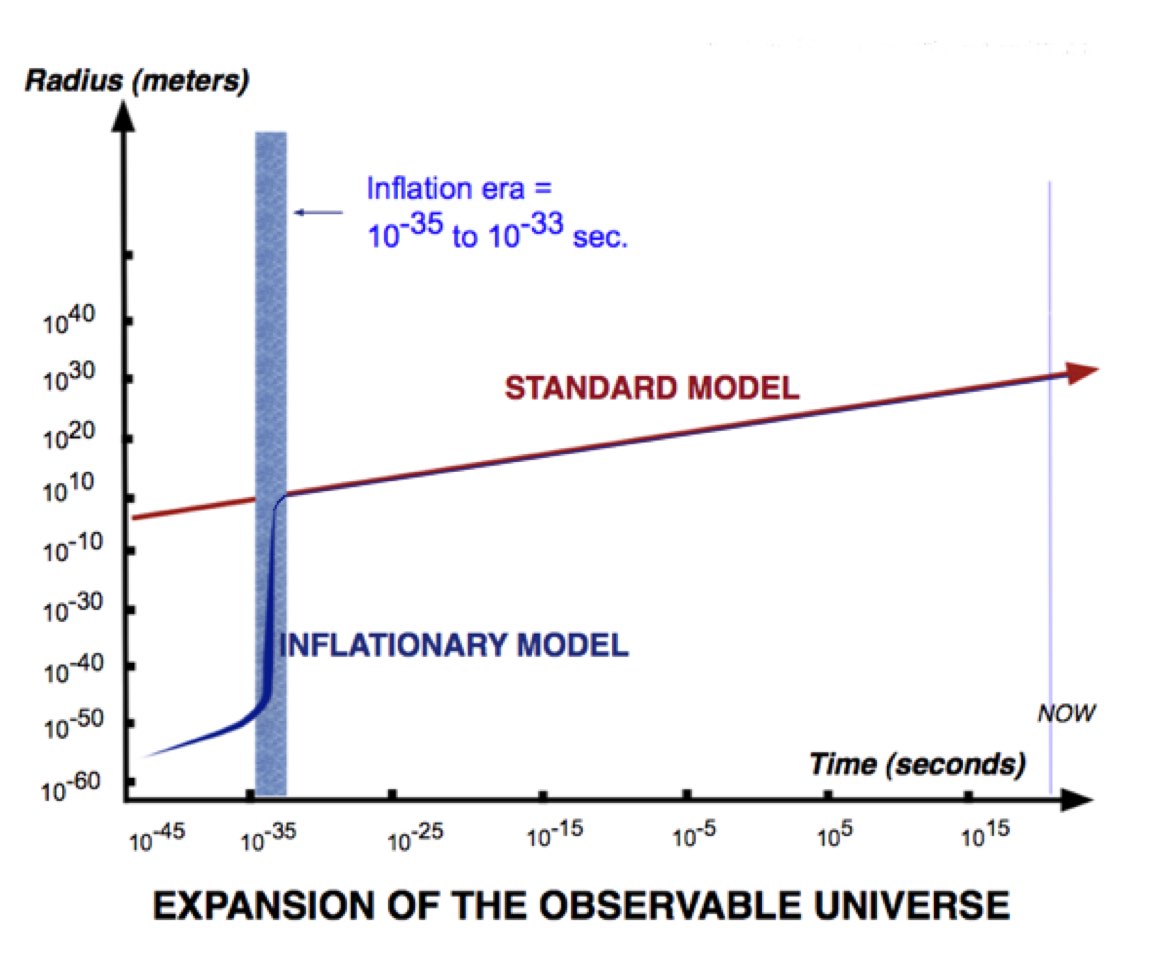
Three major space missions have shaped our understanding of the CMB. COBE (Cosmic Background Explorer) orbited Earth from 1989 to 1996; its FIRAS instrument confirmed the near-perfect blackbody spectrum at T = 2.73 K, and its Differential Microwave Radiometer detected the primary anisotropy, published in 1992. WMAP (Wilkinson Microwave Anisotropy Probe) launched in June 2001 and scanned the full sky at five frequencies using rapid-switching radiometers; its data releases, culminating in a nine-year summary, confirmed Lambda-CDM models based on six free parameters. The ESA Planck mission launched in May 2009 and operated until October 2013, employing both HEMT radiometers and bolometer technology. On 21 March 2013 it released an all-sky map showing that the universe was about 370,000 years old when the fluctuations it images were imprinted, that those fluctuations originated as early as 10⁻³⁰ seconds after the Big Bang, and that the universe consists of 4.9% ordinary matter, 26.8% dark matter, and 68.3% dark energy. A 2015 Planck data release set the age of the universe at 13.799 ± 0.021 billion years and the Hubble constant at 67.74 ± 0.46 (km/s)/Mpc.
12 What the CMB says about cosmic geometry
One of the most powerful results extracted from the CMB is the overall shape — or curvature — of the universe. The angular scale at which the first acoustic peak appears in the power spectrum acts as a cosmic ruler. If space were positively curved like a sphere, that peak would appear at larger angular scales; if negatively curved like a saddle, it would appear at smaller scales; if flat, it would appear at a specific intermediate angular scale. Ground and balloon experiments including BOOMERanG, MAT/TOCO, and MAXIMA measured this peak and found that the highest power fluctuations occur at scales of approximately one angular degree, consistent with a flat universe. These measurements ruled out cosmic strings as a major driver of structure formation and lent strong support to inflation. The Very Small Array, DASI, and the Cosmic Background Imager all provided higher-accuracy follow-up measurements confirming these findings. Together with baryon acoustic oscillations and supernova surveys, CMB geometry measurements remain one of the three main pillars supporting the standard Lambda-CDM cosmological model.
13 The far future of the CMB
The cosmic microwave background is not a permanent fixture of the observable universe. As space continues to expand, the CMB photons are continuously redshifted to longer wavelengths and lower energies. Eventually, assuming the universe does not end in a Big Crunch, a Big Rip, or a similar catastrophe, the CMB will redshift beyond any practical detectability. At that point it will be superseded by background radiation from starlight. In the extremely far future, the article notes, even more exotic sources of background radiation may dominate: photons from proton decay, from the Hawking evaporation of black holes, from the decay of positronium, or from the Unruh effect associated with the particle horizon. Today the energy density of CMB photons is 0.260 eV/cm³ (equivalent to 4.17 × 10⁻¹⁴ J/m³), making the CMB a fraction of roughly 6 × 10⁻⁵ of the total energy density of the universe — small in relative terms now, but representing the dominant photon population and a direct window to the universe's first 380,000 years.