Cosmology
Cosmic Inflation
Strong EvidenceThe idea
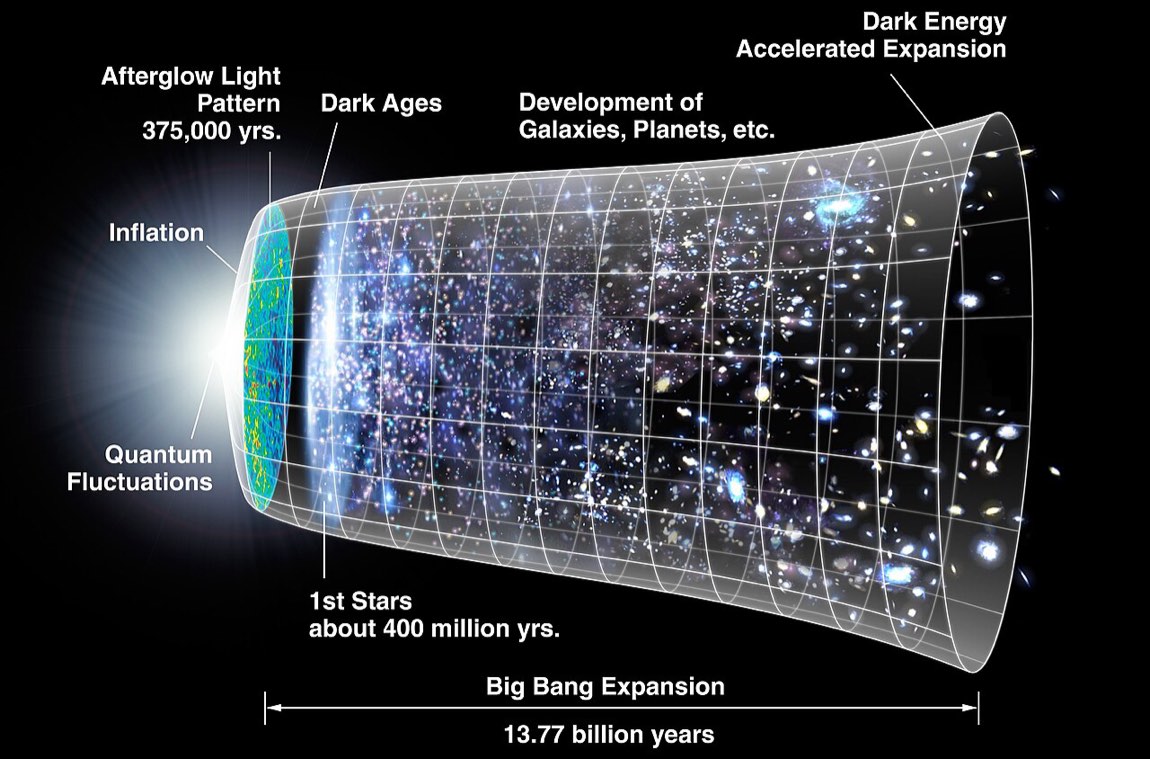
In the universe's first unimaginable fraction of a second, space may have expanded absurdly fast, in a burst that took a subatomic patch to macroscopic size instantly. This would explain why the universe looks the same in every direction and why its geometry is so flat: everything we see inflated from one tiny, smooth region, its quantum jitters stretched into the seeds of galaxies.
Go deeper Advanced
Inflation predicts the CMB's observed flatness, uniformity, and nearly-scale-invariant fluctuation spectrum — all confirmed. Not yet found: primordial gravitational waves (B-mode polarization), the would-be smoking gun (BICEP's 2014 claim died to galactic dust). Status: the dominant, well-tested-but-not-proven framework; 'Strong Evidence', not 'Confirmed'. Eternal-inflation variants spawn multiverse speculation — a separate, untestable-so-far layer.
The deep dive
Researched for the Atlas from Wikipedia — Cosmic inflation (53,287 characters read) · updated Sep 20, 2026
01 How fast was the expansion, really
The numbers behind inflation are almost impossibly extreme. Distances between any two free-floating points doubled every 10 to the power of negative 37 seconds — a timescale so short it makes a billionth of a second feel leisurely. The whole episode lasted at least 10 to the power of negative 35 seconds, though its true duration is not pinned down. In that eyeblink, a region containing all the mass-energy of every galaxy we can currently see was squeezed into a sphere roughly 4 × 10⁻²⁹ metres across — smaller than a single proton by many orders of magnitude. By the time inflation switched off, that same region had ballooned to a sphere about 0.9 metres in radius, roughly the size of a basketball. No object moved through space faster than light; instead, the fabric of space itself stretched, which general relativity permits.
02 Three problems one idea tried to fix
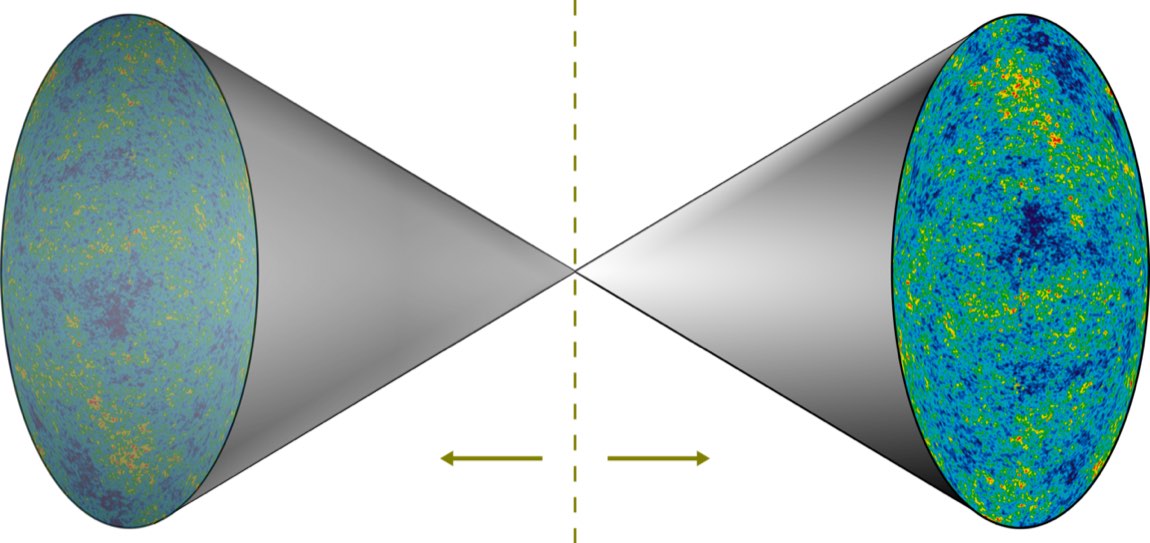
Inflation was not dreamed up for elegance alone. By the late 1970s, cosmologists had identified at least three sharp embarrassments in the standard Big Bang picture. The horizon problem asked why opposite sides of the observable universe look almost identical in temperature even though, at the speed of light, they could never have been in contact long enough to equilibrate — like two rooms that reached the same exact temperature without ever sharing a wall. The flatness problem noted that the universe's density sits within one part in 10⁶² of the precise critical value needed for flat geometry; any departure would have grown catastrophically over time. And the magnetic-monopole problem arose from Grand Unified Theories, which predicted that heavy, stable monopole particles should be as common as protons today — yet none have ever been detected. A brief burst of exponential expansion dilutes all three issues simultaneously: it stretches causally connected regions to enormous scales, irons out curvature, and thins out any exotic relics.
03 Alan Guth's original and flawed model
Alan Guth proposed inflation in January 1981 while working at Cornell, originally to explain the absence of magnetic monopoles. He was also the person who coined the term "inflation." His mechanism pictured the early universe trapped in a false vacuum — a high-energy metastable state rather like supercooled water that has not yet frozen. Escape happened when bubbles of true vacuum nucleated by quantum tunneling and expanded at the speed of light. The scheme was elegant but broke down immediately at the reheating step: the bubbles, once formed, did not generate radiation on their own. Heat could only appear in collisions between bubble walls, but if inflation lasted long enough to solve the initial-conditions problems, such collisions became extraordinarily rare. In any one causal patch, statistically only a single bubble would nucleate. Guth himself acknowledged the flaw — this is why colleagues later called his version "old inflation" once a better mechanism appeared.
04 Slow-roll inflation fixes the bubble crisis
The bubble-collision problem was resolved independently by Andrei Linde and by Andreas Albrecht and Paul Steinhardt in what they called "new inflation" or "slow-roll inflation." Rather than quantum tunneling out of a false vacuum, a scalar field — the inflaton — rolls gradually down a gently sloping potential-energy hill. As long as the field rolls slowly compared with the universe's rate of expansion, space continues its exponential stretch. When the slope steepens and the field accelerates, inflation ends and the inflaton's energy converts into particles, reheating the universe and initiating the hot dense phase described by standard Big Bang physics. Because there are no bubble walls to collide, reheating is smooth and uniform. This slow-roll picture became the backbone of nearly all subsequent inflationary models and is still the standard framework used when comparing theory to CMB data.
05 Starobinsky's Soviet rival and its predictions Deeper
Working in Moscow at the Landau Institute, Alexei Starobinsky reached a similar destination by a different route. He noticed that quantum corrections to general relativity should matter enormously in the very early universe, producing terms proportional to the square of spacetime curvature in the gravitational action. When curvatures are large, those corrections act like an effective cosmological constant, driving exponential expansion. Starobinsky proposed this mechanism before Guth's paper and derived specific numerical predictions for the corrections it would produce in the microwave background — predictions that could actually be checked. His model yields a scalar spectral index nₛ = 1 − 2/N and a tensor-to-scalar ratio r = 12/N², where N is the number of e-folds of inflation. Together with Guth and Linde, Starobinsky was awarded the 2014 Kavli Prize for pioneering inflation theory.
06 Quantum seeds of all cosmic structure
One of inflation's most striking achievements is explaining where galaxies came from. In the inflationary epoch, the inflaton field is subject to tiny quantum fluctuations — unavoidable according to quantum mechanics. Because space is expanding exponentially, these microscopic ripples get stretched to macroscopic scales before they can oscillate back, effectively freezing them into the fabric of the universe. They become slight over-densities and under-densities in matter and energy that gravity later amplifies into stars, galaxies, and the cosmic web. This calculation was first carried out by Viatcheslav Mukhanov and G. V. Chibisov for Starobinsky's model. In the context of new inflation, the result was worked out simultaneously by four independent groups — Stephen Hawking; Alexei Starobinsky; Alan Guth and So-Young Pi; and James Bardeen, Paul Steinhardt, and Michael Turner — at the three-week 1982 Nuffield Workshop on the Very Early Universe at Cambridge University.
07 What observations actually confirm
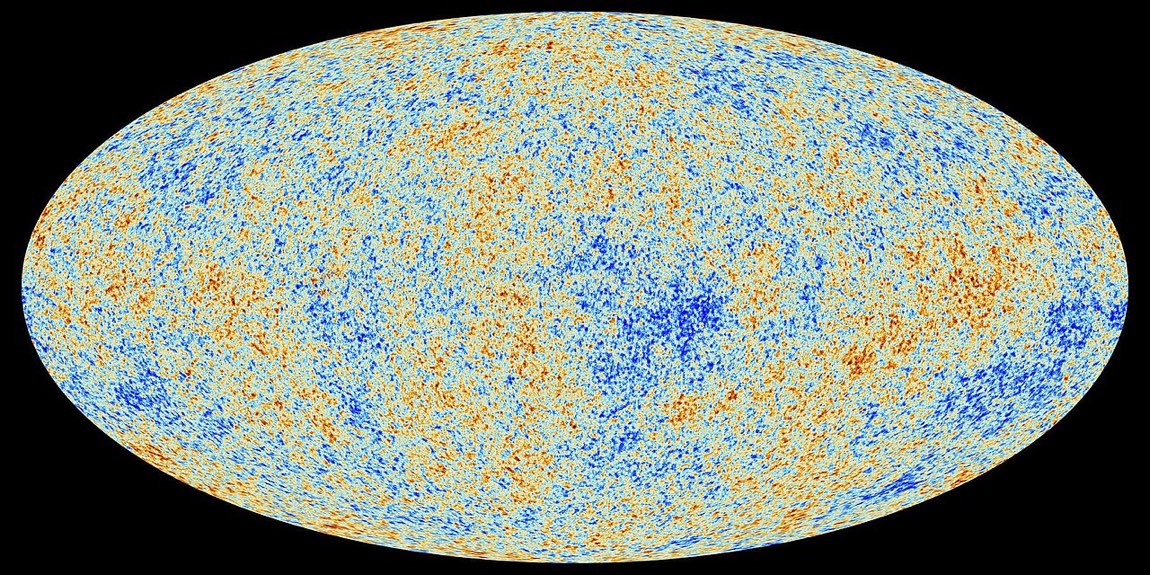
Temperature anisotropies in the cosmic microwave background, first detected by the COBE satellite in 1992, showed a nearly scale-invariant spectrum — exactly the signature inflation predicts. Later, WMAP and the Planck spacecraft refined these measurements enormously. Planck showed that the universe is flat to within one-half of one percent and homogeneous and isotropic to one part in 100,000. The spectral index measured by Planck is nₛ = 0.968 ± 0.006, squarely inside the range of 0.92 to 0.98 that the simplest inflationary models predict without fine-tuning. The tensor-to-scalar ratio r is constrained to be less than 0.11 from Planck data, and by 2018 additional data suggested with 95 percent confidence that r is 0.06 or lower — consistent with many remaining inflation models. Adiabatic (isentropic) perturbations, another inflation prediction, have also been confirmed by WMAP, Planck, and the Sloan Digital Sky Survey.
08 The BICEP2 episode and what it taught us
In March 2014, the BICEP2 team announced that they had detected B-mode polarization patterns in the CMB — a curl-like signature that could only come from primordial gravitational waves produced during inflation. They reported a tensor-to-scalar ratio r between 0.15 and 0.27, which would have pointed toward an energy scale of inflation around 10¹⁵ to 10¹⁶ GeV. The claim generated enormous excitement. But confidence collapsed rapidly: on 19 June 2014 confidence was lowered; on 19 September 2014 it fell further; and on 30 January 2015 it fell yet again. The signal turned out to be consistent with contamination from polarized dust in our own galaxy. By 2018 the combined data constrained r to 0.06 or lower. The episode was painful but productive: it demonstrated how carefully foreground sources must be controlled and spurred far more rigorous observational programs.
09 Eternal inflation and the multiverse problem Deeper
Many inflationary models have a curious self-reproducing property. Because quantum fluctuations can push the inflaton field upward in potential energy in some regions, those regions keep inflating even as neighboring regions stop. Inflating volumes expand faster than non-inflating ones, so at any moment the majority of the universe's volume is still inflating. Paul Steinhardt introduced the first example of this eternal inflation in 1983; Alexander Vilenkin showed the same year that it is generic. The logical consequence is an infinite, likely fractal multiverse populated with pocket universes having potentially different physical conditions. While this removes any need for special initial conditions — Guth called the inflationary universe the "ultimate free lunch" — it creates a deep problem: there is currently no scientific consensus on how to assign probabilities across an infinite set of outcomes. Steinhardt, one of inflation's founders, became a vocal critic precisely because he regards this probability paradox as a critical flaw in the entire framework.
10 Reheating: from empty cold to hot Big Bang Deeper
Inflation leaves the universe in a strange, cold, nearly empty state dominated entirely by the energy of the inflaton field. All pre-existing particles have been diluted to negligible density by the exponential expansion. Reheating is the process by which the inflaton's energy is converted into a thermal bath of Standard Model particles, reviving the hot dense environment needed for Big Bang nucleosynthesis. Because no direct observational probes of this period survive, its detailed mechanism is unknown. The most widely studied scenario begins with "preheating": parametric resonance causes the inflaton to dump energy explosively into other particle species. This phase ends when back-reactions fragment the inflaton condensate. A turbulent nonlinear phase follows, and finally thermalisation establishes local thermal equilibrium. One firm requirement from Big Bang nucleosynthesis is that the final temperature must be above 1 MeV.
11 Fine-tuning: inflation's internal tension Deeper
Critics and supporters alike acknowledge that inflation is not free of fine-tuning concerns. Slow-roll inflation requires the inflaton potential to be extraordinarily flat — the field must have very small mass and the potential must barely tilt over the vast scales relevant during inflation. Linde's "chaotic inflation" tried to sidestep this by arguing that inflation occurs generically in any high-energy chaotic initial state, but it requires the inflaton field to take values larger than one Planck unit. At those scales, standard effective field theory breaks down because renormalization corrections should be enormous. A separate hierarchy problem concerns the amplitude of primordial fluctuations: it requires the energy density of the inflaton potential to be roughly 10⁻¹² times the Planck density, a suppression of twelve orders of magnitude. Inflation theorists note that this naturally coincides with the energy scale of grand gauge unification, softening the concern, but it has not been fully resolved.
12 Serious alternatives that compete with inflation Deeper
Inflation is not the only proposal for solving the horizon and flatness problems. The ekpyrotic model and its descendant the cyclic model propose that the observable universe passed through a contracting phase before a Big Crunch, then bounced into the current expanding phase, generating density perturbations during contraction. These models avoid magnetic monopoles as long as temperatures at the bounce stay below the Grand Unified Scale. String gas cosmology, proposed by Robert Brandenberger and Cumrun Vafa, models the early universe as a hot gas of fundamental strings and invokes the Brandenberger–Vafa mechanism — strings winding around compact extra dimensions can annihilate only in at most three large spatial dimensions, explaining why we observe three. Variable-speed-of-light models propose that c was larger in the early universe, expanding the particle horizon enough to explain CMB isotropy without any exponential expansion. None of these alternatives has yet matched inflation's quantitative success with CMB data.
13 Prominent voices questioning the paradigm
Inflation commands broad but not universal acceptance. Mathematicians and physicists including Roger Penrose have argued since 1986 that inflation requires its own finely tuned initial conditions and therefore does not genuinely solve the problem it was designed to address. Penrose calculated that obtaining a flat universe without inflation is actually far more probable than obtaining one with inflation — by a factor he described as ten to the googol power. At a 2015 conference he declared that "inflation isn't falsifiable, it's falsified." John Earman and Jesús Mosterín published a rigorous critical review in 1999 concluding that no inflationary model had earned a place in the standard core of cosmology. Paul Steinhardt, Anna Ijjas, and Abraham Loeb argued that Planck satellite data put the inflationary paradigm in further trouble. Counter-arguments from Alan Guth, David Kaiser, Yasunori Nomura, and Andrei Linde maintain that cosmic inflation is "on a stronger footing than ever before."